
Cat Intelligence: How Smart Are Cats Really?
Are cats smart? Smarter than dogs? The answer depends entirely on how you define intelligence—and recognizing that comparing species with different evolutionary pressures may be the wrong question entirely.
Cats excel at what cats need to excel at. They're masters of spatial memory, solitary problem-solving, and sensory processing. Dogs excel at social cognition and cooperative behavior. Different niches, different intelligences—neither superior, just specialized.
The Science of Feline Cognition
Cat cognition research has exploded in recent decades, overturning assumptions that cats were simply "less trainable dogs." The reality is that cats possess sophisticated cognitive abilities that went unrecognized because researchers were asking dog-centric questions.
The most surprising finding: cats have approximately 300 million cortical neurons—the brain cells associated with complex information processing. Dogs have about 160 million. Raw neural hardware suggests cats have more computational capacity than we assumed.
 Adam Gill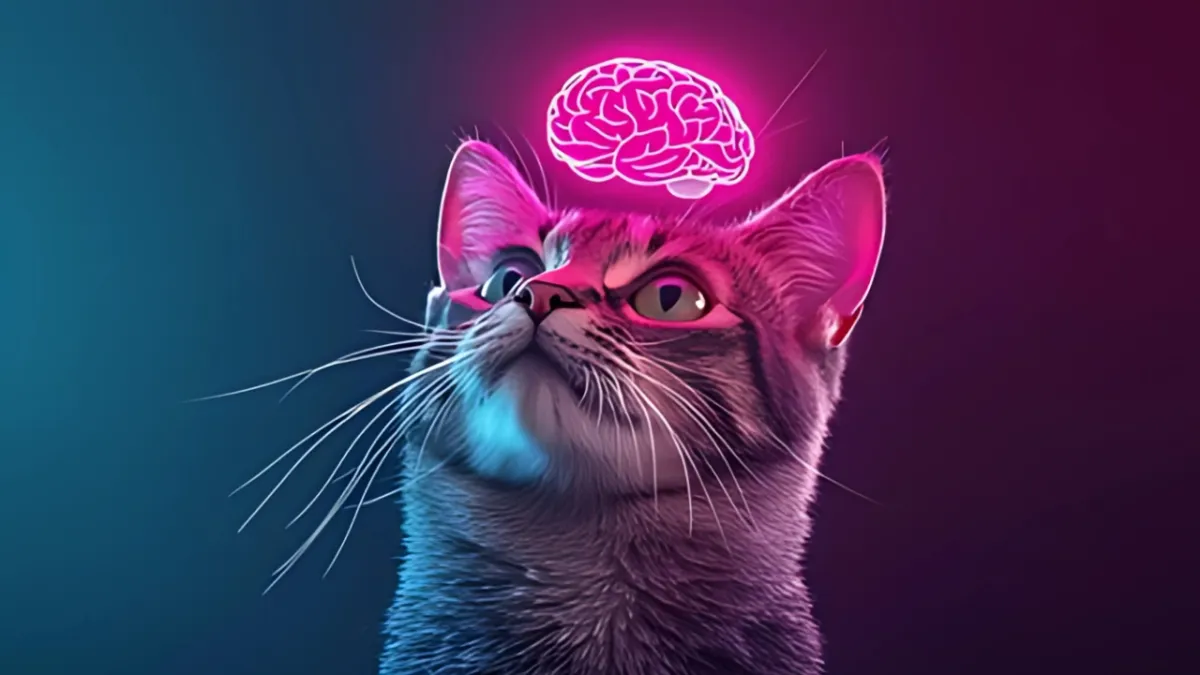
What cats do with that neural hardware reflects their evolutionary niche. As solitary hunters, they developed exceptional spatial memory (remembering where prey was last seen), independent problem-solving (no pack to rely on), and sensory processing (detecting and tracking small, fast-moving targets).
How Cat Memory Works
Cat memory, both short-term and long-term, rivals or exceeds that of dogs. Working memory (short-term) in cats lasts approximately 16 hours—compared to roughly 5 minutes in dogs. This extended working memory helped wild cats remember where they last encountered prey.
Long-term memory in cats can span years. Cats remember their owners after extended separations, recall previous homes, and retain learned behaviors indefinitely. Negative experiences also persist—a single traumatic vet visit can create lasting fear associations.
Spatial memory is particularly robust. Cats build detailed mental maps of their territory and remember the locations of resources, escape routes, and danger zones. This is why indoor-outdoor cats navigate complex neighborhoods and always find their way home.
Problem-Solving and Learning
Cats learn differently than dogs, which led to the misconception that they're less intelligent. Dogs are motivated by social approval—they perform to please their handlers. Cats evaluate whether a behavior benefits them directly.
This doesn't mean cats can't learn; it means traditional training methods fail because they're designed for dogs. Cats readily learn behaviors when properly motivated (usually with food) and show excellent observational learning—they can figure out how to open doors just by watching.
The classic "cats can't be trained" myth persists because people use dog-training approaches. Cats require shorter sessions, higher-value rewards, and training that works with their natural behaviors rather than against them. Done correctly, cats learn as readily as any other species.
Cats vs. Dogs: The Wrong Question
The "cats vs. dogs" intelligence debate misses the point entirely. These species evolved for completely different lifestyles with completely different cognitive demands.
Dogs evolved as pack hunters and human companions. Their intelligence specializes in social cognition—reading human faces, responding to pointing, inferring intent. They're outstanding at cooperative tasks and social learning.
Cats evolved as solitary predators. Their intelligence specializes in independent problem-solving, spatial navigation, and sensory processing. They don't look to others for solutions because their ancestors never had others to look to.
Asking whether cats or dogs are smarter is like asking whether fish or birds are better at moving—it depends entirely on the medium. Each species optimized for its environment, and both optimization paths represent genuine intelligence.
Recognizing Cat Intelligence
Understanding cat intelligence transforms everyday interactions. When your cat solves the puzzle of opening a cabinet, they're demonstrating sophisticated cause-and-effect reasoning. When they remember where you hid their toys months later, they're showing remarkable long-term memory.
Cats also display metacognition—awareness of their own knowledge states. Studies show cats hesitate and check before acting when uncertain, suggesting they know what they don't know. This self-awareness indicates cognitive sophistication beyond simple stimulus-response.
The next time someone claims cats are "just not that smart," consider that the claim reveals more about human bias than feline capability. Cats are exactly as intelligent as they need to be—which turns out to be considerably more intelligent than we long assumed.
Frequently Asked Questions
How good is a cat's memory?
Cats have exceptional long-term memory, especially for locations and emotionally significant experiences. Their working memory (short-term) lasts about 16 hours—10 times longer than dogs. Cats can remember people, places, and learned solutions for years.
Do cats have consciousness?
Scientific evidence suggests cats have subjective experiences and consciousness. They show self-awareness indicators like recognizing themselves in mirrors (though not consistently), dream during REM sleep, and display emotions. The Cambridge Declaration on Consciousness includes cats.
What cognitive abilities do cats have?
Cats possess remarkable cognitive abilities: spatial memory to navigate complex environments, object permanence (understanding hidden objects still exist), problem-solving skills, and the capacity to learn by observation. They also have exceptional sensory processing—hearing up to 64,000 Hz.
Are cats smarter than dogs?
Cats excel in independent problem-solving, spatial memory, and sensory processing, while dogs excel at social cognition. Cats have 250 million cortical neurons (dogs: 530 million), longer working memory, and hunt solo rather than relying on pack coordination—different kinds of intelligence.
Can cats learn their name?
Yes, cats recognize and respond to their names. A 2019 University of Tokyo study confirmed cats can distinguish their name from similar-sounding words and other cats' names. They learn through association with rewards like food and attention—they simply choose when to respond.
Explore More
Related Guides
 Adam Gill
 Adam Gill
 Adam Gill
 Adam Gill
 Adam Gill
 Adam Gill
 Adam Gill