Can Cats See in the Dark? The Science of Feline Night Vision
Cats see in 6x dimmer light than humans using a 135-fold dilating pupil, rod-dense retina, and tapetum lucidum mirror — but total darkness defeats even feline eyes.

Table of Contents
- How Well Do Cats See in the Dark?
- Do Cats Have Night Vision?
- Why Do Cat Eyes Glow in the Dark?
- Can Cats See in Complete Darkness?
- Can Kittens See in the Dark?
- How Does Cat Night Vision Compare to Humans?
- Are Cats Nocturnal or Crepuscular?
- Can Cats See Infrared or Ultraviolet Light?
- Key Terms Used
- Frequently Asked Questions
- Key Takeaways
- Sources
Cats cannot see in total darkness, but they see in light six times dimmer than humans require. A combination of 460,000 rod cells per square millimeter, a reflective tapetum lucidum mirror, and pupils that dilate 135-fold in area gives cats extraordinary scotopic vision. In pitch blackness, cats switch to whiskers, hearing, and spatial memory instead.

How Well Do Cats See in the Dark?
Cats detect contrast at 6.2 times human sensitivity under scotopic (dim light) conditions, according to a landmark 2009 behavioral study at the University of Illinois. This peer-reviewed measurement from Kang and Malpeli is the actual scientific basis behind the popular claim that cats see "six to eight times better" in the dark — a figure most websites repeat without citing the original research.
The difference stems from three anatomical adaptations working in concert. First, cat retinas pack rod photoreceptors at a peak density of 460,000 per square millimeter, roughly three times the human peak of approximately 160,000. Second, each rod cell functions as a nearly perfect photon counter, capable of registering a single photon of light. Third, a reflective tissue layer called the tapetum lucidum bounces unabsorbed photons back through the retina for a second pass at detection.
As Banks and colleagues at UC Berkeley's School of Optometry demonstrated in their 2015 study on pupil shape and ecological niche, the vertical slit pupils of domestic cats undergo a 135-fold change in area between constricted and dilated states. Human circular pupils manage only a 15-fold change. This nine-times-greater range allows cats to hunt in near-darkness and bright daylight without retinal damage — a critical adaptation for an animal that operates across extreme lighting conditions.
📊 The Evidence:
"Cats detect contrast at 6.2 times human sensitivity in scotopic conditions — the peer-reviewed basis for the popular '6x better night vision' claim." (Kang & Malpeli, 2009, Journal of Neuroscience)
The practical result: a cat navigating your hallway at 3 AM operates comfortably in light levels that would leave you stumbling into walls. But this is enhanced dim-light vision, not true darkness vision. Every photon still matters. For more on how cats experience the world through their senses, see our complete guide to cat perception.
Do Cats Have Night Vision?
Cat night vision relies on a biological system called the tapetum lucidum — a reflective layer behind the retina that functions as a photonic crystal mirror. Unlike a simple flat mirror, the tapetum consists of 15 to 20 layers of zinc-cysteine crystals and riboflavin arranged in precise subwavelength nanostructures. A 2022 study published in Scientific Reports identified these structures as photonic crystals, the same optical principle used in fiber optic technology and anti-reflective coatings.
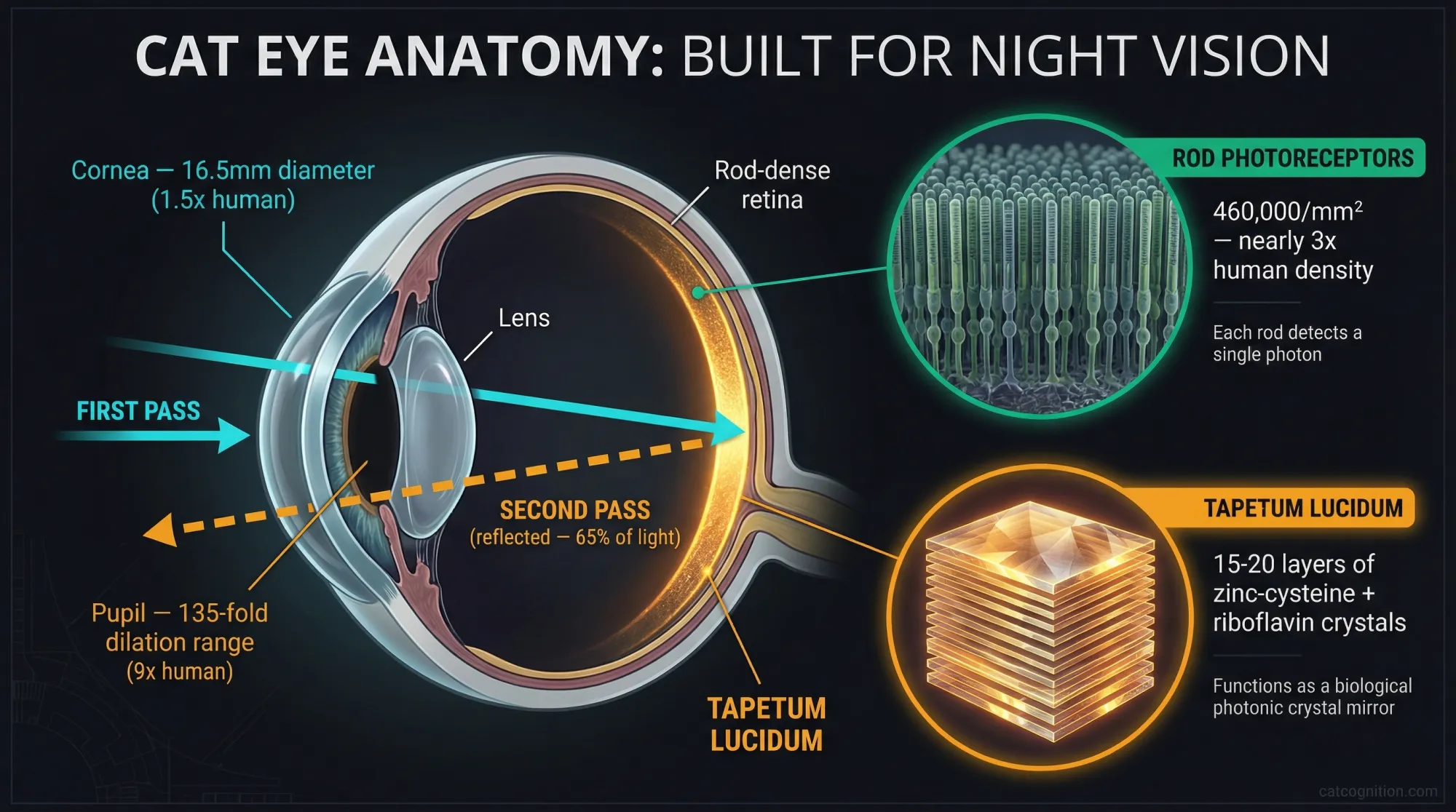
This mirror reflects approximately 65 percent of incoming light back through the photoreceptor layer, effectively giving each photon two chances to be detected. The tapetum increases the eye's overall light capture efficiency by a factor of six, according to ScienceDirect reference data — closely aligning with the behavioral 6.2x sensitivity measured by Kang and Malpeli.
The chemical composition of the tapetum matters too. Riboflavin concentrations reach up to 550 micrograms per gram of dry weight in cat tapetal tissue, absorbing shorter wavelengths and re-emitting longer ones. The zinc-cysteine crystals provide the structural framework for precise light reflection. Together, these chemicals create both the reflective function and the characteristic fluorescence that makes cat eyes glow.
📊 The Evidence:
"The cat tapetum lucidum reflects approximately 65% of incoming light back through the retina, functioning as a biological photonic crystal mirror." (Weale 1970; Scientific Reports 2022)
Cat tapeta are also more efficient than those of dogs. A 1983 comparative study found that reflective rodlets in dog tapeta are less precisely oriented than in cats, resulting in less efficient reflectance. The cat's crystalline precision is a competitive advantage even among carnivores.
Why Do Cat Eyes Glow in the Dark?
The eyeshine you see when a flashlight catches your cat's eyes at night is not bioluminescence — cat eyes do not produce their own light. Eyeshine occurs when external light enters the pupil, passes through the retina, reflects off the tapetum lucidum, and exits back through the dilated pupil toward the observer. The cat's eye acts as a retroreflector, bouncing light back along approximately the same path it entered.
The color of eyeshine varies between individual cats because of differences in tapetum crystal spacing. A 1951 study published in Nature measured two distinct reflectance peaks: a yellowish reflectance maximum at 580 nanometers and a greenish reflectance maximum at 450 nanometers. Shallower tapetal layers near the surface tend to reflect shorter (blue) wavelengths, while deeper layers reflect longer (yellow-red) wavelengths.
This is why different cats produce different eyeshine colors. A young cat with a developing tapetum may show blue eyeshine, while an adult cat typically shows yellow-green. Cats with blue eyes (which lack melanin in the iris) may produce a reddish eyeshine because light reflects off blood vessels rather than the tapetum. Age, iris pigmentation, and the angle of incoming light all influence the specific color you observe.
The riboflavin in the tapetum adds another optical dimension. When excited by certain wavelengths, riboflavin fluoresces — absorbing blue light and emitting yellow-green light. This fluorescence contributes to the characteristic warm glow of adult cat eyes and explains why the dominant eyeshine color across the species is yellow-green rather than pure white.
Can Cats See in Complete Darkness?
No. Despite their extraordinary low-light adaptations, cats cannot see in absolute zero-light conditions. The feline visual system still requires photons to function. In pitch blackness — a sealed room with no light source whatsoever — a cat's retina receives nothing to detect, and the tapetum has nothing to reflect.
What cats can do is see in light conditions so dim that humans perceive them as "total darkness." A room illuminated only by starlight filtering through curtains, the glow of a digital clock, or moonlight through a window provides sufficient photons for a cat's visual system to construct a usable image. The 6.2x sensitivity advantage means conditions you experience as blindingly dark are merely dim to a cat.
In genuinely lightless environments, cats deploy a suite of non-visual navigation tools. Whiskers (vibrissae) detect air current changes as small as movements 1/2000th the width of a human hair. Approximately 40 percent of the cat's brain sensory cortex maps to whisker input, making these tactile sensors extraordinarily sensitive to spatial information. Whiskers are anchored three times deeper than ordinary fur, connecting to dense nerve clusters that detect both direct contact and air pressure changes reflecting off nearby objects.
Cats also rely on spatial memory — they map familiar environments and navigate from memory in complete darkness with remarkable accuracy. Hearing completes the sensory triad, with cats capable of precise sound localization.
📊 The Evidence:
"Approximately 40% of the cat's brain sensory cortex maps to whisker input, enabling navigation by air-current detection when light is unavailable." (VCA Animal Hospitals)
Can Kittens See in the Dark?
Kittens are born with sealed eyelids and no functional vision. The eyes begin opening around day 8, with complete opening by days 10 to 14. Even after the eyes open, kitten vision is blurry, limited to detecting motion and light-dark contrast. The retina, tapetum lucidum, and neural visual pathways are still developing. For a detailed day-by-day guide to this process, see our kitten eye development timeline.
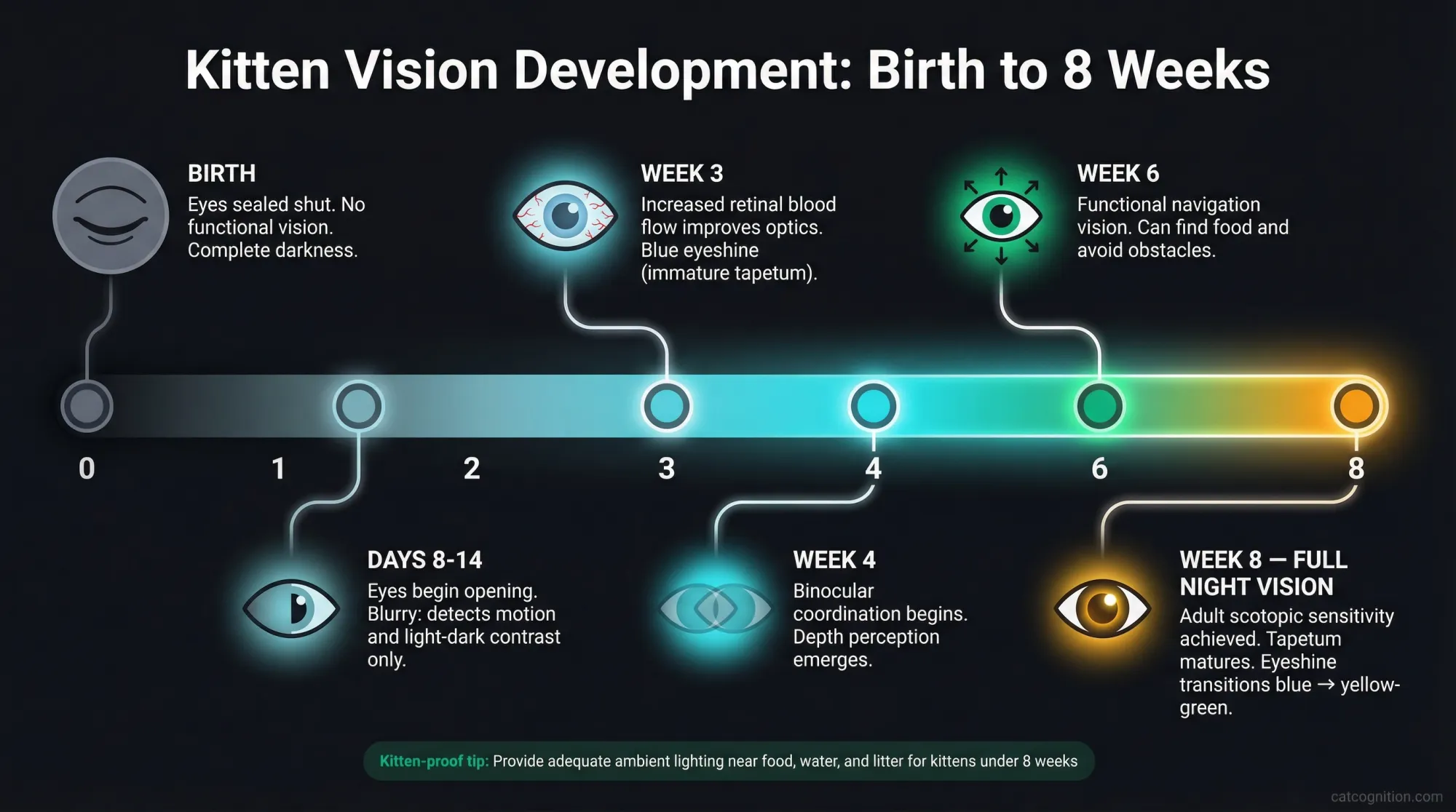
At three weeks, increased blood flow to the retina allows improved optics. Depth perception emerges around week four, when both eyes begin working together in binocular coordination. By six weeks, kittens use vision effectively enough to obtain food and navigate obstacles. Full adult visual capability — including the scotopic sensitivity that gives cats their night vision advantage — does not develop until approximately eight weeks of age.
The tapetum lucidum matures alongside other visual structures. Young kittens' eyeshine often appears blue because the tapetum has not fully developed its zinc-cysteine crystal layers. As the tapetum matures, eyeshine transitions to the adult yellow-green. This developmental timeline explains why very young kittens may struggle in dim light conditions that an adult cat navigates effortlessly.
Adult eye color also shifts during this period. All kittens are born with blue eyes due to absent iris melanin. The permanent adult eye color — determined by genetics — typically emerges around seven weeks of age. Understanding these cat life stages helps owners set realistic expectations for kitten visual capability.
How Does Cat Night Vision Compare to Humans?
The differences between cat and human visual systems reflect fundamentally different ecological strategies. Cats evolved as crepuscular ambush predators requiring maximum performance in twilight conditions. Humans evolved as diurnal social foragers prioritizing color discrimination and visual acuity in bright daylight.
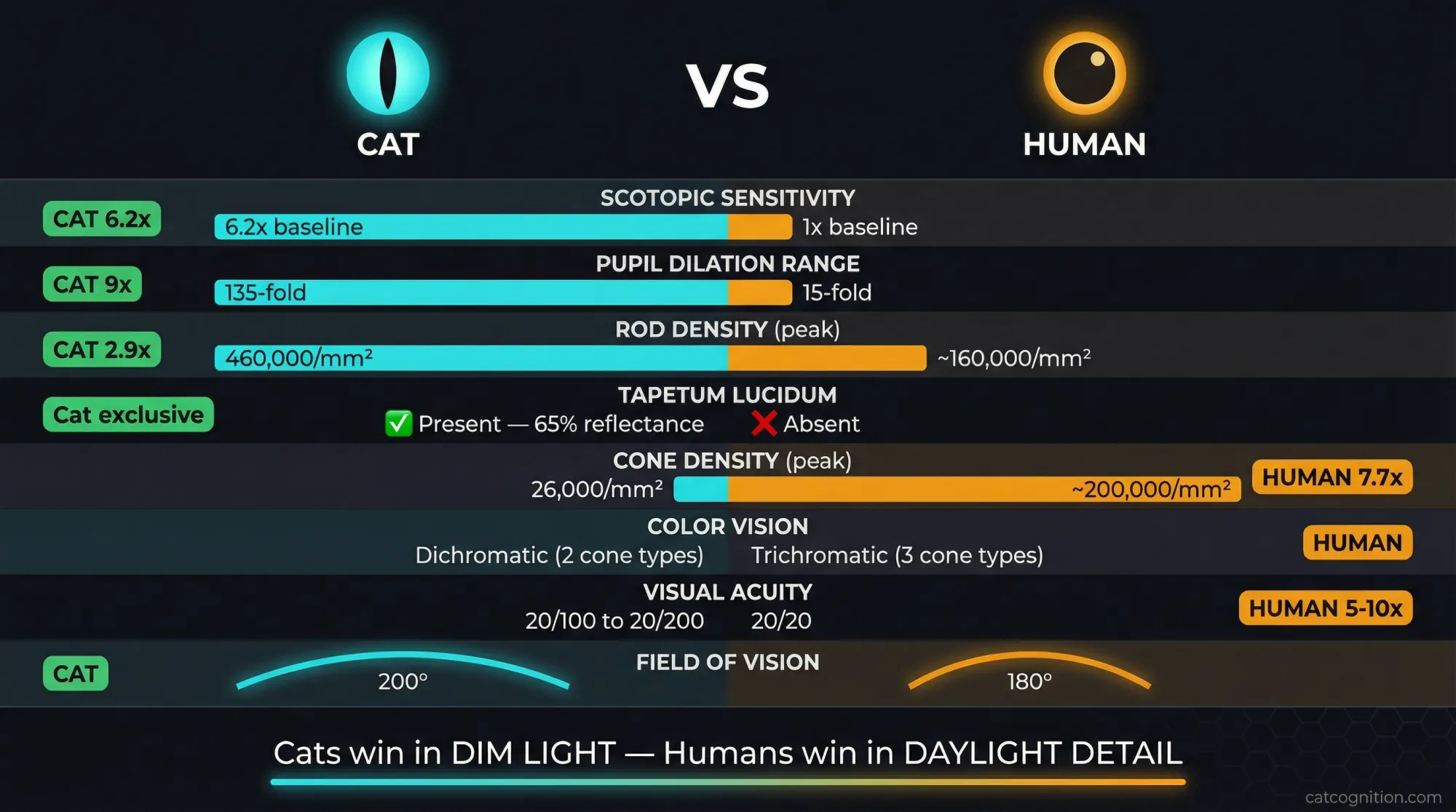
| Feature | Cat | Human | Advantage |
|---|---|---|---|
| Scotopic sensitivity | 6.2x baseline | 1x baseline | Cat (6.2x) |
| Pupil dilation range | 135-fold | 15-fold | Cat (9x) |
| Rod density (peak) | 460,000/mm2 | ~160,000/mm2 | Cat (2.9x) |
| Corneal diameter | 16.5 mm | 11.1 mm | Cat (1.5x) |
| Tapetum lucidum | Present (~65% reflectance) | Absent | Cat |
| Cone density (peak) | 26,000/mm2 | ~200,000/mm2 | Human (7.7x) |
| Color vision | Dichromatic (2 cone types) | Trichromatic (3 cone types) | Human |
| Visual acuity | 20/100 to 20/200 | 20/20 | Human (5-10x) |
| Field of vision | 200 degrees | 180 degrees | Cat |
The cat cornea, averaging 16.5 millimeters in horizontal diameter compared to 11.1 millimeters in humans, acts as a larger light-gathering lens. Combined with a dilated pupil diameter of 10.1 millimeters versus 6.0 millimeters in humans, the cat eye admits substantially more light per unit time to the retina.
📊 The Evidence:
"Cat pupils undergo a 135-fold change in area between constricted and dilated states, while human circular pupils undergo a mere 15-fold change." (Banks et al., 2015, UC Berkeley)
The tradeoff is real. Human eyes contain approximately 200,000 cone cells per square millimeter at the fovea — roughly 7.7 times the cat's peak cone density of 26,000. This gives humans vastly superior color vision and fine detail resolution. Cats see the world in lower resolution but higher sensitivity, like a security camera optimized for low light rather than sharp daytime detail. To explore what this means for color perception, see can cats see red?
The cat's 505-nanometer neutral point — the wavelength cats cannot distinguish from gray — means feline color perception resembles human red-green color blindness (deuteranopia). Cats see blues and yellows but reds appear as muted grays or dull greens. For a broader look at feline visual experience, read what do cats see that we can't?
Are Cats Nocturnal or Crepuscular?
Cats are crepuscular, not nocturnal. A 2023 study published in Applied Animal Behaviour Science tracked free-ranging domestic cat activity patterns and found statistically significant crepuscular circadian rhythms (p < 0.0001), with two clear activity peaks: late evening at approximately 21:00 and early morning at approximately 05:00.
The distinction matters because it explains why cats evolved their specific visual toolkit. A truly nocturnal animal (like an owl) needs vision optimized exclusively for darkness. A crepuscular animal needs vision that performs well across a wide range of light levels — from the deep twilight of dawn to the bright midday sun. The cat's 135-fold pupil dilation range is the engineering solution to this dual requirement, allowing rapid adaptation between extreme conditions.
Indoor cats retain these ancestral activity patterns even without natural light cues. The 21:00 and 05:00 peaks explain the common complaints of "my cat goes crazy at bedtime" and "my cat wakes me up at 5 AM." These are not random behaviors — they are biologically timed activity surges driven by circadian programming that predates domestication. This crepuscular timing is also why cats caterwaul at night — vocal activity peaks align with these same twilight windows.
The 2023 chronobiology study also found seasonal variation: 70 percent of cat observations occurred during spring and summer, and cats carrying prey were observed most frequently in summer (56 percent of prey captures) and never in winter. Even activity levels respond to lunar cycles, with suggestive evidence of higher nocturnal activity around the new moon (p = 0.065), a trend consistent with cats exploiting their visual advantage on darker nights, though it did not reach conventional statistical significance.
Moon's crepuscular programming runs like clockwork. Every evening around 20:45, he transitions from sleeping on the couch to full-speed zoomies through the hallway, batting at shadows and ambushing chair legs. At dawn — usually 05:15 in summer, closer to 06:00 in winter — he's sitting on my chest, staring at my face. I once caught his eyeshine with my phone flashlight at 3 AM when I got up for water: two bright yellow-green discs glowing from the end of the dark hallway, perfectly still, watching me fumble for the light switch while he navigated the same darkness effortlessly.
Can Cats See Infrared or Ultraviolet Light?
Cats cannot see infrared light. The feline visual system is limited to wavelengths detectable by their photoreceptors, and neither rod nor cone cells in the cat retina respond to infrared radiation (wavelengths above approximately 700 nanometers). The myth may persist because cats sometimes react to the warmth of infrared sources, using thermal detection through skin and whisker nerve endings rather than vision.
Cats can, however, see ultraviolet light. The key difference lies in lens transparency. Human eye lenses absorb UV radiation below approximately 400 nanometers, acting as a built-in UV filter. Cat lenses are significantly more transparent to UV wavelengths, allowing UV photons to reach the retina and stimulate rod photoreceptors. Research suggests that cat lenses transmit UV light that human lenses block, giving cats access to a visual spectrum slightly wider than our own.
This UV sensitivity has practical implications. Urine trails, certain flowers, and prey animal markings that are invisible to human eyes under normal lighting may be visible to cats under UV-rich conditions (such as dawn and dusk, when the UV component of natural light is proportionally higher). UV vision may also help explain why cats sometimes appear to stare intently at apparently blank walls or surfaces — they may be detecting UV-reflective patterns invisible to their human observers.
The connection to night vision is indirect but meaningful. Cat dichromatic color vision uses cone photoreceptors sensitive to approximately 460 nanometers (blue) and 560 nanometers (yellow), with a neutral point at 505 nanometers. The UV sensitivity extends the blue end of this range, potentially giving cats additional visual information during the crepuscular twilight hours when UV light is relatively abundant.
📊 The Evidence:
"Domestic cats evolved greater rod photoreceptor density than their wild Felis silvestris ancestors, sacrificing cone-based color vision for enhanced night vision." (Journal of Comparative Neurology, 1993)
This evolutionary trade-off is the central story of cat vision: every adaptation that enhanced dim-light performance came at a cost of daytime visual capability. More rods meant fewer cones. A larger pupil meant a shallower depth of field. A reflective tapetum meant light scatter that reduced image sharpness. The cat eye is an engineering masterpiece optimized for a specific ecological niche — not universal performance, but peak performance in twilight. For more on how cat sounds and other senses complement vision, explore our sensory science series.
Sudden changes in your cat's ability to navigate in low light may signal serious eye disease. Watch for: dilated pupils that do not constrict in bright light, bumping into furniture or door frames, reluctance to jump onto surfaces they previously reached easily, or cloudy and opaque-looking eyes. Dr. Thomas Kern of the Cornell Feline Health Center notes that most affected cats are "middle-aged or elderly" with "vision loss [that] has been progressing for years." If your cat shows any of these signs, schedule a veterinary eye examination promptly. Early detection of conditions like glaucoma, progressive retinal atrophy, or hypertension-related retinal detachment can preserve remaining vision.
Key Terms Used
| Term | Definition |
|---|---|
| Tapetum lucidum | A reflective tissue layer behind the retina composed of zinc-cysteine and riboflavin crystals that bounces unabsorbed light back through photoreceptors, increasing low-light detection efficiency by approximately 65% |
| Scotopic vision | Vision under low-light conditions driven primarily by rod photoreceptors, as opposed to photopic (bright light) vision driven by cones |
| Crepuscular | Describing animals most active during dawn and dusk twilight periods, as distinct from nocturnal (night-active) or diurnal (day-active) |
| Rod cells | Photoreceptors specialized for low-light sensitivity and motion detection, capable of registering individual photons |
| Cone cells | Photoreceptors responsible for color vision and fine detail, functioning primarily in well-lit conditions |
| Dichromatic | Having two types of color-sensing cone photoreceptors; cats see primarily in blue and yellow, similar to human red-green color blindness |
| Photonic crystal | A nanostructure that controls light through precisely spaced layers, the optical principle underlying tapetum lucidum function |
| Eyeshine | The visible reflection of light from the tapetum lucidum, observed when light enters a cat's eye and reflects back through the pupil |
| Vibrissae | Specialized sensory whiskers anchored three times deeper than ordinary fur, detecting air currents and spatial information for non-visual navigation |
Frequently Asked Questions
Can cats see in pitch black?
No. Cats require at least some ambient light for their visual system to function. In complete darkness, they rely on whiskers (which detect air current changes as small as 1/2000th the width of a human hair), hearing, and spatial memory. However, conditions that feel pitch black to humans often contain enough residual light — from digital clocks, starlight, or light leaking under doors — for cats to see clearly.
How much better can cats see in the dark than humans?
Cats are approximately 6.2 times more sensitive than humans in scotopic (dim light) conditions, based on a 2009 behavioral study by Kang and Malpeli at the University of Illinois. The popular "six to eight times" range reported on most websites traces back to this single peer-reviewed study.
Why do my cat's eyes glow different colors?
Eyeshine color depends on tapetum crystal spacing, iris pigmentation, and the angle of incoming light. The tapetum has two main reflectance peaks: 580 nm (yellow) and 450 nm (blue-green). Most adult cats show yellow-green eyeshine, but young kittens may show blue, and cats with blue eyes may show reddish eyeshine from blood vessel reflection.
Do cats prefer dark rooms?
Cats do not prefer darkness itself — they prefer the security and reduced stimulation that dim environments provide. Their crepuscular biology drives activity peaks at dawn and dusk, making moderate low-light conditions their optimal operating environment. Most cats choose resting spots based on warmth, safety, and vantage point rather than lighting level.
Can cats see better than dogs in the dark?
Cats generally have a slight advantage over dogs in low-light vision. A 1983 comparative study found that reflective rodlets in dog tapeta are less precisely oriented than in cat tapeta, resulting in less efficient reflectance. Both species have tapeta lucida and enhanced rod density, but the cat's more precisely structured photonic crystal tapetum provides marginally better light recycling.
When can kittens see in the dark?
Kittens develop full adult night vision capability by approximately eight weeks of age. Eyes begin opening at 8-14 days, depth perception emerges at four weeks, and functional navigation vision arrives around six weeks. The tapetum lucidum continues maturing during this period, transitioning from blue to yellow-green eyeshine.
Do cats see colors at night?
In very dim light, cat vision shifts entirely to rod photoreceptors, which cannot distinguish colors. At night, cats see in grayscale. Their dichromatic color vision (blue and yellow wavelengths) functions only when ambient light is sufficient to activate cone photoreceptors — typically at dawn, dusk, and indoor lighting conditions.
Is it bad to shine a light in a cat's eyes?
Brief exposure to normal flashlight or phone light is not harmful, but sustained bright light directed at a cat's fully dilated pupils can cause temporary discomfort and retinal adaptation disruption. Avoid pointing laser pointers or concentrated light beams directly into cat eyes. In low light, the dilated pupil and tapetum together amplify incoming light significantly, making the experience more intense for the cat than the light level suggests.
Key Takeaways
6.2x sensitivity, not "magical" dark vision: Cats see in light six times dimmer than humans can use, but they cannot see in complete darkness. The 6.2x figure comes from peer-reviewed behavioral research by Kang and Malpeli (2009) — the actual scientific basis behind the popular "6x better" claim.
Three adaptations working together: Cat night vision depends on 460,000 rods per mm2 (nearly 3x human density), a photonic crystal tapetum lucidum reflecting 65% of light for a second retinal pass, and pupils that dilate 135-fold in area (9x the human range).
Crepuscular, not nocturnal: Cats are most active at dawn (
05:00) and dusk (21:00), not midnight. Their visual system is optimized for the full twilight-to-daylight range, explaining the "bedtime zoomies" and "dawn wake-up call" behaviors.Night vision came at a cost: Every low-light adaptation reduced daytime performance. Cats have 7.7x fewer cones than humans, lower visual acuity (20/100-20/200 vs 20/20), and only dichromatic color vision. The cat eye is an engineering masterpiece optimized for twilight, not universal performance.
Kitten night vision takes eight weeks: Full scotopic visual capability does not develop until week eight. Kittens navigate with limited vision for their first two months, which is why kitten-proofing includes adequate ambient lighting near food, water, and litter stations.
Explore more feline science in our cat perception pillar, including companion articles on what cats actually see and whether cats can see red.
Sources
- Contrast Sensitivity of Cats and Humans in Scotopic and Mesopic Conditions - Kang I, Malpeli JG, 2009 (Link)
- Why do animal eyes have pupils of different shapes? - Banks MS, Sprague WW, Schmoll J, Parnell JAQ, Love GD, 2015 (Link)
- Multilayer subwavelength gratings or sandwiches with periodic structure shape light reflection in the tapetum lucidum - Scientific Reports, 2022 (Link)
- The distribution of rods and cones in the retina of the cat - Steinberg et al., Journal of Comparative Neurology (Link)
- Some reflective properties of the tapetum lucidum of the cat's eye - Weale RA, 1970 (Link)
- Isolation of a zinc protein from the tapetum lucidum of the cat - Biochemical Journal (Link)
- Fluorescence in the Tapetum of the Cat's Eye - Elliott JH, Futterman S, 1963 (Link)
- Spectral reflexion factor of the cat's tapetum - Nature, 1951 (Link)
- Neutral point testing of color vision in the domestic cat - Experimental Eye Research, 2016 (Link)
- Chronobiology of free-ranging domestic cats - Applied Animal Behaviour Science, 2023 (Link)
- Rapid evolution of the visual system: a cellular assay of the retina and dorsal lateral geniculate nucleus of the Spanish wildcat and the domestic cat - 1993 (Link)
- Corneal thickness and diameter in the domestic cat - 1987 (Link)
- Feline Vision Problems: A Host of Possible Causes - Cornell Feline Health Center (Link)
- Kitten Vision: More Than Meets the Eye - National Kitten Coalition (Link)
- Why Do Cats Have Whiskers? - VCA Animal Hospitals (Link)
- The eyes have it - Nature Photonics, 2015 (Link)
- Functional Specialization of the Rod and Cone Systems - NCBI Bookshelf (Link)