Can Cats See Red? What Science Says About Feline Color Vision
Cats cannot see red — their dichromatic vision with a 505nm neutral point renders red as gray or muddy brown, an evolutionary trade-off that gave cats 6x better night vision than humans.

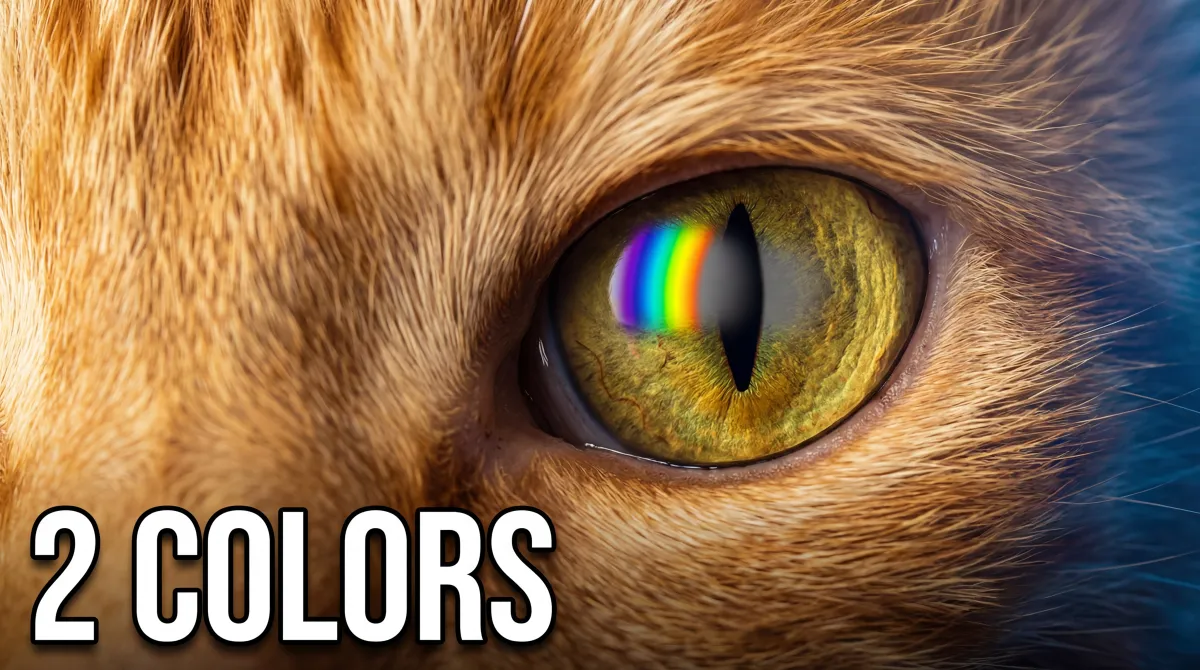
Table of Contents
- What Colors Can Cats See?
- Can Cats See Red? The 505nm Neutral Point
- Can Cats See Blue and Green?
- Can Cats See Pink, Purple, or Orange?
- What Colors Do Cats See Best?
- Why Can't Cats See Red? The Evolutionary Trade-Off
- How Does Cat Vision Compare to Humans?
- Can Cats See Ultraviolet Light?
- Key Terms Used
- Frequently Asked Questions
- Key Takeaways
- Sources
Cats cannot see red the way humans do. Cats are dichromatic, meaning they have only two types of color-detecting cone cells instead of three. Their neutral point — the wavelength where color becomes indistinguishable from gray — falls at 505 nm, making red appear as a dull gray or muddy brown. This evolutionary trade-off gave cats 6 times better night vision than humans, prioritizing prey detection over color richness. For more on the science of feline senses, see our complete guide to cat perception.
What Colors Can Cats See?
Cats perceive the world through a blue-yellow color palette, seeing blues and yellows clearly while reds, greens, and oranges fade into muted gray-brown tones. This dichromatic vision results from having two types of cone cells — S-cones peaking at 460 nm for blue wavelengths and ML-cones peaking at 556 nm for yellow-green wavelengths — compared to the three cone types that give humans full trichromatic color vision.
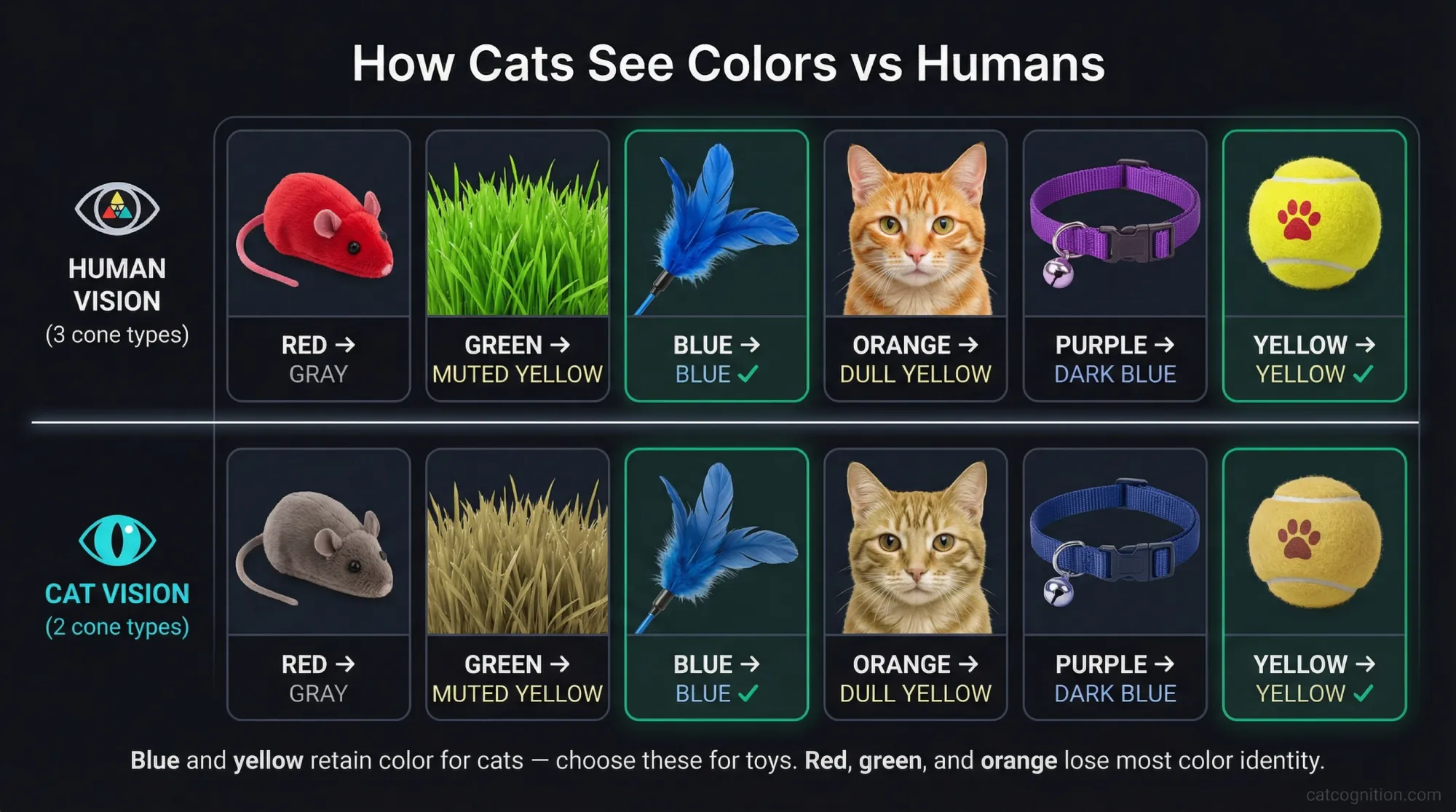
As Dr. Bruce Kornreich, Director of the Cornell Feline Health Center, explains: "They do well with blues and yellows, but have a little more trouble distinguishing greens and reds." This limited color palette doesn't mean cats see in black and white. Cat vision is comparable to what a human with red-green color blindness (deuteranopia) experiences — a world rich in blue and yellow tones but missing the red-green spectrum entirely.
The difference comes down to cone cell density. Humans possess approximately 10 times more cone cells than cats, dedicating significant retinal real estate to color processing. Cats traded those cones for rod cells — photoreceptors specialized for low-light vision and motion detection. The result is a visual system optimized for hunting at dawn and dusk rather than appreciating a sunset.
📊 The Evidence:
"Humans possess approximately 10 times more cone cells than cats, explaining the dramatic difference in color discrimination between the two species." — VCA Animal Hospitals
Can Cats See Red? The 505nm Neutral Point
Cats cannot see red as a distinct color. A 2016 study by Daria Clark and Robert Clark, published in Experimental Eye Research, provided the most definitive behavioral evidence to date. Using neutral point testing — a method where animals must distinguish monochromatic light from a gray of equal brightness — the researchers pinpointed the exact wavelength where cat color vision fails.
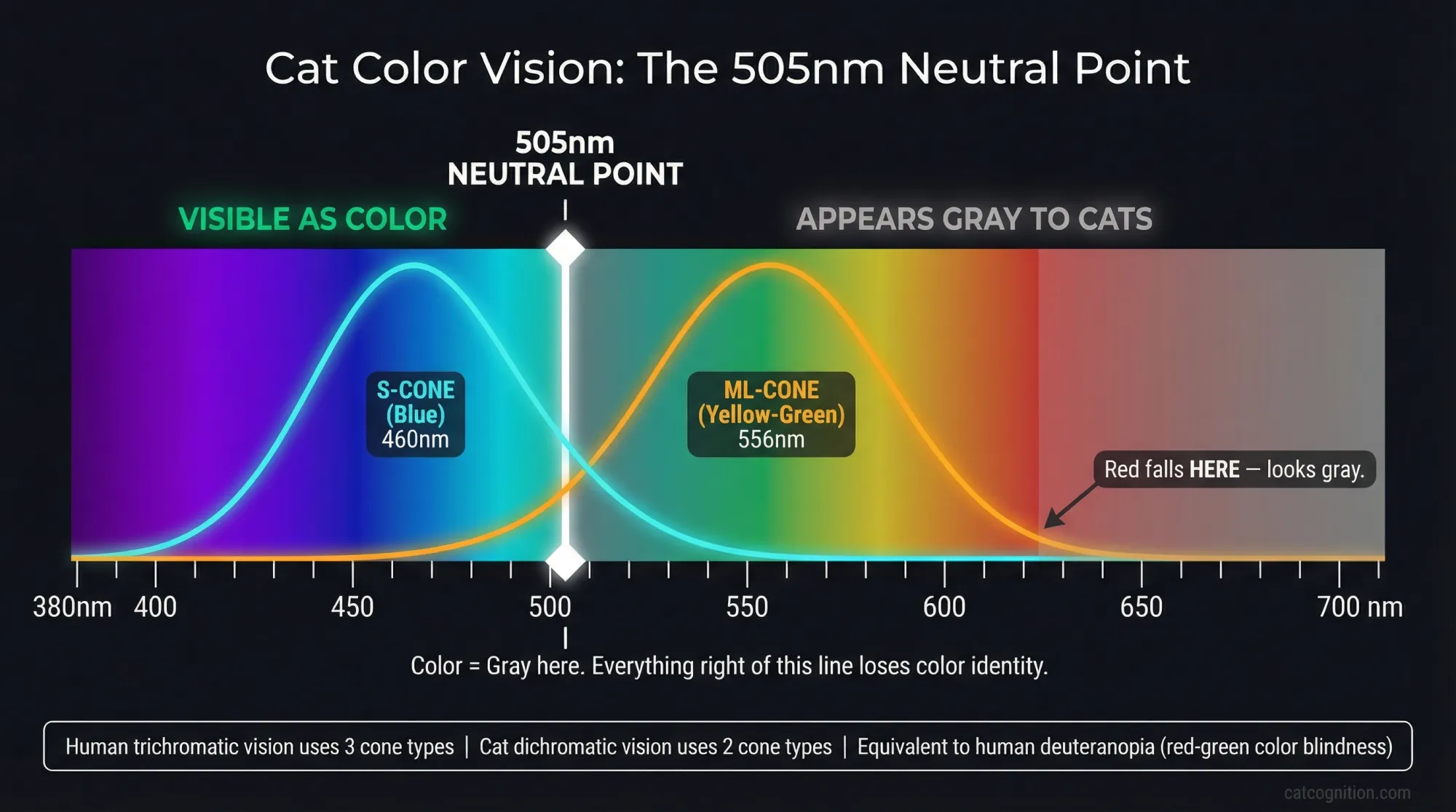
Both test cats successfully discriminated monochromatic light across two ranges: 456 to 497 nm (blue through blue-green) and 510 to 524 nm (yellow-green). But at 505 nm, both cats consistently failed to distinguish the color from gray across multiple trials. This 505 nm neutral point sits squarely in the green portion of the spectrum, confirming that wavelengths above this threshold — including red, orange, and much of green — progressively lose their color identity.
The Clark study also revealed something striking: the cat's neutral point at 505 nm is nearly identical to the neutral point of a human deuteranope (a person with red-green color blindness). This means feline vision is not just "similar to" red-green color blindness — it is functionally equivalent. Red does not simply appear dimmer to cats. Red registers as a shade of gray, a muddy brown, or at best a very faint warm tone indistinguishable from the surrounding environment.
📊 The Evidence:
"Both test cats failed to discriminate monochromatic light at 505 nm over multiple trials, establishing the neutral point of feline dichromatic vision." — Clark & Clark, 2016, Experimental Eye Research
Can Cats See Blue and Green?
Blue is the color cats see with the greatest clarity and saturation. Cat S-cones (short-wavelength sensitive cones) peak at 460 nm, placing their maximum sensitivity squarely in the blue portion of the visible spectrum. Blue objects stand out against most backgrounds because they activate the cone type cats have most reliably retained through evolution.
The neural wiring for blue perception is also more developed than one might expect. Research published in the Journal of Neuroscience found that blue-ON cells in the cat's lateral geniculate nucleus — the brain's visual relay station — have receptive fields approximately 2.7 times larger than achromatic cell receptive fields. These blue-ON cells receive excitation from S-cones (blue) and opposing signals from ML-cones (yellow-green), creating a true blue-yellow color opponent system. The larger receptive fields mean blue processing covers more visual area, making blue the most reliably detectable color for cats.
Green sits in a more ambiguous zone. Wavelengths in the 510-524 nm range (yellow-green) are still discriminable, meaning cats can distinguish these tones from gray. But pure green (around 520-540 nm) loses saturation as it approaches the 505 nm neutral point. A bright green toy would appear as a slightly yellowish or washed-out version of itself — visible but muted compared to how it appears to human eyes.
📊 The Evidence:
"Blue-ON receptive fields in the cat lateral geniculate nucleus are approximately 2.7 times larger than achromatic cell receptive fields, prioritizing blue-yellow color processing." — Journal of Neuroscience, 2013
Can Cats See Pink, Purple, or Orange?
Pink, purple, and orange are all compound colors that involve the red end of the spectrum — the exact wavelengths cats process poorly. Each one tells a different story through dichromatic eyes.
Pink is a mixture of red and white light. Since cats cannot process the red component, pink appears as a very light gray or a faintly bluish white. The blue component (if any) might register faintly, but the overall impression is a washed-out, nearly neutral tone. A hot pink toy would look like a pale gray toy to your cat.
Purple combines red and blue wavelengths. Here, cats get half the signal — the blue component registers clearly through S-cones at 460 nm, but the red component drops out entirely. Purple likely appears as a shade of blue to cats, darker and less saturated than pure blue but still recognizably in the blue family. Of the three compound colors, purple retains the most visual interest for cats.
Orange sits between red (long wavelength) and yellow (medium wavelength). Since cat ML-cones peak at 556 nm, they can partially detect the yellow component of orange. Orange likely appears as a dull, desaturated yellow or yellowish-brown — visible but stripped of the warm vibrancy humans perceive. An orange toy is functional but less visually stimulating than a blue or bright yellow one.
What Colors Do Cats See Best?
Blue and yellow are the two colors cats see with the greatest contrast, saturation, and clarity. Blue activates S-cones peaking at 460 nm while yellow stimulates ML-cones peaking at 556 nm. Together, these two wavelength ranges fall on opposite sides of the 505 nm neutral point, providing maximum color contrast in the cat visual system.
This has direct practical implications for cat owners choosing toys, enrichment items, and play equipment. A blue feather wand against a beige carpet creates strong visual contrast for cats. A red laser pointer dot — while still triggering motion-detection systems — produces less color contrast than a blue or green laser would. Yellow toys stand out well against most indoor backgrounds.
Movement, however, matters more than color. Cats evolved as crepuscular predators whose hunting success depends more on detecting motion than identifying color. A stationary blue toy and a moving red toy placed side by side would likely attract equal attention — the red toy's movement compensates for its color invisibility. The ideal approach combines optimal color with motion: a blue or yellow toy moved in prey-like patterns provides both color contrast and movement triggers.
Why Can't Cats See Red? The Evolutionary Trade-Off
Cat vision is not defective — cat vision is specialized. The limited color palette reflects a deliberate evolutionary trade-off between color discrimination and low-light performance, and cats came down firmly on the side of low-light performance.
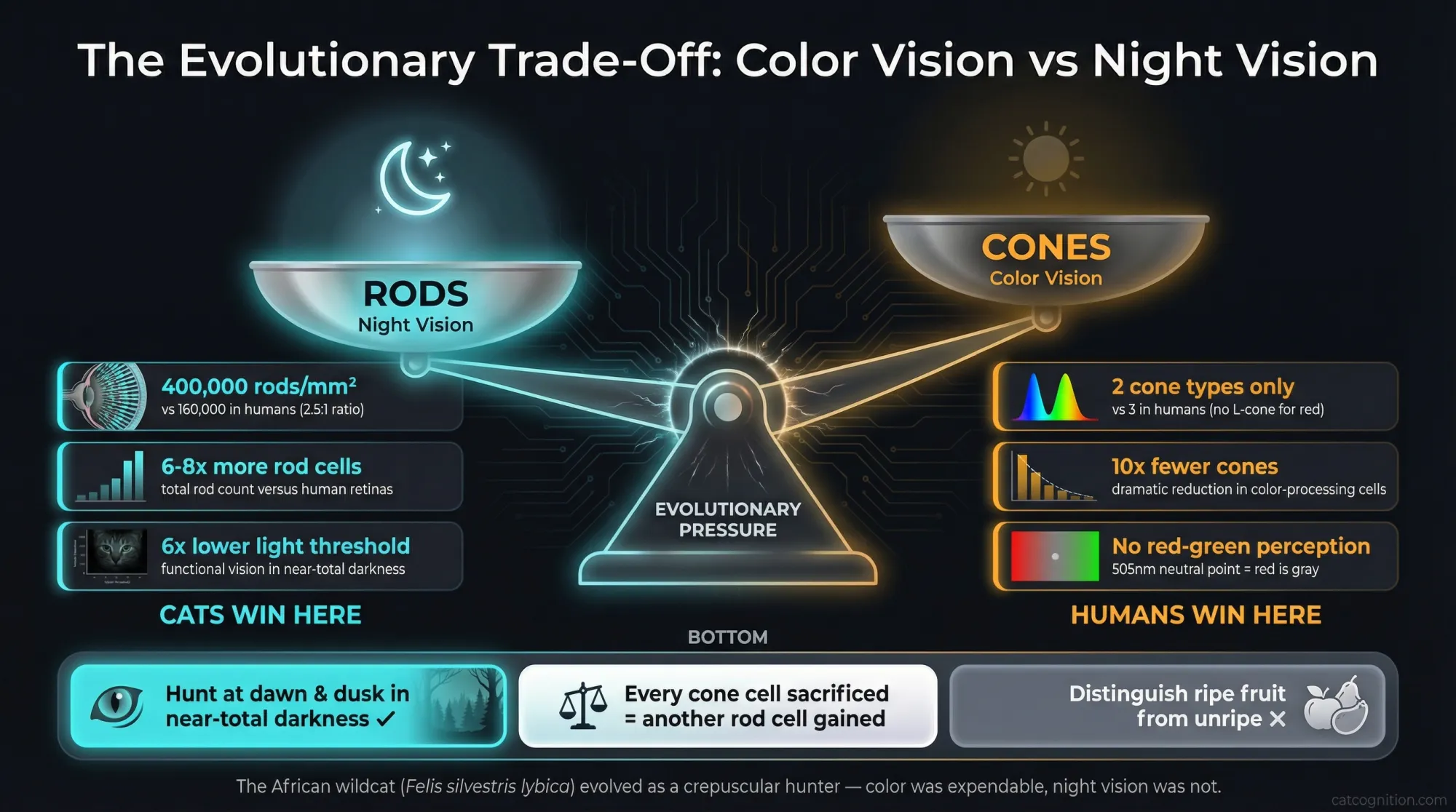
The African wildcat (Felis silvestris lybica), the domestic cat's direct ancestor, hunted primarily at dawn and dusk — the crepuscular window when prey is most active but light is scarce. Effective hunting in these conditions required maximum sensitivity to movement and contrast in low light, not the ability to distinguish ripe fruit from unripe fruit (the evolutionary pressure that gave primates trichromatic vision).
The trade-off was structural. Rod cells detect light at far lower thresholds than cone cells but cannot distinguish color. Cat retinas pack approximately 400,000 rod cells per square millimeter compared to 160,000 per square millimeter in humans. Cats possess 6 to 8 times more rod cells overall. Each cone cell sacrificed meant another rod cell could take its place, incrementally improving low-light sensitivity at the cost of color resolution.
The result: cats detect light at thresholds approximately 6 times lower than humans can perceive. A room that appears pitch-black to a human eye still provides enough photons for a cat to navigate, hunt, and identify movement. This is supplemented by the tapetum lucidum — a reflective layer behind the retina that bounces incoming photons back through the photoreceptor cells for a second pass, effectively multiplying the light available for processing. To learn more about how cats use this adaptation, see Can Cats See in the Dark?.
📊 The Evidence:
"Cat retinas house approximately 400,000 rod cells per square millimeter compared to 160,000 per square millimeter in humans — a 2.5:1 ratio that directly enables superior low-light vision." — Live Science, 2023
How Does Cat Vision Compare to Humans?
Cat vision and human vision represent two different evolutionary solutions to the same problem: extracting useful information from light. Cats optimized for low-light conditions and motion detection. Humans optimized for color discrimination and fine detail. Neither system is objectively "better" — each excels in different environments.
Visual acuity — the ability to resolve fine detail — heavily favors humans. Cat visual acuity ranges from 20/100 to 20/200, meaning objects that appear crisp and detailed to a human at 100 feet look blurred to a cat at the same distance. Measured in cycles per degree (a standard unit of visual resolution), cats resolve approximately 6 cycles per degree compared to 30 cycles per degree in humans. Cat vision is approximately five times blurrier than human vision for stationary objects.
Near focus has a practical limit in cats of approximately 10 inches. Objects closer than 10 inches become blurry, which is why cats rely on whisker input for close-range spatial awareness. Whiskers function as a tactile backup system when visual resolution fails at close range.
Field of view favors cats at approximately 200 degrees compared to the human 180-degree field. This wider peripheral vision provides better awareness of movement approaching from the sides — a critical advantage for both prey detection and predator avoidance.
Low-light sensitivity is where cats dominate. With 6 to 8 times more rod cells, a tapetum lucidum that amplifies available light by a factor of six, and pupils that can dilate to cover nearly the entire eye surface, cats function effectively in light conditions that render humans completely blind. For a deeper exploration of feline night vision, see What Do Cats See That We Can't?.
| Feature | Cats | Humans |
|---|---|---|
| Color vision | Dichromatic (2 cone types) | Trichromatic (3 cone types) |
| Visual acuity | 20/100–20/200 (6 cpd) | 20/20 (30 cpd) |
| Near focus limit | ~10 inches | ~4 inches |
| Field of view | ~200° | ~180° |
| Low-light sensitivity | 6x better | Baseline |
| Rod cell density | ~400,000/mm² | ~160,000/mm² |
| UV vision | Yes (58.9% transmission) | No |
Can Cats See Ultraviolet Light?
Cats can see into the ultraviolet spectrum that is completely invisible to human eyes. A 2014 study published in Proceedings of the Royal Society B by Ron Douglas and colleagues found that 58.9% of UV light passes through the cat's ocular lens to reach the retina. In humans, the lens filters out virtually all UV wavelengths, rendering the ultraviolet spectrum invisible.
"Nobody ever thought these animals could see in ultraviolet, but in fact, they do," said Ron Douglas, biologist at City University London.
This UV sensitivity means cats perceive a dimension of the visual world humans cannot access. Urine trails, certain flowers, and animal markings all reflect UV light in patterns invisible to the human eye. For a crepuscular predator, UV vision may provide hunting advantages by revealing rodent urine trails that fluoresce under UV — effectively creating a scent-visible map of prey movement patterns.
The UV capability partially offsets the color limitation. While cats cannot see red, they can see a portion of the spectrum beyond human violet — extending their useful visual range in a different direction. Cat vision is not simply "less than" human vision; it covers a different slice of the electromagnetic spectrum, trading the red end for access to ultraviolet wavelengths. This connects to the broader picture of how kittens develop their visual system from birth.
📊 The Evidence:
"58.9% of ultraviolet light reaches cat retinas, compared to virtually zero in humans, giving cats access to a spectrum invisible to human eyes." — Douglas et al., 2014, Proceedings of the Royal Society B
Normal dichromatic vision in cats is not a medical concern — cats have always seen the world this way. However, sudden changes in your cat's vision behavior warrant immediate veterinary attention. Signs including bumping into furniture, misjudging jump distances, dilated pupils that do not respond to light, cloudiness in the eye, or visible redness may indicate cataracts, glaucoma, retinal detachment, or progressive retinal atrophy. These conditions are treatable when caught early but can lead to permanent blindness if ignored. If your cat is showing behavioral changes alongside vision issues, consult your veterinarian promptly.
Key Terms Used
| Term | Definition |
|---|---|
| Dichromatic vision | Color vision based on two types of cone cells, producing a limited blue-yellow color palette without red-green discrimination |
| Neutral point | The specific wavelength (505 nm in cats) where a dichromat cannot distinguish color from gray |
| Tapetum lucidum | A reflective tissue layer behind the retina that bounces light back through photoreceptor cells, amplifying low-light vision by approximately 6x |
| Rod cells | Photoreceptor neurons specialized for detecting light in dim conditions and sensing motion, dominant in the cat retina |
| Cone cells | Photoreceptor neurons responsible for color vision and fine detail, requiring bright light to function, sparse in cats compared to humans |
| Crepuscular | An activity pattern characterized by peak activity during dawn and dusk twilight periods |
| S-cones | Short-wavelength sensitive cone cells peaking at 460 nm, responsible for blue color detection in cats |
| ML-cones | Medium-to-long-wavelength sensitive cone cells peaking at 556 nm, responsible for yellow-green color detection in cats |
Frequently Asked Questions
Can cats see the color red at all?
Cats cannot perceive red as a distinct color. Behavioral testing by Clark and Clark (2016) established that cat vision has a neutral point at 505 nm, meaning wavelengths in the red range (620-700 nm) register as shades of gray or muddy brown rather than the vibrant color humans see. Red is not dimmer to cats — red is effectively colorless.
Are cats completely color blind?
Cats are not color blind in the black-and-white sense. Cats are dichromatic, meaning they see a limited color palette of blues and yellows through two types of cone cells. Cat color vision is comparable to what a human with deuteranopia (red-green color blindness) experiences. Cats see color — just fewer colors than trichromatic humans.
What is the best color for cat toys?
Blue and yellow toys provide the strongest visual contrast for cats. Blue activates S-cones peaking at 460 nm, while yellow stimulates ML-cones at 556 nm. Red, green, and orange toys appear as muted gray-brown tones. However, movement matters more than color — a moving red toy still triggers hunting behavior through the motion-detection system.
Can cats see green?
Cats can partially see green, but with reduced saturation compared to human perception. Wavelengths in the 510-524 nm range (yellow-green) are discriminable from gray, but pure green approaches the 505 nm neutral point where color fades. A green object appears washed-out and slightly yellowish to cats rather than the vivid green humans see.
Why do cats have better night vision than humans?
Cats have superior night vision due to three structural adaptations: rod-dominant retinas with approximately 400,000 rods per square millimeter (compared to 160,000 in humans), a tapetum lucidum that reflects light back through photoreceptors for a second pass, and pupils that can dilate to cover nearly the entire eye surface. Together, these adaptations allow cats to detect light at thresholds 6 times lower than the human minimum.
Do cats see the world in black and white?
Cats do not see in black and white. Research has definitively established that cats possess at least two functional cone types (S-cones at 460 nm and ML-cones at 556 nm), enabling dichromatic color vision. Cats see blues and yellows clearly, while reds and greens appear as desaturated gray-brown tones. Cat vision is best described as a "muted color" world, not a monochrome one.
Can cats see ultraviolet light?
Cats can perceive ultraviolet wavelengths invisible to humans. A 2014 study found that 58.9% of UV light passes through the cat's ocular lens to reach the retina, while human lenses filter out virtually all UV light. This UV sensitivity may help cats detect rodent urine trails that fluoresce under ultraviolet light, providing a hunting advantage.
How does cat color vision compare to dogs?
Both cats and dogs are dichromats with two cone types, giving them similar limited color palettes. Dogs and cats both see blues and yellows clearly while struggling with reds and greens. The main differences lie elsewhere: cats have superior night vision (more rod cells, larger tapetum lucidum), while dogs have slightly better visual acuity. Both species prioritize motion detection over color discrimination.
Key Takeaways
- Red is invisible as a color to cats: Cats cannot see red — their 505 nm neutral point means red wavelengths register as gray or muddy brown, not as a distinct color.
- Blue is the champion color: Blue activates cat S-cones at 460 nm and is processed through neural pathways with 2.7x larger receptive fields, making blue the most visible and saturated color for cats.
- Night vision was worth the trade-off: Cats sacrificed red-green color vision to pack 6-8 times more rod cells into their retinas, enabling vision in light 6 times dimmer than the human minimum threshold.
- UV extends the cat spectrum: 58.9% of ultraviolet light reaches cat retinas, giving cats access to a visual dimension humans cannot perceive — partially offsetting the red-spectrum loss.
- Movement beats color every time: While blue and yellow toys provide better visual contrast, cats rely more on motion detection than color for hunting. A moving toy in any color will trigger prey drive more effectively than a stationary toy in the "right" color.
Explore more about how cats experience the world in our cat perception guide.
Sources
- Neutral point testing of color vision in the domestic cat - Clark & Clark, 2016, Experimental Eye Research (PubMed)
- Receptive Field Properties of Color Opponent Neurons in the Cat Lateral Geniculate Nucleus - Journal of Neuroscience, 2013 (PMC)
- Cat colour vision: evidence for more than one cone process - Journal of Physiology, 1979 (PMC)
- Blue cone function in the retina of the cat - Vision Research, 1976 (ScienceDirect)
- The distribution of rods and cones in the retina of the cat - Steinberg, Reid & Lacy, 1973, Journal of Comparative Neurology (Wiley)
- Some reflective properties of the tapetum lucidum of the cat's eye - Journal of Physiology, 1971 (PMC)
- Behavioral and Neurophysiological Studies On Cat Color Vision - International Journal of Neuroscience, 1971 (Taylor & Francis)
- Cats and Dogs May See in Ultraviolet - Tanya Lewis, Live Science, 2014 (Live Science)
- Do Cats See Color? - VCA Animal Hospitals, 2024 (VCA)
- Can Cats See Things That Humans Can't? - Inverse, 2022 (Inverse)
- How Do Cats See the World? What To Know about Cat Vision - PetMD, 2024 (PetMD)
- Cat eyes and vision: How cats see the world - All About Vision, 2024 (All About Vision)
- Can cats really see in the dark? - Live Science, 2023 (Live Science)