Does My Cat Love Me? 10 Scientific Signs of Affection
Cats form secure attachments to owners. When they choose to engage, oxytocin rises and cortisol drops. Signs include slow blinks, head bunts (scent marking), and social referencing (looking to you for safety cues).

💡 Quick Answer: Does My Cat Love Me?
Yes. Scientific studies confirm that cats form "Secure Attachments" to their owners, releasing Oxytocin (the love hormone) during interactions. The most reliable signs of this bond are Slow Blinking (trust), Head Bunting (scent marking), and Social Referencing (looking to you for safety cues).
Table of Contents
- Do Cats Actually Feel Love?
- The Chemistry of Connection: Oxytocin
- Study: Do Cats Prefer Humans Over Food?
- How Cats Read Your Mind (Social Referencing)
- The CatCog Attachment Index (10 Signs)
- How to Strengthen Your Bond
- FAQ
For decades, the scientific consensus held that cats were solitary, opportunistic hunters who viewed humans merely as "safety bases" or food dispensers.
New research in the field of Feline Cognition has shattered that stereotype.
Biologically, research indicates your cat views you similarly to how a human infant views their parent. They do not just tolerate you; they are chemically bonded to you.
Do Cats Actually Feel Love? (The Science of Attachment)
The word "love" is a human construct, but in biology, we call it Secure Attachment.
A 2019 study by Kristyn Vitale at Oregon State University applied the "Secure Base Test"—originally designed for human babies—to kittens. The results challenged existing dog-centric models of affection:
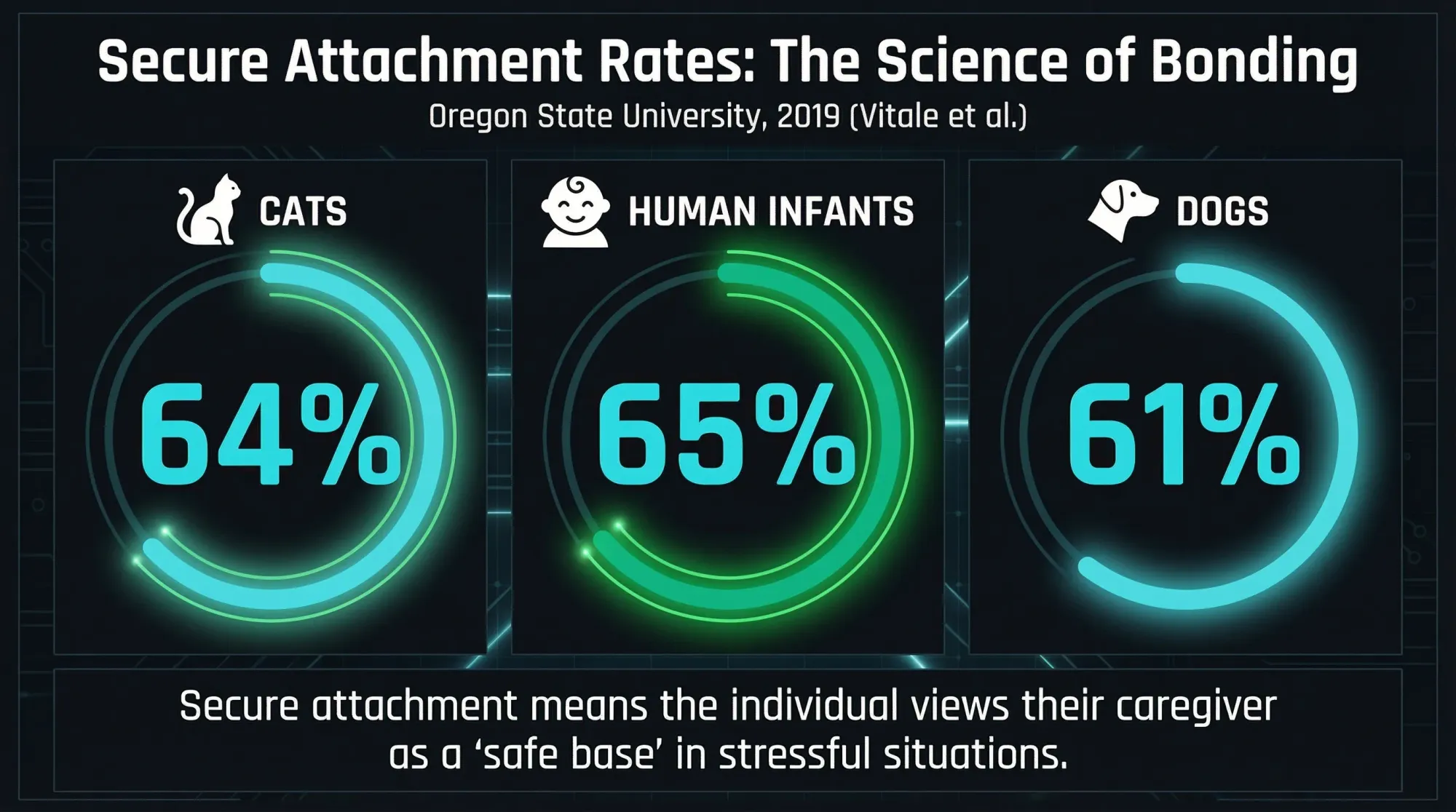
- 64% of kittens displayed a "Secure Attachment" style to their owners.
- This rate is nearly identical to human infants (65%) and higher than the rate found in dogs (61%).
⚠️ The CatCog Reality Check:
When a "Securely Attached" cat is stressed, they do not run away from you; they run to you. You are not just a food source; you are their emotional anchor in a chaotic world.

The Chemistry of Connection: Oxytocin
Feline affection is observable in bloodwork.
When you pet your dog, their Oxytocin levels (the "Love Hormone") spike by about 57%. For a long time, researchers assumed cats felt nothing. Early studies suggested cats showed only a modest 12% oxytocin increase during human interaction—but this came from a small lab study where unfamiliar environments likely stressed the cats.
A 2025 peer-reviewed study painted a clearer picture: when researchers measured oxytocin in cats interacting with their actual owners at home, securely attached cats showed significant oxytocin increases (p = 0.03). Anxiously attached cats actually showed decreased oxytocin—explaining why earlier lab studies with stressed cats found weaker results.
The takeaway: attachment style matters. A cat who trusts you experiences the same "love hormone" surge that dogs do. More importantly, interaction with a bonded human significantly lowers a cat's Cortisol (stress) levels.

Study: Do Cats Prefer Humans Over Food?
You might think your cat would trade you for a piece of tuna in a heartbeat. Science disagrees.
In a controlled study, cats were given a choice between four stimuli:
- Food
- Toys
- Scent
- Human Social Interaction
The majority of cats chose Human Interaction first—even over food. They are not manipulating you for kibble; they are prioritizing the social bond.

How Cats Read Your Mind (Social Referencing)
When a cat walks into a room, sees a strange object (like a vacuum), and immediately looks up at your face, they are performing a high-level cognitive task.
This is called Social Referencing.
- The Mechanism: The cat analyzes your facial expression and emotional state to determine if a new object is a threat.
- The Meaning: If they trust your judgment enough to base their survival decisions on your reaction, they possess a deep trust bond.
🧪 Adam's Lab Note:
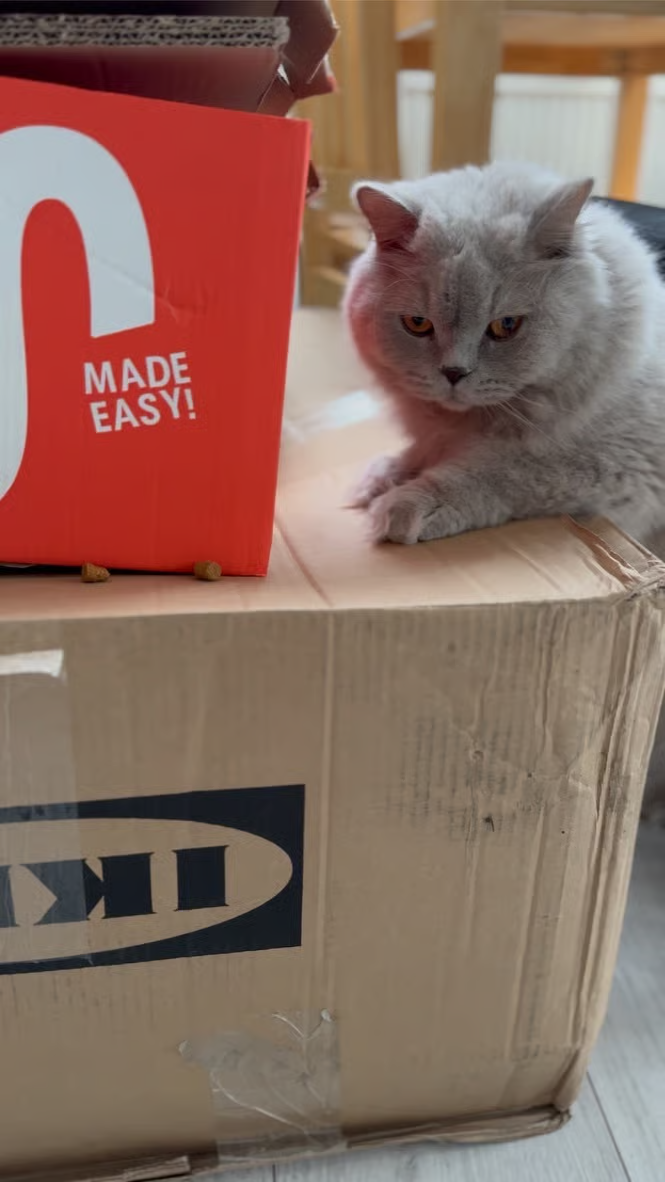
I tested this with Moon when I brought anything new in the house - usually large boxes or shopping bags. He was scared of the noise and size at first and hid in the corner. I sat on the floor and just blinked slowly at him, ignoring the boxes and let the bubble wrap noise quieten. Within 3 minutes, he came out of the corner and walked over to sniff everything. He wasn't looking at the boxes and bags; he was looking at me to see if I was scared.
The CatCog Attachment Index: 10 Biological Indicators
To decode feline affection, you must speak their language. Here are the 10 biologically validated signs of a bonded cat.
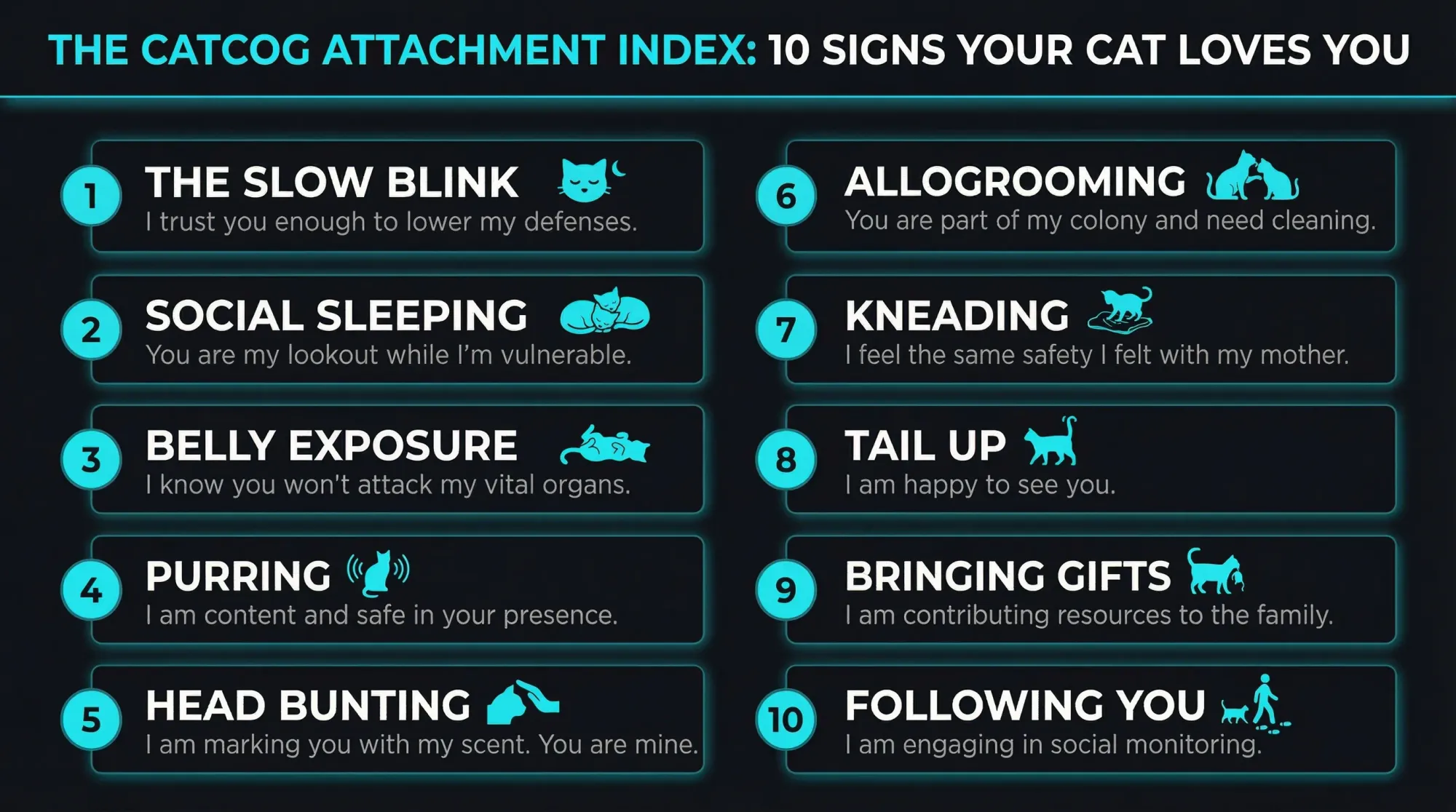
| Signal (The Behavior) | Meaning (The Translation) |
|---|---|
| 1. The Slow Blink | "I trust you enough to lower my defenses." (The Cat Kiss) |
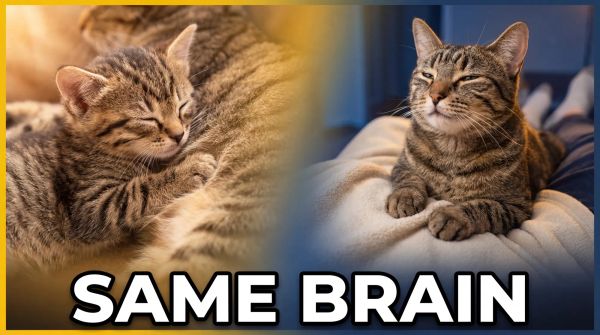
| 2. Social Sleeping | "You are my lookout while I am vulnerable." |
| 3. Belly Exposure | "I know you won't attack my vital organs." |
| 4. Purring | "I am content and safe in your presence." |
| 5. Head Bunting | "I am marking you with my scent. You are mine." |
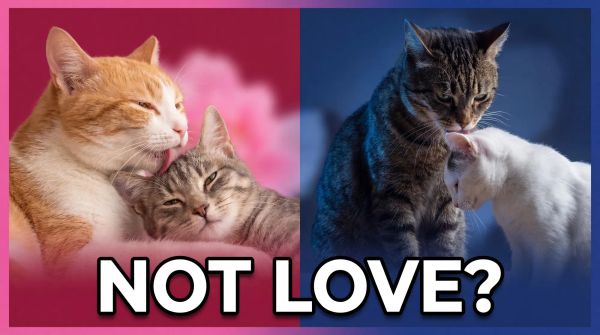
| 6. Allogrooming | "You are part of my colony and need cleaning." |
| 7. Kneading | "I feel the same safety I felt with my mother." |
| 8. The Tail Up (?) | "I am happy to see you." (Friendly Intent) |
| 9. Bringing Gifts | "I am contributing resources to the family." |
| 10. Following You | "I am engaging in social monitoring because I like you." |
How to Strengthen Your Bond (The CatCog Protocol)
- Respect the "Choice": Let them initiate contact. (See the C.A.T. Protocol).
- Blink Back: When they slow blink, return the gesture. It is a shared language.
- Scent Swap: Allow them to rub on you before you feed them to reinforce the "Colony Scent."
🔑 Key Takeaways (The CatCog Index)
- Secure Attachment: 64% of cats view their owners as parents, a rate similar to human children.
- The Oxytocin Link: Interaction releases the "Love Hormone" in cat brains, proving affection isn't just cupboard love.
- Social Referencing: Cats look to their owners to gauge safety in new situations, a sign of immense trust.
- The "Slow Blink": This is the universal sign of non-aggression and trust. Always blink back.
- Preference: Given the choice, most cats prefer human interaction over food or toys.

Frequently Asked Questions
Q: Does my cat actually know I love them?
A: Yes. Through "Social Referencing," cats are highly attuned to your tone of voice and facial expressions. Positive reinforcement and consistent gentle handling build a recognizable "Safe" pattern that they interpret as affection.
Q: Why does my cat bite me when I pet them?
A: This is usually "Overstimulation," not hatred. You may be missing their subtle "Stop" signals (tail twitching, ear flattening). They love you, but their skin sensitivity has a limit.
Q: Do cats get jealous?
A: Yes. Because they are territorial and form specific attachments, introducing a new pet or person can trigger "Resource Guarding" behaviors where they fight for your attention.
Q: Is it true cats only like us for food?
A: No. Studies show that when deprived of both food and human contact, and then offered a choice, the majority of cats go to the human first, then the food.
📚 Scientific Sources & Further Reading
- Applied Animal Behaviour Science (2025) - "The effects of owner-cat interaction on oxytocin secretion in pet cats with different attachment styles." (Link: Read Study)
- Current Biology (2019) - Vitale, K.R. et al. "Attachment bonds between domestic cats and humans." (Link: Read Study)
- Behavioural Processes (2017) - Vitale Shreve, K.R. et al. "Social interaction, food, scent or toys? A formal assessment of domestic cat preferences." (Link: Read Study)
- Animal Cognition (2015) - Merola, I. et al. "Social referencing and cat–human communication." (Link: Read Study)
- Animal Cognition (2013) - Saito, A. & Shinozuka, K. "Vocal recognition of owners by domestic cats." (Link: Read Study)
- Current Biology (2009) - McComb, K. et al. "The cry embedded within the purr." (Solicitation Purring). (Link: Read Study)
- Science (2007) - Driscoll, C.A. et al. "The Near Eastern Origin of Cat Domestication." (Link: Read Study)
- PLOS ONE (2019) - Finka, L.R. et al. "Owner personality and the wellbeing of their cats." (Link: Read Study)