Every Level of Cat Sound Explained (From Purrs to Screams)
Cats produce 21 distinct vocalizations in three acoustic categories. Domestic cats evolved meows at 609 Hz (2.5x higher than wild cats) to manipulate humans. Each cat develops a private language with their owner.

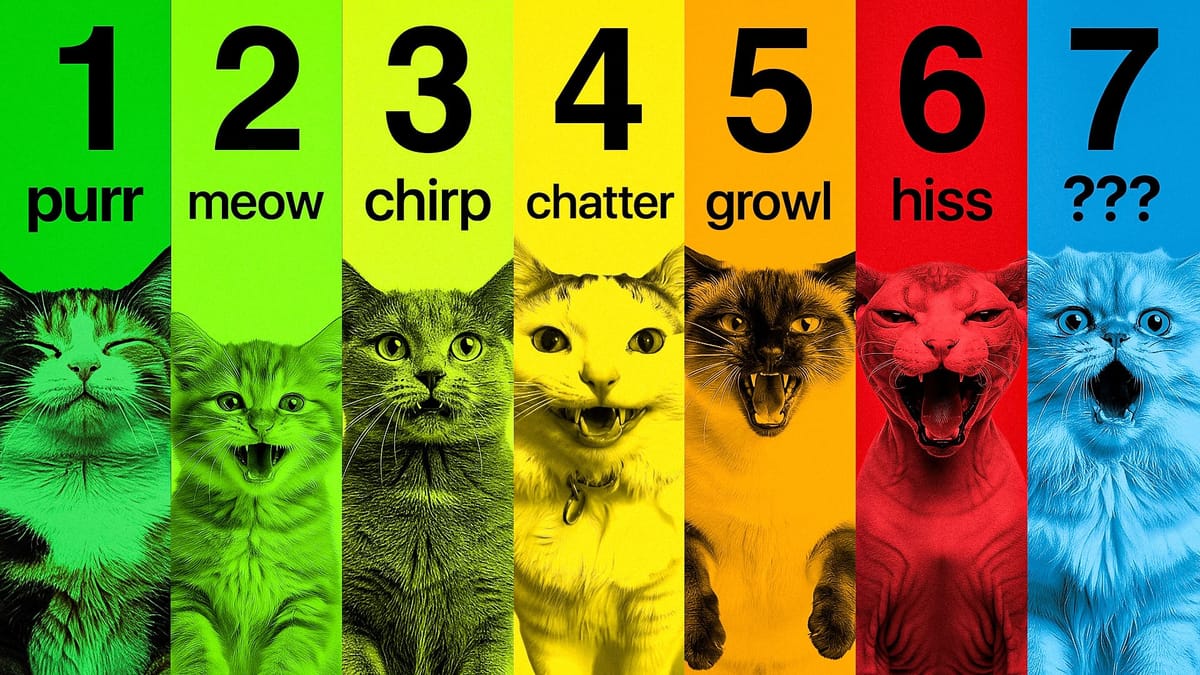
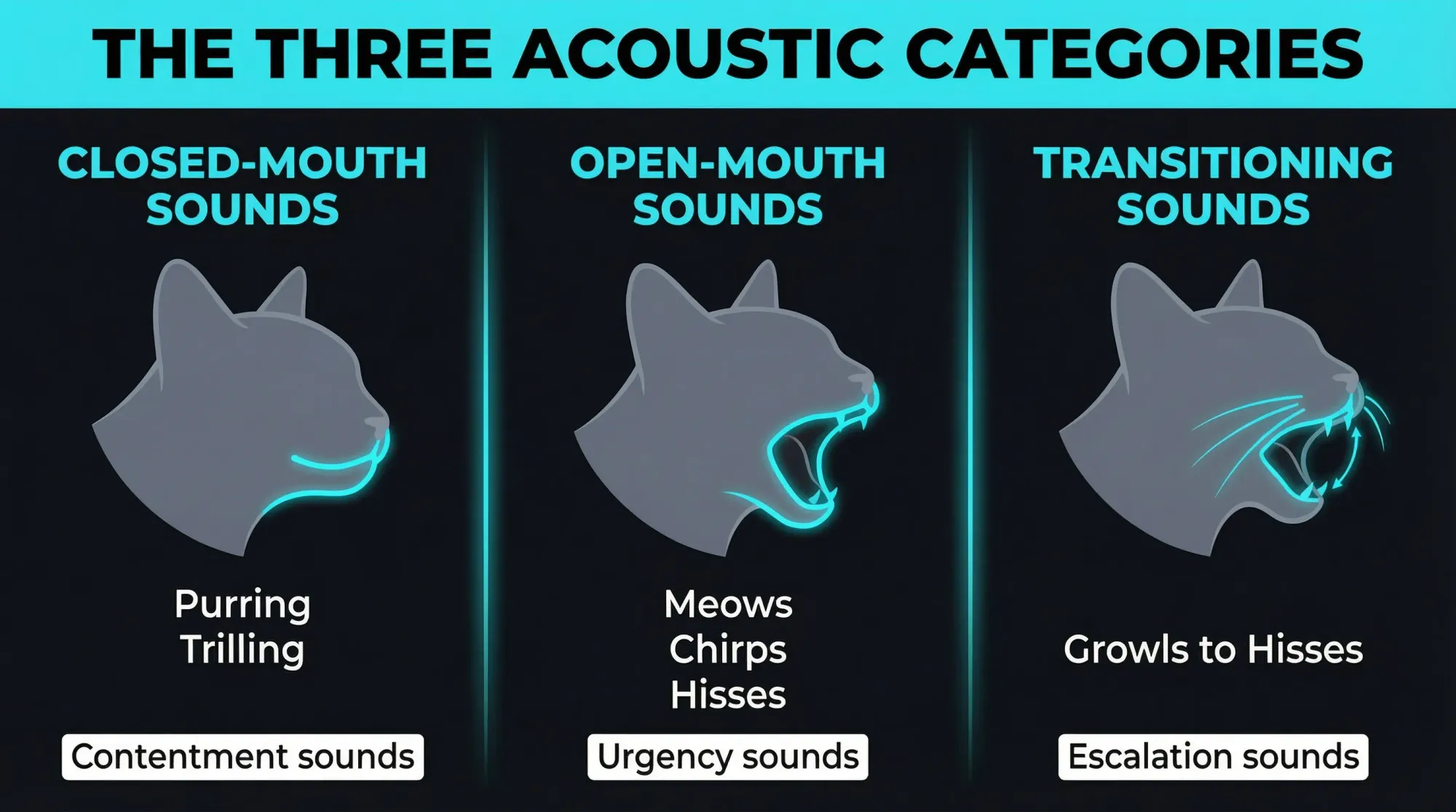
Cat vocalizations fall into three acoustic categories based on mouth position: closed-mouth sounds (purring, trilling), open-mouth sounds (meows, chirps), and sounds produced with the mouth opening then closing (growls transitioning to hisses). Each sound type serves a distinct communication purpose, with domestic cats possessing a documented repertoire of 21 distinct vocalizations. Cat sounds are NOT a universal language with fixed meanings—each cat develops personalized vocalizations that carry consistent meanings only within their individual relationship with their owner.
Table of Contents
- Why Do Cats Make Different Sounds?
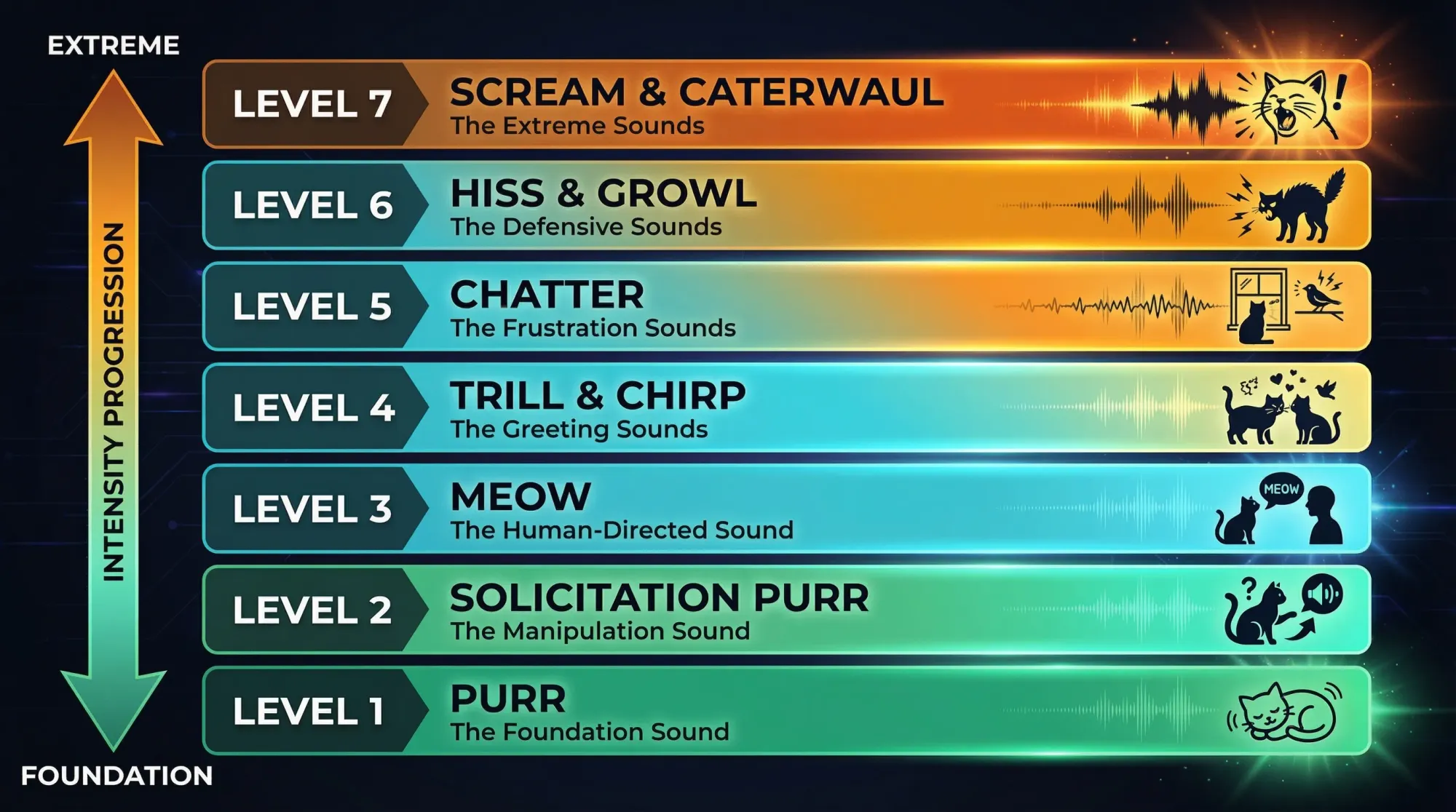
- Level 1: The Purr (The Foundation Sound)
- Level 2: The Solicitation Purr (The Manipulation Sound)
- Level 3: The Meow (The Human-Directed Sound)
- Level 4: The Trill and Chirp (The Greeting Sounds)
- Level 5: The Chatter and Teeth-Clacking (The Frustration Sounds)
- Level 6: The Hiss and Growl (The Defensive Sounds)
- Level 7: The Scream and Caterwaul (The Extreme Sounds)
- The Silent Meow: What You Can't Hear
- The CatCog Vocalization Decoder: A 3-Layer System
- Key Takeaways
- Key Terms Used
- Frequently Asked Questions
- Sources
Why Do Cats Make Different Sounds?
Domestic cats have evolved an extensive vocal repertoire specifically to communicate with humans, a phenomenon researchers call "learned vocal manipulation." Adult wildcats rarely vocalize to each other because meowing is essentially retained kitten behavior—kittens meow to mothers for care, but wild cats abandon this vocalization in adulthood. Domestic cats discovered that meowing is the "cheat code" for human manipulation, so they continue and amplify these sounds exclusively with their human caregivers. This retention of juvenile traits into adulthood is a classic example of neoteny.
As Dr. John Bradshaw of the University of Bristol's Anthrozoology Institute explains, "Feral cats are remarkably silent compared to domestic cats; in particular, such cats rarely meow at one another, whereas the meow is the pet cat's best-known call." Domestic cats have retained and amplified kitten-like vocalizations because meowing successfully manipulates human caregivers. This is not learned behavior in the traditional sense—cats are tapping into 10,000 years of co-evolution with humans.
The Evidence: "Domestic cats have evolved meows averaging 609 Hz, nearly 2.5 times higher than wild cats at 255 Hz, making their vocalizations distinctly more pleasant to human ears."
Research from Cornell University confirms that domestication fundamentally altered cat vocalizations. Wild cat meows sound harsh and demanding, while domestic cat meows evolved to be higher-pitched and more pleasant—a frequency range humans find appealing rather than alarming. Understanding these vocalizations is key to building a strong bond with your cat, which research shows creates secure attachment patterns similar to human infant-caregiver relationships. For a deeper dive into the science behind feline behavior, see our complete guide to cat behavior.

Level 1: The Purr (The Foundation Sound)
Purring represents the foundation of cat vocalization, produced through a mechanism that may operate without continuous neural input. A 2023 University of Vienna study found that excised cat larynges can produce purring-like sounds at 25-30 Hz without neural input, suggesting that specialized fatty tissue pads (up to 4mm in diameter) in the vocal folds may enable low-frequency purring—challenging the traditional "active muscle contraction" hypothesis that researchers had accepted for decades, though the study authors note this does not fully reject the traditional theory.
The Evidence: "A 2023 University of Vienna study found that excised cat larynges can produce purring sounds at 25-30 Hz without neural input, challenging (though not fully rejecting) the traditional active muscle contraction hypothesis."
All purring felids (domestic cats, cheetahs, cougars, ocelots) share a key anatomical feature: a fully ossified hyoid bone apparatus. This bone structure allows continuous purring on both inhale and exhale. In contrast, roaring cats (lions, tigers, leopards, jaguars) have a partially cartilaginous hyoid structure with an elastic ligament—they can produce 114-decibel roars audible from 5 miles away, but they cannot purr.
Research by Elizabeth von Muggenthaler at the Fauna Communications Research Institute found that all felid purring occurs at frequencies between 25-150 Hz. Researchers hypothesize that the 25-50 Hz range may promote bone growth, as these frequencies correlate with those used in some human medical therapies for fracture healing and tissue repair—though direct evidence that cat purring promotes healing in cats or humans remains limited.

Level 2: The Solicitation Purr (The Manipulation Sound)
The solicitation purr represents one of the most sophisticated examples of acoustic manipulation in the animal kingdom. Dr. Karen McComb at the University of Sussex discovered that cats embed a hidden 380 Hz cry-like frequency (ranging from 220-520 Hz) within their purrs when soliciting food or attention. This frequency exploits the same human nurturing instincts triggered by infant distress cries.
"Cats embed a hidden 380 Hz cry-like frequency within solicitation purrs, exploiting the same human nurturing instincts triggered by infant distress cries."
As Dr. McComb explains in her research on cat-human communication, "By employing such an embedded cry, cats appear to be exploiting innate tendencies that humans have for nurturing offspring." In her study of 10 cats and 50 human volunteers, participants consistently rated solicitation purrs as more urgent and less pleasant than normal contentment purrs—even when they had never owned a cat.
Notably, cats in one-on-one relationships with their owners are more likely to develop solicitation purring, while cats in larger households tend to meow instead. The solicitation purr works because it operates below conscious awareness—humans feel compelled to respond without understanding why. For more on how cats use biological mechanisms to communicate with humans, see our guide on how your cat shows they love you.

Level 3: The Meow (The Human-Directed Sound)
The meow exists almost exclusively for human communication. Adult cats rarely meow at each other; this vocalization is a retained kitten behavior that domestic cats discovered works remarkably well on humans. Meow acoustic research reveals systematic patterns: food-related meows have rising pitch contours (F0 going up), while stress-related meows have falling pitch contours (F0 going down).
Dr. Susanne Schotz of Lund University's Meowsic project has documented these melodic patterns across 70 cats, finding that meow fundamental frequency ranges from 221-1185 Hz with a mean duration of 0.42 seconds. Her research suggests cats may actually develop dialect-like variations influenced by their human companions' speech patterns---cats living in different regions produce acoustically distinct meows.
The Evidence: "Cats possess a documented repertoire of 21 distinct vocalizations, with recent AI classification systems identifying up to 40 distinct vocalization categories."
A 2025 AI classification project (FGC2.3) identified 40 distinct cat vocalization categories across 5 major behavioral groups: Food, Life, Fight, Sex, and Complaint. The system achieved over 95% recognition accuracy, demonstrating that cat vocalizations follow predictable acoustic patterns—though human interpretation varies significantly depending on methodology, with some studies showing accuracy near chance level (33-40%) while others report higher rates.

Level 4: The Trill and Chirp (The Greeting Sounds)
Trills and chirps are brief, rising-pitch vocalizations produced with a closed or partially closed mouth. The trill functions primarily as a greeting—a "hello" sound cats direct at familiar humans and other cats they live with. Mother cats use trills to call kittens, and adult cats retain this behavior for social bonding.
Chirping differs from trilling in its acoustic structure: chirps are shorter, more staccato bursts typically reserved for attention-seeking or excitement. Many cats chirp when tracking birds through a window, though this may overlap with chattering behavior.
Research on bimodal communication found that humans identify cat vocalizations alone with only 72.2% accuracy, but when visual cues (body language, facial expressions) are combined with vocal cues, accuracy jumps to 91.8%. This confirms that cat communication is inherently multimodal—sounds carry more meaning when paired with body language. Understanding body language signals like the slow blink enhances your ability to interpret what your cat is communicating.

Level 5: The Chatter and Teeth-Clacking (The Frustration Sounds)
Chattering represents one of the most distinctive and mysterious cat vocalizations. This rapid rhythmic jaw movement—often voiceless or with soft clicking sounds—typically occurs when a cat watches prey it cannot reach. A cat chattering at birds through a window is expressing frustrated predatory drive, as the predatory sequence cannot complete without a catch.
Two primary theories explain chattering behavior. The displacement hypothesis suggests chattering releases pent-up predatory energy when hunting is blocked. The kill-bite rehearsal hypothesis proposes that cats are practicing the rapid jaw movements used to sever prey spinal cords. Both theories acknowledge that chattering reflects intense, frustrated focus rather than distress.

Level 6: The Hiss and Growl (The Defensive Sounds)
Hissing is a pure fear-based vocalization—air expelled through an arched tongue creates a sound that mimics a snake. This is not aggression; hissing signals "I'm scared, back off." Cats hiss when they feel threatened and want to avoid physical confrontation. Understanding this distinction is critical for interpreting cat behavior correctly.
Growling operates differently, indicating sustained threat assessment. A growl is a low, continuous vocalization produced with an open or partially open mouth, signaling that a cat perceives ongoing danger and may escalate to defensive action. The combination of hissing and growling indicates maximum defensive arousal.
Research on cat emotional states shows cats vocalize at 10.1% higher fundamental frequency in pleasant situations compared to aversive situations, with 33.9% lower tessitura (pitch range) in positive contexts. Defensive vocalizations like hissing and growling cluster in the lower, more variable pitch range associated with negative emotional states.

Level 7: The Scream and Caterwaul (The Extreme Sounds)
Caterwauling—the intense, drawn-out yowl associated with mating season—represents cat vocalization at maximum intensity. Intact cats produce these sounds during reproductive behavior, but spayed/neutered cats may caterwaul when experiencing territorial stress, cognitive dysfunction, or extreme frustration.
The scream is a rare, high-intensity vocalization reserved for extreme situations: severe pain, terror, or intense aggression. Cats fighting may produce screams during physical confrontation. Unlike normal vocalizations, screams indicate the cat has exceeded normal stress thresholds.
The Evidence: "All purring felids produce frequencies between 25-150 Hz, a range that correlates with frequencies used in some medical therapies—hough direct evidence for healing benefits remains limited."
The Silent Meow: What You Can't Hear
Some cats produce "silent meows"—vocalizations where the mouth opens and closes in a meow pattern, but no audible sound emerges. One explanation: these meows may actually occur in ultrasonic frequencies above the human hearing limit of approximately 23,000 Hz. Cats hear frequencies up to 64,000 Hz, meaning they may be vocalizing in a range their owners cannot perceive.
However, silent meows may also be soft vocalizations below human attention threshold rather than true ultrasonic sounds. Either way, the silent meow typically functions as an affectionate, low-intensity communication—cats often use it with owners they have close bonds with.
The CatCog Vocalization Decoder: A 3-Layer System
Understanding cat vocalizations becomes systematic when analyzing three acoustic markers:
| Layer | What to Listen For | Interpretation |
|---|---|---|
| Layer 1: Pitch Direction | Is the pitch rising or falling? | Rising = request/positive state; Falling = stress/negative state |
| Layer 2: Mouth Position | Is the mouth closed, open, or transitioning? | Closed = contentment (purr, trill); Open = urgency (meow, hiss); Transitioning = escalation |
| Layer 3: Intensity Pattern | Is the sound stable or escalating? | Stable = calm communication; Escalating = increasing urgency or distress |
This framework consolidates acoustic research from multiple studies into a practical interpretation system. The key insight: context always matters. A meow from a cat at their food bowl means something different than the same meow at the front door. For a deeper understanding of what your cat expects from you, consider how vocalizations fit into their broader communication system.
Key Takeaways
- Domestic Evolution: Cats evolved vocalizations specifically to communicate with humans—adult cats rarely meow at each other, reserving this retained kitten behavior for their human caregivers.
- Purring Breakthrough: A 2023 study found that excised cat larynges can purr without neural input, challenging (though not fully rejecting) the traditional active muscle contraction hypothesis about how cats produce their most iconic sound.
- Acoustic Manipulation: Solicitation purrs contain a hidden 380 Hz cry-like frequency that exploits human nurturing instincts, operating below conscious awareness to compel caregiving responses.
- Individual Variation: Cat vocalizations are not a universal language---each cat develops personalized sounds ("private language") that carry consistent meanings only within their specific relationship with their owner.
- Health Signals: Sudden changes in vocalization patterns, especially increased nighttime vocalizing in senior cats, warrant veterinary evaluation for cognitive dysfunction, hyperthyroidism, or other medical conditions.
Key Terms Used
- Solicitation purr: A specialized purring vocalization that contains an embedded high-frequency cry-like component, used by cats to encourage human caregivers to provide food or attention.
- Fundamental frequency (F0): The lowest frequency of a periodic waveform, which determines the perceived pitch of a sound.
- Hyoid bone: A horseshoe-shaped bone in the throat that supports the tongue and larynx; its structure determines whether a felid can purr or roar.
- Acoustic dispersion: The spread or variability of sound frequencies within a vocalization.
- Bimodal communication: The simultaneous use of two communication channels (e.g., visual body language and vocal sounds) to convey information.
See the full Cat Cognition Glossary ->
Frequently Asked Questions
Why does my cat meow at me but not at other cats?
Adult cats rarely meow at each other because meowing is essentially retained kitten behavior. Kittens meow to their mothers for care, but wild cats abandon this behavior in adulthood. Domestic cats have learned that meowing is effective for manipulating humans, so they continue the behavior exclusively with their human caregivers. As Dr. John Bradshaw notes, feral cats are remarkably silent compared to domestic cats.
Is purring always a sign that my cat is happy?
Purring does not always indicate happiness. Cats also purr when stressed, injured, or even dying---researchers believe purring may serve as a self-soothing mechanism. The context matters: a relaxed body posture with purring suggests contentment, while purring during a vet visit likely indicates stress. The frequency range of purring (25-150 Hz) correlates with frequencies used in some medical therapies, though direct evidence that cat purring promotes healing remains limited.
What does chattering or teeth-chattering at birds mean?
Chattering (rapid rhythmic jaw movements, often voiceless) typically indicates frustration when a cat sees prey it cannot reach. Some researchers hypothesize this may be a displacement behavior expressing pent-up predatory energy, while others suggest it might be a "kill bite" rehearsal. The behavior is distinct from chirping, which is a brief, high-pitched sound typically used for greeting and attention-seeking.
Can cats actually develop different "accents" based on where they live?
Research from Dr. Susanne Schotz's Meowsic project at Lund University suggests cats may develop dialect-like variations influenced by their human companions' speech patterns. Cats living in different regions produce acoustically distinct meows. While this research is preliminary, it indicates that cat vocalizations are more plastic and learned than previously assumed.
What does a silent meow mean?
Silent meows---where a cat's mouth opens and closes in a meow pattern with no audible sound---may occur in ultrasonic frequencies above human hearing (23,000 Hz) or may simply be very soft vocalizations below your attention threshold. Either way, silent meows typically function as affectionate, low-intensity communication directed at owners the cat has close bonds with.
When should I be concerned about my cat's vocalizations?
Sudden changes in vocalization patterns warrant veterinary attention. Excessive meowing (especially at night in cats over 10 years old) may indicate cognitive dysfunction, hyperthyroidism, or hypertension. Voice changes or hoarseness can signal laryngeal issues. Complete loss of voice may indicate serious laryngeal problems. Never rely solely on vocalization interpretation for health assessment.
Why does my cat's purr sound different when asking for food?
Dr. Karen McComb's research identified this as the "solicitation purr"---a specialized vocalization containing an embedded 380 Hz cry-like frequency. This frequency exploits the same human nurturing instincts triggered by infant distress cries. Humans consistently rate solicitation purrs as more urgent and less pleasant than normal contentment purrs, even when they have never owned a cat.
How many different sounds can cats make?
Cats possess a documented repertoire of 21 distinct vocalizations according to traditional classification, but recent AI research (the FGC2.3 project) identified up to 40 distinct vocalization categories across 5 behavioral groups. Some sources suggest cats could potentially produce over 100 different sounds, though many are subtle variations rather than distinct communication types.
Sources
- The cry embedded within the purr - McComb et al., Current Biology, 2009 (Link)
- Domestic cat larynges can produce purring frequencies without neural input - Herbst et al., University of Vienna, Current Biology, 2023 (Link)
- Meowsic Project: Melody in Human-Cat Communication - Dr. Susanne Schotz, Lund University (Link)
- Feline vocal communication research - PubMed, 2020 (Link)
- Domestic vs wild cat meow acoustics - Nicastro, Journal of Comparative Psychology, 2004 (Link)
- The felid purr: A healing mechanism? - von Muggenthaler, Journal of the Acoustical Society of America, 2001 (Link)
- Hyoid bone anatomy in felids - PMC/Journal of Anatomy, 2002 (Link)
- Bimodal communication in cats - Applied Animal Behaviour Science, 2023 (Link)
- FGC2.3 Feline Vocalization Classification - Reznikov, ResearchGate, 2025 (Link)