Felicette: The First Cat in Space and France's Forgotten Space Program
Felicette was a Parisian stray who became the first and only cat to survive spaceflight, launched by France on October 18, 1963. She survived 9.5 g forces and 5 minutes of weightlessness.


Felicette was a Parisian stray who became the first and only cat to survive spaceflight, launched by France on October 18, 1963. French scientists surgically implanted nine electrodes across five brain regions to record neurological responses during 5 minutes of weightlessness at 157 kilometers altitude. Felicette survived the 15-minute mission, was recovered alive, and then euthanized two months later for brain examination - an autopsy scientists later admitted yielded no useful scientific data.
Table of Contents
- Why Did France Send a Cat to Space?
- The Selection Process: 14 Cats, One Survivor
- The Surgical Procedure: Nine Electrodes in a Living Brain
- October 18, 1963: The Mission
- The Second Mission: Six Days Later, Tragedy
- The Aftermath: Euthanasia and Silence
- Why Felicette Was Forgotten for 50 Years
- The Memorial Campaign: Restoring History
- What Felicette's Story Reveals About Space Research Ethics
- Key Takeaways
- Key Terms Used
- Frequently Asked Questions
Why Did France Send a Cat to Space?
France chose cats for space research because feline neurophysiology was extensively documented in 1960s scientific literature, making brain activity data easier to interpret than data from less-studied species. As Michel Viso, former head of exobiology at CNES (France's space agency), explained: "The cat was one of the animals widely used for neurophysiological studies at the time, particularly for the study of sleep and attention."
The Cold War space race was dominated by the USA versus USSR narrative. America sent monkeys and chimpanzees. The Soviet Union launched dogs. France's independent space program took a different path entirely.
French scientists at CERMA (Centre d'Enseignement et de Recherches de Medecine Aeronautique) weren't just testing if an animal could survive spaceflight - they wanted to record what happened inside a living brain during the journey. Cats, already standard subjects for neurological research, offered a baseline that other species could not.
📊 The Evidence:
"Felicette remains the only cat to survive spaceflight, launched by France on October 18, 1963, six years after Laika and two years after Gagarin."
The Selection Process: 14 Cats, One Survivor
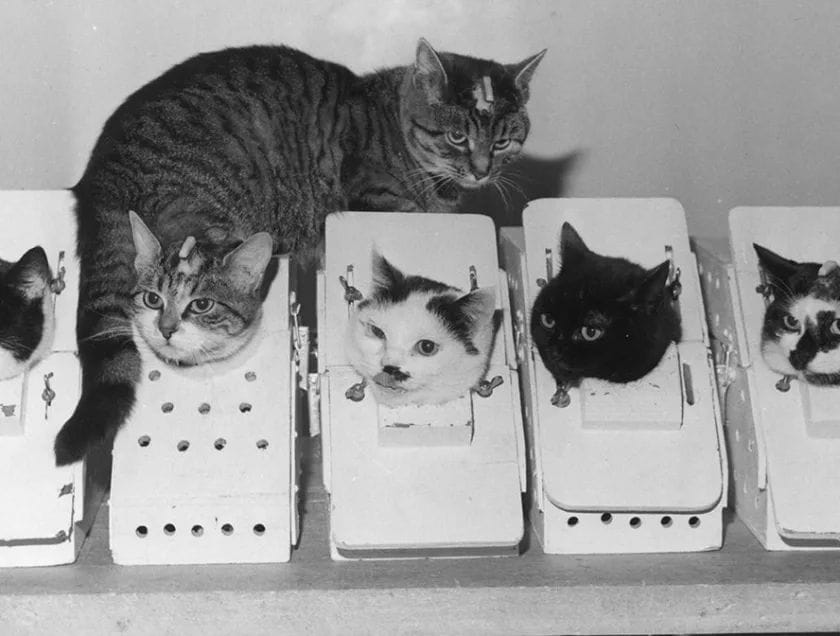
Fourteen female stray cats were purchased from a Parisian animal dealer in mid-1963 to begin a two-month training program for potential spaceflight candidates. Scientists specifically chose females because female cats weigh less than males, making weight limitations easier to manage on the small Veronique rocket.
The Training Regimen:
| Phase | Purpose | Method |
|---|---|---|
| Compression chamber | Simulate pressure changes | Gradual decompression tests |
| Centrifuge | Simulate g-forces | Rotational acceleration |
| Restraint chair | Acclimate to confinement | Extended sessions in flight container |
| High-altitude conditions | Test oxygen response | Simulated atmospheric thinning |
The cats remained deliberately unnamed - identified only by numbers (Felicette was C 341) - to prevent scientists from forming emotional attachments to their subjects. This clinical approach reflected 1963 research ethics, which prioritized data extraction over animal welfare.

One cat, designated for the program, had a severe reaction to electrode implantation surgery. Scientists removed the electrodes, named the cat Scoubidou, and kept her as the CERMA laboratory mascot. Scoubidou became the only cat in the French space program to escape both spaceflight and euthanasia through pure luck.
The Surgical Procedure: Nine Electrodes in a Living Brain
French scientists surgically implanted nine electrodes across five specific brain regions to record Felicette's neurological responses during spaceflight: two electrodes in the frontal sinus, one in the somatic area, two in the ventral hippocampal region, two in the reticular formation, and two in the association cortex. The hour-long procedure transformed a stray cat into a biological flight recorder.
Electrode Placement Details:
| Brain Region | Number of Electrodes | Function Monitored |
|---|---|---|
| Frontal sinus | 2 | Higher cognitive functions |
| Somatic area | 1 | Body sensation processing |
| Ventral hippocampus | 2 | Memory and spatial navigation |
| Reticular formation | 2 | Arousal and attention states |
| Association cortex | 2 | Complex information processing |
The electrodes weren't just passive sensors. During flight, scientists applied electrical impulses to stimulate brain responses and measure reaction times. This active probing aimed to capture how microgravity and extreme g-forces affected neural processing in real time.
📊 The Evidence:
"French scientists implanted nine electrodes across five brain regions to record Felicette's neurological responses during 5 minutes of weightlessness at 157 kilometers altitude."
The technology was crude by modern standards - essentially an early EEG system hardwired directly into the brain rather than placed on the scalp - but groundbreaking for 1963. Felicette's brain would transmit data to Earth while experiencing conditions no cat had ever survived.
October 18, 1963: The Mission
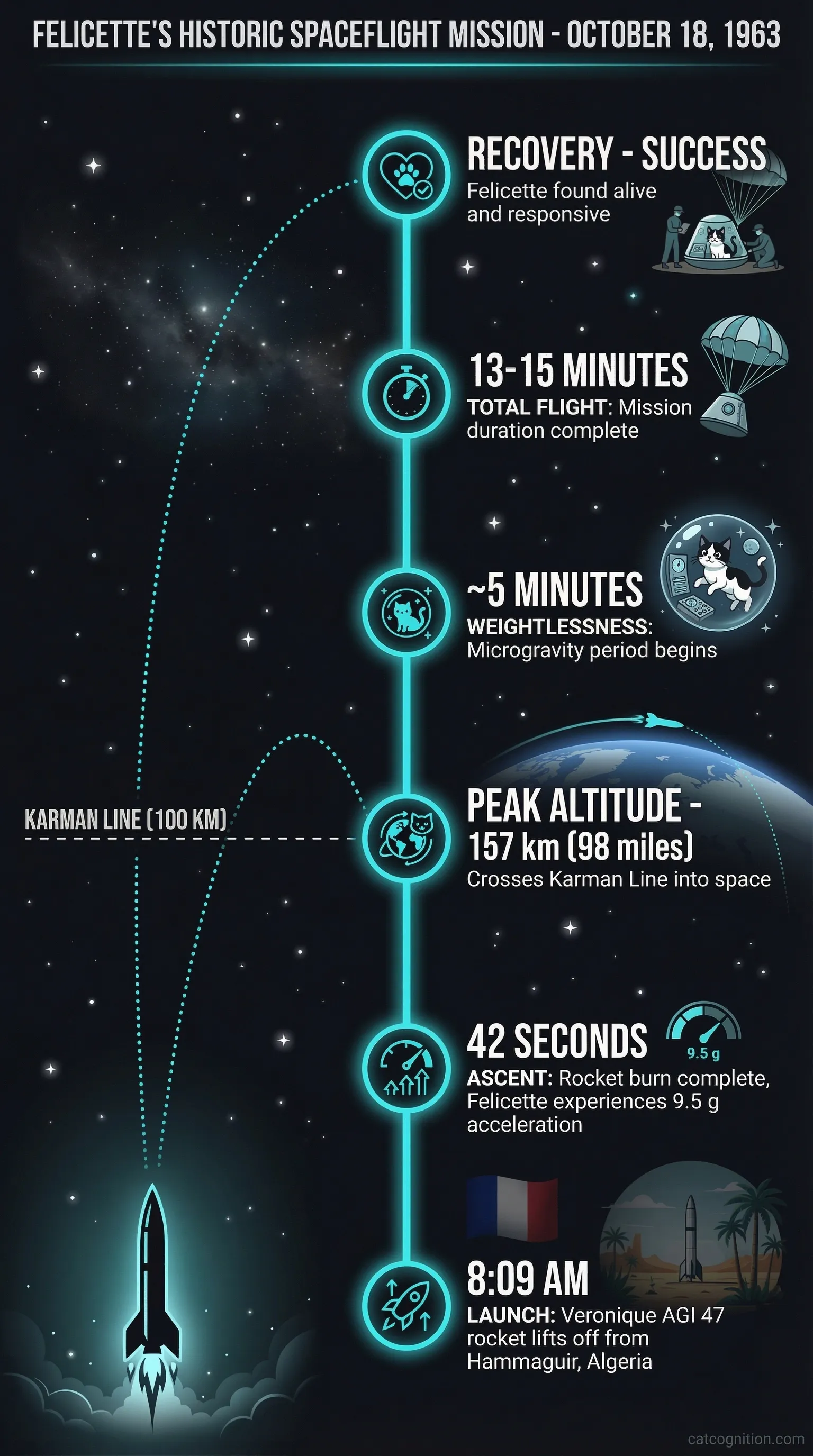
Felicette launched at 8:09 AM on October 18, 1963, aboard a Veronique AGI 47 sounding rocket from the Hammaguir launch site in the Algerian Sahara Desert. The rocket, partially developed using technology from German V-2 rockets built at Peenemunde, carried the 2.5 kg (5.5 lb) cat in a specially designed capsule.
Mission Profile:
| Parameter | Value |
|---|---|
| Launch time | 8:09 AM, October 18, 1963 |
| Launch site | Hammaguir, Algeria |
| Peak altitude | 157 km (98 miles) |
| Total flight time | 13-15 minutes |
| Weightlessness duration | ~5 minutes |
| Maximum acceleration | 9.5 g |
| Rocket burn time | 42 seconds |
| Cat weight | 2.5 kg (5.5 lbs) |
The g-forces Felicette experienced dwarfed what human astronauts would later endure. At 9.5 g acceleration during ascent, Felicette experienced more than double the approximately 4 g that Apollo astronauts felt during their missions to the Moon.
📊 The Evidence:
"Felicette experienced 9.5 g acceleration during launch - more than double the 4 g forces that Apollo astronauts endured on their missions to the Moon."
The neurological data transmitted successfully throughout the flight. Felicette's heart rate slowed during microgravity - a finding consistent with later human observations - while breathing normalized. The turbulent reentry caused elevated heart rate, as expected from the physical stress of deceleration.
The capsule parachuted back to Earth. Recovery teams found Felicette alive and responsive. The mission was declared a success.


The Second Mission: Six Days Later, Tragedy
Six days after Felicette's successful flight, France launched a second cat into space on October 24, 1963. The mission ended in catastrophe when explosive bolts malfunctioned, the rocket launched at an extreme angle, and the unnamed cat died during the resulting hard landing.
This failed second mission rarely appears in popular accounts of Felicette's story. Most sources describe Felicette as the "first cat in space" without acknowledging the follow-up attempt that killed another cat less than a week later. The contrast between the two missions - one success, one fatal failure - illustrates the genuine risks these animals faced as living test subjects.
The French space program continued animal research briefly but never launched another cat. The program's scientific value was increasingly questioned, and the political landscape was shifting. Algeria had gained independence from France in July 1962, and the Evian Accords required France to vacate its Saharan launch facilities by 1967.
The Aftermath: Euthanasia and Silence
Two months after surviving spaceflight, Felicette was euthanized so scientists could examine her brain for signs of neurological changes from the mission. The autopsy was the primary scientific goal all along - the flight itself was data collection, the death was data analysis.
Decades later, scientists admitted a devastating truth: the autopsy yielded no actionable scientific insights. The brain examination that cost Felicette her life produced no useful data.
📊 The Evidence:
"Most of the cats selected for France's space program were euthanized at the program's conclusion, including Felicette two months after her successful flight."
Of the 14 cats in the French space program, most of the remaining cats were euthanized at the program's conclusion. Only Scoubidou (the mascot) and possibly two others survived. This high mortality rate quantifies what "animal testing" meant in practice during the early space age.
Why Felicette Was Forgotten for 50 Years
While Laika the dog received a monument in Moscow and Ham the chimpanzee was commemorated at the New Mexico Museum of Space History, Felicette remained largely unknown for over five decades. Three structural factors explain this historical amnesia.
Factor 1: France Never Launched Human Astronauts
France's independent space program produced satellites and rockets but never put a French citizen into orbit using French vehicles. Without a human astronaut to celebrate, there was no narrative arc connecting animal tests to national triumph. Laika preceded Gagarin; Ham preceded the Mercury astronauts. Felicette preceded... nothing.
Factor 2: The Cold War Framing
Space history was written as USA versus USSR. France's contributions existed outside the dominant narrative, making them invisible to popular memory even when scientifically significant. A French cat didn't fit the story being told.
Factor 3: The Images
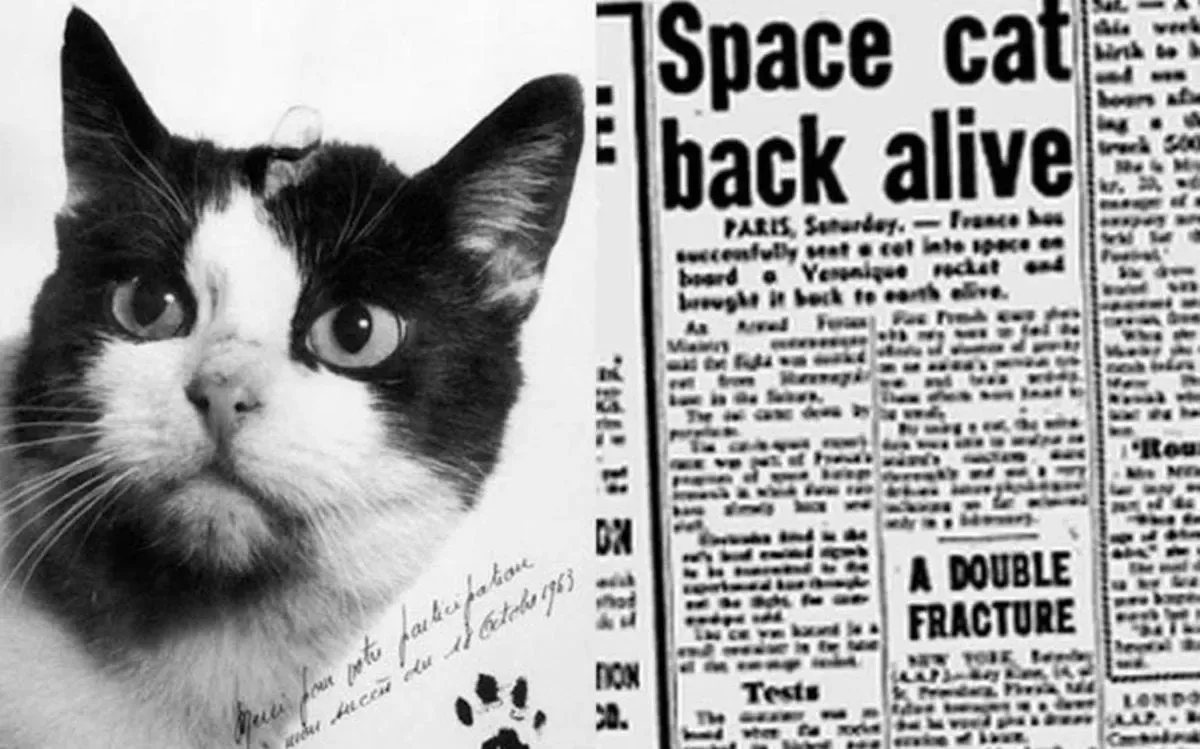
Photographs of Felicette show a cat with electrodes protruding from her skull - not exactly an image that sits well with the growing animal rights movement. Ham and Laika could be presented as heroic; Felicette's images revealed the invasive reality of animal experimentation.
The erasure went further than simple forgetting. Three former French colonies - Comoros (1992), Chad (1997), and Niger (1999) - issued commemorative stamps incorrectly identifying the space cat as a male named "Felix" (after Felix the Cat cartoon character). Official records listed her only as C 341 until after her flight, when media dubbed her "Felix" and scientists feminized the name to "Felicette."
📊 The Evidence:
"The 2017 Kickstarter campaign raised $57,000 from over 1,100 backers to create a bronze memorial for Felicette, unveiled in 2019 at the International Space University in Strasbourg."
The Memorial Campaign: Restoring History
In October 2017, space enthusiast Matthew Serge Guy launched a Kickstarter campaign to create a memorial for Felicette. "I was touched by how, out of all the animal astronauts' stories, Felicette's story seems to be the one that's become twisted the most over the years," Guy explained, "with some people even thinking she was a male cat named Felix."
Kickstarter Campaign Results:
| Metric | Value |
|---|---|
| Goal | 40,000 GBP |
| Raised | 43,324 GBP (~$57,000 USD) |
| Backers | 1,141 |
| Average pledge | 38 GBP |
| Campaign end | November 2017 |
The campaign exceeded its goal, raising funds from over 1,100 backers worldwide. Philippe Jung, Chairman of the History Council at the Aeronautical and Astronautical Association of France, co-authored an academic paper titled "Felicette, the only space cat" presented at the 2018 International Astronautical Congress - formally establishing her place in aerospace history.
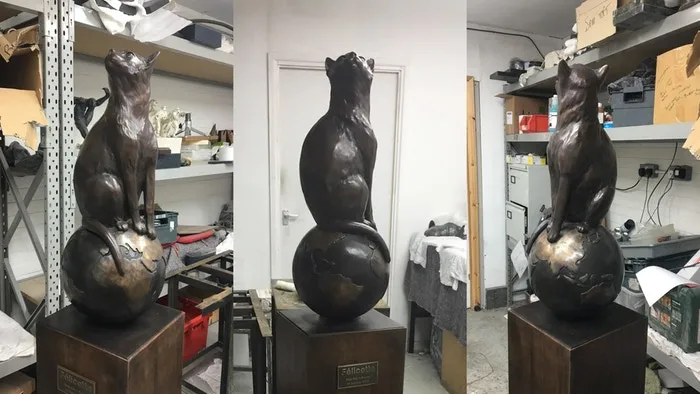
On December 18, 2019, a 5-foot (1.5 meter) bronze statue was unveiled at the International Space University in Strasbourg, France. The timing coincided with the 25th anniversary of the ISU's Master of Space Studies program. The statue depicts Felicette sitting atop a representation of Earth, gazing skyward - finally receiving the recognition denied to her for over half a century.
What Felicette's Story Reveals About Space Research Ethics
Felicette's story illuminates the "Felicette Paradox" - how historical significance can be inversely proportional to public recognition when a story doesn't fit dominant narratives. Being "first" only matters if someone writes you into the history being told.
The ethical questions raised by Felicette's mission haven't disappeared. As a 2024 article in The Conversation noted, "We've been sending animals into space for 7 decades, yet there are still no rules to protect them from harm." International space law addresses astronaut rescue, liability for space debris, and celestial body claims - but contains no binding protections for animal welfare in space research.
Evolution of Research Ethics:
| Year | Development |
|---|---|
| 1957 | Laika launched with no recovery plan (USSR) |
| 1963 | Felicette launched, recovered, euthanized (France) |
| 1985 | Animal Welfare Act amendments strengthen protections |
| 2010 | ESA formally rejects primate research |
| 2024 | Still no international rules protecting animals in space |
The contrast between 1963 and today reveals how dramatically attitudes toward animal research have shifted. What seemed acceptable - implanting electrodes in a stray cat's brain, launching her into space, then euthanizing her for examination - would face significant opposition today.
Yet Felicette's data, however limited, contributed to understanding how mammalian nervous systems respond to microgravity. Every cat, dog, and monkey launched during the early space age provided information that eventually helped protect human astronauts. The ethical weight is real, but so is the scientific contribution.
Key Takeaways
- First AND Only: Felicette remains the only cat to survive spaceflight - launched October 18, 1963, and recovered alive after reaching 157 km altitude and experiencing 9.5 g acceleration.
- Neurological Pioneer: Nine electrodes implanted across five brain regions transmitted real-time neural data during 5 minutes of weightlessness - unprecedented neuroscience conducted beyond Earth's atmosphere.
- The Tragic Admission: Scientists later acknowledged that Felicette's autopsy, performed two months after her successful flight, yielded no actionable scientific insights - the sacrifice that cost her life produced no useful data.
- High Mortality: Most of the cats in the French space program were euthanized at the program's conclusion, quantifying the ethical cost of early space research on animal subjects.
- Restored to History: A 2017 Kickstarter campaign raised $57,000 from 1,141 backers to create a bronze memorial unveiled in 2019 at the International Space University in Strasbourg - ending 50+ years of historical erasure.
Key Terms Used
- Neurophysiology: The study of how the nervous system functions - the scientific rationale for France's use of cats, whose brain activity was already extensively documented.
- Suborbital flight: A spaceflight trajectory that reaches space (above 100 km) but does not complete an orbit around Earth - Felicette's mission was suborbital, lasting only 15 minutes.
- Karman Line: The internationally recognized boundary of space at 100 km altitude - Felicette exceeded this boundary by reaching 157 km.
- G-force: A measurement of acceleration force relative to Earth's gravity; 1 g equals normal Earth gravity; Felicette experienced 9.5 g during launch.
- Sounding rocket: A research rocket designed for suborbital flights to make scientific measurements - the Veronique AGI 47 that carried Felicette was a sounding rocket.
See the full Cat Cognition Glossary ->
Frequently Asked Questions
Who was Felicette the space cat?
Felicette was a Parisian stray cat who became the first and only cat to survive spaceflight. She was launched by France on October 18, 1963, aboard a Veronique AGI 47 rocket from Algeria, reaching an altitude of 157 kilometers before being safely recovered. French scientists had surgically implanted nine electrodes in her brain to record neurological responses during the 15-minute mission.
Why did France use cats instead of dogs or monkeys?
Cats were the standard animal model for neurophysiological research in the 1960s, particularly for studying sleep and attention. As CNES exobiologist Michel Viso explained, French scientists "naturally chose an animal whose physiological characteristics were very well known." The extensive existing scientific literature on cat brain activity made interpreting the electrode data easier than using a less-studied species.
Was Felicette's mission successful?
The mission was technically successful - Felicette survived the launch, 5 minutes of weightlessness, 9.5 g acceleration forces, and capsule recovery. The neurological data transmitted successfully throughout the flight. However, scientists later admitted that the post-mission brain autopsy yielded no actionable scientific insights.
Why was Felicette euthanized after surviving her mission?
The primary scientific goal was examining brain tissue after exposure to spaceflight conditions. While modern ethics would consider this cruel, 1963 research standards prioritized data extraction over animal welfare. Felicette was euthanized two months after her flight so scientists could examine her brain - though the examination produced no useful findings.
How many cats were in the French space program?
Fourteen female stray cats were purchased from a Parisian animal dealer for the program. Most of the remaining cats were euthanized at the program's conclusion. One cat (Scoubidou) was removed from the program after a bad reaction to electrode surgery and became the CERMA laboratory mascot, surviving both spaceflight and euthanasia.
Was there a second cat space mission?
Yes. Six days after Felicette's successful flight, France launched a second cat on October 24, 1963. The mission failed when explosive bolts malfunctioned, the rocket launched at an extreme angle, and the unnamed cat died during the hard landing.
Why was Felicette forgotten for so long?
Three factors contributed to Felicette's historical obscurity: France never launched human astronauts (so there was no triumphant narrative to connect her to), the Cold War space race was framed as USA vs USSR (making French contributions invisible), and photographs showing electrodes in her skull didn't align with increasingly animal-welfare-conscious public sentiment.
Where is Felicette's memorial?
A 5-foot bronze statue was unveiled on December 18, 2019, at the International Space University in Strasbourg, France. The memorial was funded through a 2017 Kickstarter campaign that raised approximately $57,000 from 1,141 backers worldwide.
Sources
- Smithsonian Magazine - "Felicette, the First Cat in Space, Finally Gets a Memorial" (Link)
- BBC Sky at Night Magazine - "Felicette: The first cat in space" (Link)
- Space.com - "Felicette, the 1st Cat in Space, Finally Gets a Memorial" (Link)
- The Conversation - "We've been sending animals into space for 7 decades, yet there are still no rules to protect them from harm" (Link)
- IFLScience - "Remembering Felicette, The Only Cat To Ever Go To Space" (Michel Viso interview) (Link)
- Star Walk - "First Cat in Space: Felicette's Story" (Link)