The Science of Petting Cats: Why Your Cat Bites When You Pet Them
40% of cat aggression cases stem from petting mistakes. Learn the C.A.T. Protocol from Nottingham Trent University research to pet cats correctly and build trust.


Quick Answer: What is the correct way to pet a cat?
Pet cats on the face only - base of ears, cheeks, chin, and forehead - where scent glands are located. Let the cat initiate contact, limit petting to 3-5 strokes per session, and stop before warning signs appear. The C.A.T. Protocol (Choice, Attention, Touch) developed by Dr. Lauren Finka at Nottingham Trent University significantly reduces aggression and increases affiliation during human-cat interactions.
You're petting your cat. They're purring. Everything seems perfect. Then suddenly - teeth sink into your hand. What just happened?
This scenario plays out in millions of homes daily, and it's not your cat being "mean" or unpredictable. It's a communication breakdown rooted in evolutionary biology, and 40% of all feline aggression cases seen by veterinary behaviorists stem from this exact petting mistake.
The good news: science has cracked the code on how to pet cats correctly. Research from Nottingham Trent University has developed the C.A.T. Protocol - a evidence-based approach that reduces cat aggression and increases affectionate behavior. This article translates that research into actionable guidance you can use today.
Table of Contents
- Why Do Cats Bite When You Pet Them?
- The Evolutionary Mismatch: Cats Are Not Dogs
- Where Should You Pet a Cat?
- The C.A.T. Protocol: Evidence-Based Petting
- Reading Consent: Green Light vs Red Light Signals
- Why Cats React Worse to Their Owners
- The Health Benefits of Petting Cats Correctly
- Key Takeaways
- Key Terms Used
- Frequently Asked Questions
Why Do Cats Bite When You Pet Them?
Cats bite during petting because repetitive tactile stimulation overwhelms their sensory receptors, converting pleasure into irritation within seconds rather than minutes. This phenomenon, called petting-induced aggression, accounts for 40% of all feline aggression cases seen by veterinary behaviorists (Amat & Manteca, 2019).
The mechanism involves specialized nerve fibers called C-tactile afferents that respond optimally to slow, gentle strokes at approximately 3cm/second - the natural speed of allogrooming between bonded cats. When stimulation exceeds a cat's individual threshold, slow-adapting and fast-adapting touch receptors begin cross-signaling, and the "pleasant touch" sensation flips to sensory overload.
Think of it like a tickle that turns unbearable. The same nerves that register "pleasant touch" can flip to "too much" after sustained stimulation - your cat's threshold is just measured in seconds, not minutes.


The Evolutionary Mismatch: Cats Are Not Dogs
Cats tolerate limited petting because they evolved as semi-solitary hunters where adult physical contact occurred only between bonded colony members targeting specific body regions. This evolutionary history means cats and dogs have fundamentally different relationships with human touch.
In the wild, tactile contact between adult cats occurs primarily in two contexts:
- Allogrooming between bonded colony members, which targets the head and neck regions
- Allorubbing for scent exchange, focused on facial glands
A foundational 1998 study found that 94% of allogrooming interactions begin with one cat approaching the other - cats do not groom each other while already sitting together (van den Bos, 1998). This explains why letting cats approach first matters: it mirrors their natural behavior.
The Evidence:
"Cats prefer being petted on the base of the ears, cheeks, and under the chin where scent glands are located, and consistently show negative responses to petting near the tail base."
Humans often approach cats like dogs - expecting full-body contact tolerance. We pet bellies, backs, and tails based on dog body language where belly exposure signals an invitation for touch. But cats retain their ancestral programming: belly exposure signals trust, not permission. The hair follicles on the belly and tail base are hypersensitive due to evolutionary adaptation for detecting threats to vital organs.
Where Should You Pet a Cat?
The best places to pet a cat are the base of the ears, cheeks, chin, and forehead where facial scent glands produce 40 different pheromone chemicals that cats find intrinsically rewarding to activate. Research published in Applied Animal Behaviour Science confirms cats consistently prefer these head regions while showing negative responses to caudal (rear body) petting (Ellis et al., 2015).
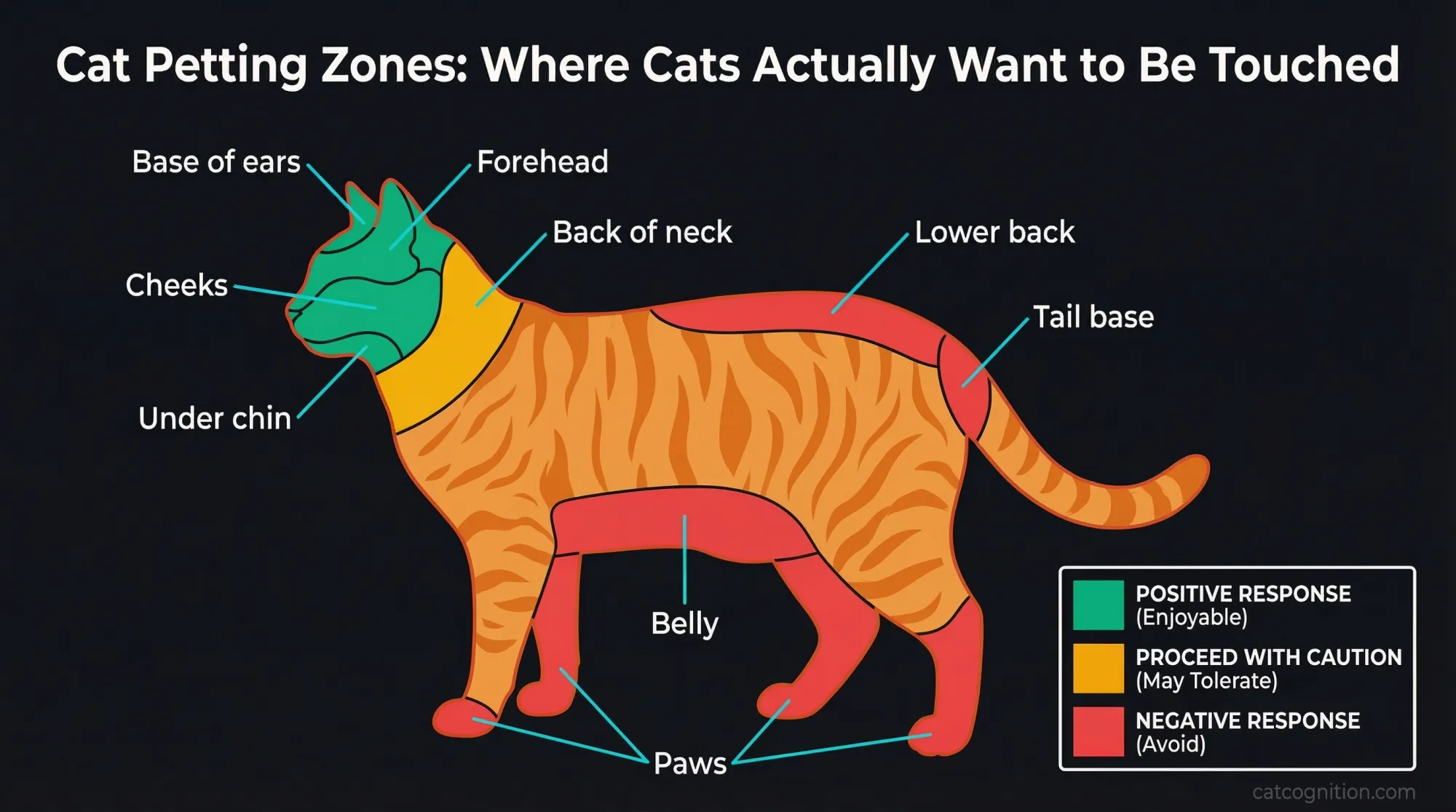
| Body Zone | Cat Response | Why |
|---|---|---|
| Base of ears | Positive | Scent gland activation, mimics allogrooming |
| Cheeks | Positive | Temporal gland stimulation |
| Under chin | Positive | Submandibular gland, difficult to self-groom |
| Forehead | Positive | Perioral gland region |
| Back of neck | Proceed with caution | Some tolerance, watch for signals |
| Lower back | Negative | Hypersensitive hair follicles |
| Tail base | Negative | Triggers defensive reflexes |
| Belly | Negative | Vital organ protection instinct |
| Paws | Negative | Sensitive pad receptors |
CatCog Reality Check:
A cat exposing its belly is NOT an invitation for belly rubs. Unlike dogs who roll over for submission and touch, cats expose their belly as a sign of trust and relaxation - touching this vulnerable area triggers defensive reflexes and can damage the bond you've built. The belly contains hypersensitive hair follicles that evolved to detect threats to vital organs.
The C.A.T. Protocol: Evidence-Based Petting
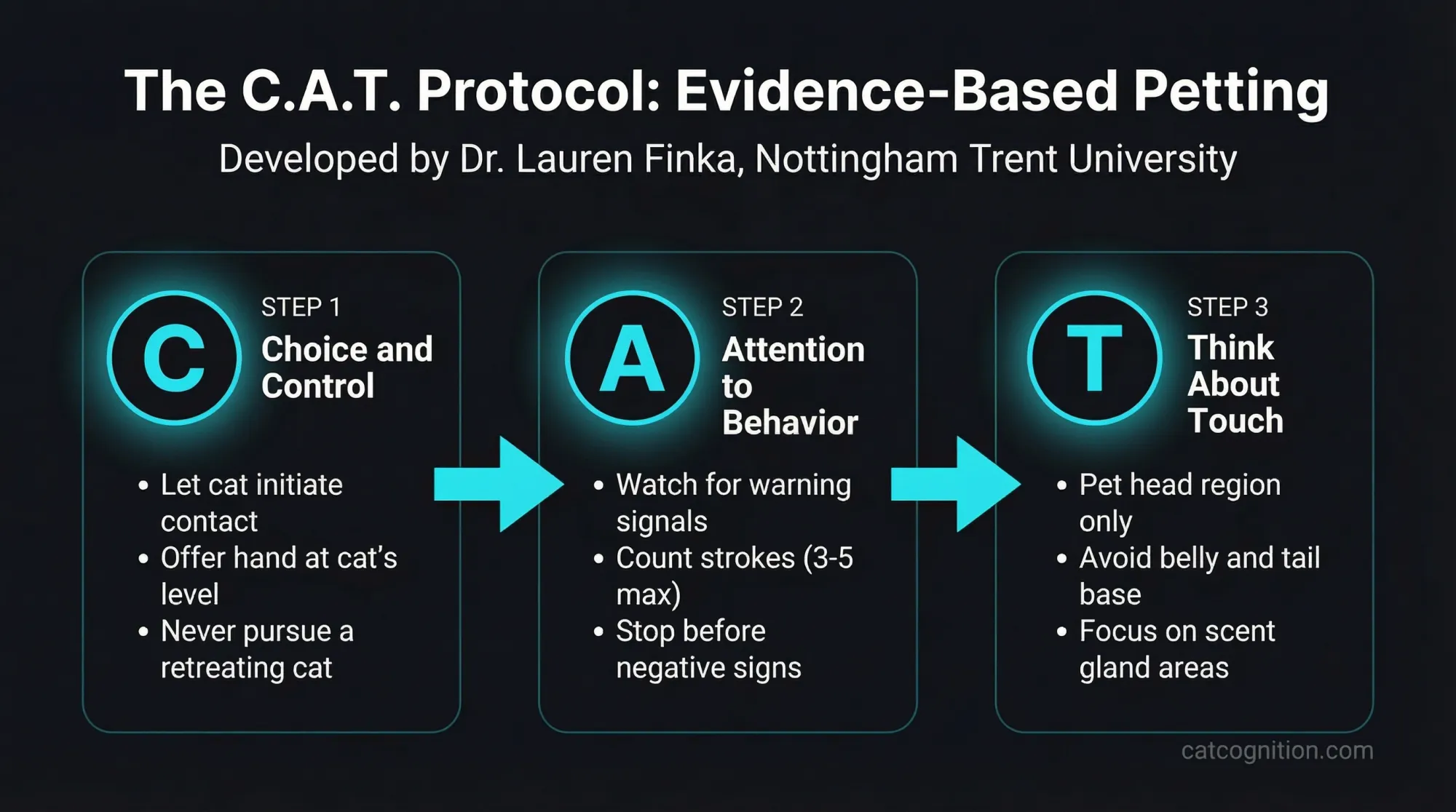
The C.A.T. Protocol developed by Dr. Lauren Finka at Nottingham Trent University provides a research-backed framework that significantly reduces feline aggression and increases affiliative behavior during human-cat interactions (Finka et al., 2021).
As Dr. Lauren Finka, Visiting Research Fellow at Nottingham Trent University and Feline Welfare Scientist at Cats Protection, explains: "Cats have a clear preference for a more 'hands off' approach to petting."
The Evidence:
"The C.A.T. Protocol - Choice, Attention, Touch - developed by Dr. Lauren Finka at Nottingham Trent University significantly reduces feline aggression and increases affiliative behavior during human-cat interactions."
C = Choice and Control
- Offer a hand at cat's level, let cat approach
- Allow cat to initiate contact by rubbing against you
- Never pursue a cat that moves away
- Let cat end the interaction when ready
A = Attention to Behavior
- Watch for green/red light signals continuously
- Count strokes mentally (most cats tolerate 3-5 strokes per session)
- Stop BEFORE you see negative signals (proactive, not reactive)
T = Think About Touch Location
- Primary zones (scent glands): Base of ears, cheeks, under chin, forehead
- Secondary zones (proceed with caution): Sides of face, back of neck
- Avoid zones: Belly, base of tail, lower back, paws, tail
The CatCog 3-Second Rule
For a simplified approach, use this protocol:
- Pet for 3 seconds
- Pause for 3 seconds
- Watch for 3 signals (tail, ears, eyes)
- Repeat only if cat re-initiates contact
This transforms abstract "pay attention" advice into a concrete, memorable protocol that matches cats' natural interaction preferences.
Reading Consent: Green Light vs Red Light Signals
Cats communicate petting consent through body language signals that most owners miss entirely, with research showing cats display warning signs 1-3 seconds before biting - enough time to prevent aggression if you know what to watch for.
🟢 Green Light Signals (Cat Wants Interaction)
| Signal | What It Looks Like |
|---|---|
| Voluntary approach | Cat walks toward you |
| Head-bunting | Cat pushes head against you |
| Slow blinking | Deliberate eye closures |
| Question mark tail | Tail upright with curved tip |
| Soft body | Relaxed, loose posture |
🔴 Red Light Signals (Stop Immediately)
| Signal | What It Looks Like |
|---|---|
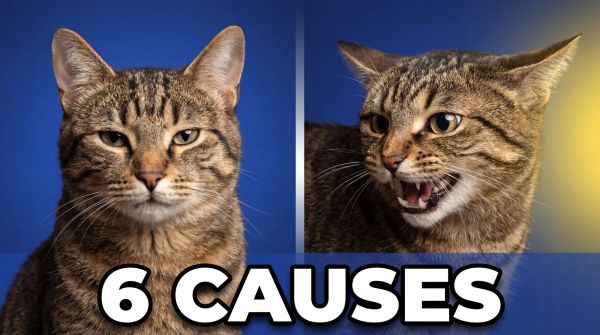
| Tail swishing | Rapid side-to-side movement |
| Ear rotation | Ears flattening or turning backward |
| Pupil dilation | Sudden enlargement of pupils |
| Skin twitching | Rippling along the back |
| Quick head turns | Sudden looks toward your hand |
| Body tensing | Muscles becoming rigid |
Adam's Lab Note:
The most reliable early warning sign I've found with Moon is ear rotation. His ears start rotating backward approximately 2 seconds before any other signal appears. Once I learned to watch specifically for ear movement rather than waiting for tail swishing or skin twitching, our petting sessions became completely bite-free.
A 2020 study published in Scientific Reports by Dr. Tasmin Humphrey at the University of Sussex confirmed that slow blinks function as positive emotional communication, with cats significantly more likely to approach humans after slow blink interactions (p = 0.035).

Why Cats React Worse to Their Owners
Cats display more negative behaviors when petted by their owners than by strangers, with research showing a median of 8.5 negative behaviors with owners versus 5.0 with strangers during equivalent petting sessions. This counter-intuitive finding suggests familiarity breeds lower tolerance, not greater acceptance (Ellis et al., 2015).
Why does this happen? Several theories exist:
- Boundary relaxation: Owners pet longer, assuming they "know" their cat's preferences
- Habituation: Cats become desensitized to owner signals and push back harder
- Comfort to protest: Cats feel safer expressing displeasure with trusted humans
The Evidence:
"Cats showed statistically more negative behaviors when petted by their owner (median: 8.5 behaviors) than by a stranger (5.0 behaviors)."
The solution isn't to pet less - it's to pet better. Following the C.A.T. Protocol reduces owner-specific aggression by restoring the choice and control cats naturally expect.
The Health Benefits of Petting Cats Correctly
Consensual petting triggers oxytocin release in both cats and humans, but only when the cat chooses to participate - forced petting causes oxytocin to decrease in anxious and avoidant cats, damaging rather than building the bond. A 2019 Washington State University study found that just 10 minutes of petting cats reduces cortisol levels in humans (Pendry & Vandagriff, 2019).
The Evidence:
"A 2019 Washington State University study found that just 10 minutes of petting cats reduces cortisol levels in humans, providing measurable stress reduction benefits."
For cats, the benefits depend on attachment style. Research by Dr. Kristyn Vitale at Oregon State University found that 65% of cats demonstrate secure attachment bonds to their human caregivers (Vitale et al., 2019). Securely attached cats show increased oxytocin after petting, while anxious and avoidant cats show decreased or no change.
The Evidence:
"Research shows 65% of domestic cats display secure attachment bonds to their human caregivers, matching the proportion seen in human infants and exceeding the 58% rate found in dogs."
CatCog Reality Check:
Purring during petting is NOT always a sign of pleasure. Cats also purr when stressed, frightened, injured, or in pain. During petting, watch for other body language signals like tail position, ear rotation, and pupil dilation to assess true emotional state. A purring cat with flattened ears is not happy - they're conflicted.
Key Takeaways
- Petting-Induced Aggression: 40% of feline aggression cases stem from petting mistakes, not unpredictable cat behavior
- Location Matters: Pet only the face region (ears, cheeks, chin, forehead) where scent glands make touch intrinsically rewarding
- The C.A.T. Protocol: Choice (let cat initiate), Attention (watch body language), Touch (head region only) - backed by peer-reviewed research
- Threshold Awareness: Most cats tolerate only 3-5 strokes before overstimulation begins - count and stop early
- Consent Is Ongoing: Green light signals indicate willingness; red light signals (ear rotation, tail swishing, skin twitching) mean stop immediately
Key Terms Used
- Allogrooming: Social grooming behavior between two cats, serving both hygienic and bonding functions; primarily targets the head and neck regions.
- Overstimulation: Also called petting-induced aggression; defensive behavior triggered when tactile contact exceeds a cat's sensory threshold.
- Secure Attachment: A bonding pattern where cats use their human as a "safe base," with 65% of cats displaying this style.
- Slow Blink: A deliberate eye closure signaling trust and non-aggression; the feline equivalent of a smile.
See the full Cat Cognition Glossary ->
Frequently Asked Questions
Why does my cat bite me suddenly when I'm petting them?
This is petting-induced aggression, occurring because cats have a limited tolerance for tactile stimulation. Repetitive stroking causes touch receptors to become overstimulated, converting pleasure to irritation. Most cats show warning signs 1-3 seconds before biting - tail swishing, ear flattening, skin twitching - but these signals often go unnoticed. The solution is to pet in short sessions (3-5 strokes), stick to the head region, and stop before any warning signs appear.
Where is the best place to pet a cat?
Research consistently shows cats prefer being petted on their face - specifically the base of the ears, cheeks, chin, and forehead. These areas contain scent glands that cats use for social bonding, and allogrooming between cats targets these same regions. Avoid the belly, base of the tail, and lower back, which contain hypersensitive hair follicles that trigger defensive responses.
Does petting my cat actually benefit them, or is it just for me?
When done correctly, petting benefits both parties. Research shows cats experience oxytocin release during consensual petting, and 65% of cats demonstrate secure attachment bonds to their caregivers. However, the key word is "consensual" - forced petting can actually decrease oxytocin in anxious or avoidant cats and damage the relationship.
Why does my cat show their belly but attack when I touch it?
A cat exposing its belly is showing trust, not requesting touch. Unlike dogs, cats did not evolve with belly rubs as part of social bonding. The belly contains vital organs protected by hypersensitive hair follicles evolved to detect predator attacks. When you touch a cat's belly, you trigger defensive reflexes regardless of how relaxed they appeared moments before.
How do I know if my cat wants to be petted?
Look for green light signals: voluntary approach, head-bunting, slow blinking, question mark tail (upright with curved tip), and relaxed body posture. The most reliable indicator is the cat approaching you and initiating contact by rubbing against your hand. If a cat is sitting near you but not actively seeking touch, they may prefer companionship without physical contact.
Can you train a cat to tolerate more petting?
Yes, but gradually. Multiple short positive sessions build tolerance better than pushing boundaries. End every session before overstimulation, pair petting with treats to create positive associations, and respect individual variation - some cats will always have lower thresholds than others. Never force extended petting in hopes of "getting them used to it."
When should I see a vet about petting aggression?
Consult a veterinarian if your cat shows sudden changes in petting tolerance (may indicate pain from arthritis, skin conditions, or hyperesthesia), skin twitching or rippling along the back (potential hyperesthesia syndrome), aggression that breaks skin or seems unpredictable, or self-directed aggression after petting. These symptoms may indicate medical issues beyond normal overstimulation.
Sources
- Providing Humans With Practical, Best Practice Handling Guidelines During Human-Cat Interactions Increases Cats' Affiliative Behaviour and Reduces Aggression and Signs of Conflict - Finka et al., 2021, Frontiers in Veterinary Science (PubMed)
- Attachment bonds between domestic cats and humans - Vitale et al., 2019, Current Biology (Full Text)
- The role of cat eye narrowing movements in cat-human communication - Humphrey et al., 2020, Scientific Reports (Nature)
- The influence of body region, handler familiarity and order of region handled on the domestic cat's response to being stroked - Ellis et al., 2015, Applied Animal Behaviour Science (ScienceDirect)
- Animal Visitation Program (AVP) Reduces Cortisol Levels of University Students - Pendry & Vandagriff, 2019, AERA Open (SAGE)
- Common feline problem behaviours: Owner-directed aggression - Amat & Manteca, 2019, Journal of Feline Medicine and Surgery (SAGE)
- The function of allogrooming in domestic cats - van den Bos, 1998, Journal of Ethology (Springer)
- Cornell Feline Health Center - Feline Behavior Problems: Aggression (Cornell)