Pallas's Cat Discovered on Mount Everest: The World's Highest-Altitude Wild Cat
In 2019, scientists confirmed Pallas's cats living at 17,027 feet on Mount Everest via DNA analysis. This ancient species, with the densest fur of any cat, survives at -58°F (-50°C) where most mammals cannot.

Quick Answer: Was a Wild Cat Discovered on Mount Everest?
Yes. In 2019, scientists confirmed Pallas's cats (Otocolobus manul) living at 5,190 meters (17,027 feet) on Mount Everest's Southern Flank. Environmental DNA analysis from scat samples identified at least two individual cats, representing the highest confirmed altitude for this species. Pallas's cats are NOT climbers scaling the summit - they inhabit the rocky alpine terrain where their prey (pikas and mountain weasels) live.
Table of Contents
- How Was Pallas's Cat Discovered on Mount Everest?
- What is a Pallas's Cat?
- How Scientists Found Them
- Extreme Cold Survival Adaptations
- Diet and Hunting Behavior
- Conservation Status
- Frequently Asked Questions
- Key Takeaways
- Key Terms Used
- Sources
How Was Pallas's Cat Discovered on Mount Everest?
The 2019 National Geographic Perpetual Planet Everest Expedition became the most comprehensive scientific investigation of Mount Everest in history. Dr. Tracie Seimon of the Wildlife Conservation Society led the biology team alongside Dr. Anton Seimon, collecting samples across the mountain's Southern Flank within Nepal's Sagarmatha National Park.
The team collected scat samples from two locations: one at 16,765 feet (5,110 meters) and another at 17,027 feet (5,190 meters). These sites were 6 kilometers (3.7 miles) apart. DNA metabarcoding analysis confirmed the samples came from at least two individual Pallas's cats, marking the first documentation of this species in Sagarmatha National Park.
The Evidence:
"Environmental DNA analysis from the 2019 Everest expedition confirmed at least two Pallas's cats living at 5,190 meters elevation on Mount Everest, representing the highest confirmed altitude for this species."
This discovery exceeded the previous altitude record of 5,050 meters documented in Gerze County, Tibet in 2005. The findings were published in Cat News 76 in December 2022.
What is a Pallas's Cat?
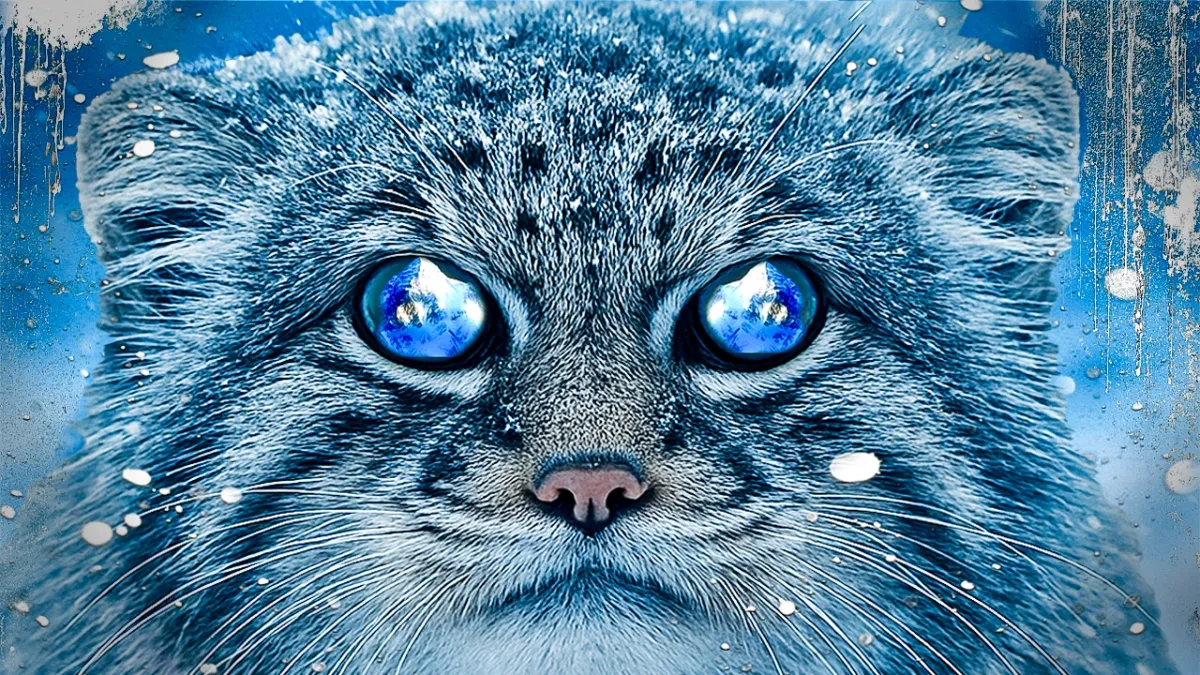
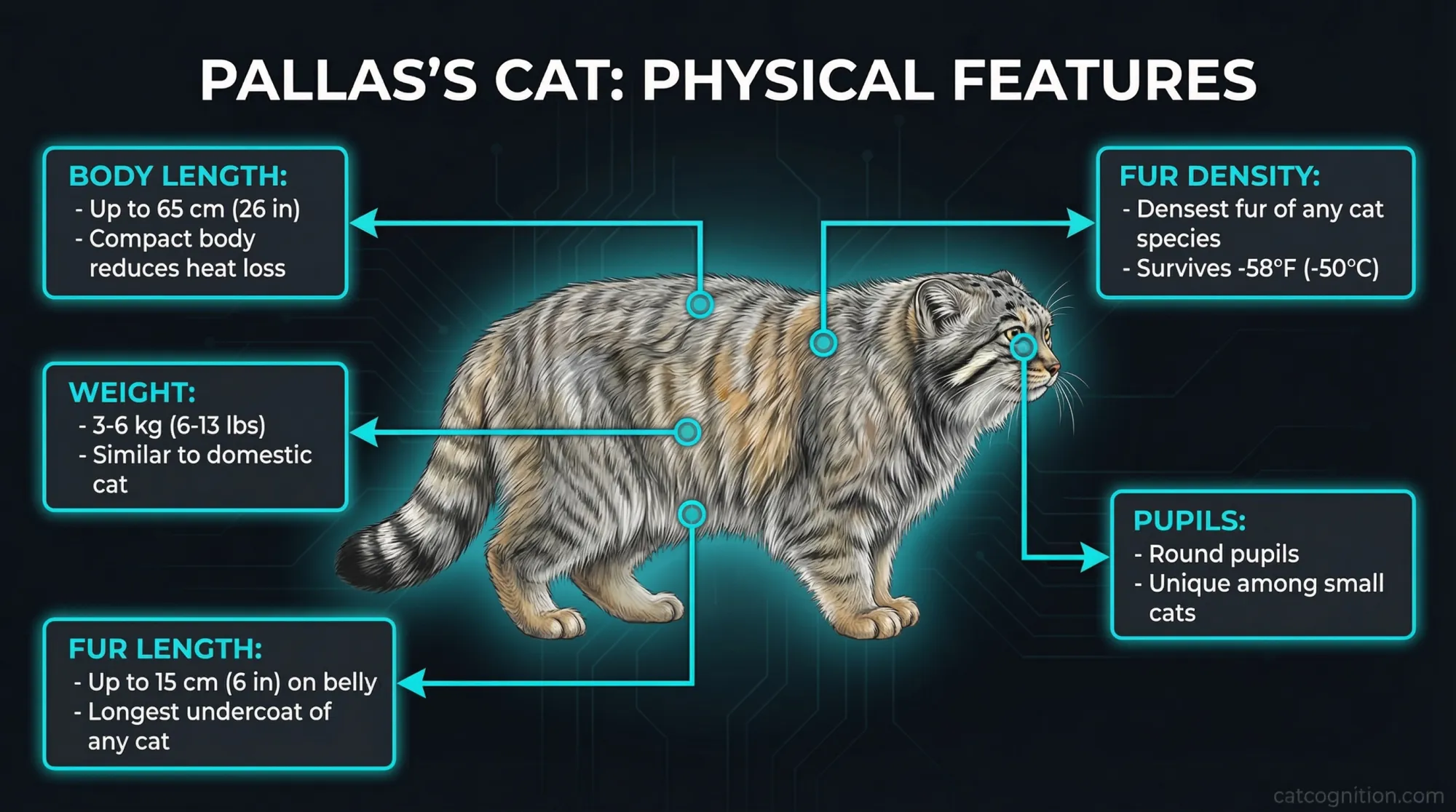
Pallas's cats (Otocolobus manul) are small wild felids native to the grasslands and montane steppes of Central Asia, weighing 3-6 kilograms (6-13 pounds) - roughly the same as an average domestic cat. However, their extraordinarily dense fur makes them appear nearly twice their actual size.
This species diverged from a leopard cat ancestor approximately 5.9 million years ago, making Pallas's cats one of the oldest living cat species on Earth. They are the sole member of the genus Otocolobus, occupying a unique branch on the feline family tree.
| Feature | Measurement | Significance |
|---|---|---|
| Body Length | Up to 65 cm (26 inches) | Compact body reduces heat loss |
| Weight | 3-6 kg (6-13 lbs) | Similar to domestic cat |
| Fur Length | Up to 15 cm (6 inches) on belly | Longest undercoat of any cat |
| Fur Density | Densest of any cat species | Critical for -58°F (-50°C) survival |
| Pupils | Round (unique among small cats) | Shared only with large cats |
The Evidence:
"Pallas's cats have the densest fur of any cat species on Earth, enabling survival at temperatures reaching minus 58 degrees Fahrenheit (-50 degrees Celsius)."
Unlike other small cats that have vertical slit pupils, Pallas's cats possess round pupils - a trait shared only with large cats like lions and tigers. Scientists remain uncertain why this ancient species evolved round pupils despite being ambush predators that hunt primarily at dawn and dusk.

How Scientists Found Them
The Mount Everest Pallas's cat discovery relied on environmental DNA (eDNA) - genetic material that organisms shed into their environment through feces, urine, skin cells, and hair.
The DNA Metabarcoding Process
- Sample Collection: Researchers collected scat samples from the alpine terrain at 5,110m and 5,190m elevation
- DNA Extraction: DNA is extracted from the sample and purified
- PCR Amplification: The DNA is amplified using primers targeting mitochondrial 12S rRNA
- High-Throughput Sequencing: Next-generation sequencing identifies all DNA present
- Species Identification: Sequences are matched against reference databases
As Dr. Tracie Seimon of the Wildlife Conservation Society explains: "High-alpine and aeolian environments, which have often been thought of as barren and mostly devoid of life, in fact have abundant biodiversity."
CatCog Reality Check:
The expedition's primary goal was collecting water samples for broader biodiversity surveys. The Pallas's cat discovery came from opportunistically collected scat - a reminder that great science sometimes emerges from investigating unexpected findings. The eDNA water samples did NOT detect Pallas's cat DNA, highlighting that no single method captures all species present.
The same scat samples that identified the cats also revealed their diet: DNA from pikas and mountain weasels was detected, confirming these Himalayan Pallas's cats feed on the same prey as their Mongolian and Tibetan counterparts.
Extreme Cold Survival Adaptations
Pallas's cats have evolved a suite of adaptations enabling survival in conditions that would kill most mammals.
The Double-Layer Fur System
Pallas's cat fur operates like a high-performance winter jacket. A dense woolly undercoat traps dead air - the best natural insulator - while longer guard hairs block wind and moisture. The undercoat on the belly is nearly twice as long as on the back and sides, providing extra insulation when the cat lies on frozen ground.
The Evidence:
"Pallas's cats are among the oldest living cat species, having diverged from their leopard cat ancestor approximately 5.9 million years ago."
Additional Cold Adaptations
| Adaptation | Function |
|---|---|
| Compact Body Shape | Minimizes surface area to volume ratio, reducing heat loss per Bergmann's rule |
| Low-Set Ears | Partially hidden beneath fur tufts to reduce exposed surface area |
| Fur-Covered Paws | Insulates feet against snow and ice |
| Fluffy Tail as Seat | Pallas's cats sit on their tails to keep paws warm |
| Third Eyelid | Protects eyes from cold winds and dust storms |
Unlike many cold-adapted animals, Pallas's cats do not hibernate. Their adaptations enable continuous activity through brutal Eurasian winters where temperatures plummet to -58 degrees Fahrenheit (-50 degrees Celsius).
Diet and Hunting Behavior
Pallas's cats are obligate carnivores with a specialized diet centered on small mammals.
According to peer-reviewed research published in the Journal of Mammalogy, pikas comprise more than 50% of the Pallas's cat diet. These rabbit-like mammals are selected disproportionately to their availability because they're 2-4 times larger than other small mammal prey, optimizing energy intake per hunting effort.
| Prey Species | Diet Proportion | Notes |
|---|---|---|
| Pikas (Ochotona spp.) | 50%+ | Primary prey, actively selected |
| Voles | Significant | Especially during population peaks |
| Gerbils | Secondary | |
| Mountain Weasels | Occasional | Confirmed in Everest samples |
| Birds | Seasonal |
Hunting Techniques
Pallas's cats employ three primary hunting strategies:
- Stalking: Creeping low to the ground using rocks and vegetation as cover
- Flushing: Walking quickly through grass to startle and capture prey
- Ambush: Waiting outside burrows for prey to emerge
The flat face and low-set ears that give Pallas's cats their distinctive "grumpy" expression are actually anatomical adaptations for stalking prey while lying flat against the ground in open terrain with minimal cover.
The Evidence:
"Unlike other small cats, Pallas's cats have round pupils similar to lions and tigers, though scientists remain uncertain why this ancient species evolved this trait."
Conservation Status
The IUCN Red List currently classifies Pallas's cats as "Least Concern" globally, though regional populations face serious threats.
| Region | Conservation Status |
|---|---|
| Global | Least Concern (declining) |
| China | Endangered |
| Turkmenistan | Endangered |
| Armenia | Extinct |
| Azerbaijan | Extinct |
| Mongolia | Near Threatened |
Major Threats
- Prey Base Decline: Rodent control programs in China and Mongolia poison the pikas that Pallas's cats depend on. Between 2005-2009, 54,147 square kilometers of Tibetan grassland was poisoned, eliminating an estimated 50,000-80,000 tonnes of pika biomass.
- Habitat Degradation: Overgrazing from domestic livestock and agricultural conversion
- Incidental Mortality: Pallas's cats are caught in traps set for wolves and foxes, and killed by domestic dogs
- Climate Change: As temperatures rise, cold-adapted species may be forced to higher elevations - but eventually run out of mountain
CatCog Reality Check:
While the Everest discovery is exciting, two individuals confirmed via DNA does not tell us the full population size. Future camera trap surveys are needed to estimate how many Pallas's cats actually live in Sagarmatha National Park.
Pallas's cats are protected under CITES Appendix II, meaning international trade requires permits. The species is legally protected across most of its range including Russia, Kazakhstan, Kyrgyzstan, Uzbekistan, and China.
Frequently Asked Questions
Can Pallas's cats be kept as pets?
Pallas's cats are wild animals protected under CITES Appendix II and are not suitable for domestic life. They require specialized diets (primarily pikas), extreme cold environments, and are highly susceptible to toxoplasmosis in captivity. Zoo survival rates remain poor. Their "grumpy" expression comes from cold-adaptation anatomy, not personality - these are wild animals poorly suited to human interaction.
Why are Pallas's cats called "the world's grumpiest cat"?
The "grumpy" expression results from anatomical adaptations to extreme cold. The flat face reduces exposed surface area, and the low-set ears are partially hidden to minimize heat loss. These features create a permanent scowl that has made Pallas's cats social media famous - but the expression reflects 5 million years of cold-weather evolution, not actual mood.
How did scientists identify individual cats from scat samples?
DNA metabarcoding extracts mitochondrial DNA from cells shed in fecal matter. By analyzing specific genetic markers, scientists determine both species identity and distinguish between individuals. The Everest study identified at least two different cats based on genetic variation between samples collected 6 kilometers apart.
Is Pallas's cat related to Persian or Himalayan domestic cats?
Despite the similar flat-faced appearance, Pallas's cats are not closely related to Persian or Himalayan breeds. The flat face evolved independently for different reasons: in Pallas's cats, it's a cold-weather adaptation; in Persian cats, it's the result of selective breeding for appearance. Pallas's cats diverged from other felines approximately 5.9 million years ago - long before humans domesticated any cats.
Why do Pallas's cats have round pupils?
Scientists remain uncertain. Round pupils typically appear in larger cats and animals that hunt in open environments during daytime. Pallas's cats are small, crepuscular ambush predators - all conditions that usually favor vertical slit pupils. The round pupil remains one of many mysteries about this ancient species.
Could climate change push Pallas's cats higher up mountains?
Possibly. As lower-altitude habitats warm, cold-adapted species may be forced upward. The Mount Everest discovery at 5,190 meters already represents the highest documented altitude. However, higher elevation means less prey, harsher conditions, and eventually no more mountain to climb. Climate-driven altitude shifts are concerning, not encouraging.
Are there Pallas's cats in the United States?
Pallas's cats do not exist in the wild in North America. A small number live in accredited zoos including the Smithsonian's National Zoo, where they participate in conservation breeding programs. These captive populations help researchers study the species while wild populations remain difficult to observe.
How many Pallas's cats live on Mount Everest?
Unknown. The 2022 study confirmed at least two individuals via DNA analysis, but this represents the minimum - not a population estimate. The cats were detected at two sites 6 kilometers apart within Sagarmatha National Park. Camera trap surveys would be needed to estimate the actual Himalayan population.
Key Takeaways
- Discovery: The 2019 National Geographic Everest Expedition confirmed Pallas's cats at 5,190 meters (17,027 feet) - the highest altitude ever documented for this species.
- Methodology: Environmental DNA analysis from scat samples identified at least two individual cats without ever observing them directly.
- Adaptations: Pallas's cats possess the densest fur of any cat species, enabling survival at -58°F (-50°C) temperatures where most mammals would perish.
- Ancient Lineage: At approximately 5.9 million years old, Pallas's cats are among the oldest living cat species - yet scientists are still discovering new populations.
- Conservation: While globally classified as "Least Concern," regional populations face serious threats from prey base poisoning, habitat loss, and climate change.
Key Terms Used
- Environmental DNA (eDNA): Genetic material organisms shed into their environment through cells, feces, skin, and hair, enabling species detection without direct observation.
- Metabarcoding: DNA analysis technique that identifies multiple species from a single environmental sample using high-throughput sequencing.
- Crepuscular: Behavioral pattern where animals are most active during dawn and dusk twilight periods.
- Obligate Carnivore: An animal that must consume animal-source nutrients to survive because it cannot synthesize essential nutrients from plants.
- Pallas's Cat: Small wild felid (Otocolobus manul) native to Central Asian steppes, characterized by the densest fur of any cat species.
See the full Cat Cognition Glossary ->
Sources
- First report of Pallas's Cat in Sagarmatha National Park - Seimon et al. (2022), Cat News 76 (ResearchGate)
- Wildlife Conservation Society Announcement - WCS Newsroom (Link)
- National Geographic Perpetual Planet Expedition - National Geographic (Link)
- IUCN Cat Specialist Group - Pallas's Cat Profile - IUCN (Link)
- Dietary composition of Pallas's cats - Ross et al. (2010), Journal of Mammalogy (Link)
- Smithsonian National Zoo - Pallas's Cat - Smithsonian Institution (Link)
- Sagarmatha National Park - UNESCO World Heritage Centre (Link)