Can a Cat Parasite Make You More Attractive? The Science of Toxoplasma gondii
Toxoplasma gondii infects one-third of humanity and may alter testosterone levels and facial symmetry. Research suggests infected people are rated more attractive, yet cat ownership poses minimal risk.


Quick Answer: Can Toxoplasma gondii make people more attractive?
Preliminary research suggests yes. A 2022 study found Toxoplasma-infected individuals were rated significantly more attractive than non-infected people, possibly due to elevated testosterone and improved facial symmetry. However, cat ownership is NOT a major risk factor for infection - undercooked meat poses a greater transmission threat.
One-third of humanity carries a microscopic passenger in their brain - a single-celled parasite called Toxoplasma gondii. Most infected people never know they have it. But emerging research suggests this cat parasite might be doing something remarkable: making its human hosts more attractive.
This is not science fiction. A 2022 peer-reviewed study found that Toxoplasma-infected men and women were rated as significantly more attractive and healthier-looking than their non-infected counterparts. The findings raise a fascinating evolutionary question: Why would a cat parasite care about human beauty?
The answer involves cats, rats, dopamine, testosterone, and one of nature's most sophisticated manipulation schemes.
Table of Contents
- What is Toxoplasma gondii?
- Why Cats Are the Key
- The Fatal Attraction Phenomenon
- How Toxoplasma Affects Human Attractiveness
- The Dopamine Connection
- Is Cat Ownership Actually Risky?
- Health Considerations
- Frequently Asked Questions
- Key Takeaways
What is Toxoplasma gondii?
Toxoplasma gondii is a single-celled parasite infecting approximately 2 billion people worldwide - roughly one-third of humanity - yet most infected individuals experience no symptoms throughout their lifetime.
The parasite's prevalence ranges from 11% in the United States to over 50% in Germany and historically up to 80% in France.
The parasite belongs to a group called Apicomplexa - the same family that includes malaria. But unlike malaria, Toxoplasma has evolved to be remarkably subtle in its effects on healthy hosts. It forms microscopic cysts in brain and muscle tissue, where it can remain dormant for the host's entire lifetime.
Adam's Lab Note:
When I first learned that Moon might carry Toxoplasma, I'll admit I was concerned. But after researching the actual transmission routes, I realized my indoor cat who has never hunted poses essentially zero risk. The parasite needs a specific lifecycle that indoor cats simply don't participate in.
What makes Toxoplasma truly extraordinary is not its prevalence but its strategy. This parasite has evolved one of nature's most sophisticated manipulation systems - and understanding it requires understanding why cats are so central to the story.

Why Cats Are the Key
Cats are the only known definitive host where Toxoplasma gondii can sexually reproduce, making felines essential to the parasite's survival as a species. This biological fact has profound implications for how the parasite evolved.
In parasitology, a definitive host is the animal where a parasite reaches sexual maturity. For Toxoplasma, that host must be a member of the cat family - domestic cats, lions, tigers, or any other felid. Inside cat intestines, Toxoplasma produces millions of microscopic eggs called oocysts that are shed in feces.
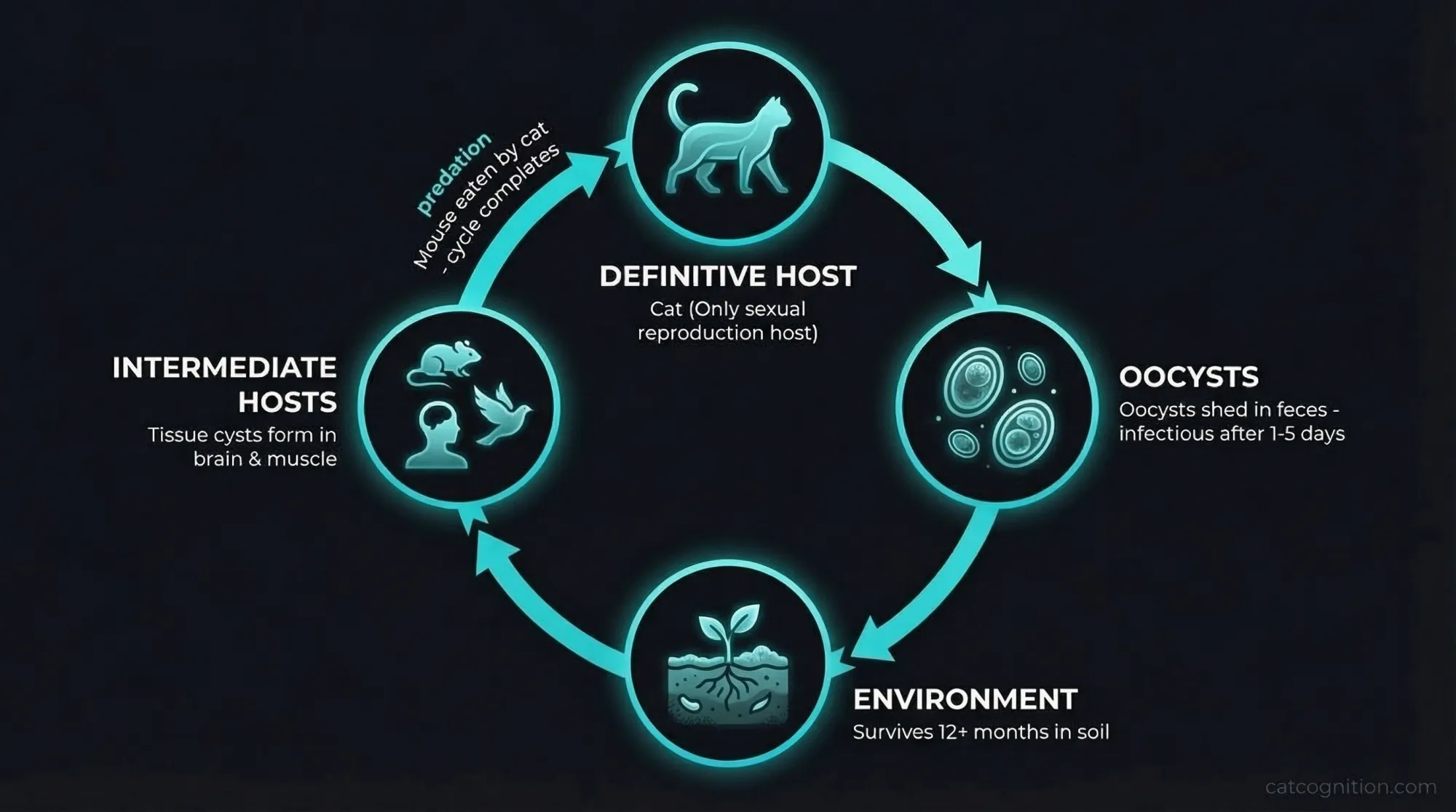
These oocysts can survive in soil for over a year. When mice, birds, or other animals ingest them, the parasite establishes itself in their tissues. But here's the evolutionary challenge: How does a parasite that needs to be inside a cat get from the mouse it currently inhabits back to a cat?
The answer is both elegant and disturbing.
The Evidence:
"Cats are the only known definitive host where Toxoplasma gondii can sexually reproduce, making felines essential to the parasite's lifecycle."
The Fatal Attraction Phenomenon
Toxoplasma evolved the ability to manipulate rodent behavior, making infected mice lose their fear of cat urine and even become attracted to it - dramatically increasing their chances of being eaten by cats.
Research by Dr. Jaroslav Flegr of Charles University in Prague, who has studied Toxoplasma behavioral effects for over 30 years, revealed what scientists call the "fatal attraction" phenomenon.
Normal mice show intense fear of cat urine - it triggers a hardwired avoidance response. But Toxoplasma-infected mice lose this fear entirely. Even more remarkably, research published in PLoS ONE found that infected male rats become more attractive to females, not less.
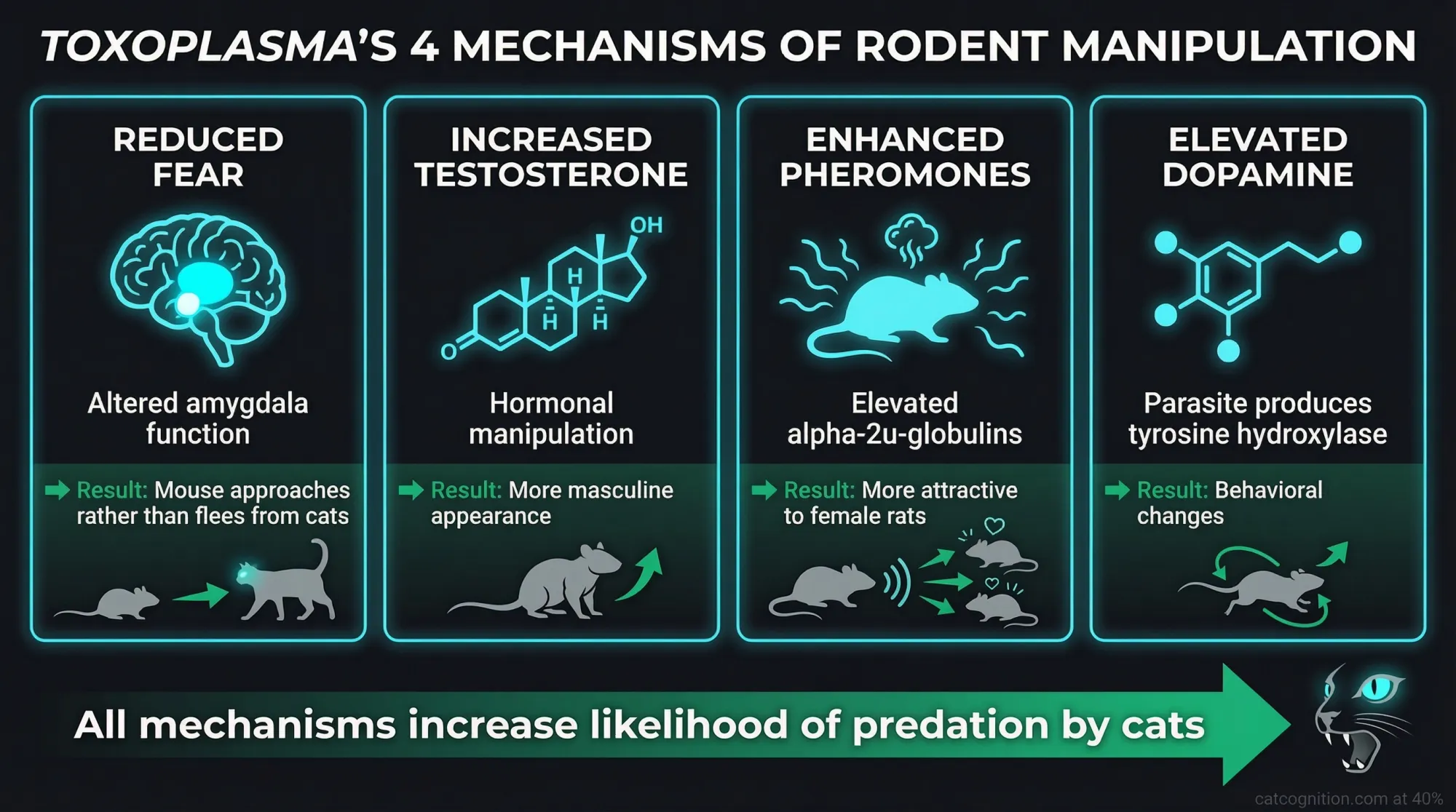
The mechanism involves multiple pathways:
| Effect | Mechanism | Result |
|---|---|---|
| Reduced fear of cats | Altered amygdala function | Mouse approaches rather than flees |
| Increased testosterone | Hormonal manipulation | More masculine appearance |
| Enhanced pheromone production | Elevated alpha-2u-globulins | More attractive to female rats |
| Elevated dopamine | Parasite produces tyrosine hydroxylase | Behavioral changes |
This multi-pronged approach increases the odds that an infected rodent ends up in a cat's stomach, delivering the parasite to its ultimate destination.
CatCog Reality Check:
The "fatal attraction" phenomenon has been replicated across multiple independent laboratories using randomized controlled trials. This is not preliminary speculation - it represents well-established science.
How Toxoplasma Affects Human Attractiveness
A 2022 peer-reviewed study found Toxoplasma-infected individuals were rated significantly more attractive than non-infected people (p < 0.001), with infected men showing higher testosterone and more symmetrical faces.
Humans are "dead-end hosts" for Toxoplasma - we are not typically eaten by cats, so there is no evolutionary pressure for the parasite to manipulate our behavior specifically. However, because humans share similar brain chemistry with rodents, the same mechanisms may produce unintended effects in people.
A 2022 study published in PeerJ by Dr. Javier Borraz-Leon compared photographs of 35 Toxoplasma-infected individuals against 178 non-infected controls. Independent raters who did not know infection status consistently rated infected individuals as more attractive.
The findings included:
- Higher attractiveness ratings: Infected men and women were rated significantly more attractive (p < 0.001)
- Better health perception: Infected individuals appeared healthier to raters
- Lower facial fluctuating asymmetry: Infected men had more symmetrical faces (p = 0.006)
- Height difference: Previous research found infected men average 3 cm taller than non-infected men
The Evidence:
"Toxoplasma-infected men have measurably higher testosterone levels and faces rated as more masculine and dominant by independent female raters."
A separate 2007 study by Hodkova and colleagues found that women rated photographs of Toxoplasma-infected men as more dominant and masculine compared to non-infected men, even when controlling for actual physical differences.
The Dopamine Connection
Toxoplasma cysts contain the enzyme tyrosine hydroxylase, enabling the parasite to directly manufacture dopamine inside infected brain cells - a remarkable example of active neurotransmitter manipulation by a single-celled organism.
The mechanism behind Toxoplasma's effects involves direct manipulation of neurotransmitter production. Research published in PLoS ONE discovered that Toxoplasma cysts contain the enzyme tyrosine hydroxylase - the rate-limiting step in dopamine synthesis.
This finding is remarkable: the parasite does not just disrupt host dopamine production; it actively manufactures dopamine using its own molecular machinery. Infected brain cells show dramatically elevated dopamine levels in the areas immediately surrounding cysts.
The Evidence:
"Toxoplasma cysts contain the enzyme for dopamine production - the parasite actively manufactures the neurotransmitter, not just disrupts host production."
The elevated dopamine may explain several behavioral changes observed in infected individuals, including:
- Altered risk-taking behavior
- Changed reaction times
- Modified social behaviors
- Potentially increased extraversion
Additionally, research published in PLoS Neglected Tropical Diseases found a sex-specific effect on cat urine perception: infected men rated cat urine odor as MORE pleasant, while infected women rated it as LESS pleasant. This mirrors the "fatal attraction" pattern seen in rodents but with unexpected complexity.
Adam's Lab Note:
I tracked how Moon responds to different visitors to our apartment. Some people he approaches immediately; others he avoids entirely. While I cannot test their Toxoplasma status, it makes me wonder whether cats can somehow detect infected individuals - though this remains purely speculative.
Is Cat Ownership Actually Risky?
Multiple epidemiological studies confirm cat ownership is NOT a significant risk factor for Toxoplasma infection - undercooked meat consumption poses substantially greater transmission risk than living with cats.
Despite Toxoplasma being called the "cat parasite," cat ownership is NOT a significant risk factor for human infection. This counterintuitive finding has been confirmed across multiple epidemiological studies and represents one of the most important misconceptions to correct.
The Cornell Feline Health Center explains that cats shed oocysts for only 1-2 weeks after their initial infection - typically during their first exposure as kittens. After this brief window, most cats never shed again. At any given time, only about 1% of cats are actively shedding oocysts.
Furthermore, oocysts require 1-5 days to sporulate (become infectious) after being shed. A litter box cleaned daily poses virtually no transmission risk.
Toxoplasma Transmission Risk Assessment
| Risk Factor | Risk Level | Notes |
|---|---|---|
| Owning an indoor-only cat | LOW | Cat unlikely to be infected |
| Owning an outdoor/hunting cat | MODERATE | Higher exposure risk for cat |
| Eating undercooked meat | HIGH | Primary transmission route in developed countries |
| Gardening without gloves | MODERATE | Soil may contain oocysts from outdoor cats |
| Cleaning litter within 24 hours | LOW | Oocysts not yet infectious |
| Cleaning litter after 5+ days | MODERATE-HIGH | Oocysts fully sporulated |
The Evidence:
"Cat ownership is not a significant risk factor for Toxoplasma infection - undercooked meat poses a greater transmission risk than living with cats."
The CDC's epidemiological data confirms that foodborne transmission through undercooked meat - particularly lamb, pork, and venison - represents the primary infection route in developed countries.
Health Considerations
Latent Toxoplasma infection requires no treatment in healthy adults, but poses serious risks to pregnant women (congenital defects) and immunocompromised individuals (potentially fatal brain inflammation).
For healthy adults, latent Toxoplasma infection typically causes no symptoms and requires no treatment. However, certain populations face elevated risks that warrant serious consideration.
Who Should Be Concerned
Pregnant Women: Toxoplasma can cross the placenta and cause congenital toxoplasmosis, potentially leading to miscarriage, stillbirth, or birth defects including vision problems and cognitive impairment. Pregnant women should avoid changing litter boxes and take food safety precautions seriously.
Immunocompromised Individuals: People with HIV/AIDS, organ transplant recipients, and those on immunosuppressive medications face risk of reactivation of latent infection, which can cause life-threatening brain inflammation (toxoplasmic encephalitis).
Mental Health Association: Research has associated chronic Toxoplasma infection with modestly elevated risks of certain mental health conditions, including schizophrenia and suicide attempts. However, these associations are correlational and do not prove causation.
CatCog Reality Check:
The attractiveness research, while fascinating, comes with important caveats. The 2022 study had a relatively small sample size (35 infected vs. 178 non-infected), and researchers acknowledge a potential reverse causality question: Could more attractive people simply be more likely to get infected through increased social and sexual contact?
Frequently Asked Questions
Can I tell if I am infected with Toxoplasma?
Most healthy people show no symptoms when infected with Toxoplasma gondii - the infection remains latent or dormant indefinitely. A simple blood test can detect antibodies indicating past exposure. Approximately 11-15% of Americans and up to 50% of people in some European countries carry the parasite without knowing it.
Does Toxoplasma infection have any negative effects?
For healthy individuals, latent toxoplasmosis typically causes no symptoms. However, research has associated chronic infection with slightly elevated risks of certain mental health conditions, including schizophrenia and suicide attempts, as well as increased risk-taking behavior. The absolute risk increase is small, but these findings warrant continued research.
How can I prevent Toxoplasma infection?
Cook meat to safe internal temperatures (at least 145F/63C for whole cuts), wash produce thoroughly, wear gloves when gardening, and clean cat litter boxes daily. Oocysts take 1-5 days to become infectious, so prompt litter cleaning virtually eliminates this transmission route. Indoor cats that do not hunt pose very low risk.
Should I get rid of my cat if I am pregnant?
No. The American Veterinary Medical Association and medical authorities agree that cat ownership is safe during pregnancy with simple precautions: have someone else clean the litter box daily, avoid handling stray cats, and follow food safety guidelines. Your existing cat, especially if indoor-only, poses minimal risk.
Does the attractiveness effect mean I should try to get infected?
Absolutely not. Toxoplasma is a parasitic infection with documented associations to mental health changes, and the attractiveness research remains preliminary. There is no safe or ethical way to intentionally acquire the infection, and the potential risks far outweigh any speculative cosmetic benefits.
How does Toxoplasma actually change the brain?
The parasite forms cysts in brain tissue that produce elevated levels of dopamine through their own enzymatic machinery. These cysts concentrate in areas associated with fear processing (amygdala) and reward circuits. The elevated dopamine and potential effects on testosterone may explain the observed behavioral and physical changes.
Key Takeaways
- Definitive Host Status: Cats are the only animals where Toxoplasma gondii can sexually reproduce, making them essential to the parasite's lifecycle - but this does not make cat ownership dangerous.
- Fatal Attraction: Toxoplasma evolved sophisticated mechanisms to manipulate rodent behavior, increasing the likelihood that infected mice get eaten by cats and complete the parasite's lifecycle.
- Human Collateral Effects: Because humans share similar brain chemistry with rodents, the parasite's manipulation mechanisms may produce unintended effects in people, including altered testosterone levels and potentially increased attractiveness.
- Transmission Reality: Cat ownership is NOT a major risk factor for infection. Undercooked meat poses significantly greater transmission risk than living with cats, especially indoor cats.
- Scientific Caution: While the attractiveness research is intriguing, the studies have limitations and require larger-scale replication before drawing firm conclusions.
Key Terms Used
- Definitive Host: The animal in which a parasite reaches sexual maturity and reproduces sexually - for Toxoplasma, this is exclusively cats.
- Oocyst: A thick-walled, environmentally resistant structure shed in cat feces that becomes infectious 1-5 days after shedding.
See the full Cat Cognition Glossary ->
Sources
- Toxoplasma-infected subjects are more attractive, symmetrical and have more sex partners - Borraz-Leon et al. (PeerJ, 2022)
- The Parasite-Induced Dopamine Mechanism - Prandovszky et al. (PLoS ONE, 2011)
- Fatal Attraction Phenomenon in Humans - Flegr et al. (PLoS NTD, 2011)
- Masculinity and Dominance Perception - Hodkova et al. (Neuro Endocrinology Letters, 2007)
- Sexual Attraction in Infected Rats - Dass et al. (PLoS ONE, 2011)
- Pheromone Binding Protein Mechanism - Vasudevan et al. (ISME Journal, 2015)
- Toxoplasmosis in Cats - Cornell Feline Health Center (Cornell University)
- CDC Toxoplasmosis Overview - Centers for Disease Control (CDC DPDx)