What Do Cats See That We Can't? The Hidden World of Feline Vision
Cats perceive ultraviolet light, detect microscopic movements, and see in near-darkness using a biological light amplifier. Their eyes evolved for twilight hunting, not daytime detail.

Quick Answer: What do cats see that humans cannot?
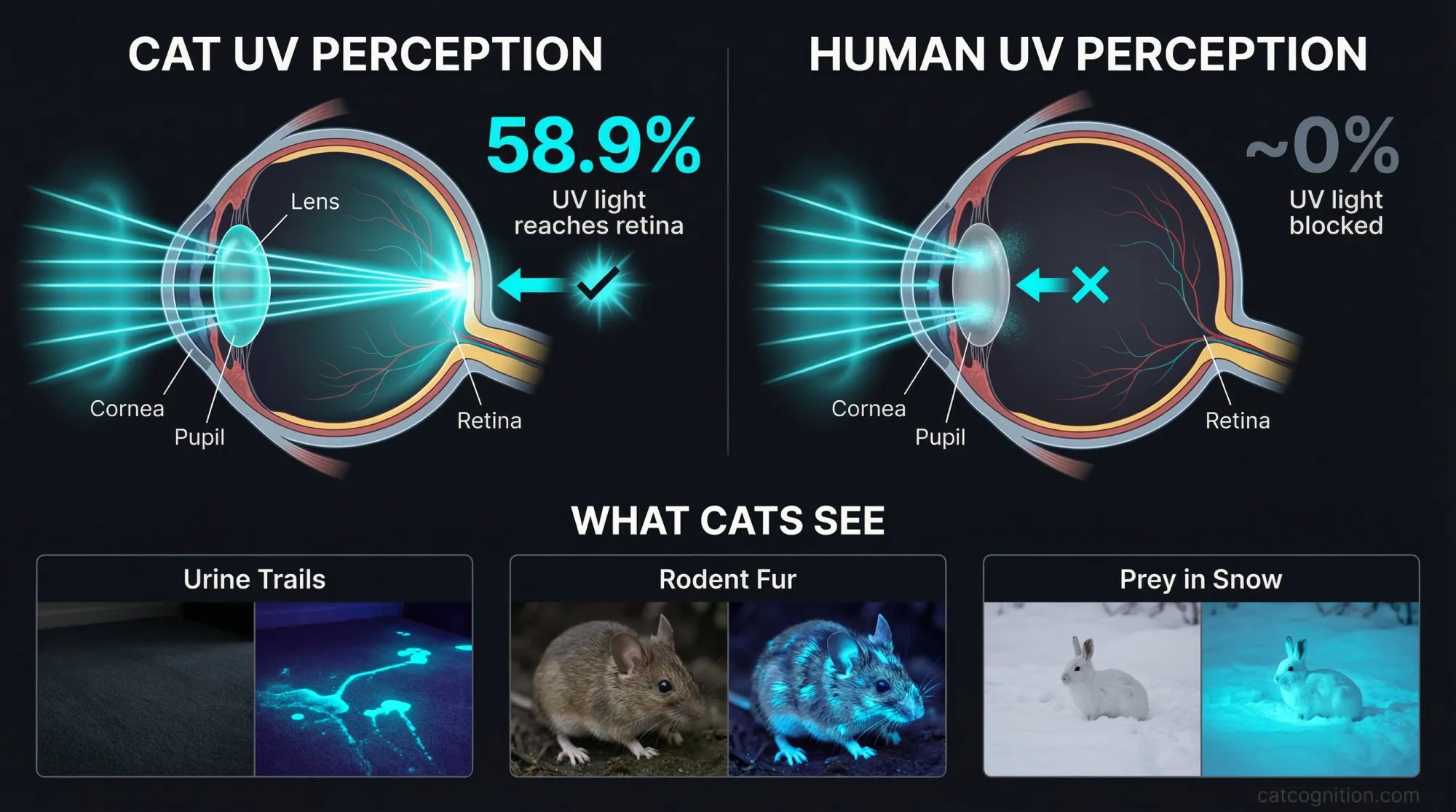
Cats can see ultraviolet (UV) light, detect motion 6-8 times better in low light, and perceive a wider visual field than humans. While humans block UV with our eye lenses, 58.9% of ultraviolet light reaches a cat's retina, revealing patterns invisible to us. Cats are NOT seeing ghosts when they stare at walls; they are detecting stimuli beyond human perception, including UV reflections, ultrasonic sounds, and air pressure changes through their whiskers.
Table of Contents
- Can Cats See Ultraviolet Light?
- How Do Cats See in the Dark?
- How Do Cats Detect Motion So Well?
- What Colors Do Cats Actually See?
- How Wide Is a Cat's Field of Vision?
- What Do Cats See Worse Than Humans?
- Why Do Cats Stare at Nothing?
- Key Takeaways
- Key Terms Used
- Frequently Asked Questions
Can Cats See Ultraviolet Light?
For decades, scientists assumed mammals couldn't see ultraviolet light. A 2014 study published in the Proceedings of the Royal Society B shattered that assumption. Researchers analyzed the eye lenses of 38 mammal species and discovered that cats allow 58.9% of UV light to reach their retinas, compared to virtually zero in humans.
The Evidence:
"Cats perceive ultraviolet light because their eye lenses are transparent to UV wavelengths, allowing 58.9% of ultraviolet light to reach the retina."
The human eye lens blocks ultraviolet light as a protective mechanism, preventing UV damage to our retinas. Cats evolved without this filter, trading long-term retinal protection for immediate visual advantages. As study leader Dr. Ron Douglas of City University London noted, "Nobody ever thought these animals could see in ultraviolet, but in fact, they do."
What UV Vision Reveals to Cats
Ultraviolet perception transforms the visual world in ways humans cannot imagine:
| UV-Visible Pattern | Human Perception | Cat Perception |
|---|---|---|
| Urine trails | Invisible | Bright fluorescent markings |
| Rodent fur | Brown/gray | UV-reflective patterns stand out |
| White rabbit in snow | Camouflaged | Distinct UV reflection differences |
| Flower patterns | Single color | UV nectar guides visible |
| Fresh vs. stale prey | Similar | Different UV signatures |
Adam's Lab Note:
I noticed Moon tracking something across the ceiling one evening when there was absolutely nothing visible to me. After reading about UV perception, I realized the afternoon sun had left UV-reflective dust particles drifting through the room. To Moon, the "empty" air was filled with floating points of light. What looked like madness was actually precision tracking.
This explains why cats can detect prey that appears perfectly camouflaged to human eyes. A white mouse in snow reflects UV light differently than the surrounding snow, making the prey obvious to a cat's UV-sensitive vision.
How Do Cats See in the Dark?
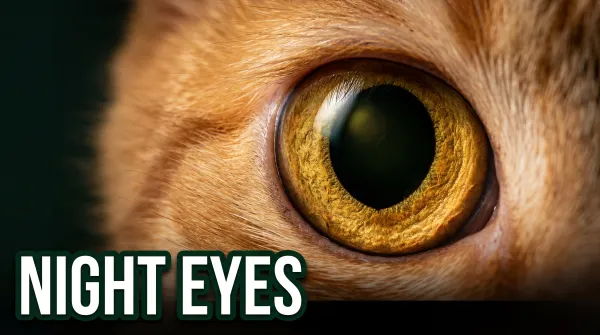
The tapetum lucidum is the biological equivalent of a light amplifier, giving cats one of the most significant visual advantages in the animal kingdom. This reflective tissue layer sits behind the retina, bouncing photons back through photoreceptor cells for a second chance at detection.
The Evidence:
"The tapetum lucidum significantly increases available light to photoreceptors by reflecting photons back through the retina, enabling cats to see in light conditions six to eight times dimmer than humans require."
How the Tapetum Lucidum Works
When light enters a cat's eye, photoreceptor cells capture some photons on the first pass. Light that passes through reflects off the tapetum lucidum and travels back through the retina—a "second chance" mechanism that dramatically increases sensitivity. The characteristic greenish-gold "eye shine" visible at night is this light reflecting back out.
| Light Condition | Human Capability | Cat Capability |
|---|---|---|
| Bright daylight | Excellent detail | Good (but less than humans) |
| Indoor lighting | Normal vision | Enhanced vision |
| Twilight/dawn | Limited | Optimal hunting vision |
| Moonlight | Minimal | Clear vision |
| Near-complete darkness | Blind | Functional vision |
CatCog Reality Check:
Cats cannot see in complete darkness. The tapetum lucidum amplifies available light but requires at least some photons to function. In absolute darkness (zero light), cats rely on whiskers, hearing, and spatial memory, not vision.
Rod Cell Dominance
Cats possess approximately 6-8 times more rod cells than humans. This rod-dominant retina sacrifices color perception and detail resolution for superior low-light performance—a trade-off reflecting millions of years of crepuscular hunting at dawn and dusk.

How Do Cats Detect Motion So Well?
A cat's visual system is fundamentally optimized for detecting motion, not static detail. Research by Dr. John Bradshaw at the University of Bristol confirms that cats can detect movements invisible to the human eye, particularly in peripheral vision and low-light conditions.
The Evidence:
"Cats detect motion in low light 6-8 times more effectively than humans due to rod cell density and faster neural processing of movement signals."
The Flickering Prey Response
Cat eyes process visual information at a higher flicker rate than human eyes—where humans see smooth motion on a 60Hz screen, cats may perceive individual frames. This sensitivity means cats notice insect wing movements, subtle prey trembling, muscle tension changes preceding movement, and dust particles drifting in air currents.
Rod cells respond faster to light changes than cone cells, making the cat's visual system optimized for tracking erratic prey movement.
Vertical Slit Pupils
Cat pupils can dilate to 135 times their contracted size, far exceeding human pupil range. The vertical slit shape provides several hunting advantages:
| Pupil Feature | Function | Hunting Benefit |
|---|---|---|
| Vertical slit | Precise light control | Prevents blinding in bright ambush positions |
| 135x dilation range | Extreme light adaptation | Instant transition from hiding to pouncing |
| Rapid contraction | Fast light adjustment | No vision loss during prey chase |
| Depth perception enhancement | Stereoscopic accuracy | Precise pounce distance calculation |
As demonstrated in a 2015 Science Advances study by Dr. Martin Banks at UC Berkeley, the vertical pupil shape also helps cats judge distance more accurately when preparing to pounce, providing the precision required for successful predation.
What Colors Do Cats Actually See?
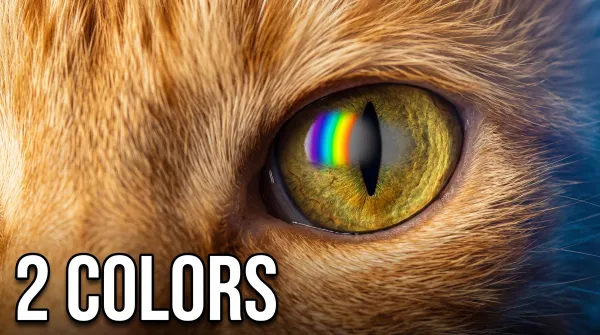
Cats are dichromats, possessing two types of color-detecting cone cells compared to the three types in human trichromatic vision. A 2016 study published in Experimental Eye Research confirmed that cats have a neutral point near 505nm, similar to humans with red-green color blindness.
The Evidence:
"Cats perceive blue and yellow wavelengths clearly but cannot distinguish red from green, seeing both as grayish-brown tones."
The Cat Color Palette
| Color (Human View) | Cat Perception | Practical Implication |
|---|---|---|
| Blue | Vivid blue | High visibility |
| Yellow | Clear yellow | High visibility |
| Green | Yellowish-gray | Moderate visibility |
| Red | Dark gray/brown | Low visibility |
| Orange | Brownish-yellow | Moderate visibility |
| Purple | Blue | High visibility |
| Pink | Gray-blue | Moderate visibility |
This limited color palette represents an evolutionary trade-off. Unlike primates who evolved trichromatic vision to detect ripe fruit, cats' ancestors prioritized low-light hunting efficiency. The retinal space devoted to cone cells in humans is dominated by rod cells in cats.
Practical Applications
Blue and yellow toys are more visible to cats than red or green. Red laser dots appear as dim gray spots—green lasers are more visible. For enrichment, contrast matters more than color variety.
How Wide Is a Cat's Field of Vision?
Cats possess a visual field spanning approximately 200 degrees, compared to 180 degrees in humans. This 20-degree advantage translates to significantly enhanced peripheral awareness, a critical adaptation for both predator and prey detection.
The Evidence:
"Cats' 200-degree visual field provides 11% more peripheral coverage than humans, enabling simultaneous awareness of threats and prey across a wider arc."
Eye Placement and Field Geometry
Cat eyes face more forward than prey animals but less than pure predators, creating a balance between hunting precision and threat detection:
| Species | Visual Field | Binocular Overlap | Primary Function |
|---|---|---|---|
| Rabbit (prey) | 360 degrees | Minimal | Predator detection |
| Cat | 200 degrees | 140 degrees | Hunting + defense |
| Human | 180 degrees | 120 degrees | Fine manipulation |
| Owl (predator) | 110 degrees | 70 degrees | Precision hunting |
The 140-degree binocular overlap provides depth perception superior to prey animals while maintaining peripheral threat detection—reflecting cats' position as mesopredators (both predator and potential prey).
What Do Cats See Worse Than Humans?
Cat vision is not universally superior. The specializations that enable night vision and motion detection come at measurable costs.
Visual Acuity
Cats have approximately 20/100 to 20/200 visual acuity by human standards. Objects that humans see clearly at 100-200 feet require cats to be within 20 feet for equivalent clarity. This reduced resolution results from:
- Fewer cone cells (detail detection)
- Rod-dominant retina (prioritizes motion over detail)
- UV-transparent lens (increases blur)
- Tapetum lucidum reflection (slight image doubling)
CatCog Reality Check:
Your cat is NOT ignoring you when you wave from across the room. At distances beyond 20 feet, your visual details blur significantly. Cats rely on motion, scent, and voice recognition for distant identification, not facial feature detection.
Close-Focus Limitations
Cats cannot focus on objects closer than approximately 25-30 centimeters (10-12 inches). Objects within this range appear blurred. This explains why cats may struggle to see treats placed directly under their noses and instead rely on whiskers and scent to locate nearby objects.
Daylight Color Saturation
In bright daylight, human vision significantly outperforms cat vision for color discrimination and fine detail. The rod-dominant cat retina becomes partially "overloaded" in bright conditions, reducing contrast sensitivity.
The CatCog Twilight Hunter Profile
Cat vision represents a precise evolutionary optimization for twilight hunting. The CatCog Twilight Hunter Profile summarizes these trade-offs:
| Visual Attribute | Cat Performance | Human Performance | Evolutionary Reason |
|---|---|---|---|
| Low-light sensitivity | 6-8x better | Baseline | Dawn/dusk hunting window |
| UV perception | 58.9% transmission | ~0% | Prey detection, urine trails |
| Motion detection | Superior | Moderate | Erratic prey tracking |
| Visual field | 200° | 180° | Predator awareness |
| Color discrimination | 2 cone types | 3 cone types | Rod space prioritized |
| Visual acuity | 20/100-20/200 | 20/20 | Detail less critical than motion |
| Near focus | 25-30cm minimum | 7-10cm | Whiskers compensate |
This profile explains why cats excel at detecting a mouse at dusk but struggle to see a stationary treat placed under their nose in bright daylight.
Why Do Cats Stare at Nothing?
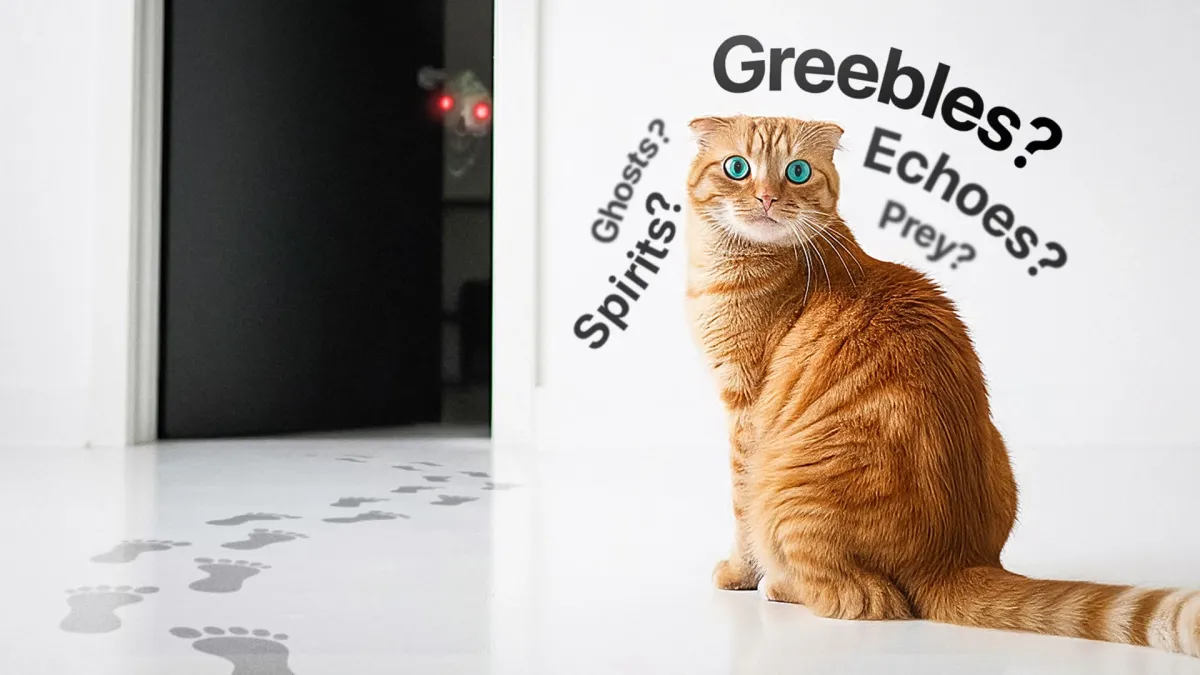
The internet phenomenon of "Greebles," invisible entities cats appear to detect, has a scientific explanation rooted in feline sensory superiority.
When your cat stares intently at an empty wall or corners, they are typically detecting:
- Ultrasonic sounds (cats hear up to 64-85kHz vs. 20kHz for humans)
- UV light patterns from sun angles, dust, or UV-reflective materials
- Air pressure changes detected by whisker mechanoreceptors
- Subsonic vibrations from electrical wiring, pipes, or distant machinery
The Evidence:
"Cats can detect ultrasonic frequencies up to 64,000-85,000 Hz, allowing them to hear mouse heartbeats, electrical current in walls, and insect wing vibrations invisible to human perception."
As Dr. Mikel Delgado's research on feline play behavior demonstrates, cats maintain constant environmental scanning as an evolved survival mechanism. What appears as staring at nothing is active sensory processing of stimuli beyond human detection thresholds.
Adam's Lab Note:
Moon regularly "alerts" to the corner where our refrigerator's compressor cycles. His "ghost detection" is actually mechanical noise detection in frequencies I cannot hear without equipment.
Key Takeaways
- UV Light Vision: Cats perceive ultraviolet light invisible to humans because 58.9% of UV reaches their retinas, revealing urine trails, prey patterns, and environmental details we cannot see.
- Night Vision Superiority: The tapetum lucidum reflects light back through the retina, enabling cats to see in light conditions 6-8 times dimmer than human minimum requirements.
- Motion Detection Excellence: Rod-dominant retinas with 6-8 times more rod cells than humans create superior motion sensitivity, particularly in peripheral vision and low light.
- Limited Color Vision: Cats are dichromats who see blue and yellow clearly but cannot distinguish red from green, seeing both as grayish-brown.
- Evolutionary Trade-Offs: Superior night vision and motion detection come at the cost of visual acuity (20/100-20/200), close-focus ability, and color saturation.
Key Terms Used
- Tapetum Lucidum: Reflective layer that amplifies light by bouncing photons back through the retina.
- Crepuscular: Active primarily at dawn and dusk.
- Dichromat: Having two cone types, limiting color discrimination.
- Rod Cells: Photoreceptors for low-light and motion detection.
- Cone Cells: Photoreceptors for color and fine detail.
See the full Cat Cognition Glossary ->
Frequently Asked Questions
Can cats see in complete darkness?
No. Cats require at least some ambient light to see. The tapetum lucidum amplifies available light but cannot create vision from zero photons. In complete darkness, cats rely on whiskers, hearing, and spatial memory.
Do cats see ghosts or spirits?
No. When cats appear to track invisible entities, they are detecting stimuli beyond human perception: ultrasonic sounds (up to 64-85kHz), UV light patterns, air pressure changes, or subsonic vibrations from electrical and mechanical sources.
Why do cats' eyes glow in photos and at night?
The greenish-gold glow is light reflecting off the tapetum lucidum after passing through the retina. This "eyeshine" indicates the light-amplifying system actively reflecting photons back through photoreceptor cells.
Should I buy red or green toys for my cat?
Blue and yellow toys are more visible to cats. Red appears as dark gray and green appears as yellowish-gray to dichromatic cat vision. Choose toys with high contrast patterns rather than relying on color.
Can cats see TV and phone screens?
Yes, but differently than humans. Cat eyes may perceive individual frames on screens with lower refresh rates, and the color palette appears muted. Movement on screens triggers prey-tracking instincts regardless of color accuracy.
Why does my cat ignore treats right under their nose?
Cats cannot focus on objects closer than 25-30 centimeters (10-12 inches). Within this range, they rely on whiskers and scent rather than vision. Place treats slightly further away or let your cat sniff your hand.
Do cats have better eyesight than dogs?
For different purposes. Cats have superior night vision (approximately 6-8x better than dogs), but dogs have wider visual fields and better motion detection in daylight. Both species are dichromats with similar color limitations.
At what age do kittens develop full vision?
Kittens' eyes open at 7-10 days but take approximately 10-12 weeks to develop full visual capability. The tapetum lucidum continues developing during the first few months of life.
Sources
- "Biogenic amines in mammalian lenses: Amounts and UV-spectroscopic properties" - Douglas RH et al., Proceedings of the Royal Society B (2014) (Link)
- "Neutral point testing of color vision in the domestic cat" - Clark DL et al., Experimental Eye Research (2016) (DOI)
- "Hearing range of the domestic cat" - Heffner RS & Heffner HE, Hearing Research (1985) (DOI)
- Cat Sense: How the New Feline Science Can Make You a Better Friend to Your Pet - Dr. John Bradshaw, University of Bristol (2013)
- Ohio State Indoor Pet Initiative - Dr. Tony Buffington (Link)
- Cornell Feline Health Center - Vision and Eye Health Resources (Link)
- "A review of the development and functions of cat play" - Dr. Mikel Delgado, Applied Animal Behaviour Science (2019) (DOI)