Why Does My Cat Eat My Hair? (Pica vs. Grooming Explained)
Cats chew or lick human hair primarily as a form of "Allogrooming" (social bonding), treating you as part of their colony. However, excessive hair eating can be a sign of Pica, a condition linked to nutritional deficiencies or anxiety that requires veterinary attention

Quick Answer: Why does my cat eat my hair?
Cats chew or lick human hair primarily as a form of Allogrooming (social bonding). When your cat grooms your hair, they are treating you as a member of their colony and creating a shared "group scent." However, if your cat is actually swallowing hair, this may indicate Pica—a compulsive disorder linked to nutritional deficiencies, early weaning, or anxiety that requires veterinary attention.
Table of Contents
- Why Do Cats Chew Hair? (The Short Answer)
- What is Allogrooming in Cats?
- Is Hair Chewing a Sign of Stress?
- Why Does My Cat Love My Shampoo?
- What is Pica in Cats?
- Is My Cat Just Playing With My Hair?
- How to Stop Your Cat From Eating Hair
- Key Takeaways
- Frequently Asked Questions
Why Do Cats Chew Hair?
You wake up to the sound of tiny teeth gnawing on your scalp. Your cat is perched on your pillow, methodically working through your hair like it owes them money.
This is not an attack. This is a compliment.
When a cat grooms your hair, they are performing a behavior called Allogrooming—mutual grooming between members of a social group. In the feline world, this is the ultimate status upgrade: Your cat has officially declared you part of the colony.
But here is the critical distinction every cat owner needs to understand: Licking is bonding. Swallowing is a disorder.
If your cat is simply grooming your hair—mimicking the behavior they would perform on another cat—this is normal social behavior. If they are actually ingesting hair in significant quantities, this is called Pica, and it requires veterinary attention.
Let us break down exactly what is happening in your cat's brain.
What is Allogrooming in Cats?
Allogrooming is a social behavior where cats groom other cats in their colony. Unlike self-grooming (which is about hygiene), allogrooming serves three distinct biological functions:
| Function | What It Does | Why It Matters |
|---|---|---|
| Scent Exchange | Deposits colony odor on all members | Creates a "group identity" that reduces territorial aggression |
| Social Bonding | Associated with oxytocin and bonding hormones | May strengthen attachment (though research on feline oxytocin shows complex results) |
| Hierarchy Display | Higher-ranking cats groom subordinates | Establishes trust and social structure |
When your cat grooms your hair, they are activating all three circuits. They are marking you with their scent, releasing bonding hormones, and performing a behavior typically reserved for their closest social allies.
In multi-cat households, researchers have observed that cats who allogroom each other also display more affiliative behaviors—sleeping together, following each other, and showing less aggression during resource competition.
Adam's Lab Note: Moon used to do this when he was very young but quickly grew out of it. I have very short hair so it probably helps lessen that behaviour anyway. However, he does allogroom in other ways including licking my hand occasionally when I pet him.
The key anatomical detail: Cats focus on areas they cannot easily groom themselves—the head and neck. Your hair, from their perspective, is just a very strange, very long version of cat fur in the "social grooming zone."
Is Hair Chewing a Sign of Stress?
Yes—but context matters.
Allogrooming triggers a parasympathetic response in cats. Translation: It activates the "rest and digest" nervous system, lowers cortisol, and releases endorphins. This is why cats often purr while grooming you.
For some cats, grooming your hair becomes a self-soothing behavior during times of anxiety. If your cat specifically seeks out your hair when:
- There are loud noises (thunderstorms, construction)
- You have been away for an extended period
- Changes have occurred in the household (new pet, new baby, furniture rearrangement)
...they may be using your hair as a "security blanket." The scent, texture, and physical contact combine to create a calming ritual.
The CatCog Reality Check: Self-soothing grooming is not inherently problematic. It becomes a concern when the behavior is compulsive—when your cat seems unable to stop, grooms until they cause bald patches (on themselves), or becomes distressed when they cannot access your hair.
Why Does My Cat Love My Shampoo?
Here is where it gets interesting.
Cats have approximately 200 million scent receptors in their nasal cavity (compared to 5 million in humans). Certain compounds in human shampoos and hair products trigger specific responses in the feline brain.
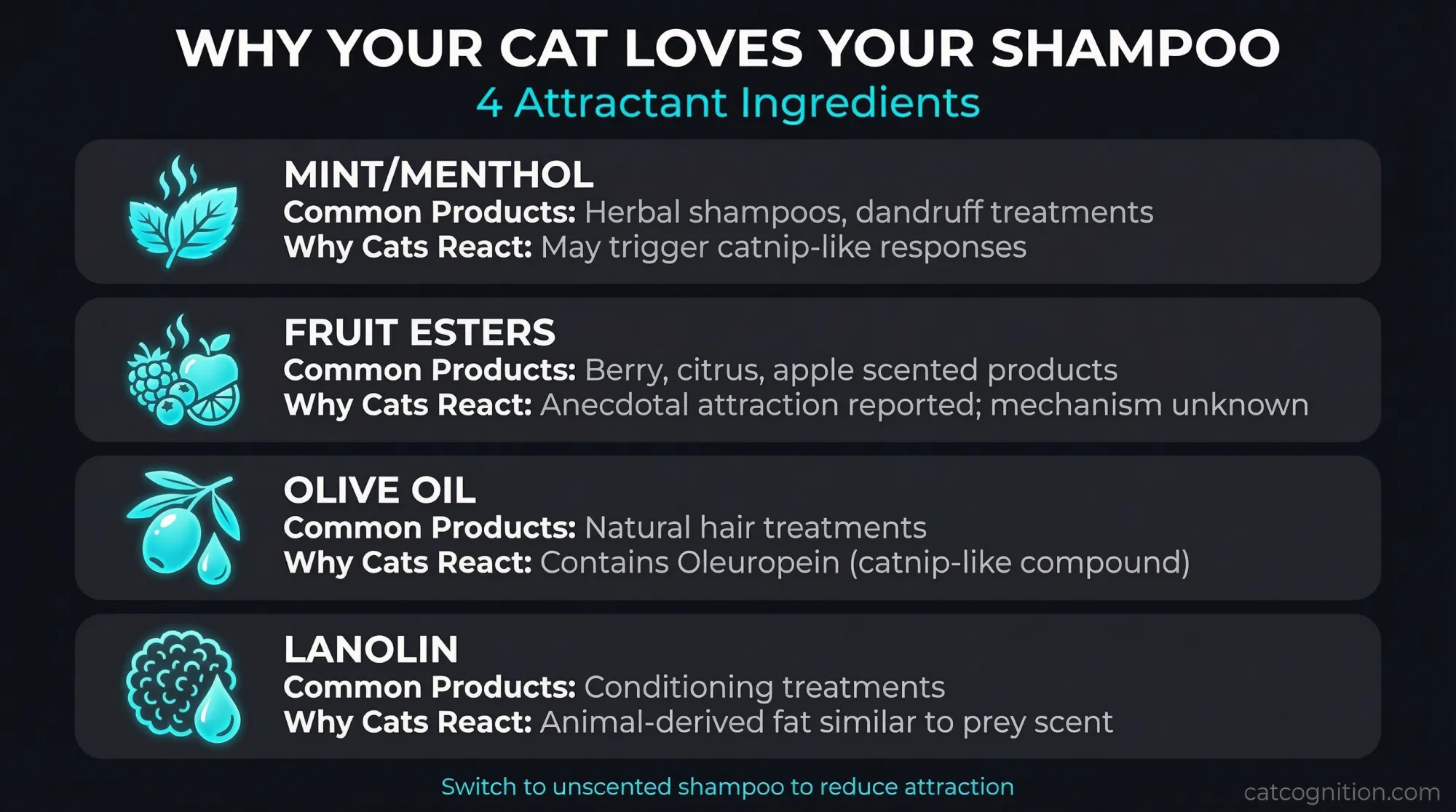
The main attractants:
| Ingredient Type | Common Products | Why Cats React |
|---|---|---|
| Mint/Menthol | Herbal shampoos, dandruff treatments | May trigger catnip-like responses in some cats (anecdotal; not chemically identical to Nepetalactone) |
| Fruit Esters | Berry, citrus, apple scented products | Anecdotal attraction reported; mechanism unknown |
| Olive Oil | Natural hair treatments | Related to Oleuropein (found in olives), which can trigger catnip-like responses in some cats |
| Lanolin | Conditioning treatments | Animal-derived fat similar to prey scent |
If you recently switched shampoos and your cat suddenly became obsessed with your hair, the fragrance is likely the trigger. Some cats will specifically target freshly washed hair because the scent concentration is highest.
Adam's Lab Note: Speaking of hair, be very careful of certain chemicals like Minoxidil for hair loss which are lethal to felines. Even a few drops dried onto the carpet or your pillow could prove fatal.
The fix: If you want to reduce hair-chewing behavior without discouraging bonding, switch to unscented or baby shampoo. You will still smell like "you" without the attractant compounds.
What is Pica in Cats? (Nutritional Deficiency)
Pica is defined as the persistent eating of non-nutritive, non-food materials. In cats, this commonly includes:
- Human or animal hair
- Wool and fabric (especially Siamese and Burmese breeds)
- Plastic bags and shower curtains
- Cardboard and paper
Unlike allogrooming—which is a surface-level social behavior—Pica involves actually ingesting the material.
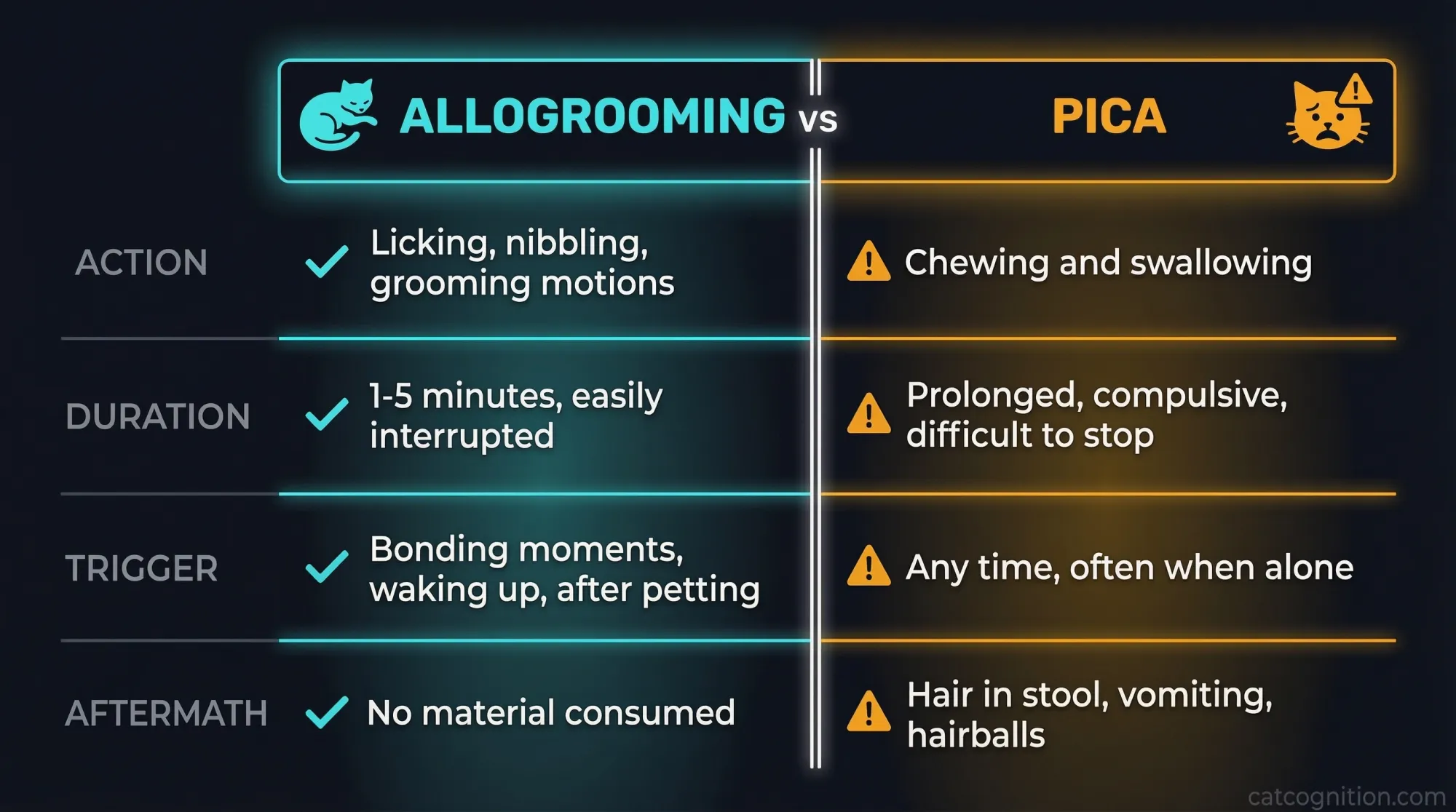
The diagnostic difference:
| Behavior | Allogrooming | Pica |
|---|---|---|
| Action | Licking, nibbling, "grooming" motions | Chewing and swallowing |
| Duration | 1-5 minutes, easily interrupted | Prolonged, compulsive, difficult to stop |
| Trigger | Bonding moments, waking up, after petting | Any time, often when alone |
| Aftermath | No material consumed | Hair in stool, vomiting, hairballs |
Primary causes of Pica in cats:
- Nutritional Deficiency: Some veterinarians suspect fiber deficiency, though peer-reviewed evidence is limited. Behavioral and genetic factors are more consistently documented causes.
- Early Weaning: Kittens weaned before 12 weeks are more likely to develop Pica (some studies suggest 14-16 weeks for Oriental breeds). The behavior mimics nursing and provides oral soothing.
- Anxiety and OCD: Pica can function as a compulsive disorder, particularly in high-stress environments or cats with genetic predisposition.
- Underlying Medical Issues: Gastrointestinal disease, hyperthyroidism, and anemia have all been linked to Pica behavior.
The CatCog Reality Check: If your cat is actually swallowing hair—not just grooming—schedule a veterinary appointment. Pica can cause intestinal blockages, which are a medical emergency. Your vet can run bloodwork to check for deficiencies and rule out underlying disease.
Is My Cat Just Playing With My Hair?
Sometimes, yes.
Hair moves. It dangles. It looks like prey.
Cats are hardwired to respond to linear, string-like objects with their predatory motor pattern—stalk, pounce, grab, bite. Your ponytail, swinging from side to side, triggers the exact same neural pathway as a mouse tail.
How to tell if it is play vs. grooming:
| Play Behavior | Grooming Behavior |
|---|---|
| Pupils dilated (hunting mode) | Pupils normal |
| Batting with paws before biting | No paw involvement |
| "Bunny kicks" with back feet | Slow, methodical licking |
| Tail twitching or lashing | Tail relaxed or wrapped |
| Occurs when hair is moving | Occurs when you are still (sleeping, resting) |
If your cat primarily attacks your hair when you are moving around—especially if they crouch, wiggle, and pounce—they are in hunting mode, not grooming mode.
The fix: Redirect with appropriate prey toys. Wand toys, laser pointers, or even a piece of string (supervised) can satisfy the hunting urge without your scalp becoming the target.
How to Stop Your Cat From Eating Hair
If you want to reduce hair-chewing behavior, the strategy depends on the underlying cause.
Step 1: Rule Out Pica
If your cat is swallowing hair, see your veterinarian. They can:
- Check for nutritional deficiencies (bloodwork)
- Rule out gastrointestinal issues
- Assess for anxiety or compulsive disorder
- Recommend dietary changes (higher fiber, raw food, etc.)
Step 2: Reduce Attractant Scents
Switch to unscented shampoo and conditioner. Avoid:
- Mint or menthol products
- Fruit-scented products
- Tea tree or essential oil treatments
Step 3: Redirect the Bonding
Your cat wants connection. Offer alternatives that satisfy the same social need:
| Alternative | Why It Works |
|---|---|
| Brushing them | Physical contact + scent exchange |
| Chin and cheek scratches | Triggers same bonding hormones |
| Interactive play before bed | Burns energy, reduces night grooming |
| Slow blink exchanges | Reinforces trust without physical contact |
Step 4: Physical Prevention (If Needed)
For nighttime groomers:
- Wear a sleep cap or wrap your hair
- Close the bedroom door (if cat is comfortable sleeping elsewhere)
- Apply a cat-safe bitter spray to hair (as a last resort).
Key Takeaways
The CatCog Index: Hair Chewing Decoded
Allogrooming is a compliment. When your cat grooms your hair, they are treating you as a trusted colony member and depositing their scent.Licking is normal. Swallowing is a warning. If your cat is ingesting hair, this may indicate Pica—a disorder requiring veterinary attention.Your shampoo might be the trigger. Mint, fruit, and olive oil compounds can act as pheromone-like attractants.Stress increases grooming behavior. Anxious cats may use your hair as a self-soothing mechanism.Play-based attacks are different. If your cat is stalking and pouncing, they are hunting, not bonding.Redirect, do not punish. Offer alternative bonding activities and address the underlying need.
Frequently Asked Questions
Why does my cat only chew my hair and not my partner's? Cats often show grooming preference based on scent (your shampoo or natural body chemistry), bond strength (who feeds them, who they sleep with), and hair texture (some cats prefer fine hair, others prefer thick hair). You may simply smell more "interesting" to them.
Can my cat get sick from eating my hair? Yes. Ingested hair can accumulate in the stomach and intestines, causing hairballs, vomiting, or in severe cases, intestinal blockages. If your cat is swallowing hair regularly, consult your veterinarian.
Why does my cat chew my hair after I shower? Freshly washed hair has the highest concentration of shampoo scent. If your product contains mint, fruit, or herbal extracts, these act as attractants. The warmth and moisture may also make your hair more texturally appealing.
Is it okay to let my cat groom my hair? If they are licking/nibbling without swallowing, this is generally harmless social behavior. Many cat owners enjoy this as a bonding ritual. The concern arises only when actual ingestion occurs or the behavior becomes compulsive.
My cat only chews my hair at 3 AM. Why? Cats are crepuscular (most active at dawn and dusk). The 3-6 AM window is a natural activity peak. They may be grooming you as a way to initiate bonding/attention when they are awake and you are available (immobile, in bed). Adding a play session before bed can shift their energy expenditure.
Sources
- Crowell-Davis, S.L., Curtis, T.M., & Knowles, R.J. (2004). Social organization in the cat: A modern understanding. Journal of Feline Medicine and Surgery. PubMed | Full Text
- Bradshaw, J.W.S. (2013). Cat Sense: The Feline Enigma Revealed. Basic Books. Publisher
- Overall, K.L. (2013). Manual of Clinical Behavioral Medicine for Dogs and Cats. Elsevier. Publisher