Why Do Cats Sleep More When It Rains? The Science Explained
Cats sleep more during rain due to three factors: melatonin surges from low light, barometric pressure drops signaling rest, and evolutionary energy conservation when hunting is inefficient.

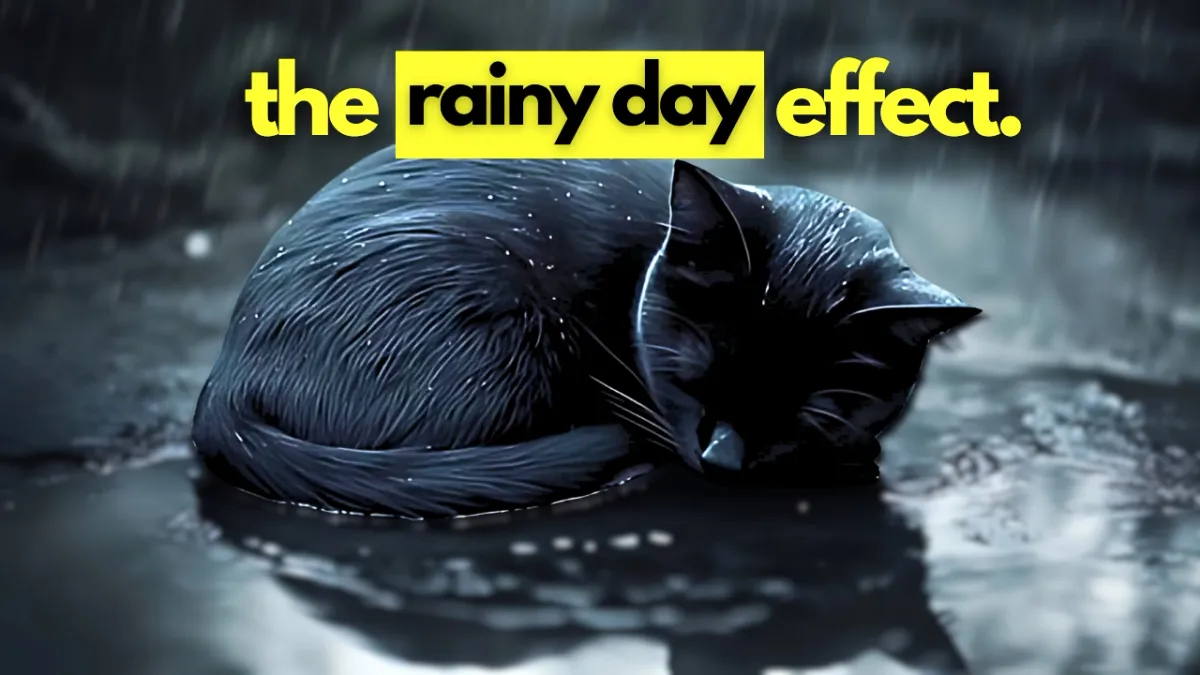
Quick Answer: Why do cats sleep more when it rains?
Cats sleep more during rainy weather due to three biological mechanisms working together. Cats are NOT nocturnal—they are crepuscular, meaning peak activity occurs at dawn and dusk when light levels naturally shift. First, low light levels trigger increased melatonin production, signaling the brain that it is time to rest. Second, drops in barometric pressure before storms activate energy conservation instincts inherited from wild ancestors. Third, cats instinctively recognize that hunting in wet conditions wastes calories. This "Rainy Day Effect" is not laziness but an evolutionary survival strategy refined over 10,000 years.
Table of Contents
- How Does Melatonin Make Cats Sleepy During Rain?
- Can Cats Sense Barometric Pressure Changes?
- Why Does Hunting in Rain Waste Energy?
- Does Temperature Affect Cat Sleep During Rain?
- Key Takeaways
- Key Terms Used
- Frequently Asked Questions
- Sources
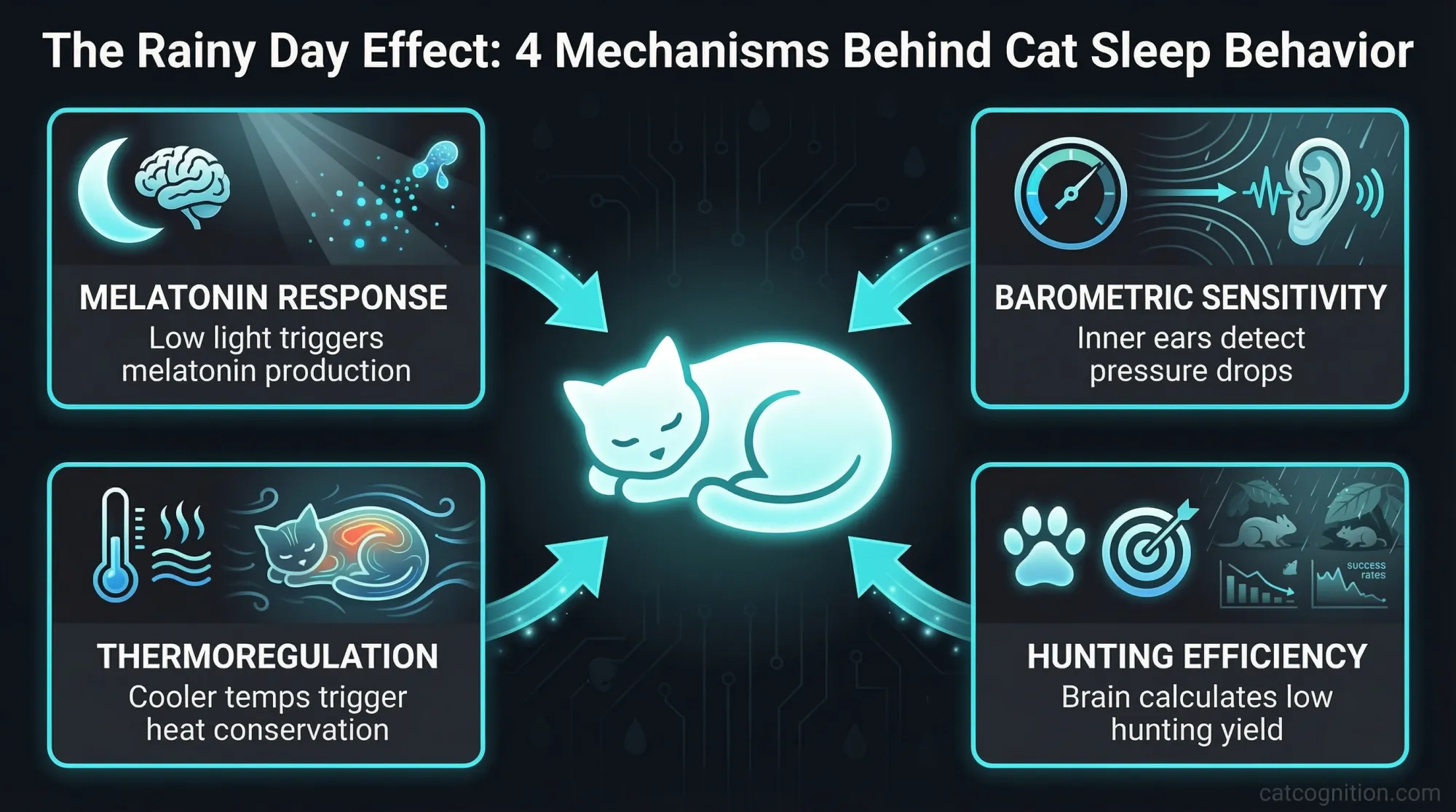
If you have ever noticed your cat sleeping the entire day during a rainstorm, you are observing ancient survival programming in action. The "Rainy Day Effect" in cats is not a quirk or coincidence. It is the result of three distinct biological systems working in harmony: hormonal responses to light, atmospheric pressure sensitivity, and evolutionary hunting efficiency calculations.
How Does Melatonin Make Cats Sleepy During Rain?
The primary driver of rainy day sleepiness in cats is melatonin, the hormone that regulates sleep-wake cycles across all mammals. Melatonin production is directly controlled by light exposure. When light levels drop, the pineal gland increases melatonin secretion. When light levels rise, melatonin production decreases.
On overcast, rainy days, ambient light can drop by 80-99% compared to clear conditions. This significant reduction in light exposure triggers the same hormonal cascade that normally occurs at dusk.
The Evidence:
"Melatonin is secreted only during the dark phase of the day and is essential to synchronize circadian rhythms and neuroendocrine physiological processes."
According to Dr. Justin Shmalberg, DVM, a clinical associate professor at the University of Florida, seasonal variations significantly affect hormone concentrations in cats, including melatonin. The same mechanism applies during rainy weather: reduced light mimics twilight conditions, prompting the feline brain to prepare for sleep.
Cats are crepuscular animals, meaning their peak activity naturally occurs at dawn and dusk. Their circadian rhythm is finely tuned to light levels. When a storm rolls in and dims the sky at 2 PM, a cat's internal clock interprets this as approaching nighttime. The result is a melatonin surge that induces drowsiness regardless of actual clock time.
Adam's Lab Note:
Anecdotal but Moon does like to cosy up and sleep more when it rains. He is an indoor cat so perhaps its the rain pattering on the windows and being cosy inside that's making him sleepier?
Can Cats Sense Barometric Pressure Changes?
Beyond light levels, cats possess a remarkable sensitivity to atmospheric pressure changes. Barometric pressure drops before storms arrive, sometimes hours before rain actually begins. Cats are believed to detect these pressure changes through their inner ears, which are significantly more sensitive than human ears.
The feline inner ear contains structures that respond to subtle air pressure fluctuations. When pressure drops, these sensory systems signal the brain that weather conditions are changing. This early warning system likely evolved to help wild cats seek shelter before storms arrived.
The Evidence:
"Cats are incredibly sensitive to changes in atmospheric pressure. Their inner ears are finely tuned to detect even the slightest fluctuations."
Research on mammals demonstrates that barometric pressure changes affect activity levels across many species. In cats, a pressure drop typically triggers a decrease in activity and an increase in rest-seeking behavior. Some cats become more clingy or seek enclosed spaces, while others simply sleep through the pressure change.
CatCog Reality Check:
Not all cats react visibly to pressure changes. Individual variation is significant. Some cats remain unbothered by approaching storms while others become anxious or hypervigilant. The baseline response, however, trends toward reduced activity and increased sleep.
This pressure sensitivity explains why many cat owners notice their pets becoming drowsy hours before rain actually arrives. The cat is not predicting weather through mystical means. The cat is responding to measurable atmospheric changes that human senses cannot detect.
Why Does Hunting in Rain Waste Energy?
The third component of the Rainy Day Effect is pure evolutionary mathematics. Cats descend from the African wildcat (Felis lybica), a species that hunted small prey in semi-arid environments. Hunting in wet conditions presents multiple disadvantages that make the activity calorie-inefficient.
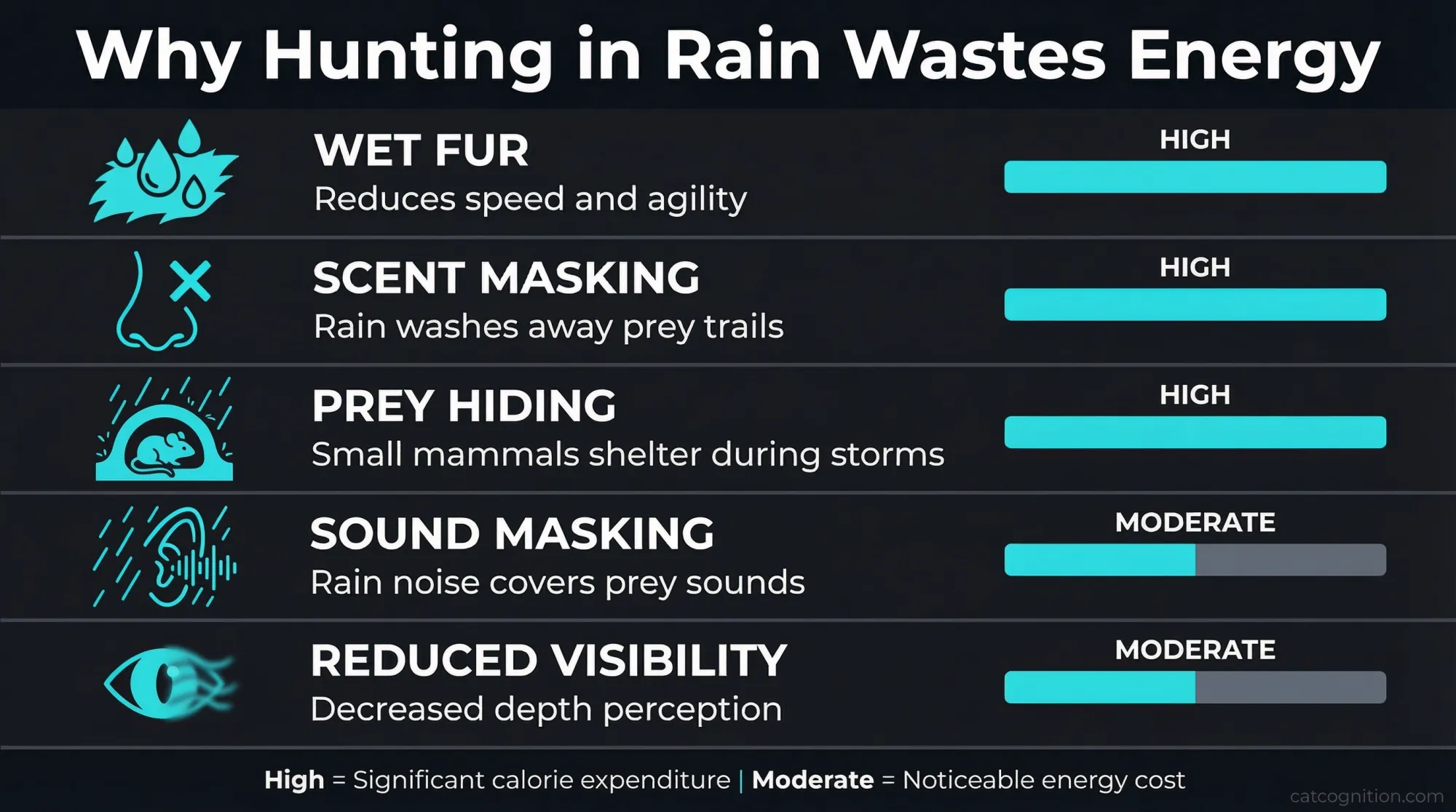
Why hunting in rain wastes energy:
| Factor | Effect on Hunting | Energy Cost |
|---|---|---|
| Wet fur | Reduces speed and agility | High |
| Scent masking | Rain washes away prey scent trails | High |
| Prey hiding | Small mammals shelter during storms | High |
| Sound masking | Rain noise covers subtle prey sounds | Moderate |
| Reduced visibility | Decreased light affects depth perception | Moderate |
As Dr. John Bradshaw of the University of Bristol explains in his book Cat Sense, domestic cats still have "three out of four paws firmly planted in the wild" and can revert to independent survival within just a few generations. This includes the instinctive recognition that certain environmental conditions make hunting unprofitable.
The Evidence:
"During rainfalls, insects are unable to fly and be active as normal. This dramatically affects every animal on the food chain, making it more energy efficient to wait for things to clear up."
When rain falls, prey animals go into hiding. Rodents retreat to burrows. Birds shelter in dense vegetation. Insects become inactive. A cat's brain calculates this scarcity automatically and triggers conservation mode. The logical response is to sleep through the low-yield period and hunt when conditions improve.
This behavior is not learned. It is hardwired. Even indoor cats who have never hunted a day in their lives exhibit the same rainy day lethargy because the programming exists at a genetic level.
Does Temperature Affect Cat Sleep During Rain?
A fourth contributing factor involves temperature and thermoregulation. Rainy weather typically brings cooler temperatures, and cats respond to cold by conserving body heat through behavioral adjustments.
Cats have a thermoneutral zone of 86-100 degrees Fahrenheit, significantly warmer than typical indoor environments. When ambient temperature drops during rainstorms, cats instinctively seek warmth and reduce activity to minimize heat loss.
The classic rainy day sleeping position, a tight curl with the tail wrapped around the body and nose tucked in, significantly reduces exposed surface area. This position conserves body heat while the cat waits for temperatures to rise.
The Evidence:
"As cats sleep, they experience a decrease in their metabolic rate, which helps reduce heat loss. This decrease in metabolic rate is a natural response to the reduced energy needs during sleep."
The combination of melatonin, pressure sensitivity, hunting efficiency calculations, and thermoregulation creates the perfect storm for extended sleep. When all four systems align during rainy weather, cats may sleep 16-20 hours compared to their typical 12-16 hours.
Key Takeaways
- Melatonin Response: Low light during rainy weather triggers increased melatonin production, signaling the feline brain that it is time to rest regardless of actual clock time.
- Barometric Sensitivity: Cats detect barometric pressure drops through their inner ears hours before storms arrive, triggering energy conservation behaviors.
- Evolutionary Efficiency: Wild ancestors learned that hunting in rain wastes calories because prey hides, scent trails wash away, and wet fur reduces speed.
- Thermoregulation: Cooler temperatures during rain trigger heat-conservation behaviors including curling into tight balls and sleeping more to reduce metabolic demands.
- The Rainy Day Effect: These four mechanisms working together explain why cats consistently sleep more during storms, a survival strategy refined over 10,000 years of feline evolution.
Key Terms Used
- Circadian Rhythm: The internal 24-hour biological clock that synchronizes sleep-wake cycles to environmental light cues.
- Crepuscular: The behavioral pattern where cats are most active during dawn and dusk twilight periods.
- Melatonin: The hormone produced by the pineal gland that regulates sleep-wake cycles, triggered by darkness.
- Thermoregulation: The biological process by which cats maintain optimal internal body temperature through behavioral adjustments.
See the full Cat Cognition Glossary ->
Frequently Asked Questions
Why do cats sleep more when it rains?
Cats sleep more during rainy weather due to a combination of increased melatonin production from low light levels, sensitivity to barometric pressure drops, evolutionary energy conservation instincts, and thermoregulation needs in cooler temperatures. These four biological systems work together to trigger extended rest during storms.
Can cats predict rain before it happens?
Many cats appear to detect barometric pressure drops through their sensitive inner ears, often 1-24 hours before rain arrives depending on the individual cat and severity of the approaching weather. This is not weather prediction through mystical means but a measurable physiological response to atmospheric pressure changes that human senses cannot detect.
Is it normal for my cat to sleep all day during a storm?
Completely normal. Cats may sleep 16-20 hours during rainy weather compared to their typical 12-16 hours. This extended sleep is a natural response to environmental conditions, not a sign of illness or depression.
Do indoor cats still sleep more during rain even though they do not hunt?
Yes. The behavioral programming that triggers rainy day sleepiness is genetic, not learned. Indoor cats who have never hunted exhibit the same response because their brains still contain the ancient efficiency calculations inherited from wild ancestors.
Does the sound of rain make cats sleepy?
The sound of rain can contribute to feline drowsiness by acting as white noise that masks environmental sounds and creates a calming atmosphere. However, the primary drivers of rainy day sleepiness are hormonal (melatonin), physiological (barometric pressure sensitivity), and evolutionary (energy conservation programming).
Why does my cat get anxious during storms instead of sleepy?
Individual variation exists in how cats respond to weather changes. While the baseline response trends toward reduced activity and increased sleep, some cats become anxious or hypervigilant during storms. This may relate to sensitivity to thunder, lightning flashes, or static electricity buildup in the air.
Does the Rainy Day Effect occur in all weather, or just rain?
Similar effects occur during any weather that reduces light levels significantly, including heavy cloud cover, fog, and winter darkness. The key trigger is reduced light exposure, which increases melatonin production regardless of whether actual precipitation occurs.
Should I be concerned if my cat does not sleep more during rain?
No. Cats vary in their sensitivity to weather conditions. Some cats respond dramatically to pressure changes and light reduction, while others show minimal behavioral changes. Both responses are within the normal range of feline behavior.
Sources
- "Melatonin, Circadian Rhythms, and Sleep" - Zhdanova IV, Tucci V. (2003) - General mammalian melatonin review (PubMed)
- "Circadian, sleep and brain temperature rhythms in cats under sustained daily light-dark cycles and constant darkness" - Ursin R. (PubMed)
- "Chronobiology of free-ranging domestic cats: Circadian, lunar and seasonal activity rhythms in a wildlife corridor" - Mercnik N., Prevolnik Povse M., Skorjanc D., Skok J. (2023) (Applied Animal Behaviour Science)
- "The palaeogenetics of cat dispersal in the ancient world" - Ottoni C, et al. (2017) (Nature Ecology & Evolution)
- African Wildcat: Hunting Behavior and Ecology - (ScienceDirect)
- Cat Sense: How the New Feline Science Can Make You a Better Friend to Your Pet - Dr. John Bradshaw, University of Bristol
- The Ohio State University Indoor Pet Initiative - Dr. Tony Buffington (Ohio State)
- Cornell Feline Health Center - (Cornell)