Why Do Cats Caterwaul at Night? Causes and Solutions
Caterwauling maps to six biological triggers — hormonal mating calls, cognitive dysfunction, pain, territorial disputes, separation anxiety, and learned behavior. Diagnose by your cat's age and status.

Table of Contents
- The CatCog Caterwauling Triage Matrix: Which Cat, Which Cause
- Why Nighttime: The Circadian Biology of Caterwauling
- Why Do Intact Cats Caterwaul? The Hormonal Mating Call
- Why Do Older Cats Scream at Night? Cognitive Dysfunction
- When Does Caterwauling Mean a Medical Emergency?
- Can Separation Anxiety Cause Caterwauling?
- Is Your Cat's Caterwauling a Learned Behavior?
- Management Protocols by Cause
- Key Terms Used
- Frequently Asked Questions
- Key Takeaways
- Sources
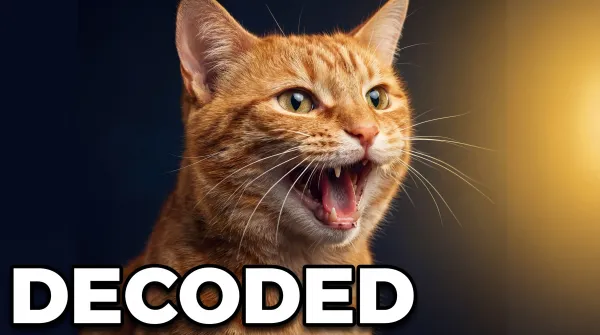
Cats caterwaul at night because nighttime amplifies at least six distinct biological triggers -- hormonal mating calls, cognitive dysfunction "sundowning," pain signaling, territorial disputes, separation anxiety, and learned attention-seeking. The specific cause depends on the cat's age, sex, and reproductive status. Caterwauling is NOT the same as meowing -- caterwauling is a prolonged, repetitive howl produced by gradually opening and closing the mouth, acoustically distinct from a short meow and typically driven by hormonal, cognitive, or medical causes that each require a different intervention.
The CatCog Caterwauling Triage Matrix: Which Cat, Which Cause
Caterwauling cause maps directly to cat demographics -- age bracket, reproductive status, and onset pattern determine the most likely trigger. The CatCog Caterwauling Triage Matrix segments six primary causes by these three diagnostic variables, replacing generic "reasons cats yowl" lists with a personalized diagnostic framework that points each cat owner to the specific cause and matched intervention for that owner's cat.
As Dr. John Bradshaw, anthrozoologist at the University of Bristol, established through decades of research on feline domestication, cats developed an expanded vocal repertoire specifically for communicating with humans -- but caterwauling is not part of that human-directed communication. As Dr. Susanne Schotz, Senior Lecturer in Phonetics at Lund University, classifies through her Meowsic Project research on feline vocal repertoires, caterwauling belongs to the "opening-closing mouth" category of vocalizations -- long, repeated howls that are acoustically distinct from the short meow or the open-mouth pain shriek. Understanding which type of vocalization a cat is producing is the first step toward diagnosing the cause. For a breakdown of every cat vocalization type, see our guide to every level of cat sound explained.
Dr. Lorena Sordo and Dr. Danielle Gunn-Moore of the University of Edinburgh's Royal (Dick) School of Veterinary Studies further established that excessive vocalization is the single most prevalent clinical sign of feline cognitive dysfunction -- so prominent that their updated VISHDAAL diagnostic framework places Vocalization first in the acronym (Sordo & Gunn-Moore, 2021).
Use the Triage Matrix below. Find the row that matches the cat's profile, then follow the recommended action.
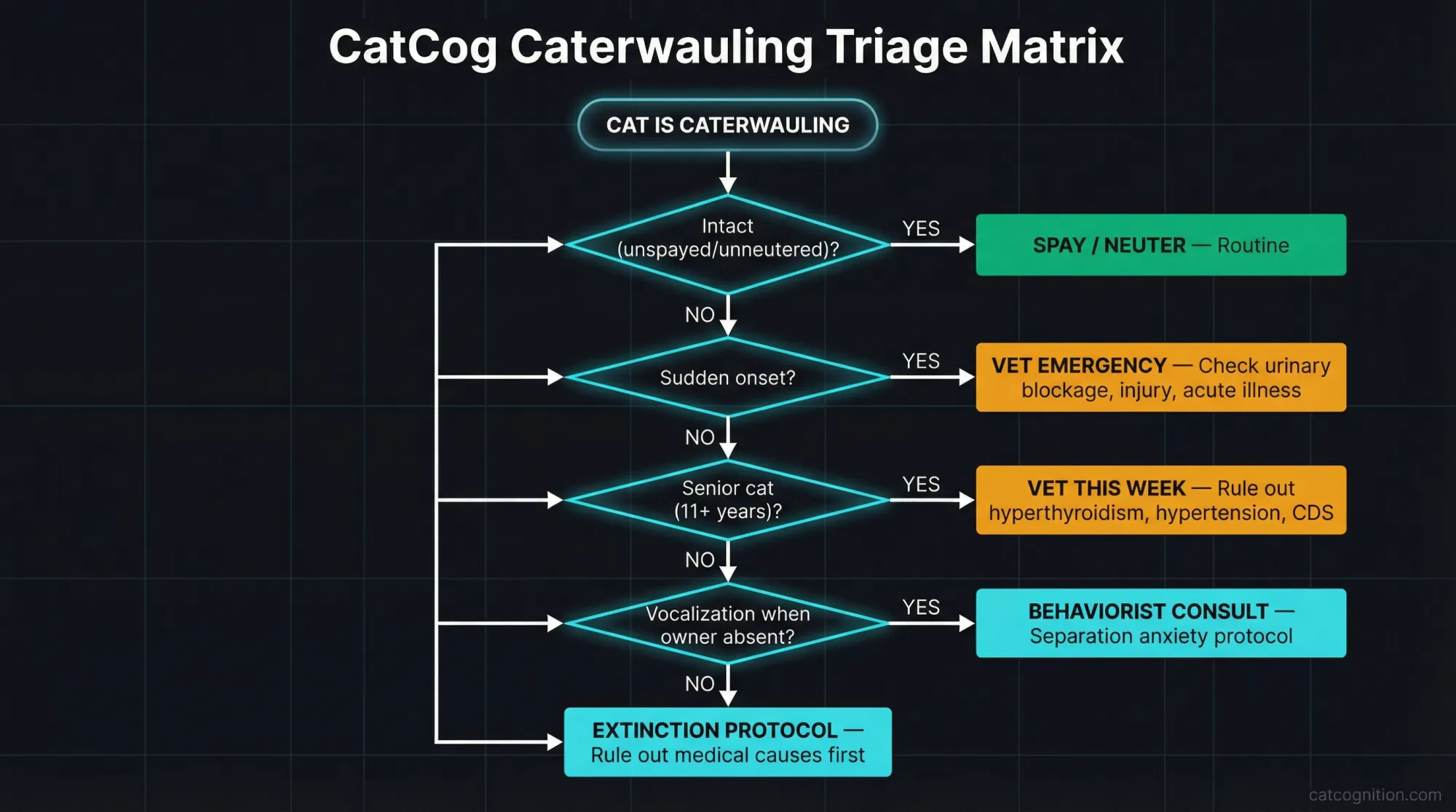
| Cat Profile | Age | Most Likely Cause | Urgency | Action |
|---|---|---|---|---|
| Intact (unspayed) female | Any | Estrus (heat) cycle | Routine | Spay. Consult veterinarian. |
| Intact (unneutered) male | Any | Territorial / mating response | Routine | Neuter. Block visual access to outdoor cats. |
| Spayed/neutered, senior | 11+ years | Cognitive dysfunction (CDS) | This week | Veterinary exam: rule out hyperthyroidism, hypertension, pain |
| Any cat, sudden onset | Any | Pain or medical emergency | Emergency | Immediate vet visit -- check urinary blockage, injury, acute illness |
| Any cat, owner-absent trigger | Any | Separation anxiety | This week | Veterinary behaviorist consultation; environmental modification |
| Any spayed/neutered, gradual increase | Any | Learned behavior (operant conditioning) | Non-urgent | Extinction protocol (after medical causes ruled out) |
📊 The Evidence:
"Inappropriate vocalization was the most prevalent symptom of feline cognitive dysfunction, affecting 40% of FCD-positive cats in a survey of 615 cat owners." -- MacQuiddy, 2022, Colorado State University
Why Nighttime: The Circadian Biology of Caterwauling
Caterwauling intensifies at night because cats are crepuscular animals with bimodal activity peaks around 5 AM and 9 PM, and nighttime conditions amplify every trigger simultaneously. Reduced ambient noise carries territorial calls further, declining daylight triggers estrus cycling in intact cats, cognitive dysfunction "sundowning" peaks during evening hours, and absent daytime stimulation leaves anxious cats with no competing behavioral outlets.
Cats are not truly nocturnal. Feline activity follows a crepuscular pattern -- two daily peaks of heightened alertness, roughly at dawn and dusk. These peaks evolved to coincide with the activity patterns of small prey animals. In a domestic setting, the 5 AM peak coincides with the deepest phase of human sleep, which is exactly why caterwauling feels so disruptive. The 9 PM peak often occurs as households wind down for the evening, creating another window of conflict.
Several biological mechanisms converge at night to make caterwauling worse:
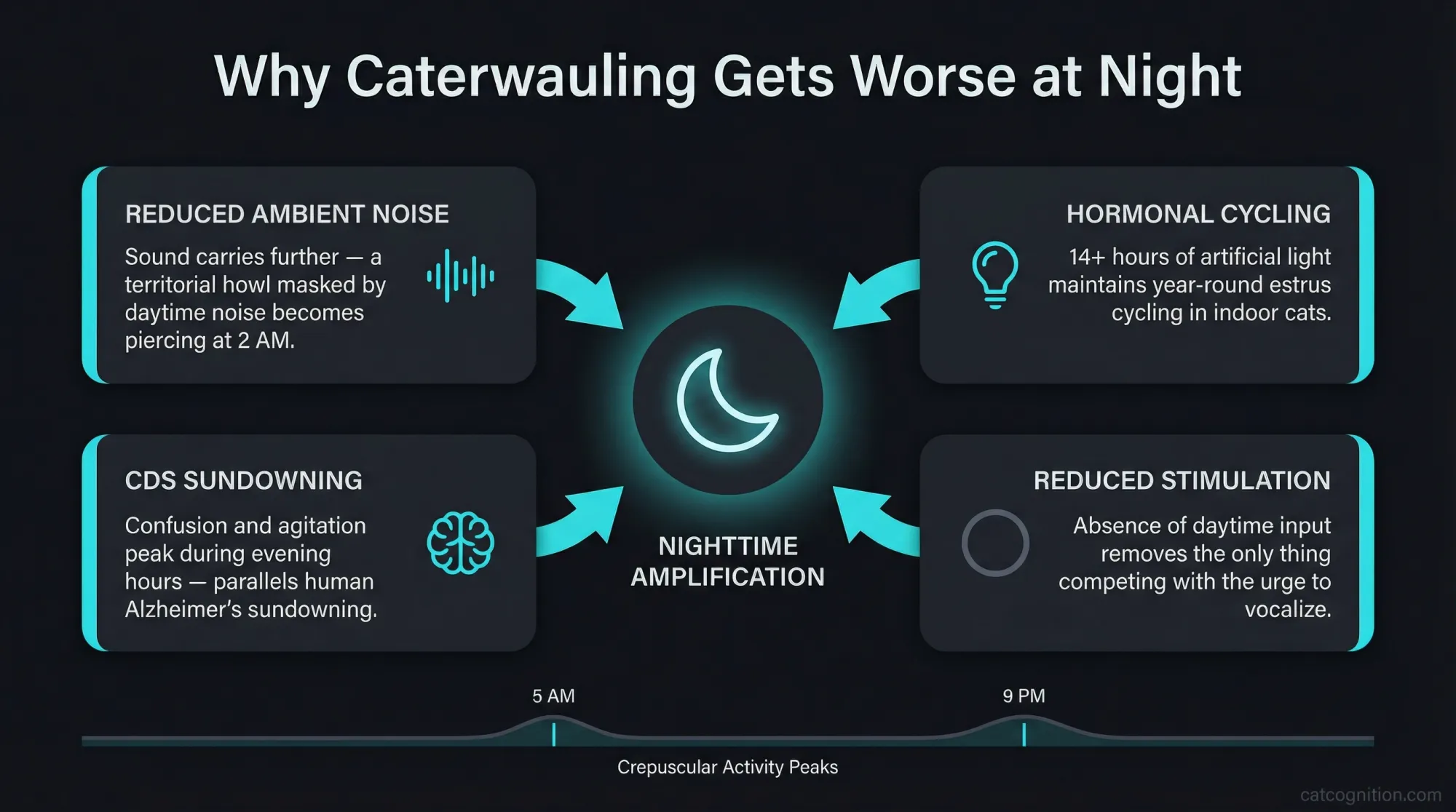
Reduced ambient noise. Sound carries further when background noise drops. A territorial howl that would be masked by daytime traffic, conversation, and appliance hum becomes piercing in a quiet house at 2 AM. Outdoor cats patrolling territory at night produce mating calls and territorial vocalizations that indoor cats can hear through windows, triggering reactive caterwauling.
Hormonal cycling. Cats are "long day breeders." Queens require 12 or more hours of light to maintain estrous cycling. Indoor cats exposed to 14 or more hours of artificial lighting can cycle year-round, regardless of season. The hormonal cascade that triggers estrus vocalizations does not respect human sleep schedules.
Sundowning in cognitive dysfunction. Feline cognitive dysfunction syndrome produces a pattern strikingly similar to sundowning in human dementia patients. A 2020 study from the University of Edinburgh surveyed owners of CDS cats and found that vocalization timing was roughly evenly distributed -- 35.1% primarily at night, 34.4% during the day, and 32.4% at both times -- with no statistically significant difference. However, the researchers noted the pattern bears similarities with sundown syndrome documented in human Alzheimer's patients, suggesting the link warrants further study (Cerna, 2020).
Reduced stimulation. During the day, environmental input -- movement, sounds, human interaction -- occupies a cat's attention. At night, these inputs disappear. For cats with separation anxiety, learned vocalization habits, or cognitive confusion, the absence of stimulation removes the only thing competing with the urge to vocalize.
📊 The Evidence:
"More than half of the owners (62%) reported being occasionally or regularly awakened at night by their CDS cat's vocalization." -- Cerna, 2020, University of Edinburgh. Note: The study found no statistically significant difference between nighttime and daytime vocalization frequency.
Why Do Intact Cats Caterwaul? The Hormonal Mating Call
Estrus-driven caterwauling is the loudest and most persistent form of feline vocalization, triggered when estradiol levels exceed 20 pg/mL in unspayed queens and amplified by the fact that indoor cats under artificial lighting can cycle into heat year-round. Spaying or neutering eliminates estrus-driven caterwauling permanently -- no behavioral workaround exists for hormonally driven cat vocalizations.
Queens in estrus produce distinctive "heat cries" -- monotone howls that repeat for the duration of estrus, which averages 5.8 days but ranges from two to nineteen days. These calls are not distress signals. Queens broadcast estrus availability across large territories to attract mates. Intact males respond with their own caterwauling -- counter-calls that assert mating rights and deter rival toms.
The hormonal mechanism is straightforward. FSH (follicle-stimulating hormone) initiates the development of three to seven ovarian follicles, which produce rising levels of estradiol. When estradiol exceeds 20 pg/mL, estrus behavior activates: rolling, rubbing, lordosis, treading with the hind feet, and -- most disruptive for owners -- persistent, loud vocalization.
Indoor cats present a specific problem. Cats are photoperiod-sensitive breeders. In natural conditions, queens in the Northern Hemisphere cycle from February through September and stop cycling as days shorten in October through January. But exposure to 14 hours of artificial lighting for at least two months induces and maintains cyclicity. Most indoor environments easily exceed 14 hours of combined natural and artificial light, meaning an unspayed indoor cat can cycle into estrus continuously.
The fix is definitive. Spaying eliminates the hormonal cascade entirely. There is no behavioral modification, pheromone diffuser, or environmental change that stops estrus-driven caterwauling in an intact cat. For intact males, neutering reduces testosterone-driven territorial and mating vocalizations.
| Estrus Fact | Detail |
|---|---|
| Hormonal trigger | Estradiol > 20 pg/mL |
| Cycle duration | 2-19 days (average 5.8 days) |
| Light requirement | 12+ hours for cycling; 14+ hours induces year-round |
| Follicles per cycle | 3-7 |
| Seasonal cycling (outdoor) | February-September (Northern Hemisphere) |
| Indoor cycling | Year-round under artificial lighting |
Why Do Older Cats Scream at Night? Cognitive Dysfunction
Feline cognitive dysfunction syndrome (CDS) affects 28% of cats aged 11-14 and over 50% of cats older than 15, with excessive vocalization as the most common clinical sign of CDS -- present in 40% of CDS-positive cats. CDS-related nighttime vocalization parallels sundowning in human Alzheimer's patients, producing disoriented howling that peaks during evening hours when confusion and agitation intensify. See our cat life stages guide for more on CDS in senior cats.
CDS is a progressive neurodegenerative condition. Like human Alzheimer's disease, feline CDS involves extracellular beta-amyloid accumulation and intraneuronal hyperphosphorylated tau deposits. These pathological changes disrupt normal brain function, producing a constellation of behavioral signs captured by the VISHDAAL framework: Vocalization, Interaction changes, Sleep-wake cycle alterations, House-soiling, Disorientation, Activity changes, Anxiety, and Learning/memory deficits.
The VISHDAAL framework, published by Sordo and Gunn-Moore in 2021, upgraded the earlier DISHA framework by placing Vocalization first -- reflecting the clinical reality that excessive vocalization is often the earliest and most noticeable sign of cognitive decline in aging cats.
The vocalization in CDS cats has multiple drivers. A 2020 Edinburgh study surveyed owners of 37 cats with CDS-related increased vocalization (median age 15.9 years, range 10-23). Owners attributed the vocalization to disorientation (40.5%), attention-seeking (40.5%), resource-seeking or food demands (16.2%), and pain (2.7%). Notably, 64.8% of owners reported that their cat's increased vocalization had more than one perceived cause.
📊 The Evidence:
"Vocalization is the most prevalent clinical sign of feline cognitive dysfunction, affecting 40% of FCD-positive cats." -- MacQuiddy, 2022, Colorado State University
The differential diagnosis is critical. Nighttime vocalization in a senior cat is not automatically CDS. The Cornell Feline Health Center advises that hyperthyroidism and hypertension must be ruled out first -- both conditions cause nighttime vocalization through increased central nervous system stimulation, and both are treatable. A veterinary workup for a senior cat with new nighttime vocalization should include a complete blood panel, thyroid panel, blood pressure measurement, and urinalysis before attributing the behavior to cognitive decline.
One commonly cited cause that deserves scrutiny: hearing loss. Multiple competitor articles list age-related hearing loss (presbycusis) as a major trigger for elderly cat caterwauling. However, Dr. George Strain at Louisiana State University found that no clinical studies on feline presbycusis have been reported, and unpublished data suggests presbycusis in cats is uncommon and much less severe than in dogs (Strain, 2017). While hearing loss may contribute to vocalization in some elderly cats, the evidence base is thin enough that it should not be presented as a leading cause.
When Does Caterwauling Mean a Medical Emergency?
Cats rarely vocalize pain -- when a cat screams, the distress is typically severe enough to warrant immediate veterinary attention, and urinary blockage specifically can become fatal within 24-48 hours. Pain-related caterwauling is produced through a different neural pathway than other vocalization types, driven by the periaqueductal gray region of the midbrain where pain processing and vocal output converge.
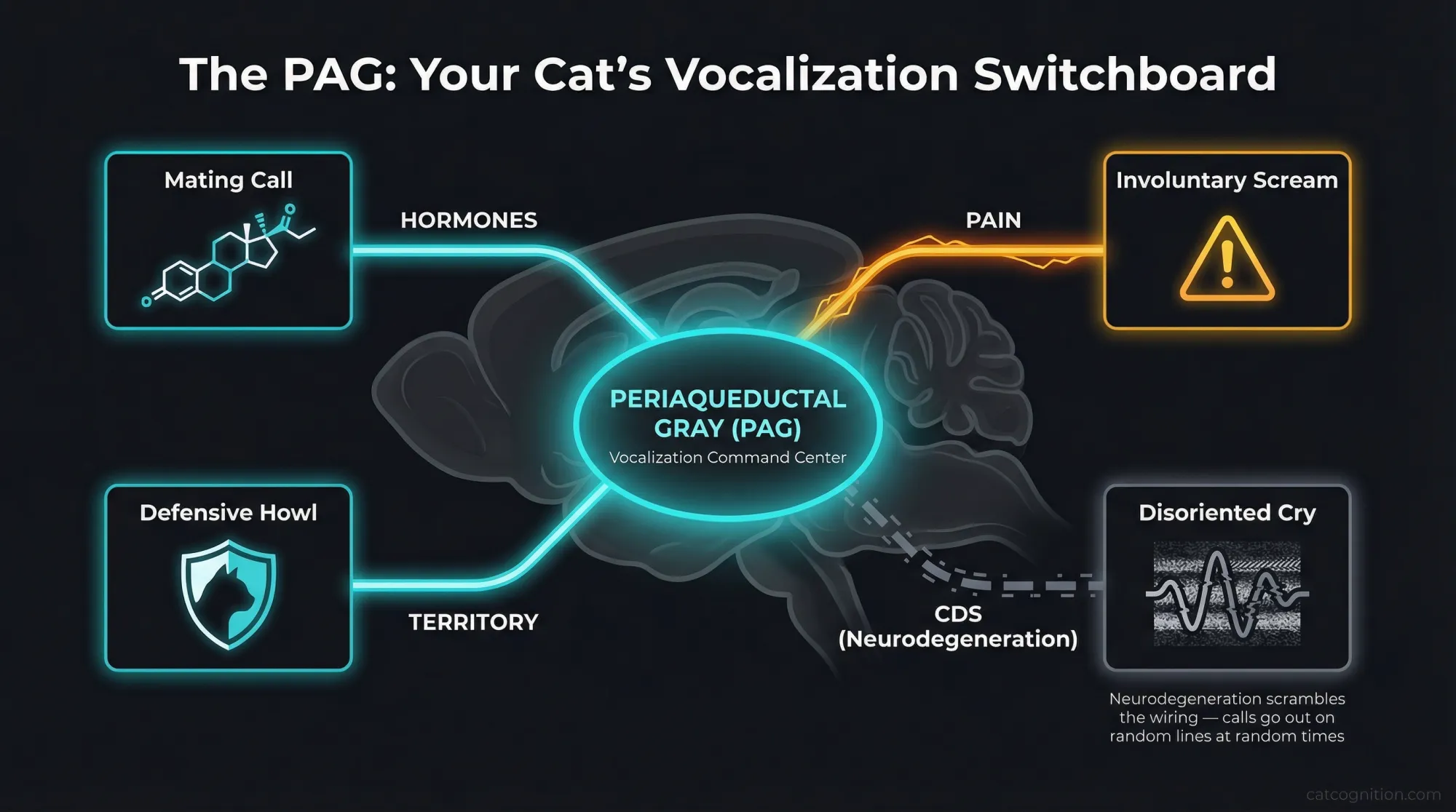
The periaqueductal gray (PAG) functions as the brain's vocalization command center. Different sub-regions of the PAG produce different call types -- mews, howls, cries, and hisses -- depending on which neurons fire. The PAG also processes pain signals. This neuroanatomical overlap explains why severe pain triggers involuntary screaming: the pain signal activates the PAG's vocal output circuitry directly. Think of the PAG like a switchboard with separate lines for each call type -- pain routes to the scream line, hormones route to the mating-call line, and cognitive degeneration scrambles the wiring so calls go out on random lines at random times. To understand how hissing fits into this vocal repertoire, the PAG routes defensive arousal to its own dedicated line.
The Feline Grimace Scale, developed and validated by Dr. Marina C. Evangelista at the Universite de Montreal, provides a practical tool for assessing pain in cats. The scale uses five observable action units -- ear position, orbital tightening, muzzle tension, whisker position, and head position. A score of 4 or higher out of 10 indicates the cat needs pain medication. Critically, the FGS does not require touching the patient -- owners can assess pain from observation alone (Evangelista et al., 2019).
Nighttime vocalization in senior cats should always be evaluated by a veterinarian before assuming a behavioral cause. The medical differential -- hyperthyroidism, hypertension, urinary blockage, severe pain -- must be ruled out first. Urinary blockage is a life-threatening emergency. If a cat is screaming while straining to urinate, showing a firm painful abdomen, or persistently licking the genital area, this requires an immediate emergency veterinary visit. Without treatment, toxins build up in the bloodstream causing serious complications within 24-48 hours. Never adopt a "wait and see" approach with sudden-onset screaming in a previously quiet cat.
When to call the vet immediately:
| Sign | Possible Emergency | Urgency |
|---|---|---|
| Screaming while straining to urinate | Urinary blockage | Emergency (hours) |
| Screaming with hunched posture, abdominal guarding | Internal pain, injury | Emergency (hours) |
| Sudden screaming in a previously quiet cat | Acute pain, injury, stroke | Emergency (same day) |
| Vocalization with dilated pupils or apparent vision loss | Hypertension, retinal detachment | Urgent (same day) |
| New nighttime vocalization in any cat over 10 | Hyperthyroidism, hypertension, CDS | Schedule this week |
Can Separation Anxiety Cause Caterwauling?
What researchers call separation-related problems -- commonly known as separation anxiety -- affects 13.45% of domestic cats, and 63.33% of affected cats display excessive vocalization, the second most frequently reported behavioral sign after destructive behavior (66.67%) -- making separation-related distress a significant but frequently overlooked cause of nighttime caterwauling. Separation anxiety vocalization typically occurs when the owner is absent, asleep, or behind a closed door, distinguishing separation-related caterwauling from other caterwauling causes.
A 2020 study published in PLoS ONE found that separation-related problems in cats are more common than previously recognized. Unlike the popular misconception that cats are indifferent to their owners' presence, research on feline attachment bonds demonstrates that cats form genuine attachment relationships. When those bonds are disrupted -- by closed bedroom doors, schedule changes, or owner absence -- anxious vocalization can result.
Separation anxiety caterwauling shares a key feature with the nighttime amplification effect: it intensifies when other stimulation drops away. A cat that copes adequately during a busy household's waking hours may begin vocalizing once the house goes quiet and the bedroom door closes. The reduced stimulation that comes with nighttime removes the environmental buffers that mask the underlying anxiety during the day.
📊 The Evidence:
"13.45% of cats in a systematic study showed separation-related problems, with 63.33% of those cats displaying excessive vocalization as a primary behavioral sign." -- PLoS ONE, 2020
Distinguishing separation anxiety from learned behavior: If the vocalization stops immediately when the owner opens the door or provides attention, and the cat shows no other signs of distress (pacing, house-soiling, over-grooming, destructive behavior), the cause is more likely operant conditioning than genuine anxiety. Separation anxiety cats typically show multiple concurrent behavioral signs beyond vocalization alone.
Is Your Cat's Caterwauling a Learned Behavior?
Cat vocalization is under operant control -- reinforcement schedules directly shape the frequency, intensity, and duration of caterwauling. When owners respond to nighttime vocalization with food, attention, or even eye contact, the cat learns that vocalizing produces a reward, creating a self-reinforcing cycle that escalates over time. One documented case recorded at least 208 consecutive meows in a single operantly conditioned episode (the observer stopped counting).
This mechanism was established as early as 1963 by Molliver, who demonstrated that cats trained under reinforcement schedules miaowed rapidly during reinforcement periods and much less during non-reinforcement periods (Molliver, 1963). The principle applies directly to the 3 AM caterwauling scenario: a cat meows, the owner gets up to feed the cat or tell the cat to be quiet, and the cat learns that vocalizing at 3 AM produces a reliable response.
A 2023 case study documented by Kate Luse in the IAABC Foundation Journal illustrates the pattern and its resolution. A three-year-old spayed female DSH had been inadvertently trained to vocalize excessively -- medical workup was completely normal (bloodwork, thyroid, blood pressure, urinalysis all clear). The intervention used a three-part protocol:
- Extinction: Never reward the vocalization. No food, no attention, no eye contact, no verbal response.
- Differential reinforcement of incompatible behavior (DRI): Clicker-train silence or a "quiet" cue. Reward the cat for the behavior incompatible with meowing.
- Environmental modification: Autofeeder on timer for pre-dawn hunger, Feliway pheromone diffuser, restricted bedroom access.
The results: 80% reduction in daytime vocalization within two weeks, and normal vocalization levels at two months (Luse, 2023).
The extinction burst warning. When reinforcement stops, a cat will typically increase vocalization intensity before the behavior decreases. This temporary escalation -- called an extinction burst -- is exactly when most owners give in, which resets the entire cycle. Per the JFMS behavioral management guidelines (Halls, 2018), if an owner stops getting out of bed in response to nighttime vocalization, the reinforcement ceases and calling will reduce or stop -- but the owner must expect the behavior to get worse in the short term before improvement begins (Halls, 2018). One reward during the extinction burst resets the cycle completely.
📊 The Evidence:
"Behavioral extinction combined with differential reinforcement of incompatible behavior reduced a cat's excessive vocalization by 80% within two weeks without medication." -- Luse, 2023, IAABC Foundation Journal
Management Protocols by Cause
Each caterwauling cause requires a different intervention. Applying the wrong protocol wastes time and can worsen the behavior -- extinction training on a cat with cognitive dysfunction causes unnecessary distress, while veterinary workups on a cat with a learned vocalization habit will return normal results. Match the cause to the protocol.
CDS and Medical Causes
For any senior cat (10+ years) with new nighttime vocalization, the first step is always a veterinary workup:
| Test | Purpose |
|---|---|
| Bloodwork (complete blood panel + thyroid T4) | Check for hyperthyroidism, the most common medical mimic of CDS vocalization |
| Blood pressure measurement | Rule out hypertension, which causes restlessness and vocalization through CNS stimulation |
| Urinalysis | Check kidney function and rule out urinary tract issues |
| VISHDAAL behavioral assessment | Evaluate for additional CDS behavioral signs beyond vocalization |
If CDS is diagnosed, management focuses on slowing progression and reducing nighttime distress:
| Intervention | Purpose |
|---|---|
| Night lights in hallways and near litter boxes | Reduce disorientation during nighttime wandering |
| Easier access to food, water, and litter (no jumping required) | Remove physical barriers that increase confusion and frustration |
| Antioxidant-enriched diet (omega-3 fatty acids, vitamin E) | Support cognitive function and slow neurodegeneration |
| Consistent daily routine | Minimize distress from schedule changes, which worsen CDS symptoms |
| Cognitive enrichment during the day (puzzle feeders, novel scents) | Maintain neural engagement and reduce nighttime restlessness |
| Pheromone diffusers (Feliway) in sleeping areas | Reduce anxiety and promote calm during overnight hours |
| Regular veterinary screening every 6-12 months | Monitor CDS progression (standard recommendation for cats 11+) |
Hormonal Causes
Spay or neuter. No behavioral workaround exists for hormonally driven caterwauling. This is the single most effective intervention in all of feline behavioral medicine for this specific problem.
Learned Behavior
Only appropriate after medical causes are ruled out:
| Intervention | Detail |
|---|---|
| Maintain the extinction protocol with zero exceptions | No food, attention, or eye contact in response to vocalization |
| Use an autofeeder on a timer | Eliminates pre-dawn hunger demands that trigger vocalization |
| Structured evening play session (minimum 15 minutes) | Active predatory play before bedtime reduces nighttime restlessness |
| Restrict bedroom access | Remove the target audience if the cat vocalizes at the bedroom door |
| Never punish the cat | Punishment increases anxiety and worsens vocalization |
Separation Anxiety
| Intervention | Detail |
|---|---|
| Veterinary behaviorist consultation | Recommended for moderate to severe separation-related cases |
| Gradual desensitization to triggers | Slowly reintroduce closed doors and departure cues |
| Environmental enrichment | Reduce the cat's dependence on owner presence |
| Anxiolytic medication (veterinarian-prescribed) | Consider for severe cases unresponsive to behavioral modification |
| Background noise during absences | Radio or white noise reduces the silence that triggers anxiety |
Moon has never caterwauled -- which tracks perfectly with the Triage Matrix. He was neutered at six months, he is under ten years old, and he has no medical conditions that would trigger pain-related vocalization. What he does do is a short, insistent meow at exactly 5:15 AM if his automatic feeder has not dispensed breakfast yet. That 5 AM crepuscular peak is real -- I have watched his internal clock activate like an alarm, shifting from deep sleep to "standing on my chest" in under thirty seconds. The autofeeder was the single best investment for my own sleep quality. Before the autofeeder, responding to that meow every morning was textbook operant conditioning -- she meowed, I fed her, and the meow got earlier and louder every week.
Key Terms Used
| Term | Definition |
|---|---|
| Caterwauling | A prolonged, repetitive howl distinct from standard meowing; classified in phonetics as an "opening-closing mouth" vocalization lasting significantly longer than a typical meow |
| Periaqueductal gray (PAG) | The midbrain region that serves as the command center for both vocalization output and pain processing in cats |
| Estrus | The "heat" phase of a female cat's reproductive cycle, driven by estradiol hormones and triggered by photoperiod (daylight length) |
| Cognitive Dysfunction Syndrome (CDS) | A progressive neurodegenerative condition in aging cats analogous to Alzheimer's disease in humans; diagnosed via the VISHDAAL framework |
| VISHDAAL | Updated CDS diagnostic acronym: Vocalization, Interaction changes, Sleep-wake cycle alterations, House-soiling, Disorientation, Activity changes, Anxiety, Learning/memory deficits |
| Extinction burst | A temporary increase in behavior intensity when reinforcement is removed -- the vocalization gets worse before it gets better |
| Operant conditioning | A learning process where behavior frequency is modified by consequences -- reinforcement increases the behavior, removal of reinforcement decreases it |
| Crepuscular | Active primarily during dawn and dusk; cats have bimodal activity peaks around 5 AM and 9 PM |
| Sundowning | Increased confusion, agitation, and vocalization during late afternoon and evening hours in individuals with cognitive dysfunction |
| Feline Grimace Scale (FGS) | A validated pain assessment tool using five facial action units; a score of 4/10 or higher indicates need for pain medication |
See the full Cat Cognition Glossary ->
Frequently Asked Questions
Is caterwauling at night always a sign something is wrong?
Not always. Intact (unspayed/unneutered) cats caterwaul as normal reproductive behavior -- the behavior is biologically driven and not a sign of distress. However, in spayed or neutered cats, nighttime caterwauling that is new, sudden, or escalating almost always signals an underlying medical or behavioral cause. The key diagnostic question is whether the behavior is new or has changed in character. Any new nighttime vocalization in a cat over 10 years old warrants a veterinary evaluation.
How do I stop my cat from caterwauling without punishing the cat?
Punishment increases anxiety and worsens vocalization -- never yell at, spray, or physically discipline a caterwauling cat. The evidence-based approach depends on the cause. For learned behavior, use extinction (never reward the vocalization) combined with differential reinforcement of incompatible behavior (reward silence or a calm behavior). For CDS, use environmental modifications like night lights, easier resource access, and pheromone diffusers. For medical causes, treat the underlying condition. For hormonal causes, spay or neuter. Always rule out medical causes before starting behavioral interventions.
At what age should I worry about cognitive dysfunction causing caterwauling?
Peer-reviewed research shows 28% of cats aged 11-14 develop at least one behavioral sign of CDS, rising to 50% of cats over 15 years. Any cat over 10 years showing new nighttime vocalization should receive a veterinary workup including thyroid panel and blood pressure check. The VISHDAAL framework places vocalization as the number one clinical sign of CDS. Median age at diagnosis in one Edinburgh study was 15.9 years, but signs can appear as early as age 10.
What is the difference between caterwauling and normal meowing?
Caterwauling is a prolonged, repetitive howl produced by gradually opening the mouth wider and closing it again. A standard meow is a short vocalization lasting approximately 0.42 seconds with a fundamental frequency of 221-1185 Hz. Caterwauling lasts significantly longer, often repeating in sustained sequences, and typically signals hormonal, cognitive, or pain-related distress rather than the social communication that drives most meowing. Dr. Susanne Schotz's phonetic classification system at Lund University categorizes both as "opening-closing mouth" vocalizations, but caterwauling is acoustically distinct in duration, repetition pattern, and pitch contour. For a full breakdown of cat vocalization types, see our guide to every level of cat sound explained.
Can my indoor cat caterwaul year-round even without outdoor cat contact?
Yes. Indoor cats exposed to 14 or more hours of artificial lighting for at least two months can cycle into estrus year-round, regardless of season. In natural conditions, cats are seasonal breeders cycling from February through September in the Northern Hemisphere. But most indoor environments exceed 14 hours of combined natural and artificial light daily. An unspayed indoor cat can therefore experience continuous estrous cycling -- and continuous estrus-driven caterwauling -- throughout the year.
Is hearing loss really a major cause of caterwauling in elderly cats?
The evidence is weaker than commonly presented. Dr. George Strain at Louisiana State University found that no clinical studies on feline presbycusis (age-related hearing loss) have been reported, and unpublished data suggests presbycusis is uncommon in cats and much less severe than in dogs. While hearing loss may contribute to increased vocalization in some elderly cats, it should not be assumed as a primary cause. Cognitive dysfunction, hyperthyroidism, and hypertension are better-supported explanations for nighttime vocalization in senior cats and should be investigated first.
How long does an extinction burst last when I stop responding to nighttime caterwauling?
When reinforcement stops, a cat will typically increase vocalization intensity in the short term before the behavior begins to decrease. The exact duration varies by individual cat and how long the behavior has been reinforced. The critical rule: one reward during the extinction burst -- getting up to feed the cat, yelling at the cat, or even making eye contact -- resets the entire operant conditioning cycle. Consistency is absolute. The extinction protocol should only be used after medical causes have been thoroughly ruled out by a veterinarian.
Should I use calming supplements or essential oils to stop caterwauling?
Do not use essential oils around cats -- many essential oils are toxic to felines, and cats lack the liver enzymes needed to metabolize certain compounds safely. Calming supplements and pheromone diffusers (such as Feliway) may provide supplemental benefit as part of a broader management plan, but they are not substitutes for veterinary evaluation in senior cats or cats with sudden-onset vocalization. Address the underlying cause first. Pheromone diffusers have the strongest evidence base among non-pharmaceutical calming interventions.
Key Takeaways
Caterwauling maps to six distinct biological triggers, each requiring a different intervention. Diagnose by matching the cat's age, reproductive status, and onset pattern to the correct cause -- then apply the targeted protocol. Rule out medical emergencies first, especially in senior cats or cases of sudden onset.
- Diagnose by demographics, not by guessing: The CatCog Caterwauling Triage Matrix matches caterwauling cause to cat profile -- age, reproductive status, and onset pattern determine the most likely trigger and the correct intervention.
- Nighttime makes everything louder: Cats are crepuscular with activity peaks at approximately 5 AM and 9 PM, reduced ambient noise amplifies territorial and mating calls, cognitive dysfunction sundowning peaks in the evening, and artificial lighting can maintain year-round estrus cycling in indoor cats.
- Vocalization is the number one sign of cognitive dysfunction: The VISHDAAL framework places vocalization first among CDS behavioral signs, with 40% of CDS-positive cats showing inappropriate vocalization as the most common symptom. Any cat over 10 with new nighttime vocalization needs a veterinary workup.
- Never ignore sudden-onset screaming: Pain-related caterwauling signals severe distress. Urinary blockage can become fatal within 24-48 hours. Rule out medical emergencies before considering behavioral causes.
- The extinction burst is where most owners fail: When reinforcement stops, caterwauling temporarily gets worse before getting better. One reward during the escalation phase resets the entire operant conditioning cycle. The extinction protocol only works with absolute consistency -- and only after medical causes are ruled out.
Explore related topics in our guide to cat communication.
Sources
- Potential Causes of Increased Vocalisation in Elderly Cats with Cognitive Dysfunction Syndrome - Cerna, 2020, University of Edinburgh (Link)
- Cognitive Dysfunction in Cats: A Syndrome we Used to Dismiss as 'Old Age' - Landsberg et al., 2010 (Link)
- Survey of Risk Factors and Frequency of Clinical Signs Observed with Feline Cognitive Dysfunction Syndrome - MacQuiddy, 2022, Colorado State University (Link)
- Cognitive Dysfunction in Cats: Update on Neuropathological and Behavioural Changes Plus Clinical Management - Sordo & Gunn-Moore, 2021, University of Edinburgh (Link)
- Female Reproduction (The Cat: Clinical Medicine and Management) - Little, 2011 (Link)
- Normal Feline Reproduction: The Queen - Johnson, 2022, Auburn University (Link)
- Operant Control of Vocal Behavior in the Cat - Molliver, 1963 (Link)
- Tools for Managing Feline Problem Behaviours: Environmental and Behavioural Modification - Halls, 2018, JFMS (Link)
- Cognitive Dysfunction - Cornell Feline Health Center, 2024 (Link)
- Cat Vocalisation Types (Meowsic Project) - Schotz, Lund University (Link)
- Hearing Disorders in Cats: Classification, Pathology and Diagnosis - Strain, 2017, Louisiana State University (Link)
- Facial Expressions of Pain in Cats: The Development and Validation of a Feline Grimace Scale - Evangelista et al., 2019, Universite de Montreal (Link)
- Case Study: Excessive Vocalization in a Cat - Luse, 2023, IAABC Foundation Journal (Link)
- Microstimulation in Different Parts of the Periaqueductal Gray Generates Different Types of Vocalizations in the Cat - Subramanian et al., 2020, Journal of Voice (Link)
- Hypertension (High Blood Pressure) - Cornell Feline Health Center, 2024 (Link)
- Cognitive Dysfunction Syndrome in Cats - International Cat Care, 2024 (Link)
- Cat Urinary Blockage: Emergency Signs and Critical Steps - Garden State Veterinary Specialists, 2024 (Link)
- Older Cats with Behavior Problems - ASPCA, 2024 (Link)
- Indoor Pet Initiative - Ohio State University (Dr. Tony Buffington) (Link)