Why Does My Cat Lick Me? The Science Behind Feline Grooming
Cats lick humans as social grooming behavior. Research shows 91.6% of cat grooming is one-directional, with higher-ranking cats grooming subordinates to signal trust and group membership.

Table of Contents
- What Science Reveals About Cat Licking Behavior
- Why Higher-Ranking Cats Do the Grooming
- The Neuroscience of Why Cats Lick
- How Cat Tongue Structure Relates to Licking Behavior
- Why Cats Lick You Then Bite You
- What Displacement Grooming Reveals About Your Cat
- The CatCog Method: A Three-Part Licking Assessment
- Why Cat Licking Creates Shared Scent Profiles
- The Deeper Meaning Behind Your Cat's Grooming
- Key Terms Used
- Frequently Asked Questions
- Key Takeaways
- Sources
Why Does My Cat Lick Me? The Science Behind Feline Grooming
Cats lick humans as a social grooming behavior inherited from wild cat allogrooming patterns. When a cat licks you, the cat is incorporating you into their social group, depositing pheromones to create a shared scent profile, and triggering endorphin release that makes grooming self-reinforcing. Cat licking is NOT simply "affection" - research shows higher-ranking cats groom subordinates more often, making feline grooming a complex social negotiation that communicates trust, ownership, and group membership. For more on cat-human emotional connections, explore our complete guide to cat bonding.
What Science Reveals About Cat Licking Behavior
Cat licking is allogrooming - social grooming behavior that evolved as a bonding mechanism in group-living cats. According to Dr. John Bradshaw of the University of Bristol, the behaviors binding cat social groups together, including mutual grooming, have obvious parallels in how pet cats behave toward owners. When cats rub against human legs and lick human hands, cats extend ancestral social repertoire to human family members.
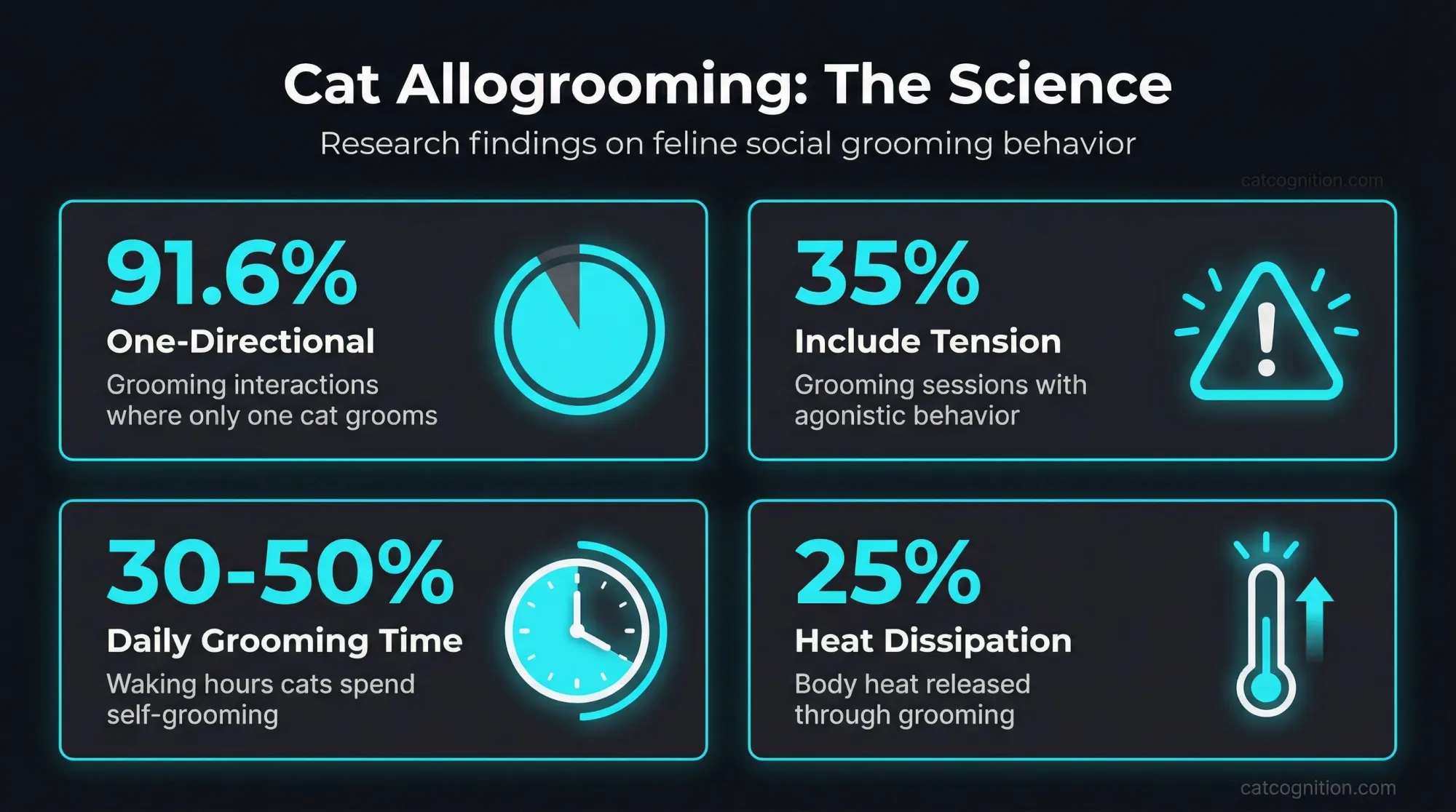
But the word "mutual" is misleading when describing cat grooming. In one 1998 study published in the Journal of Ethology, Dr. Ruud van den Bos found that 91.6% of cat grooming interactions were one-directional among a group of confined cats. One cat grooms while the other cat simply receives the grooming - no reciprocation occurs. However, more recent interpretations emphasize allogrooming as primarily affiliative bonding behavior rather than a dominance display.
The Evidence:
"According to research, 91.6% of cat grooming interactions are unidirectional, challenging the assumption that grooming represents mutual exchange between cats."
This finding transforms how cat owners should interpret licking behavior. When a cat licks a human, the cat has positioned that human within the cat's social hierarchy - typically as a trusted subordinate worthy of the cat's grooming investment.
Why Higher-Ranking Cats Do the Grooming
Higher-ranking cats groom subordinates more often, with 35% of allogrooming interactions including agonistic behavior. Cat allogrooming may serve as a conflict-redirection strategy in feline social groups. Modern experts note that cats do not form strict hierarchical structures like dogs or primates, and allogrooming is now understood primarily as affiliative bonding rather than dominance signaling.
When a cat licks you, the cat may be communicating something far more complicated than simple love. The cat is asserting social position while simultaneously signaling that overt conflict is unnecessary. This explains why some cats lick intensely and then suddenly bite - the grooming session can tip into tension when the underlying hierarchy becomes activated.
The Evidence:
"In one 1998 study, higher-ranking cats groomed subordinates more often, though modern interpretations emphasize allogrooming as primarily affiliative bonding rather than dominance signaling."
Think of cat grooming as a diplomatic gesture wrapped in a soft tongue. The cat is communicating: "I'm in charge here, but there's no need for conflict." This is classic cat logic - social management through tactile contact rather than aggression.
Understanding this hierarchy dynamic helps explain why your cat stares at you - another behavior rooted in social positioning and communication.
The Neuroscience of Why Cats Lick
Every time a cat licks, the cat's brain releases endorphins - neurochemicals that create a natural reward sensation. Grooming creates a self-reinforcing behavioral loop where the act of licking produces pleasure, which motivates more licking. This endorphin release explains why cats spend between 30 and 50 percent of their waking hours engaged in autogrooming behavior.
The endorphin mechanism means cats don't lick only from social instinct. Cats lick because the behavior feels good neurochemically. When cats groom humans, cats experience the same reward pathway activation that occurs during self-grooming. This neurochemical high reinforces the cat's motivation to groom trusted social partners repeatedly.
According to Cats Protection UK, "The act of licking causes the release of 'feel good' hormones, called endorphins, in their brains. This gives them a natural 'high' so it's understandable that they may want to do it at every opportunity."
Moon tends to lick my hand very rarely these days. It's usually only during a petting session, and even then, it only lasts 5-10 seconds. This is in stark contrast to how much time he spends licking himself. Perhaps it has something to do with the fact that he views me as a higher ranking cat so doesn't feel as though he should be licking me? I'm happy to not experience too much of that sandpaper sensation though so I consider it a win-win!
How Cat Tongue Structure Relates to Licking Behavior
A 2018 study published in the Proceedings of the National Academy of Sciences by researchers Alexis C. Noel and David L. Hu at Georgia Tech discovered something remarkable about cat tongues. Cat tongue papillae - the tiny spines that make cat tongues feel like sandpaper against human skin - are hollow structures called cavo papillae. These hollow spines function as scoops that wick saliva deep into fur during grooming.
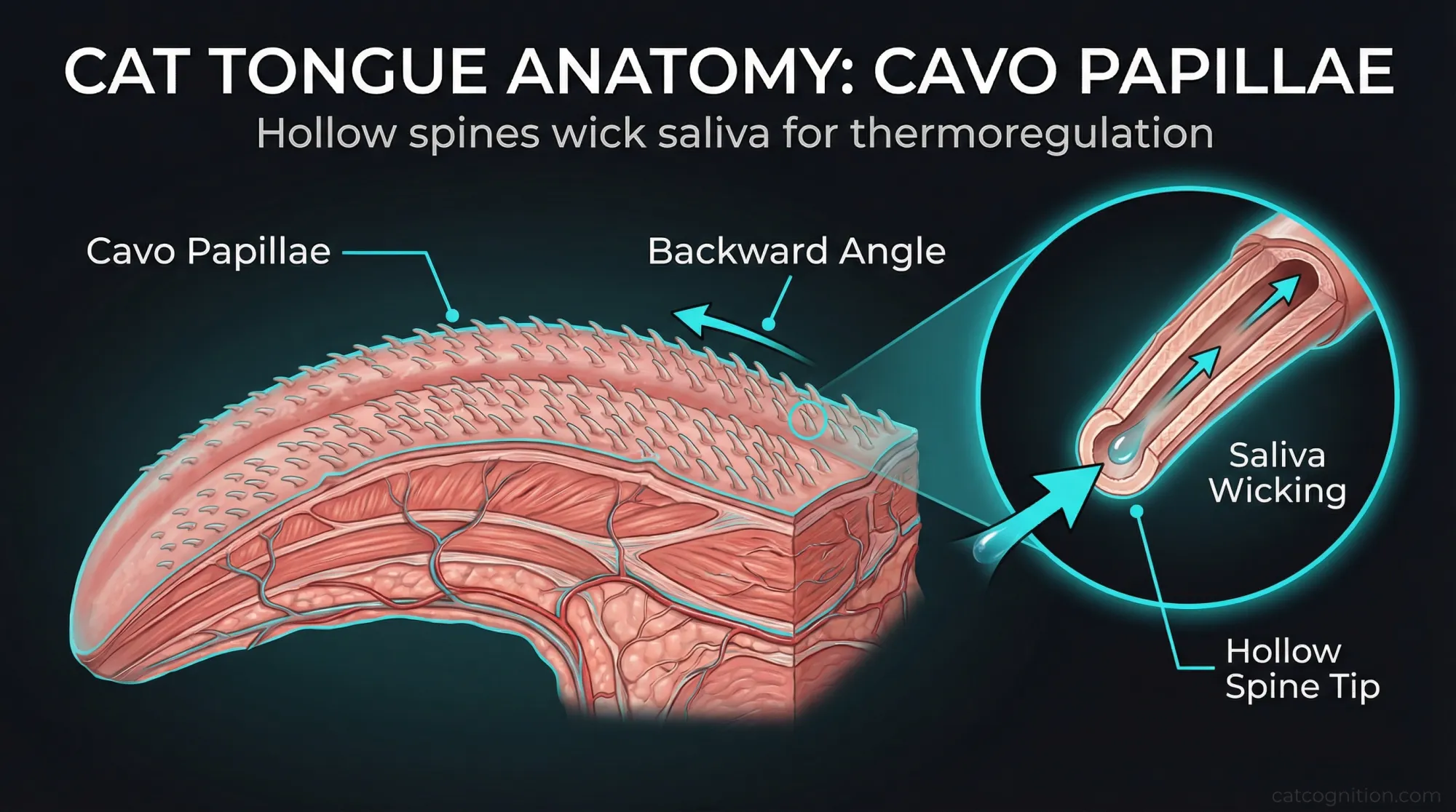
The thermoregulation implications are significant. Through this saliva-wicking mechanism, cats dissipate approximately 25% of their required daily heat through grooming. Cat grooming is partially a cooling system - cats regulate body temperature by spreading saliva across fur, where evaporation removes heat from the body.
The Evidence:
"Cat tongue papillae are hollow spines called cavo papillae that wick saliva deep into fur, allowing cats to dissipate 25% of their required daily heat through grooming."
When cats lick human skin, cats are extending a behavior that normally serves fur maintenance and thermoregulation purposes to their relationship with humans. This extension of grooming behavior to human skin suggests the human has earned significant social standing within the cat's group.
Why Cats Lick You Then Bite You
The lick-to-bite pattern confuses many cat owners, but the explanation involves understanding the overstimulation threshold. Cat nerve endings are incredibly sensitive to repetitive tactile contact. The repetitive motion of licking can shift from pleasant to irritating within seconds as sensory fatigue accumulates.
The initial lick signals positive engagement with the human. But if contact continues past the cat's individual tolerance point, that positive engagement flips to defensive aggression. The bite is not random - the bite is the cat's nervous system responding to sensory overload.
Warning signs that a cat is approaching the overstimulation threshold include dilated pupils, ears rotating backward, and a twitching or lashing tail. When these signals appear, humans should stop interaction immediately and pull hands away slowly. Waiting for the bite means the cat has already crossed into defensive mode. Learning to read cat body language signals helps prevent these situations.
If a cat's licking becomes compulsive, creates bald patches on the cat's own fur, or changes suddenly in frequency or intensity, that warrants a veterinary visit rather than behavioral interpretation. Excessive licking can signal pain, allergies, nausea, or anxiety disorders that require medical attention. Every cat has a different tolerance threshold - what triggers overstimulation in one cat may be completely acceptable to another cat.
What Displacement Grooming Reveals About Your Cat
Cat owners often notice that cats will lick a human and then immediately begin grooming themselves. This behavior is not rejection or disgust at the human's taste. This behavior is displacement behavior - a mechanism where cats process conflicting emotions through a calming behavior.
When an interaction creates mild uncertainty or emotional arousal in a cat, the cat redirects to self-grooming because the behavior releases those same endorphins discussed earlier. Displacement grooming is self-soothing, not rejection. The behavior parallels how humans might fidget, scratch their heads, or check their phones when experiencing social uncertainty.
The Evidence:
"Displacement grooming after petting is not rejection but a cat processing conflicting emotions through endorphin-releasing self-soothing behavior."
Understanding displacement grooming transforms how owners interpret post-interaction grooming. The cat is not removing human scent in disgust. The cat is regulating emotional state through a behavior that provides neurochemical comfort.
The CatCog Method: A Three-Part Licking Assessment
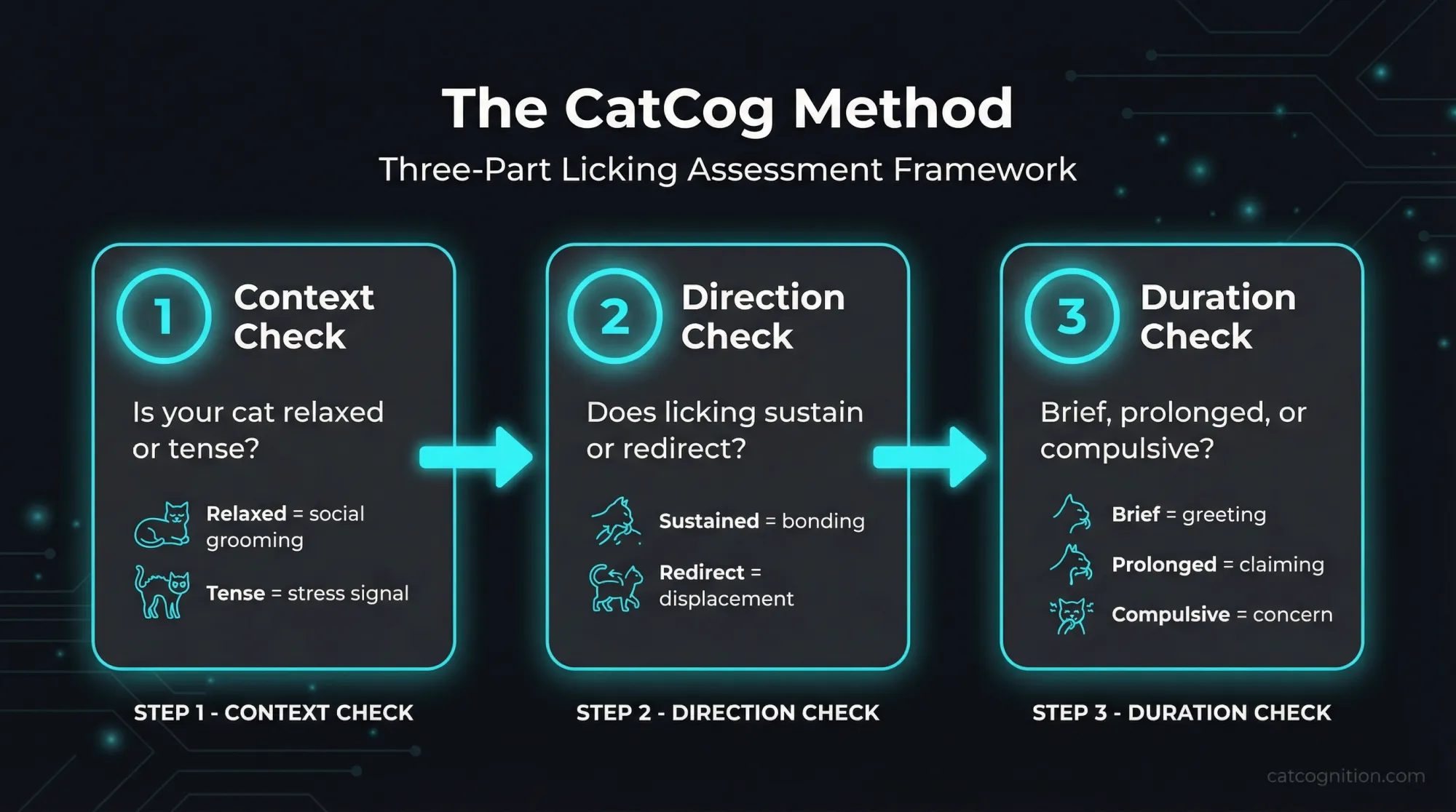
Decoding what any specific licking episode means requires systematic assessment rather than guessing among generic explanations. The CatCog Method provides a three-part framework for interpreting cat licking behavior in context.
Part One: The Context Check
Observe whether the cat is relaxed or tense before and during licking. Relaxed posture combined with slow blinks indicates genuine social grooming - the cat is bonding and affiliating. Tense body positioning, wide pupils, or flattened ears may indicate stress-driven licking or impending overstimulation. Context establishes the behavioral baseline.
Part Two: The Direction Check
Note whether licking is directed sustainably at the human or whether the cat immediately redirects to self-grooming afterward. Direct, sustained licking functions as social grooming - the cat is investing in the relationship. Immediate self-grooming following human contact indicates displacement behavior - the cat is processing emotional complexity. Direction reveals function.
Part Three: The Duration Check
Assess how long the licking continues. Brief licks function as acknowledgment - a quick "hello, group member" gesture. Prolonged grooming indicates claiming and bonding - the cat is investing significant social effort. Excessive, compulsive licking that cannot be interrupted may indicate stress requiring behavioral or veterinary intervention. Duration reveals intent.
Why Cat Licking Creates Shared Scent Profiles
When cats groom humans, cats deposit pheromones from mouth-area scent glands onto human skin. This pheromone transfer creates what researchers call a shared scent profile - a chemical signature that marks the human as belonging to the cat's social group.
As Pam Johnson-Bennett of Cat Behavior Associates explains, cats who are familiar and friendly often engage in allogrooming to strengthen their bond and create a common group scent. The mixing of scents through grooming results in formation of a group social odor that reassures cats that their social group is stable.
This scent-marking function explains why cats may lick specific body parts more than others. Cats target areas like hands, face, and hair because these locations offer strong opportunities for scent exchange. Human faces and hands contain oils and skin secretions that mix effectively with feline pheromones to create the shared chemical identity that signals group membership.
The scent-marking behavior connects to other affiliation signals like bunting (head-butting) and allorubbing, all of which create the shared colony scent that defines family membership.
The Deeper Meaning Behind Your Cat's Grooming
According to cat behavior experts, adult cats typically lick individuals they trust and are not in competition with. When a cat licks a human, the cat has made a significant social decision: this human is safe, this human is family, and this human is worth the precious thermoregulation resources that grooming requires.
The Evidence:
"According to cat behavior experts, adult cats typically lick other cats they trust and are not in competition with, and this grooming behavior may extend to humans the cat considers social group members."
That calculation is not simple affection. That calculation is a biological commitment to relationship. The cat is incorporating the human into feline social structure, claiming the human as a trusted group member, and depositing chemical signals that announce shared identity to any other cat that might encounter that human.
Understanding cat licking through this lens transforms the experience. The sandpaper tongue against skin represents evolutionary machinery operating in service of social bonding. Each lick is a small investment of biological resources in the human-cat relationship.
If you want to strengthen this bond further, understanding how to pet a cat properly ensures your reciprocal touch reinforces rather than disrupts the relationship. You can also learn to recognize the signs your cat loves you beyond just licking behavior.
Key Terms Used
| Term | Definition |
|---|---|
| Allogrooming | Social grooming between two individuals. In domestic cats, allogrooming typically flows from higher-ranking to lower-ranking individuals and strengthens social bonds. |
| Displacement behavior | Behavior occurring when an animal experiences conflicting motivations, such as self-grooming after uncertain social interaction. Releases endorphins for self-soothing. |
| Cavo papillae | Hollow, backward-facing spines on cat tongues discovered in 2018. These scoop-shaped structures wick saliva into fur, enabling heat dissipation through evaporation. |
| Overstimulation threshold | The point where repetitive tactile contact shifts from pleasant to irritating, triggering defensive responses like biting. Varies by individual cat. |
| Pheromones | Chemical signals from scent glands conveying identity, emotional state, and territory. Cat licking deposits pheromones creating shared "group scent" with humans. |
Frequently Asked Questions
Why does my cat lick my face specifically?
Cats target human faces because the face is where cats focus attention during cat-to-cat allogrooming. In feline social groups, grooming typically concentrates around the head and neck areas. Human faces also contain natural skin oils and mild salt from perspiration that cats may find appealing to taste. The face represents a high-value grooming target that signals strong social affiliation.
Why does my cat lick my hair?
Cat attraction to human hair involves multiple factors. Hair texture may trigger grooming instincts developed for fur maintenance. Hair also absorbs scents from products, food, and environment that cats find interesting to investigate through licking. Some cats may be attracted to specific shampoo or styling product ingredients. Hair licking often indicates strong social bonding rather than taste preference. For a deeper exploration of this behavior, see our article on why cats eat hair.
Is it safe to let my cat lick me?
For most healthy humans, cat licking is safe. Cat saliva does contain bacteria, but transmission of illness through casual licking is uncommon. Humans with compromised immune systems, open wounds, or allergies should exercise more caution. Avoid allowing cats to lick areas with fresh cuts or skin conditions. If a cat bite occurs during licking, clean the wound thoroughly as bite wounds carry higher infection risk than licking contact.
Why does my cat lick me then run away?
Running after licking often indicates that the licking episode triggered slight arousal or uncertainty in the cat. The cat may be processing the social interaction and choosing to create distance while self-regulating. Running may also follow overstimulation - the cat reached tolerance threshold and disengaged before defensive behavior became necessary. This pattern is normal and not cause for concern.
Why does my cat only lick me and not other family members?
Cats often show licking preference based on social rank within the household, scent profiles of individual humans, or learned associations between specific humans and positive outcomes. The preferred human may occupy a particular position in the cat's social hierarchy that makes grooming appropriate. Alternatively, the preferred human's skin chemistry, lotions, or residual food scents may be more appealing to that specific cat.
Can excessive licking indicate a health problem?
Yes. Compulsive licking that creates bald patches, skin irritation, or cannot be interrupted may indicate underlying medical issues including pain, nausea, allergies, or anxiety disorders. Sudden increases in licking frequency or intensity warrant veterinary evaluation. Psychogenic alopecia - hair loss from stress-induced overgrooming - is a recognized feline condition that requires behavioral and sometimes pharmaceutical intervention.
Why does my cat lick me when I pet him?
Licking during petting represents reciprocal social grooming behavior. The cat is returning the tactile social contact you initiated. This mutual grooming pattern strengthens the social bond between cat and human. Cats that lick during petting are typically demonstrating comfort, trust, and positive association with the human's touch. However, monitor for signs of approaching overstimulation if licking intensity increases suddenly.
Why does my cat lick blankets or fabric instead of me?
Fabric licking may indicate self-soothing behavior, particularly if the cat was weaned too early from the mother cat. Blanket licking and suckling can persist into adulthood as a comfort behavior. The texture of certain fabrics may trigger grooming instincts. Wool-sucking behavior has been reported as particularly common in certain breeds, including Siamese and Burmese cats. Excessive fabric licking should be evaluated for underlying anxiety or nutritional deficiencies.
Key Takeaways
- Cat licking is social hierarchy signaling: Research shows that 91.6% of cat grooming is one-directional, with higher-ranking cats grooming subordinates. When cats lick humans, cats are positioning humans within feline social structure.
- Grooming involves neurochemical reward: Licking triggers endorphin release in cat brains, creating a self-reinforcing behavior loop. Cats lick because grooming produces pleasure, not only because of social instinct.
- Cat tongues serve thermoregulation: The hollow papillae on cat tongues wick saliva into fur, allowing cats to dissipate 25% of daily heat requirements through grooming. Licking humans means cats spend precious cooling resources on the relationship.
- Lick-to-bite patterns indicate overstimulation: When cats bite after licking, the cat's sensory threshold was exceeded. Watch for dilated pupils, backward ears, and tail twitching to prevent bites before they occur.
- Displacement grooming is self-soothing: When cats groom themselves immediately after licking humans, cats are processing emotional complexity through endorphin-releasing behavior - not rejecting the human.
Sources
- The function of allogrooming in domestic cats - van den Bos, R. (1998), Journal of Ethology (Link)
- Cats use hollow papillae to wick saliva into fur - Noel, A.C. & Hu, D.L. (2018), Proceedings of the National Academy of Sciences (Link)
- Normal feline behaviour: and why problem behaviours develop - Bradshaw, J. (2018), Journal of Feline Medicine and Surgery (Link)
- Cats that Lick Too Much - Cornell Feline Health Center (Link)
- Grooming and Temperature - Ohio State University Indoor Pet Initiative (Link)
- Why does my cat lick me? - Cats Protection UK (Link)