Why Is My Cat Meowing So Much? The Science of Excessive Vocalization
Excessive meowing signals medical issues, cognitive decline, environmental stress, or learned behavior. Learn the four diagnostic categories and when to see a vet.

Table of Contents
- Why Do Cats Meow at Humans But Not Each Other?
- What Causes Sudden Excessive Meowing in Cats?
- Why Does My Cat Meow at Night?
- How Can You Tell What Different Cat Meows Mean?
- Do Some Cat Breeds Meow More Than Others?
- When Should You Take a Meowing Cat to the Vet?
- How Can You Reduce Excessive Cat Meowing?
- Key Terms Used
- Frequently Asked Questions
- Key Takeaways
- Sources
Excessive meowing signals one of four causes: medical issues, cognitive decline, environmental stress, or learned behavior. Cats developed meowing specifically for human communication through thousands of years of domestication. When meowing suddenly increases, cat owners should first rule out hyperthyroidism (affecting approximately 10% of cats over 10) and cognitive dysfunction syndrome (affecting 28% of cats aged 11-14) before assuming behavioral causes. The key is identifying whether the meowing pattern changed recently or represents long-standing communication habits.
Excessive meowing is NOT just a personality trait or attention-seeking behavior. Sudden increases in vocalization often signal treatable medical conditions or environmental stress requiring specific intervention rather than dismissal as "chatty cat syndrome." For more on how cats communicate with humans, explore our complete guide to cat communication.
Why Do Cats Meow at Humans But Not Each Other?
Adult cats meow almost exclusively at humans, not at other cats, because meowing evolved through domestication specifically as a human communication tool, as documented by Dr. John Bradshaw in Cat Sense. Wild cats abandon meowing after weaning, relying instead on body language, scent marking, and hissing for adult communication. Domestic cats retained and modified kitten vocalizations because humans responded to vocal signals more reliably than subtle body language cues.
Research by Nicholas Nicastro at Cornell University documented that wild cat vocalizations sound "permanently angry" compared to the more pleasant tones domestic cats produce. Through domestication, cats that produced more appealing sounds likely received more food, shelter, and care from their human companions, creating evolutionary pressure toward what researchers call "infant-like" vocalizations. This neoteny---the retention of juvenile traits into adulthood---explains why adult cats continue meowing despite wild cats abandoning the behavior.
📊 The Evidence:
"Adult cats meow almost exclusively at humans, not at other cats. Wild cat vocalizations sound 'permanently angry' compared to domesticated cats, suggesting domestication selected for more pleasant vocalizations that humans would respond to positively."
As Dr. Susanne Schotz of Lund University explains from her Meowsic research project, cats and their human companions develop a unique vocal "pidgin language" together. Each cat-human pair creates individualized communication patterns through repeated interaction, which explains why one cat's meows sound completely different from another's. This learned communication system means cat owners often recognize their own cat's vocalizations but struggle to interpret unfamiliar cats.
The implications for excessive meowing are significant. When a cat meows excessively, that cat has learned through operant conditioning that vocalization produces desired outcomes. Whether requesting food, demanding attention, or signaling distress, the cat has discovered which specific sounds generate which responses from their particular human.

What Causes Sudden Excessive Meowing in Cats?
Sudden increases in cat vocalization typically indicate medical issues, cognitive decline, environmental changes, or reinforced attention-seeking behavior rather than random personality shifts. The diagnostic approach requires first ruling out medical causes before assuming behavioral explanations, as several serious conditions present with excessive meowing as a primary symptom.
Medical Causes of Excessive Meowing
Hyperthyroidism stands as one of the most common medical causes of increased vocalization in cats over 10 years old. The condition affects approximately 10% of senior cats and causes weight loss despite increased appetite, hyperactivity, and excessive meowing, particularly at night. Hyperthyroid cats often appear restless and vocal because elevated thyroid hormones accelerate metabolism and create a state of constant physiological agitation.
Cognitive Dysfunction Syndrome (CDS) affects approximately 28% of cats aged 11-14 and 50% of cats over 15. Research published in the Journal of Feline Medicine and Surgery found that inappropriate vocalization is the most common symptom of feline cognitive dysfunction, affecting 40% of diagnosed cats. Disorientation (40.5%) and attention-seeking (40.5%) account for the primary triggers of CDS-related vocalization, while pain accounts for only 2.7%.
If your male cat is meowing or straining in the litter box with no urine output, this is a life-threatening urinary blockage requiring immediate emergency veterinary care. Death can occur within 36-48 hours without treatment. Do not wait to see if symptoms improve.
Kidney disease, diabetes, and high blood pressure can all cause increased thirst, discomfort, and subsequent vocalization. Any cat showing increased meowing alongside changes in water consumption, litter box habits, or weight should receive veterinary evaluation with bloodwork.
Cognitive Dysfunction and Nighttime Vocalization
Cats with cognitive dysfunction often exhibit nighttime vocalization patterns similar to "sundown syndrome" observed in human dementia patients. As daylight fades, disorientation and confusion increase, leading to increased vocalizing during evening and nighttime hours. This pattern distinguishes cognitive-related meowing from other causes.
📊 The Evidence:
"Research shows 28% of cats aged 11-14 and 50% of cats over 15 exhibit signs of cognitive dysfunction syndrome. Inappropriate vocalization is the most common symptom, affecting 40% of diagnosed cats, with disorientation and attention-seeking as primary triggers."
Environmental and Behavioral Causes
Environmental stress triggers include recent moves, new pets or family members, changes in household routine, or loss of a companion animal. Cats experiencing separation anxiety may vocalize excessively when owners leave or return. The Ohio State Indoor Pet Initiative notes that some single indoor-housed cats become anxious when left alone for long periods of time.
Learned attention-seeking behavior develops when cats discover that meowing produces desired outcomes. If a cat meows and receives food, opens a door, or gains attention, that behavior strengthens. Over time, the cat may increase vocalization frequency and intensity to maintain the same response level. Understanding these patterns connects to the broader science of cat psychology.
Why Does My Cat Meow at Night?
Nighttime meowing has distinct causes depending on cat age and whether the behavior represents a sudden change or long-standing pattern. Cats are naturally crepuscular, meaning they experience peak activity during dawn and dusk rather than during human sleep hours, which creates inherent scheduling conflicts with their owners.
For cats under 10 years old, nighttime meowing typically signals hunger, boredom, or attention-seeking behavior. These cats may have learned that nighttime vocalization eventually produces a response, even if that response takes longer than daytime meowing. The solution involves environmental enrichment, scheduled play sessions before bedtime, and avoiding reinforcement of nighttime vocalizations.
For cats over 10 years old, sudden onset of nighttime yowling often indicates hyperthyroidism or cognitive dysfunction rather than behavioral causes. Dr. Karen McComb's research at the University of Sussex found that cats embed a hidden frequency around 380 Hz within solicitation purrs, similar to infant distress cries. This frequency exploits mammalian nurturing instincts, making cat vocalizations particularly difficult for humans to ignore.
📊 The Evidence:
"Cats embed a 380 Hz cry-like frequency within solicitation purrs that exploits the same mammalian nurturing response triggered by infant distress cries, making nighttime vocalizations particularly difficult for humans to ignore."
Moon's used to meow a lot. I thought that was just his personality, but it turns out he was requesting things or was bored - there was always a reason behind it. And I didn't pick up on this at the time. But as I educated myself on the subject of cats more it became clear with hindsight. Today, Moon is a relatively quiet cat, meowing infrequently, which I take to mean as he is generally satisfied in all areas of his life!
The Four-Category Meow Classification System
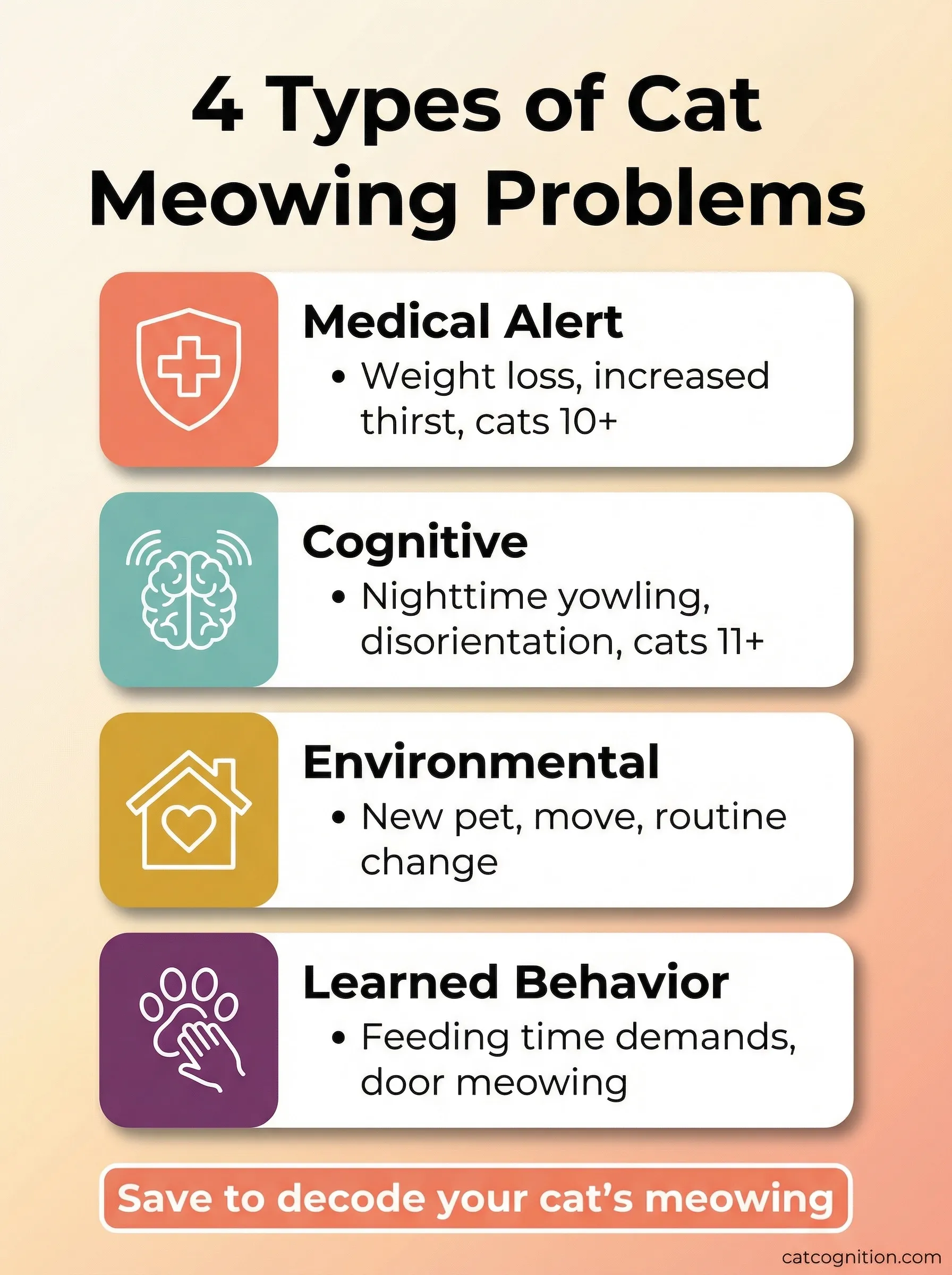
Cat owners can classify excessive meowing into four diagnostic categories based on pattern, timing, and accompanying signs:
| Category | Type | Key Signs | Action |
|---|---|---|---|
| A | Medical Alert | New onset in cats 10+, physical symptoms (weight loss, increased thirst, litter box changes) | Veterinary examination within 24-48 hours |
| B | Cognitive | Nighttime predominance in cats 11+, disorientation, getting lost, wall staring | Veterinary evaluation for CDS; environmental modifications |
| C | Environmental | Onset correlates with move, new pet, schedule change, or companion loss | Identify stressor; gradual reintroduction or enrichment |
| D | Learned Behavior | Long-standing pattern at specific triggers (feeding time, owner arrival, closed doors) | Behavioral modification through extinction and redirection |
How Can You Tell What Different Cat Meows Mean?
Research on human ability to interpret cat vocalizations reveals significant limitations. Humans correctly identify the context of cat meows less than 50% of the time when hearing audio alone, barely better than chance. However, accuracy improves dramatically when body language accompanies vocalization, with correct identification reaching 91.8% for bimodal communication signals combining meowing with physical cues.
This finding has practical implications for understanding excessive meowing. Cat owners relying solely on the sound of meows miss critical contextual information. Observing the cat's body posture, ear position, tail movement, and environmental context provides far more reliable interpretation than audio alone. For a complete guide to reading your cat's signals, see our article on cat body language.
Meow Characteristics and Their Meanings
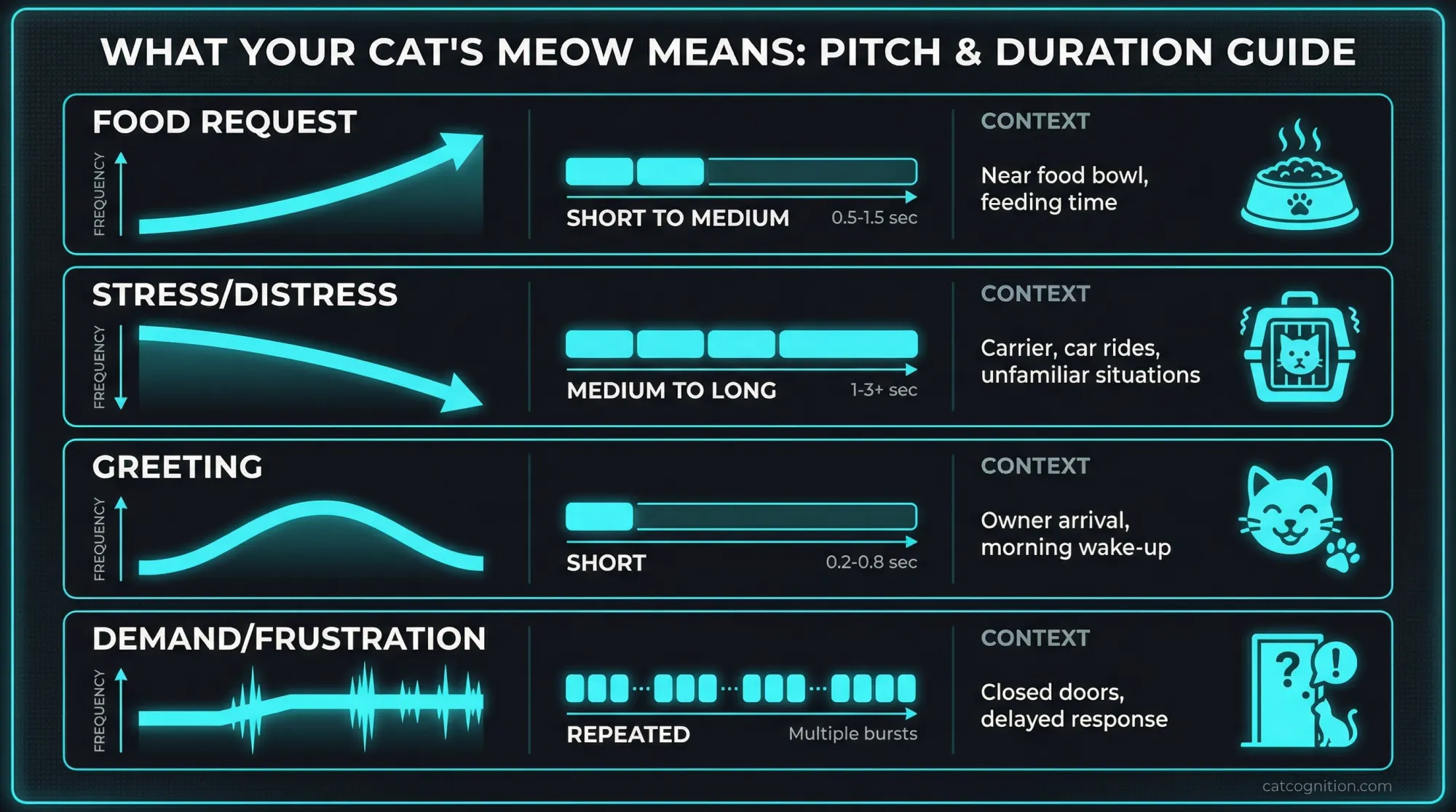
Research by Dr. Susanne Schotz documented that different emotional and contextual states produce distinct vocalization patterns:
| Meow Type | Pitch Pattern | Duration | Typical Context |
|---|---|---|---|
| Food request | Rising (upward inflection) | Short to medium | Near food bowl, feeding time |
| Stress/distress | Falling (downward inflection) | Medium to long | Carrier, car rides, unfamiliar situations |
| Greeting | Rising then falling | Short | Owner arrival, morning wake-up |
| Demand/frustration | Flat or rising with increased intensity | Repeated | Closed doors, delayed response |
📊 The Evidence:
"Research from 2020 found humans correctly identify meow context less than 50% of the time from audio alone. A separate 2024 study (de Mouzon et al.) showed accuracy improves to 91.8% when body language accompanies vocalization. Food-related meows typically have rising pitch contours, while stress-related meows have falling contours."
The meow repertoire develops throughout kittenhood. Cats develop their full vocal range by 3-4 months of age, achieve adult voice quality around 6 months, and refine their individualized communication patterns with specific humans over the first year.
Do Some Cat Breeds Meow More Than Others?
Breed significantly influences baseline vocalization frequency, which owners should consider when evaluating whether meowing is truly "excessive." Siamese and Oriental breeds are widely recognized as among the most vocal cat breeds, though quantitative comparisons have not been precisely established in peer-reviewed research.
This breed-specific tendency reflects selective breeding for traits including vocalization. Siamese cats were historically valued for their distinctive voices, and breeding programs perpetuated this characteristic. Owners of naturally vocal breeds may interpret normal vocalization patterns as excessive when compared to quieter breeds.
For owners concerned about excessive meowing in vocal breeds, the key question becomes whether the vocalization represents a change from the individual cat's baseline rather than comparison to other breeds. A Siamese cat that has always been vocal but suddenly becomes more vocal warrants investigation, while a consistently vocal Siamese may simply represent breed-typical behavior.
When Should You Take a Meowing Cat to the Vet?
Certain meowing patterns warrant immediate veterinary attention rather than behavioral investigation, particularly in senior cats where sudden vocalization changes often signal treatable medical conditions. Understanding these red flags helps cat owners differentiate between concerning symptoms and normal vocalization patterns, enabling timely intervention that can significantly improve outcomes for conditions like hyperthyroidism and cognitive dysfunction syndrome.
Immediate Emergency Signs
Male cats vocalizing while straining in the litter box with no urine output require emergency care within hours. Urinary blockage can become fatal within 36-48 hours, and vocalization combined with posturing indicates distress and pain from bladder distension.
Schedule Within 24-48 Hours
Sudden onset of nighttime yowling in cats 10 years or older suggests hyperthyroidism or cognitive dysfunction, both treatable conditions. Weight loss combined with increased appetite and vocalization indicates possible thyroid disease requiring blood work. Meowing combined with hiding, reduced activity, or changes in grooming may indicate pain or illness.
Schedule Within One Week
Gradual increase in vocalization over weeks to months warrants evaluation but lacks the urgency of sudden changes. Changes in vocalization pattern without other symptoms may indicate early-stage conditions best caught through routine senior wellness screening. Understanding your cat's life stages helps contextualize age-related changes in vocalization.
How Can You Reduce Excessive Cat Meowing?
Effective intervention for excessive meowing depends entirely on accurate diagnosis of the underlying cause, as treating behavioral meowing medically or medical meowing behaviorally wastes time and prolongs cat distress. The Four-Category Meow Classification System provides a diagnostic framework that guides appropriate response strategies, ensuring cat owners address root causes rather than symptoms.
For Medical Causes (Category A)
Veterinary treatment addresses the underlying condition. Hyperthyroidism responds well to medication, dietary management, or radioiodine therapy. Once thyroid levels normalize, excessive vocalization typically resolves. Kidney disease management may reduce discomfort-related vocalization through diet, fluids, and medications.
For Cognitive Dysfunction (Category B)
Environmental modifications help cats with cognitive decline navigate their world. Nightlights reduce disorientation in low-light conditions. Consistent routines provide predictability that reduces anxiety. Confining the cat to a smaller space at night may reduce wandering and associated vocalization. Veterinary medications including selegiline may help some cats with cognitive dysfunction.
For Environmental Stress (Category C)
Gradual introduction to changes reduces stress-related vocalization. For new pets, slow introduction protocols over weeks rather than days give cats time to adjust. Feliway or similar synthetic pheromone products may reduce anxiety in some cats. Maintaining consistent feeding, play, and attention schedules provides stability during transitions. Understanding what cats need to be happy provides a framework for reducing environmental stress.
For Learned Attention-Seeking (Category D)
Never punish meowing, as punishment increases anxiety and worsens the behavior. Instead, avoid reinforcing unwanted vocalization by ignoring meowing and providing attention only during quiet periods. Establish predictable routines so cats can anticipate feeding, play, and attention times without needing to demand them. Enrichment including puzzle feeders, vertical space, and interactive toys provides appropriate outlets for energy and attention needs.
📊 The Evidence:
"The Ohio State Indoor Pet Initiative recommends that environmental enrichment can help reduce stress-related behaviors in cats. Punishment increases anxiety and worsens vocalization problems. Predictable routines and appropriate outlets for natural behaviors reduce the need for attention-seeking vocalization."
Key Terms Used
- Crepuscular: Animals most active during dawn and dusk (twilight hours), explaining why cats often vocalize early morning and evening
- Cognitive Dysfunction Syndrome (CDS): Age-related neurodegenerative condition in cats similar to Alzheimer's in humans, causing disorientation, behavioral changes, and increased vocalization
- Hyperthyroidism: Overproduction of thyroid hormone, common in cats over 10 years, causing weight loss, increased appetite, hyperactivity, and excessive vocalization
- Solicitation Purr: A specialized purr containing an embedded high-frequency (380 Hz) cry that cats use to request food from humans
- Operant Conditioning: Learning process where behavior increases or decreases based on consequences; cats learn which vocalizations produce desired responses
- Bimodal Communication: Communication using two simultaneous channels (such as vocalization plus body language), which humans interpret more accurately than single-channel signals
Frequently Asked Questions
Is it normal for my cat to meow at night?
Some nighttime meowing is normal for cats, who are naturally crepuscular (most active at dawn and dusk). However, sudden onset of nighttime yowling, especially in cats over 10 years old, often indicates hyperthyroidism or cognitive dysfunction rather than normal behavior. If nighttime vocalization represents a change from previous patterns, schedule a veterinary examination to rule out medical causes before assuming behavioral issues.
Should I ignore my cat when they meow excessively?
Never completely ignore excessive meowing without first ruling out medical causes through veterinary examination. If medical issues are excluded, avoid reinforcing attention-seeking meows by responding only when the cat is quiet. However, punishment including scolding, spraying with water, or physical correction increases anxiety and worsens vocalization. Address root causes rather than attempting to suppress symptoms.
Why does my cat meow differently at different times?
Cats modulate vocalizations based on context and desired outcome through learned communication patterns. Research shows food-related meows typically have rising pitch contours (going up at the end), while stress-related meows have falling contours. Cats develop personalized "vocabulary" with their specific humans, learning which sounds produce which responses over time.
What does it mean when my cat meows when I pet them?
Meowing during petting may indicate several responses depending on accompanying body language. Soft, short meows with relaxed body posture suggest contentment or communication. However, meowing combined with skin twitching, tail swishing, or ear flattening may indicate overstimulation and impending aggression. Cats have individual tolerance levels for petting duration and location.
Why doesn't my cat meow at all?
Some cats are naturally less vocal than others, particularly certain breeds. However, sudden loss of voice or significant decrease in vocalization warrants veterinary attention, as laryngeal problems, respiratory infections, or other medical conditions can affect vocalization ability. Deaf cats may also meow less or produce unusually loud meows due to inability to hear their own vocalizations.
Can excessive meowing indicate my cat is in pain?
While pain can cause vocalization, research shows pain accounts for only 2.7% of excessive vocalization in cats with cognitive dysfunction. Cats more commonly vocalize due to disorientation and attention-seeking than direct pain response. However, meowing combined with hiding, reduced activity, changes in posture, or reluctance to move may indicate pain requiring veterinary evaluation.
How do I stop my cat from meowing for food at 5 AM?
Early morning food-demand meowing responds to schedule modification rather than ignoring. Timed automatic feeders can provide a small meal during early morning hours without requiring human involvement. Feeding the largest meal at bedtime may reduce overnight hunger. Avoid feeding in response to early morning meowing, as this reinforces the behavior and may cause escalation.
At what age do cats typically start meowing more?
Cats over 10 years old commonly experience increased vocalization due to age-related changes including cognitive decline, thyroid disease, kidney disease, or hearing loss. Research shows cognitive dysfunction affects 28% of cats aged 11-14 and 50% of cats over 15. Senior cats exhibiting increased vocalization benefit from veterinary screening for treatable underlying conditions.
Key Takeaways
- Medical First: Always rule out hyperthyroidism (approximately 10% of cats over 10) and cognitive dysfunction (28% of cats 11-14) before assuming behavioral causes for excessive meowing, as both conditions are treatable when identified.
- Domestication Adaptation: Adult cats meow almost exclusively at humans because vocalization evolved through domestication as a specialized human communication tool, with each cat-human pair developing unique vocal patterns through operant conditioning.
- Context Matters: Humans correctly interpret cat meows less than 50% of the time from audio alone, but accuracy reaches 91.8% when observing body language alongside vocalization, making whole-cat observation essential for understanding excessive meowing.
- Age Determines Approach: Nighttime vocalization in cats under 10 typically indicates behavioral causes requiring environmental modification, while sudden nighttime yowling in cats over 10 often signals medical conditions requiring veterinary evaluation.
- Never Punish: Punishment including scolding, spraying, or physical correction increases anxiety and worsens vocalization problems. Effective intervention addresses underlying causes through medical treatment, environmental modification, or strategic non-reinforcement of attention-seeking behavior.
Sources
- Phonetic Methods in Cat Vocalisation Studies: A Report from the Meowsic Project - Dr. Susanne Schotz, Lund University (ResearchGate)
- The Cry Embedded Within the Purr - Dr. Karen McComb, University of Sussex, Current Biology 2009 (ScienceDirect)
- Human Perception of Cats' Communicative Cues - de Mouzon et al., Applied Animal Behaviour Science 2024 (ScienceDirect)
- Feline Cognitive Dysfunction and Vocalization - PMC 2020 (PubMed Central)
- Cognitive Dysfunction in Cats: Recognition and Management - Colorado State University, Journal of Feline Medicine and Surgery 2022 (PubMed Central)
- Hyperthyroidism in Cats - UC Davis School of Veterinary Medicine (UC Davis)
- Separation Anxiety in Cats - Ohio State Indoor Pet Initiative (Ohio State)
- Meow Isn't Language, But It's Enough to Manage Humans - Nicholas Nicastro, Cornell University 2002 (Cornell Chronicle)