Your Cat Isn't a Psychopath: What Science Actually Says About Feline Behavior
The 2021 CAT-Tri+ study mislabeled normal feline behaviors as psychopathic traits. Here's what the science actually shows about cat personality.

No, cats are not psychopaths. The 2021 CAT-Tri+ study that sparked "psychopath cat" headlines actually measured normal feline behaviors like hunting instinct, independence, and facial anatomy, then mislabeled them as pathological traits. Psychopathy requires theory of mind, a cognitive ability not conclusively demonstrated in cats, making the entire framework scientifically inappropriate for feline assessment.
Table of Contents
- Why Did Scientists Call Cats Psychopaths?
- What Does "Boldness" Actually Mean in Cats?
- Why Do Cats Seem "Mean" or Emotionally Cold?
- Can Cats Even Be Psychopaths? The Theory of Mind Problem
- What Do Real Cat Personality Tests Measure?
- Why Is the "Psychopath" Label Harmful?
- What Should You Do About "Problem" Cat Behaviors?
- How Do Cats Actually Experience the World?
- The Real Question About Cat Behavior
- Frequently Asked Questions
- Key Takeaways
- Key Terms Used
- Sources
Why Did Scientists Call Cats Psychopaths?
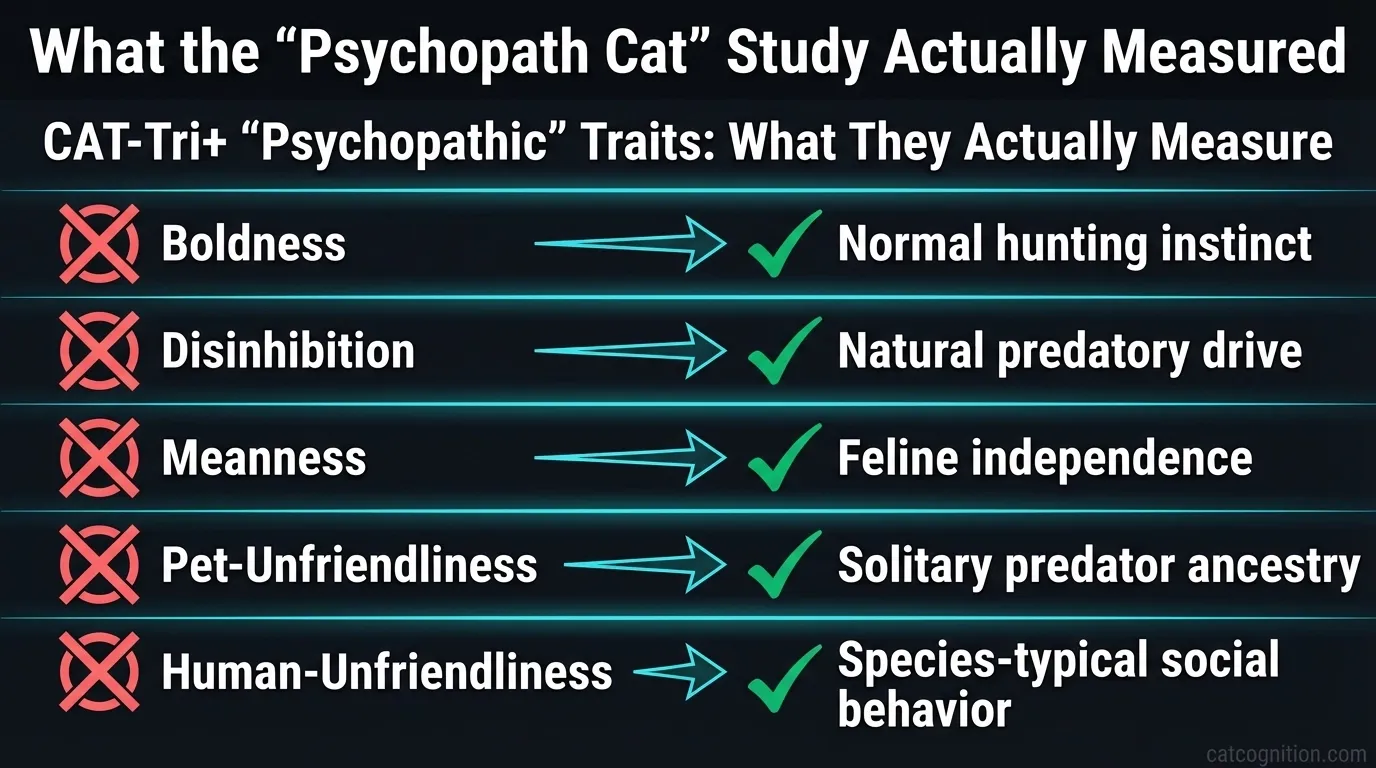
The 2021 CAT-Tri+ study from the University of Liverpool surveyed 2,042 cat owners using a 46-item questionnaire that concluded "all cats have an element of psychopathy." Headlines followed: "Scientists Prove Your Cat Is A Psychopath." The CAT-Tri+ questionnaire identifies five factors—boldness, disinhibition, meanness, pet-unfriendliness, and human-unfriendliness—all traits borrowed from human psychopathy research and applied to feline behavior.
The fundamental problem: every single one of those traits describes normal cat behavior, not pathology. Dr. John Bradshaw, a renowned anthrozoologist at the University of Bristol and author of Cat Sense, has spent decades documenting how applying human psychological frameworks to cats leads to misunderstanding. As Dr. Michael W. Fox, a veterinarian and syndicated columnist, noted, the CAT-Tri+ study represents "unscientific anthropomorphizing," applying human mental health concepts to species-typical animal behavior. The research did not discover psychopaths. The research rediscovered cats.
The Evidence:
"The 2021 CAT-Tri+ study labeled normal feline hunting, independence, and facial anatomy as psychopathic traits, prompting experts to call it 'unscientific anthropomorphizing.'"
What Does "Boldness" Actually Mean in Cats?
The CAT-Tri+ counted hunting behavior as a sign of boldness, one of the core psychopathic traits. Cats are obligate carnivores who evolved as apex predators over millions of years, and hunting is hardwired into feline neurobiology. When cats stalk, pounce, and "play" with a toy mouse, the brain's reward system activates regardless of whether the cat is hungry. Hunting behavior is instinct, not cruelty, the same program that kept feline ancestors alive for 10,000 years of domestication.
Research from Cecchetti et al. (2021) in Ecosphere puts this in stark perspective: in a UK study of pet cats with outdoor access, stable isotope analysis showed approximately 96% of their diet came from owner-provided food, with only 3-4% from wild prey. Cats who hunt are not killing out of hunger or malice. Cats who hunt are running neurological software that evolution spent millions of years perfecting. Labeling this survival adaptation as "psychopathic" misunderstands both psychopathy and feline biology.
The Evidence:
"In a UK study, approximately 96% of pet cats' diet came from owner-provided food, with only 3-4% from wild prey, demonstrating that predatory behavior is instinct-driven rather than motivated by hunger or cruelty."
Why Do Cats Seem "Mean" or Emotionally Cold?
The CAT-Tri+ interpreted independence and low social deference as "meanness," another psychopathic trait. Domestic cats evolved from solitary predators, and modern cats are social generalists who can live alone or form social groups depending on resources and environment. Unlike dogs, who evolved alongside humans with pack-based social hierarchies, cats do not have the same instincts for social deference. Expecting a cat to greet owners at the door like a Golden Retriever is like expecting a fish to climb a tree.
The study also counted what researchers called "lack of empathy" based on facial expressions. Here is where the science gets genuinely interesting: a 2023 study observed 276 different combinations of 26 facial muscle movements in cats, identifying 8 muscle movements that showed statistically significant communicative associations. Cats do not lack emotional expression. Cat expressions are subtle, evolved primarily for cat-to-cat communication, and humans are often poor at reading them. That "cold stare" is not emotional detachment. That face was designed for a different audience entirely. Understanding cat body language signals requires learning a communication system that evolved for feline social dynamics, not human interpretation.
The Evidence:
"A 2023 study observed 276 different combinations of 26 facial muscle movements in cats, with 8 showing statistically significant communicative associations, contradicting the notion that cats lack emotional expression."
Can Cats Even Be Psychopaths? The Theory of Mind Problem
Psychopathy requires theory of mind—the cognitive ability to understand that others have mental states different from one's own—as a prerequisite. Psychopathic individuals must first understand that other beings have thoughts and feelings, then choose not to care. Research on psychopathy in primates requires establishing this theory of mind capability before any psychopathy assessment can be valid.
Theory of mind has not been conclusively demonstrated in cats.
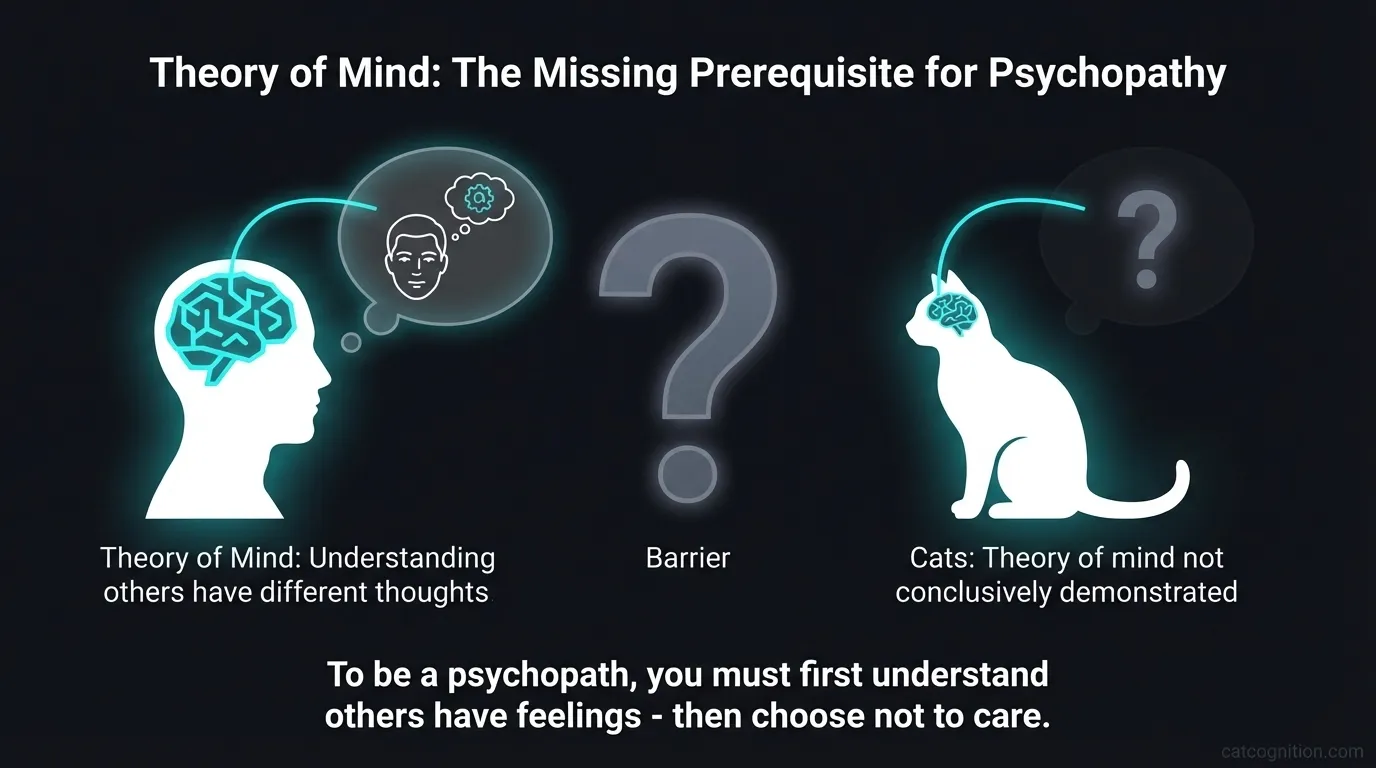
This means the entire CAT-Tri+ framework is applying a human mental health concept to an animal whose cognitive architecture may not even support the prerequisite for psychopathy. Professor Marc Bekoff, an Emeritus Professor of Ecology and Evolutionary Biology at the University of Colorado, called the implication that species-appropriate cat behaviors are psychopathic "alarming" because it conflates normal feline behavior with human pathology. The research on the psychology of cats continues to reveal complex cognitive abilities, but applying human psychiatric diagnoses remains scientifically problematic.
The Evidence:
"Psychopathy research requires theory of mind, which has not been conclusively demonstrated in cats, making human psychopathy frameworks scientifically inappropriate for feline assessment."
What Do Real Cat Personality Tests Measure?
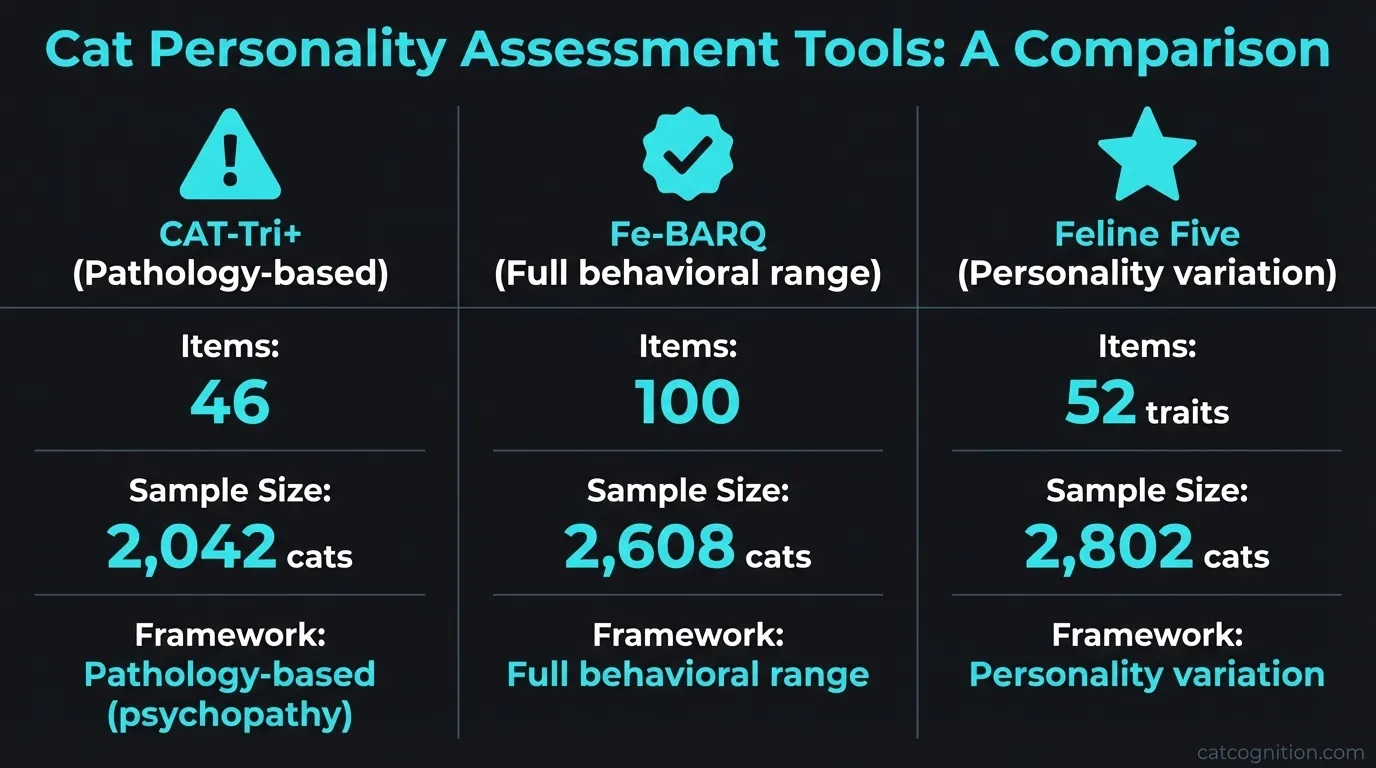
Validated cat personality assessments exist that measure feline behavior without pathologizing normal traits. The Fe-BARQ questionnaire, developed at the University of Pennsylvania, contains 100 validated items assessing the full range of cat behavior—more than double the CAT-Tri+'s 46 items. Unlike the CAT-Tri+ which starts from a psychopathy framework, the Fe-BARQ starts with normal behavior, providing a comprehensive picture of feline behavioral variation without suggesting pathology.
The Feline Five study surveyed 2,802 cats and identified five personality factors: Neuroticism, Extraversion, Dominance, Impulsiveness, and Agreeableness. This framework describes personality variation in cats without suggesting that any cat has a mental disorder. The Feline Five mirrors the Big Five human personality model but was developed specifically for cats using cat-appropriate behavioral measures.
| Assessment Tool | Items | Sample Size | Framework |
|---|---|---|---|
| CAT-Tri+ | 46 | 2,042 cats | Pathology-based (psychopathy) |
| Fe-BARQ | 100 | 2,608 cats | Full behavioral range |
| Feline Five | 52 traits | 2,802 cats | Personality variation |
The Evidence:
"The Fe-BARQ questionnaire contains 100 validated items assessing full behavioral range, compared to CAT-Tri+'s 46 items focused on pathology."
Why Is the "Psychopath" Label Harmful?
As Dr. Mikel Delgado, a Certified Applied Animal Behaviorist and Senior Research Scientist at Purdue University, noted in an interview with Psychology Today, labeling cats as having psychopathic traits "suggests that behaviors and behavior problems are innate and cannot be resolved with training or environmental modification." This framing does not help cats. This framing abandons cats.
Research demonstrates that cat behaviors can be modified. Environmental enrichment works. Training works. A 2019 study by Dr. Kristyn Vitale at Oregon State University found that 65% of cats demonstrate secure attachment bonds to their owners, comparable to human infants. Cats are not cold-blooded manipulators. Cats are complex animals running ancient software in a modern environment. The "psychopath" label suggests nothing can be done, when in reality, most behavioral concerns have environmental causes and behavioral solutions. Many issues stem from common cat owner mistakes that can be corrected once identified.
What Should You Do About "Problem" Cat Behaviors?
If you are reading this because you are genuinely worried about your cat's behavior, here is something more useful than a psychopathy test.
Hunting Behavior (Stalking, Pouncing, "Attacking" Ankles)
This is instinct, not psychopathy. Redirect predatory drive to wand toys and interactive play sessions. Regular play satisfies the stalk-chase-pounce sequence without involving ankles or live prey.
Aloof or "Unfriendly" Behavior
Check if you are comparing your cat to dogs unfairly. Cats are facultatively social, meaning their social behavior is flexible and influenced by genetics, early development, and lifetime experiences. Some cats bond intensely. Other cats need more space. Neither is pathological. Understanding how cats show love helps owners recognize feline affection that looks different from canine displays.
Aggressive Behavior
Look for environmental stressors first: new pets, schedule changes, insufficient vertical territory. Sudden behavioral changes warrant a veterinary visit because pain and hyperthyroidism commonly cause aggression in cats. Work with a Certified Applied Animal Behaviorist (CAAB) or board-certified veterinary behaviorist rather than assuming your cat has a personality disorder.
Some cats do have genuine behavior problems that require professional intervention, including redirected aggression, inappropriate elimination, and fear-based responses. The issue is not that cat behavior problems do not exist. The issue is framing normal species-typical behavior as pathology and giving up. Real behavior problems have real solutions.
How Do Cats Actually Experience the World?
Understanding cat behavior requires understanding feline evolutionary history. Cats evolved as solitary hunters who secured territory, stalked prey, and survived through individual competence rather than pack cooperation. These survival strategies shaped feline neurology, social behavior, and communication patterns over millions of years.
When a cat pushes objects off tables, the cat is likely investigating the object using predatory motor patterns. When a cat ignores commands, the cat is not being defiant, the cat simply did not evolve with the pack-based social hierarchy that makes dogs responsive to human authority. When a cat stares without blinking, the cat is using a communication style evolved for other cats, not for human social signaling. Learning to read what cat stares mean reveals intentional communication rather than emotional coldness.
I watched Moon stalk a feather wand last Tuesday evening for nearly 20 minutes straight. The focused stare, the butt wiggle, the explosive pounce, then immediately resetting to stalk again. He had eaten dinner 30 minutes earlier. This was not hunger. This was millions of years of evolutionary programming running exactly as designed. Calling that "psychopathic" would be like calling my heart "pathological" for beating.
The Real Question About Cat Behavior
Let me be clear about what I am not saying.
Some cats do have genuine behavior problems that require professional intervention. Redirected aggression. Inappropriate elimination. Fear-based responses that make life difficult for everyone. Those problems are real. Those problems need solutions.
But the solution is never to label normal behavior as pathology and give up.
If your cat hunts, stalks, and pounces, your cat is running the program evolution wrote. If your cat does not greet you at the door, your cat is being a cat, not a dog. If your cat's face looks "cold," you are reading a face that evolved to communicate with other cats, not with humans.
The 2021 study did not discover that your cat is a psychopath. The study revealed how badly we misunderstand the species we share our homes with.
Maybe the real question is not "Is my cat a psychopath?" Maybe the real question is "Am I expecting my cat to be something my cat never evolved to be?"
Frequently Asked Questions
Is the CAT-Tri+ test completely useless?
The CAT-Tri+ may have some utility for understanding behavioral variation, but the framing as "psychopathy" is scientifically inappropriate and potentially harmful. Better alternatives exist: the Fe-BARQ questionnaire for comprehensive behavioral assessment, and the Feline Five for understanding personality variation without pathologizing normal behavior.
Why do cats "play" with their prey if not for cruelty?
Hunting behavior is driven by dopamine release in the brain's reward system. Cats experience pleasure from the stalk-chase-pounce sequence regardless of hunger state. What looks like "playing" is actually the cat completing instinctive motor patterns. Redirecting this drive to wand toys satisfies the instinct without involving live prey.
Can cats form emotional bonds with humans?
Yes. A 2019 study by Dr. Kristyn Vitale at Oregon State University found that 65% of cats demonstrate secure attachment bonds to their owners, comparable to the attachment rates seen in human infants. Cats are capable of deep emotional connection, even if they express attachment differently than dogs.
What causes aggression in cats?
Common causes include pain, medical conditions like hyperthyroidism, fear, territorial stress, inadequate socialization, and environmental stressors such as new pets or schedule changes. Aggression almost always has an identifiable cause and can be addressed through veterinary care, environmental modification, or behavioral intervention.
How can I tell if my cat's behavior is a problem or just normal?
Ask three questions: Is this behavior seen in wild or feral cats? Is this behavior causing harm to the cat or humans? Did this behavior emerge suddenly? Species-typical behaviors like hunting, territorial marking, and independence are normal. Sudden behavioral changes warrant a veterinary visit. Behavior causing harm requires professional behavioral assessment.
Do cats understand human emotions?
Research suggests cats can read human emotional cues and may adjust their behavior accordingly, though the extent of this ability is still being studied. Cats respond to owner emotional states and can form strong social bonds. The misconception that cats are emotionally indifferent comes from misreading feline communication signals rather than from genuine emotional deficit.
Are some cat breeds more "psychopathic" than others?
No. The 2021 CAT-Tri+ study found no breed-specific differences in the psychopathy-related factors it measured. Other research has documented breed differences in personality factors like activity level, sociability, and aggression, but these represent normal personality variation, not psychopathy.
Should I be concerned if my cat matches the CAT-Tri+ "psychopathic" traits?
No. High scores on boldness, disinhibition, and meanness simply mean your cat displays normal feline behaviors like hunting instinct, independence, and neutral facial expressions. These are features of being a cat, not symptoms of pathology. Concern is warranted only if behavior is causing harm, emerged suddenly, or significantly impacts quality of life.
Key Takeaways
- The CAT-Tri+ study measured normal cat behavior: The 2021 study that sparked "psychopath cat" headlines actually identified hunting instinct, independence, and feline facial anatomy as "psychopathic traits," mislabeling normal species-typical behavior as pathology.
- Psychopathy requires theory of mind: Psychopathy is a human personality disorder requiring the cognitive ability to understand that others have mental states different from one's own. Theory of mind has not been conclusively demonstrated in cats, making psychopathy frameworks inappropriate for feline assessment.
- Cats have complex facial expressions: The notion that cats lack emotional expression is factually incorrect. A 2023 study observed 276 different combinations of 26 facial muscle movements, with 8 showing statistically significant communicative associations. Human difficulty reading cat faces reflects species differences in communication, not feline emotional deficit.
- Validated alternatives exist: The Fe-BARQ (100 items) and Feline Five (52 traits, 2,802 cats) provide scientifically validated frameworks for understanding cat behavior and personality without pathologizing normal behavior.
- The "psychopath" label is harmful: Labeling cats as psychopaths suggests behaviors are innate and cannot be resolved, discouraging owners from seeking training, environmental modification, or behavioral intervention that could genuinely help. Real behavior problems have real solutions.
Key Terms Used
- Obligate carnivore: An animal that requires nutrients found only in animal tissue to survive, unable to synthesize essential amino acids like taurine from plant sources
- Theory of mind: The cognitive ability to understand that others have mental states, including beliefs, desires, and intentions, different from one's own
- Facultatively social: A species whose social behavior is flexible and context-dependent, able to live solitarily or in groups depending on resources and environment
- Species-typical behavior: Normal behaviors characteristic of a species, shaped by evolutionary pressures and expressed across populations
Sources
- "A domestic cat (Felis silvestris catus) model of triarchic psychopathy factors: Development and initial validation of the CAT-Tri+ questionnaire" - Evans, R. et al., Journal of Research in Personality, 2021 (Link)
- "The role of cat eye narrowing movements in cat-human communication" - Humphrey, T. & Proops, L., Scientific Reports, 2020 (Link)
- "Attachment bonds between domestic cats and humans" - Vitale, K. et al., Current Biology, 2019 (Link)
- "Fe-BARQ: A new questionnaire for assessment of feline behavior" - Duffy, D., Moura, R., Serpell, J., University of Pennsylvania, 2017 (Link)
- "The 'Feline Five': An exploration of personality in pet cats" - Litchfield, C. et al., PLOS ONE, 2017 (Link)
- "No, Your Cat Isn't a Psychopath" - Dr. Mikel Delgado, Guest Blog, 2022 (Link)
- "Are Some Cats Psychopathic, or Are They Just Being Cats?" - Marc Bekoff, Psychology Today, 2022 (Link)
- "Cats and wildlife: is predation by domestic cats (Felis catus) biologically significant?" - Cecchetti, M. et al., Ecosphere, 2021 (Link)
- "Why We Think Cats Are Psychopaths" - UC Davis School of Veterinary Medicine, 2022 (Link)
- "Feline Faces: Unraveling the Social Function of Domestic Cat Facial Signals" - Scott, L. et al., Behavioural Processes, 2023 (Link)