Do Full Moons Affect Cats? The Science of the 'Lunar Effect' Explained
A Colorado State University analysis of 11,940 vet cases found a real but clinically tiny full-moon effect: about one extra cat visit per full-moon period. “Moon madness” is mostly perception. Cats are crepuscular; brighter nights can boost activity via circadian cues, not gravity.

Quick Answer: Do Full Moons Make Cats Crazy?
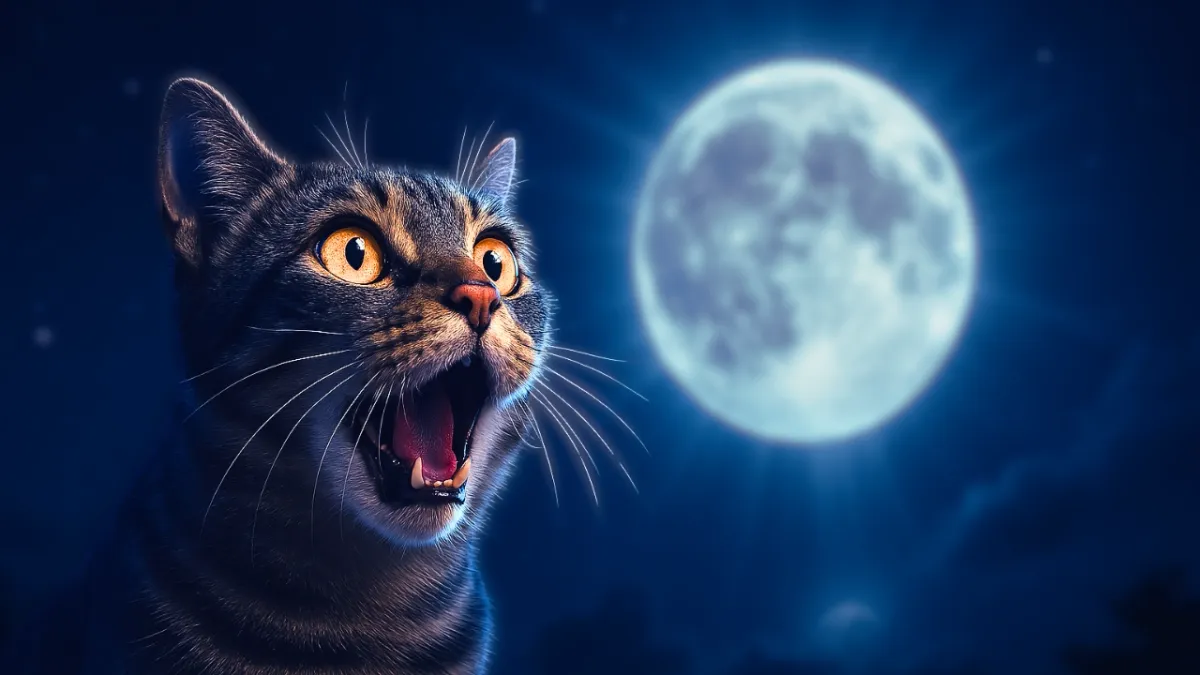
Not in any meaningful way. A Colorado State University study of 11,940 veterinary cases found a statistically significant but clinically negligible increase during full moons—about one extra cat visit per full moon period. The researchers cautioned against overinterpretation, as the absolute numbers were tiny. Increased ambient light from a full moon can trigger crepuscular hunting instincts in cats, leading to higher nighttime activity. The behavior is driven by vision biology and circadian rhythms, not lunar "madness."
Table of Contents
- Where Did the "Moon Madness" Myth Come From?
- What Do Cat Owners Report During Full Moons?
- What Do Veterinary Studies Say About the Lunar Effect?
- Is the Full Moon Effect Confirmation Bias?
- How Do Circadian Rhythms Affect Cat Activity?
- What Do Behaviorists Say About the Moon?
- Does Moonlight Trigger Hunting Behavior?
- Why Does My Cat Get Zoomies at Night?
- The CatCog Lunar Activity Index
- Frequently Asked Questions
Every full moon, the same question appears in veterinary clinics and Reddit threads: "Why is my cat acting insane?"
The Lunar Effect---the belief that full moons alter animal behavior---has persisted for centuries. But what does the science actually say?
The answer is simultaneously boring and fascinating. The moon does not make cats crazy. But the light from the moon changes everything. Understanding this distinction is key to decoding cat behavior.
Where Did the "Moon Madness" Myth Come From?
The word "lunatic" derives from the Latin luna, meaning moon. Ancient civilizations believed the moon influenced human and animal behavior, a belief that persists in modern folklore.
For cats specifically, the myth gained traction because:
- Cats are nocturnal-adjacent. Cats exhibit peak activity at dusk and dawn, when the moon is often visible.
- Full moons are memorable. When a cat acts strangely under a full moon, the event becomes a vivid memory. When a cat acts strangely under a crescent moon, nobody notices the moon.
- Cultural reinforcement. Black cats, full moons, and witchcraft have been linked in Western culture for centuries, reinforcing the association between lunar cycles and feline behavior.
The CatCog Reality Check:
The dramatic "Lunar Effect" on cats is largely a myth of perception. While one peer-reviewed study found a small statistical increase during full moons, the clinical significance is negligible—about one extra cat per full moon period. No causal mechanism has been established between lunar cycles and feline behavioral changes. What is real: the impact of light on crepuscular predators.
What Do Cat Owners Report During Full Moons?
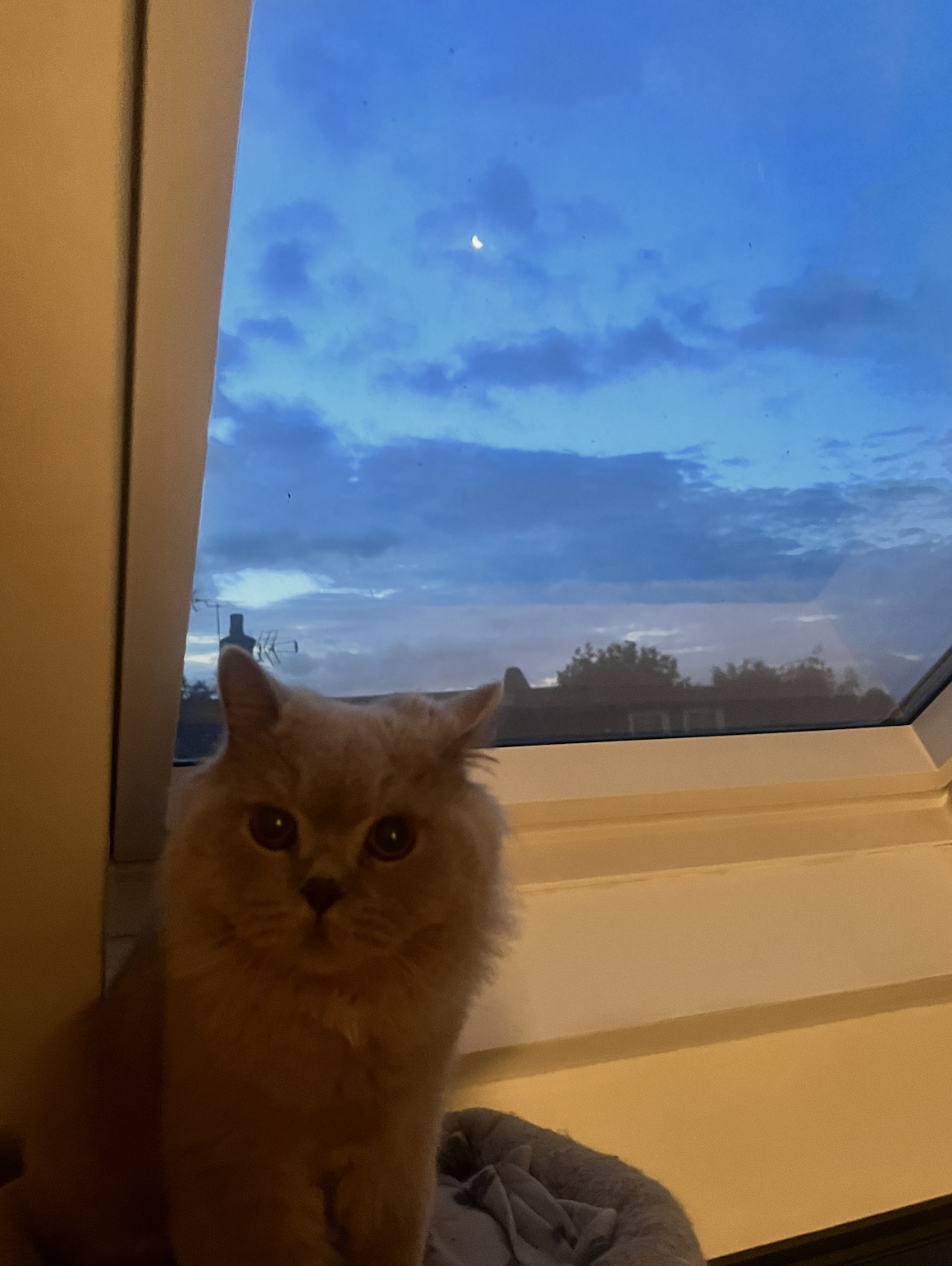
Cat owners commonly report increased activity during full moons, including:
- More frequent "zoomies" and nighttime running
- Increased vocalization (meowing, yowling)
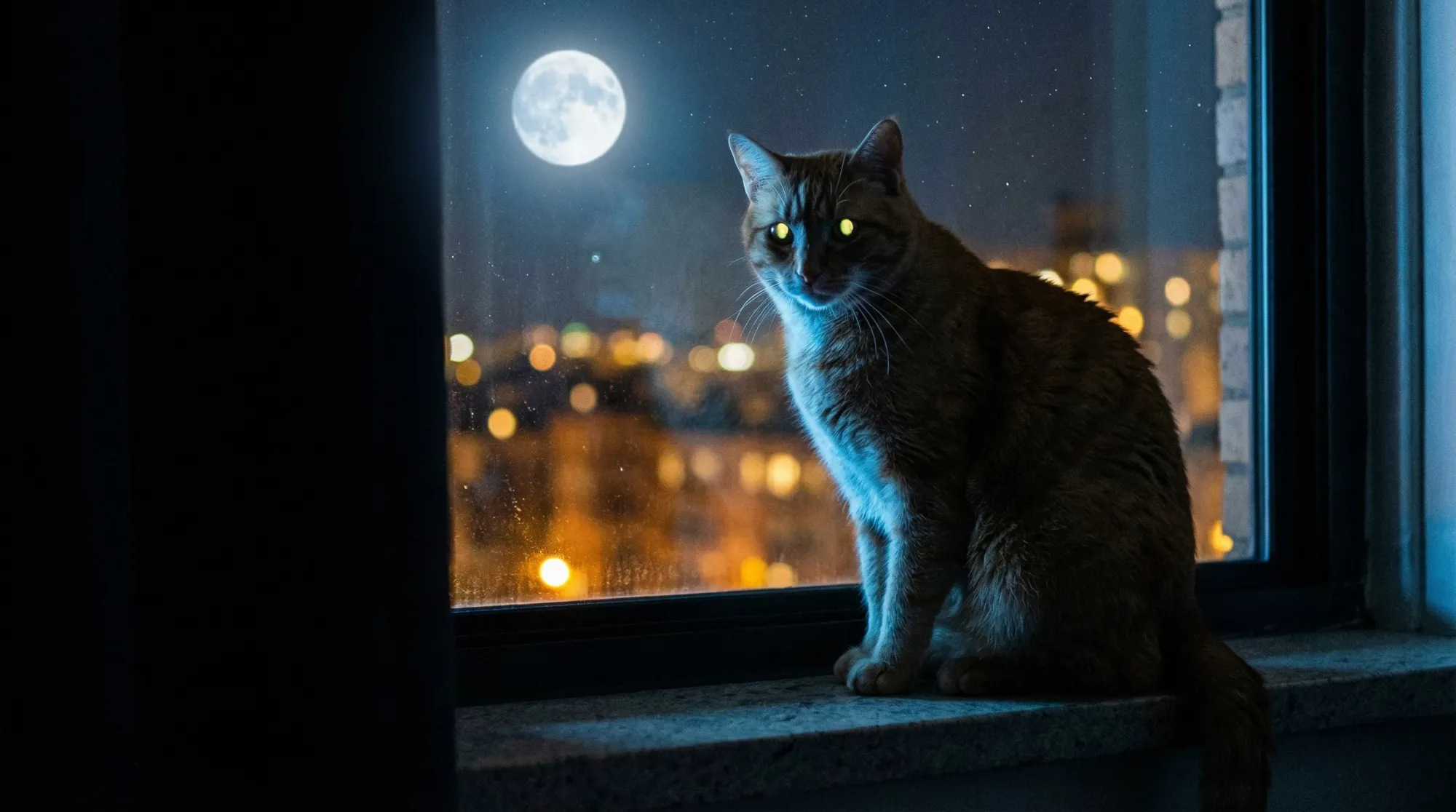
- Heightened alertness and window-watching
- Difficulty settling down at night
- More playful or hyperactive behavior
These reports are genuine observations—cat owners are not imagining their cats' behavior. However, the attribution to the moon itself is where perception diverges from reality. The same behaviors occur on non-full-moon nights, but without a memorable celestial event to associate them with, those instances fade from memory.
Studies asking pet owners about lunar effects consistently find perceived correlations, while studies measuring actual behavior or emergency visits find either no effect or clinically insignificant differences. This gap between perception and measurement is the signature of confirmation bias.
What Do Veterinary Studies Say About the Lunar Effect?
The most comprehensive study on lunar effects and pet emergencies was conducted by Colorado State University in 2007. Researchers analyzed 11,940 cases from the Veterinary Teaching Hospital, examining cats and dogs over an 11-year period.
The Colorado State Findings
| Metric | Full Moon Period | Other Days | Statistical Significance |
|---|---|---|---|
| Cat emergency visits | +23% | Baseline | Significant (p < 0.05) |
| Dog emergency visits | +28% | Baseline | Significant (p < 0.05) |
| Absolute increase (cats) | +0.13 visits/day | — | ~1 extra cat per full moon |
| Absolute increase (dogs) | +0.59 visits/day | — | ~1-2 extra dogs per full moon |
The findings require context: while the percentage increase was statistically significant, the absolute numbers were tiny. The researchers found roughly one additional cat and one to two additional dogs per fuller moon period across an 11-year dataset. The study authors explicitly cautioned against overinterpreting these results, noting that "the clinical significance of these findings is unclear."
This is the critical distinction between statistical significance and practical significance. A 23% increase sounds dramatic until you realize it represents a fraction of one additional cat per day.
Why the Data Matters
The Colorado State study represents one of the largest controlled analyses of pet behavior and lunar cycles. While it did find a statistically significant effect, the researchers themselves were cautious about interpretation, noting the tiny absolute numbers involved. This distinction between statistical and clinical significance is crucial for understanding the "Lunar Effect" debate.
Adam's Lab Note:
I've never noticed any weird correlations between Moon and well, the moon. But he is a quirky and eccentric cat most of the time, so maybe he doesn't need a full moon to be weird.
Is the Full Moon Effect Confirmation Bias?
Yes. The persistence of the Lunar Effect myth is a textbook case of confirmation bias---the tendency to notice and remember information that confirms existing beliefs while ignoring contradictory evidence.
How Confirmation Bias Works
| Scenario | Human Response | Reality |
|---|---|---|
| Cat acts crazy during full moon | "The moon made my cat crazy!" | Remembered |
| Cat acts crazy during new moon | No lunar association made | Forgotten |
| Cat acts normal during full moon | "Must be an exception" | Discounted |
| Cat acts normal during new moon | No observation made | Ignored |
The result: cat owners develop a strong perceived correlation between full moons and cat behavior, despite the absence of any actual correlation.
Research on human cognitive biases shows that this pattern is nearly universal. Emergency room staff, police officers, and psychiatric nurses often report increased activity during full moons---but when their actual case logs are analyzed, no statistical increase exists.
The CatCog Reality Check:
Believing in the Lunar Effect is not irrational. The human brain is wired to find patterns, even when patterns do not exist. Recognizing confirmation bias is the first step to understanding what actually drives cat behavior.
How Do Circadian Rhythms Affect Cat Activity?
If the moon does not affect cat behavior, why do cats seem more active at night?
The answer lies in circadian rhythms and the biological classification of cats as crepuscular animals.
Understanding Crepuscular Activity
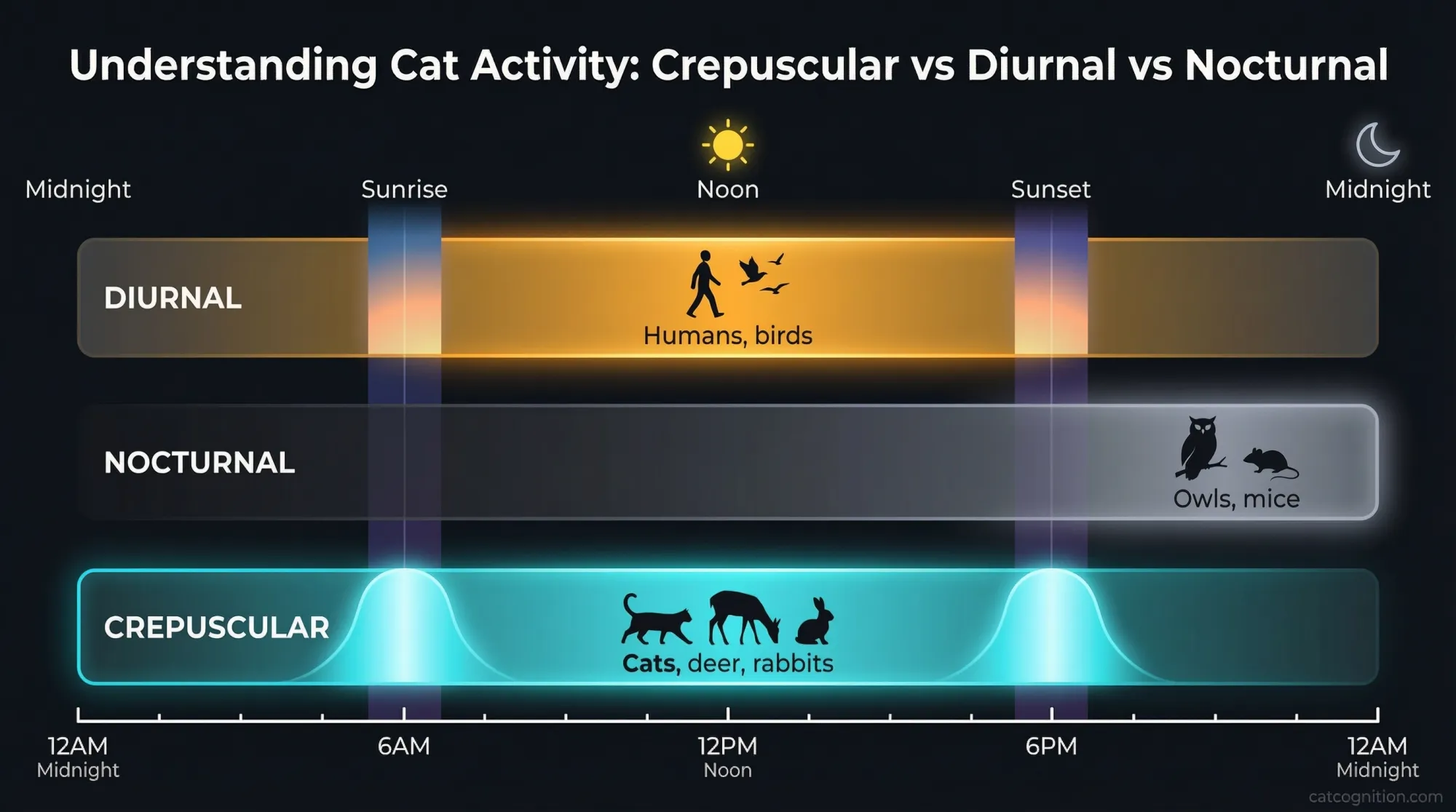
Cats are not nocturnal. Cats are not diurnal. Cats are crepuscular, meaning their peak activity occurs during the twilight hours of dawn and dusk.
| Activity Classification | Peak Activity Time | Examples |
|---|---|---|
| Diurnal | Daytime (6 AM - 6 PM) | Humans, birds |
| Nocturnal | Nighttime (8 PM - 4 AM) | Owls, mice |
| Crepuscular | Twilight (Dawn + Dusk) | Cats, deer, rabbits |
This crepuscular pattern evolved because prey animals (mice, birds, rabbits) are most active during twilight, and predators (larger cats, wolves) are less effective hunters in low-light conditions. Dawn and dusk provide optimal hunting conditions: prey is active, but visibility favors the cat's superior low-light vision.
The Circadian Mechanism
Cat circadian rhythms are regulated by the suprachiasmatic nucleus (SCN), a cluster of neurons in the hypothalamus that responds to light exposure. When ambient light decreases at dusk, the SCN signals increased activity. When light increases at dawn, the cycle resets.
Research by Dr. Tony Buffington at Ohio State University's Indoor Pet Initiative demonstrates that indoor cats retain crepuscular patterns despite artificial lighting, though these patterns can shift based on owner schedules and feeding times.
What Do Behaviorists Say About the Moon?
Animal behaviorists approach the lunar effect question with consistent skepticism—not because they dismiss owner observations, but because they understand the mechanisms driving cat behavior.
Dr. John Bradshaw of the University of Bristol, author of Cat Sense, emphasizes that cat behavior is driven by environmental stimuli—light, sound, temperature, prey availability—not gravitational or mystical forces from celestial bodies. The moon's gravitational effect on a cat is approximately one-millionth the gravitational effect of a human standing next to the cat.
Dr. Tony Buffington's research at Ohio State's Indoor Pet Initiative focuses on environmental factors affecting feline stress and behavior. His work demonstrates that light exposure, feeding schedules, and enrichment opportunities have measurable impacts on cat activity patterns. Lunar cycles are not among the variables that predict behavior.
The consensus among feline behavior specialists: if your cat seems more active during full moons, look for environmental explanations—increased ambient light, seasonal changes, or your own altered perception—rather than lunar mysticism.
Does Moonlight Trigger Hunting Behavior?
Here is where the science gets interesting. While the moon's gravity has no effect on cat behavior, the moon's light genuinely does.
The Moonlight Mechanism
A full moon produces up to 0.25 lux of illumination (typically 0.1-0.25 lux depending on conditions)—enough to significantly enhance feline night vision.
| Light Level | Lux Value | Cat Vision Capability |
|---|---|---|
| Direct sunlight | 100,000 lux | Optimal, but pupils constrict |
| Overcast day | 1,000 lux | Excellent |
| Full moon | 0.1-0.25 lux | Enhanced advantage |
| New moon | 0.001 lux | Still functional |
| Complete darkness | 0 lux | No vision possible |
Cats possess a tapetum lucidum, a reflective layer behind the retina that amplifies available light. In moonlight conditions, this adaptation provides cats with a significant hunting advantage over prey animals.
The Prey Detection Cascade
When moonlight illuminates the environment:
- Cat visual acuity increases. More photons reach the retina, improving object detection.
- Prey movement becomes visible. Mice and birds that would be invisible on dark nights can be tracked.
- Predatory drive activates. Visual stimulation of potential prey triggers the hunting sequence.
- Activity levels rise. The cat becomes alert, focused, and active.
This cascade explains why cat owners perceive increased activity during full moons. The behavior is real—but the mechanism is light exposure, not lunar mysticism.
Why Does My Cat Get Zoomies at Night?
The phenomenon known as "zoomies" has a formal scientific name: Frenetic Random Activity Periods (FRAPs).
What Are FRAPs?
FRAPs are brief bursts of high-energy activity characterized by:
- Running at full speed through the house
- Sudden direction changes
- Dilated pupils
- Elevated tail position
- Vocalization (chirping, trilling)
- Duration of 1-5 minutes
FRAPs occur when pent-up energy reaches a threshold and requires immediate release. The behavior is completely normal and serves an important biological function.
Why FRAPs Happen at Night
| Trigger | Mechanism | Timing |
|---|---|---|
| Crepuscular rhythm | Circadian clock signals activity | Dusk/dawn |
| Energy accumulation | Daytime rest creates surplus | Evening |
| Light transition | Decreasing light triggers alertness | Sunset |
| Prey-drive activation | Movement detection (real or imagined) | Variable |
| Post-elimination energy | Bathroom use triggers response | Variable |
FRAPs are NOT caused by:
- Full moons
- Seeing "ghosts"
- Supernatural influences
- Random insanity
Understanding the biological basis of FRAPs allows cat owners to manage nighttime activity effectively rather than attributing the behavior to mysterious forces.
The CatCog Lunar Activity Index
Combining the scientific evidence, The CatCog Method provides a framework for understanding when and why cats exhibit increased nighttime activity:
| Factor | Impact | Management Strategy |
|---|---|---|
| Ambient Light | High | Close blinds/curtains to reduce visual stimulation |
| Circadian Phase | High | Schedule play sessions 1 hour before expected activity |
| Energy Surplus | High | Increase daytime enrichment and play |
| Prey-Drive Stimulation | Medium | Remove visible wildlife (bird feeders near windows) |
| Feeding Schedule | Medium | Feed larger meal in evening to induce post-prandial sleep |
| Moon Phase | Negligible | Statistically detectable but clinically insignificant |
The Protocol for Nighttime Activity
Following the environmental enrichment principles outlined by Dr. Tony Buffington's Indoor Pet Initiative:
- Pre-empt the zoomies. Schedule a 15-minute interactive play session 1-2 hours before your bedtime.
- Feed after play. The hunt-catch-kill-eat-groom-sleep sequence is hardwired. Leverage this pattern.
- Control light exposure. Close blinds on bright nights to reduce prey-drive activation.
- Provide appropriate outlets. Puzzle feeders, cat trees, and rotating toys reduce energy accumulation.
The CatCog Reality Check:
Your cat's midnight zoomies are not mysterious. Zoomies are the predictable result of crepuscular biology, energy accumulation, and environmental stimulation. The moon is irrelevant.
Key Takeaways (The CatCog Index)
The Lunar Effect on cats is clinically negligible. A Colorado State University study found a statistically significant but tiny increase—about one extra cat per full moon period.Confirmation bias amplifies the perception. Humans remember unusual events during full moons and forget identical events at other times, making the effect seem larger than it is.Moonlight does affect cats—through vision, not gravity. Up to 0.25 lux of full moonlight enhances feline night vision and can trigger prey-drive activation.Cats are crepuscular, not nocturnal. Peak activity occurs at dawn and dusk, governed by circadian rhythms, not lunar cycles.Zoomies (FRAPs) are biological, not mystical. Energy accumulation and prey-drive activation explain nighttime activity completely.
Frequently Asked Questions
Q: Do full moons make cats crazy?
A: Not in any meaningful way. A Colorado State University study of 11,940 veterinary cases found a statistically significant but clinically negligible increase during full moons—about one extra cat visit per full moon period. The researchers cautioned against overinterpretation. The "Lunar Effect" is largely a myth of perception driven by confirmation bias. However, brighter moonlight can increase nocturnal activity because cats are crepuscular hunters whose tapetum lucidum improves vision in low-light conditions.
Q: Why does my cat act weird at night during a full moon?
A: Cats are crepuscular animals with peak activity at dawn and dusk. A full moon provides up to 0.25 lux of illumination, enough to enhance feline night vision and trigger predatory instincts. The increased activity is a response to better hunting conditions created by ambient light, not lunar gravity or mystical forces.
Q: Is the "Full Moon Effect" on pets real?
A: The evidence is nuanced. A Colorado State University study of 11,940 veterinary cases found a statistically significant increase (23% for cats, 28% for dogs) during full moons, but the absolute numbers were tiny—roughly one extra cat per full moon period. The researchers cautioned the clinical significance is unclear. The dramatic "Lunar Effect" of folklore is largely a myth of perception, amplified by confirmation bias: unusual events during full moons are remembered, while similar events on other nights are forgotten.
Q: Why does my cat get zoomies at night?
A: Nocturnal "zoomies" in cats are called Frenetic Random Activity Periods (FRAPs). FRAPs occur when cats release pent-up energy, typically during their natural activity windows at dusk and dawn. The behavior is triggered by circadian rhythms and prey-drive activation, not lunar cycles. Managing FRAPs requires scheduled play sessions and environmental enrichment.
Q: Can cats sense things during a full moon that humans cannot?
A: Cats possess superior low-light vision due to their tapetum lucidum, which amplifies available light. During a full moon, cats can detect movement and objects that are invisible to humans. This enhanced perception may make cats appear more alert or reactive, but the effect is optical, not paranormal.
Q: Should I keep my cat indoors during a full moon?
A: Outdoor cats may exhibit increased hunting behavior during full moons because improved visibility makes prey detection easier. From a wildlife conservation perspective, keeping cats indoors during bright nights can reduce predation on native species. This recommendation is based on light conditions, not lunar mysticism.
Scientific Sources & Further Reading
- Raison, C.L., Klein, H.M., & Steckler, M. (1999). "The moon and madness reconsidered." Journal of Affective Disorders, 53(1), 99-106. (Link: PubMed)
- Wells, D.L., Gionfriddo, J.R., Hackett, T.B., & Radecki, S.V. (2007). "Canine and feline emergency room visits and the lunar cycle: 11,940 cases (1992-2002)." Journal of the American Veterinary Medical Association, 231(2), 251-253. (Link: PubMed)
- Dr. John Bradshaw - University of Bristol, Anthrozoology Institute. Cat Sense: How the New Feline Science Can Make You a Better Friend to Your Pet (2013). Comprehensive analysis of feline behavior and biology.
- Ohio State University Indoor Pet Initiative - Dr. Tony Buffington's research on environmental factors affecting feline behavior and stress. (Link: Indoor Pet Initiative)
- Cornell Feline Health Center - Comprehensive resource on feline health, behavior, and circadian biology. (Link: Cornell Feline Health Center)
- Mott, M. (2007). "Does the Full Moon Affect Animals?" National Geographic News. Analysis of lunar effect research across species.
- Journal of Veterinary Emergency and Critical Care - Peer-reviewed research on veterinary emergency patterns and environmental factors. (Link: JVECC)