Operation Acoustic Kitty: Why the CIA's $20 Million Spy Cat Failed
The CIA spent $20 million turning a cat into a surveillance device. It failed because cats evolved as solitary predators whose brains prioritize hunting over obedience.

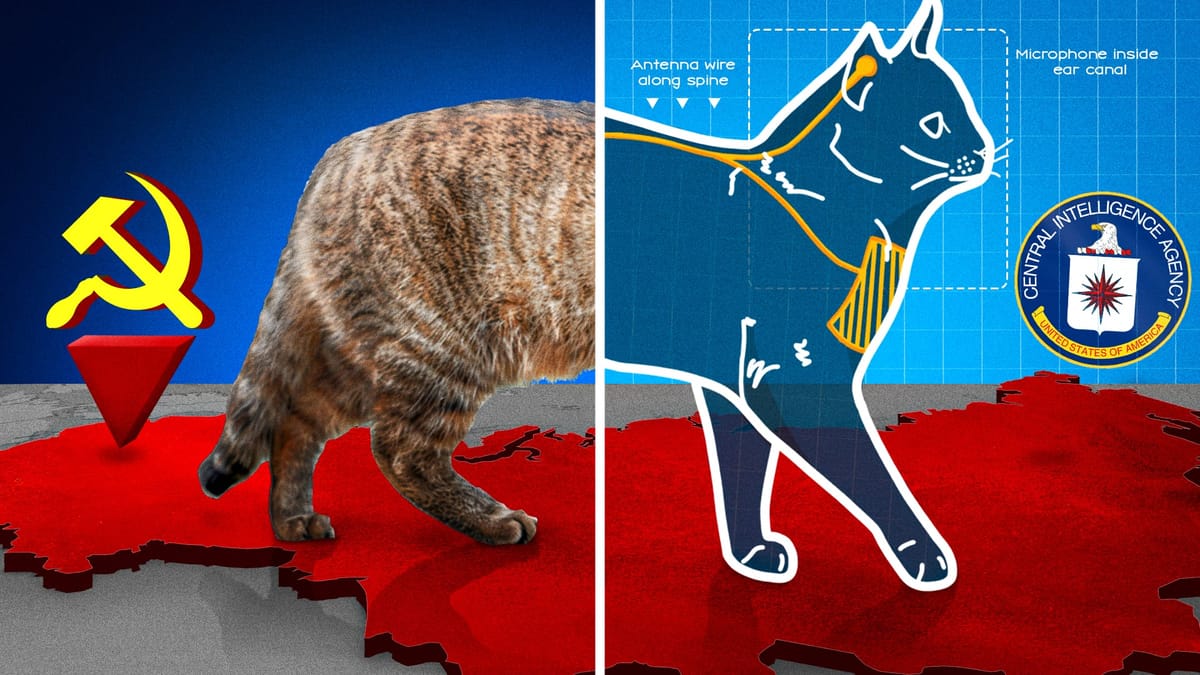
Quick Answer: What was Operation Acoustic Kitty?
Operation Acoustic Kitty was a classified CIA project (1960-1967) that surgically implanted microphones and transmitters into cats for espionage. The $20 million program failed because cats evolved as solitary predators whose brain reward systems prioritize hunting success over following commands. The CIA concluded that "environmental and security factors" made cats impractical for intelligence work.
Table of Contents
- What Was Operation Acoustic Kitty?
- The Surgical Procedure
- Why Did Operation Acoustic Kitty Fail?
- The Evolutionary Biology Explanation
- Comparison to Successful Animal Programs
- Other CIA Animal Espionage Programs
- What This Teaches Us About Cat Behavior
- Key Takeaways
- Key Terms Used
- Frequently Asked Questions
What Was Operation Acoustic Kitty?
Operation Acoustic Kitty cost the CIA an estimated $20 million between 1960-1967, making a single cat one of the most expensive surveillance devices in Cold War history. The program aimed to transform ordinary housecats into mobile listening devices capable of eavesdropping on Soviet officials.
The CIA's Directorate of Science and Technology conceived the project after observing that stray cats could wander into high-security areas without raising suspicion. A human agent would immediately trigger alarms. A cat? Invisible.
The logic seemed sound: if cats could access Soviet facilities undetected, why not equip them with recording equipment? The technology was achievable. The biology, however, was not.
The Evidence:
"A declassified 1967 CIA memo titled 'Views on Trained Cats' concluded that while cats could be trained to move short distances, environmental factors made them impractical for intelligence purposes."
The project remained classified until 2001, when Jeffrey Richelson of the National Security Archive at George Washington University obtained documents through the Freedom of Information Act.

The Surgical Procedure
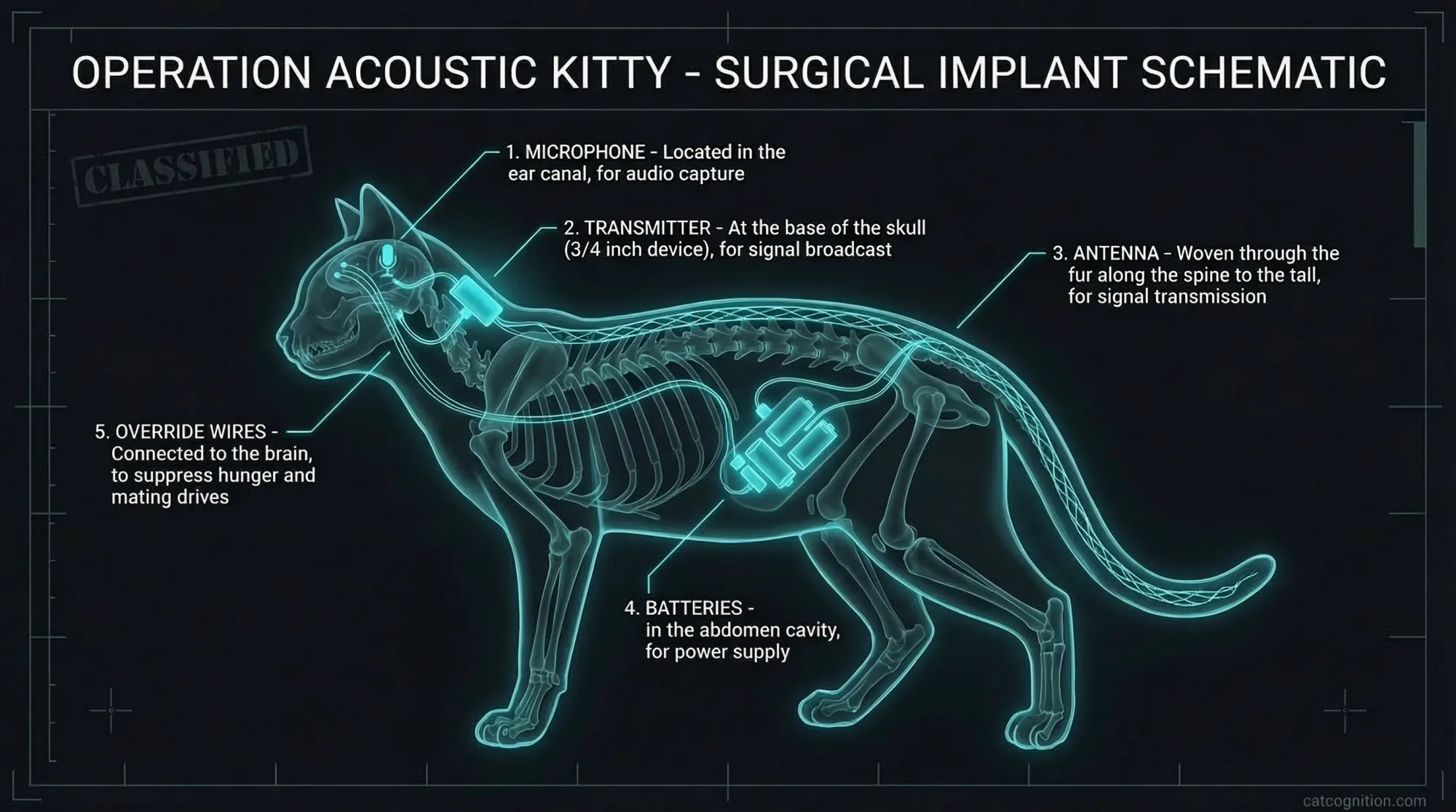
CIA veterinarians surgically implanted five components into the cat: a microphone in the ear canal, a 3/4-inch transmitter at the skull base, an antenna woven through the fur to the tail, batteries in the abdomen, and wires connected to the brain to override hunger drives. The hour-long procedure created what Victor Marchetti, former CIA executive assistant, called "a monstrosity."
The Equipment:
| Component | Location | Function |
|---|---|---|
| Microphone | Ear canal | Audio capture |
| Transmitter | Base of skull | Signal broadcast (3/4 inch) |
| Antenna | Woven through fur to tail | Signal transmission |
| Batteries | Abdomen | Power supply |
| Override wires | Connected to brain | Suppress hunger/mating drives |
Declassified CIA documents reveal that cats required additional brain surgery to override hunger drives because the animals kept abandoning missions to find food. The CIA was essentially trying to rewire predator psychology with 1960s electronics.
Adam's Lab Note:
The fact that the CIA had to surgically suppress a cat's hunger drive tells you everything about why this failed. Moon regularly ignores me calling his name unless I'm holding a treat bag. The idea that any amount of surgery could override 10,000 years of predator instinct is almost endearing in its optimism.
Early technical challenges included microphones picking up cat heartbeats and stomach gurgles, transmitters overheating, and batteries dying quickly due to size constraints. The equipment also couldn't affect natural movement or cause irritation that might draw attention to the cat.
Why Did Operation Acoustic Kitty Fail?
The core failure of Operation Acoustic Kitty was behavioral, not technical. As former CIA Office of Technical Service director Robert Wallace admitted in 2013: "The cat wanted to do what the cat wanted to do, and not what we wanted it to do."
The First Field Test (Disputed):
According to Victor Marchetti's account, the first deployment occurred near the Soviet embassy in Washington, D.C. The mission: eavesdrop on two men sitting on a park bench.
Marchetti claimed: "They put him out of the van, and a taxi comes and runs him over. There they were, sitting in the van with all those dials, and the cat was dead!"
Robert Wallace disputes this version, claiming the cat was safely retrieved, the equipment surgically removed, and "the cat lived a long and happy life afterwards."
CatCog Reality Check:
The taxi death story may be apocryphal. What is NOT disputed is the fundamental reason for project cancellation: cats cannot be directed to perform tasks on command. The 1967 CIA memo acknowledged this explicitly.
The official assessment from the declassified memo stated: "Cats can indeed be trained to move short distances... [but] the environmental and security factors in using this technique in a real foreign situation force us to conclude that for our (intelligence) purposes, it would not be practical."
Paradoxically, the same memo praised the project as "a remarkable scientific achievement" and called the scientists "models for scientific pioneers." The technology worked. The biology did not cooperate.
The Evolutionary Biology Explanation
Cats evolved as solitary ambush predators, meaning their brain reward systems are connected to hunting success rather than social approval - the opposite of what espionage requires. This fundamental evolutionary mismatch explains why Operation Acoustic Kitty was doomed from conception.
As Dr. John Bradshaw of the University of Bristol explains in his research on feline domestication, cats retain approximately 95% of their wild behavioral repertoire. "Cats still have three out of four paws firmly planted in the wild," Bradshaw notes, "and within only a few generations can easily revert back to the independent way of life that was the exclusive preserve of their predecessors some 10,000 years ago."
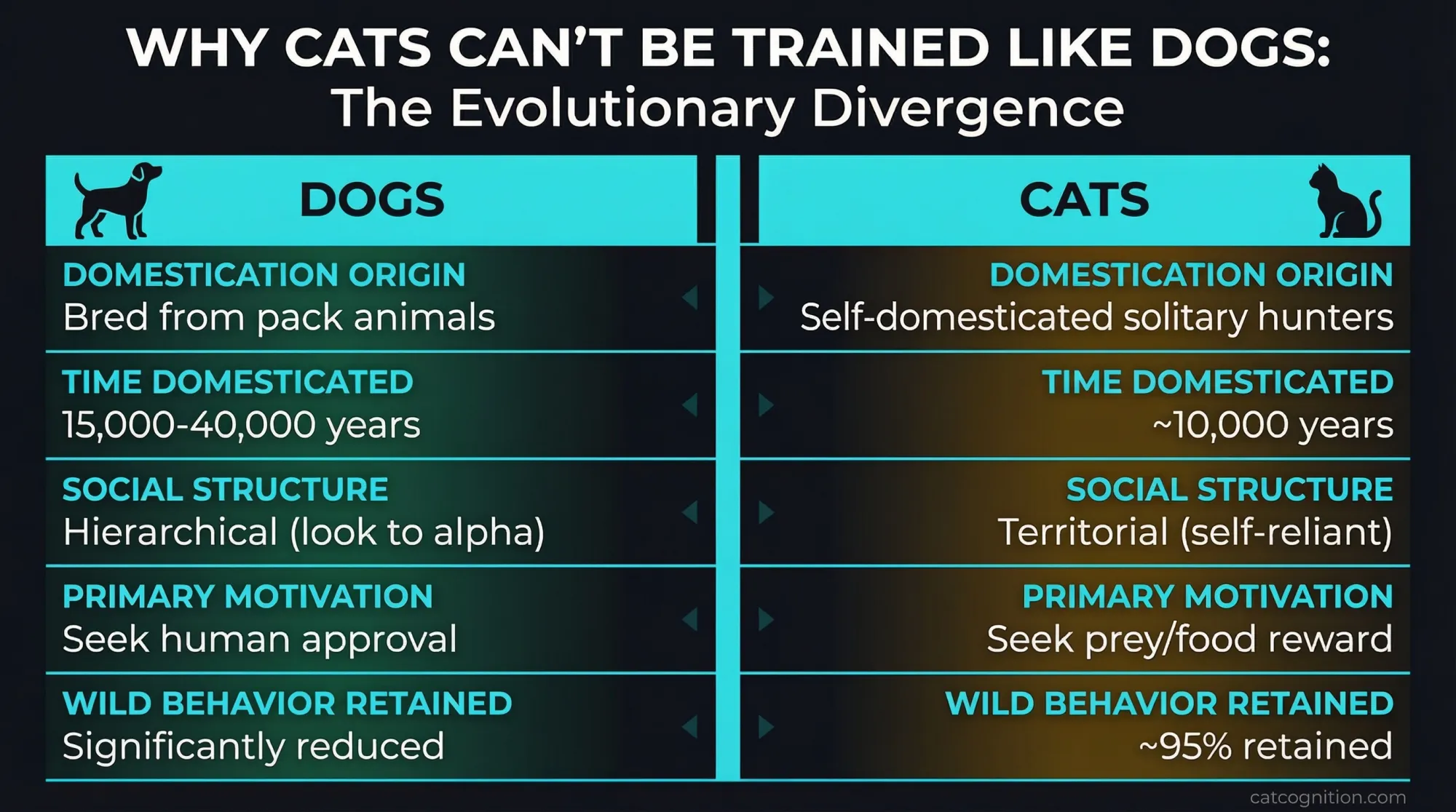
Dogs vs. Cats: The Evolutionary Divergence
| Trait | Dogs | Cats |
|---|---|---|
| Domestication origin | Bred from pack animals | Self-domesticated solitary hunters |
| Time domesticated | 15,000-40,000 years | ~10,000 years |
| Social structure | Hierarchical (look to alpha) | Territorial (self-reliant) |
| Motivation | Seek human approval | Seek prey/food reward |
| Wild behavior retained | Significantly reduced | ~95% |
The Evidence:
"Dogs were domesticated from pack animals with a social hierarchy - they are neurologically wired to seek approval from a leader figure. Cats descended from solitary territorial hunters and were 'self-domesticated' - they chose to live near humans because of abundant rodent prey, not because they sought human approval."
A 2024 study in Applied Animal Behaviour Science proposed that cats remain "solitary predators for hire" - their characteristic independence "is most probably the result of the unchanged feeding ecology." Unlike dogs, cats still hunt. Their brains reward successful hunting, not successful obedience.
Comparison to Successful Animal Programs
Unlike the failed Acoustic Kitty, the Navy's dolphin program succeeded because dolphins are social animals whose echolocation abilities actually benefit from human-directed training. The contrast illustrates why animal selection matters more than technology investment.
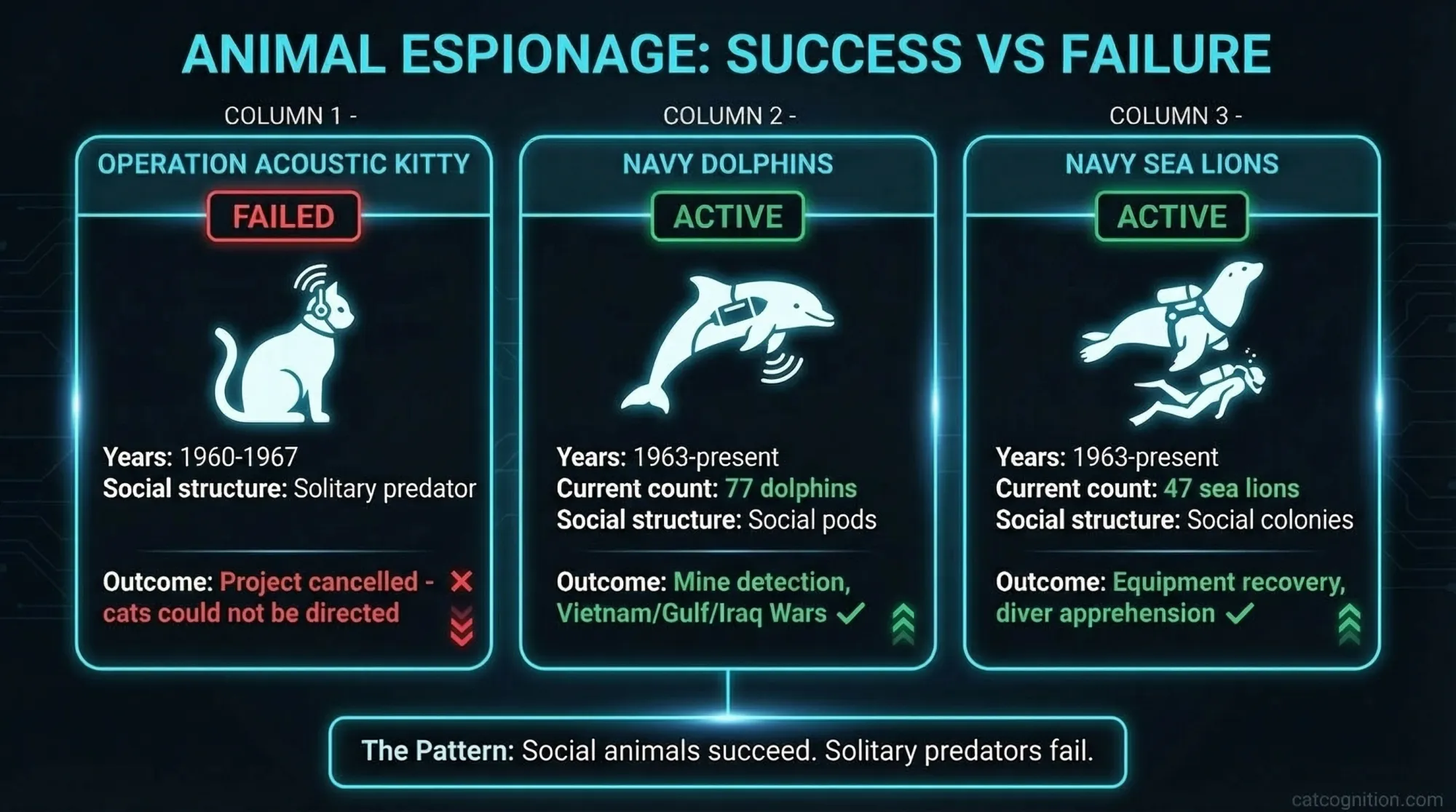
The U.S. Navy Marine Mammal Program (1963-present):
The Navy currently maintains approximately 77 dolphins and 47 sea lions for military operations. Dolphins detect underwater mines using biological sonar that remains superior to any human-made technology. Sea lions recover underwater equipment and can handcuff divers with specially designed clamps.
| Program | Animal | Social Structure | Outcome |
|---|---|---|---|
| Operation Acoustic Kitty | Cat | Solitary predator | Failed |
| Navy Marine Mammal Program | Dolphins | Social pods | Active since 1963 |
| Navy Marine Mammal Program | Sea Lions | Social colonies | Active since 1963 |
Why Dolphins Succeeded Where Cats Failed:
Dolphins evolved in social pods with complex communication systems. Their echolocation abilities naturally align with mine-detection tasks. Training enhances rather than suppresses their biological capabilities.
The CIA attempted the opposite with cats: suppressing natural instincts to impose unnatural behaviors. This approach fights evolution rather than leveraging it.
The Evidence:
"The Navy Marine Mammal Program has deployed dolphins in the Vietnam War, Gulf War, and Iraq War. Their biological sonar remains unmatched by human technology - a success built on understanding animal psychology rather than fighting it."
Other CIA Animal Espionage Programs
Operation Acoustic Kitty was not the CIA's only attempt to weaponize wildlife. The agency explored numerous animal-based surveillance and attack programs during the Cold War, with mixed results that further illuminate why certain species succeed in human-directed tasks.
Project Tacana - Spy Pigeons (1970s):
Pigeons wearing tiny 35-gram cameras trained to fly over Soviet shipyards. Tests showed approximately half of 140 photos achieved good quality - better than spy satellites of the era. The program never became fully operational.
Ravens:
Trained to drop bugging devices on window sills using specially designed carrying mechanisms. Ravens successfully delivered an eavesdropping device to a European target, though no audio was ever captured.
Remote-Controlled Dogs (MKUltra Subproject 94):
The CIA implanted electrodes in dogs' brains, creating six "field operational" remote-controlled animals that could be made to run, turn, and stop via radio signals. Range was limited to 100-200 yards. The program was cancelled before operational deployment.
The Pattern:
Animals with social structures (dogs, pigeons) performed better than solitary predators (cats). However, even dogs required invasive brain modification to achieve reliable compliance - a testament to the limits of overriding natural behavior.
What This Teaches Us About Cat Behavior
Cats cannot be directed like dogs because their attention is stimulus-driven, not command-driven - they evolved to focus on prey, not instructions. Understanding why provides insight into daily cat ownership that transcends Cold War curiosity.
The Attention Problem:
Environmental stimuli like birds, movement, and sounds hijack cat attention regardless of human wishes. Their brains prioritize potential prey over commands.
Research confirms this pattern. A 2023 comparative study found that cats made "considerably fewer choices than dogs in the laboratory environment, and their tendency to make a choice declined during trials." Dogs outperformed cats "both at the group and individual level."
This does not indicate lower intelligence. Cats simply prioritize differently. Their evolutionary success depended on independent decision-making, not following instructions.
The Trainability Spectrum:
Cats CAN be trained using positive reinforcement - treats function as prey substitutes that trigger reward pathways. But training requires cat cooperation. You cannot compel a cat to perform a task on command the way you can with dogs.
A 2019 study by Dr. Kristyn Vitale at Oregon State University found that 65% of cats demonstrate secure attachment to their owners, comparable to human infants and dogs. Cats bond with humans. Bonding does not equal obedience.
Key Takeaways
- Project Cost: Operation Acoustic Kitty consumed an estimated $20 million over five years (1960-1967) before cancellation.
- Technical Success: The surgical implantation of microphones, transmitters, and antennas was technically successful - the failure was biological, not mechanical.
- Evolutionary Mismatch: Cats evolved as solitary predators whose brain reward systems prioritize hunting over social approval, making them fundamentally unsuitable for directed espionage work.
- Contrast with Success: The Navy's dolphin program succeeds because dolphins are social animals whose natural abilities align with training objectives.
- Behavioral Lesson: The CIA's conclusion - "the cat wanted to do what the cat wanted to do" - remains the most accurate summary of feline psychology ever funded by taxpayer dollars.
Key Terms Used
- Solitary Predator: An animal that hunts alone rather than in packs; cats evolved from solitary hunters (Felis silvestris lybica), which explains their independent psychology and resistance to directed commands.
- Positive Reinforcement: A training method that rewards desired behaviors with treats or play; the only effective approach for cats because their brain reward systems respond to prey-like rewards, not social approval.
- Secure Attachment: A bonding pattern where a cat uses their human as a "safe base," seeking proximity during stress.
See the full Cat Cognition Glossary ->
Frequently Asked Questions
What was Operation Acoustic Kitty?
Operation Acoustic Kitty was a classified CIA project from 1960-1967 that surgically implanted surveillance equipment into cats, including a microphone in the ear canal, a transmitter at the skull base, and an antenna woven through the fur to the tail. The project cost approximately $20 million and was cancelled after cats proved impossible to direct reliably.
Why did the CIA choose cats for espionage?
The CIA observed that stray cats could wander into high-security Soviet facilities without raising suspicion. Unlike human agents who would immediately trigger alarms, cats appeared harmless and could potentially carry recording equipment into sensitive locations undetected.
Did the spy cat really get hit by a taxi?
The taxi death story is disputed. Victor Marchetti, former CIA executive assistant, claimed the cat was killed by a taxi during its first field test. However, Robert Wallace, former CIA Office of Technical Service director, stated in 2013 that the cat was safely retrieved and "lived a long and happy life afterwards."
Why did Operation Acoustic Kitty fail?
The project failed because cats evolved as solitary predators whose brain reward systems prioritize hunting success over social approval. Cats cannot be directed to perform tasks on command the way dogs can. The CIA tried to surgically override hunger and mating drives, but fundamental predator psychology could not be rewired.
Are there any successful animal spy programs?
Yes. The U.S. Navy Marine Mammal Program has successfully used dolphins and sea lions since 1963. The program currently maintains approximately 77 dolphins and 47 sea lions for mine detection and equipment recovery. These programs succeed because dolphins and sea lions are social animals whose natural abilities align with training objectives.
Could modern technology make cat spies viable?
Unlikely. The problem was never the technology - modern GPS collars and cameras are far smaller than 1960s equipment. The fundamental issue is cat psychology. Cats follow their own instincts rather than mission parameters, and this evolutionary trait cannot be changed through technology alone.
What other animals did the CIA try to use for espionage?
The CIA experimented with pigeons carrying cameras (Project Tacana), ravens trained to drop bugging devices, remote-controlled dogs with brain electrodes (MKUltra Subproject 94), and robotic catfish for underwater surveillance. Results varied, but animals with social structures generally performed better than solitary predators.
How much did Operation Acoustic Kitty cost?
The project cost an estimated $20 million over five years according to Victor Marchetti, who served as executive assistant to the CIA director during the 1960s. Some sources cite figures ranging from $15-25 million, but $20 million is the most commonly referenced estimate.
Sources
- National Security Archive (GWU) - "Document Friday: Acoustic Kitty" (Link)
- CIA.gov - "Natural Spies: Animals in Espionage" (Link)
- Smithsonian Magazine - "The CIA Experimented On Animals in the 1960s Too" (Link)
- HISTORY.com - "When the CIA Learned Cats Make Bad Spies" (Link)
- International Cat Care - "The Social Structure of Cat Life" (Link)
- Vitale et al. (2019) - "Attachment bonds between domestic cats and humans" Current Biology (DOI)
- Bradshaw, John - "Cat Sense: How the New Feline Science Can Make You a Better Friend to Your Pet" (2013)