When Do Kittens Open Their Eyes? Day-by-Day Development Guide
Kittens open their eyes between 7-14 days after birth. Learn the day-by-day timeline, why vision stays blurry for weeks, and when to worry about delayed eye opening.

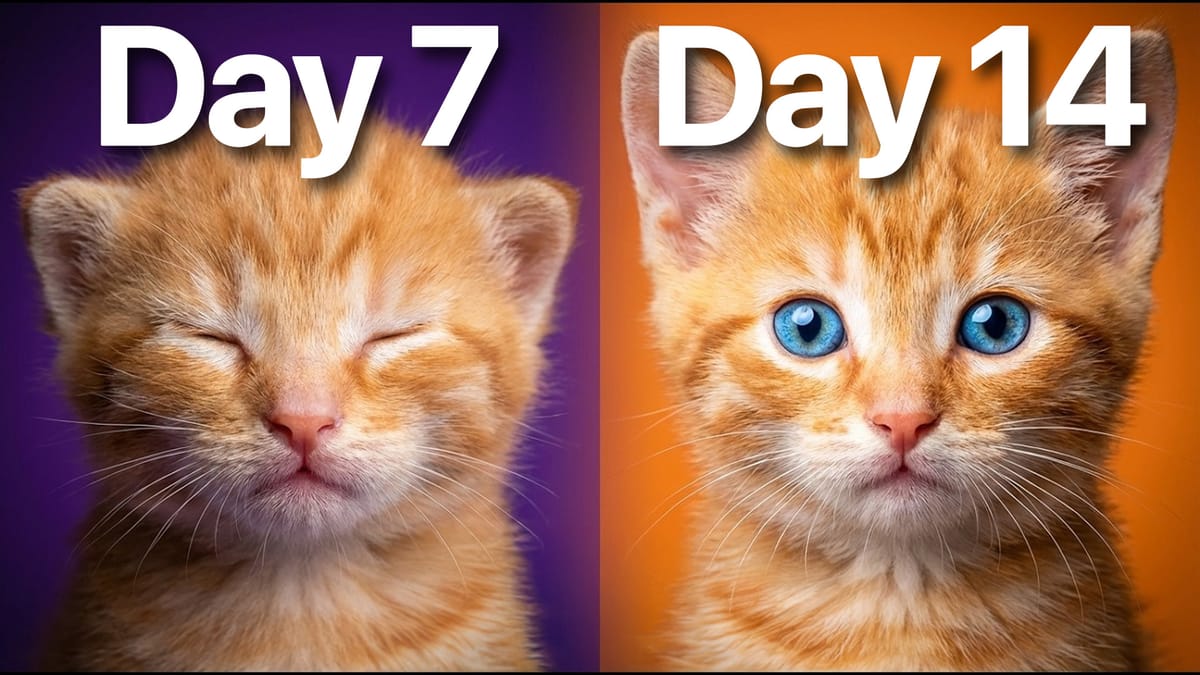
Kittens open their eyes between 7-14 days after birth, with most eyes fully open by day 10-14. Eye opening begins at the inner corner (medial canthus) and progresses outward over 2-3 days. Even after eyelids separate, kitten vision remains blurry for several weeks because a vascular network covering the lens must clear (substantially reduced by day 16, with holes appearing around 3 weeks), and photoreceptors require additional weeks to mature.
Eye opening is NOT the same as functional vision. Kittens cannot see clearly until 4-5 weeks of age, with full adult vision developing by 8-18 weeks.
Table of Contents
- When Do Kittens Open Their Eyes?
- Why Are Kittens Born With Their Eyes Closed?
- The CatCog Kitten Vision Development Timeline
- What Factors Affect When Kittens Open Their Eyes?
- Can Kittens See in the Dark
- When Do Kittens' Eyes Change Color?
- How Can You Tell if a Kitten Is Blind?
- What Eye Problems Can Kittens Have?
- Do Newborn Kittens Have Night Vision?
- At What Age Can Kittens See Clearly?
- Key Terms Used
- Frequently Asked Questions
- Key Takeaways
- Sources
When Do Kittens Open Their Eyes?
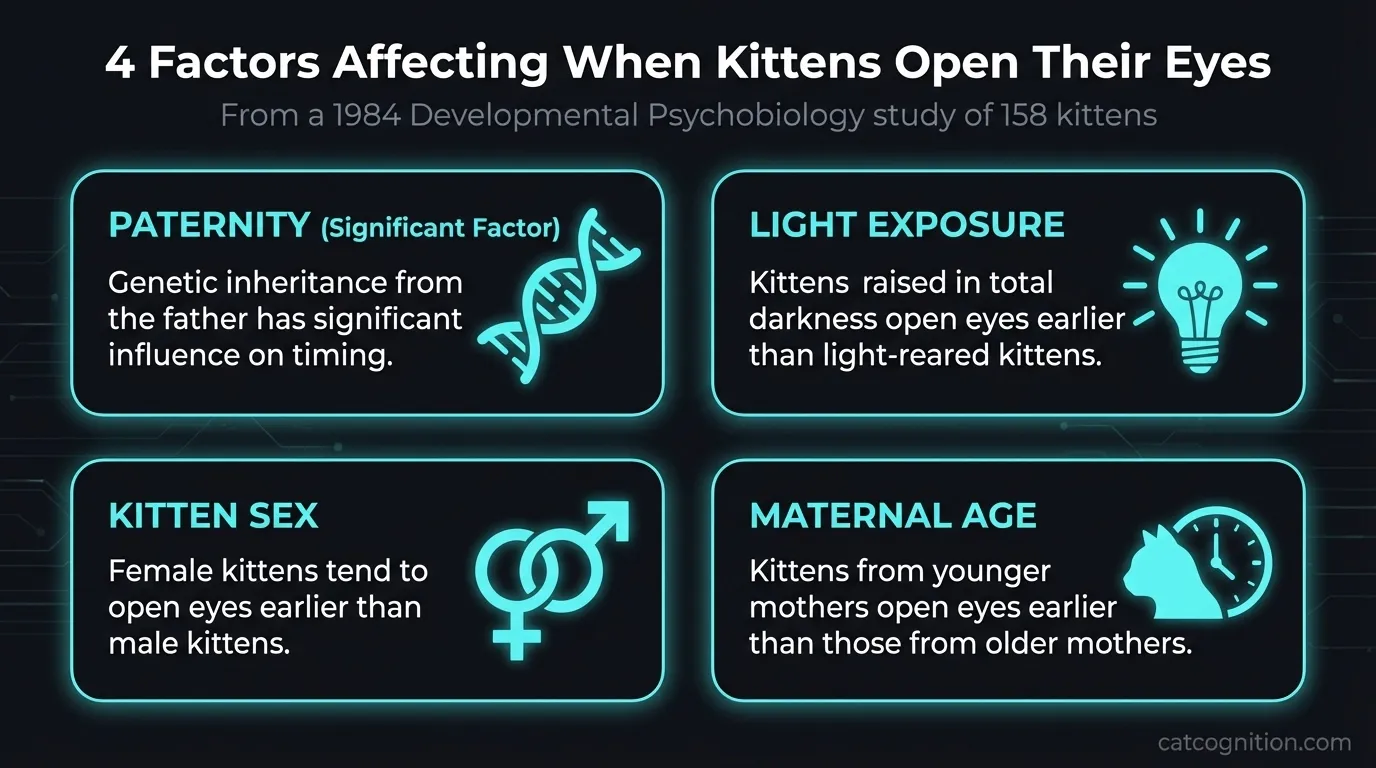
Kittens open closed eyelids between days 7 and 14 after birth. Eye separation begins at the medial canthus (inner corner) and progresses outward over 2-3 days. A 1984 study published in Developmental Psychobiology identified four factors affecting eye-opening timing: paternity, light exposure, kitten sex, and maternal age.
The sealed eyelids at birth serve a protective function. Kitten eyes are not fully formed at birth, and premature exposure to light could damage the developing photoreceptors. The thin membrane fusing the eyelids, called ankyloblepharon, dissolves naturally as the underlying structures mature.
Most veterinary sources confirm that the majority of kittens have both eyes open on the same day. However, asymmetric opening is common and normal. If one eye opens 1-2 days before the other, this represents typical variation rather than a medical concern.
The Evidence:
"Kitten eyelids open between days 7 and 14 after birth, with both eyes typically separating within 1-2 days of each other."

Why Are Kittens Born With Their Eyes Closed?
Kittens are born with sealed eyelids because cats are altricial mammals—born helpless with underdeveloped sensory organs. As Dr. John Bradshaw notes in Cat Sense, this altricial development pattern means kittens arrive with incomplete neural wiring that requires environmental input to fully mature. Closed eyelids protect immature photoreceptors from light damage and prevent infection while the visual system completes development after birth.
The protective mechanism of sealed eyelids makes biological sense when examining kitten visual anatomy. At birth, the retina contains only a minority of functional photoreceptors. On postnatal day 5, only a minority of retinal ganglion cells respond to light stimulation. By day 10, all retinal ganglion cells become responsive, coinciding with the typical eye-opening window.
Beyond the retina, an extensive vascular network engulfs the lens in newborn kittens. This network supplies nutrients during development but severely limits optical quality. The vascular network remains prominent at day 11 but substantially reduces by day 16, with holes appearing around 3 weeks of age.
Think of kitten eye development like firmware installation on a camera. The lens cover opens when eyelids separate, but the software (neural pathways and optical structures) requires additional weeks to calibrate before producing sharp images.
The CatCog Kitten Vision Development Timeline
Kitten visual development follows a predictable sequence from birth through adult vision at approximately 18 weeks. The timeline below synthesizes data from multiple peer-reviewed studies into a comprehensive day-by-day developmental guide.
| Day/Week | Milestone | What Happens |
|---|---|---|
| Day 0 (Birth) | Eyes sealed | Ankyloblepharon (fused eyelids) protects undeveloped structures |
| Day 5 | Minimal light response | Only minority of retinal ganglion cells respond to light |
| Day 7-10 | Eyes begin opening | Separation starts at medial canthus (inner corner) |
| Day 10 | All retinal cells active | 100% of retinal ganglion cells now respond to light |
| Day 10-14 | Eyes fully open | Both eyelids completely separated |
| Day 11 | Motion tracking begins | Eyes can follow movement; lens vascular network still prominent |
| Day 14-16 | Pupil control develops | Pupils can constrict; lens vascular network substantially reduced, holes appearing |
| Day 17-18 | Photoreceptor threshold adult | Late receptor potential reaches adult sensitivity values |
| Day 23-26 | Photoreceptor amplitude adult | Late receptor potential amplitude becomes adult-like |
| Week 3 | Lens clearing continues | Holes in vascular network visible; optical quality improving |
| Week 3-4 | Depth perception develops | Binocular vision coordination improves |
| Week 4-5 | Near-adult vision (bright light) | Optical quality approaches adult for high-intensity stimuli |
| Week 5-7 | B-wave maturation | High-intensity retinal responses become adult-like |
| Week 8-10 | Near-adult vision (all conditions) | B-wave implicit time and low-light responses mature |
| Week 18 | Full retinal maturation | Oscillatory potentials (advanced processing) reach adult values |
The Evidence:
"Kitten vision remains blurry for weeks after eye opening because a vascular network covering the lens remains prominent until day 16, with holes appearing around 3 weeks of age."
What Factors Affect When Kittens Open Their Eyes?
A 1984 study published in Developmental Psychobiology identified four primary factors affecting eye-opening timing in kittens: paternity (genetic inheritance from the father), light exposure, kitten sex, and maternal age. The study documented a significant paternity effect, meaning genetic inheritance from the father contributes to whether kitten eyes open on day 7 or day 14. Paternal genetics explain much of the variation observed between different litters.
The Four Factors of Eye Opening:
- Paternity (Significant Factor): A 1984 study found genetic inheritance from the father has a significant influence on timing
- Light Exposure: The same study found kittens raised in total darkness open eyes earlier than light-reared kittens
- Kitten Sex: A 1984 study found female kittens tend to open eyes earlier than male kittens
- Maternal Age: A 1984 study found kittens from younger mothers open eyes earlier than those from older mothers
The finding about light exposure is particularly counterintuitive. Most caregivers assume kittens need light exposure for normal development. However, the 1984 study demonstrated that kittens raised in complete darkness actually opened their eyes earlier than kittens raised in normal lighting conditions.
This does not mean caregivers should darken the kitten environment. The effect size is small, and artificial darkness is unnecessary. The finding simply demonstrates that light exposure is not required to trigger eye opening. The developmental program proceeds based on internal biological timing rather than external light cues.

Can Kittens See in the Dark?
Newborn kittens cannot see in the dark or any other lighting condition because kitten eyes remain functionally blind for several weeks after opening. Adult cats possess exceptional night vision due to rod-dominant retinas and approximately 6-8 times more rod cells than human eyes, but kitten retinas require weeks of postnatal development before achieving functional night vision. By week 8 or later, kittens develop the night vision capabilities characteristic of crepuscular predators.
The development of night vision follows the broader timeline of visual maturation. Retinal responses to low-intensity light stimuli require 3-5 additional weeks beyond the timeline for high-intensity responses. This means kittens develop bright-light vision first, with low-light and night vision capabilities following later.
For the first 2-3 days after eyes open, kitten pupils cannot constrict properly. During this period, caregivers should keep the nesting area dimly lit to protect developing eyes from light damage. Once pupillary control develops around day 14-16, kittens can regulate light intake independently.
The Evidence:
"Cats have rod-dominant retinas with approximately 6-8 times more rod cells than human eyes, enabling exceptional night vision once the visual system matures."
When Do Kittens' Eyes Change Color?
All kittens are born with blue eyes because melanocytes (pigment-producing cells) have not yet migrated to the iris, and the blue appearance results from Rayleigh scattering of light off unpigmented iris layers. Melanocytes begin generating melanin pigment around 6-7 weeks of age, with adult eye color typically established by 12-16 weeks. The amount of melanocytes present and the quantity of melanin they produce determines final eye color.
This process follows the same genetic principles that determine coat color in cats.
Kitten Eye Color Progression:
| Week | Stage | Appearance |
|---|---|---|
| 0-6 | Blue only | All kittens have blue eyes (no melanin) |
| 6-7 | Transition begins | Melanocytes start producing melanin |
| 7-10 | Active color change | Iris pigmentation develops visibly |
| 12-16 | Adult color set | Final eye color established for most cats |
| Up to 1 year | Continued darkening | Some cats' eye color continues deepening |
What Determines Final Eye Color:
- Heavy melanin production: Orange, copper, or gold eyes
- Moderate melanin production: Green or hazel eyes
- No melanin in both iris layers: Blue eyes persist
Certain breeds retain blue eyes into adulthood due to genetic factors that limit melanin production in the iris. Breeds with point coloration (Siamese, Ragdoll, Birman, Himalayan, Tonkinese, Snowshoe, Colorpoint Shorthair, Balinese) characteristically maintain blue eyes throughout life.
How Can You Tell if a Kitten Is Blind?
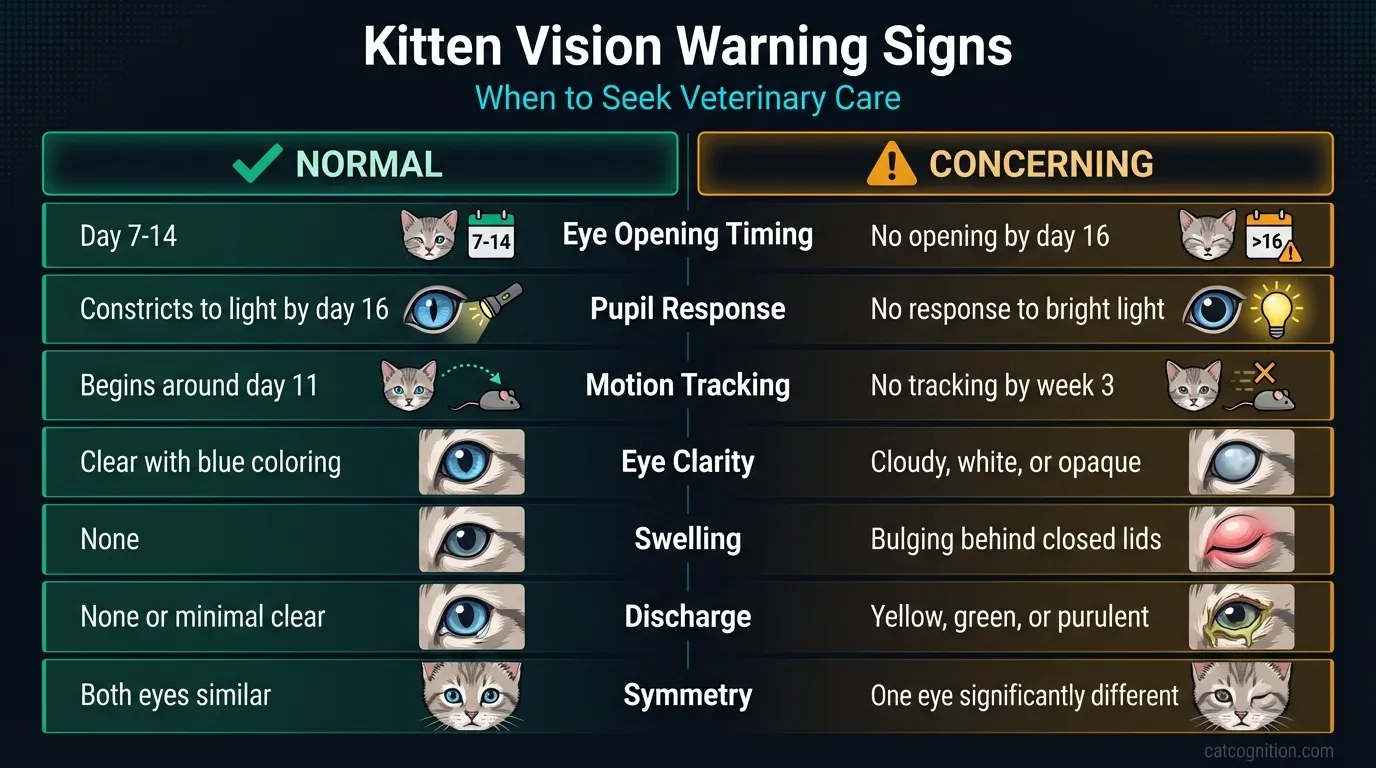
A kitten may be blind if eyes remain closed past day 16, if opened eyes show no pupillary response to light, or if the kitten consistently fails to track moving objects by week 3-4. Normal kittens begin tracking motion around day 11 and develop depth perception by week 3-4, so inability to follow movement or frequent collisions with objects beyond this age warrants veterinary evaluation. Cloudy, opaque, or discolored eyes also indicate potential vision problems requiring immediate examination.
Warning Signs Requiring Veterinary Attention:
| Sign | Normal | Concerning |
|---|---|---|
| Eye opening timing | Day 7-14 | No opening by day 16 |
| Pupil response | Constricts to light by day 16 | No response to bright light |
| Motion tracking | Begins around day 11 | No tracking by week 3 |
| Eye clarity | Clear with blue coloring | Cloudy, white, or opaque |
| Swelling | None | Bulging behind closed lids |
| Discharge | None or minimal clear | Yellow, green, or purulent |
| Symmetry | Both eyes similar | One eye significantly different |
Nobel Prize-winning research by David Hubel and Torsten Wiesel demonstrated that visual deprivation during a kitten's critical period causes permanent vision impairment. Kittens whose eyes were sutured closed for the first 3 months of life showed no signs of vision when the sutures were removed, while the normal eye functioned properly. This research established that early visual input is essential for proper development of the visual cortex.
What Eye Problems Can Kittens Have?
Ophthalmia neonatorum (neonatal eye infection) is the most common kitten eye problem, occurring when bacteria or viruses infect the space behind fused eyelids during the first 10-14 days of life. A 2023 UC Davis study of 40 kittens classified symblepharon (conjunctival adhesion to eye structures) into five distinct types, with feline herpesvirus identified as a primary cause. Early recognition and treatment of kitten eye infections prevents permanent damage including corneal scarring and blindness.
Signs of Ophthalmia Neonatorum:
- Swelling or bulging of closed eyelids
- Red or irritated periorbital tissue
- Yellow, green, or purulent discharge
- Matted or crusted eyelids
- One eye larger than the other behind closed lids
Common Pathogens:
- Feline herpesvirus
- Staphylococcus bacteria
- Streptococcus bacteria
- Chlamydia
- Mycoplasma
Treatment involves carefully opening the fused eyelids using warm compresses to allow drainage, followed by topical antibiotics. Without treatment, the accumulated bacteria-filled discharge can cause permanent damage to the cornea. In severe cases, the cornea may rupture completely, resulting in permanent blindness.
Premature eye opening, though rare, can also cause problems. If eyelids separate before the tear production system matures, the cornea lacks adequate lubrication and may develop drying, keratitis, or ulcers. Kittens with premature eye opening require frequent artificial tear application until the lacrimal system catches up.
Understanding these warning signs is one of the most common mistakes new cat owners need to avoid, and part of broader cat care.
The Evidence:
"A 2023 UC Davis retrospective study examined 54 eyes in 40 kittens with symblepharon, classifying this condition into five distinct types and introducing new surgical management techniques."
Do Newborn Kittens Have Night Vision?
Newborn kittens have no functional vision at all, including night vision, because the visual system requires weeks of postnatal development before processing any visual information. Retinal ganglion cells achieve 100% light responsiveness by day 10, but meaningful vision depends on clearing of the lens vascular network (day 25), photoreceptor maturation (days 17-26), and neural pathway development (weeks 8-18). Adult night vision capability develops by week 8 or later, when retinal rod cells and associated neural processing reach functional maturity.
The extended development timeline reflects the complexity of the mammalian visual system. Unlike simple light detection, true vision requires:
- Optical clarity: Lens vascular network must absorb (complete by day 25)
- Photoreceptor maturation: Rods and cones must reach adult sensitivity (days 17-26)
- Neural processing: Retinal oscillatory potentials must mature (week 18)
- Cortical integration: Visual cortex must receive and process input (weeks 8-18)
Cats' exceptional adult night vision results from specialized adaptations including the tapetum lucidum (reflective layer behind the retina), large corneas relative to eye size, and approximately 6-8 times more rod cells than human eyes. These structures develop during kittenhood but do not function at adult capacity until the complete visual system matures.
At What Age Can Kittens See Clearly?
Kittens can see clearly in bright light conditions by 4-5 weeks of age, when optical quality approaches adult values for high-intensity stimuli. Full adult vision across all lighting conditions develops between weeks 8-18, with low-light vision and advanced visual processing (oscillatory potentials) reaching maturity last. The 1978 study published in Vision Research documented that optical quality continues improving through 10 weeks, with slower gains extending beyond.
Vision Clarity Timeline:
| Age | Visual Capability | Details |
|---|---|---|
| Week 2 | Blurry, minimal | Eyes open but lens still vascularized |
| Week 3 | Improving | Lens clearing; can track movement |
| Week 4 | Functional | Depth perception develops |
| Week 4-5 | Near-adult (bright) | Optical quality approaches adult for bright conditions |
| Week 8 | Near-adult (all) | B-wave timing matures; functional in low light |
| Week 18 | Full adult | Oscillatory potentials reach adult values |
The vision development timeline coincides with the critical socialization period identified by Dr. John Bradshaw in his research on cat psychology. The second month of a kitten's life represents a narrow window for human socialization, precisely when vision matures enough for meaningful visual learning and face recognition.
This developmental stage is part of the broader cat life stages that define feline growth from kittenhood to adulthood.
Key Terms Used
- Altricial: Describes species born helpless with underdeveloped sensory organs, requiring extensive parental care; domestic cats are altricial, born blind and deaf
- Ankyloblepharon: The physiological fusion of kitten eyelids at birth; this thin membrane naturally dissolves between days 10-14 as the underlying eye structures mature
- Medial canthus: The inner corner of the eye where eyelid separation typically begins during kitten eye opening
- Ophthalmia neonatorum: Eye infection occurring behind fused eyelids in the first weeks of life; characterized by swelling behind closed lids and purulent discharge
- Photoreceptors: Light-sensitive cells in the retina (rods and cones) that convert light into electrical signals; kitten photoreceptors require 17-26 days to reach adult function
- Retinal ganglion cells: Neurons in the retina that process visual information before transmitting to the brain; only a minority respond to light at day 5, with all cells responsive by day 10
- Symblepharon: Abnormal adhesion of the conjunctiva to nearby eye structures, often secondary to feline herpesvirus infection; classified into 5 types by UC Davis researchers
- Tapetum lucidum: Reflective layer behind the retina that enhances night vision by reflecting light back through photoreceptors; gives cat eyes their characteristic "glow" in low light
Frequently Asked Questions
How long does it take for kittens to open their eyes?
Kittens open their eyes between 7-14 days after birth, with most eyes fully open by day 10-14. The process takes 2-3 days from initial separation at the inner corner to complete opening. Both eyes typically open within 1-2 days of each other, though asymmetric opening is normal.
What happens if a kitten's eyes don't open by 2 weeks?
If kitten eyes remain closed past day 14-16, consult a veterinarian. Delayed opening may indicate ophthalmia neonatorum (infection behind closed lids) or incomplete eyelid development. Watch for swelling, discharge, or redness around closed eyes, which require immediate veterinary attention.
Can I help my kitten's eyes open faster?
No intervention can safely accelerate eye opening, and attempting to pry open kitten eyelids causes serious damage including corneal drying, keratitis, and ulcers. A 1984 study found darkness actually accelerates opening naturally, but artificially darkening the environment is unnecessary. Let development proceed naturally.
What if one eye opens before the other?
Asymmetric eye opening is normal and common. Eyelid separation may progress at different rates for each eye. If one eye remains closed more than 2-3 days after the other opens, or if swelling or discharge is present, consult a veterinarian to rule out infection.
Why are all kittens born with blue eyes?
Kittens are born with blue eyes due to absence of melanin pigment in the iris. The blue color results from Rayleigh scattering of light off unpigmented iris layers. Melanocytes begin producing melanin around 6-7 weeks, with adult eye color established by 12-16 weeks.
When can kittens see clearly?
Kittens achieve near-adult vision in bright conditions by 4-5 weeks of age. Full adult vision across all lighting conditions develops between weeks 8-18. Even after eyes open, vision remains blurry until the lens vascular network clears around 3 weeks.
What are signs of eye infection in newborn kittens?
Signs of ophthalmia neonatorum include swelling or bulging behind closed eyelids, redness around the eye area, yellow or green discharge, matted or crusted eyelids, and one eye appearing larger than the other. Immediate veterinary care is essential to prevent permanent damage.
When do kitten eyes change from blue to their adult color?
Eye color transition begins around 6-7 weeks when melanocytes start producing melanin. Most kittens have their adult eye color by 12-16 weeks, though some cats continue darkening for up to one year. Breeds with point coloration retain blue eyes permanently.
Can newborn kittens see in the dark?
Newborn kittens cannot see in the dark or any lighting condition. Vision develops gradually after eyes open, with functional night vision not developing until week 8 or later. Adult cats have rod-dominant retinas with approximately 6-8 times more rod cells than human eyes, enabling excellent night vision once the visual system matures.
Should I keep newborn kittens in a dark or lit environment?
Maintain a dimly lit, calm nesting area. For 2-3 days after eyes open, keep lighting low because kitten pupils cannot constrict yet. A 1984 study found darkness accelerates eye opening, but this effect is small and artificial darkness is unnecessary. Normal indoor lighting is appropriate after pupillary control develops around day 14-16.
What breeds keep blue eyes as adults?
Breeds with point coloration retain blue eyes due to genetic factors limiting melanin production: Siamese, Ragdoll, Birman, Himalayan, Tonkinese, Snowshoe, Colorpoint Shorthair, and Balinese. White cats with blue eyes may carry genes for deafness and should be evaluated by a veterinarian.
Key Takeaways
- Eye Opening Window: Kittens open their eyes between days 7-14, with paternity (genetics) being a significant factor affecting timing according to a 1984 study of 158 kittens.
- Opening Is Not Seeing: Eyelid separation is just the first step. Vision remains blurry until the lens vascular network clears (around 3 weeks) and photoreceptors mature (days 17-26), with full adult vision not achieved until weeks 8-18.
- Never Force Eyes Open: Attempting to pry open kitten eyelids causes corneal damage, keratitis, and ulcers. If infection is suspected (swelling, discharge), seek veterinary care for safe intervention.
- Blue Eyes Are Temporary: All kittens are born with blue eyes due to absent melanin. Adult eye color develops between 6-16 weeks, with point-colored breeds (Siamese, Ragdoll) retaining blue eyes permanently.
- When to Worry: Consult a veterinarian if eyes remain closed past day 16, if swelling or discharge appears behind closed lids, if opened eyes show no pupillary response, or if kittens cannot track movement by week 3-4.
Sources
- Eye-opening in kittens: effects of light and some biological factors - Braastad BO, Heggelund P, Developmental Psychobiology, 1984 (PubMed)
- Symblepharon in kittens: a retrospective study of 40 kittens and 54 eyes (2002-2022) - UC Davis School of Veterinary Medicine, Journal of Feline Medicine and Surgery, 2023 (JFMS)
- Development of optical quality in the kitten eye - Vision Research, 1978 (ScienceDirect)
- Physiological development of the kitten's retina: an ERG study - 1985 (PubMed)
- David H. Hubel and Torsten N. Wiesel's Research on Optical Development in Kittens - Arizona State University Embryo Project Encyclopedia (ASU)
- Neonatal Clinical Assessment of the Puppy and Kitten: How to Identify Newborns at Risk? - PubMed Central, 2024 (PMC)
- Cat Sense: How the New Feline Science Can Make You a Better Friend to Your Pet - Dr. John Bradshaw, University of Bristol, 2013 (Amazon)
- Kitten - ScienceDirect Topics - Multiple authors, 2024 (ScienceDirect)
- Kitten Vision: More Than Meets the Eye - National Kitten Coalition, 2024 (Kitten Coalition)
- When Do Kittens Open Their Eyes? - Hannah Hart, DVM, PetMD, 2024 (PetMD)
- How to Determine a Kitten's Age - Hannah Shaw (Kitten Lady), 2024 (Kitten Lady)