Why Does My Cat Sleep With Me? 9 Scientific Reasons Explained
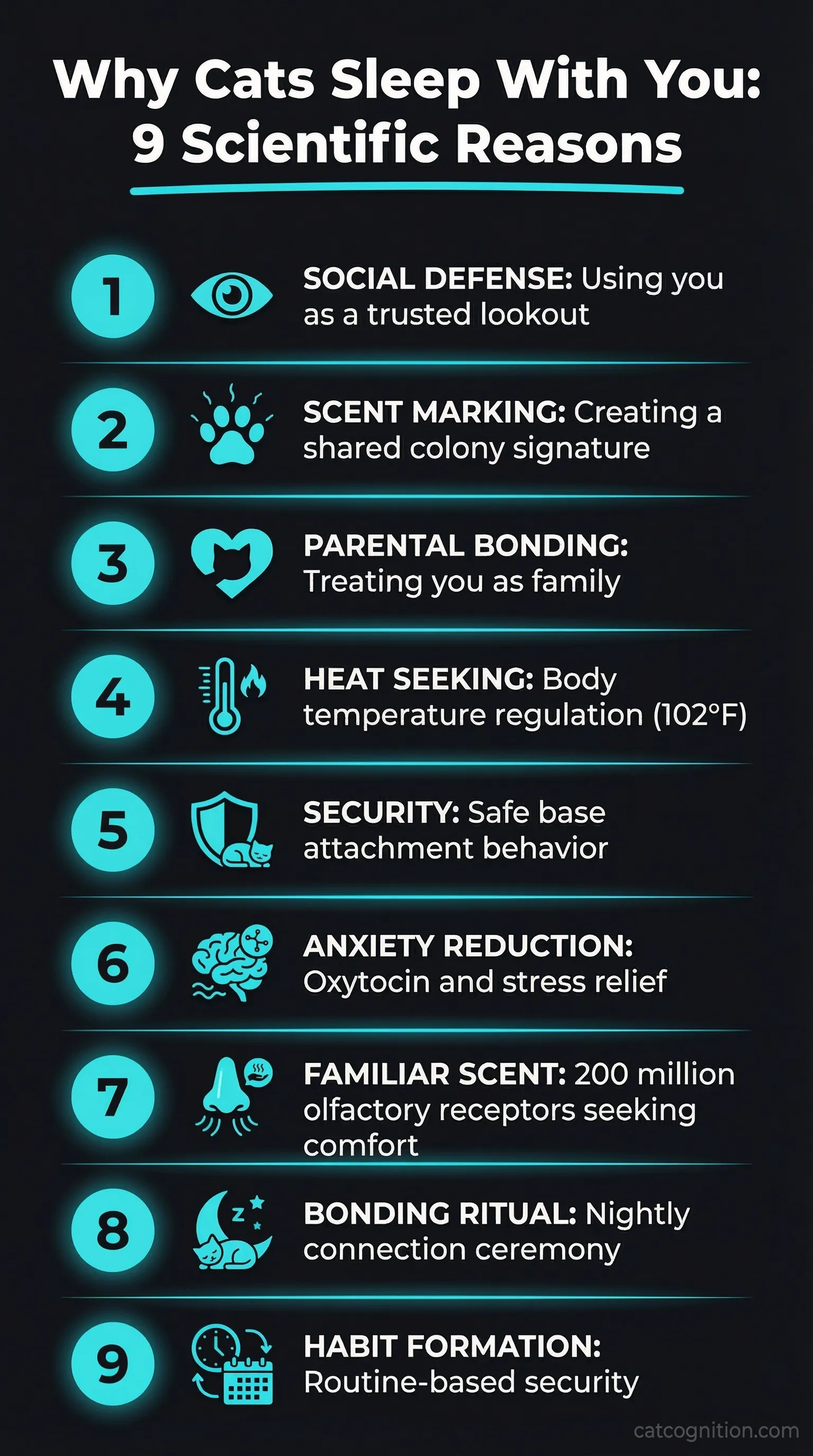
When cats sleep with you, it signals deep trust. Beyond warmth-seeking (cats run 102°F), they use you for Social Defense, scent bonding, and secure attachment. Here are the 9 biological drivers.


Quick Answer: Why does my cat want to sleep with me?
Your cat sleeps with you because sleep is their most vulnerable state, and choosing you as their sleep partner is the ultimate sign of trust. Beyond seeking body heat (cats have a baseline temperature of 102°F), cats engage in "Social Defense" behavior, using you as a trusted lookout. A 2019 Oregon State University study found 65% of cats display secure attachment to their owners, explaining why they seek proximity during their most defenseless hours.
Understanding why your cat chooses to sleep with you reveals fascinating insights into feline behavior and the depth of the human-cat bond.
Table of Contents
- Is My Cat Protecting Me While I Sleep?
- Is My Cat Scent Marking Me?
- Do Cats See Owners as Parents?
- Do Cats Sleep With You for Warmth?
- Does Sleeping With a Cat Make Them Feel Safe?
- Does Co-Sleeping Reduce Cat Anxiety?
- Why Does My Cat Like My Smell?
- Is Sleeping Together a Bonding Ritual?
- How Do Cats Form Sleeping Habits?
- Key Takeaways
- Key Terms Used
- Frequently Asked Questions
Is My Cat Protecting Me While I Sleep?
When your cat chooses to sleep on or beside you, they are activating an ancient survival mechanism called Social Defense. In wild cat colonies, sleeping cats position themselves strategically within the group, trusting colony members to act as lookouts during their most vulnerable hours.
Your cat views you as a trusted member of their colony. By sleeping near you, they gain the security of having a "night watchman" on duty while they enter deep sleep. This behavior explains why cats often position themselves facing the bedroom door or toward windows while pressed against your side.
The Evidence:
"Cats that sleep with their owners demonstrate elevated trust levels, as sleep represents the most vulnerable state in a predator-prey survival context."
This Social Defense behavior is particularly pronounced in cats who have bonded closely with their owners. If your cat sleeps with their back to you while facing potential entry points, they are literally trusting you to watch their back.
Is My Cat Scent Marking Me?
Every time your cat sleeps on your bed, they are engaging in territorial scent marking. Cats possess scent glands on their cheeks, paws, and along their body that deposit pheromones onto surfaces and individuals they claim as "theirs."
When your cat sleeps on your pillow or blankets, they are not just seeking comfort. They are mixing their scent with yours, creating a combined "colony signature" that reinforces their bond with you. This scent-blending behavior, known as bunting when performed through head rubbing, serves the same function during sleep through full-body contact.
This territorial marking is not possessive aggression. Rather, it represents your cat's desire to integrate their identity with yours and your shared environment.
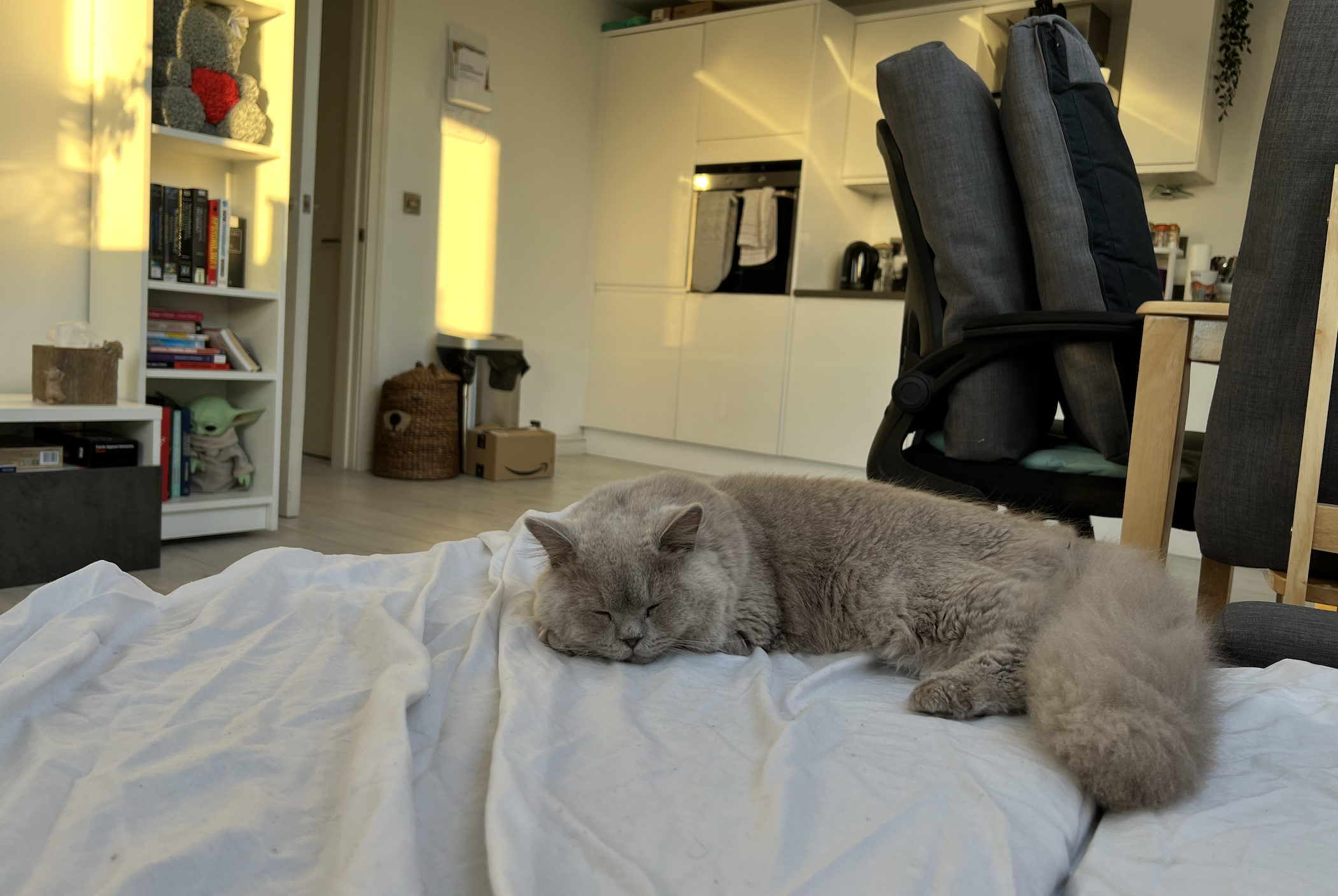
Do Cats See Owners as Parents?
Research demonstrates that adult cats retain juvenile behaviors when interacting with their human caregivers. A phenomenon called neoteny explains why cats continue kneading behavior, high-pitched vocalizations, and dependent sleeping arrangements into adulthood.
In kitten development, littermates and mother cats sleep together in "kitten piles." The warmth, security, and rhythmic breathing of sleeping companions become neurologically associated with safety. Adult cats sleeping with their owners are essentially treating humans as surrogate family members.
As noted by Dr. John Bradshaw of the University of Bristol in his book Cat Sense, domestic cats retain essentially the same behavioral repertoire as their wild ancestors, and the behaviors they reserve for humans closely mirror those used with their mothers and siblings.
The Evidence:
"A 2019 Oregon State University study found 65% of cats demonstrated secure attachment to their owners, comparable to rates observed in human infant-caregiver relationships."
Do Cats Sleep With You for Warmth?
Cats have a normal body temperature of 100.5-102.5°F (38-39.2°C), significantly higher than the human average of 98.6°F. Their thermoneutral zone ranges from 86-100°F, meaning cats feel comfortable at temperatures most humans find uncomfortably warm.
This biological reality makes human bodies attractive heat sources. When your cat drapes across your chest or curls against your legs, they are using your body heat through direct thermal conduction to maintain their preferred temperature without expending metabolic energy.
The CatCog Reality Check:
Your cat is not being "clingy" when they follow you from room to room and settle on whatever surface you just vacated. They may be heat-seeking. That warm spot on the couch you just left is prime real estate for a cat's temperature regulation strategy.
Cats are particularly drawn to sleeping near human torsos, where core body heat is highest. This explains why many cats prefer sleeping on chests, stomachs, or tucked into the curve of a sleeping human's body.
Does Sleeping With a Cat Make Them Feel Safe?
Beyond the Social Defense mechanism, cats experience genuine feelings of safety when sleeping with trusted humans. Secure attachment research by Dr. Kristyn Vitale at Oregon State University demonstrated that cats use their owners as a "secure base" during stressful situations.
The 2019 study published in Current Biology found that securely attached cats displayed reduced stress behaviors and increased exploratory confidence when their owner was present. During sleep, a period of maximum vulnerability, this attachment need becomes amplified. Sleeping with their owner satisfies the cat's fundamental need for a protected environment.
Cats who have experienced trauma, rehoming, or environmental instability often demonstrate increased co-sleeping behavior as a method of security-seeking.
Does Co-Sleeping Reduce Cat Anxiety?
Co-sleeping provides anxiety reduction benefits for cats. The presence of a trusted human can promote the release of oxytocin, particularly when the cat initiates contact. Research shows securely attached cats experience oxytocin increases during positive interactions, though the effect is less pronounced than in dogs.
Research by Dr. Tony Buffington at Ohio State's Indoor Pet Initiative has demonstrated that environmental stressors significantly impact feline health and behavior. Having access to a trusted companion during the vulnerable sleep period reduces the chronic stress that can lead to behavioral disorders and stress-related illnesses.
The presence of a trusted human companion during sleep may help reduce feline anxiety, though direct cortisol measurements during co-sleeping have not been extensively studied.
For cats with generalized anxiety or those adapting to new environments, co-sleeping can serve as a transitional coping mechanism that gradually builds confidence and security.
Why Does My Cat Like My Smell?
Cats possess 45 to 200 million olfactory receptors (up to 40 times more than humans' 5-6 million). Your personal scent carries significant emotional and bonding information for your cat.
The scent of their owner has been shown to have calming effects on cats, similar to how a familiar blanket or toy provides comfort to young children. When your cat sleeps on your dirty laundry, your pillow, or directly on you, they are surrounding themselves with olfactory cues that signal safety and belonging.
This scent-seeking behavior intensifies when owners are frequently absent. Cats whose owners work long hours or travel often show increased interest in sleeping on owner-scented items and locations.
Adam's Lab Note:
When I returned from a five-day trip, Moon spent the first night sleeping directly on my chest rather than his usual spot at my feet. He also spent nearly ten minutes intensively sniffing my luggage and the clothes I had been wearing. By the third night, he returned to his normal sleep position. The scent reconnection period seemed to take approximately 48-72 hours.
Is Sleeping Together a Bonding Ritual?
Co-sleeping functions as a daily bonding ritual that reinforces the cat-human relationship. The consistent pattern of settling into sleep together creates predictable positive experiences that strengthen attachment over time.
From a behavioral perspective, the pre-sleep period often includes allogrooming behaviors, slow blinks, and physical proximity seeking. These combined behaviors create a nightly "bonding ceremony" that maintains relationship quality.
Cats who are denied access to their owner's sleeping space often display frustration behaviors, including scratching at doors, vocalizing, and increased daytime attention-seeking. This reaction indicates co-sleeping has become an expected component of the human-cat bond.
How Do Cats Form Sleeping Habits?
Cats are creatures of habit with strong circadian rhythms. Once a sleeping arrangement becomes established, cats strongly prefer maintaining that routine.
The predictability of knowing where they will sleep, who they will sleep with, and the sensory environment of that space provides security and reduces decision-making stress. Disrupting established sleeping arrangements can cause behavioral disturbances that persist for days or weeks.
The CatCog Reality Check:
If you have allowed your cat to sleep with you and then attempt to exclude them from the bedroom, expect behavioral protests. Cats do not easily abandon established routines, and sudden changes to sleeping arrangements can trigger anxiety responses.
This habit formation explains why many cats develop specific sleeping positions, preferred sides of the bed, and particular timing for when they join their owners in bed.
Key Takeaways
- Trust Signal: When your cat sleeps with you, it represents their highest expression of trust, as sleep is a cat's most vulnerable state.
- Temperature Regulation: Cats have a body temperature of 102°F and a thermoneutral zone of 86-100°F, making human bodies ideal heat sources.
- Secure Attachment: Research confirms 65% of cats demonstrate secure attachment to owners, comparable to human infant-caregiver bonds.
- Social Defense: Cats use owners as "lookouts" during sleep, positioning themselves strategically for protection while trusting you to watch for threats.
- Scent Bonding: Co-sleeping allows cats to blend their scent with yours, reinforcing colony membership and territorial bonding.
Key Terms Used
- Secure Attachment: A bonding pattern where cats use their human as a "safe base," seeking proximity during stress and showing reduced anxiety in the owner's presence.
- Thermoregulation: The biological process by which cats maintain optimal internal body temperature through behavioral adjustments like seeking warm sleeping companions.
- Bunting: Scent-marking behavior where cats rub their cheek glands against objects or individuals to deposit ownership pheromones.
- Neoteny: The retention of juvenile behaviors like kneading and dependent sleeping into adulthood, explaining why cats treat owners as parental figures.
See the full Cat Cognition Glossary ->
Frequently Asked Questions
Why does my cat only sleep with me and not other family members?
Cats typically choose their primary attachment figure for sleep partners. This person is usually the one who provides most of the feeding, play, and positive interactions. Cats also prefer individuals with calmer sleep patterns, as restless sleepers may disrupt feline rest.
Is it unhealthy to let my cat sleep in my bed?
For most healthy adults, co-sleeping with cats poses minimal health risks. However, individuals with compromised immune systems, allergies, or asthma may experience complications. A 2024 study in Scientific Reports found that unlike dogs, cats do not significantly disrupt human sleep quality during co-sleeping.
Why does my cat sleep on my head or face?
Your head releases significant body heat and carries concentrated personal scent. Additionally, cats may feel more secure near your face because they can detect your breathing patterns, confirming you are alive and present.
My cat used to sleep with me but stopped. Why?
Changes in sleeping preferences can indicate medical issues, environmental stressors, or relationship changes. New pets, schedule disruptions, or changes to the sleeping environment can all prompt cats to seek alternative sleeping locations. If the change is sudden, a veterinary consultation is recommended.
Why does my cat knead before sleeping on me?
Kneading is a comfort behavior retained from nursing kitten behavior. When your cat kneads before settling on you, they are activating self-soothing neural pathways associated with their mother and early security. It indicates high comfort and trust.
Do cats dream when they sleep with their owners?
Cats experience REM sleep cycles and likely dream. Research indicates cats spend approximately 25% of sleep time in REM phases. Whether co-sleeping affects dream content is unknown, but the security of sleeping with a trusted companion may promote deeper, more restorative sleep states.
Why does my cat sleep at my feet instead of near my face?
Sleeping at feet may indicate a cat that values security over warmth. The foot of the bed provides quick escape routes while maintaining proximity to their owner. Less confident cats or those new to co-sleeping often start at feet before gradually moving closer over time.
Can I train my cat to sleep in a specific spot?
Yes. Consistent positive reinforcement can establish preferred sleeping locations. Place comfortable bedding in the desired location, reward your cat with treats for using it, and maintain consistency. However, forcing a cat away from your bed after co-sleeping is established typically causes more behavioral problems than it solves.
Sources
- Attachment bonds between domestic cats and humans - Vitale, Behnke & Udell, Current Biology 2019 (Link)
- Co-sleeping with pets, stress, and sleep in a nationally-representative sample of United States adults - Scientific Reports 2024 (Link)
- My Cat and Me: A Study of Cat Owner Perceptions of Their Bond and Relationship - PMC 2021 (Link)
- Indoor Pet Initiative: Environmental Enrichment for Cats - Ohio State University (Link)
- Cat Sense: How the New Feline Science Can Make You a Better Friend to Your Pet - Dr. John Bradshaw, 2013
- Feline Behavioral Health and Welfare - Cornell Feline Health Center (Link)