Every Cat Body Language Signal Explained: The Science of Feline Communication
Cat body language uses ears, eyes, tail, and posture as a multi-channel system. Learn to read the 'Whole Cat' with the CatCog 5-Point Signal Check for accurate interpretation.

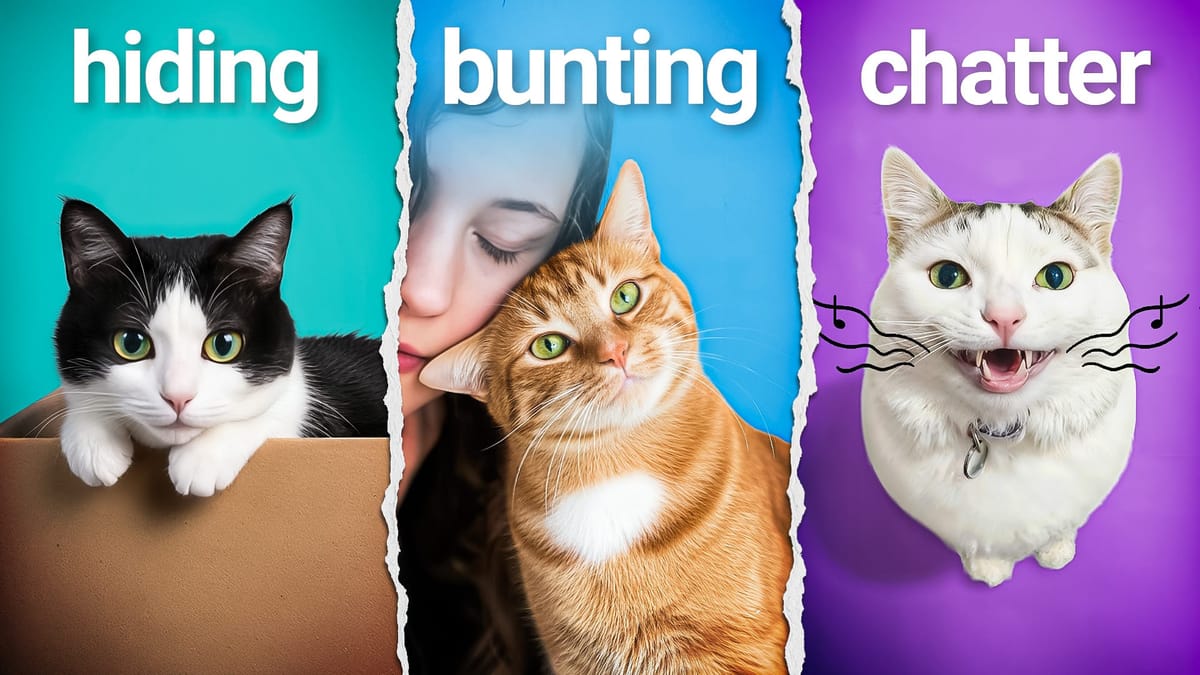
Cat body language is a multi-channel communication system where every signal must be read together for accurate interpretation. Reading just one signal is like judging someone's mood by only seeing their hands - cats use ears, eyes, tail, body posture, and whiskers simultaneously. The same signal can mean different things depending on context, which is why the "Whole Cat" approach is essential for understanding what your cat is actually saying.
Table of Contents
- Why Do Cats Use Body Language Instead of Vocalizations?
- What Does a Slow Blink Mean From a Cat?
- Why Does My Cat's Tail Twitch When I Pet Them?
- What Does Head Bunting Mean When My Cat Does It?
- Why Do Cats Chatter at Birds?
- When Should I Worry About My Cat Hiding?
- What Does an Arched Back Mean in Cats?
- What Do Flat Ears Mean on a Cat?
- Why Do Cats Knead Blankets and People?
- The Whole Cat Approach: Reading All Signals Together
- Key Takeaways
- Key Terms Used
- Frequently Asked Questions
- Sources
Why Do Cats Use Body Language Instead of Vocalizations?
Cats evolved as solitary hunters who developed a sophisticated non-verbal communication system to signal intentions without physical confrontation. Each body signal evolved to prevent costly conflicts and ensure survival without the energy expenditure of actual fighting. As Dr. John Bradshaw of the University of Bristol notes, domestic cats retain approximately 95% of their wild behavioral repertoire.
In the domestic environment, cats now direct these survival signals at humans who frequently misread them. An exposed belly (a trust display) gets interpreted as an invitation to pet. A twitching tail (an overstimulation warning) goes unnoticed until the cat bites. Understanding cat behavior requires learning this ancient communication system.
The Evidence:
"Humans correctly identify cat contentment 90.1% of the time but cat discontentment only 71.6% of the time, creating a dangerous perception gap that leads to bites."

What Does a Slow Blink Mean From a Cat?
Slow blinks function as positive emotional communication between cats and humans, according to research by Dr. Tasmin Humphrey at the University of Sussex. In her 2020 study, cats were significantly more likely to approach a person after receiving a slow blink interaction, with experiments using 21 and 24 cats confirming the effect (Humphrey et al., 2020).
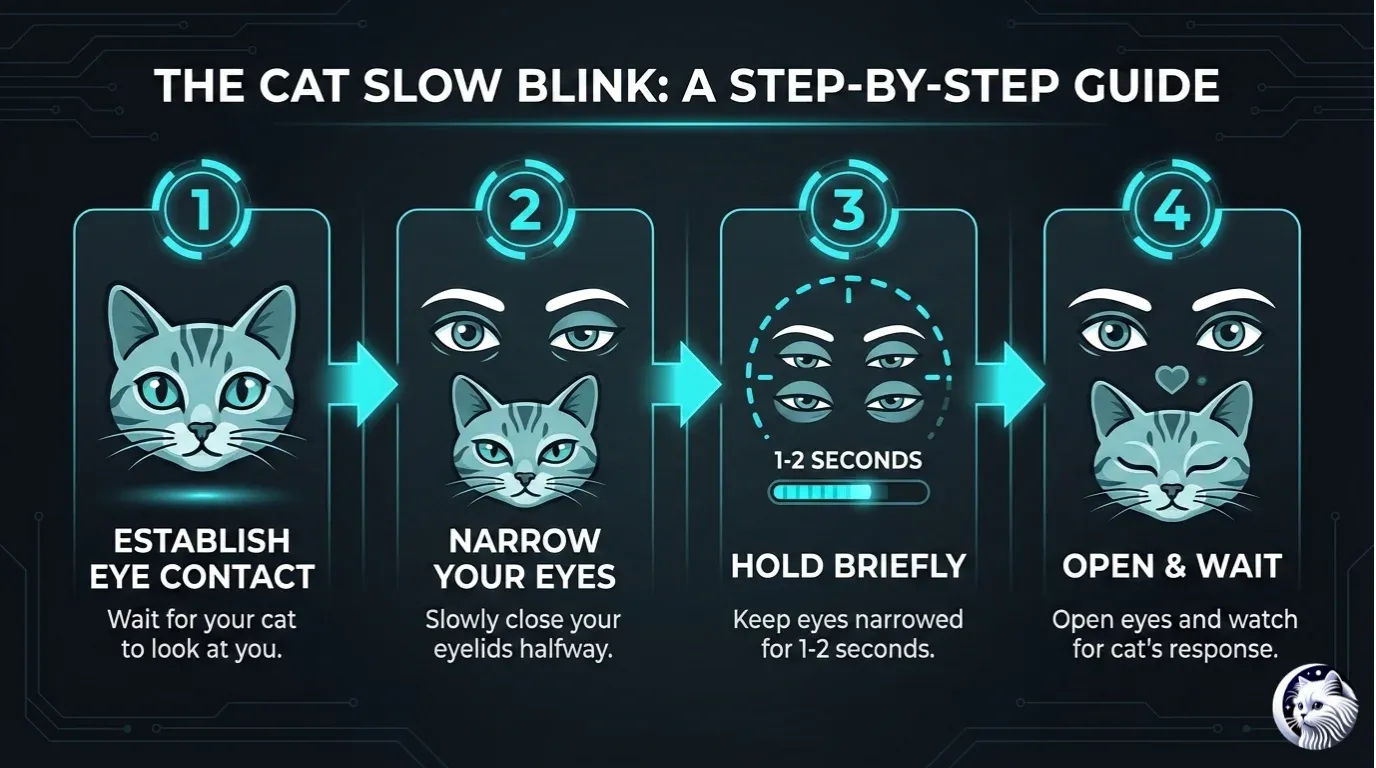
The mechanism involves voluntary control of the orbicularis oculi muscles. Eye narrowing and half-blinks signal relaxation and affiliative intent. This is not a sleepy cat drifting off; slow blinking is a deliberate communication signal that cats use with trusted individuals.
The Evidence:
"Slow blink sequences function as positive emotional communication between cats and humans, making cats more likely to approach after the interaction."
Why Does My Cat's Tail Twitch When I Pet Them?
A twitching tail is an overstimulation warning signal indicating that a cat's threshold for tactile stimulation is being reached. According to Dr. Tony Buffington of Ohio State University's Indoor Pet Initiative, cats with rapidly moving tails can be quite aroused and may bite or scratch (Indoor Pet Initiative). Continued petting past this point frequently results in petting-induced aggression.
Warning signs preceding a bite include: tail swishing, skin rippling along the back, ear rotation, body tensing, dilated pupils, and low growling. Purring can continue during overstimulation because cats also purr when stressed or in pain.
What Does Head Bunting Mean When My Cat Does It?
Head bunting is allorubbing behavior where cats deposit pheromones from facial glands onto objects or individuals, functioning as both scent marking and affiliative bonding. A 2021 study in Applied Animal Behaviour Science found that 83% of cats rub against their owners after separation, confirming allorubbing as significant reunion behavior (Behnke, Vitale & Udell, 2021).
The Evidence:
"83% of cats engage in owner-directed allorubbing after reuniting with their owners, confirming allorubbing as significant reunion behavior."
As Dr. John Bradshaw explains, "Putting their tails up in the air, rubbing around our legs, and sitting beside us and grooming us are exactly what cats do to each other." When your cat bunts you, they are treating you as a fellow cat worthy of inclusion in their social circle. This behavior reflects the same social bonding mechanisms explored in research on how cats show affection.
Why Do Cats Chatter at Birds?
Cat chattering - the rhythmic jaw stuttering that produces a distinctive clicking sound - occurs when prey is visible but inaccessible. According to Dr. Mikel Delgado at Purdue University, chattering may represent frustration or intense excitement when a cat cannot reach potential prey.
An alternative theory suggests chattering simulates the "kill bite" cats use to sever prey's spinal cord. The behavior may be motor rehearsal, with predatory instincts firing despite inability to complete the hunt. This activation of the predatory sequence without completion can lead to frustrated energy that needs appropriate outlets.
When Should I Worry About My Cat Hiding?
Sudden increases in hiding behavior - especially combined with decreased appetite, litter box changes, or reduced social interaction - warrant veterinary attention. Cats display minimal behavioral signs of illness due to evolutionary survival strategy: showing weakness in the wild attracts predators. Cats actively mask pain and illness, making hiding one of the few visible indicators that something may be wrong.
The key distinction is baseline deviation. If your cat has always preferred enclosed spaces (a behavior driven by thigmotaxis), hiding is normal. If your typically social cat suddenly spends hours in concealed locations, this change from baseline is the warning sign.
What Does an Arched Back Mean in Cats?
An arched back with raised fur (piloerection) is the classic "Halloween cat" pose, indicating fear combined with defensive readiness. The piloerection is an involuntary adrenergic response - arrector pili muscles contract in response to adrenaline, making the cat appear larger and more threatening.
The arched back represents "fear aggression" - the cat is scared but feels cornered and ready to defend itself. A cat in this posture may redirect aggression toward anyone who approaches. The distinction between playful and fearful arches lies in accompanying signals: playful arches occur during play with no hissing or flattened ears; fearful arches include dilated pupils, flattened ears, hissing, and a puffed tail. This is why understanding redirected aggression is essential for safe interactions.

What Do Flat Ears Mean on a Cat?
Flattened ears predict negative interaction outcomes and indicate fear or aggression, with the degree of flattening correlating to emotional intensity. Research found that erect, forward-facing ears predict positive outcomes, while ears pressed flat against the head predict negative outcomes. Ears flatten to protect them from claws and teeth during conflict.
The Evidence:
"Cats have 276 distinct facial expressions using 26 facial action units, with 45.7% being friendly and 37% being unfriendly or aggressive."
This finding from Lauren Scott's 2023 research demonstrates ear position is just one component of a complex facial communication system (Scott & Florkiewicz, 2023).
Why Do Cats Knead Blankets and People?
Kneading is a kitten nursing behavior retained into adulthood through neoteny - the persistence of juvenile traits in mature animals. Kittens knead their mother's mammary glands to stimulate milk flow, and the behavior becomes associated with comfort and security. Researchers believe kneading releases dopamine and may stimulate oxytocin, reinforcing kneading as a self-soothing mechanism.
As Dr. Lauren Finka of Nottingham Trent University notes, "Humans unknowingly encourage cats to maintain kneading" through positive responses when cats knead. Cats may also deposit scent from paw pad glands while kneading, adding territorial marking to the comfort behavior.
The Whole Cat Approach: Reading All Signals Together
The "Whole Cat" approach recognizes that the same behavior may occur with activation of different emotional systems, requiring multimodal reading for accurate interpretation. A 2018 JFMS study confirms that individual signals are insufficient for emotional assessment - context and signal combination determine meaning (JFMS, 2018).
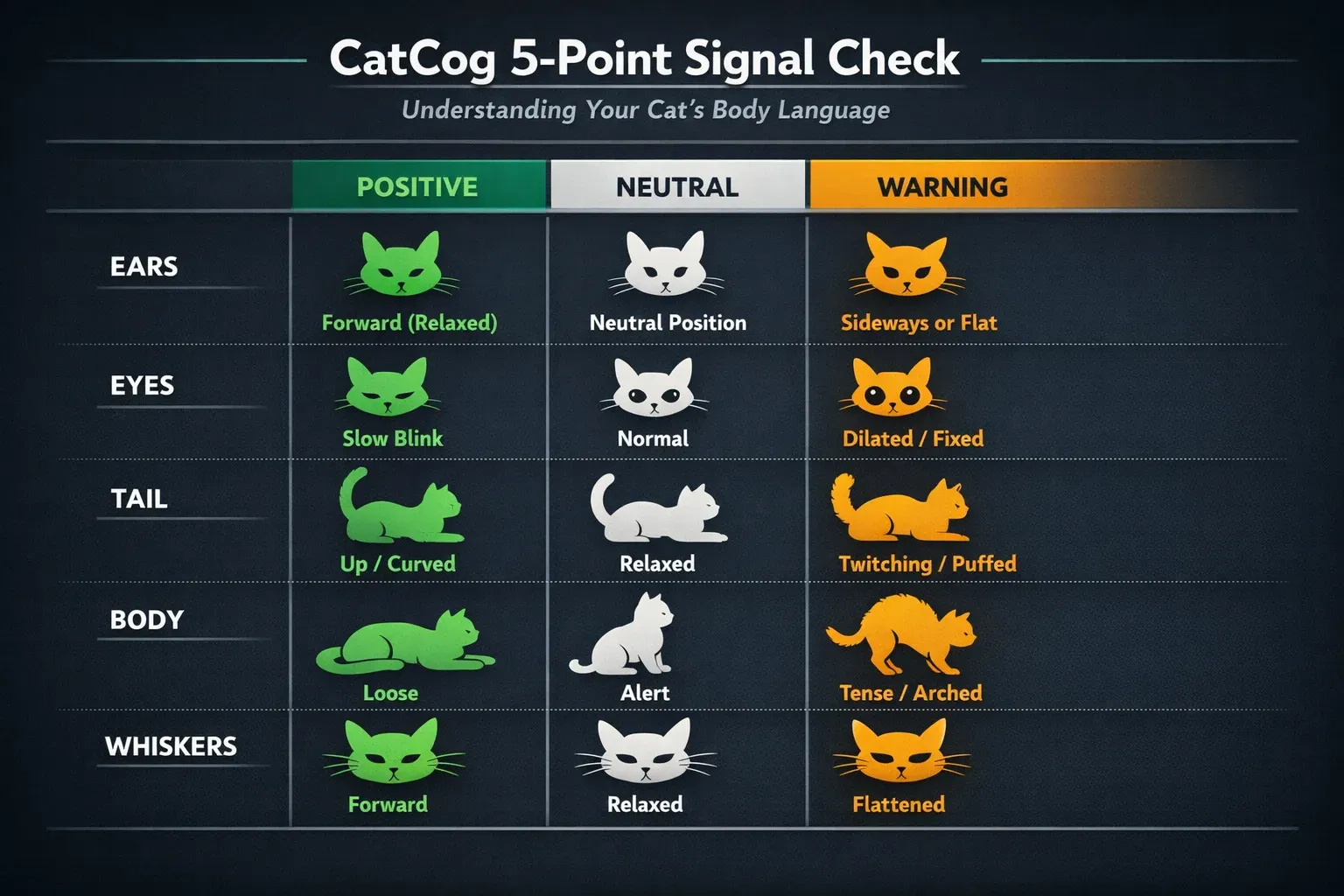
The CatCog 5-Point Signal Check:
| Body Part | Positive Signal | Neutral Signal | Warning Signal |
|---|---|---|---|
| Ears | Forward (relaxed) | Neutral position | Sideways (annoyed) or flat (fearful/aggressive) |
| Eyes | Slow blink (affiliative) | Normal (neutral) | Dilated/fixed (aroused/fearful) |
| Tail | Up/curved (friendly) | Relaxed (neutral) | Twitching/puffed (overstimulated/defensive) |
| Body | Loose (comfortable) | Neutral (alert) | Tense/arched (fearful/aggressive) |
| Whiskers | Forward (interested) | Neutral (relaxed) | Flattened (fearful/defensive) |
When signals conflict - such as purring with a twitching tail - prioritize warning signals over comfort signals. Stop interaction immediately and allow the cat to re-approach on their terms.
Key Takeaways
- The Whole Cat: Read all body parts simultaneously - ears, eyes, tail, body, and whiskers together provide accurate emotional assessment while isolated signals can mislead.
- Warning Signals: Prioritize warning signals (tail twitching, flat ears, dilated pupils) over comfort signals (purring) when they conflict - cats often purr during stress.
- Baseline Matters: Establish your cat's normal behavior patterns so you can recognize meaningful deviations indicating illness, stress, or emotional distress.
- Slow Blinks Work: Scientific research confirms slow blinking functions as positive emotional communication - cats are more likely to approach humans who slow blink at them.
- Context Changes Meaning: The same signal can indicate different emotional states depending on context - an arched back during play differs entirely from one during confrontation.
Key Terms Used
- Piloerection: Involuntary raising of fur along the spine and tail, controlled by arrector pili muscles responding to adrenaline, making the cat appear larger when threatened.
- Allorubbing: Social rubbing behavior where cats deposit pheromones from facial glands onto objects or individuals, functioning as scent marking and affiliative bonding.
- Neoteny: Retention of juvenile behaviors into adulthood; in cats, behaviors like kneading persist because domestication and human interaction reinforce them.
- Petting-induced aggression: Overstimulation response where a cat transitions from tolerance to defensive aggression during petting, preceded by warning signals.
See the full Cat Cognition Glossary ->
Frequently Asked Questions
What does a slow blink from a cat mean?
A slow blink is a deliberate affiliative signal indicating trust and positive emotional intent. Research by Dr. Tasmin Humphrey found cats are significantly more likely to approach humans after receiving slow blinks. To return the signal, narrow your eyes slowly and hold briefly before opening.
Why does my cat bite me when I'm petting them and they were just purring?
This is petting-induced aggression caused by overstimulation. Warning signs precede the bite: tail swishing, skin twitching, ear rotation, body tensing, and dilated pupils. Purring can continue during overstimulation because cats also purr when stressed.
Is my cat sick if they're suddenly hiding more than usual?
Possibly. Cats hide illness and pain because showing weakness in the wild attracts predators. A sudden increase in hiding - especially combined with decreased appetite or reduced social interaction - warrants veterinary attention.
What does it mean when my cat chatters at birds?
Chattering occurs when prey is visible but inaccessible, likely representing frustration or intense excitement. Some researchers theorize it simulates the "kill bite" used to sever prey's spinal cord.
How do I know if my cat is happy or just tolerating me?
Happy cats display multiple positive signals: soft forward-facing ears, slow blinking, a loosely curved tail, and relaxed body posture. A tolerating cat may freeze, avert gaze, or display subtle tail twitching.
Why does my cat expose their belly but then attack when I pet it?
An exposed belly is a trust display, not an invitation to pet. Cats show their vulnerable underside to indicate safety - but the belly remains sensitive. Many cats defensively grab and kick when touched there.
Sources
- The role of cat eye narrowing movements in cat-human communication - Humphrey et al., Scientific Reports (2020) (Link)
- Feline Faces: Unraveling the Social Function of Domestic Cat Facial Signals - Scott & Florkiewicz, Behavioural Processes (2023) (Link)
- The effect of owner presence and scent on stress resilience in cats - Behnke, Vitale & Udell, Applied Animal Behaviour Science (2021) (Link)
- Ohio State Indoor Pet Initiative: Reading Cat Body Language - Dr. Tony Buffington (Link)
- Cornell Feline Health Center: Hyperesthesia Syndrome (Link)
- University of Sussex: Slow Blink Research (Link)
- Multimodal perception of cat emotional states - ScienceDirect (2023) (Link)
- JFMS Consultation Guidelines on Feline Emotional Assessment - Journal of Feline Medicine and Surgery (2018) (Link)