Cat Personality Types Explained: Science-Backed Guide to Your Cat's Temperament
Cats have five measurable personality dimensions -- the Feline Five. Validated across 2,802 cats, these traits explain why every cat is unique. Learn how genetics, socialization, and environment shape your cat's temperament.

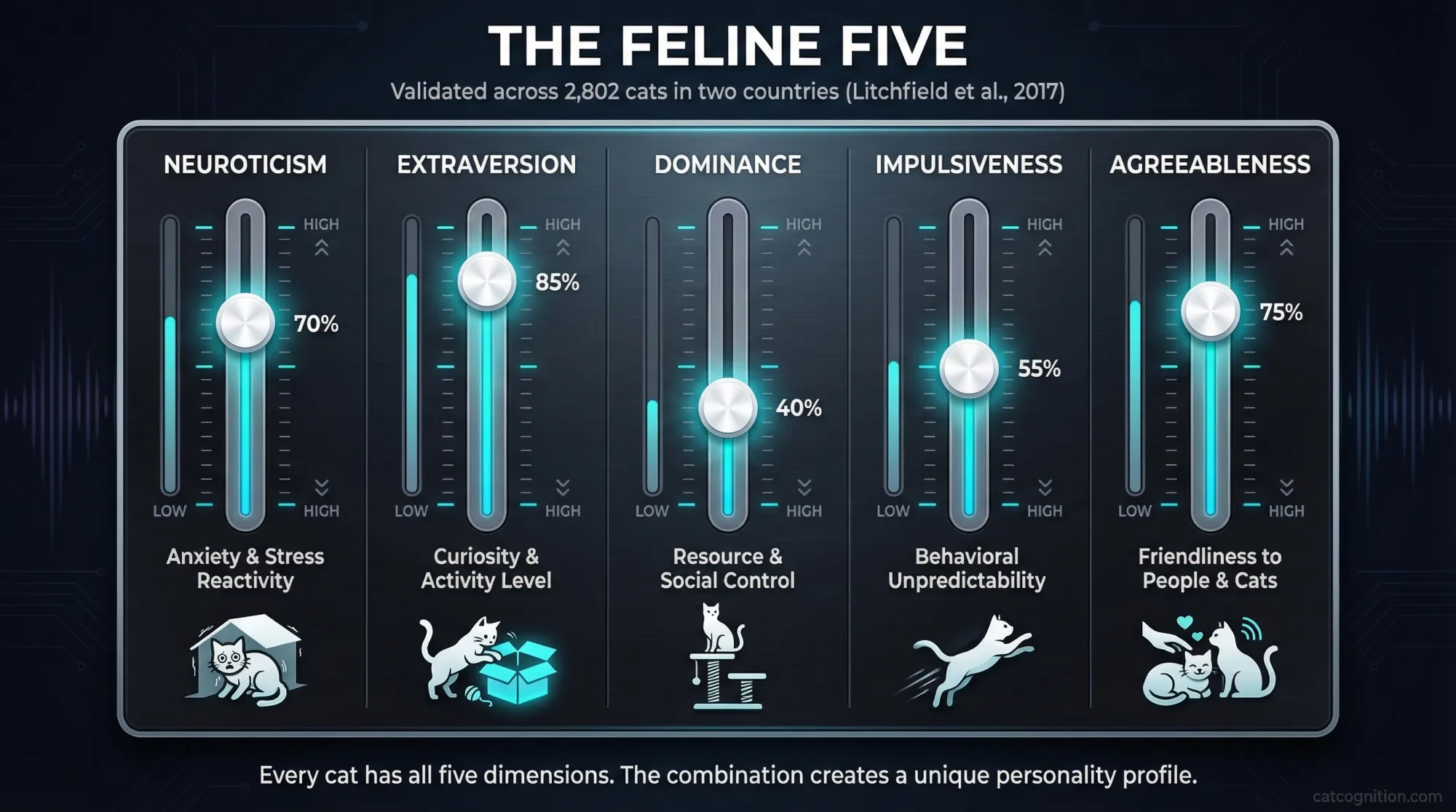
Cats have five measurable personality dimensions -- Neuroticism, Extraversion, Dominance, Impulsiveness, and Agreeableness -- known as the Feline Five. These dimensions were validated across 2,802 cats in two countries by Litchfield et al. (2017) and function like sliding scales, not fixed labels. Every cat falls somewhere on each dimension, creating a unique personality profile shaped by genetics, early socialization between 2 and 7 weeks of age, and ongoing environmental factors including the owner's own personality. For more on the science of why cats do what they do, see our complete guide to cat behavior.
Table of Contents
- What Are Cat Personality Types?
- The Feline Five: Science-Backed Personality Traits
- How Your Cat's Personality Develops
- Do Cat Breeds Predict Personality?
- The Color-Personality Myth
- Can Your Cat's Personality Change?
- How to Identify Your Cat's Personality Type
- Multi-Cat Households: Personality Compatibility
- Frequently Asked Questions
- Key Takeaways
- Key Terms
- Sources
What Are Cat Personality Types?
Cat personality types are measurable, stable behavioral tendencies consistent across time and context. A 2020 literature review of 43 studies spanning three decades confirmed cats possess reliable, quantifiable personality dimensions. Feline personality is not the same as breed temperament -- individual variation within a single breed can match or exceed variation between different breeds.
The most widely validated framework is the Feline Five, identified by Litchfield et al. in 2017 through factor analysis of 2,802 cats rated on 52 personality traits across two independent samples in South Australia and New Zealand. As Prof. Hannes Lohi's research team at the University of Helsinki has demonstrated through one of the largest cat personality datasets -- surveying over 4,300 cats across 26 breed groups -- feline personality traits are not only measurable but show significant breed-level patterns while preserving enormous individual variation.
Think of cat personality like an audio mixing board with five sliders. Every cat has all five channels, but each slider sits at a different level. The combination of slider positions creates that cat's unique personality profile. No two cats produce exactly the same mix.
As Dr. John Bradshaw of the University of Bristol has noted, understanding feline personality requires distinguishing genuine individual differences from situational responses. A critical methodological note: nearly all cat personality research relies on owner-reported questionnaires rather than direct behavioral observation. Owners rate their cats on standardized scales, and researchers extract personality dimensions from the patterns. This approach has been validated extensively, but it means that the data reflects how owners perceive their cats -- and perception bias is a documented confound, particularly around coat color.
The Feline Five: Science-Backed Personality Traits
The Feline Five model identifies five core personality dimensions in every domestic cat: Neuroticism, Extraversion, Dominance, Impulsiveness, and Agreeableness. Extracted from owner ratings of 52 personality traits, the Feline Five structure replicated across two independent samples in different countries, making the five-factor model one of the most robust personality frameworks in animal behavior research.
Five reliable personality factors were identified in domestic cats -- Neuroticism, Extraversion, Dominance, Impulsiveness, and Agreeableness -- across 2,802 cats in two countries. -- Litchfield et al., 2017, PLoS ONE
Here is what each dimension measures:
Neuroticism captures anxiety, fearfulness, and stress reactivity. Cats scoring high on Neuroticism are shy, skittish, and prone to hiding when confronted with new people, sounds, or environments. Cats scoring low are bold, confident, and may take more physical risks. The underlying mechanism involves the hypothalamic-pituitary-adrenal (HPA) axis, which governs the stress response -- genetic variation in HPA sensitivity creates stable individual differences in how readily a cat enters a fear state.
Extraversion measures curiosity, activity level, and engagement with the environment. High-Extraversion cats are the ones who investigate every grocery bag, chase every shadow, and demand interactive play. Low-Extraversion cats are content to observe from a warm perch. The dopaminergic reward system drives this dimension -- cats with more responsive reward circuitry find novelty intrinsically motivating.
Dominance reflects how a cat controls resources, space, and social interactions. High-Dominance cats claim the best sleeping spots, eat first, and may bully housemates. This dimension has deep evolutionary roots -- Gartner et al. (2014) found that each of five felid species -- domestic cats, Scottish wildcats, clouded leopards, snow leopards, and African lions -- exhibited three personality factors, with a Dominance factor appearing in all five species.
Impulsiveness captures how predictable or erratic a cat's reactions are. High-Impulsiveness cats shift between behaviors rapidly and may startle easily. Low-Impulsiveness cats are steady and deliberate. This dimension is distinct from Neuroticism -- a cat can be bold (low Neuroticism) but still unpredictable (high Impulsiveness).
Agreeableness measures friendliness toward people and other animals. Cats scoring high on Agreeableness seek physical contact, tolerate handling, and integrate well into multi-cat households. Cats scoring low prefer solitude and resist being picked up. Understanding where your cat falls on this dimension can improve how you approach petting and physical contact.
These dimensions are continuous scales, not categories. A cat does not "belong" to the Neuroticism type -- rather, every cat falls somewhere along the Neuroticism spectrum while simultaneously occupying positions on the other four dimensions.
The Seven-Trait Model: A Complementary Lens
Prof. Hannes Lohi's team at the University of Helsinki developed a complementary framework by surveying 4,316 cats across 26 breed groups. The Mikkola et al. (2021) study identified seven personality and behavior traits: activity/playfulness, fearfulness, aggression toward humans, sociability toward humans, sociability toward cats, litterbox issues, and excessive grooming.
The Feline Five and seven-trait models are not competing -- they are complementary lenses. The Feline Five captures broad personality dimensions (the "why"), while the seven-trait model captures specific behavioral expressions (the "what"). Three traits overlap directly: activity/playfulness maps to Extraversion, fearfulness maps to Neuroticism, and aggression connects to low Agreeableness and high Dominance. The seven-trait model adds behavioral specificity that the Feline Five lacks, particularly around stress indicators like litterbox issues and excessive grooming.
How Your Cat's Personality Develops
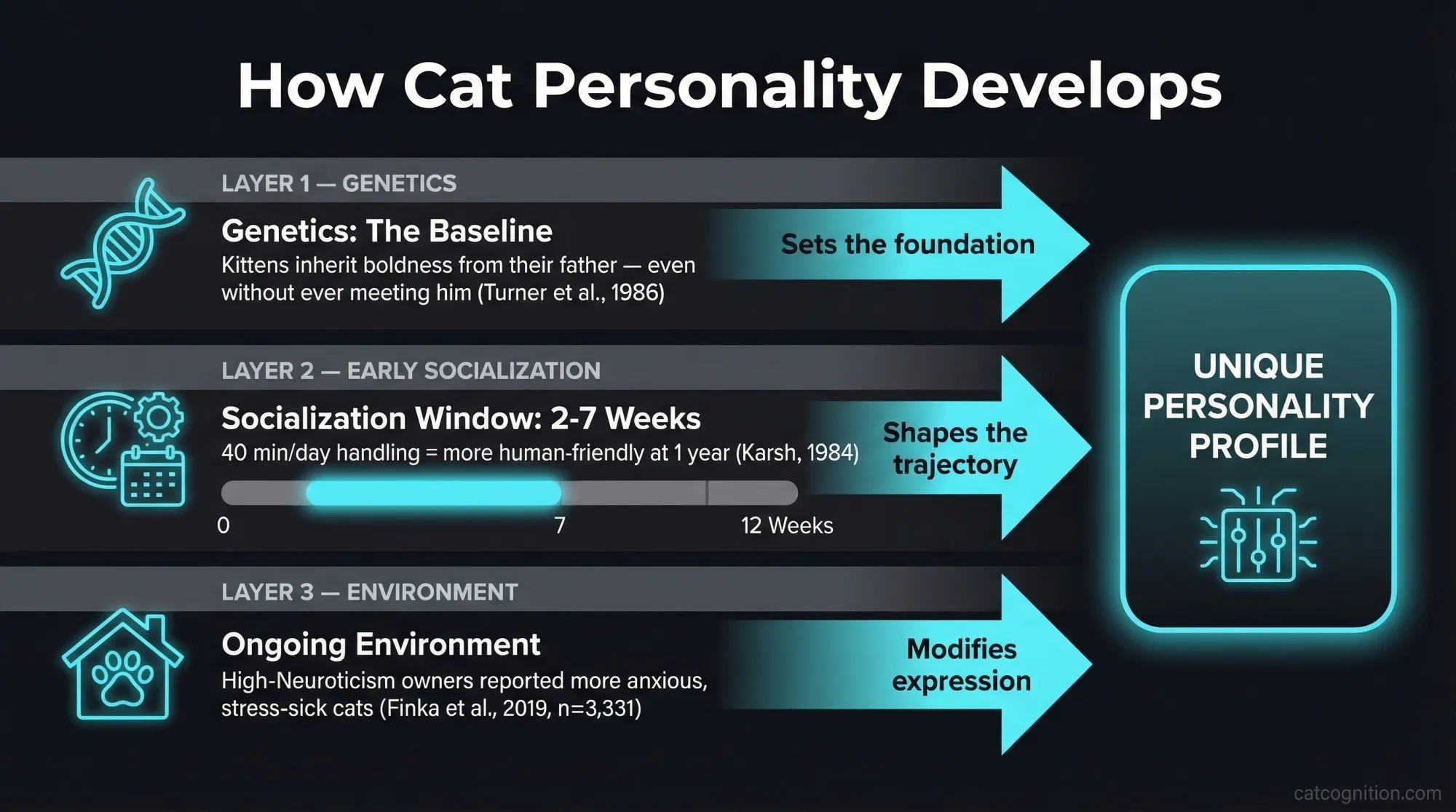
Cat personality emerges from the interaction of three forces: genetic inheritance, early developmental experience during the critical socialization window, and ongoing environmental influences throughout life. Genetics set the baseline, early experience shapes the trajectory, and environment modifies the expression -- but the relative weight of each factor varies by personality dimension.
Kittens sired by bold fathers scored significantly higher on boldness measures than kittens sired by timid fathers, even without any direct paternal contact -- establishing that feline temperament has a heritable genetic foundation independent of socialization. -- Turner, Feaver, Mendl & Bateson, 1986, Animal Behaviour
Genetics: The Paternal Effect
Research from Cambridge University demonstrated that kittens inherit personality traits from their father (the tom) even without any direct paternal contact. Kittens sired by bolder fathers were bolder themselves, despite never meeting the father -- establishing that feline temperament has a genetic component independent of socialization or learning. This paternal effect has been confirmed in both Cambridge and Zurich cat colonies, and the finding aligns with modern behavioral genetics showing heritable variation in stress-response systems across mammalian species.
It is similar to how two siblings raised in the same household can have completely different temperaments -- one outgoing, one reserved. A cat's personality is not a training failure or an owner's mistake. Genetics load the dice before the kitten opens its eyes.
Early Socialization: The 2-7 Week Window
The critical socialization period between 2 and 7 weeks of age is the single most impactful environmental influence on a cat's lifelong personality toward humans. Research by Karsh (1984), later confirmed by Casey and Bradshaw (2008), found that kittens handled for 40 minutes per day between 3 and 7 weeks of age spent more time in close contact with people at one year of age than kittens handled for only 15 minutes per day. The socialization window closes rapidly -- kittens who receive no human contact before 7 weeks may never develop comfortable social bonds with people.
This finding has direct implications for shelter-adopted cats. A cat that seems "unfriendly" or "aloof" may simply have missed the socialization window -- not because the cat lacks an Agreeableness dimension, but because early experience pushed the Agreeableness slider toward the lower end during a period when it was most malleable.
Owner Influence: The Mirror Effect
A 2019 study by Dr. Lauren Finka at Nottingham Trent University surveyed 3,331 cat owners and found a striking pattern: owners who scored higher on Neuroticism reported cats with more aggressive and anxious behavioral styles, more stress-related sickness, more ongoing medical conditions, and higher rates of being overweight. The relationship between owner personality and cat personality expression parallels the parent-child personality relationship documented in human developmental psychology.
In a survey of 3,331 cat owners, owners scoring higher in Neuroticism reported more aggressive, anxious, and stress-sick cats -- mirroring the parent-child personality relationship documented in human developmental psychology. -- Finka et al., 2019, PLoS ONE
This finding is correlational, not causal -- the study cannot determine whether neurotic owners create anxious cats, or whether anxious cats make owners more neurotic, or whether both are influenced by shared environmental stressors. However, it strongly suggests that the human half of the cat-human relationship matters. A cat's personality does not develop in isolation from the person who feeds, houses, and interacts with that cat every day. The many ways cats communicate their emotional state through body language signals can help owners recognize stress before it escalates.
Do Cat Breeds Predict Personality?
Breed contributes to personality tendencies but does not determine individual personality. Analysis of 5,726 cats across 19 breeds by Salonen et al. (2019) found marked breed differences in aggression, fearfulness, and sociability -- but individual variation within a single breed can be as large as variation between different breeds.
Individual personality variation within a cat breed can be as large as variation between breeds, based on analysis of 5,726 cats across 19 breeds and breed groups. -- Salonen et al., 2019, Scientific Reports
What does this mean in practice? A specific Maine Coon might score higher on Neuroticism than a specific rescued alley cat. A Siamese might be quieter than a British Shorthair. Breed tendencies describe averages across populations -- they are statistical patterns, not guarantees about any individual cat.
The Mikkola et al. (2021) study of 4,316 cats found that breed groups differed significantly on all seven behavioral traits, with the Russian Blue ranking highest on fearfulness, the Abyssinian ranking as the least fearful breed, and the Bengal ranking highest on activity/playfulness. But even within the most "active" breed, there were couch-potato individuals. And even within the most "fearful" breed, there were bold explorers.
The practical takeaway: breed information is a useful starting point when selecting a cat, but meeting an individual cat and assessing that specific cat's personality dimensions is far more predictive of compatibility than breed label alone.
Indoor vs. Outdoor Personality Expression
Living environment significantly modifies how personality dimensions are expressed. Indoor cats tend to direct their Extraversion toward human interaction and household exploration, while outdoor cats express the same dimension through territorial patrol and prey-seeking behavior. A high-Dominance cat in a single-cat indoor home may express dominance through resource guarding of food bowls and favorite sleeping spots, while the same personality profile in an outdoor cat manifests as territorial boundary defense.
This environmental context matters for personality assessment. An indoor cat that seems "lazy" may simply lack the environmental stimulation to express a normal level of Extraversion. An outdoor cat that seems "aloof" may be directing the majority of social behavior toward feline neighbors rather than human housemates.
The Color-Personality Myth
Color-based personality stereotypes -- orange cats are "friendlier," black cats are "mysterious" -- are among the most persistent myths in cat culture. Research by Dr. Mikel Delgado (then at UC Berkeley, now at Purdue University) directly tested coat-color personality claims and found color-personality associations are driven by human perception bias, not biological reality. For a deeper look, see our science of orange cat behavior coverage.
Delgado et al. (2012) surveyed 189 participants and found that people consistently rated orange cats as "friendlier" and white or tri-colored cats as more "aloof." But these ratings reflect what people expect based on coat color, not how cats with different coat colors actually behave. As Dr. Delgado has noted, there are serious real-world consequences when people believe some cat colors are friendlier than others -- coat color influences adoption rates, with black cats consistently spending longer in shelters.
The Tortoiseshell Question
A 2016 study by Stelow, Bain, and Kass did find a statistically significant difference in aggression scores for tortoiseshell, calico, and torbie cats compared to other females. Tortoiseshell-patterned cats scored a mean of 2.5 on human-directed aggression versus 2.0 for other females on a 0-20 scale. The overall average aggression score across all cats was just 1.8 on that same 20-point scale.
However, this finding has not been replicated. A 2022 study of Mexican cat owners by Gonzalez-Ramirez et al. found no significant coat-color personality differences, and a separate 2022 study by Leech et al. reached the same conclusion. The scientific picture is mixed at best, and the absolute effect size in the original Stelow study -- 0.5 points on a 20-point scale -- is so small that it does not constitute a meaningful behavioral difference in any practical context.
The truth about coat color and personality is more interesting than the myth: there may be a pleiotropic link between the X-linked orange gene and behavior (the gene that controls coat color could theoretically influence neural development), but the effect is so vanishingly small that color-personality stereotypes massively overstate reality. The genetics behind how cat coat colors actually work are far more fascinating than the personality myths attached to them.
Color-personality stereotypes massively overstate reality -- tortoiseshell cats scored only 0.5 points higher on aggression than average on a 20-point scale, and subsequent studies found no significant coat-color differences. -- Stelow, Bain & Kass, 2016, Journal of Applied Animal Welfare Science; Gonzalez-Ramirez et al., 2022
Can Your Cat's Personality Change?
Core personality dimensions are relatively stable in adult cats, but expression shifts across life stages and can change after major environmental disruptions. The AAHA/AAFP Feline Life Stage Guidelines (2021) divide the cat lifespan into five stages, each affecting how personality manifests in daily behavior. Understanding how each life stage affects your cat provides important context.
Kittens and young adults tend to score higher on Extraversion and Impulsiveness -- the exploratory, risk-taking behavior that drives play. Mature adult cats often show a gradual decline in Impulsiveness as they settle into predictable routines. Senior cats may show reduced activity and increased Neuroticism, particularly if experiencing pain or cognitive decline. Research indicates that 28% of cats aged 11 to 14 show signs of cognitive dysfunction syndrome, which can dramatically alter personality expression.
Neutering and Personality
A common question is whether neutering changes a cat's personality. The available evidence suggests that neutering affects specific hormone-driven behaviors -- spraying, roaming, mounting, and some forms of intermale aggression -- but does not fundamentally alter core personality structure. A bold cat remains bold after neutering. A shy cat remains shy. The personality dimensions themselves are stable; what changes are the hormonally amplified behaviors layered on top of those dimensions.
The evidence base for this claim is limited. The most commonly cited study on neutering and personality (Cafazzo, Bonanni & Natoli, 2019) observed only 16-17 free-roaming cats, which is too small a sample to draw definitive conclusions about pet cat personality. Larger, more rigorous studies specifically examining personality dimension stability before and after neutering in pet cats are needed.
A sudden personality change in an adult cat is not normal aging or "just a phase." A previously bold cat becoming withdrawn, a calm cat becoming aggressive, or an active cat becoming lethargic should trigger a veterinary visit to rule out pain, illness, hyperthyroidism, or cognitive dysfunction syndrome. Personality assessment tools describe stable traits -- they should never be used to explain away changes that may signal a medical emergency.
How to Identify Your Cat's Personality Type
Identifying a cat's personality profile requires systematic observation across multiple contexts over at least two weeks. Single observations are unreliable -- a cat that hides when guests visit may be bold in every other situation. Personality is a pattern, not a snapshot.
The CatCog Personality Profile Method
Rate your cat on each of the five Feline Five dimensions using a simple low-medium-high scale based on these behavioral indicators:
Neuroticism: Does the cat hide when the doorbell rings? Startle at sudden sounds? Avoid unfamiliar people? A cat that consistently retreats from novelty scores high. A cat that investigates novel stimuli scores low.
Extraversion: Does the cat initiate play? Explore new objects in the home? Follow household members from room to room? High-Extraversion cats are in constant motion during waking hours. Low-Extraversion cats choose one comfortable spot and stay there.
Dominance: In a multi-cat home, does the cat eat first? Claim the highest perch? Stare down housemates? In a single-cat home, does the cat demand attention on its own terms and resist being moved from chosen spots?
Impulsiveness: Does the cat shift rapidly between activities -- grooming, then suddenly running, then attacking a toy, then freezing? Or does the cat move deliberately from one activity to the next with clear transitions?
Agreeableness: Does the cat seek lap time? Tolerate handling by strangers? Greet family members at the door? High-Agreeableness cats are the ones who flop on their backs in front of guests. Low-Agreeableness cats observe from another room.
For a more rigorous assessment, the Fe-BARQ (Feline Behavioral Assessment and Research Questionnaire) is a validated 100-item tool developed at the University of Pennsylvania that measures 23 behavioral factors with reliability coefficients (Cronbach's alpha) ranging from 0.712 to 0.923 across 17 of those factors. The Fe-BARQ takes 10-15 minutes to complete and is available free to cat owners.
Multi-Cat Households: Personality Compatibility
Personality compatibility is a key factor in multi-cat household success. Elzerman et al. (2020) found across a survey of 2,492 multi-cat households that the owner's perception of the initial introduction correlated with the long-term relationship quality between paired cats. Knowing whether your cat shows signs of genuine affection toward other animals can help gauge readiness for a companion.
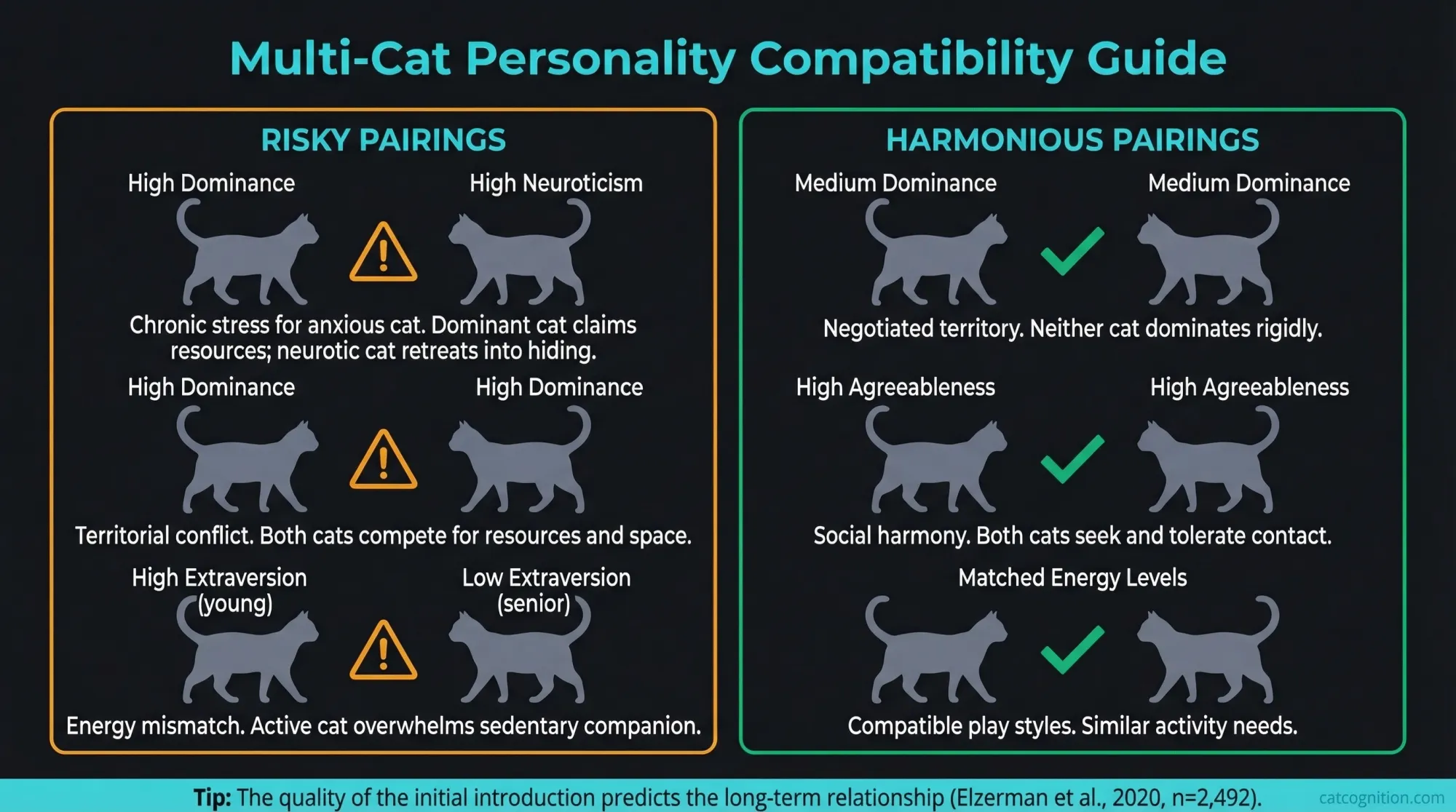
The personality dimensions most relevant to multi-cat compatibility are Dominance and Agreeableness. Pairing a high-Dominance cat with a high-Neuroticism cat is likely to create chronic stress for the more anxious cat -- the dominant cat will claim resources and space, and the neurotic cat will retreat further into hiding rather than compete. Over time, this dynamic can produce stress-related health problems including urinary issues and over-grooming.
More harmonious pairings tend to involve cats with similar Agreeableness levels and non-competing Dominance scores. Two medium-Dominance cats are more likely to negotiate shared territory than one high-Dominance and one low-Dominance pair, where the hierarchy becomes rigid and the subordinate cat may lose access to essential resources.
Practical steps for personality-matched introductions:
| Factor | What to Assess | Why It Matters |
|---|---|---|
| Dominance Levels | Rate both cats on resource-guarding, space-claiming, and stare-down behavior | Mismatched Dominance creates rigid hierarchies |
| Agreeableness Match | Assess both cats' tolerance of other animals | Low-Agreeableness cats may never accept a companion |
| Neuroticism Level | Evaluate the existing cat's stress response to novelty | High-Neuroticism cats need slower, more gradual introductions |
| Age and Energy | Compare activity levels and play styles | Young high-Extraversion cats may overwhelm senior low-Extraversion cats |
Frequently Asked Questions
What are the five cat personality types?
The Feline Five personality dimensions are Neuroticism (anxiety and stress reactivity), Extraversion (curiosity and activity level), Dominance (resource control and social assertiveness), Impulsiveness (behavioral unpredictability), and Agreeableness (friendliness toward people and other animals). These are continuous dimensions, not discrete types -- every cat falls somewhere along each scale.
Do cat personalities change with age?
Core personality dimensions remain relatively stable in adult cats, but expression shifts across life stages. Kittens and young adults score higher on Extraversion and Impulsiveness. Senior cats may show increased Neuroticism and decreased activity, particularly if experiencing pain or cognitive dysfunction syndrome (which affects 28% of cats aged 11-14). Sudden personality changes at any age should prompt a veterinary visit.
Are orange cats really friendlier?
Research does not support the claim that orange cats are inherently friendlier. A 2012 study by Dr. Mikel Delgado found that people perceive orange cats as friendlier, but this reflects human bias, not actual behavioral differences. Coat color is determined by genes that are largely unrelated to the neural systems governing personality. Adoption decisions based on coat color stereotypes can disadvantage cats, particularly black cats who spend longer in shelters.
Can I change my cat's personality?
Core personality dimensions cannot be fundamentally altered after the critical socialization window closes around 7 weeks of age. However, owners can modify the environment to support healthier expression of existing traits. Enrichment can reduce the negative effects of high Neuroticism (chronic hiding, stress-sickness). Environmental design -- separate resource stations, vertical territory, predictable routines -- can manage high Dominance in multi-cat homes. The goal is not to change the cat but to match the environment to the personality.
Does neutering change a cat's personality?
Neutering affects specific hormone-driven behaviors including spraying, roaming, and some forms of intermale aggression, but available evidence suggests that core personality structure remains intact. A bold cat stays bold. A shy cat stays shy. The personality dimensions themselves are stable; what changes are the hormonally amplified behaviors layered on top of those dimensions. However, the research base for this claim is limited, and more rigorous studies are needed.
Is there a test for cat personality?
The Fe-BARQ (Feline Behavioral Assessment and Research Questionnaire) is a scientifically validated 100-item questionnaire developed at the University of Pennsylvania that measures 23 behavioral factors in cats. The Fe-BARQ takes 10-15 minutes to complete and is available free to cat owners online. For a quicker informal assessment, rate your cat on each of the five Feline Five dimensions (Neuroticism, Extraversion, Dominance, Impulsiveness, Agreeableness) on a low-medium-high scale based on at least two weeks of observation.
Do male and female cats have different personalities?
The Mikkola et al. (2021) study of 4,316 cats included sex as a variable and found some differences in behavioral trait expression. However, the personality differences between individual cats within the same sex are far larger than the average differences between sexes. Neutered males and females tend to converge in personality expression as the hormonal influences that drive sex-typical behaviors are reduced. Selecting a cat based on individual personality assessment is far more informative than selecting based on sex alone.
How do I know if my cats' personalities are compatible?
Assess each cat's Dominance and Agreeableness levels -- these dimensions most predict multi-cat harmony. Avoid pairing a high-Dominance cat with a high-Neuroticism cat, as this creates chronic stress. Look for complementary profiles: similar Agreeableness levels and non-competing Dominance scores. The quality of the initial introduction also matters enormously -- Elzerman et al. (2020) found that the owner's perception of the initial meeting predicted the long-term relationship quality between paired cats.
Key Takeaways
- Cat personality is dimensional, not categorical. The Feline Five identifies five continuous dimensions -- every cat has a unique profile, not a fixed label.
- Breed is a starting point, not a destiny. Within-breed variation can match between-breed variation (5,726 cats studied).
- Genetics and early experience set the foundation. Kittens inherit temperament from their father; the 2-7 week socialization window shapes lifelong human attitudes.
- Coat color does not predict personality. Color stereotypes reflect human perception bias, not biology.
- Match the environment to the personality. Targeted enrichment supports healthier trait expression rather than trying to change who the cat is.
Key Terms
| Term | Definition |
|---|---|
| Feline Five | The five personality dimensions (Neuroticism, Extraversion, Dominance, Impulsiveness, Agreeableness) identified by Litchfield et al. (2017) through factor analysis of 2,802 cats across two independent samples |
| Neuroticism (feline) | A personality dimension measuring anxiety, fearfulness, and stress reactivity, governed by the hypothalamic-pituitary-adrenal (HPA) axis |
| Fe-BARQ | The Feline Behavioral Assessment and Research Questionnaire, a validated 100-item tool developed at the University of Pennsylvania measuring 23 behavioral factors in cats |
| Critical socialization period | The developmental window between 2 and 7 weeks of age during which kittens form lasting attitudes toward humans, other animals, and novel stimuli |
| Paternal effect | The genetic influence of the father (tom) on kitten personality, independent of any direct contact between father and offspring |
| HPA axis | The hypothalamic-pituitary-adrenal axis, the neuroendocrine system that governs the stress response and underlies the Neuroticism personality dimension |
| Pleiotropic effect | When a single gene influences multiple unrelated traits, such as the theoretical link between coat color genes and behavioral traits |
Sources
- The "Feline Five": An exploration of personality in pet cats -- Litchfield et al., 2017, PLoS ONE (PLoS ONE)
- Seven personality and behaviour traits identified in cats -- Mikkola et al., 2021, Animals (MDPI)
- Breed differences in heritable behaviour traits with comparison to temperament traits in cats -- Salonen et al., 2019, Scientific Reports (Nature)
- The relationship between coat color and aggressive behaviors in the domestic cat -- Stelow, Bain & Kass, 2016, Journal of Applied Animal Welfare Science (Taylor & Francis)
- Mikel Delgado, Rachel Munera & Greg Reevy coat color perception study -- Delgado et al., 2012, Anthrozoos (Taylor & Francis)
- Owner personality and the wellbeing of their cats share parallels with the parent-child relationship -- Finka et al., 2019, PLoS ONE (PubMed Central)
- Personality structure in the domestic cat, Scottish wildcat, clouded leopard, snow leopard, and African lion -- Gartner et al., 2014, Journal of Comparative Psychology (PubMed)
- Feline Behavioral Assessment and Research Questionnaire (Fe-BARQ) validation -- Duffy, de Moura & Serpell, 2017, Behavioural Processes (PubMed)
- Understanding the feline temperament: a review of methodological approaches -- Travnik et al., 2020, Animals (PubMed Central)
- Multi-cat household relationships and conflict -- Elzerman et al., 2020, Journal of Feline Medicine and Surgery (PubMed Central)
- Owner personality and mental wellbeing are associated with attachment to cats and dogs -- Stahl et al., 2023, iScience (Cell Press)
- CAT-Tri+: A measure of feline psychopathic traits -- Evans et al., 2021, Journal of Research in Personality (ScienceDirect)
- Feline Life Stage Guidelines -- AAHA/AAFP, 2021, Journal of Feline Medicine and Surgery (SAGE Journals)
- Cat coat color, personality traits and the cat-owner relationship scale: a study with cat owners in Mexico -- Gonzalez-Ramirez & Landero-Hernandez, 2022, Animals (MDPI)
- Coat colour and personality in cats -- Leech et al., 2022, Proceedings of the British Society of Animal Science
- Neutering effects on social behaviour of urban unowned free-roaming domestic cats -- Cafazzo, Bonanni & Natoli, 2019, Animals (PubMed Central)
- Fe-BARQ Online Assessment Tool -- University of Pennsylvania (UPenn)