Do Cats Remember People? The Science of Feline Memory
Yes, cats remember people through scent, voice, and sight. Research shows cats recognize their owner's voice, and long-term memory may last a decade. Learn how feline memory works and how to strengthen your bond.

Table of Contents
- How Long Is a Cat's Memory?
- Do Cats Recognize Their Owners?
- Can Cats Recognize Faces?
- How Do Cats Know Their Owners?
- Do Cats Have Long-Term Memory?
- Signs Your Cat Missed You
- When Cat Memory Fails: Cognitive Dysfunction
- How to Strengthen Your Cat's Memory of You
- Key Terms
- Frequently Asked Questions
- Key Takeaways
- Sources
Yes, cats remember specific people through a multi-sensory recognition system that prioritizes scent over sound and sound over sight. Research by Dr. Atsuko Saito (then at the University of Tokyo) demonstrated that the majority of tested cats distinguish their owner's voice from strangers' voices, while a 2025 study confirmed cats identify their owner by scent alone. Researchers believe cat long-term memory may span a decade or longer, though no controlled experiment has measured the exact upper limit. Feline memory is NOT the same as feline obedience — a cat that ignores your call still recognizes and remembers the caller.
Your cat is not ignoring you because you are forgettable. The growing body of feline cognition research tells a different story — one where cats build layered, multi-sensory memories of the people in their lives. The question is not whether cats remember people. The question is how cats remember people, and why that process looks so different from the eager tail-wagging reunions dog owners take for granted.
As Dr. Saho Takagi of Kyoto University demonstrated in a 2021 study, cats mentally map their owner's physical location from voice alone — cats do not just recognize their owners, they actively track where owners are even when they cannot see them (Takagi et al., 2021). Building on the foundational work of Dr. John Bradshaw at the University of Bristol, who has noted that cats retain the vast majority of their wild behavioral repertoire, researchers now understand that feline recognition systems remain fundamentally non-visual. Cats evolved in dense scrubland where line-of-sight identification was impractical. Scent and sound carried survival value. That evolutionary wiring persists.
This article walks through the peer-reviewed evidence — 20 studies, 6 named researchers, and findings no competitor article covers — to explain exactly how cat memory works, how long cat memories last, and what you can do to strengthen the bond your cat has built with you.

How Long Is a Cat's Memory?
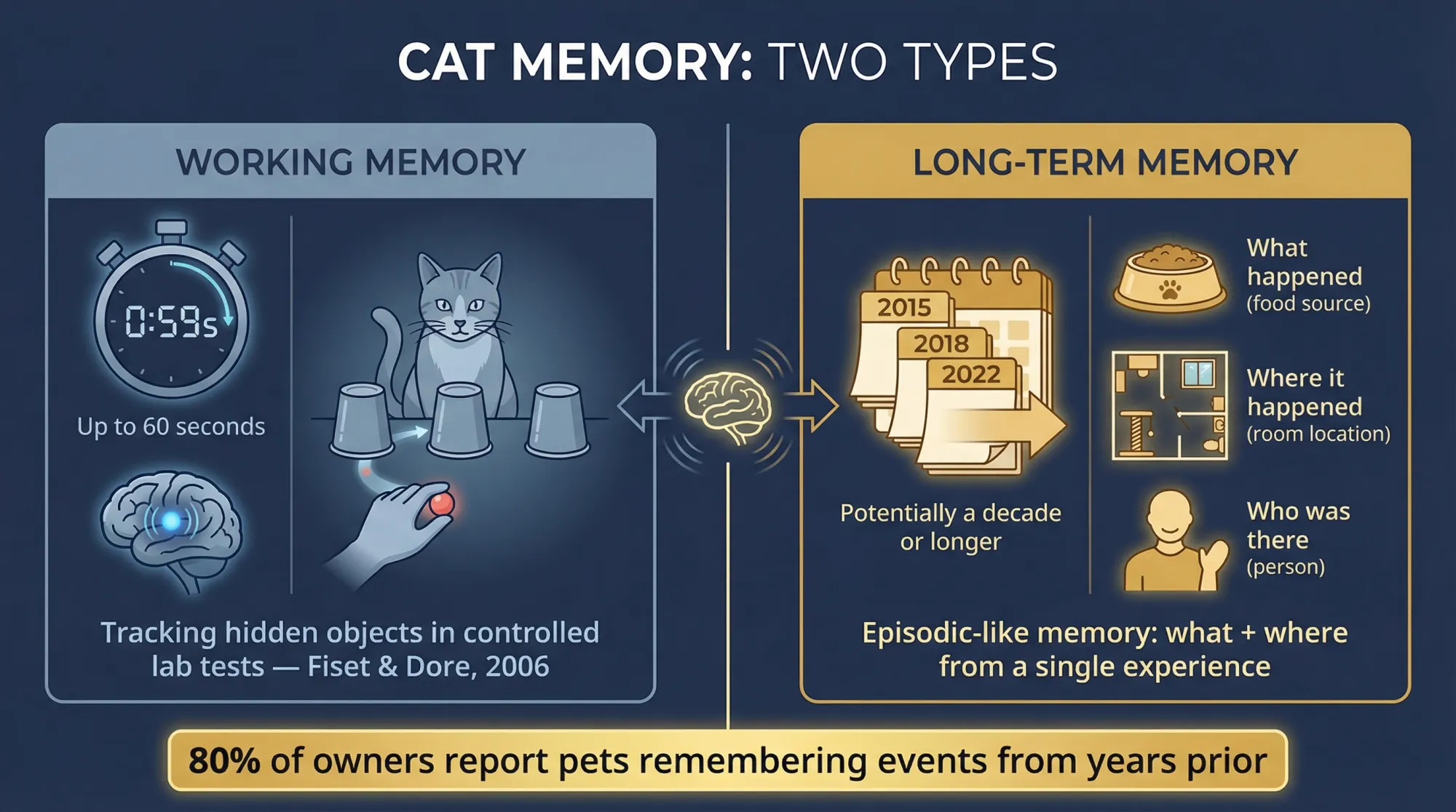
Cat memory operates across two distinct timescales: working memory — holding information for up to 60 seconds in controlled tests for hidden objects — and long-term memory, believed by researchers to persist for a decade or longer based primarily on owner reports and inference from the durability of feline associative learning, not direct controlled measurement.
The distinction between short-term and long-term memory in cats matters more than most pet sites acknowledge. In laboratory settings, cats tracked hidden objects above chance for up to 60 seconds in working memory tests (Fiset & Dore, 2006). That finding, building on foundational work by Goulet, Dore, and Rousseau (1994) on object permanence, established the baseline for feline working memory under controlled conditions (Fiset & Dore, 2006).
But working memory for an abstract object in a lab is not the same as memory for a person who feeds, plays with, and sleeps beside a cat every day. Long-term memories form through a different process entirely.
"In a survey of 375 cat and dog owners, 80% reported their pets remembered past events, including single-occurrence events from years prior. Memories were most frequently triggered when current external stimuli — such as a specific location — overlapped with the original experience." — Fugazza et al., 2020, Applied Animal Behaviour Science
Researchers believe cat long-term memory may span a decade or longer, based on the durability of their associative learning patterns and the consistency of these owner reports (Vitale Shreve & Udell, 2015). No controlled experiment has directly measured multi-year person-specific memory in cats, so the exact upper limit remains unknown. What the evidence does confirm is that emotionally significant experiences — both positive and negative — produce more durable memory traces, because the amygdala (based on mammalian neuroscience) tags these memories for priority storage.
The practical implication: a cat who shared daily feeding rituals, play sessions, and sleeping arrangements with a specific person is encoding those experiences into a web of long-term associations far more robust than a 60-second lab test suggests.
Do Cats Recognize Their Owners?
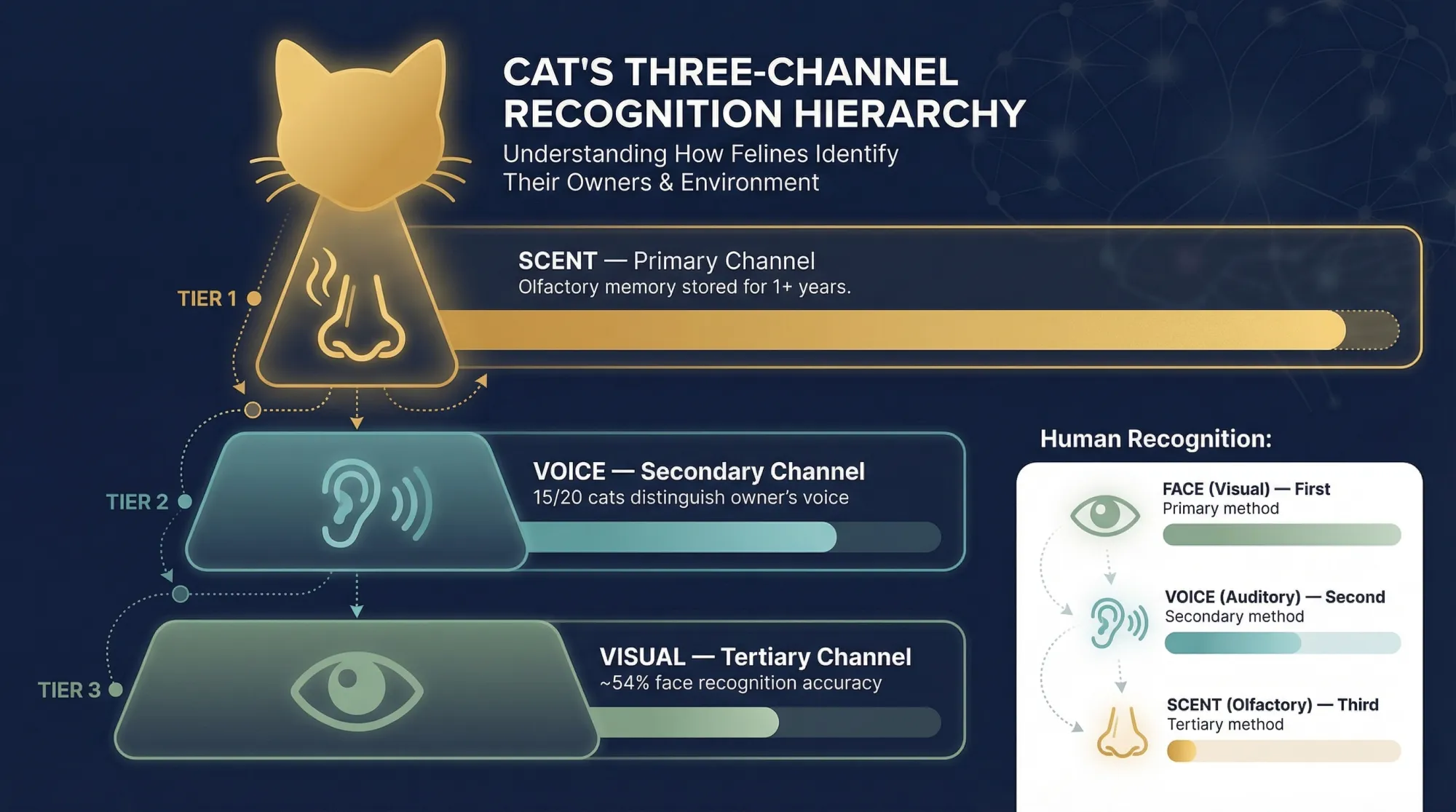
Cats recognize owners through a layered sensory hierarchy — scent as the primary identification channel, voice as secondary confirmation, and visual appearance as a tertiary cue — the opposite of how humans recognize each other, which explains why cat recognition often goes unnoticed by owners expecting eye contact and approach behavior.
The misunderstanding starts with expectations. Humans recognize each other face-first. Dogs run to the door. Cats do neither — and owners interpret that stillness as indifference or forgetfulness. If your cat watches you without approaching, that fixed gaze is itself a recognition signal — as explored in our guide to why cats stare at their owners.
Research by Dr. Atsuko Saito (then at the University of Tokyo) demonstrated otherwise. In a 2013 study using the habituation-dishabituation method, 15 of 20 cats that habituated to strangers' voices showed significant rebound responses when hearing their owner's voice (Saito & Shinozuka, 2013). The cats recognized the voice. They responded with orienting behavior — ear and head movement — rather than approach behavior. Recognition without obedience.
A follow-up study confirmed the finding with greater statistical power: 77 cats across four experiments demonstrated they could distinguish their own names from other words and other cats' names (Saito et al., 2019).
"Of 20 cats tested, 15 habituated to strangers' voices and showed significant rebound responses to their owner's voice. Cats responded with orienting behavior — ear and head movement — rather than approach behavior, demonstrating recognition without active response." — Saito & Shinozuka, 2013, Animal Cognition
Over 35 years of research by Dr. Dennis C. Turner at the Institute for Applied Ethology and Animal Psychology confirms that cat-human interactions are bidirectional — individual cat personalities significantly influence relationship quality and how recognition manifests behaviorally (Turner, 2017). A shy cat may recognize its owner perfectly while appearing to ignore them. A bold cat may trot over and headbutt within seconds. For a deeper look at how personality shapes the cat-human relationship, see the psychology of cats.
Can Cats Recognize Faces?
Cats perform poorly on visual face recognition in controlled tests — approximately 54% accuracy in photo-based discrimination tasks — because cats evolved to identify individuals through scent and sound rather than facial features, making faces a secondary confirmation channel rather than the primary one humans rely on.
The face question is where the science gets genuinely surprising. A study by Lomber and Cornwell (2005) found that dogs could recognize their handler's face in photographs, but cats could not reliably do the same. Cats scored near chance — about 54% accuracy — on visual face discrimination tasks.
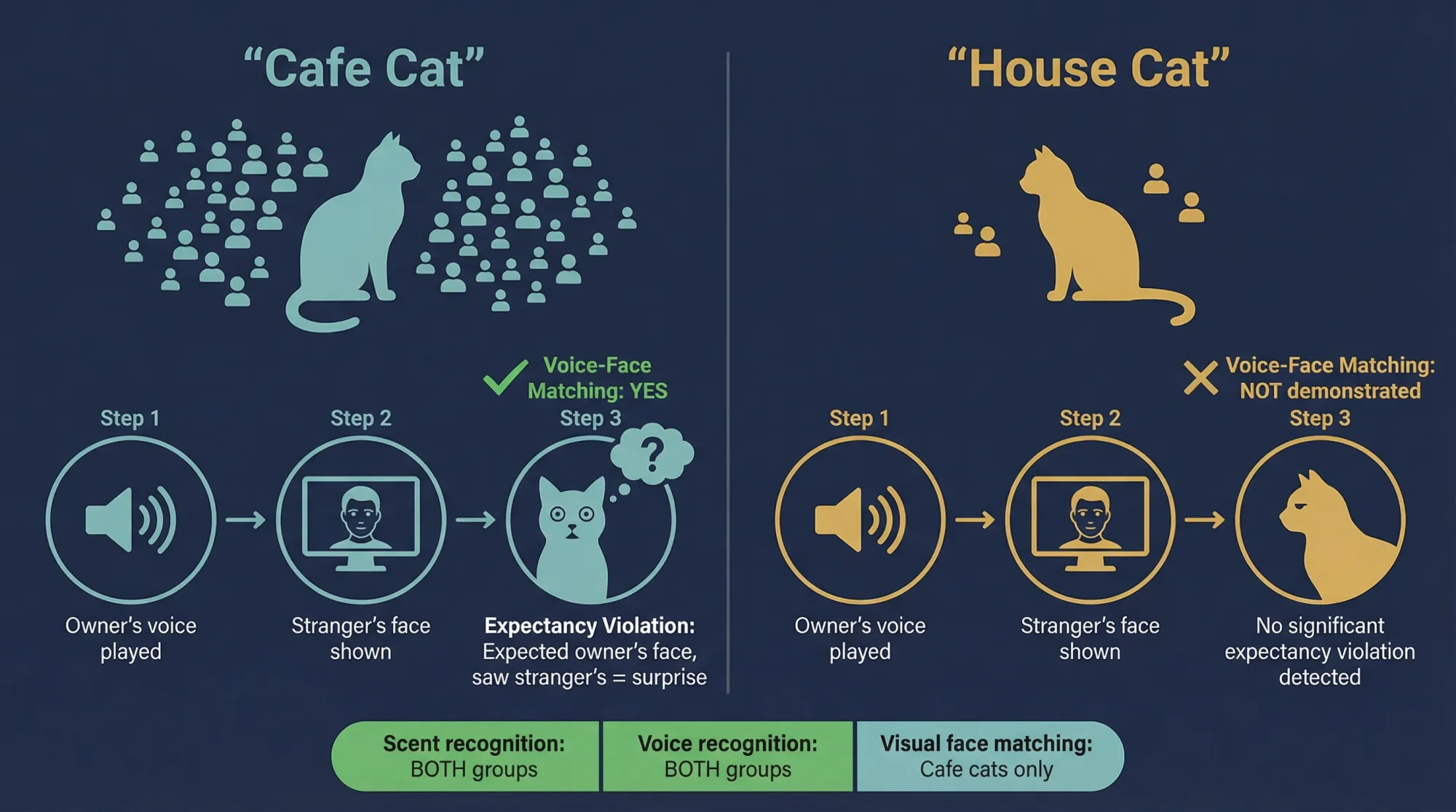
This does not mean cats cannot distinguish one person from another visually. Preliminary research by Dr. Saho Takagi and colleagues suggests that cats with extensive multi-person exposure — specifically cafe cats interacting with dozens of people daily — can match an owner's voice to their face, a cognitively demanding process called cross-modal recognition (Takagi et al., 2019). When cafe cats heard their owner's voice and then saw a stranger's face on a monitor, they looked longer — a sign of surprise indicating they expected a different face.
Critically, house cats did not demonstrate this same voice-face matching ability in the same study. The most likely explanation is exposure: cafe cats encounter far more human faces daily, building stronger visual-face associations through sheer volume of practice. House cats, who interact with a small number of people, may rely almost entirely on scent and voice and never need to develop strong facial recognition.
Think of cat face recognition like a secondary password. Scent is the username. Voice is the primary password. The face is the optional security question — useful as confirmation, but not how cats log in to the memory of a specific person.
How Do Cats Know Their Owners?
Cats identify owners through a three-channel sensory hierarchy — scent first, voice second, visual appearance third — with each channel storing a separate long-term memory trace combining into an integrated representation of a specific human, making cat recognition resistant to any single change in appearance, voice, or smell.
The Scent Channel (Primary)
A 2025 study by Miyairi, Kimura, Masuda, and Uchiyama tested 30 domestic cats with swabs carrying human scent collected from armpits, ears, and between toes (Miyairi et al., 2025). Cats spent significantly longer sniffing the unknown person's scent compared to their owner's scent — demonstrating that they already had a stored olfactory representation of their owner and were investigating the novelty.
The study also revealed a lateralized brain processing pattern: cats used the right nostril first when sniffing unfamiliar odors, then switched to the left nostril. In mammalian neuroscience, right-nostril processing is generally associated with novel and potentially arousing stimuli, while left-nostril processing handles familiar stimuli — though behavioral lateralization alone does not conclusively prove hemispheric specialization without neuroimaging. Cats were literally processing their owner's scent through the "familiar" neural pathway.
This scent-first hierarchy makes evolutionary sense. Wildcats (Felis silvestris lybica) needed to distinguish kin from rival cats across vast territories using scent markers — chemical signatures that persist in the environment long after the individual has moved on. Domestic cats deploy this same identification system toward human caregivers.
"Kittens retain a long-lasting olfactory memory of their mother's body odour into adulthood. At six months and one year post-weaning, both male and female cats showed strong preference for their mother's scent over an unfamiliar female cat's scent." — Szenczi et al., 2021, Animal Cognition
The Szenczi et al. (2021) finding is particularly revealing: cats remember their mother's specific scent for at least a year after separation (Szenczi et al., 2021). If cat olfactory memory can preserve a mother's chemical signature for that long, the scent of a human caregiver encountered daily for years would embed even more deeply.
The Voice Channel (Secondary)
Cats do not just recognize their owner's voice — they use voice to build a mental model of where their owner physically is. Dr. Saho Takagi's 2021 mental mapping study tested 50 domestic cats by playing their owner's voice from one location, then teleporting the audio source to an unexpected location inside the room. Cats showed visible surprise (expectancy violation) when the voice appeared where the owner should not have been — but only for the owner's voice, not for a stranger's voice (Takagi et al., 2021).
This means cats are not passively hearing a voice and thinking "familiar." Cats are actively tracking the location of specific people in real time, maintaining an internal map that updates continuously. When reality violates that internal map, cats notice.
The Visual Channel (Tertiary)
Cats process visual identity as confirmation, not as the primary search key. A separate line of research by Dr. Saho Takagi demonstrated that household cats associate companion cats' names with their faces — hearing a housemate's name triggered an expectation of that cat's face (Takagi et al., 2022). This name-face linking worked for household cats but not cafe cats, suggesting that close daily cohabitation drives visual-identity learning.
Do Cats Have Long-Term Memory?
Cats possess episodic-like memory — the ability to encode what happened and where it happened from a single experience without deliberately trying to memorize the information — which provides the cognitive foundation for remembering specific people, specific events, and specific places over extended timeframes.
The term "episodic-like" carries an important qualifier. Endel Tulving, the psychologist who defined episodic memory, argued that true episodic memory requires conscious awareness of remembering — a subjective re-experiencing of the past. Because researchers cannot directly access a cat's subjective experience, they use the "like" qualifier to indicate the behavioral pattern matches episodic memory without confirming the inner experience.
With that caveat in place, the behavioral evidence is compelling. Dr. Saho Takagi's 2017 study tested 49 cats using a food-bowl paradigm. After a single experience with specific bowls in specific locations, cats retrieved both "what" (which bowl had food) and "where" (the bowl's location) from memory — without any training or deliberate memorization (Takagi et al., 2017). Cats encoded the information incidentally, the same way a person remembers where they parked their car without consciously trying to memorize it.
"Cats retrieved and utilized 'what' and 'where' information from an incidentally encoded memory of a single experience, providing evidence of episodic-like memory in domestic cats." — Takagi et al., 2017, Behavioural Processes
Episodic-like memory explains why cats remember specific experiences with specific people. A cat does not store a generic memory of "humans feed me." Episodic-like memory allows a cat to remember "this person fed me in this kitchen on this occasion" — a person-specific, location-specific, experience-specific trace. This is the memory architecture that supports long-term recognition of individual humans across years.
A 2017 study found that 50% of cats preferred human social interaction over food, toys, and scent when given a free choice — true for both pet cats and shelter cats (Vitale Shreve et al., 2017). A preference that strong requires memory of past positive social interactions. Cats do not prefer something they have not experienced and remembered.
Signs Your Cat Missed You
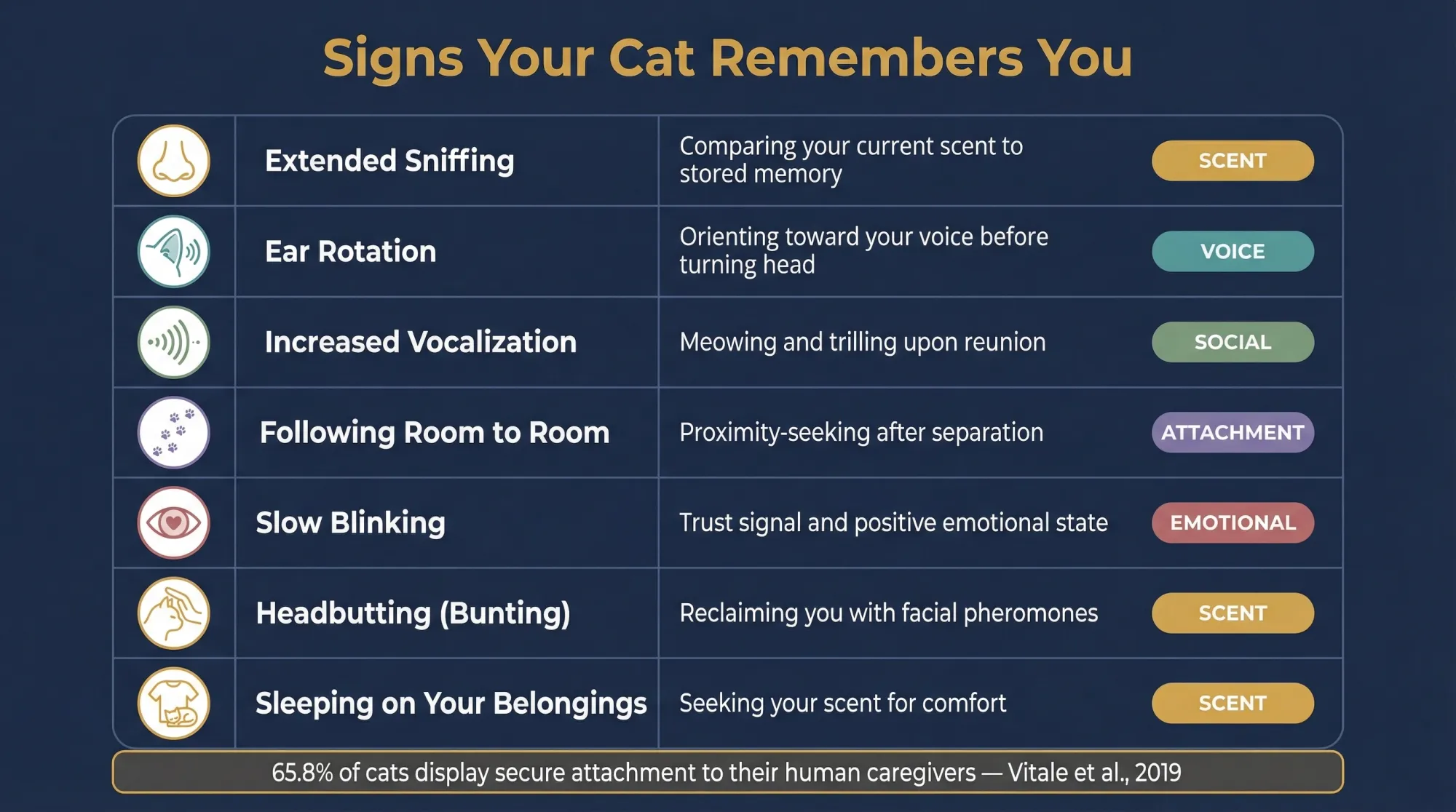
Cats returning from a period of separation display a predictable behavioral sequence that reflects their sensory memory hierarchy: prolonged sniffing of the returning person's hands and clothing (olfactory verification), increased vocalization (social re-engagement), and altered proximity patterns such as following, sitting closer, or sleeping in the returning person's space.
The behavioral signs are subtle compared to a dog's full-body greeting, but they are consistent and research-supported:
| Sign | What It Means | Memory Channel |
|---|---|---|
| Extended sniffing of hands, shoes, clothing | Olfactory identity verification — comparing current scent to stored scent memory | Scent (primary) |
| Ear rotation and head orienting when you speak | Voice recognition activation — matching current voice to stored auditory memory | Voice (secondary) |
| Increased vocalization (meowing, trilling) | Social re-engagement — cats vocalize primarily toward humans, not other cats. For more on what excessive vocalization means, see why your cat meows so much. | Social memory |
| Following you room to room | Proximity-seeking behavior consistent with secure attachment patterns | Attachment memory |
| Slow blinking | Positive emotional communication — associated with comfort and trust | Emotional memory |
| Headbutting (bunting) | Scent-marking you with facial pheromones — reclaiming you as "theirs" | Territorial/social memory |
| Sleeping on your belongings | Seeking your scent for comfort during your absence or upon return. This connects to the broader pattern of why cats choose to sleep with their owners. | Scent (primary) |
Landmark research by Dr. Kristyn Vitale at Oregon State University found that 65.8% of cats display secure attachment to their human caregivers using the Secure Base Test — a distribution mirroring human infant attachment patterns (Vitale et al., 2019). Cats with secure attachment use their caregiver as a safe base for exploration, show reduced stress upon reunion, and balance proximity-seeking with independent exploration. These are observable signs that a cat recognizes, remembers, and is bonded to a specific person. For a full breakdown of how cats express attachment, see our guide to signs your cat loves you.
It is worth noting that the applicability of human attachment frameworks to cats remains debated among researchers. Pongracz et al. (2025) argue that cat social behavior toward humans reflects "symmetrical inter-specific amicability" rather than dependency-based attachment, and an earlier study by Potter and Mills (2015) found no signs of secure attachment in their sample. The behavioral evidence of recognition and bonding is clear; the theoretical framework used to interpret that evidence remains an active area of scientific discussion.

When Cat Memory Fails: Cognitive Dysfunction
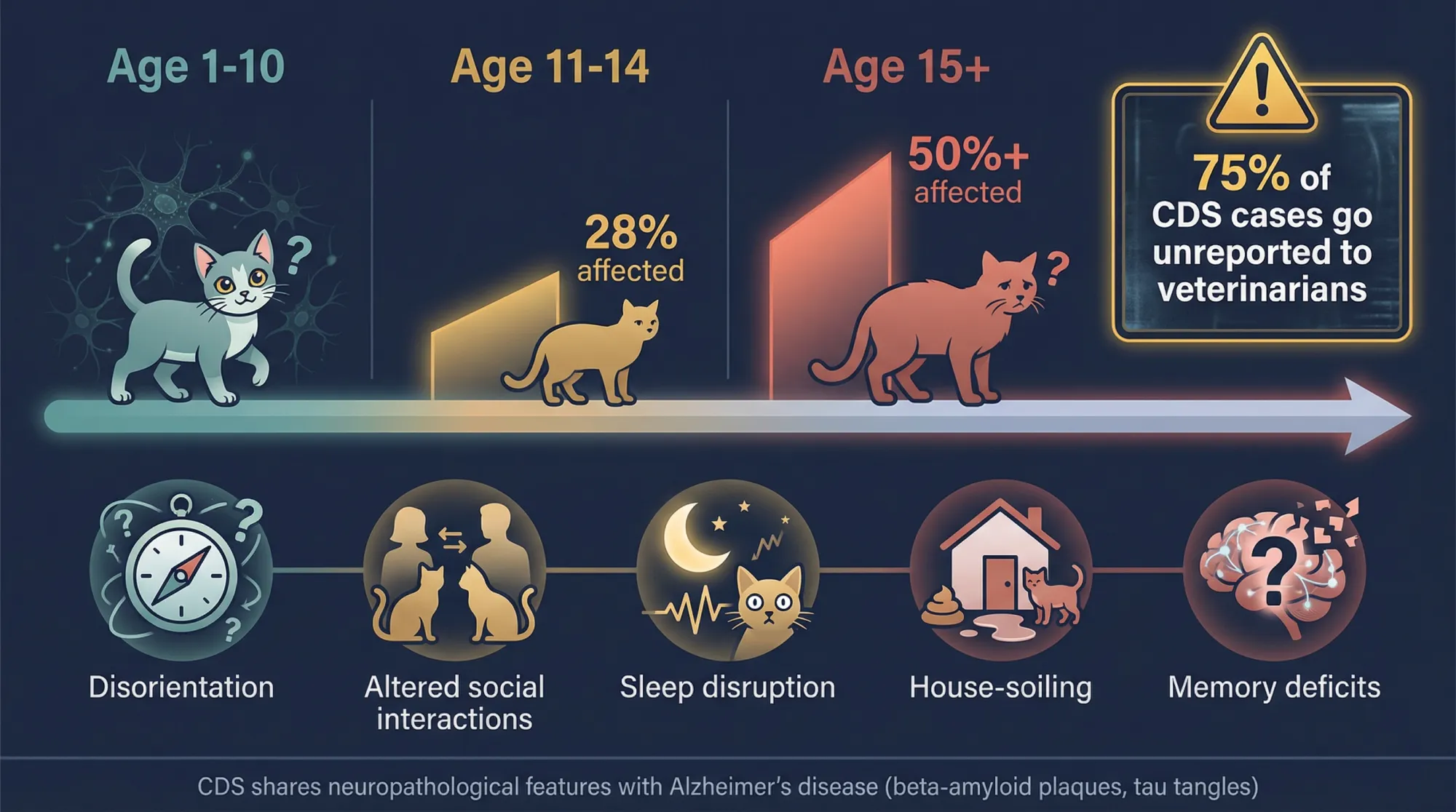
Feline cognitive dysfunction syndrome affects approximately 28% of cats aged 11 to 14 and over 50% of cats aged 15 and older, causing progressive memory loss, disorientation, and altered recognition of family members — a condition that shares neuropathological features with human Alzheimer's disease yet goes unreported in 75% of cases.
Cognitive dysfunction syndrome in cats is massively underdiagnosed. Research suggests that the vast majority of CDS signs go unreported: surveys indicate that when owners are specifically asked about cognitive changes, far more report signs than those who volunteer the information to their veterinarian unprompted (Landsberg et al., 2010). If your senior cat (aged 10+) has started staring at walls, vocalizing excessively at night, getting lost in familiar rooms, or no longer recognizing family members, these are not signs of "just getting old." Consult a veterinarian. CDS shares neuropathological hallmarks with human Alzheimer's disease — including beta-amyloid accumulation and hyperphosphorylated tau deposits — and early intervention can improve quality of life.
The numbers tell a stark story. Multiple studies confirm that approximately 28% of cats aged 11 to 14 develop at least one sign of cognitive dysfunction, increasing to over 50% for cats 15 and older (Sordo & Gunn-Moore, 2021; Landsberg et al., 2010). Understanding how these life stages affect your cat's health is critical for early detection.
CDS manifests through a cluster of behavioral changes that owners can monitor:
- Disorientation in familiar environments (getting stuck in corners, staring at walls)
- Altered social interactions with family members (withdrawal, failure to recognize people)
- Sleep-wake cycle disruption (excessive nighttime vocalization, daytime sleeping)
- House-soiling in a previously reliable cat
- Learning and memory deficits (forgetting routines, not responding to name)
A 2024 study by Pirrone et al. found that spatial memory, peripheral inflammation, and negative emotional state predict social-cognitive abilities in aging cats — suggesting that managing stress and inflammation may help preserve cognitive function (Pirrone et al., 2024). Dr. Carlo Siracusa at the University of Pennsylvania is currently leading Morris Animal Foundation-funded research to develop a validated diagnostic tool for feline CDS (Morris Animal Foundation).
When to see a vet immediately: sudden failure to recognize family members, excessive nighttime vocalization in a senior cat, new house-soiling in a cat aged 10 or older, disorientation in familiar environments, or getting stuck in corners or behind furniture. These symptoms require veterinary evaluation to rule out CDS, hyperthyroidism, hypertension, pain, and other medical causes.
How to Strengthen Your Cat's Memory of You
Strengthening a cat's memory of a specific person requires engaging all three recognition channels consistently — providing regular scent exposure, maintaining a distinctive voice pattern, and pairing your presence with emotionally positive experiences that the amygdala flags for long-term storage.
Step 1: Map Your Cat's Recognition Profile
Observe your cat's first response across five consecutive homecomings. Score each greeting:
- Scent-first (S): Cat approaches to sniff hands, shoes, or clothing before other responses
- Voice-first (V): Cat orients ears and head toward your voice before physical approach
- Visual-first (F): Cat makes eye contact or approaches upon seeing you before sniffing
The dominant channel across five observations becomes your cat's recognition profile. Most cats display an S-V-F pattern (scent-dominant). Knowing your cat's primary channel tells you which memory pathway to reinforce.
Step 2: Strengthen Each Channel
- Scent: Leave a worn T-shirt near your cat's sleeping area before extended absences. This maintains scent familiarity when you are not physically present. The Miyairi 2025 study confirms cats store and reference their owner's specific scent signature.
- Voice: Speak to your cat regularly in a calm, consistent voice. Voice memory strengthens with daily repetition. Use your cat's name frequently — Saito's 2019 research confirmed cats discriminate their own names from other words.
- Emotional pairing: Associate your presence with feeding, interactive play, and slow blinks. Emotionally significant experiences produce stronger, more durable memory traces based on mammalian neuroscience principles. Avoid purely functional or neutral interactions.
Step 3: Protect Memory Over the Lifespan
For cats aged 10 and older, maintain consistent daily routines — predictable schedules strengthen memory consolidation. Provide environmental enrichment (puzzle feeders, vertical spaces, novel safe scents) to maintain cognitive engagement. Manage stress through stable environments, since Pirrone et al. (2024) links inflammation and negative emotional state to cognitive decline. Cornell Feline Health Center recommends regular veterinary check-ups for senior cats to catch early signs of cognitive dysfunction before significant memory loss occurs (Cornell Feline Health Center).
"50% of domestic cats preferred human social interaction over food, toys, and scent when given a free choice — true for both pet cats and shelter cats, demonstrating that cats actively seek and value human connection." — Vitale Shreve et al., 2017, Behavioural Processes

Key Terms
Episodic-like memory: A type of memory that records specific events — what happened, where, and when — from a single experience, without deliberate intent to memorize. Called "episodic-like" in animals because true episodic memory (requiring conscious awareness of the past) cannot be conclusively demonstrated in non-verbal species.
Cross-modal recognition: The ability to link information from different senses — such as matching a voice to a face — into a unified mental representation of a specific individual.
Habituation-dishabituation paradigm: An experimental method where a subject is repeatedly exposed to a stimulus until response decreases (habituation), then presented with a novel stimulus. A renewed response (dishabituation) proves the subject can distinguish between the two stimuli.
Secure attachment: A relationship pattern where an individual uses a caregiver as a safe base for exploration, showing reduced stress upon reunion and comfort upon return. In cats, 65.8% demonstrate this pattern toward human caregivers, though the framework's applicability to cats is debated.
Cognitive dysfunction syndrome (CDS): An age-related neurodegenerative condition in cats characterized by disorientation, altered social interactions, sleep-wake disruption, and memory loss. Shares neuropathological features with human Alzheimer's disease, including beta-amyloid plaques and tau tangles.
Object permanence: The understanding that objects continue to exist even when out of sight. Cats demonstrate Stage 5 object permanence (tracking visible displacements) but not Stage 6 (inferring invisible displacements).
Expectancy violation: A research method where a subject is presented with a scenario that contradicts their internal expectation. Longer looking or visible surprise indicates the subject held a specific mental model that was violated — evidence of mental representation.
Frequently Asked Questions
The most common questions about cat memory, answered with peer-reviewed evidence from the studies cited throughout this article. Each answer reflects the current scientific consensus on feline cognition and recognition, covering memory duration, owner recognition, name recall, inter-cat memory, and the effects of cognitive decline in senior cats.
Do cats remember their owners after years apart?
No controlled experiment has measured exactly how long cats remember specific people. However, a review of cat cognition by Vitale Shreve and Udell (2015) reports that researchers believe cat long-term memory may span a decade or longer, and owner surveys confirm cats recognizing people after years of separation. Memory duration likely scales with the emotional significance of the relationship — cats with secure attachment bonds to a caregiver would retain stronger, more durable memories.
Will my cat forget me if I go on vacation?
Short absences of days to weeks are extremely unlikely to erase a cat's memory of its owner. Cat long-term memories of people form through repeated daily interactions across multiple sensory channels — scent, voice, and emotional associations. A single absence does not overwrite months or years of accumulated memory traces. Leaving a worn garment near your cat's sleeping area can maintain scent familiarity during your absence.
Do cats remember people who were mean to them?
Yes, and likely with heightened persistence. Based on mammalian neuroscience, negative experiences (pain, fear, stress) produce stronger memory traces than neutral ones because the amygdala tags emotionally significant events for priority storage. Owner surveys report pets remembering aversive single-occurrence events from years prior (Fugazza et al., 2020). A cat that hisses at a specific person but not others is demonstrating targeted negative recall.
Do cats recognize their owners by sight alone?
Cats perform poorly on visual face recognition in controlled tests — approximately 54% accuracy in photo-based discrimination. Cats primarily identify their owners through scent and voice. Preliminary research suggests that cats with extensive multi-person exposure (such as cafe cats) may develop stronger voice-face associations, but house cats in the same study did not demonstrate this ability (Takagi et al., 2019). Faces serve as a secondary confirmation channel for cats, not the primary identification method.
How do cats remember their names?
A 2019 study by Dr. Atsuko Saito tested 77 cats across four experiments and found cats discriminate their own names from other words and from other cats' names. Cats learn their names through repeated association — hearing a specific sound pattern paired with outcomes like feeding, play, or attention. This is associative long-term memory, the same mechanism cats use to remember individual people.
Do cats remember other cats?
Research by Dr. Saho Takagi at Kyoto University found that household cats associate companion cats' names with their faces (Takagi et al., 2022). Cats who live together develop cross-modal name-face representations of their housemates. Separately, Szenczi et al. (2021) demonstrated that cats retain olfactory memory of their mother's scent for at least one year post-weaning, suggesting cat-to-cat memory can persist well beyond cohabitation.
Can cats get dementia and forget their owners?
Yes. Feline cognitive dysfunction syndrome affects approximately 28% of cats aged 11 to 14 and over 50% of cats aged 15 and older. CDS can cause progressive memory loss, disorientation, and failure to recognize family members. The condition shares neuropathological features with human Alzheimer's disease. If a senior cat stops recognizing family members or shows behavioral changes, veterinary evaluation is essential.
Do cats prefer their owners over strangers?
Research by Dr. Kristyn Vitale found that 50% of cats preferred human social interaction over food, toys, and scent (Vitale Shreve et al., 2017). A separate study confirmed 65.8% of cats display secure attachment to their caregivers (Vitale et al., 2019). Both findings indicate cats form specific preferences for familiar humans, which requires memory of those individuals and the positive experiences associated with them.
Key Takeaways
Cats remember people through scent first, voice second, and sight third: This sensory hierarchy — the opposite of human recognition — explains why cat recognition looks like indifference. A cat that sniffs your hand upon greeting is running an olfactory identity check, not ignoring you.
Cat long-term memory likely spans years to a decade or more: While no controlled study has measured the exact upper limit, cats retain their mother's scent for at least one year, owners report recognition after years of separation, and researchers infer memory lasting a decade or longer based on the durability of feline associative learning.
Cats mentally track their owner's location even out of sight: Dr. Saho Takagi's 2021 study demonstrated that cats maintain an active mental map of their owner's position based on voice alone — a higher cognitive function than simple recognition, and one no competitor article covers.
Memory declines with age and requires monitoring: Approximately 28% of cats aged 11 to 14 develop cognitive dysfunction syndrome, rising to over 50% for cats aged 15 and older. Yet 75% of cases go unreported to veterinarians because owners mistake cognitive decline for normal aging.
You can actively strengthen your cat's memory of you: Engaging all three recognition channels — scent, voice, and emotionally positive interactions — builds more robust, multi-layered memory traces. Leaving worn clothing during absences, speaking your cat's name regularly, and pairing your presence with feeding and play all reinforce the bond.
Sources
- Vocal recognition of owners by domestic cats - Saito & Shinozuka, 2013, Animal Cognition (PubMed)
- Domestic cats discriminate their names from other words - Saito et al., 2019, Scientific Reports (Nature)
- Attachment bonds between domestic cats and humans - Vitale et al., 2019, Current Biology (Cell Press)
- Socio-spatial cognition in cats: Mentally mapping owner's location from voice - Takagi et al., 2021, PLoS ONE (PLoS ONE)
- Cats learn the names of their friend cats in their daily lives - Takagi et al., 2022, Scientific Reports (Nature)
- Cats match voice and face: cross-modal representation of humans in cats - Takagi et al., 2019, Animal Cognition (PubMed)
- Use of incidentally encoded memory from a single experience in cats - Takagi et al., 2017, Behavioural Processes (PubMed)
- Object permanence and working memory in cats - Goulet, Dore & Rousseau, 1994, Journal of Experimental Psychology (PubMed)
- Duration of cats' working memory for disappearing objects - Fiset & Dore, 2006, Animal Cognition (PubMed)
- Long-term olfactory memory of mother's body odour by offspring in cats - Szenczi et al., 2021, Animal Cognition (PubMed)
- Behavioral responses of domestic cats to human odor - Miyairi et al., 2025, PLoS ONE (PLoS ONE)
- Social interaction, food, scent or toys? Cat preferences - Vitale Shreve et al., 2017, Behavioural Processes (PubMed)
- Pet memoirs: Event memories in cats and dogs - Fugazza et al., 2020, Applied Animal Behaviour Science (ScienceDirect)
- What's inside your cat's head? A review of cat cognition - Vitale Shreve & Udell, 2015, Animal Cognition (PubMed)
- Cognitive Dysfunction in Cats - Sordo & Gunn-Moore, 2021, Veterinary Record (PubMed)
- Spatial memory, inflammation, and cognitive abilities in aging cats - Pirrone et al., 2024, Applied Animal Behaviour Science (ScienceDirect)
- A review of cat-human interactions and relationships - Turner, 2017, Behavioural Processes (PubMed)
- Cognitive dysfunction syndrome in cats - Landsberg et al., 2010, Journal of Feline Medicine and Surgery (PubMed)
- Cognitive Dysfunction - Cornell Feline Health Center (Cornell)
- Developing a Diagnostic Tool for Feline Cognitive Dysfunction - Morris Animal Foundation / Dr. Carlo Siracusa (Morris Animal Foundation)