
Male Cat Behavior After Neutering: What the Science Actually Shows
Neutering reduces fighting in 88%, roaming in 94%, and spraying in 87% of male cats — but the timeline varies by individual. Here's what 50 years of behavioral research actually shows.


Table of Contents
- How Does Neutering Change Male Cat Behavior?
- The Hormonal Timeline: What Happens After Surgery
- Which Behaviors Change After Neutering?
- Why Does My Neutered Cat Still Spray, Mount, or Fight?
- What Does Unneutered Male Cat Behavior Look Like?
- When Is the Best Age to Neuter a Cat?
- Frequently Asked Questions
- Key Takeaways
- Sources
Most neutering-driven behavior changes manifest within 6-8 weeks as testosterone clears. Spraying declines in 87%, roaming in 94%, and fighting in 88% of male cats (Hart and Barrett, 1973). But behaviors with a learned component (like territorial marking in older cats) may persist. The timeline depends on your cat's age at surgery and how long the behavior was practiced before neutering.
Your cat just came home from surgery. He is groggy, confused, and wearing a cone of shame that makes him look like a satellite dish. You are probably wondering: when does the behavior actually change? Will he stop spraying? Will he calm down? And why is the internet giving you twelve different timelines?
Here is the thing most articles will not tell you: there is no single answer. Researchers at UC Davis tracked 42 neutered cats and found that behavioral change follows two distinct patterns — rapid and gradual — with the split varying by behavior. Some cats change within days. Others take months. And a small percentage keep doing what they have always done, hormones or not.
This article breaks down what fifty years of behavioral research actually shows about male cat behavior after neutering, with real study citations, real statistics, and real expectations you can set for your specific cat.

How Does Neutering Change Male Cat Behavior?
Neutering removes the primary source of testosterone, which drives spraying, fighting, and roaming. Landmark research shows 88% of male cats reduce fighting, 94% reduce roaming, and 87% reduce urine spraying after castration. But the timeline varies widely between individual cats.
To understand what changes and why, you need to know what testosterone actually does in your cat's brain. Think of it as the software running three specific programs: territorial spraying, inter-male aggression, and mate-seeking roaming. Neutering does not delete those programs. It cuts off the power supply that keeps them running. For a broader look at the science behind why cats do what they do, see our guide to cat behavior.
"Castration produces a marked reduction in three key behaviors in male cats: 88% reduce fighting (53% rapid, 35% gradual), 94% reduce roaming (56% rapid, 38% gradual), and 87% reduce urine spraying (78% rapid, 9% gradual)." — Hart and Barrett (1973), Journal of the American Veterinary Medical Association

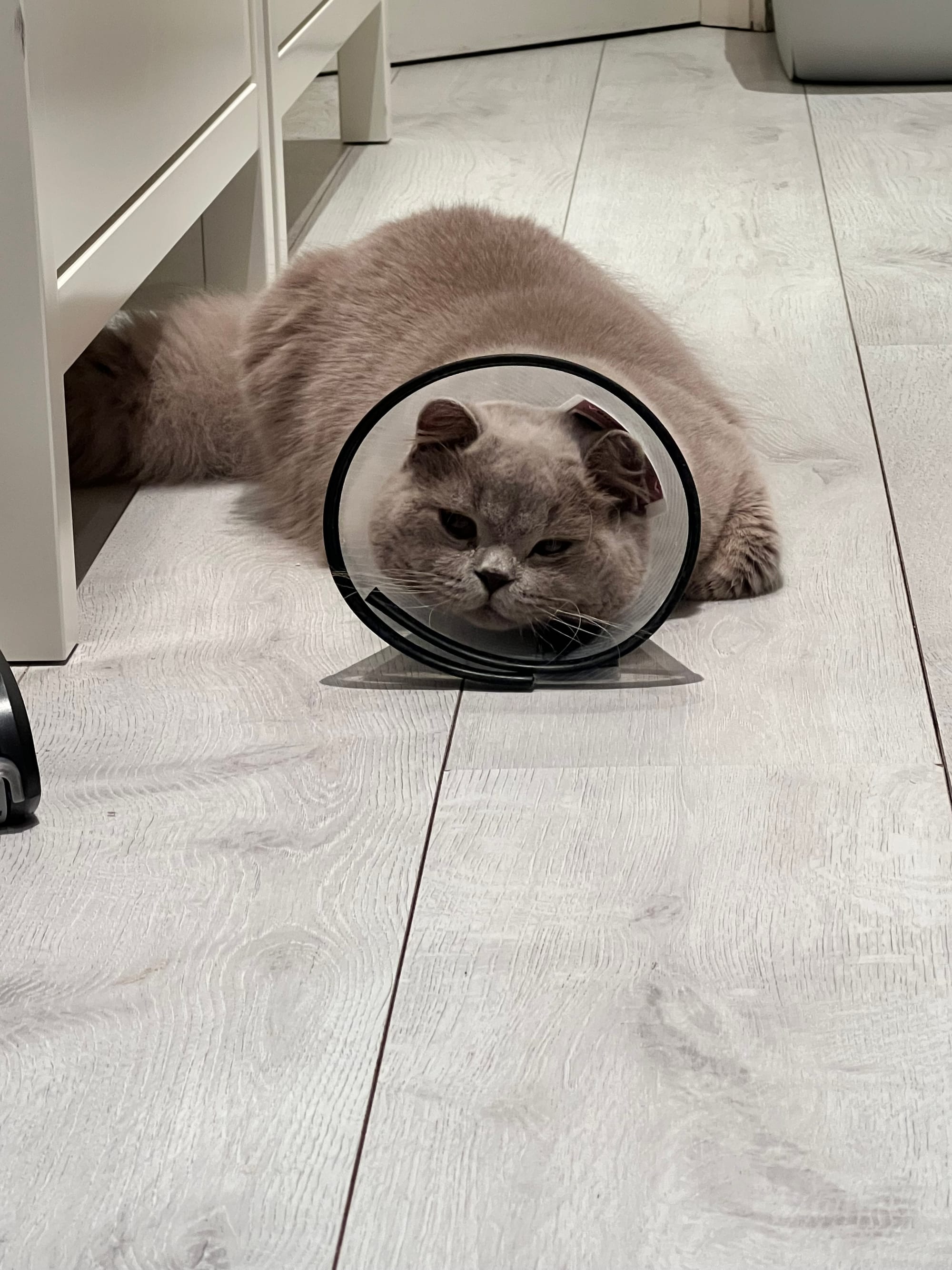

Moon after his neutering. He was very glad to see the last of the cone!
Hart and Barrett published their landmark study at UC Davis in 1973, tracking behavioral outcomes across 42 adult male cats castrated in adulthood. Their key finding was that behavioral change follows two distinct patterns: some cats decline rapidly (within days to weeks) while others decline gradually (over weeks to months). The combined effect across both patterns produced the headline statistics that remain the most-cited numbers in feline behavioral science.
But here is where it gets interesting. Those percentages tell you how many cats change. They do not tell you how fast your cat will change. For that, you need to understand the hormonal timeline.
The Hormonal Timeline: What Happens After Surgery
Testosterone drops to near-zero in the bloodstream within hours of neutering, but tissue-bound testosterone takes 6 to 8 weeks to fully clear. This two-phase process explains why surgery happens in one day but behavioral changes unfold over weeks to months.
Most pet care websites say something vague like "hormones take time to clear." That is technically true, but it misses the actual mechanism. Hart and Eckstein (1997) reviewed the role of gonadal hormones in objectionable behaviors in dogs and cats, establishing that not all males change behavior after castration and that the timeline varies by individual.
Phase one: serum testosterone. This is the testosterone circulating in the bloodstream. It drops significantly within days of surgery. Martin et al. (2006) measured testosterone in cats post-castration and found levels dropped from 16.6 nmol/L to 2.7 nmol/L within the first week.
Phase two: behavioral clearance. Even after testosterone levels drop, behavioral changes can take 6 to 8 weeks to fully manifest. This is the period during which hormone-dependent neural pathways gradually lose their activation.
"Testosterone drops significantly within the first week of castration, but behavioral changes typically take 6 to 8 weeks to fully manifest as hormone-dependent neural pathways gradually lose activation." — Hart and Eckstein (1997), Applied Animal Behaviour Science; Martin et al. (2006), Journal of Feline Medicine and Surgery
Think of it this way: the surgery turns off the faucet, but the pipes still have water in them. Your cat's body is metabolizing stored testosterone for the next month and a half. That is the biological reason some behaviors linger.
But there is a third factor that even the hormonal timeline does not fully explain. And it is the one that separates the cats who change quickly from the cats who take months.
Which Behaviors Change After Neutering?
Spraying, fighting, and roaming all decline in approximately 87-90% of neutered males. Spraying tends to drop fastest because it is the most hormone-dependent. Fighting and roaming follow, but their timelines are more variable because they involve learned patterns alongside hormonal drives.
Not all testosterone-driven behaviors are created equal. Each one has a different balance of hormonal fuel and learned habit, which is why each one follows a slightly different trajectory after neutering.
Urine Spraying
This is the behavior that brings most people to this article, and the good news is it is the most reliably responsive to neutering. Hart and Barrett (1973) found that approximately 87% of castrated male cats show a marked reduction or complete cessation of spraying.
Why does spraying respond so well? Because it is one of the most hormone-dependent behaviors in the cat's repertoire. Testosterone directly increases both the pungency and volume of urine marking. Remove the testosterone, and the chemical signal driving the behavior weakens rapidly.
Some cats stop spraying within days. Others take weeks. Hart and Barrett (1973) documented this variability: 78% of cats showed rapid decline in spraying within days to weeks, while 9% experienced a more gradual tapering over weeks to months. The remaining 13% showed little to no change.
"Approximately 10% of neutered male cats continue to spray after castration. Research shows persistent spraying is typically driven by stress, multi-cat household conflict, or environmental triggers rather than residual hormones." — Neilson (2004)
Fighting and Inter-Male Aggression
About 90% of neutered males show a marked reduction in fighting. But aggression is more complicated than spraying because it is multifactorial. Veterinary behaviorists including Dr. Sharon Crowell-Davis at the University of Georgia have documented that testosterone is a primary driver of inter-male aggression, but it is not the only one. Fear-based aggression and territorial aggression can persist or even increase after neutering if the underlying cause was never hormonal to begin with.
This means that if your cat fights because he is afraid of the neighborhood tom, neutering the neighborhood tom might help, but neutering your cat may not change that particular dynamic. Learning to read your cat's body language signals can help you distinguish between fear-based and hormone-driven aggression.
Roaming
Hart and Barrett (1973) found approximately 90% of neutered males reduce their roaming range. This makes intuitive sense: mate-seeking is a powerful motivator. A tomcat's home range can be enormous compared to a neutered male's territory. Once the hormonal drive to find females disappears, most males are content with a much smaller world. Understanding the difference between stray and feral cats can also help you recognize territorial dynamics in your neighborhood.
The practical impact goes beyond behavior. Reduced roaming means lower risk of FIV and FeLV transmission through bite wounds, fewer encounters with vehicles, and less chance of your cat simply vanishing.
Mounting and Sexual Behavior
This is the behavior that confuses owners the most. Your cat is neutered. The testosterone is gone. So why is he still mounting the blanket?
The answer comes from a groundbreaking 1958 study by Rosenblatt and Aronson at the American Museum of Natural History. They found a critical distinction:
- Sexually inexperienced males stopped sexual behaviors quickly after castration
- Sexually experienced males continued mounting for months or even years after castration
"Sexual behaviors in male cats have both hormonal and learned components. Cats with extensive mating experience before neutering are more likely to continue mounting afterward because the behavior has been reinforced through learning, not just hormones." — Rosenblatt and Aronson (1958), Behaviour
This is the single most important framework in understanding post-neutering behavior. It is not about residual hormones. It is about learned behavior: neural pathways that formed through repeated experience and no longer need hormonal fuel to fire.
The Three-Tier Expectation Framework
Hart and Barrett (1973) gave us the clearest picture of what to actually expect. Their data across fighting, roaming, and spraying reveals three distinct response patterns:
- Majority of cats: rapid decline. Behavioral changes appear within days to the first few weeks. Hart and Barrett found 53-78% of cats showed rapid decline depending on the behavior (78% for spraying, 53% for fighting, 56% for roaming).
- Smaller group: gradual decline. Changes unfold over weeks to months. Hart and Barrett found 9-38% of cats experienced gradual decline (9% for spraying, 35% for fighting, 38% for roaming).
- Roughly 6-13%: persistent behaviors. Little to no change. These are cats whose behaviors have become deeply encoded through experience, or whose behaviors were never purely hormonal in the first place.
"Hart and Barrett (1973) found that behavioral response to castration follows two distinct patterns — rapid decline and gradual decline — with the split varying by behavior. Spraying responds most dramatically (78% rapid), while fighting and roaming show more gradual change." — Hart and Barrett (1973), JAVMA
If your cat falls in the rapid-decline group, you will feel like neutering was a miracle. If he is in the gradual group, patience is the answer. And if he is in the persistent group? The issue is behavioral, not hormonal, and you will need a different strategy.
Why Does My Neutered Cat Still Spray, Mount, or Fight?
Persistent behaviors after neutering are almost always explained by one of two mechanisms: learned behavior patterns that became independent of hormones before surgery, or stress and environmental triggers that have nothing to do with testosterone. Roughly 10% of neutered males continue spraying, and the cause is usually environmental, not hormonal.
This is the question that keeps cat owners up at night. You did the responsible thing. You got your cat neutered. And he is still doing the thing. What went wrong?
Nothing went wrong. Your cat's brain is working exactly as designed. The problem is that we tend to think of neutering as a behavioral reset button. It is not. It is the removal of one specific input, testosterone, from a system that often has multiple inputs.
The Learned Behavior Explanation
Rosenblatt and Aronson (1958) gave us the framework that every veterinary behaviorist still uses today. Feline behavior runs on two parallel tracks:
- Hormone-driven behaviors are directly triggered and maintained by testosterone. Remove it, and the behavior loses its fuel. These decline reliably.
- Learned behaviors have been reinforced through experience and repetition. Over time, they become independent of hormonal status. The neural pathways remain active even after testosterone is gone. The behavior has become a habit.
The longer a behavior has been practiced before castration, the more deeply it is encoded as a learned pattern. This is why age at neutering matters for behavior, though not for the reason most people think. It is not that older cats "cannot change." It is that older cats have had more time to practice and reinforce behaviors, making those behaviors more resistant to fading once the hormonal driver is removed.
The Stress and Environment Explanation
For the roughly 10% of neutered males that continue spraying, Dr. Jacqueline Neilson (2004) identified the primary drivers. They are not hormonal. They are environmental:
- Multi-cat household conflict where territorial tension between cats triggers marking
- Visual triggers such as outdoor or stray cats visible through windows
- Routine disruption from new family members, a move, or schedule changes
- Inadequate resources including too few litter boxes, no vertical space, and no safe retreat areas
The AAFP and ISFM Feline Environmental Needs Guidelines (Ellis, Rodan, Heath et al., 2013) recommend a specific approach: rule out medical causes first (urinary tract infections, cystitis, kidney issues), then address environmental and behavioral factors. If your neutered cat suddenly starts spraying after months of not spraying, call your vet first. A medical issue is more likely than a behavioral one in that scenario.
When to Talk to Your Vet
Behavioral science is CatCog's territory, but medical aftercare is not. Contact your veterinarian if:
| Warning Sign | Why It Matters |
|---|---|
| Spraying started suddenly after a period of not spraying | May indicate urinary tract infection or cystitis |
| Your cat shows signs of pain during urination | Possible urinary blockage, which can be life-threatening in males |
| You notice blood in the urine | Could signal infection, stones, or other urinary tract issues |
| Urination frequency or volume has changed (not just location) | Suggests a medical rather than behavioral cause |
| Behavioral changes are accompanied by appetite loss, lethargy, or other physical symptoms | Multiple symptoms together point to systemic illness |
| You have any concern about surgical recovery | Post-operative complications need prompt veterinary attention |
What Does Unneutered Male Cat Behavior Look Like?
Intact male cats are driven by testosterone to spray pungent urine to mark territory, fight rival males for mating access, and roam extensively to find females in heat. These behaviors typically begin around sexual maturity at 4 to 6 months and intensify throughout the first year. They are the biological baseline that neutering interrupts.
Understanding unneutered male cat behavior puts everything else in context. An intact tom is running the full testosterone program, and it is a demanding one.
Spraying in intact males is not a litter box problem. It is a communication system. The testosterone-laden urine carries chemical information about the cat's identity, territory, and reproductive status. The smell is distinctly pungent, far stronger than normal urine, because testosterone increases the concentration of specific amino acids (most notably felinine) in the spray.
Fighting is often ritualistic but can be severe. Intact males compete for territory and mating access through physical confrontation. This is the primary transmission route for FIV (feline immunodeficiency virus) through bite wounds during fights.
Roaming in intact males is driven by the need to find receptive females. Unneutered toms can have home ranges many times larger than neutered males, sometimes covering several city blocks or more. This roaming exposes them to traffic, predators, parasites, and territorial conflicts with other cats.
Caterwauling, the loud, distinctive vocalization of an intact male, is a mating call. It can be persistent, especially at night, and is one of the behaviors most likely to decline rapidly after neutering as the hormonal drive to attract females disappears. If your cat's vocalizations concern you beyond mating calls, our article on why cats meow excessively covers the full range of causes.
"A long-term cohort study found that male cats neutered before 5.5 months of age were no more likely to develop urine spraying than those neutered at the traditional age of 5.5 to 12 months." — Spain, Scarlett, and Houpt (2004), Journal of the American Veterinary Medical Association
The key takeaway: everything on this list is the software that testosterone is running. Neutering shuts down the operating system. But any programs that have been copied to the hard drive through learning may continue to run on their own.
When Is the Best Age to Neuter a Cat?
The evidence shows a range of options, not a single correct answer. Major veterinary organizations recommend neutering between 4 and 6 months, before sexual maturity. Research from Cornell University found no increased behavioral problems with early neutering before 5.5 months. Discuss timing with your vet based on your individual cat.
This is a question where the science and the recommendations are clearer than you might expect, but where the internet has muddied the waters considerably. Here is what the evidence actually shows.
What the Research Found
Spain, Scarlett, and Houpt at Cornell University published two landmark studies in 2004 (both in the same issue of JAVMA — one for cats, one for dogs) following cats long-term after gonadectomy at different ages. Their findings were clear: male cats neutered before 5.5 months of age showed no increased risk of spraying or other behavioral problems compared to those neutered at the traditional age of 5.5 to 12 months. Understanding when kittens hit key developmental milestones can help you plan the timing of neutering around your cat's growth.
"Early-age gonadectomy before 5.5 months does not increase spraying risk or behavioral problems compared to traditional-age neutering at 5.5 to 12 months." — Spain, Scarlett, and Houpt (2004), JAVMA. Long-term cohort study at Cornell University.
Where the Major Organizations Stand
- iCatCare recommends neutering before 4 months, before sexual maturity
- ISFM published guidelines in 2013 in the Journal of Feline Medicine and Surgery recommending neutering before sexual maturity, around 4 months
- AAFP (now FelineVMA) and partner organizations endorsed neutering by 5 months through the Veterinary Task Force on Feline Sterilization (2016-2017)
- Traditional veterinary practice has conventionally recommended 6 months, though this is based on convention rather than evidence
The range runs from 4 to 6 months, and the differences between these recommendations are institutional interpretations of the same underlying data, not conflicting evidence.
The Delayed Neutering Debate: Why It Exists
You may have come across articles arguing that neutering should be delayed to 12 months or even later. This argument comes primarily from canine research, and this distinction matters enormously.
McGreevy et al. (2018) studied 6,235 male dogs and found that eight fearfulness-related behaviors were significantly more likely in dogs with less lifetime exposure to gonadal hormones.
"The movement to delay neutering is primarily driven by canine research, including McGreevy et al. (2018), which studied over 6,000 dogs. No equivalent large-scale feline study has found the same risks. Cat-specific evidence from Spain et al. does not show increased behavioral problems with early neutering."
These are dog studies. Cats are not small dogs. No equivalent large-scale feline study has replicated these findings. The cat-specific evidence from Spain et al. does not show the same pattern of risks from early neutering.
This does not mean the question is settled forever. Future feline research may reveal considerations we do not yet know about. But the current evidence supports a window of 4 to 6 months, and the decision should be made with your vet based on your cat's breed, health status, and living situation.
Frequently Asked Questions
Can My Cat Lick Himself After Being Neutered?
Your cat should not lick the surgical site during the recovery period, typically 10 to 14 days. Licking can introduce bacteria and prevent proper healing. Your vet will likely send your cat home with an e-collar (the cone) or recommend a recovery suit. Follow your vet's specific aftercare instructions, as protocols can vary. This is a medical aftercare question, so defer to your veterinarian's guidance for your cat's specific situation.
Do Neutered Cats Still Spray?
Yes, approximately 10% of neutered male cats continue to spray after castration. Neilson (2004) found that persistent spraying in neutered cats is almost always driven by stress, multi-cat household dynamics, or environmental triggers rather than residual hormones. If your neutered cat is spraying, look at what changed in his environment. New cat in the neighborhood? Different litter box setup? Household routine disrupted? These are the likely culprits, not a neutering failure. If spraying starts suddenly after a long period without it, consult your vet to rule out urinary tract issues first. Unexpected drooling alongside spraying changes can also signal a health issue worth checking.
What Does Neutered Mean for Cats?
Neutering (also called castration or orchiectomy in males) is the surgical removal of the testes, the primary source of testosterone. Without testosterone production, the hormonal drive behind spraying, fighting, roaming, and mate-seeking behavior loses its fuel source. The term "neutering" is sometimes used broadly to mean sterilization in either sex, but technically, spaying refers to females (ovariohysterectomy) and neutering or castration refers to males. An intact male cat is commonly called a tom or tomcat.
Why Is My Neutered Male Cat Kneading and Shaking?
Kneading (the rhythmic pushing motion with the paws) and the accompanying shaking or treading of the hind end is a behavior that can look a lot like mating behavior, and that is because it often is, at least in origin. This is one of the clearest examples of the Rosenblatt and Aronson (1958) learned behavior framework in action. If your cat practiced mounting and the associated motor patterns before neutering, those neural pathways still exist. The behavior has been reinforced through repetition and does not require testosterone to continue. It is not a sign that the neutering did not work. It is a sign that your cat's brain learned this pattern thoroughly enough that it persists without hormonal support. It is harmless, normal, and typically decreases gradually over time. Repetitive grooming-like behaviors such as licking their owners can follow a similar pattern of learned habit persisting after the original trigger fades.
Key Takeaways
The numbers. Hart and Barrett (1973) at UC Davis found that neutering produces a marked reduction in fighting (88%), roaming (94%), and urine spraying (87%) in 42 adult male cats, with each behavior showing distinct rapid-decline and gradual-decline patterns.
The timeline is not one-size-fits-all. Testosterone drops significantly within the first week (Martin et al., 2006), but behavioral changes typically take 6 to 8 weeks to fully manifest. The rate of change varies by behavior — spraying responds fastest (78% rapid decline), while fighting and roaming change more gradually.
Hormones versus habits. Rosenblatt and Aronson (1958) showed that behaviors can run on two tracks: hormone-driven and learned. The longer a behavior was practiced before neutering, the more likely it is to persist afterward. This is not a failure of neutering. It is normal brain function.
Persistent spraying is environmental. The roughly 10% of neutered cats that continue spraying are almost always responding to stress, multi-cat conflict, or environmental triggers (Neilson, 2004). Address the environment, not the hormones.
Early neutering is supported by feline evidence. Spain, Scarlett, and Houpt (2004) found no increased behavioral problems with neutering before 5.5 months. Major veterinary organizations recommend 4 to 6 months. The delayed-neutering movement is driven by canine research that has not been replicated in cats.
Sources
- Effects of castration on fighting, roaming, and urine spraying in adult male cats — Hart and Barrett (1973), JAVMA, 163(3):290-292
- Factors relating to urine spraying and fighting in prepubertally gonadectomized cats — Hart and Cooper (1984), JAVMA, 184(10):1255-1258
- The role of gonadal hormones in the occurrence of objectionable behaviours in dogs and cats — Hart and Eckstein (1997), Applied Animal Behaviour Science, 52:331-344
- The decline of sexual behavior in male cats after castration with special reference to the role of prior sexual experience — Rosenblatt and Aronson (1958), Behaviour, 12(4):285-338
- Thinking outside the box: Feline elimination — Neilson (2004), Journal of Feline Medicine and Surgery, 6(1):5-11
- Long-term risks and benefits of early-age gonadectomy in cats — Spain, Scarlett, and Houpt (2004), JAVMA, 224(3):372-379
- Serum testosterone concentrations in intact and castrated male domestic cats in a colony — Martin et al. (2006), Journal of Feline Medicine and Surgery
- AAFP and ISFM Feline Environmental Needs Guidelines — Ellis, Rodan, Heath et al. (2013), Journal of Feline Medicine and Surgery, 15(3):219-230
- ISFM Guidelines on Population Management and Welfare of Unowned Domestic Cats — Sparkes et al. (2013), Journal of Feline Medicine and Surgery, 15(9):811-817
- Behavioural risks in male dogs with minimal lifetime exposure to gonadal hormones — McGreevy et al. (2018), PLOS ONE