What Does It Mean When a Cat Purrs? The Science Explained
A 2023 Vienna study discovered that cats don't even need muscles to purr -- specialized 'purring pads' do the work passively. Learn the 4C Purr Context Protocol, decode solicitation purrs, and know when purring signals a problem.

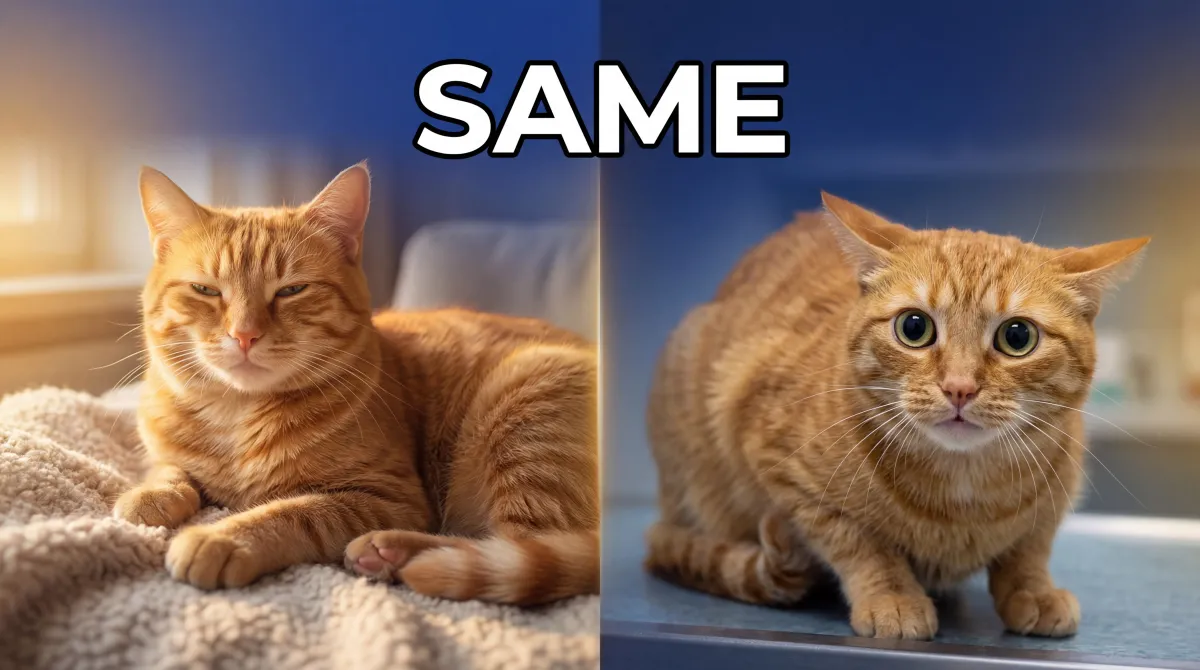
Table of Contents
- What Does It Mean When a Cat Purrs? (Common Meanings)
- How Does Purring Work? (The Science)
- Why Do Cats Purr When You Pet Them?
- The CatCog Purr Context Protocol
- Why Do Kittens Purr?
- Why Is My Cat Purring So Loud?
- Can Cat Purring Heal You?
- Why Doesn't My Cat Purr?
- When Should Purring Concern You?
- Key Terms Used
- Frequently Asked Questions
- Key Takeaways
- Sources
Purring is not a single emotion -- it is a context-dependent signal that can mean contentment, hunger, stress, pain, or a deliberate attempt to manipulate you. A 2023 University of Vienna study discovered that cats possess specialized connective tissue "purring pads" in their vocal folds that produce low-frequency vibrations without any muscular effort. And Dr. Karen McComb's research at the University of Sussex found that cats embed a 380 Hz cry-like frequency inside their purr to exploit human nurturing instincts and get fed. As feline behaviorist John Bradshaw notes in Cat Sense, purring predates domestication and serves functions far beyond expressing pleasure. The meaning of a purr depends entirely on body language and environmental context -- never assume a purring cat is happy. For a broader look at how cats communicate, see our guide to cat communication.

What Does It Mean When a Cat Purrs? (Common Meanings)
Most people assume purring equals happiness. Research identifies at least five distinct purring contexts — contentment is only one, and misreading a purr can mean missing signs of pain, stress, or illness.
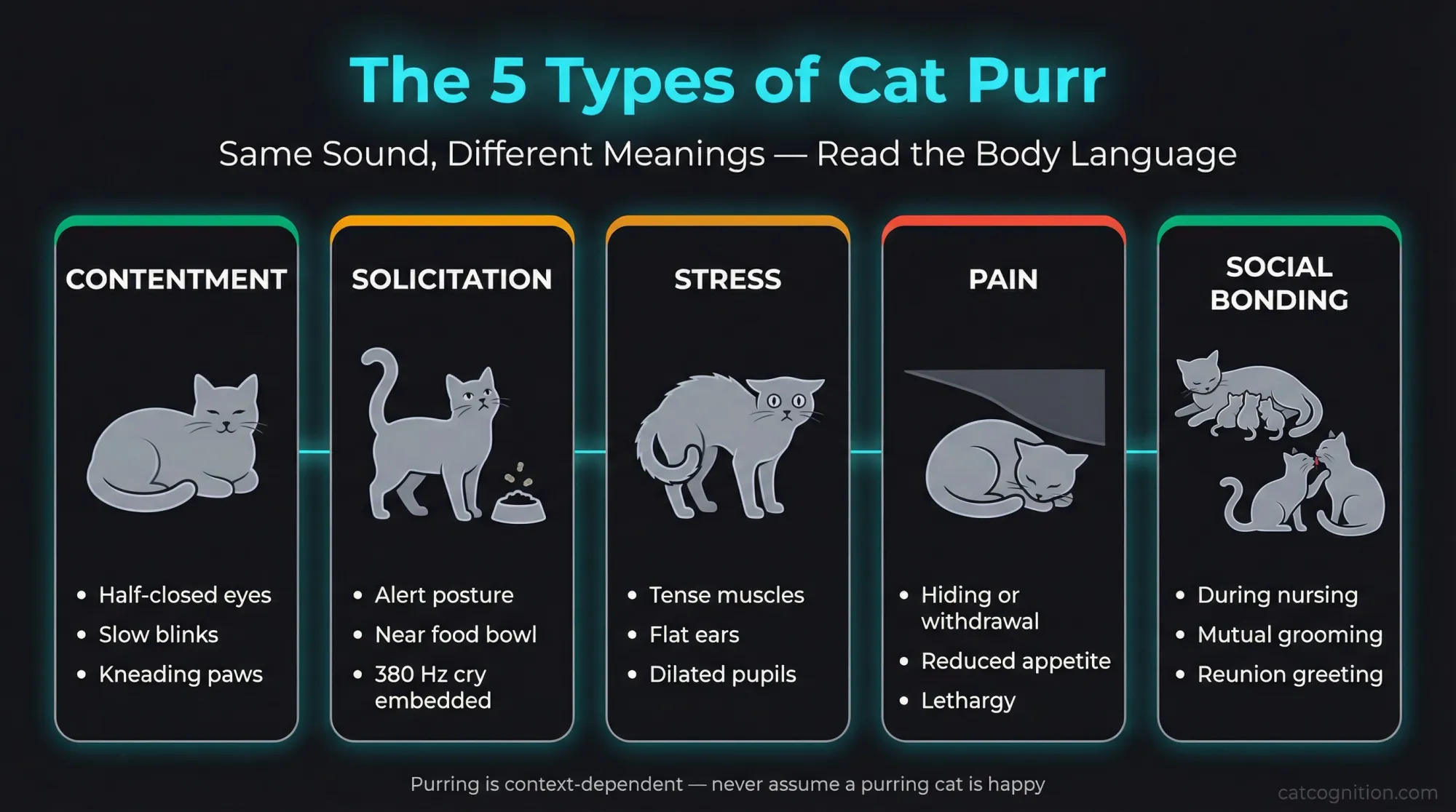
Cats purr across a wide spectrum of emotional and physical states. Contentment is only one of them. Research and clinical observation identify at least five distinct purring contexts:
1. Contentment purring. The one everyone knows. A relaxed cat with half-closed eyes, slow blinks, and kneading paws produces a steady, low-frequency rumble. This is the baseline purr -- rhythmic, consistent, and accompanied by visibly relaxed body posture.
2. Solicitation purring. This is where it gets interesting. Dr. Karen McComb's peer-reviewed observational study (10 cats, 50 human listeners) at the University of Sussex found that cats produce a specialized purr when seeking food. This solicitation purr embeds a high-frequency 380 Hz component -- resembling an infant distress cry -- within the normal low-frequency rumble. Human listeners rated these purrs as significantly more urgent and less pleasant than regular contentment purrs, even when they had no experience with cats.
📊 The Evidence:
The solicitation purr contains an embedded high-frequency component (mean approximately 380 Hz) that may exploit mammalian sensitivity to infant distress cries, manipulating humans into providing food. -- McComb et al., Current Biology, 2009
Your cat is not asking for food. Your cat is hacking your parental instincts.
3. Stress and anxiety purring. Cats purr during veterinary visits, thunderstorms, car rides, and other stressful situations. This is self-soothing behavior -- the vibrations appear to have a calming physiological effect. A purring cat with tense muscles, flattened ears, dilated pupils, or hiding behavior is not content. It is coping.
4. Pain purring. Cats in significant pain -- from injury, illness, or post-surgical recovery -- frequently purr. This is one of the most misunderstood purring contexts. A cat purring while showing reduced appetite, lethargy, or behavioral withdrawal may be using purring as a pain management mechanism, not expressing comfort.
5. Social bonding purring. Mother cats purr during nursing. Adult cats purr during mutual grooming. Cats purr when reunited with familiar humans. This social purring serves as a low-volume communication channel that maintains proximity and connection without attracting predators the way louder vocalizations like meowing would.
The critical takeaway: purring tells you a cat is communicating. Body language tells you what it is communicating. The two must be read together.
How Does Purring Work? (The Science)
For decades, the dominant explanation was the Active Muscle Contraction (AMC) hypothesis: cats actively contract the laryngeal muscles 20 to 30 times per second, rapidly opening and closing the glottis to produce the characteristic vibration. This theory, established by Remmers and Gautier in 1972, became textbook science.
In October 2023, a peer-reviewed laboratory study from the University of Vienna fundamentally challenged that model.
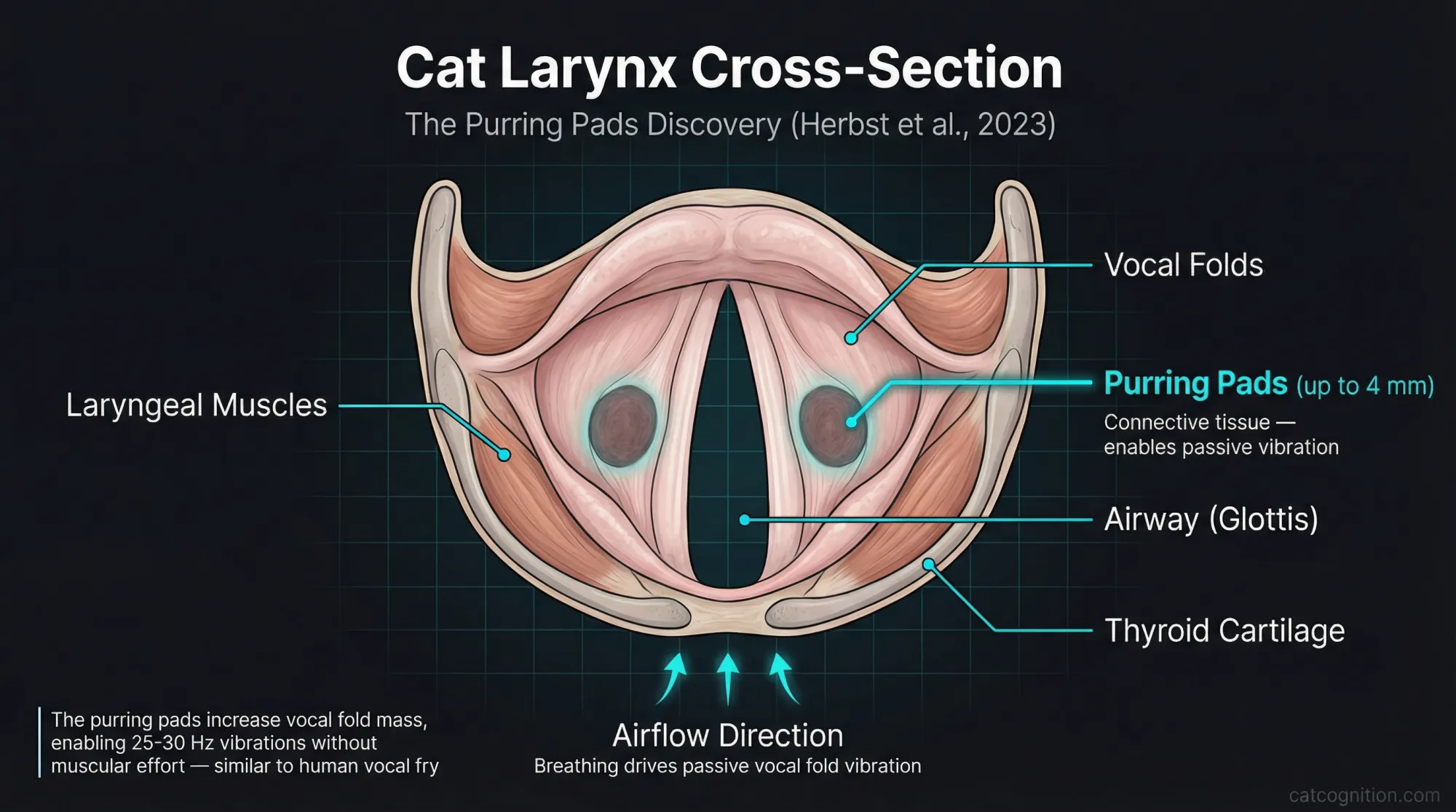
Christian T. Herbst and colleagues at the University of Vienna removed larynges from eight domestic cats (post-mortem, euthanized for unrelated medical reasons) and pumped air through them. The excised larynges produced purring frequencies of 25 to 30 Hz with no neural input and no muscular contraction whatsoever.
📊 The Evidence:
In a peer-reviewed laboratory study (ex vivo, n=8), excised cat larynges produced purring frequencies of 25-30 Hz without neural input, due to specialized connective tissue "pads" up to 4 mm in diameter embedded in the vocal folds. -- Herbst et al., Current Biology, 2023
The key discovery: specialized connective tissue masses -- which the researchers named "purring pads" -- up to 4 mm in diameter embedded in the vocal folds. These pads are composed of spindle-shaped and star-shaped cells, myxoid tissue, vessels, glycosaminoglycans, elastic fibers, and sparse collagen fibers. They increase vocal fold density, enabling low-frequency vibrations despite cats' small laryngeal size.
Think of it this way: a cat's vocal folds work like a speaker with built-in bass boosters. The purring pads add mass that slows vibration rates, just as adding weight to a tuning fork lowers its pitch. This is why a 4 kg cat can produce sounds at frequencies that would normally require a much larger resonating structure.
The mechanism is functionally similar to human "vocal fry" -- that low, creaky phonation some people use at the end of sentences. Both rely on tissue properties rather than constant muscular effort. The difference is that cats evolved dedicated anatomy for it.
This is a myoelastic-aerodynamic (MEAD) mechanism: airflow from breathing causes the vocal folds to vibrate passively. The Vienna team's conclusion is that this passive mechanism may be the primary purring driver, potentially augmented -- but not solely caused -- by active muscle contractions.
An important caveat: the Vienna study does not fully reject the AMC hypothesis. The researchers themselves note that active muscular control likely still plays a role in modulating purr frequency and amplitude. What the study demonstrates is that muscular contraction is not required for purring -- the anatomy alone can produce it.
The roar-purr divide. Cats that purr cannot roar, and cats that roar cannot purr. The traditional explanation centers on the hyoid bone: in purring cats (domestic cats, cheetahs, bobcats), the hyoid is completely ossified (rigid bone), allowing rapid, tight vibrations. In roaring cats (lions, tigers, leopards, jaguars), the hyoid is incompletely ossified, permitting the longer, more elastic vocal fold movements that produce roars audible up to 5 miles away.
However, this binary is a simplification. Weissengruber et al. (2002) argued that hyoid anatomy alone does not determine purring ability, and the snow leopard -- a member of the genus Panthera alongside lions and tigers -- can purr despite being classified with the roaring cats. The relationship between hyoid structure and vocalization remains an area of active debate, and the traditional either-or rule is increasingly questioned.
Why Do Cats Purr When You Pet Them?
When you pet a cat and it starts purring, you are most likely hearing contentment purring -- the steady, low-frequency vibration that signals relaxation and positive social engagement. But the science reveals something deeper than simple pleasure.
Petting triggers a physiological feedback loop. Tactile stimulation activates slow-conducting nerve fibers that respond specifically to gentle, stroking touch -- the same class of neurons (C-tactile afferents) involved in processing pleasant touch across mammals. These fibers project to brain regions involved in reward processing and social bonding. The resulting purr is both a response to pleasurable input and a signal encouraging the petting to continue.
This is not passive. The cat is actively communicating: keep doing that. Research from the Meowsic project at Lund University, which studied cat vocalizations in 70 home environments, found that cats adjust vocalization patterns based on the responses they receive. Purring during petting is a learned, reinforced behavior -- cats that purr during interaction receive more interaction.
The location of petting matters. Cats generally prefer being stroked on the cheeks, chin, and base of the ears -- areas rich in scent glands. Petting the belly or base of the tail often produces a different response entirely, from overstimulation to defensive aggression. If a cat purrs while you pet its cheeks but switches to tail-flicking and ear-flattening when you move to the belly, the purr has stopped meaning contentment. For a deep dive on the preferred zones and the science behind them, see our complete guide to petting cats.
Some cats purr and then bite. This "petting-induced aggression" occurs when a cat reaches its tactile stimulation threshold. The purr may continue right up to the moment of the bite because the transition from pleasant to overstimulated can be rapid. Watch for the early warning signs: tail twitching, ear rotation, skin rippling, and cessation of kneading.
The CatCog Purr Context Protocol
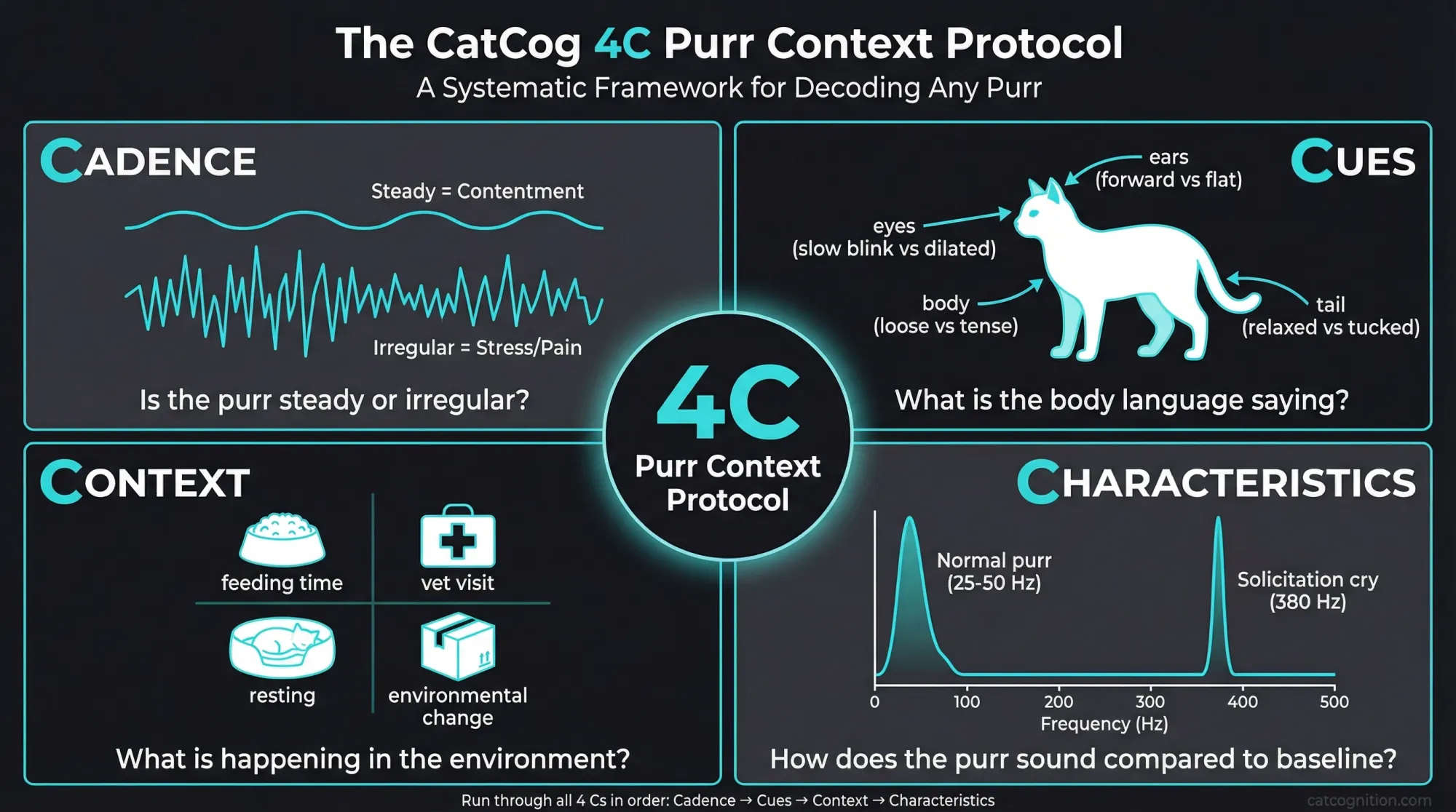
Most cat care guides list purr types but stop there. The CatCog Purr Context Protocol -- the 4C Purr Assessment -- transforms observation into a systematic, repeatable framework for decoding what your cat's purr actually means.
The 4 Cs:
1. Cadence -- Is the purr steady or irregular? A steady, rhythmic purr at a consistent volume suggests contentment or social bonding. An irregular purr -- stopping and starting, changing in intensity, or punctuated by pauses -- suggests stress, pain, or uncertainty. Pain-related purring tends to be shorter in duration with more frequent interruptions.
2. Cues -- What is the body language saying? The purr is the audio channel. Body language is the visual channel. Read them together:
| Body Language | + Steady Purr | + Irregular Purr |
|---|---|---|
| Relaxed ears, slow blinks, kneading | Contentment | Unusual -- observe closely |
| Alert posture, near food bowl | Solicitation | Escalating demand |
| Tense body, dilated pupils, hiding | Self-soothing (stress) | Pain or distress |
| Exposed belly, loose tail | Trust and relaxation | Overstimulation approaching |
| Flattened ears, tucked tail | Unlikely combination | Significant stress or fear |
3. Context -- What is happening in the environment? Is it feeding time? The purr is likely solicitation. Did the cat just return from the vet? Probably stress-relief. Is the cat settled in its favorite spot after a meal? Contentment. Did you just rearrange furniture or introduce a new pet? Anxiety. The same purr sound means different things in different environments.
4. Characteristics -- What does the purr sound like? Pitch, volume, and the presence of additional frequency elements matter. The solicitation purr has a detectably higher pitch with an embedded "cry" element that most humans perceive as more urgent. A louder-than-usual purr may indicate heightened emotional state (positive or negative). A noticeably quieter purr in a normally loud purrer can signal malaise.
Using the protocol: When your cat purrs, run through the 4 Cs in order. Cadence first (steady or irregular?), Cues second (what does the body say?), Context third (what is the situation?), Characteristics fourth (how does it sound compared to baseline?). With practice, this takes seconds and dramatically improves your ability to respond appropriately.
Why Do Kittens Purr?
Kittens are born blind and deaf. Purring is their first communication channel.
Faint vibrations can occur as early as 2 days after birth, though audible purring typically develops around 3 weeks of age. These early vibrations serve a critical survival function: they help the kitten locate the mother for nursing and signal that feeding is going well. The mother purrs back, creating a vibrotactile communication loop that requires no vision, no hearing, and minimal energy.
This is why purring evolved as a low-frequency vibration rather than a higher-pitched vocalization. Low frequencies travel through direct contact -- body-to-body transmission that a predator cannot detect from a distance. A kitten purring against its mother's body is effectively whispering through touch.
📊 The Evidence:
Kittens produce faint purring vibrations as early as 2 days old, with audible purring typically developing around 3 weeks of age. Early purring serves as a vibrotactile communication channel before the kitten's vision and hearing are fully developed.
As kittens grow, purring takes on new functions. By 4 months, kittens are prolific purrers -- a 4-month-old kitten that purrs frequently is displaying normal developmental behavior, not a medical concern. Kittens purr during play, social interaction, feeding, and rest. This developmental period is when cats learn that purring produces results: it brings the mother, it maintains warmth, it signals safety.
Critically, kittens that are separated from their mother too early may show altered purring patterns. Early separation during the critical socialization window (2 to 7 weeks) can affect vocal development, and some cats raised without maternal interaction purr less as adults or develop atypical purring patterns. This parallels the broader developmental effects of early separation on kitten behavior.
Anecdotally, feral cats appear to vocalize less as adults than domestic cats, with some observers suggesting they reserve purring primarily for kittenhood to avoid attracting predators. However, no peer-reviewed study has directly investigated this claim, and it should be treated as behavioral observation rather than established science. What is well-documented is that domestic cats continue purring throughout their lives -- a behavior that may have been selected for through thousands of years of cohabitation with humans who responded positively to it.
Why Is My Cat Purring So Loud?
Volume varies enormously between individual cats, and a loud purr is not inherently a concern. But understanding what drives volume differences helps decode the signal.
Genetics play a role. A 2025 peer-reviewed study from Kyoto University (Okamoto, Hattori, and Inoue-Murayama; n=280 cats) found that cats carrying short-type androgen receptor genes displayed higher owner-assessed purring scores. This suggests a hereditary component to purring behavior -- some cats are genetically predisposed to purr more frequently and more intensely.
📊 The Evidence:
In a study of 280 cats, those carrying short-type androgen receptor genes displayed higher owner-assessed purring scores, suggesting a genetic component to purring behavior. -- Okamoto et al., PLOS ONE, 2025 (note: purring scores were owner-assessed, not acoustically measured)
Breed differences matter. Some breeds are notably louder purrers than others. Siamese and Oriental breeds, known for their vocal expressiveness in meowing, also tend to produce more intense purrs. Maine Coons and Ragdolls are frequently described by owners as powerful purrers, though controlled breed-comparative acoustic studies remain limited.
Emotional intensity amplifies volume. A cat that is extremely content -- freshly fed, warm, being petted in its preferred zone -- may purr louder than during routine rest. Similarly, a cat under significant stress may produce a louder purr as the self-soothing response intensifies. The 4C Protocol helps here: loud purr + relaxed body language = intense contentment; loud purr + tense body language = intense stress.
Individual acoustic fingerprints. A 2025 peer-reviewed study (Russo, Schild, and Knornschild, published in Scientific Reports) found that purrs function as stable "vocal fingerprints" for individual cat identification, with 84.6% classification accuracy across individuals -- significantly higher than meows, which achieved only 63.2% accuracy. Each cat's purr is acoustically unique, which means what is "loud" for one cat may be baseline for another. Track your own cat's normal range to detect meaningful changes.
📊 The Evidence:
Purrs achieved 84.6% individual classification accuracy compared to 63.2% for meows, confirming that purrs function as stable individual vocal fingerprints. -- Russo et al., Scientific Reports, 2025
When loud purring is worth monitoring: If your cat's purr has become noticeably louder than its established baseline -- particularly if accompanied by other changes like increased vocalization, restlessness at night, weight loss, or appetite changes -- a veterinary check is reasonable. Hyperthyroidism, common in senior cats, can alter vocalization patterns.
Can Cat Purring Heal You?
This is the most viral claim about purring -- and the one that requires the most careful handling.
The hypothesis: cat purr frequencies (25 to 50 Hz) overlap with frequencies used in human orthopedic medicine for bone growth and fracture healing (20 to 50 Hz). Therefore, purring may promote healing in cats, and proximity to a purring cat may benefit human health.
The reality is more nuanced than headlines suggest.
The frequency overlap is real. Elizabeth von Muggenthaler presented data at the Acoustical Society of America in 2001 showing that all 44 individual felids recorded produce vibrations between 25 and 150 Hz, with domestic cats generating dominant frequencies at 25 Hz and 50 Hz. These frequencies do overlap with the range used in therapeutic vibration medicine for bone density and wound healing.
However, three critical caveats apply:
1. The von Muggenthaler data is a conference abstract, not a peer-reviewed paper. It was published in the JASA Supplement as a one-page abstract for an ASA meeting presentation. Conference abstracts undergo minimal review -- acceptance to present -- and are not equivalent to peer-reviewed journal articles. The data has not been independently replicated.
2. Correlation is not causation. The overlap between purr frequencies and therapeutic frequencies is an observed coincidence, not a demonstrated mechanism. No controlled study has demonstrated that purring directly heals bones or tissues in cats. Additionally, clinical vibration platforms deliver far greater mechanical energy (amplitude and duration) than a purring cat produces -- frequency alone is insufficient. The hypothesis that purring evolved as an energy-efficient way to maintain bone density during prolonged sedentary rest periods is plausible and interesting, but it remains unproven.
3. Human health claims are even less supported. Claims that sitting near a purring cat reduces blood pressure, promotes bone healing, or lowers heart attack risk are frequently repeated in popular media but lack controlled clinical evidence. Some correlational studies link cat ownership to cardiovascular benefits, but these cannot be attributed specifically to purring rather than to the broader stress-reducing effects of pet companionship.
No controlled study has demonstrated that purring directly heals bones or tissues in cats or humans. The overlap between purr frequencies (25-50 Hz) and therapeutic vibration frequencies (20-50 Hz) is a real observation based on a 2001 conference abstract, not a peer-reviewed paper. The healing hypothesis is intriguing and plausible -- but it is preliminary, correlational, and unreplicated. Purring cannot replace veterinary care for injuries or illness. If your cat is injured, see a vet. If you have a fracture, see a doctor. Enjoy your cat's purr for what it demonstrably is: a remarkable biological communication system.
That said, the subjective benefits of a purring cat are not nothing. The rhythmic, low-frequency vibration is calming. Holding a warm, purring cat reduces perceived stress. Whether this operates through specific vibroacoustic pathways or simply through the general calming effect of tactile contact with a bonded companion, the experiential benefit is real for many cat owners. It just is not a medical intervention.
Why Doesn't My Cat Purr?
Some cats simply do not purr, or purr so quietly that their owners never detect it. This is usually not a medical concern.
Anatomical variation. Just as human voices vary, cats have individual differences in vocal fold structure, laryngeal anatomy, and the size and composition of their purring pads. Some cats produce vibrations too faint to hear but detectable by touch -- placing a hand gently on the cat's throat or chest may reveal purring that is invisible to the ear.
Personality and temperament. Some cats communicate through body language, head bunts, slow blinks, and physical proximity rather than vocalization. A non-purring cat that kneads your lap, sleeps on your chest, and gives slow blinks is bonded to you -- it is simply expressing that bond through a different channel. For more on the ways cats show affection, purring is only one of many signals.
Early socialization. Cats raised without maternal interaction during the critical 2-to-7-week socialization window may purr less as adults. If a kitten never learned that purring produces a response -- because no mother cat was there to respond -- the behavior may remain underdeveloped.
Medical considerations. If a cat that previously purred regularly has stopped, this warrants investigation. Potential causes include:
- Laryngeal paralysis -- a condition where the nerves controlling the larynx lose function, affecting vocalization
- Upper respiratory infection -- inflammation or congestion affecting the throat and vocal apparatus
- Trauma or injury to the throat or neck area
- Significant behavioral stress -- a major environmental change, loss of a companion, or chronic anxiety
A sudden change in an established pattern is always more clinically significant than a lifelong absence of purring. If your normally purring cat goes silent and shows any other behavioral changes -- appetite loss, hiding, lethargy, changes in breathing patterns -- see your vet.
When Should Purring Concern You?
Purring itself is almost never the problem. But purring in the wrong context is a diagnostic clue that something else may be.
Red flags -- see your vet if purring accompanies:
| Warning Sign | What to Watch For |
|---|---|
| Hiding or withdrawal | Reluctance to move, seeking isolation |
| Appetite loss | Reduced food intake lasting more than 24 hours |
| Breathing changes | Labored breathing, wheezing, or open-mouth breathing |
| Pain responses | Flinching when touched, guarding a body part |
| Voice changes | Purr sounds different, raspy, or strained |
| Activity drop | Lethargy or dramatic reduction in normal activity |
| Digestive issues | Vomiting, diarrhea, or unexplained weight loss |
The key principle: purring combined with relaxed body language is almost always normal. Purring combined with signs of illness or distress suggests the cat is self-soothing and requires veterinary evaluation of the underlying cause -- not of the purring itself.
Cats purr in their sleep. This is normal. Cats cycle through light and deep sleep phases, and purring during sleep -- sometimes accompanied by twitching paws or whisker movements -- appears to correlate with relaxed sleep states. It is not a concern unless accompanied by breathing difficulties.
Cats purr when dying. This is the hardest truth about purring. Cats in end-of-life stages frequently purr, likely as a self-soothing mechanism during pain or physiological distress. A purring cat in hospice or palliative care is not necessarily comfortable. Work with your vet to assess pain levels through behavioral indicators beyond the purr.
Key Terms Used
Laryngeal Muscles: Muscles in the voice box (larynx) that control vocalization. In the traditional Active Muscle Contraction hypothesis, these were thought to contract 20 to 30 times per second to produce purring. The 2023 Vienna study showed purring can occur without their activation.
Hyoid Bone: A small bone in the throat that anchors the tongue and larynx. Completely ossified (rigid) in purring cats, incompletely ossified in roaring cats -- though exceptions like the snow leopard complicate this binary.
Solicitation Purr: A specialized purr type containing an embedded high-frequency (380 Hz) component resembling an infant cry, used by domestic cats to solicit food from human caregivers. Identified by McComb et al. in 2009.
Myoelastic-Aerodynamic (MEAD) Mechanism: The passive sound production process where airflow from breathing causes vocal fold vibration without continuous muscular effort. The purring pads discovered in 2023 support this as a primary purring mechanism.
Purring Pads: Specialized connective tissue masses up to 4 mm in diameter embedded in cat vocal folds, discovered by Herbst et al. in 2023. Composed of myxoid tissue, elastic fibers, and glycosaminoglycans, they increase vocal fold density to enable low-frequency vibration.
Frequently Asked Questions
Why do cats purr when you pet them?
Petting activates C-tactile afferent nerve fibers that trigger reward processing in the brain. The resulting purr signals contentment and encourages continued interaction. Cats learn that purring during petting produces more petting -- it is a reinforced communication behavior. The response is strongest when petting preferred zones (cheeks, chin, base of ears) and weakest or negative in sensitive areas (belly, tail base). See our guide to petting cats for the full science.
Do cats only purr when they're happy?
No. Cats purr during contentment, stress, pain, hunger, labor, social bonding, and end-of-life stages. Purring is a context-dependent signal, not an emotion indicator. Always read the accompanying body language and environmental context to determine the purr's meaning.
Can purring heal humans?
The evidence does not support this claim. Cat purr frequencies (25-50 Hz) overlap with frequencies used in human therapeutic vibration medicine, based on a 2001 conference abstract. However, no controlled study has demonstrated that proximity to a purring cat produces measurable healing effects in humans. The subjective calming experience is real; the medical claims are not evidence-based.
What frequency do cats purr at?
Domestic cats produce dominant purring frequencies at 25 Hz and 50 Hz, within a broader range of 25 to 150 Hz observed across felid species. The solicitation purr adds a higher-frequency component around 380 Hz. Individual cats produce acoustically unique purrs -- a 2025 study achieved 84.6% individual identification accuracy from purr recordings alone.
Why does my cat purr and then bite me?
This is petting-induced aggression caused by reaching the cat's tactile stimulation threshold. The purr may continue right up to the moment of overstimulation because the shift from pleasure to irritation is rapid. Watch for pre-bite warning signals: tail twitching, ear rotation backward, skin rippling along the back, and cessation of kneading or slow blinks.
When do kittens start purring?
Faint vibrations can occur as early as 2 days after birth. Audible purring typically develops around 3 weeks of age. Early purring serves as a vibrotactile communication channel between kitten and mother before the kitten's vision and hearing are fully functional.
Can cats control their purring?
Partially. The 2023 Vienna study showed that the basic purring vibration can occur passively through tissue mechanics. However, cats appear to modulate purring through active muscular control -- varying pitch, volume, and the embedded frequency components. The solicitation purr, with its specialized 380 Hz cry element, is evidence that cats actively shape their purrs to produce specific responses in humans.
Can cats purr in their sleep?
Yes. Cats purring during sleep is normal behavior that appears to correlate with relaxed sleep phases. Sleep purring may be accompanied by twitching paws, whisker movements, or other signs of light sleep activity. It is not a concern unless accompanied by breathing difficulties or other signs of respiratory distress.
Key Takeaways
Purring is not happiness -- it is communication. Cats purr during contentment, stress, pain, hunger, and social bonding. The 2023 Vienna "purring pads" discovery showed the mechanism is partially passive, built into the anatomy itself.
Your cat's solicitation purr is manipulating you. McComb's peer-reviewed research (2009) found that cats embed a 380 Hz cry-like frequency in their food-seeking purr, exploiting sensory biases humans have for responding to infant distress.
Use the CatCog 4C Purr Context Protocol -- Cadence, Cues, Context, Characteristics -- to systematically decode any purr. A steady purr with relaxed body language means contentment. An irregular purr with tense body language means distress. Always read both channels.
The healing frequency hypothesis is intriguing but unproven. Purr frequencies (25-50 Hz) overlap with therapeutic vibration frequencies, but this is based on a 2001 conference abstract, not peer-reviewed research. No controlled study has demonstrated purring heals bones or tissues.
Each cat's purr is unique. A 2025 peer-reviewed study confirmed purrs function as individual acoustic fingerprints with 84.6% classification accuracy. Track your cat's baseline purring patterns -- a change in purring behavior is more diagnostically significant than the purring itself.
Sources
- Domestic cat larynges can produce purring frequencies without neural input - Herbst, C.T. et al., Current Biology, October 2023 (Link)
- The cry embedded within the purr - McComb, K. et al., Current Biology, 2009 (Link)
- The felid purr: A healing mechanism? - von Muggenthaler, E., Journal of the Acoustical Society of America (conference abstract), 2001 (Link)
- Meows encode less individual information than purrs - Russo, D., Schild, A.B. & Knornschild, M., Scientific Reports, 2025 (Link)
- Association between androgen receptor gene and behavioral traits in cats - Okamoto, Y., Hattori, M. & Inoue-Murayama, M., PLOS ONE, 2025 (Link)
- Cat vocalization study (Meowsic Project) - Schotz, S. et al., Lund University (Link)
- Why Does My Cat Purr? - Cat Friendly Homes, American Association of Feline Practitioners (Link)
- Respiratory pattern and motor control of the laryngeal muscles during purring - Remmers, J.E. & Gautier, H., Respiration Physiology, 1972
- Every Cat Body Language Signal Explained - CatCog (Link)
- Every Level of Cat Sound Explained - CatCog (Link)