Why Do Cats Hiss? The Defensive Reflex Your Cat Can't Control
Cats hiss because hissing is a hardwired, involuntary defensive reflex — a voiceless burst of air triggered by the brain's fear center, not a sign of aggression. The 2024 AAFP guidelines classify hissing as self-protective behavior.

Table of Contents
- What Does Cat Hissing Actually Mean?
- Why Do Cats Hiss at Each Other?
- Why Do Cats Hiss at Kittens?
- Why Is My Cat Hissing at Me?
- Cat Hissing at Other Cat After Vet Visit
- Why Do Cats Hiss at People?
- How to Calm a Hissing Cat
- What Cat Hissing Sounds Like (And Why It Mimics Snakes)
- Key Terms
- Frequently Asked Questions
- Key Takeaways
- Sources
Cats hiss because hissing is a hardwired, involuntary defensive reflex. The hiss is a voiceless burst of air forced through the mouth — no vocal cords involved — triggered by the ventromedial hypothalamus when a cat perceives a threat. Hissing is classified as "self-protective" behavior by the 2024 AAFP clinical guidelines. A hissing cat is trying to increase distance from a perceived threat, not initiate a fight.
If your cat just hissed at you, at a new cat, or at a guest who reached out a friendly hand, your first instinct was probably alarm. Maybe guilt. Maybe the thought: My cat is aggressive.
The science says otherwise.
Cat hissing is not aggression. Cat hissing is a voiceless defensive reflex — a burst of air forced through the mouth without any vocal cord involvement — triggered involuntarily by the brain's fear center when a cat perceives a threat. Dr. John Bradshaw of the University of Bristol's Anthrozoology Institute has proposed that cat hissing may have evolved as Batesian mimicry of snake defensive sounds — the flattened ears, exposed fangs, and turbulent hiss combining to approximate a defensive snake's warning display. The 2024 AAFP Intercat Tension Guidelines, authored by Dr. Ilona Rodan and a panel of leading feline behaviorists including Dr. Kristyn Vitale and Prof. Daniel Mills, explicitly classify hissing as "self-protective" — not aggressive. Understanding hissing is part of learning to read cat behavior — the science behind why cats do what they do.
A hissing cat is not attacking. A hissing cat is saying back up.

What Does Cat Hissing Actually Mean?
Cat hissing means a cat's brain has detected a threat and triggered an involuntary defensive response designed to increase distance between the cat and the source of fear, pain, or frustration. The 2024 AAFP clinical guidelines define hissing as "self-protective" behavior, and research confirms hissing is a voiceless vocalization — produced without vocal cord involvement — sitting at step six of CatCog's eight-step Defensive Escalation Ladder (see below).
Hissing is not a choice. Neurostimulation studies at the University of Medicine and Dentistry of New Jersey demonstrated that feline hissing is elicited by stimulation of the ventromedial hypothalamus, the brain region responsible for coordinated defensive behavior. The hiss response is mediated by both dopamine and serotonin pathways. A cat does not decide to hiss any more than a human decides to flinch when startled.
This distinction matters. When cat owners hear a hiss and think "aggression," they often respond by approaching, scolding, or trying to comfort the cat. All three responses decrease distance between the cat and the perceived threat — the exact opposite of what the cat's nervous system is demanding. The correct interpretation of a hiss is always the same: the cat needs more space.
"Hissing is self-protective and may be accompanied by a fixated gaze, tense body posture and flattened ears." — 2024 AAFP Intercat Tension Guidelines (Rodan et al., 2024, Journal of Feline Medicine and Surgery)
Understanding what hissing actually means requires one more piece: the vocal mechanics. A 2020 review published in the Journal of Veterinary Science by Tavernier et al. confirmed that hissing belongs to a distinct category of cat sound — voiceless vocalizations produced by forcing air rapidly through the mouth with the tongue arched, creating turbulent airflow. Meowing, growling, and yowling all engage the larynx. Hissing does not. Hissing is the fastest defensive vocalization a cat can deploy because it requires no preparatory muscle tension in the vocal cords.
Mildred Moelk's foundational 1944 phonetic study — the first systematic classification of cat sounds — placed hissing in Class 3: sounds produced with the mouth held tensely open in a fixed position. Over 80 years later, that classification still holds. Dr. Susanne Schotz of Lund University's Meowsic project built on Moelk's framework and identified six distinct agonistic vocalization types in cats: growl, howl, howl-growl, hiss, spit, and snarl.
"The vocalization is voiceless, involuntary and triggered by the surprise appearance of an enemy." — Tavernier et al., 2020 (Journal of Veterinary Science)
Hissing is not growling. Growling is a vocalized, continuous sound produced by the larynx at 100-225 Hz. Growling signals ongoing danger over a sustained period. Hissing is a short-duration burst — an involuntary warning designed to deter an immediate threat. Confusing the two leads to misreading the cat's emotional state and responding incorrectly.
Why Do Cats Hiss at Each Other?
Cats hiss at each other because one cat's presence has triggered a defensive response in the second cat, most commonly during territorial disputes, new introductions, or competition for resources. Research shows that 62% to 88% of multi-cat households report intercat tension, and in a documented case study, Dr. Susanne Schotz recorded 468 agonistic vocalizations when a new cat was introduced to three resident cats — demonstrating that intercat hissing is both normal and intense.
Intercat hissing falls into a pattern. One cat perceives the other as a threat — either to territory, resources, or personal space — and the hypothalamus fires the defensive response. The hissing cat is not "being mean" to the other cat. The hissing cat's brain is executing the same hardwired distance-increasing protocol it would use against any perceived threat.
The 2024 AAFP Intercat Tension Guidelines note that intercat tension manifests on a spectrum. Subtle signs — staring, blocking pathways, resource guarding — often go unnoticed by owners. Hissing is the point on the defensive escalation ladder where most people finally pay attention. But by the time a cat is hissing, the conflict has already passed through several earlier stages. Learning to read the body language signals that precede hissing is how you intervene before escalation.
The CatCog Defensive Escalation Ladder
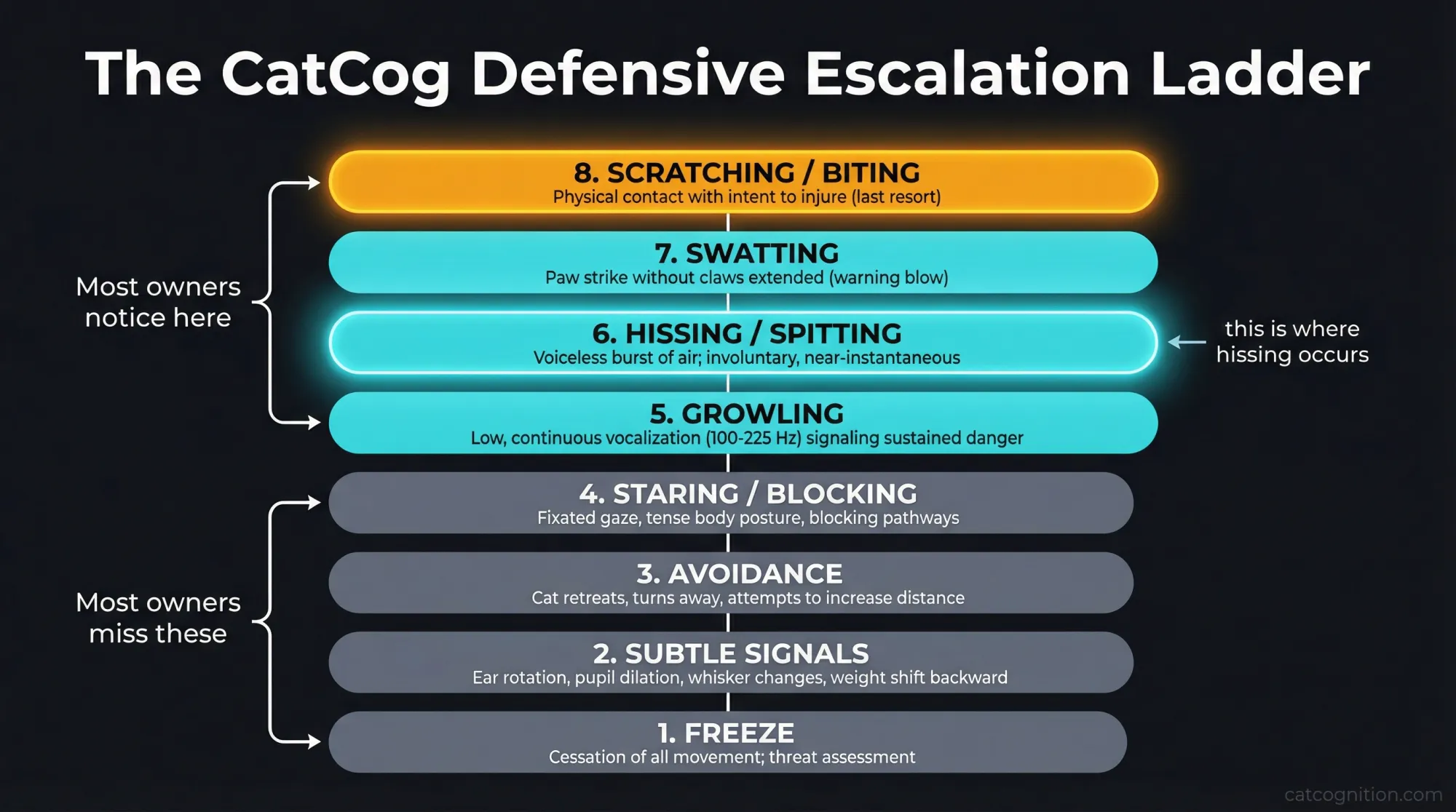
Hissing does not occur in isolation. CatCog's Defensive Escalation Ladder maps where hissing sits in the full eight-step feline defensive sequence:
| Step | Behavior | What It Looks Like |
|---|---|---|
| 1 | Freeze | Cessation of all movement; threat assessment |
| 2 | Subtle signals | Ear rotation, pupil dilation, whisker position changes, weight shift backward |
| 3 | Avoidance | Cat retreats, turns away, attempts to increase distance |
| 4 | Staring/blocking | Fixated gaze, tense body posture, blocking pathways |
| 5 | Growling | Low, continuous vocalization (100-225 Hz) signaling sustained danger |
| 6 | Hissing/spitting | Voiceless burst of air; involuntary, near-instantaneous deployment |
| 7 | Swatting | Paw strike without claws extended (warning blow) |
| 8 | Scratching/biting | Physical contact with intent to injure (absolute last resort) |
Most cat owners only notice behavior at step 6. The 2024 AAFP guidelines specifically state that "signs can be subtle (staring, blocking) and go unrecognized by caregivers." Learning to read steps 1 through 4 means intervening before hissing ever starts.
A 2004 study by Dr. Sharon Crowell-Davis published in the Journal of Feline Medicine and Surgery found that hissing occurred at least daily in 18% of multi-cat households (Crowell-Davis et al., 2004) — confirming that regular hissing between cohabiting cats is common, not pathological.
The practical takeaway for multi-cat households: if cats are hissing at each other, the solution is never to force them into closer contact. Follow Dr. Tony Buffington's Indoor Pet Initiative resource framework — provide separate food stations, water stations, litter boxes, and resting spots in locations where cats cannot see each other while using them. The rule of thumb: n+1 resources, where n equals the number of cats.
Why Do Cats Hiss at Kittens?
Cats hiss at kittens because the resident cat perceives the kitten as a territorial intrusion, and the kitten's high energy and unfamiliar scent trigger the resident cat's defensive response. Hissing during kitten introductions is normal — not a sign of permanent incompatibility. However, a mother cat may also hiss at her own older kittens during the weaning process — weaning hissing serves a developmental function rather than a defensive function.
Two distinct scenarios produce hissing directed at kittens.
Resident cat hissing at a new kitten. This is territorial defense. The resident cat's environment has been invaded by an unfamiliar animal. Even though the invader is small and non-threatening by human standards, the resident cat's hypothalamus does not assess threat levels with human logic. A new scent in the territory triggers the defensive cascade. The solution is a slow, structured introduction: complete physical separation first, then scent swapping, then visual access through a barrier, then supervised face-to-face contact — a process that typically takes one to three weeks.
Mother cat hissing at her own kittens. Queens begin distancing themselves from kittens around the weaning period, typically six to eight weeks. The hissing serves a function: it teaches kittens to become independent. A mother cat hissing at a weaning-age kitten is not rejecting the kitten. The mother cat's behavior is shifting the kitten from dependent to self-sufficient. This behavior resolves naturally and requires no intervention.
Why Is My Cat Hissing at Me?
A cat hissing at its owner is almost always a response to pain, overstimulation, or redirected arousal — not a rejection of the person. Cats do not hiss at specific individuals out of personal animosity — unlike excessive meowing, which can be directed and intentional, hissing is purely reflexive. Hissing is an involuntary reflex triggered by the brain's threat-detection system, and a 2024 study in the Journal of Feline Medicine and Surgery found that 42.6% of cats exhibit aggression during veterinary visits.
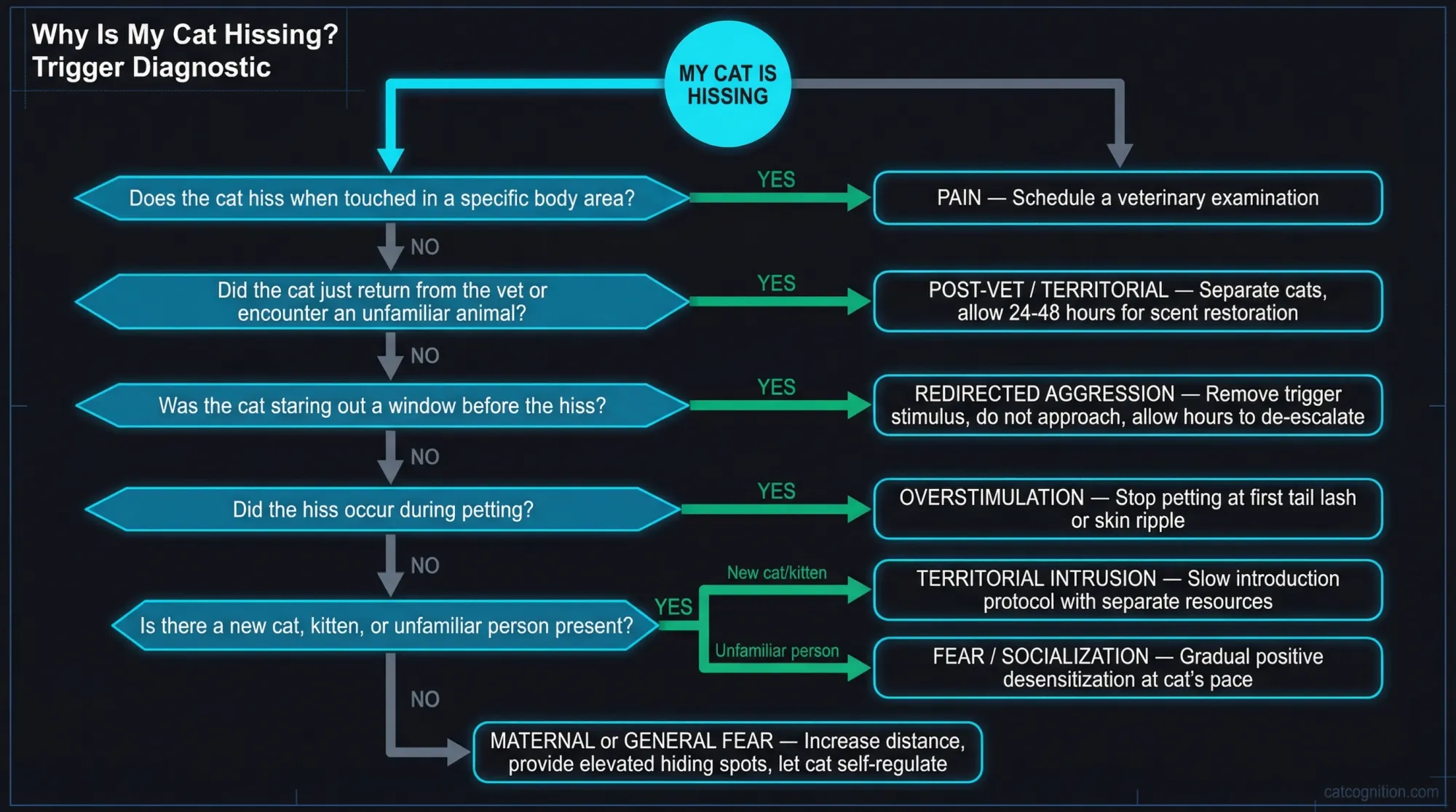
Three scenarios account for the vast majority of owner-directed hissing:
Pain. If your cat hisses when you touch a specific area of the body, the cat may be experiencing localized pain. Cats with osteoarthritis hiss when affected joints are touched. Dental disease, urinary tract infections, and hidden injuries all produce hissing when the painful area is contacted. Any new or sudden hissing triggered by touch warrants a veterinary examination.
Petting-induced overstimulation. A cat purring on your lap can suddenly hiss without apparent warning. The cat is not being capricious. Every cat has a sensory threshold — a point at which tactile stimulation shifts from pleasant to intolerable. The warning signs appear before the hiss: tail lashing, skin rippling along the back, ear rotation, and a shift in body tension. As Dr. Lauren Finka of Nottingham Trent University has noted from her research on cat handling, cats have a clear preference for a "hands off" approach to petting. Learning your individual cat's petting threshold eliminates most petting-induced hissing — our guide to the science of petting cats covers the research behind finding that threshold.
Redirected aggression. A cat staring out the window at a bird or a neighborhood cat becomes highly aroused. The cat cannot reach the trigger. You walk past, and the cat hisses — seemingly at you, out of nowhere. The arousal from the original stimulus has been redirected to the nearest available target. The delay between the original trigger and the redirected response can last hours, making the connection invisible to the owner.
"42.6% of cats exhibited aggression during veterinary visits, with most cats not receiving medications intended to reduce fear, anxiety, or pain before veterinary visits." — Gerken et al., 2024 (Journal of Feline Medicine and Surgery)
Hissing is not personal. The Merck Veterinary Manual, reviewed by Dr. Carlo Siracusa of the University of Pennsylvania School of Veterinary Medicine, states that "any unpleasant response related to people can have a learned fear component that escalates with repeated exposure." Punishing a hissing cat teaches the cat that the person is a threat — which increases hissing. The correct response is always to increase distance and remove the triggering stimulus.
Cat Hissing at Other Cat After Vet Visit
Cats frequently hiss at housemates returning from a veterinary visit because the returning cat carries unfamiliar clinical scents — disinfectants, other animals, medication — that disrupt the colony odor shared by cohabiting cats. This phenomenon, called non-recognition aggression or post-vet olfactory disruption, occurs because cats identify group members primarily through scent rather than visual recognition.
The scenario is alarmingly common. A cat returns from the vet clinic and the resident cat treats a lifelong companion like a stranger — hissing, growling, and refusing to allow the returning cat into shared spaces. The returning cat smells wrong. The colony scent signature has been replaced by clinical odors, and the resident cat's brain processes the returning cat as an intruder.
The intervention is scent-based:
- Separate the cats immediately upon return from the vet. Do not force reintroduction.
- Allow the returning cat to self-groom and reestablish its natural scent in a separate room.
- Exchange bedding between the cats to blend scent profiles.
- Reunite gradually once the returning cat has been home for 24 to 48 hours and natural grooming has restored familiar scent.
Following the Cat Friendly Practice principles developed by Dr. Ilona Rodan, some veterinary clinics now recommend wiping down cats with a cloth carrying the household scent before the return trip, preemptively reducing the olfactory mismatch.

Why Do Cats Hiss at People?
Cats hiss at unfamiliar people because the stranger's presence triggers the same hypothalamic defense response activated by any perceived threat, particularly in cats with insufficient socialization during the sensitive period (2 to 9 weeks per Karsh & Turner 1988; 0 to 12 weeks per Mikkola et al. 2022). A University of Helsinki study of over 4,300 cats identified fearfulness as one of seven measurable personality traits, with breed variation — Russian Blue scoring most fearful, Abyssinian least (Mikkola et al. 2021). A follow-up study of over 3,200 cats found that early socialization plays a determining role in fearfulness (Mikkola et al. 2022).
A cat that hisses at every visitor is not "mean." That cat's nervous system was shaped during kittenhood. Cats socialized to diverse humans, sounds, and environments during the sensitive period develop broader tolerance for novelty. Cats with minimal human contact before 12 weeks of age show significantly higher lifelong fearfulness, as demonstrated by the Mikkola et al. 2022 study at the University of Helsinki.
"Poorly socialized cats were more fearful than well or moderately socialized cats. Thus, it seems beneficial for cats to meet unfamiliar adults and children at least weekly during 0-12 weeks of age." — Mikkola et al., 2022 (iScience, University of Helsinki)
Feral cats — cats that missed the socialization window entirely — produce significantly higher-frequency hisses than house cats in agonistic situations, according to a 2011 study published in Behavioural Processes by Yeon et al. Socialization does not just reduce hissing frequency. Socialization modulates the acoustic intensity of the hiss itself. The more socialized the cat, the softer the defensive response. For a deeper look at the difference between stray and feral cats and how the socialization window shapes lifelong behavior, that distinction matters here.
For cats that hiss at visitors, the protocol is gradual positive desensitization: have the visitor sit quietly at a distance the cat tolerates, toss treats in the cat's direction without approaching, and let the cat set the pace. Never force a fearful cat to interact. Forced exposure (flooding) is a discredited technique that causes genuine psychological harm.

How to Calm a Hissing Cat
Calming a hissing cat begins with increasing distance, not decreasing it — a counterintuitive response for most owners. Cats Protection (UK), the country's largest cat welfare charity, states directly: "Unlike humans, cats don't like to be comforted when stressed — they prefer to be left alone." The single most effective intervention for a hissing cat is removing the trigger and giving the cat space to de-escalate on its own terms.
Here is the evidence-based protocol by trigger type:
| Trigger | What to Do | What NOT to Do |
|---|---|---|
| Fear (general) | Increase distance; let cat retreat to elevated hiding spot | Do not approach, pick up, or make eye contact |
| Pain | Schedule veterinary examination; do not touch affected area | Do not dismiss as "just hissing" — pain-related hissing warrants a vet visit |
| New cat/territorial | Separate cats; provide n+1 resources in separate locations | Do not force cats together or punish either cat |
| Overstimulation | Stop petting at first sign of agitation (tail lash, skin ripple) | Do not continue petting "through" the warning signs |
| Redirected aggression | Remove triggering stimulus (close blinds); do not approach the aroused cat | Do not attempt to calm or touch the cat; arousal can last hours |
| Post-vet return | Separate cats; allow 24-48 hours for natural scent restoration | Do not force immediate reintroduction |
| Maternal | Minimize approaches to the nesting area | Do not handle kittens unnecessarily while queen is present |
The universal principle across every scenario: never punish a hissing cat. Hissing is involuntary. Punishment teaches the cat that the trigger (often the owner) is even more dangerous — which increases fear, which increases hissing. The Merck Veterinary Manual confirms that punishment creates a "learned fear component that escalates with repeated exposure."

What Cat Hissing Sounds Like (And Why It Mimics Snakes)
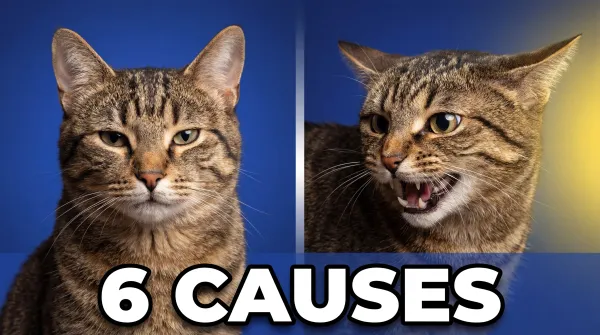
Cat hissing sounds like a sharp, turbulent burst of air — acoustically similar to the defensive hiss of a snake — because some zoologists, including Dr. John Bradshaw of the University of Bristol, propose that cat hissing evolved as Batesian mimicry of snake defensive behavior. The visual display accompanying the hiss reinforces the mimicry: flattened ears remove the mammalian ear silhouette, the gaping mouth exposes fang-like canines, and piloerection along the arched back creates an elongated, serpentine profile.
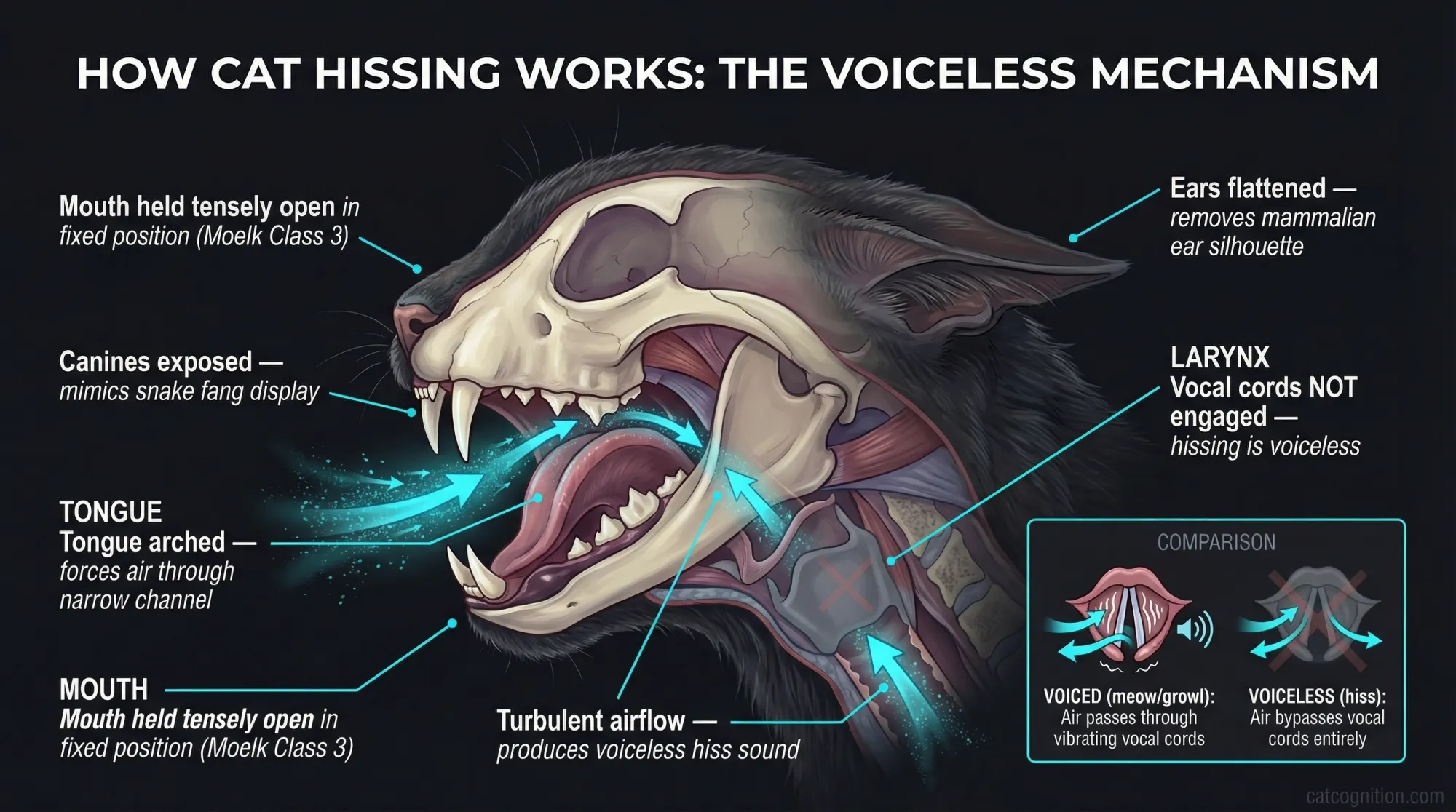
Batesian mimicry is a survival strategy where a harmless species evolves to resemble a dangerous one. Bradshaw's hypothesis holds that cats mimicking snakes would cause predators and rivals — animals that have learned to avoid venomous snakes — to instinctively retreat from a hissing cat. The energy cost is minimal (hissing is voiceless and requires no laryngeal effort), while the potential payoff — avoiding a physical fight — is enormous.
This hypothesis is compelling but unproven. No spectral analysis has directly compared the acoustic frequency profiles of cat hisses and snake hisses. An alternative hypothesis suggests that hissing may represent a conserved vertebrate defensive response rather than specific snake mimicry — multiple species including cats, birds, possums, and some lizards produce hissing sounds defensively, which could point to a shared ancestral mechanism rather than targeted mimicry.
Both explanations may contain truth. Whether cats evolved to sound specifically like snakes, or whether hissing emerged as a general vertebrate defense, the function is identical: create maximum deterrence with minimum physical risk.
Hissing is normal defensive behavior — but changes in hissing patterns can signal medical problems that require professional attention.
Any change in hissing frequency or pattern warrants a conversation with your veterinarian. Hissing is normal. Sudden changes to established patterns are not.
| Warning Sign | Possible Concern | Action |
|---|---|---|
| Sudden hissing in a previously non-hissing cat | Pain from arthritis, dental disease, injury, or UTI | Veterinary examination within one week |
| Hissing when a specific body area is touched | Localized pain or hidden injury | Prompt veterinary examination |
| Hissing plus appetite changes, litter box avoidance, or lethargy | Systemic illness presenting as behavioral change | Full veterinary workup |
| Persistent intercat hissing lasting weeks with no improvement | Chronic stress leading to stress-associated disease | Behavioral consultation per AAFP 2024 guidelines |
| Hissing combined with weight loss, overgrooming, or house soiling | Stress-induced Pandora Syndrome (Buffington) | Combined veterinary and behavioral assessment |
| Escalation from hissing to repeated physical fights | Intercat aggression beyond normal tension | Immediate separation and veterinary behaviorist referral |
Key Terms
- Voiceless Vocalization: A sound produced without vocal cord involvement; hissing is voiceless, while meowing, growling, and yowling are all voiced (laryngeal) sounds.
- Batesian Mimicry: An evolutionary strategy where a harmless species evolves to resemble a dangerous species; some researchers propose cat hissing evolved to mimic snake defensive sounds.
- Ventromedial Hypothalamus: The brain region that triggers the involuntary defensive response in cats, including hissing, piloerection, ear retraction, and pupillary dilation.
- Agonistic Behavior: Any behavior related to conflict between individuals, including both offensive and defensive actions such as hissing, growling, and physical contact.
- Piloerection: The involuntary raising of hair along the back and tail, creating the appearance of a larger body — commonly seen alongside hissing in defensive displays.
- Defensive Escalation Ladder: CatCog's framework mapping the eight-step sequence of feline defensive behavior, from freeze (step 1) to physical contact (step 8), with hissing at step 6.
- Non-Recognition Aggression: Hissing or aggression directed at a familiar housemate who has returned from a vet visit carrying unfamiliar clinical scents that disrupt the shared colony odor.
- Petting-Induced Overstimulation: Defensive behavior (including hissing) triggered when tactile stimulation exceeds a cat's individual sensory threshold during petting.
Frequently Asked Questions
Should I punish my cat for hissing?
Never. Hissing is an involuntary reflex, not a behavioral choice. Punishing a cat for hissing teaches the cat that the trigger — often the owner — is a threat, which increases fear and produces more hissing. The Merck Veterinary Manual confirms that punishment creates learned fear that escalates with repeated exposure.
Is a hissing cat dangerous?
A hissing cat is communicating fear, not planning an attack. Hissing sits at step six of the defensive escalation ladder — two full steps before physical contact. A hissing cat is asking for space. If the space is provided, the vast majority of hissing episodes end without any physical escalation.
Why does my cat hiss at the new cat but not at the dog?
Cats perceive other cats as direct territorial competitors for the same environmental resources — food stations, resting spots, litter boxes, elevated perches. A dog may not trigger the same territorial defense because dogs and cats do not compete for identical resources in the same way. Intercat territorial defense is one of the most common triggers for hissing, with 62% to 88% of multi-cat households reporting intercat tension.
Why did my cat suddenly start hissing at me for no reason?
Sudden, unexplained hissing directed at an owner most commonly indicates redirected aggression or pain. If the cat was staring out a window before the hiss, the likely trigger was an external stimulus (a bird, another cat) that redirected arousal toward the nearest target. If the hissing occurs when touched, pain is the likely cause. Both scenarios warrant investigation.
Can I train my cat not to hiss?
Hissing cannot be trained away because hissing is not a learned behavior — it is a hardwired neurological reflex. However, reducing the triggers for hissing is possible. Gradual desensitization to feared stimuli, environmental enrichment, adequate resource provision in multi-cat homes, and respecting individual petting thresholds all reduce the frequency of situations that trigger hissing.
Do some cat breeds hiss more than others?
Yes. A University of Helsinki study of over 4,300 cats found that fearfulness — the primary driver of hissing — varies significantly by breed, with Russian Blue cats scoring highest in fearfulness and Abyssinian cats scoring lowest (Mikkola et al. 2021). However, a follow-up study found that individual socialization history during the first 12 weeks of life has a stronger influence on fearfulness than breed alone (Mikkola et al. 2022).
Why does my cat hiss when I come home from the vet with the other cat?
The returning cat carries unfamiliar clinical scents — disinfectants, other animals, medication — that disrupt the shared colony odor used by cats to identify group members. The resident cat processes the returning cat as an intruder. Separate the cats for 24 to 48 hours, allow natural grooming to restore familiar scent, and reintroduce gradually.
Is hissing the same as growling?
Hissing and growling are acoustically and mechanistically distinct. Hissing is voiceless — a short burst of air produced without vocal cord involvement. Growling is a vocalized, continuous sound produced by the larynx at frequencies between 100 and 225 Hz. Hissing deters an immediate threat; growling signals sustained, ongoing danger.
Key Takeaways
Hissing is a defensive reflex, not aggression. Cat hissing is an involuntary, voiceless burst of air triggered by the ventromedial hypothalamus. The 2024 AAFP clinical guidelines classify hissing as "self-protective." A hissing cat is trying to create distance, not start a fight.
Most owners miss the warnings before the hiss. Hissing sits at step 6 of 8 on the Defensive Escalation Ladder. Freezing, subtle body language shifts, avoidance, and staring all precede hissing. Learning to read steps 1 through 4 prevents the majority of hissing episodes.
Never punish, comfort, or approach a hissing cat. All three responses decrease distance between the cat and the perceived threat — the opposite of what the cat needs. The correct response is always to increase space and remove the trigger.
Sudden hissing changes may signal pain. A cat that begins hissing when touched in a specific area, or starts hissing after previously being non-reactive, may be experiencing arthritis, dental disease, or other hidden pain. Any change in hissing pattern warrants veterinary examination.
Early socialization determines lifetime hissing frequency. Kittens socialized to diverse humans, sounds, and environments during the 2-to-9-week sensitive period develop lower baseline fearfulness. Cats that missed this window hiss more often because the neural wiring for threat tolerance was never established.
Sources
- Tavernier, C., Ahmed, S., Houpt, K.A., & Yeon, S.C. (2020). Feline vocal communication. Journal of Veterinary Science. https://pmc.ncbi.nlm.nih.gov/articles/PMC7000907/
- Yeon, S.C., et al. (2011). Differences between vocalization evoked by social stimuli in feral cats and house cats. Behavioural Processes. https://pubmed.ncbi.nlm.nih.gov/21443933/
- Rodan, I., Ramos, D., Carney, H., DePorter, T., Horwitz, D., Mills, D., & Vitale, K. (2024). 2024 AAFP intercat tension guidelines. Journal of Feline Medicine and Surgery. https://pmc.ncbi.nlm.nih.gov/articles/PMC11292941/
- Cornell Feline Health Center. Feline Behavior Problems: Aggression. Cornell University. https://www.vet.cornell.edu/departments-centers-and-institutes/cornell-feline-health-center/health-information/feline-health-topics/feline-behavior-problems-aggression
- Buffington, C.A.T. Indoor Pet Initiative: Conflict Between Cats. Ohio State University. https://indoorpet.osu.edu/cats/problemsolving/conflict
- International Cat Care. Cat Communication. https://icatcare.org/articles/cat-communication
- Moelk, M. (1944). Vocalizing in the House-Cat; A Phonetic and Functional Study. American Journal of Psychology. https://www.jstor.org/stable/1416947
- Schotz, S. (2015). Agonistic Vocalisations in Domestic Cats: A Case Study. Lund University. https://www.academia.edu/15543795/
- Gerken, A., Lee, K., Bain, M., & Kim, S. (2024). Correlation between aggression at the veterinary clinic and problem behaviors at home. Journal of Feline Medicine and Surgery. https://journals.sagepub.com/doi/10.1177/1098612X231214907
- Mikkola, S., Salonen, M., & Lohi, H. (2022). Fearfulness associates with problematic behaviors and poor socialization in cats. iScience. https://pmc.ncbi.nlm.nih.gov/articles/PMC9579021/
- Mikkola, S., Salonen, M., Puurunen, J., Hakanen, E., & Lohi, H. (2021). Reliability and Validity of Seven Feline Behavior and Personality Traits. Animals (MDPI). https://pmc.ncbi.nlm.nih.gov/articles/PMC8300181/
- ASPCA. Aggression in Cats. https://www.aspca.org/pet-care/cat-care/common-cat-behavior-issues/aggression-cats
- Barrios, F., et al. (2025). Tools for the Approach of Fear, Anxiety, and Stress in the Domestic Feline: An Update. Veterinary Medicine International. https://onlinelibrary.wiley.com/doi/full/10.1155/vmi/9109397
- Jakobi, P., et al. (2021). A Review on Mitigating Fear and Aggression in Dogs and Cats in a Veterinary Setting. Animals (MDPI). https://pmc.ncbi.nlm.nih.gov/articles/PMC7826566/
- Frontiers in Veterinary Science. (2023). Exploring factors associated with cat owners' perceptions of the cat-cat relationship in two-cat households. https://www.frontiersin.org/journals/veterinary-science/articles/10.3389/fvets.2023.1128757/full
- Cats Protection (UK). Why Is My Cat Hissing? https://www.cats.org.uk/cats-blog/why-is-my-cat-hissing
- Sweidan, S., Edinger, H., & Siegel, A. (1990). The role of D1 and D2 receptors in dopamine agonist-induced modulation of affective defense behavior in the cat. Pharmacology Biochemistry and Behavior. https://pubmed.ncbi.nlm.nih.gov/1974065/
- Hassanain, M., Bhatt, S., & Siegel, A. (2003). Differential modulation of feline defensive rage behavior by 5-HT1A and 5-HT2 receptors. Brain Research. https://pubmed.ncbi.nlm.nih.gov/12885442/
- Factors influencing stress and fear-related behaviour of cats during veterinary examinations. (2021). Italian Journal of Animal Science. https://www.tandfonline.com/doi/full/10.1080/1828051X.2020.1870175
- VCA Animal Hospitals. Cat Behavior Problems — Aggression Redirected. https://vcahospitals.com/know-your-pet/cat-behavior-problems-aggression-redirected
- Merck Veterinary Manual. Behavior Problems of Cats. https://www.merckvetmanual.com/behavior/behavior-of-cats/behavior-problems-of-cats
- UC Davis School of Veterinary Medicine. Managing Your Kitten's Rough Play. https://healthtopics.vetmed.ucdavis.edu/health-topics/feline/managing-your-kittens-rough-play
- Schotz, S. Meowsic Project: Cat Vocalisation Types. Lund University. https://meowsic.se/catvoc.html
- Bradshaw, J.W.S. (2013). Cat Sense: How the New Feline Science Can Make You a Better Friend to Your Pet. ISBN: 978-0141024042
- ScienceDirect. Feline Aggression — Topics. https://www.sciencedirect.com/topics/veterinary-science-and-veterinary-medicine/feline-aggression
- Crowell-Davis, S.L., Curtis, T.M., & Knowles, R.J. (2004). Social organization in the cat: A modern understanding. Journal of Feline Medicine and Surgery. https://journals.sagepub.com/doi/full/10.1016/j.jfms.2003.09.013
- Karsh, E.B., & Turner, D.C. (1988). The human-cat relationship. In D.C. Turner & P. Bateson (Eds.), The Domestic Cat: The Biology of its Behaviour. Cambridge University Press.