Why Do Cats Knead? The Science Behind Making Biscuits
Cats knead because domestication preserved a neonatal nursing reflex into adulthood through neoteny. Kneading activates an oxytocin-endorphin reward loop originally tied to the mother-kitten bond. Learn the neuroscience, the 5 functions of adult kneading, and when it crosses into pica.

Why Do Cats Knead? The Science Behind Making Biscuits
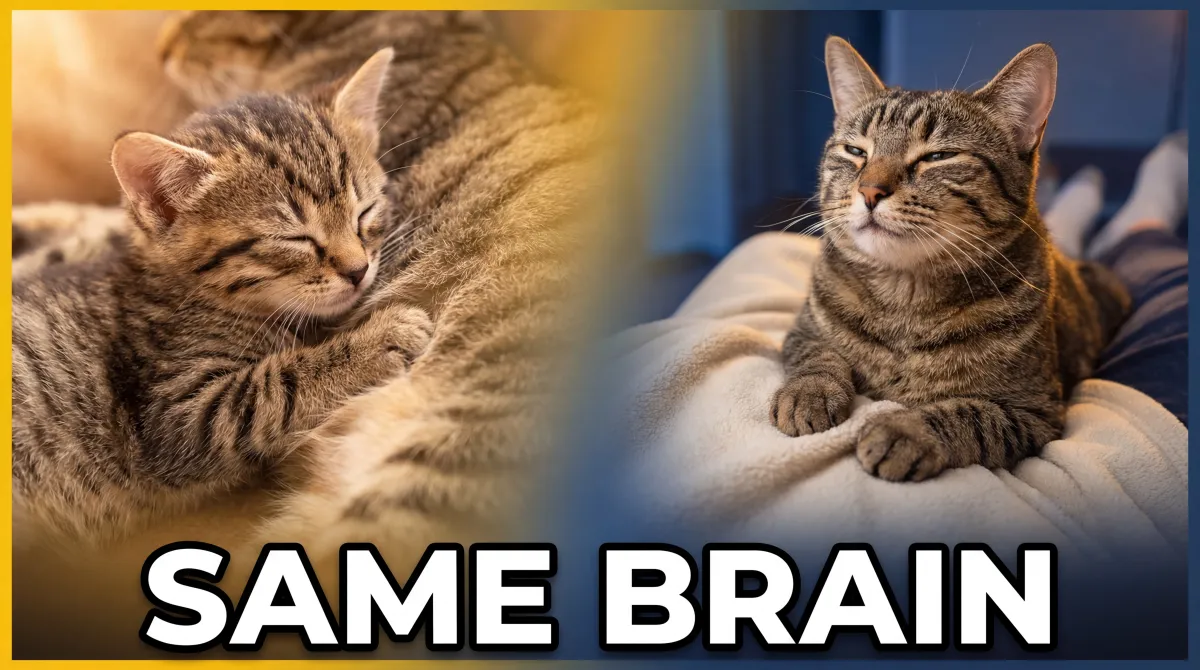
Cats knead because domestication preserved a neonatal nursing behavior into adulthood through neoteny, the retention of juvenile traits in adult animals. Kneading activates a neurochemical reward loop involving oxytocin and endorphins that originally reinforced the mother-kitten nursing bond. Adult cats re-create this comfort state on soft surfaces and human companions, making kneading one of the strongest behavioral signatures of cat domestication.
Table of Contents
- Where does cat kneading come from?
- Why do adult cats still knead?
- Why do cats knead as adults? 5 evidence-based reasons
- The kneading-purring connection: evidence from pibi research
- Catcog kneading context decoder: what different kneading styles mean
- When kneading becomes a problem: wool sucking and pica
- How to handle cat kneading: practical tips
- Key terms
- Frequently asked questions
- Key takeaways
- Sources

Where Does Cat Kneading Come From?
Cat kneading is a rhythmic push-pull motion performed with alternating front paws, claws flexing, eyes half-closed. The internet calls the behavior "making biscuits" because the slow, rhythmic paw action looks exactly like working bread dough. But the real explanation behind cat kneading is more interesting than the metaphor.
As Dr. John Bradshaw of the University of Bristol's Anthrozoology Institute documented in Cat Sense, adult cat social behavior is "derived from kitten behavior," a consequence of domestication selecting for the retention of juvenile traits. Bradshaw describes domestic cats as retaining essentially the same behavioral repertoire as their wild ancestors, with one critical exception: adult cats continue performing kitten behaviors in social contexts with humans. Kneading is one of those behaviors -- and it connects to the broader science of why cats do what they do.
According to Dr. Kristyn Vitale, a certified applied animal behaviorist at Unity Environmental University, "it's possible that some of" the juvenile behaviors that "used to be directed at the mother are now directed at the owner." Vitale's landmark 2019 study in Current Biology demonstrated that 65% of cats form secure attachment bonds with their human caregivers, providing the relational framework in which kneading functions. When a cat kneads on a human lap, that cat is deploying a kitten-to-mother bonding signal within a new attachment relationship. If you have ever wondered whether your cat truly loves you, kneading is one of the strongest indicators.
This article introduces the CatCog Kneading Context Decoder, a diagnostic framework that maps kneading context, intensity, and accompanying behaviors to meaning and appropriate response. Because kneading on your lap before sleep and kneading obsessively on wool require entirely different interpretations.
Cat kneading originates in the first hours of life, when newborn kittens push rhythmically against the mother's mammary glands to stimulate milk flow. This neonatal motor pattern, which zoologist Desmond Morris termed "milk treading" in Catwatching (1986), serves a dual biological purpose: the physical pressure triggers oxytocin release in the mother cat, facilitating milk letdown, while simultaneously reinforcing the kitten's neurochemical association between rhythmic pushing, warmth, milk, and security.
The behavior is universal across all newborn kittens. Kittens in feral populations nurse for approximately six months (WSAVA 2001), and during that entire period the kneading-nursing association strengthens through daily repetition. By the time a kitten weans, the motor pattern and its neurochemical reward loop are deeply embedded.
In wild felid species, kneading typically extinguishes after weaning. Adult wild cats rarely knead in natural settings, though the behavior has been observed in captive big cats (lions, tigers, pumas) that have developed relationships with human caregivers. This pattern suggests that kneading persistence in adulthood is linked to human socialization rather than genetics alone. Domestic cats, which maintain lifelong social bonds with humans, retain the behavior indefinitely.
📊 The Evidence: "The more responsive the cats were to clipthesia, the more they displayed kneading and purring." Kneading and purring intensity positively correlate with depth of behavioral inhibition when scruff pressure recreates the infantile transport state. (University of Pisa, 2016, Animal Welfare)
Why Do Adult Cats Still Knead?
Adult cats knead because domestication selected for paedomorphic traits, the retention of juvenile characteristics in mature animals. Neoteny explains why adult domestic cats meow to humans, purr in social contexts, and continue kneading long after weaning. As Dr. John Bradshaw documents, neoteny is the mechanism through which cats became domesticated at all.
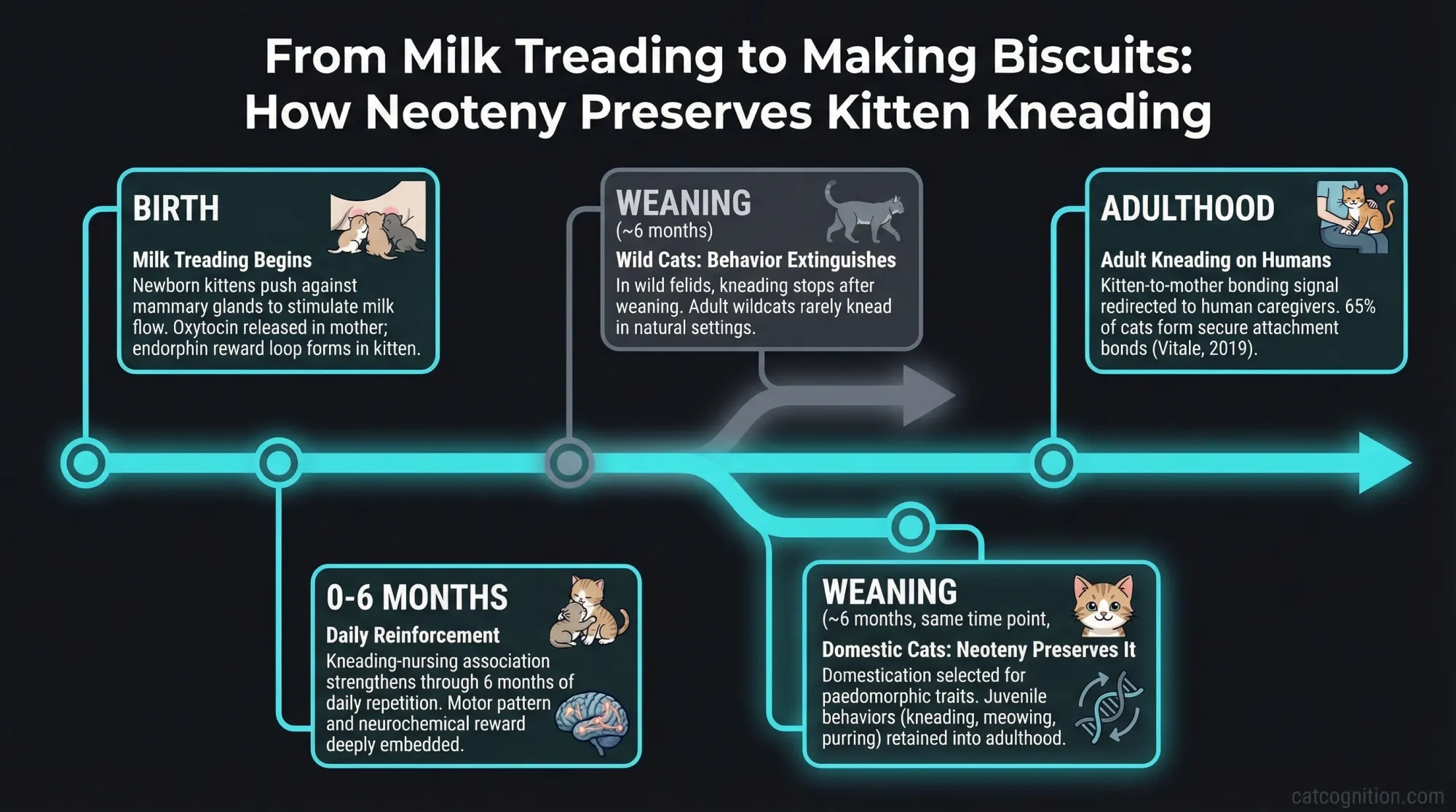
Cat domestication was self-directed. African wildcats (Felis silvestris lybica) wandered into human grain stores approximately 10,000 years ago. Unlike dogs, which humans selectively bred for specific behaviors over thousands of generations, cats were never systematically bred for temperament. The few behavioral shifts that emerged through domestication center on social tolerance and the retention of juvenile social behaviors. Kneading sits at the core of this cluster.
The science behind neoteny in cats is supported by comparative behavioral data. BBC Science Focus reported that domestic cats' behavior is "drastically altered" by living in human care compared to wild felids. The critical difference is not what domestic cats gained, but what they kept: the entire repertoire of kitten social behaviors, deployed in new relational contexts throughout adulthood. This same neotenic retention explains other comfort behaviors, such as why cats loaf -- tucking their paws beneath them in a position that signals security and trust.
Why Do Cats Knead as Adults? 5 Evidence-Based Reasons
Cat kneading in adult cats serves at least five distinct functions, each rooted in different aspects of feline biology, from oxytocin-driven bonding and endorphin-mediated self-soothing to scent marking through interdigital gland pheromone deposits. Not every kneading session activates all five. Context, intensity, and accompanying body language determine which function dominates.
1. Comfort and Bonding (The Primary Function)
The primary reason adult cats knead is to re-create the neurochemical comfort state associated with nursing. Kneading activates a dual neurochemical mechanism: oxytocin for bonding and endorphins for self-soothing. This dual mechanism explains an observation that puzzles many cat owners: cats knead both when content and when stressed or in pain.
The oxytocin component is supported by multiple lines of evidence. A 2024 study published in Scientific Reports by Hattori et al. demonstrated that exogenous oxytocin increases gaze duration toward humans in male cats, confirming oxytocin's role in cat-human social bonding. The endorphin component is supported by the University of Pisa clipthesia study (Nuti et al., 2016), which noted that "purring in cats just before death and following a chronic disease may reflect a state of euphoria, perhaps resulting from an endorphin release." The American Animal Hospital Association (2024) confirms: "Cats who feel stressed or are experiencing pain may knead to soothe themselves."
This dual reward system means kneading is not simply a "happy" behavior. Kneading signals that a cat is accessing its deepest comfort circuit, whether the trigger is contentment, anxiety, or physical discomfort.
2. Scent Marking Through Interdigital Glands
Cats have scent glands between the toes of their paw pads, called interdigital glands, that deposit pheromones during kneading. According to Dr. Julia Albright, a board-certified veterinary behaviorist (DACVB) at the University of Tennessee, some behaviorists suggest that kneading deposits "a familiar, comforting scent on their sleeping area," effectively claiming the surface as the cat's own.
This scent-marking function is distinct from scratching. Scratching deposits interdigital pheromones and leaves a visual mark; kneading deposits pheromones without visible damage. When a cat kneads on a specific blanket, lap, or bed spot repeatedly, that cat is layering pheromone deposits to build an olfactory signature of ownership. This pheromone-driven communication is part of the broader system of cat body language signals that cats use to navigate their social world.
3. Nest Preparation (Ancestral Bed-Making)
Wild cats knead grass and vegetation to create comfortable resting spots, pressing down tall growth into a soft sleeping surface. AAHA (2024) identifies this ancestral nest-preparation behavior as a secondary function that persists in domestic cats. The circling-then-kneading-then-settling sequence that many cats perform before sleep mirrors the wild ancestor's bed-making routine. This nest-building instinct also explains why cats seek out their humans at bedtime -- they want to knead and settle in the safest spot they know.
4. Self-Soothing Under Stress
The endorphin component of the kneading reward loop means cats may increase kneading frequency when anxious, in pain, or adjusting to environmental change. WebMD (2021) notes that "compulsive kneading may release pain-relieving chemicals in the cat's brain, driving the cat to repeat the action for coping."
This self-soothing function explains why a cat that normally kneads gently before sleep might begin kneading intensely after a move, a new pet introduction, or during illness. The behavior itself has not changed. The motivation driving it has shifted from comfort-seeking to stress regulation.
5. Estrus Signaling (Intact Females Only)
Intact female cats may knead more intensely during estrus (heat), depositing interdigital pheromones to signal reproductive availability. This function applies only to unspayed female cats and resolves after spaying eliminates the hormonal driver.
📊 The Evidence: "It's possible that some of these juvenile behaviors... used to be directed at the mother are now directed at the owner." Adult cat kneading is a redirected kitten-to-mother bonding signal deployed within the cat-human attachment relationship. (Dr. Kristyn Vitale, Unity Environmental University, in Scientific American, 2023)
The Kneading-Purring Connection: Evidence from PIBI Research
Kneading and purring are not merely associated behaviors -- kneading and purring are neurologically co-regulated. Research co-authored by Dr. Tony Buffington at Ohio State University's College of Veterinary Medicine demonstrated scruff pressure triggers adult cats to spontaneously knead and purr together, recreating the infantile transport response and confirming a common neurological substrate for both comfort behaviors.
The evidence comes from pinch-induced behavioral inhibition (PIBI) studies. Pozza et al. (2008), published in the Journal of Feline Medicine and Surgery, found that when scruff clips were applied to adult cats, recreating the pressure a mother cat applies when transporting kittens, cats spontaneously began kneading and purring simultaneously. The cats became passive, their tails curled up, and they entered a calm state resembling the infantile transport response. A replication study at the University of Pisa (Nuti et al., 2016) confirmed the correlation: kneading and purring intensity increased in proportion to the depth of the behavioral inhibition response, with susceptibility rates of 66.9% (Andrews et al., 2021, n=142) to 81.5% (Nuti et al., 2016, n=27) across PIBI studies.
An important caveat: the interpretation of PIBI is contested. A 2020 study by Moody et al. published in Veterinary Record found that clip restraint produced more negative responses than passive handling, including greater pupil dilation and negative vocalizations. The authors recommend against clip restraint as a routine handling method. The observational finding (kneading and purring co-occur when scruff pressure is applied) remains consistent across studies. But whether this co-occurrence reflects a positive emotional state or a more complex stress-displacement response is an active area of scientific debate.
What the PIBI research establishes definitively: kneading and purring are neurologically co-regulated. Both behaviors emerge from the same infantile neural circuit. When one activates, the other frequently follows.
CatCog Kneading Context Decoder: What Different Kneading Styles Mean
Not all kneading communicates the same thing. The context, intensity, duration, and accompanying behaviors such as purring, drooling, or restlessness reveal the cat's motivational state, distinguishing contentment from stress-driven self-soothing. Use the CatCog Kneading Context Decoder below to interpret what a specific kneading session means and determine the appropriate response.
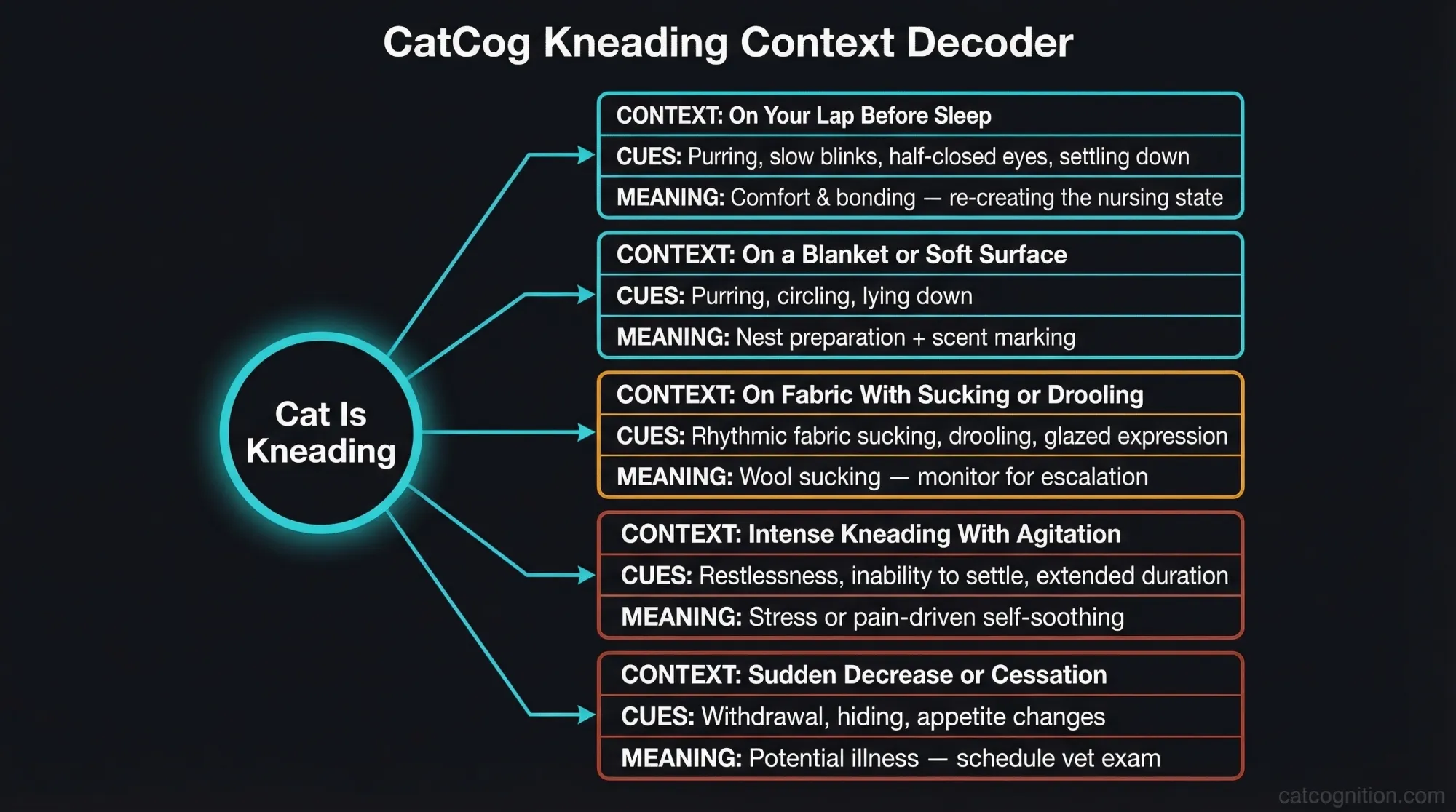
| Kneading Context | Accompanying Behaviors | Likely Meaning | Recommended Response |
|---|---|---|---|
| On your lap or chest before sleep | Purring, slow blinks, half-closed eyes, settling down | Comfort and bonding: re-creating the nursing state of security | Place a thick blanket on your lap if claws are uncomfortable. Do not push the cat away. |
| On a blanket or soft surface | Purring, circling, eventual lying down | Nest preparation plus scent marking: claiming a sleeping spot | Normal behavior. Provide soft, dedicated blankets for kneading. |
| On a blanket with sucking or drooling | Rhythmic fabric sucking, drooling, glazed expression | Wool sucking: displaced nursing. Normal if mild; monitor for escalation. | If fabric is ingested (not just sucked), consult a veterinarian immediately. |
| Intense kneading with agitation | Restlessness, inability to settle, extended kneading without relaxing | Stress or pain-driven self-soothing | Rule out medical causes. Evaluate environmental stressors. |
| Sudden decrease or cessation | Withdrawal, hiding, reduced social interaction, appetite changes | Potential illness: the cat may be too unwell to engage in comfort behaviors | Schedule a veterinary exam promptly. |
📊 The Evidence: "Cats are a little more subtle than dogs in their ways of telling a person, 'I like you.' Kneading is one of those clues." Cats deposit pheromones from interdigital glands between the toes during kneading, marking their preferred people and surfaces with a comforting scent signature. (Dr. Julia Albright, DACVB, University of Tennessee)
An important note about individual variation: not all cats knead. As Dr. Kristyn Vitale emphasized in Scientific American (2023), "There's so much individual variability" in feline behavior. A cat that does not knead is not necessarily less bonded to its owner. Cats express attachment through multiple behavioral channels, and kneading is just one of them.
When Kneading Becomes a Problem: Wool Sucking and Pica
Normal kneading exists on a behavioral continuum from gentle, rhythmic paw-pushing to compulsive oral fixation on fabric, escalating from sucking to chewing to ingestion. The clinical term for the ingestion end of the continuum is pica; the intermediate stage is wool sucking. If your cat's oral behaviors extend to chewing on human hair or other non-food items, the underlying mechanisms are closely related.
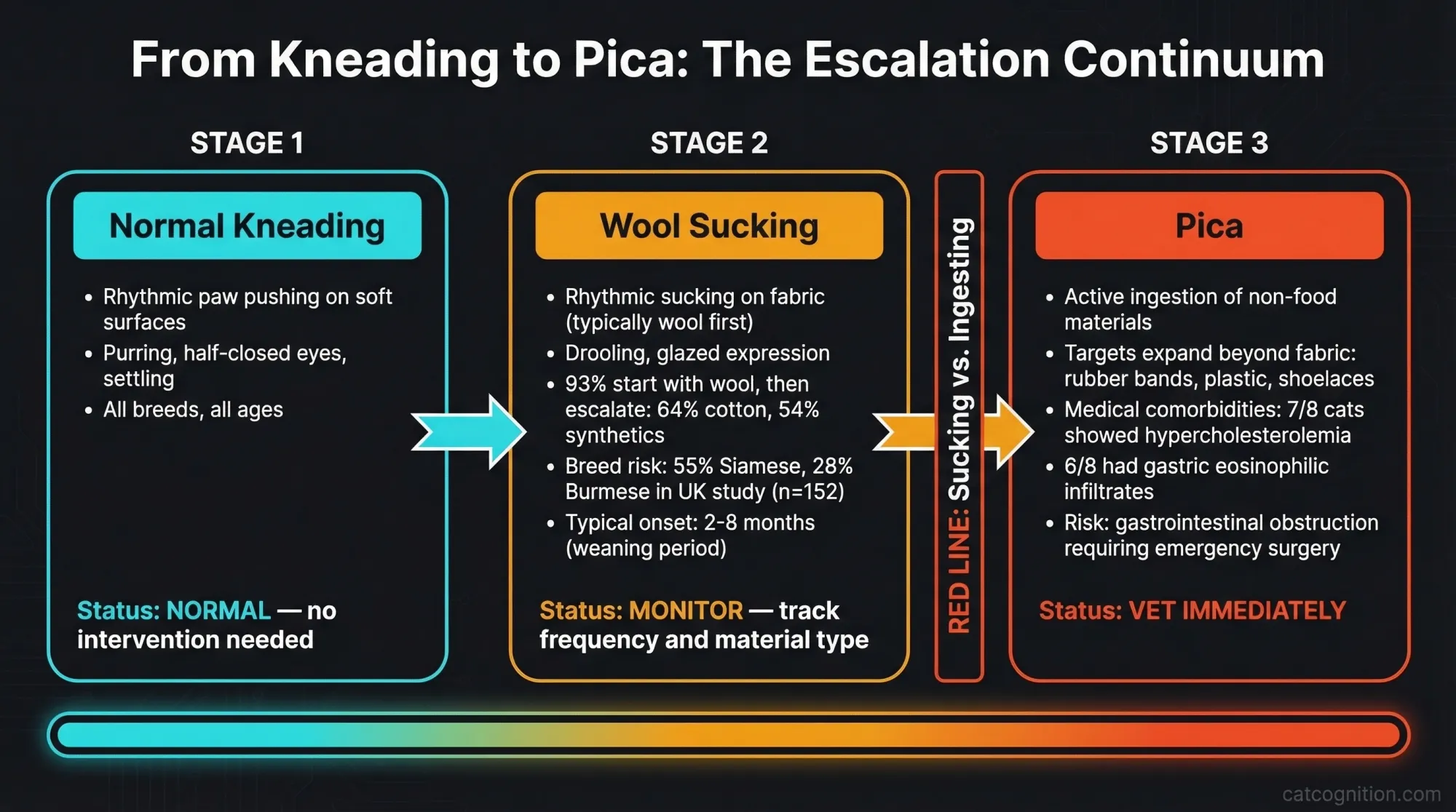
The Kneading-to-Pica Escalation Framework
WSAVA conference proceedings (2001) documented the escalation pattern in a UK study of 152 fabric-eating cats. Of those cats, 93% started with wool and then progressed to other fabrics: 64% moved to cotton, 54% to synthetic materials. The typical onset age was 2 to 8 months, coinciding with the weaning period.
The breed predisposition is striking. In that same 152-cat cohort, 55% were Siamese and 28% were Burmese, with only 11% being crossbreeds. Oriental breeds are massively overrepresented in wool-sucking populations. A case-control study of 204 Siamese and Birman cats (Borns-Weil et al., 2015, Journal of Veterinary Behavior) found that every affected cat showed an abnormally intense appetite, regardless of breed. Separate genetic research by Dr. Nicholas Dodman at Tufts University suggests a possible genetic predisposition for compulsive wool sucking in these breeds.
Early weaning increases the risk. The Borns-Weil study found that early weaning and small litter size were associated with increased wool-sucking risk specifically in Birman cats. Wool sucking may represent a behavior "left over" from the prolonged six-month suckling period common in feral cat populations, according to the WSAVA proceedings.
Medical Complications of Pica
A veterinary pilot study at the Universite de Montreal (Demontigny-Bedard et al., 2019, Canadian Veterinary Journal) evaluated eight cats with chronic fabric ingestion and found significant medical comorbidities: seven of eight cats had mild hypercholesterolemia, and six of eight had gastric or intestinal eosinophilic infiltrates. Four cats partially responded to treatment targeting the underlying medical conditions. Fabric ingestion is not merely a behavioral curiosity. Swallowed fabric can cause life-threatening gastrointestinal obstruction requiring emergency surgery.
Red Flags: When to See a Veterinarian
| Red Flag | Why It Matters |
|---|---|
| Cat ingests fabric (not just sucks on it) | Risk of gastrointestinal obstruction requiring emergency surgery |
| Cat targets non-fabric items (rubber bands, plastic bags, shoelaces) | Indicates generalized pica, not breed-specific wool sucking |
| Abnormally intense appetite alongside compulsive oral behavior | Associated with genetic predisposition in Borns-Weil et al. study |
| Oriental breed cat (Siamese, Birman, Burmese) showing any fabric-sucking behavior | 55% Siamese / 28% Burmese in 152-cat UK study; genetic predisposition confirmed |
| Sudden, dramatic changes in kneading frequency (sharp increase or cessation) | May indicate pain, illness, or significant environmental stress |
If your cat's kneading has escalated to chewing, sucking, or ingesting fabric, contact your vet promptly. Pica carries a real risk of gastrointestinal obstruction, which can require emergency surgery. Do not wait for symptoms to appear.
📊 The Evidence: "In a UK study of 152 fabric-eating cats, 55% were Siamese and 28% were Burmese. Ninety-three percent started with wool and escalated to other fabrics." Oriental cat breeds carry a genetic predisposition for wool sucking, the pathological cousin of normal kneading behavior. (WSAVA Conference Proceedings, 2001)
How to Handle Cat Kneading: Practical Tips
Cat kneading is a hardwired neurological behavior with deep emotional significance. The goal is never to eliminate kneading but to manage the physical experience for both cat and human. Understanding the science of tactile interaction with cats provides useful context for why touch-based behaviors like kneading carry such emotional weight.
Universal Rule: Never Punish Kneading
Punishing a cat for kneading damages the cat-human bond and removes a comfort mechanism the cat depends on for emotional regulation. Kneading is not a voluntary decision the cat makes. Kneading is an involuntary activation of a neonatal motor circuit tied to the cat's deepest sense of safety.
Managing Claw Discomfort
- Place a thick, folded blanket or towel on your lap before the cat settles. This creates a "kneading pad" that absorbs claw pressure.
- Trim nails every two to three weeks to reduce sharpness.
- If claws cause significant skin irritation, gently redirect the cat to a nearby soft surface rather than pushing the cat away abruptly.
- Nail caps (soft plastic covers for individual claws) are an option for cats whose kneading causes persistent skin damage.
Supporting Healthy Kneading
- Provide dedicated soft surfaces. Fleece blankets, sherpa beds, and soft throws placed in the cat's preferred resting spots give cats appropriate kneading outlets.
- Maintain the routine. Cats that knead before sleep are performing a transition ritual. Disrupting the routine (moving the cat, removing the blanket, making sudden noise) increases stress and delays settling.
- Monitor the kneading-to-sucking boundary. Occasional fabric sucking without ingestion falls within normal range. Fabric ingestion is a medical emergency risk.
- Know your breed's risk profile. If you own an oriental breed cat (Siamese, Birman, Burmese, Tonkinese), monitor for any fabric-sucking behavior and restrict access to loose wool or fabric during unsupervised time.
Key Terms
- Neoteny: The retention of juvenile physical or behavioral traits in adult animals, driven by domestication. In cats, neoteny explains why adults continue performing kitten behaviors such as kneading, meowing, and purring in social contexts.
- Milk treading: The term coined by zoologist Desmond Morris (1986) for the rhythmic alternating push-pull motion kittens perform on the mother's mammary glands to stimulate milk flow. Adult kneading is a continuation of milk treading.
- Paedomorphism: The broader biological term for the appearance of juvenile characteristics in adult organisms. Neoteny is one mechanism through which paedomorphism occurs.
- Interdigital glands: Scent glands located between the toes of a cat's paw pads that deposit pheromones during kneading and scratching. These pheromones mark surfaces with a familiar scent.
- PIBI (Pinch-Induced Behavioral Inhibition): A physiological response in which scruff pressure triggers a calm, passive state in cats, recreating the infantile transport response. During PIBI, cats spontaneously knead and purr.
- Wool sucking: A compulsive oral behavior in which a cat rhythmically sucks on fabric (typically wool), representing a displaced nursing behavior on the escalation continuum between normal kneading and pathological pica.
- Pica: The ingestion of non-food materials. In cats, pica often begins as wool sucking and escalates to consumption of fabrics, rubber bands, plastic, or other inedible items. Pica carries a risk of gastrointestinal obstruction.
- Oxytocin: A neuropeptide hormone involved in social bonding, maternal behavior, and milk letdown. Released during kitten nursing when kneading stimulates mammary tissue, and implicated in the bonding component of adult cat kneading.
- Clipthesia: An alternative term for PIBI used in some European veterinary research. Refers to the behavioral inhibition response induced by scruff clips.
Frequently Asked Questions
Why does my cat knead on me but not on other people?
Cat kneading is an attachment behavior. Cats preferentially knead on individuals they have formed secure bonds with. Dr. Kristyn Vitale's 2019 research demonstrated that 65% of cats show secure attachment to their primary caregiver. A cat that kneads exclusively on one person is expressing a directed attachment bond, similar to how kittens preferentially nursed from and kneaded on their own mother.
Does kneading mean my cat is happy?
Not always. Kneading activates a dual neurochemical circuit involving oxytocin (bonding) and endorphins (self-soothing). Cats knead when content and relaxed, but also when stressed, anxious, or in pain. The American Animal Hospital Association (2024) confirms that "cats who feel stressed or are experiencing pain may knead to soothe themselves." Context and accompanying body language determine whether kneading reflects contentment or distress.
Is kneading a sign my cat was weaned too early?
No. ScienceAlert (2018) explicitly addresses this misconception: most cats exhibit kneading behavior regardless of weaning age. Kneading is a species-typical retained behavior driven by neoteny, not a consequence of premature weaning. However, early weaning has been linked to increased risk of wool sucking specifically in Birman cats (Borns-Weil et al., 2015).
Why does my cat drool while kneading?
Drooling during kneading occurs because the cat's brain is reactivating the full nursing circuit. The rhythmic paw motion, the purring, and the salivation are all components of the original neonatal feeding response. Some cats re-create this response so completely that salivation (which originally facilitated swallowing milk) activates alongside the motor and vocal components.
Should I stop my cat from kneading on blankets?
No. Kneading on soft surfaces is normal, healthy behavior that serves comfort, scent-marking, and nest-preparation functions. The only situation requiring intervention is when kneading progresses to wool sucking with fabric ingestion (pica), which poses a risk of gastrointestinal obstruction. Monitor for fabric ingestion, not for kneading itself.
My cat kneads with claws extended. Is that normal?
Yes. Claw extension during kneading is part of the original nursing motor pattern. Kittens extend and retract their claws rhythmically while kneading to grip mammary tissue. Adult cats retain this full motor sequence. Managing claw discomfort through nail trimming, lap blankets, or nail caps is preferable to attempting to suppress the behavior.
Do all cats knead?
No. Individual variation is significant. Dr. Kristyn Vitale notes "so much individual variability" in feline behavior expression. Cats that do not knead are not less bonded, less happy, or less healthy. Cats express attachment and comfort through multiple behavioral channels including head bunting, slow blinking, and allorubbing.
When should I worry about my cat's kneading?
Consult a veterinarian if kneading frequency changes dramatically (sudden increase or cessation), if kneading is accompanied by fabric ingestion, if the cat belongs to an oriental breed and shows wool-sucking behavior, or if kneading appears pain-driven (the cat flinches, vocalizes, or guards a body area during or after kneading sessions). The AAHA (2024) identifies significant changes in kneading behavior as a potential indicator of illness.
Key Takeaways
Cat kneading is a domestication-preserved neonatal behavior driven by neoteny, activating an oxytocin-endorphin reward loop that serves bonding, scent marking, nest preparation, and self-soothing functions. The behavior exists on a continuum from normal comfort kneading to pathological wool sucking and pica, with oriental breeds at elevated genetic risk.
Cat kneading is a neonatal nursing behavior preserved into adulthood through neoteny, the retention of juvenile traits driven by domestication. Kneading is not a learned habit; it is a hardwired motor program that activates involuntarily.
Kneading triggers a dual neurochemical reward loop: oxytocin reinforces social bonding (originally between mother and kitten, now between cat and owner), while endorphins provide self-soothing. This dual mechanism explains why cats knead when content and when stressed.
Kneading and purring are neurologically co-regulated behaviors originating from the same infantile circuit. PIBI research (Pozza et al., 2008; Nuti et al., 2016) demonstrates that both behaviors activate simultaneously when the infantile neural state is triggered, with kneading intensity correlating with purring intensity.
The behavioral continuum from normal kneading through wool sucking to pica has specific breed epidemiology. Oriental breeds (55% Siamese, 28% Burmese in a 152-cat UK study) are genetically predisposed to wool sucking. Early weaning increases risk. Fabric ingestion requires immediate veterinary intervention.
Never punish kneading. Manage claw discomfort through blankets, nail trimming, and gentle redirection. Monitor for the boundary between normal kneading and pathological oral fixation, especially in oriental breed cats.
Sources
- Pinch-induced behavioral inhibition ('clipnosis') in domestic cats — Pozza, Stella, Chappuis-Gagnon, Wagner, Buffington, 2008, Journal of Feline Medicine and Surgery (SAGE Journals)
- Pinch-induced behavioural inhibition (clipthesia) as a restraint method for cats — Nuti, Bartolommei, Lunghini, Lucarini, Lucarini, Gazzano, 2016, Animal Welfare (Cambridge University Press)
- The efficacy of pinch-induced behavioral inhibition (clip restraint) in domestic cats declines with age — Andrews, Cosner, Thomas, 2021, Journal of Veterinary Behavior (ScienceDirect)
- Exogenous oxytocin increases gaze to humans in male cats — Hattori, Kinoshita, Saito, Yamamoto, 2024, Scientific Reports (Nature)
- Exploring women's oxytocin responses to interactions with their pet cats — Johnson, Portillo, Bennett, Gray, 2021, PeerJ (PeerJ)
- Medical and behavioral evaluation of 8 cats presenting with fabric ingestion — Demontigny-Bedard, Belanger, Helie, Frank, 2019, Canadian Veterinary Journal (PubMed)
- A case-control study of compulsive wool-sucking in Siamese and Birman cats (n=204) — Borns-Weil, Emmanuel, Longo, Kini, Barton, Smith, Dodman, 2015, Journal of Veterinary Behavior (ScienceDirect)
- Characterization of pica and chewing behaviors in privately owned cats — Demontigny-Bedard, Beauchamp, Belanger, Frank, 2016, Journal of Feline Medicine and Surgery (SAGE Journals)
- Attachment bonds between domestic cats and humans — Vitale, Behnke, Udell, 2019, Current Biology (Cell Press)
- Why Do Cats Knead like They're Making Biscuits? — Scientific American, 2023 (Scientific American)
- Why do cats knead with their paws? — Julia Albright, DVM, DACVB, 2021, The Conversation (The Conversation)
- The (very cute) science of why cats knead — Thomas Ling, 2023, BBC Science Focus (BBC Science Focus)
- Here's Why Cats Knead You With Their Paws, According to Science — ScienceAlert, 2018 (ScienceAlert)
- Is my cat's kneading normal? — American Animal Hospital Association, 2024 (AAHA)
- Feline Obsessive-Compulsive Disorders — WSAVA Conference Proceedings, 2001 (VIN)
- Obsessive-Compulsive Behavior in Cats: Wool Sucking in Siamese and Birmans — Dodman, Ginns, 2013, EveryCat Health Foundation (EveryCat)
- Getting a grip: cats respond negatively to scruffing and clips — Moody, Mason, Dewey, Niel, 2020, Veterinary Record (Wiley)
- Cat Sense: How the New Feline Science Can Make You a Better Friend to Your Pet — John Bradshaw, 2013, Basic Books
- Catwatching: The Essential Guide to Cat Behaviour — Desmond Morris, 1986, Jonathan Cape
- The Domestic Cat: The Biology of its Behaviour — Dennis C. Turner, Patrick Bateson (eds.), 2014, Cambridge University Press (3rd edition)