Why Do Cats Land on Their Feet? The Physics, the Myth, and the Data
Cats rotate mid-air using a vestibular-driven righting reflex that puzzled physicists for 75 years. The 2025 Andrade mega-study of 1,125 cats reveals the real survival data -- and why 'higher is safer' is a myth.

Table of Contents
- How Does the Cat Righting Reflex Work?
- How Do Cats Rotate Without Pushing Off Anything?
- What Role Does the Vestibular System Play?
- How Did a Falling Cat Puzzle Physicists for 75 Years?
- What Is High-Rise Syndrome and How Dangerous Are Cat Falls?
- When Do Cats NOT Land on Their Feet?
- When Do Kittens Develop the Righting Reflex?
- How Can You Protect Your Cat from High-Rise Falls?
- Key Terms
- Frequently Asked Questions
- Key Takeaways
- Sources

How Does the Cat Righting Reflex Work?
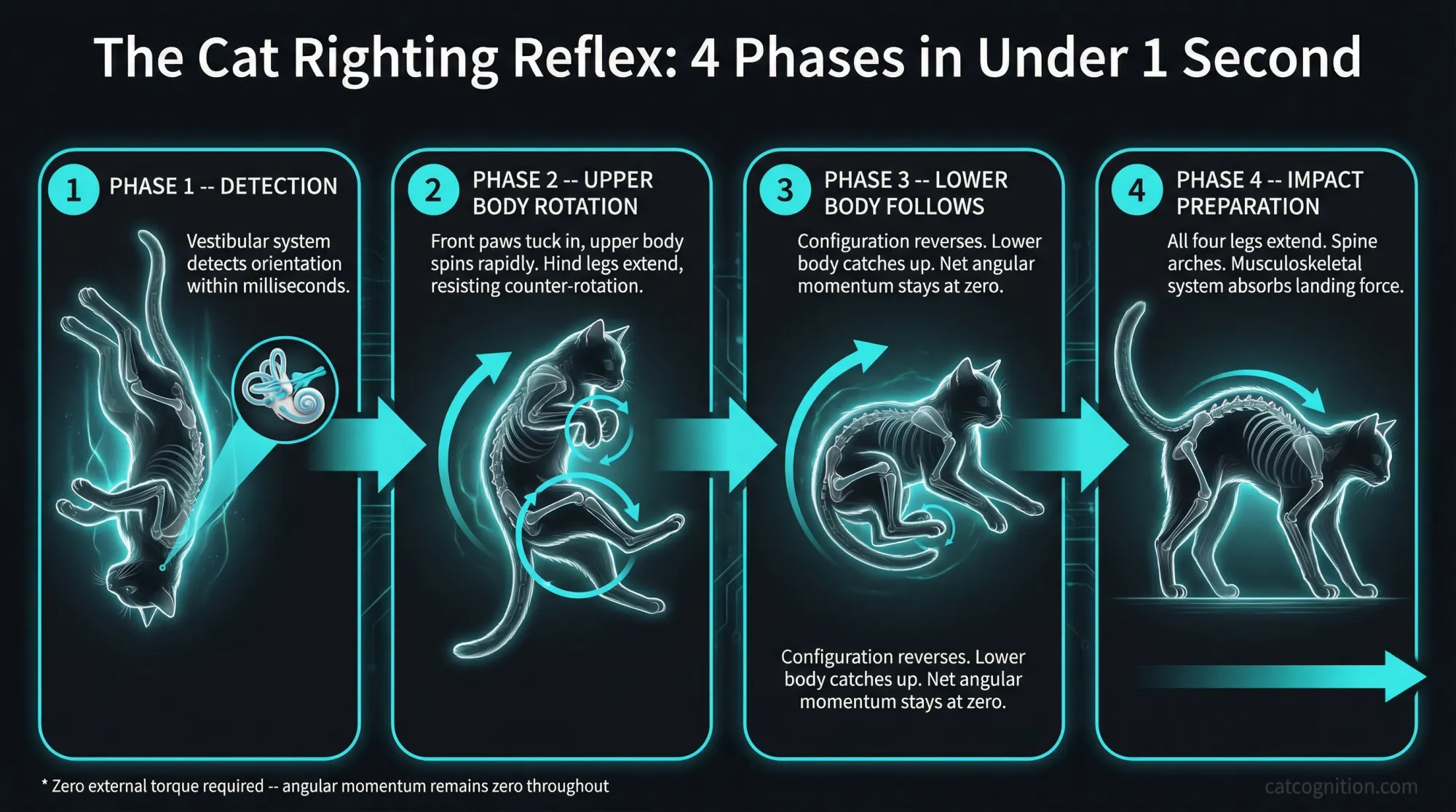
The feline aerial righting reflex is a four-phase neuromuscular sequence that rotates a falling cat from any orientation to a feet-down posture in under one second, using zero external torque. The cat righting reflex relies on the vestibular apparatus in the inner ear, a flexible spine with 30 vertebrae, and a vestigial collarbone that allows extreme torso rotation -- anatomical features refined over millions of years of arboreal hunting. As Gregory J. Gbur, PhD, Professor of Physics and Optical Science at the University of North Carolina at Charlotte, details in Falling Felines and Fundamental Physics, the righting reflex captivated physicists for over a century because it appeared to violate conservation of angular momentum -- a problem the Cornell Feline Health Center's vestibular system research helped resolve by clarifying the sensory mechanism behind the reflex.
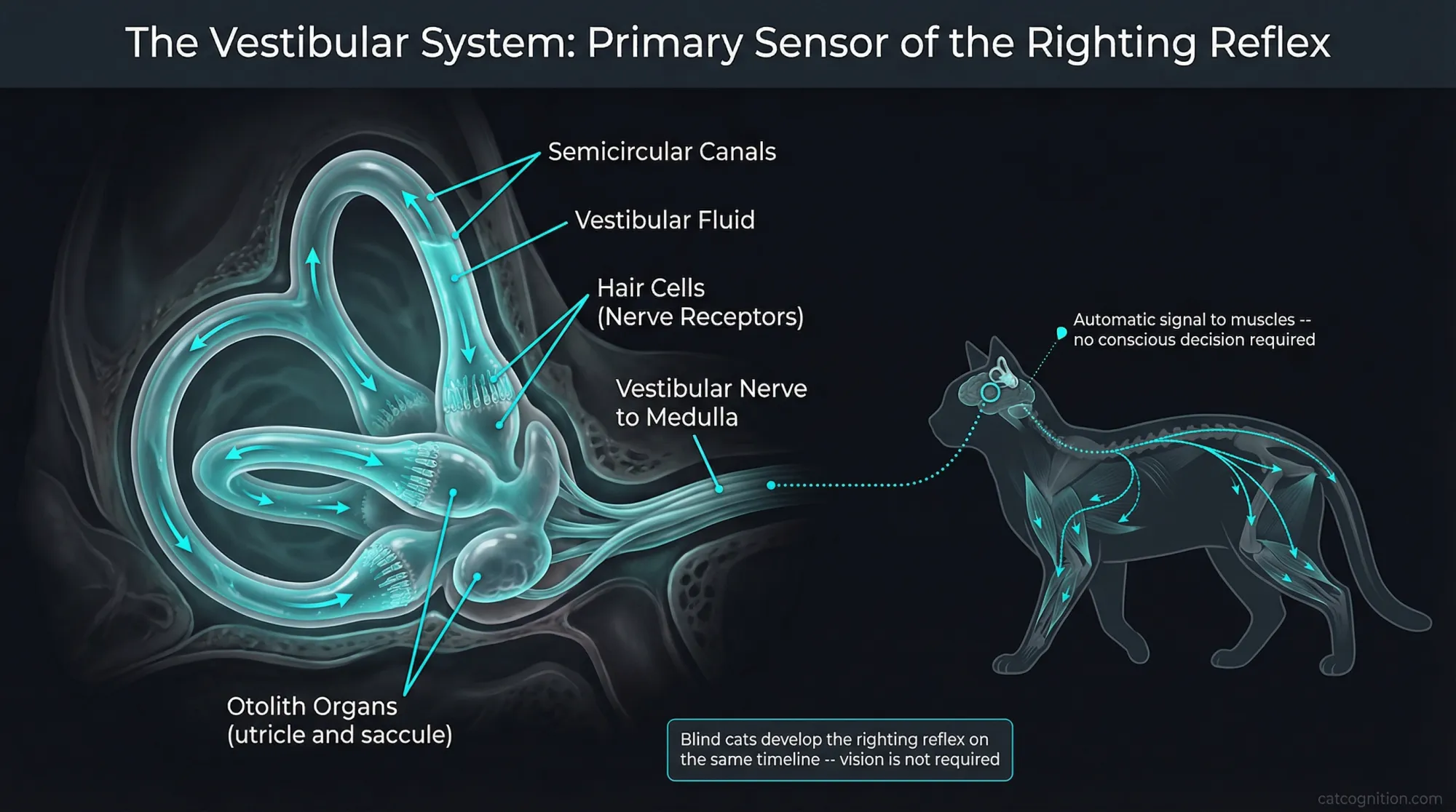
Phase 1 -- Detection. The vestibular apparatus -- fluid-filled semicircular canals containing specialized nerve cells -- detects the cat's orientation relative to gravity within milliseconds. According to the Cornell Feline Health Center, this apparatus automatically sends signals to muscles to compensate for position changes. Research on kittens born completely blind demonstrated that the righting reflex matures on the identical 33-day timeline as sighted kittens, confirming that vision is not required (PubMed, 1984). The vestibular system is the primary driver.
Phase 2 -- Upper body rotation. The cat tucks its front paws close to its body, reducing the moment of inertia of the upper half. With a smaller rotational mass, the upper body spins rapidly toward the feet-down orientation. Meanwhile, the hind legs extend outward, increasing the lower body's moment of inertia and resisting counter-rotation.
Phase 3 -- Lower body follows. Once the upper body reaches the correct orientation, the cat reverses the configuration. The front legs extend outward and the hind legs tuck inward. The lower body catches up to the correct position. The net angular momentum of the entire system remains zero throughout this sequence.
Phase 4 -- Impact preparation. The cat extends all four legs downward and arches its back, a posture that uses the same spinal flexibility behind why cats love squeezing into boxes. The legs, spine, and joints spread the landing force across the entire musculoskeletal system, functioning as biological shock absorbers.
"The feline righting reflex rotates a falling cat from any orientation to a feet-down posture in under one second using zero external torque."
How Do Cats Rotate Without Pushing Off Anything?
Cats exploit conservation of angular momentum by rotating the upper and lower halves of their bodies independently -- a maneuver physicists call "zero-angular-momentum rotation." The feline spine's 30 vertebrae (six more than the human spine) and a vestigial collarbone enable the extreme flexibility required for zero-angular-momentum rotation, which Stanford physicists mathematically proved in 1969.
The physics works like an ice skater pulling in their arms to spin faster. When the cat tucks its front legs and extends its hind legs, the upper body has a smaller moment of inertia and rotates quickly, while the extended lower body resists counter-rotation. Then the cat reverses the limb configuration and the lower body catches up. The two halves rotate in opposite directions, but the net angular momentum stays at zero because the system obeys Newton's third law at every instant.
Stanford mechanical dynamics researchers Thomas Kane and M.P. Scher proved this mathematically in 1969 by modeling the cat as two rigid cylinders joined at a flexible point (NASA Technical Reports Server). The model demonstrated that a body can rotate 180 degrees without any external torque -- a result that had puzzled physicists for 75 years.
In 1998, researchers at the University of Arizona built a more sophisticated multi-joint model showing that the real righting reflex involves more degrees of freedom than the minimum required, giving cats multiple possible rotation solutions (Arabyan & Tsai, 1998). Cats do not just flip -- cats select from a repertoire of rotation strategies depending on their starting orientation.
What Role Does the Vestibular System Play?
The vestibular apparatus in the inner ear is the primary sensor driving the cat righting reflex, detecting head position relative to gravity through fluid-filled semicircular canals and sending automatic corrective signals to muscles. The vestibular system is so dominant that cats born without sight develop the aerial righting reflex on the identical timeline as sighted cats, but cats placed in zero gravity lose the righting reflex almost entirely.
The Cornell Feline Health Center describes the vestibular apparatus as a fluid-filled structure connected to the medulla in the lower brain (Cornell Feline Health Center). When the head tilts, fluid movement activates specialized nerve cells that relay position data to the muscles. The righting response is automatic -- cats do not "decide" to flip.
The vestibular system is the primary driver, but not the only one. The cat righting reflex uses triple sensory redundancy: vestibular, visual, and proprioceptive inputs working simultaneously. Feline vision itself is optimized for low-light detection rather than fine detail, but it still serves as a backup orientation sensor during falls. A 1983 study on cats with surgically eliminated vestibular function found that these cats still retained partial aerial righting ability, relying on vision and proprioception as backup systems (PubMed, 1983). This multi-sensory redundancy explains why the righting reflex is so robust across nearly all cats and conditions.
The one environment where redundancy fails is zero gravity. Without gravitational pull on the vestibular fluid, the primary sensor has no reference point. In 1957, US Air Force researchers Siegfried Gerathewohl and Herbert Stallings tested 8 kittens aboard F-94 and T-33 aircraft during parabolic flight and reported that the cat righting reflex is "almost completely lost under weightlessness" (PubMed, 1957). Zero-gravity failure is the most direct proof that the righting reflex depends on gravity acting on the vestibular system.
"Cats born completely blind develop the righting reflex on the same 33-day timeline as sighted cats, proving vision is unnecessary for mid-air rotation."
How Did a Falling Cat Puzzle Physicists for 75 Years?
The falling cat problem captivated physicists from Etienne-Jules Marey's 1894 chronophotography to NASA-funded research in 1969, spanning 75 years of scientific debate over how a cat rotates mid-air without violating conservation of angular momentum. As Gregory J. Gbur, PhD, Professor of Physics and Optical Science at the University of North Carolina at Charlotte, documents in Falling Felines and Fundamental Physics (Yale University Press, 2019), the problem touched physics, photography, mathematics, neuroscience, and space exploration.
In 1894, French physiologist Etienne-Jules Marey used a chronophotographic gun -- capable of 12 frames per second, later refined to 60 -- to capture the first photographic proof that a cat dropped upside-down from three to four feet could rotate to land feet-first. Marey presented the images to the French Academy of Sciences, and the physics community was baffled. The cat appeared to violate conservation of angular momentum by rotating without pushing off anything.
Luminaries including George Gabriel Stokes and James Clerk Maxwell investigated the problem. Maxwell reportedly dropped cats from windows and heights, observing their rotation technique firsthand. But the mathematical proof eluded physicists for decades.
The solution came in 1969, when Stanford researchers Thomas Kane and M.P. Scher demonstrated that the cat maintains zero angular momentum throughout its rotation. By manipulating the distribution of its own mass -- tucking and extending different limb pairs in sequence -- the cat achieves what physicists now call "zero-angular-momentum rotation." The paper was published in the International Journal of Solids and Structures and listed on the NASA Technical Reports Server because NASA funded the research to solve astronaut orientation problems in weightlessness.
In 1968, a gymnast dressed as an astronaut was filmed on a trampoline mimicking the cat's twisting motion for NASA, photographed by Ralph Crane for LIFE magazine. The falling cat equations were adapted into astronaut zero-gravity training protocols -- making a house cat's reflex directly relevant to human space exploration.
"NASA funded Stanford's 1969 falling cat research because zero-angular-momentum rotation solved astronaut orientation problems in weightlessness."
What Is High-Rise Syndrome and How Dangerous Are Cat Falls?
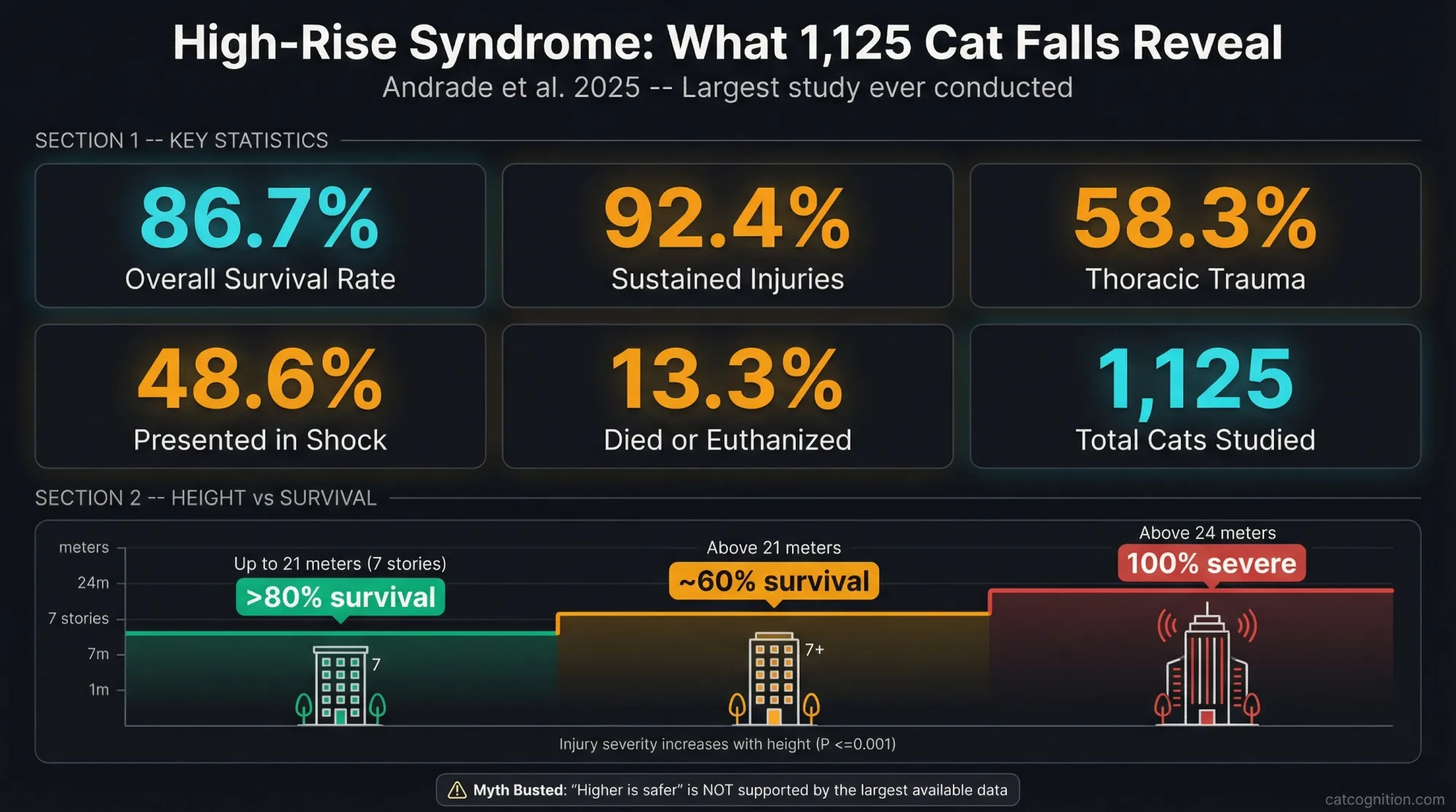
High-rise syndrome -- the pattern of injuries sustained by cats falling from significant heights -- was first described by Whitney and Mehlhaff in a landmark 1987 study of 132 cats in New York City, which reported a 90% survival rate. The largest high-rise syndrome study ever conducted, published in 2025 by Andrade and colleagues at Freie Universitat Berlin, analyzed 1,125 fall cases collected between 2004 and 2013, finding an 86.7% overall survival rate but with 92.4% of cats sustaining injuries.
The 1987 study introduced a puzzling finding: injury severity appeared to increase up to 7 stories, then paradoxically decreased at greater heights. Whitney and Mehlhaff hypothesized that cats reaching terminal velocity might relax their muscles, spreading their limbs to increase drag and reduce impact force. The finding was widely repeated and became the basis for the popular claim that "cats are safer falling from higher up."
The Andrade 2025 data, with 8.5 times the sample size, tells a different story. Injury severity increases with fall height (Spearman rho = 0.259, P <=0.001) -- a statistically significant but modest correlation that reflects the complexity of fall outcomes (Andrade et al. 2025, Part 2). The height-injury relationship is real, but height explains only a portion of the variance in injury severity because factors like landing surface, body position at impact, and individual anatomy also matter.
Survival remained above 80% for falls up to 21 meters (approximately 7 stories), but dropped to approximately 60% beyond 21 meters, with 100% of falls exceeding 24 meters classified as severe. Of all surviving cats, 48.6% presented in shock, 58.3% had thoracic trauma, and 25.9% had life-threatening injuries. If your cat shows signs of rapid breathing after a fall, seek emergency veterinary care immediately.
The "7-story paradox" from the 1987 Whitney study has multiple possible explanations. Survivorship bias is one factor: cats that died on impact were less likely to be brought to a veterinary clinic, potentially skewing the data toward survivors at greater heights. However, survivorship bias alone does not fully account for the reduced injury severity Whitney observed among higher-fall survivors. The terminal velocity relaxation hypothesis -- that cats spread their limbs and relax after reaching terminal velocity, increasing drag -- has not been definitively proven or disproven. What the Andrade 2025 data demonstrates clearly is that when examining a much larger sample, the overall trend shows increasing injury severity with height. The simplified "higher is safer" claim is not supported by the largest available data.
A domestic cat reaches terminal velocity at approximately 97 to 120 km/h (60 to 75 mph), depending on body position and limb spread -- roughly half the human terminal velocity of 193 km/h (120 mph). The lower terminal velocity, combined with the righting reflex and impact-absorbing anatomy, gives cats better fall survival than most mammals of comparable size -- but "better" does not mean "safe."
1. Whitney & Mehlhaff (1987) — 132 cats, New York City. 90% survival rate. Coined "high-rise syndrome"; reported injury decrease above 7 stories.
2. Vnuk et al. (2004) — 119 cats, Croatia. 96.5% survival rate. 59.6% of falling cats were under one year old.
3. Andrade et al. (2025) — 1,125 cats, Berlin (data: 2004–2013). 86.7% survival rate. Injury severity increases linearly with height.
Survival rates vary across studies due to differences in inclusion criteria, average fall heights, city architecture, and veterinary care timelines.
"The largest-ever high-rise syndrome study of 1,125 cats found an 86.7% survival rate, with injury severity increasing with fall height (Spearman rho = 0.259, P <=0.001)."
When Do Cats NOT Land on Their Feet?
The cat righting reflex is not a universal guarantee of safe landing -- the reflex fails in several specific situations including insufficient fall height, immature vestibular development in young kittens, vestibular disease, and zero-gravity environments. The popular phrase "cats always land on their feet" is a dangerous oversimplification that can lead to complacency about fall prevention.
Short falls. Cats need a minimum height of approximately 1 to 3 feet (0.3 to 0.9 meters), depending on starting orientation, to complete the full rotation sequence. Falls from furniture, countertops, or low shelves may not provide enough time for the four-phase righting sequence to execute. Short falls can actually be more dangerous than moderate ones because the cat strikes the ground mid-rotation.
Young kittens. The aerial righting reflex does not exist at birth. Kittens younger than approximately four weeks show no aerial righting reflexes, though body righting reflexes are present from birth. The aerial reflex begins developing around the third week and reaches maturity by approximately 33 to 35 days, according to Villablanca and Olmstead's 1979 developmental study (PubMed, 1979). Full mastery -- consistent righting from any starting orientation -- is typically achieved by 6 to 7 weeks. For a complete breakdown of kitten developmental milestones, see our guide to when kittens open their eyes.
Vestibular disease. Cats suffering from vestibular dysfunction -- characterized by head tilting, circling, and rapid eye oscillation (nystagmus) -- may have impaired righting ability. The vestibular system is the primary sensor for the reflex, and damage to the inner ear or its neural connections degrades the cat's ability to detect orientation.
Elderly cats. Senior cats over 15 years may show reduced righting efficacy due to decreased muscle elasticity and slower neural responsiveness. Understanding where your cat falls on the six cat life stages can help you assess their physical capabilities and fall risk. The research has not yet quantified this degradation precisely, but age-related decline in musculoskeletal and neurological function is well documented.
Pre-existing conditions. Cats with arthritis, neurological disorders, or musculoskeletal injuries may have compromised righting ability. Any condition that affects spinal flexibility, limb coordination, or neural processing speed can impair the reflex.
Disorientation. Cats startled or already in mid-tumble may not activate the vestibular detection phase quickly enough. Falls from slippery surfaces where the cat is already scrambling for grip can delay the righting sequence. Recognizing the body language signals that indicate a cat is off-balance or distressed can help you intervene before a fall occurs.
Body weight and injury severity. The Andrade 2025 study found no significant relationship between body weight and injury severity (P=0.549) (Andrade et al. 2025, Part 2). This finding addresses injury outcomes, not righting ability itself. Whether excess body weight impairs the biomechanics of mid-air rotation remains a separate, unstudied question. These are different measurements, and the distinction matters.
When Do Kittens Develop the Righting Reflex?
The aerial righting reflex begins developing around the third week of life and matures by approximately 33 to 35 days (the fifth week), with full mastery achieved by 6 to 7 weeks. Kittens younger than approximately four weeks show no aerial righting reflexes, making very young kittens especially vulnerable to falls from even modest heights.
Villablanca and Olmstead's 1979 study mapped the developmental timeline of postural reflexes in kittens. The righting reflex appears alongside other advanced motor skills -- forelimb tactile placing and hind limb hopping -- during the fifth week. Earlier reflexes like visual placing and body righting develop by the third week, but these do not include the aerial rotation component.
The most striking developmental finding comes from research on kittens born completely blind. These kittens developed the aerial righting reflex on the identical timeline as sighted kittens -- mature by 33 days -- proving that visual input is unnecessary for the reflex. The vestibular system alone provides sufficient sensory information for mid-air orientation and rotation.
This developmental timeline has direct safety implications. Kittens under 5 weeks of age have no reliable aerial righting ability. Kittens between 5 and 7 weeks are developing the reflex but have not yet mastered consistent rotation from all starting orientations. Elevated surfaces, open windows, and unscreened balconies pose a heightened risk for kittens in this age range.
How Can You Protect Your Cat from High-Rise Falls?
The Andrade 2025 mega-study provides specific, actionable prevention data: 77% of high-rise falls occur between April and September when windows are open, 62.1% happen between 6 PM and 6 AM when cats are most active and supervision is lowest, and the median age of falling cats is just 2.3 years (Andrade et al. 2025, Part 1). Converting these epidemiological patterns into household prevention measures is the single most effective way to protect cats.
Window and balcony security. Install secure window screens or mesh on all windows above ground level. This single intervention eliminates the primary cause of high-rise syndrome. Use window limiters or stops that prevent windows from opening more than 5 cm (2 inches) if screens are not feasible. Keep balcony doors closed or install cat-proof netting on balconies.
Seasonal vigilance. Be especially cautious during warm months (April through September), when 77% of falls occur. Windows are open more frequently, and cats are drawn to fresh air, insects, and birds visible through openings.
Evening supervision. Close or secure windows during evening and nighttime hours (6 PM to 6 AM), when 62.1% of falls occur. Cats are naturally more active during crepuscular and nocturnal periods, and human supervision is typically lower.
Age awareness. Young adult cats are the highest-risk group, with a median fall age of 2.3 years. Younger cats tend to be more curious, more agile, and more willing to attempt risky jumps than older cats. Younger cats did sustain less severe injuries when falls occurred (P=0.019 in the Andrade study), but prevention is always preferable to survival.
If a fall happens. Seek emergency veterinary care immediately, even if the cat appears to have landed on its feet and seems uninjured. The Andrade study found 92.4% of falling cats sustained musculoskeletal injuries, 58.3% had thoracic trauma, and 48.6% were in shock -- many of these injuries are not visible externally. Internal injuries including pulmonary contusions and pneumothorax may not show symptoms for hours. Landing on hard surfaces produces significantly more severe injuries than soft surfaces (P=0.016). Note the estimated fall height and landing surface for the veterinarian.
"Body weight shows no significant relationship to fall injury severity in cats (P=0.549, n=1,125), though this measures outcomes, not righting reflex mechanics."

Key Terms
- Righting reflex (aerial righting reflex): An automatic neuromuscular response that rotates a falling animal from any orientation to a feet-down landing posture; in cats, the process completes in under one second.
- Vestibular system (vestibular apparatus): A fluid-filled sensory structure in the inner ear containing semicircular canals and specialized nerve cells that detect head position relative to gravity.
- High-rise syndrome: A veterinary term for the pattern of injuries sustained by cats falling from significant heights, first described by Whitney and Mehlhaff in 1987.
- Terminal velocity: The maximum speed a falling object reaches when air resistance equals gravitational force; approximately 97 to 120 km/h (60 to 75 mph) for a domestic cat, depending on body position, versus 193 km/h (120 mph) for a human.
- Angular momentum: The rotational equivalent of linear momentum; a falling cat maintains zero net angular momentum by spinning upper and lower body in opposite directions simultaneously.
- Proprioception: The body's sense of its own position in space, provided by receptors in muscles, tendons, and joints; one of three sensory systems supporting the righting reflex alongside vestibular and visual input.
Frequently Asked Questions
Can cats survive falls from any height?
Cats cannot survive falls from any height. While the Andrade 2025 study of 1,125 cats found an 86.7% overall survival rate, survival decreases significantly at greater heights. Survival remained above 80% for falls up to 21 meters (approximately 7 stories), but dropped to approximately 60% beyond 21 meters, with 100% of falls exceeding 24 meters classified as severe. Of the surviving cats, 48.6% presented in shock and 25.9% had life-threatening injuries.
Does the tail help cats balance during falls?
Contrary to popular belief, the tail plays no significant role in the cat righting reflex. The rotation is achieved entirely through differential manipulation of the upper and lower body -- tucking and extending limbs to change the moment of inertia of each half independently. Kane and Scher's 1969 mathematical proof modeled the cat as two rigid cylinders with no tail and successfully explained the complete rotation. Manx cats and other tailless breeds reportedly demonstrate the righting reflex, though no controlled study has directly compared tailed and tailless breeds. The tail may contribute minor aerodynamic stability during longer falls, but the core rotation mechanism does not depend on it.
Do overweight cats have more trouble landing on their feet?
The Andrade 2025 study found no significant relationship between body weight and injury severity in high-rise falls (P=0.549). However, this finding measures injury outcomes after a fall, not the biomechanics of the righting reflex itself. Whether excess body weight impairs the mid-air rotation sequence is a different question that has not been directly studied. The two claims -- injury severity and righting ability -- should not be conflated.
At what age do kittens develop the righting reflex?
The aerial righting reflex begins developing around the third week of life and reaches maturity by approximately 33 to 35 days (the fifth week). Full mastery -- consistent righting from any starting orientation -- is typically achieved by 6 to 7 weeks. Kittens younger than approximately four weeks show no aerial righting reflexes, though body righting reflexes are present from birth. Research on kittens born blind confirmed that the reflex develops on the identical timeline regardless of vision, proving the vestibular system is the primary driver.
Is it true that higher falls are safer for cats?
The popular claim that "cats are safer falling from higher up" is not supported by the largest available data. The Andrade 2025 mega-study of 1,125 cats found that injury severity increases with fall height (Spearman rho = 0.259, P <=0.001), and survival drops to approximately 60% above 21 meters. The original 1987 Whitney study of 132 cats reported a paradoxical decrease in injuries above 7 stories, but this finding is likely influenced by survivorship bias (cats that died on impact were not brought to veterinary clinics) and has not been replicated at scale.
Why does the righting reflex fail in zero gravity?
The righting reflex depends on the vestibular system in the inner ear detecting the cat's orientation relative to gravity. In zero gravity, there is no gravitational pull on the vestibular fluid, so the primary sensor has no reference point. In 1957, US Air Force researchers tested kittens aboard aircraft during parabolic flight and found that the cat righting reflex was "almost completely lost under weightlessness." Cats retained some ability to reorient using vision and proprioception, but without gravity as a reference, the automatic vestibular-driven response could not function.
Can a cat be injured even if it lands on its feet?
Landing on all four feet does not prevent injury. The Andrade 2025 study found that 92.4% of cats sustained musculoskeletal injuries, 58.3% had thoracic trauma, and 48.6% presented in shock -- despite the righting reflex functioning. The impact forces from a multi-story fall are severe regardless of landing orientation. Internal injuries including pulmonary contusions and pneumothorax are common and may not show symptoms for hours. Any cat that falls from a significant height should receive emergency veterinary evaluation immediately.
What is the minimum height needed for the righting reflex to work?
Cats need a minimum fall height of approximately 1 to 3 feet (0.3 to 0.9 meters), depending on starting orientation, to complete the full four-phase righting sequence. Below this range, there is insufficient time for the vestibular detection, upper body rotation, lower body rotation, and impact preparation phases to execute. Falls from very low heights -- such as rolling off a couch or low table -- can actually result in awkward landings because the cat hits the ground mid-rotation.
Key Takeaways
The righting reflex is automatic, not learned: The vestibular system in the inner ear detects orientation relative to gravity and triggers a four-phase rotation sequence that completes in under one second -- even in cats born blind.
The physics stumped scientists for 75 years: Etienne-Jules Marey first photographed the reflex in 1894, but the mathematical proof did not arrive until Kane and Scher's 1969 paper, which NASA funded to help astronauts orient in zero gravity.
"Higher is safer" is not supported by the largest data: The Andrade 2025 study of 1,125 cats found injury severity increases with fall height, with survival dropping to approximately 60% above 21 meters -- contradicting the oversimplified interpretation of the 1987 Whitney study.
Prevention is specific and actionable: 77% of high-rise falls occur in summer months, 62.1% happen at night, and the median age of falling cats is 2.3 years. Window screens on all above-ground windows are the single most effective prevention measure.
Landing on feet does not mean landing safely: Of 1,125 cats studied, 92.4% sustained musculoskeletal injuries, 58.3% had thoracic trauma, and 13.3% died or were euthanized -- all despite the righting reflex functioning. Any cat that falls from height needs immediate veterinary evaluation.
Sources
- Andrade, D.G.A., et al. (2025). High-rise syndrome in cats (Part 1): epidemiology and risk factors. Journal of Feline Medicine and Surgery. https://pmc.ncbi.nlm.nih.gov/articles/PMC12126638/
- Andrade, D.G.A., et al. (2025). High-rise syndrome in cats (Part 2): injury patterns and survival rate. Journal of Feline Medicine and Surgery. https://pmc.ncbi.nlm.nih.gov/articles/PMC12126627/
- Whitney, W.O. & Mehlhaff, C.J. (1987). High-rise syndrome in cats. Journal of the American Veterinary Medical Association. https://pubmed.ncbi.nlm.nih.gov/3692980/
- Kane, T.R. & Scher, M.P. (1969). A Dynamical Explanation of the Falling Cat Phenomenon. International Journal of Solids and Structures. https://ntrs.nasa.gov/citations/19690058843
- Cornell Feline Health Center. Vestibular Syndrome. https://www.vet.cornell.edu/departments-centers-and-institutes/cornell-feline-health-center/health-information/feline-health-topics/vestibular-syndrome
- Gbur, G.J. (2019). Falling Felines and Fundamental Physics. Yale University Press. https://yalebooks.yale.edu/book/9780300231298/falling-felines-and-fundamental-physics/
- Bischoff, M. (2023). Why Do Cats Land on Their Feet? Physics Explains. Scientific American. https://www.scientificamerican.com/article/why-do-cats-land-on-their-feet-physics-explains/
- Vnuk, D., et al. (2004). Feline high-rise syndrome: 119 cases (1998-2001). Journal of Feline Medicine and Surgery. https://pmc.ncbi.nlm.nih.gov/articles/PMC10822212/
- Villablanca, J.R. & Olmstead, C.E. (1979). Development and maturation of postural reflexes in normal kittens. Developmental Psychobiology. https://pubmed.ncbi.nlm.nih.gov/456750/
- Development of the air righting reflex in cats visually deprived since birth. (1984). Experimental Neurology. https://pubmed.ncbi.nlm.nih.gov/6723872/
- Analysis of righting reflex in cats with labyrinthectomy. (1983). https://pubmed.ncbi.nlm.nih.gov/6622028/
- Arabyan, A. & Tsai, D. (1998). A distributed control model for the air-righting reflex of a cat. Biological Cybernetics. https://pubmed.ncbi.nlm.nih.gov/9851020/
- Gerathewohl, S. & Stallings, H. (1957). The labyrinthine posture reflex in the cat during weightlessness. https://pubmed.ncbi.nlm.nih.gov/13462942/