Why Do Cats Love Catnip? The Opioid Science Behind the Catnip Response
Catnip triggers beta-endorphin release through mu-opioid receptors, producing feline euphoria. The rubbing and rolling response transfers insect-repelling compounds onto cat fur, cutting mosquito landings by 50%. Learn the opioid science, genetic basis, and silver vine alternatives.


Table of Contents
- What Is Catnip and How Does It Work?
- Why Do Cats React to Catnip the Way They Do?
- Why Do Cats Chew and Tear Catnip Leaves?
- Is the Catnip Response Genetic?
- Do All Cats Respond to Catnip?
- Why Did Cats Evolve to Love Catnip?
- What Is the Difference Between Catnip and Silver Vine?
- Is Catnip Safe for Cats?
- How to Use Catnip Effectively
- Key Terms
- Frequently Asked Questions
- Key Takeaways
- Sources
What Is Catnip and How Does It Work?
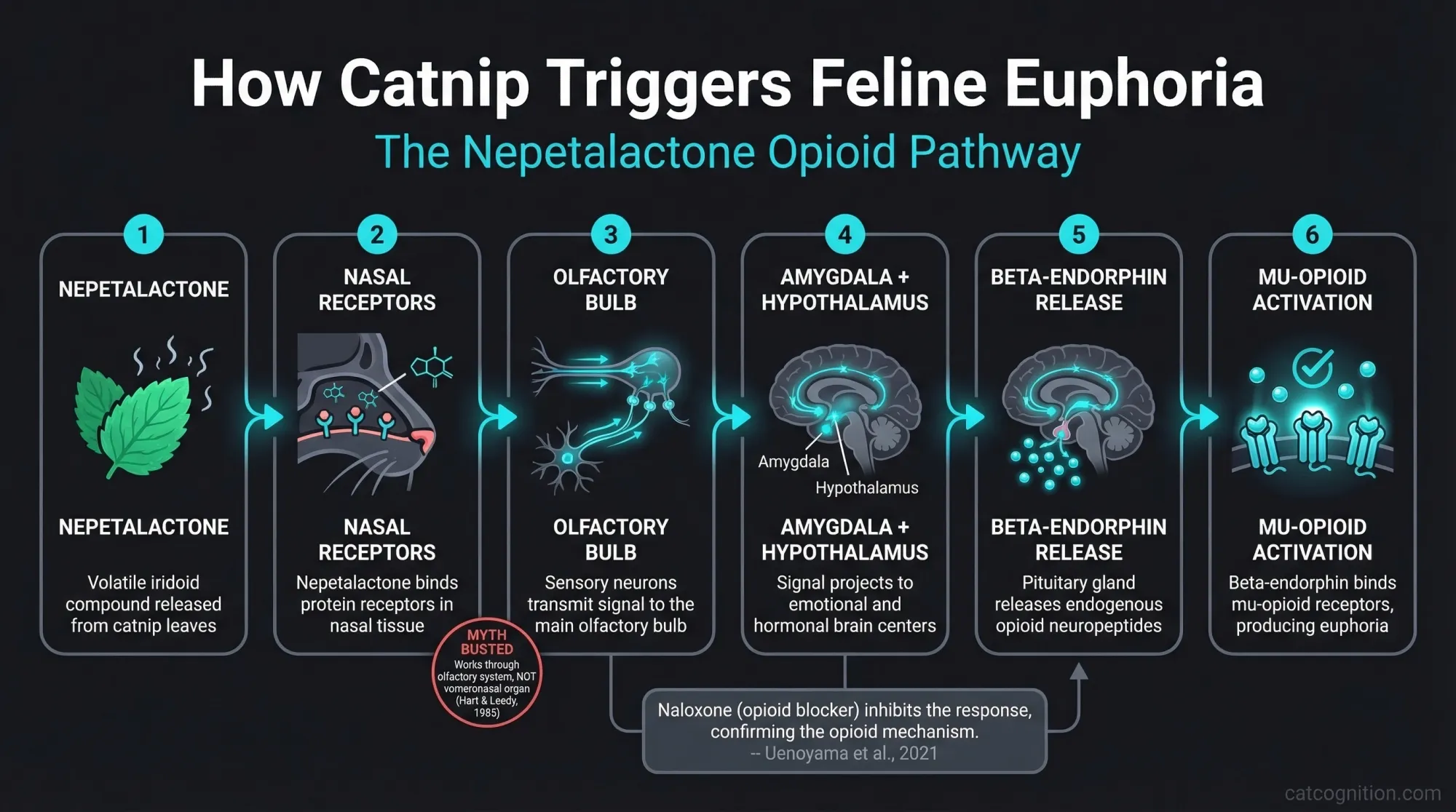
Catnip (Nepeta cataria) is a mint-family herb that produces nepetalactone, a volatile compound that triggers beta-endorphin release through mu-opioid receptors in the feline brain. The resulting opioid activation produces a brief, self-limiting state of euphoria that drives cats to rub, roll, and lick the plant.
As Dr. Masao Miyazaki's research group at Iwate University demonstrated, inhaled nepetalactone binds protein receptors in nasal tissue, stimulating sensory neurons that project from the olfactory bulb to the amygdala and hypothalamus (Uenoyama et al., 2021, Science Advances).
The effect is remarkably consistent across cats. Within seconds of exposure, a responding cat will sniff, rub its face against the source, begin licking or chewing, and often roll onto its back. R. C. Hatch's pharmacological analysis documented six distinct behavioral phases that unfold over approximately 10 minutes (Hatch, 1972, AJVR). After the response ends, cats enter a refractory period of 30 minutes to two hours during which they will not respond to catnip again, regardless of how much is offered.
One of the most persistent myths about catnip is that nepetalactone "mimics cat pheromones" and acts through the vomeronasal organ (Jacobson's organ). Hart and Leedy (1985) disproved this directly: surgical removal of the vomeronasal organ had no effect on the catnip response, while olfactory bulbectomy (removing the main olfactory bulb) eliminated the response entirely. Catnip works through the standard olfactory pathway, not the pheromone system.
📊 The Evidence:
"Nepetalactone binds nasal receptors and triggers beta-endorphin release through mu-opioid receptors, producing a brief, self-limiting state of feline euphoria."
Why Do Cats React to Catnip the Way They Do?
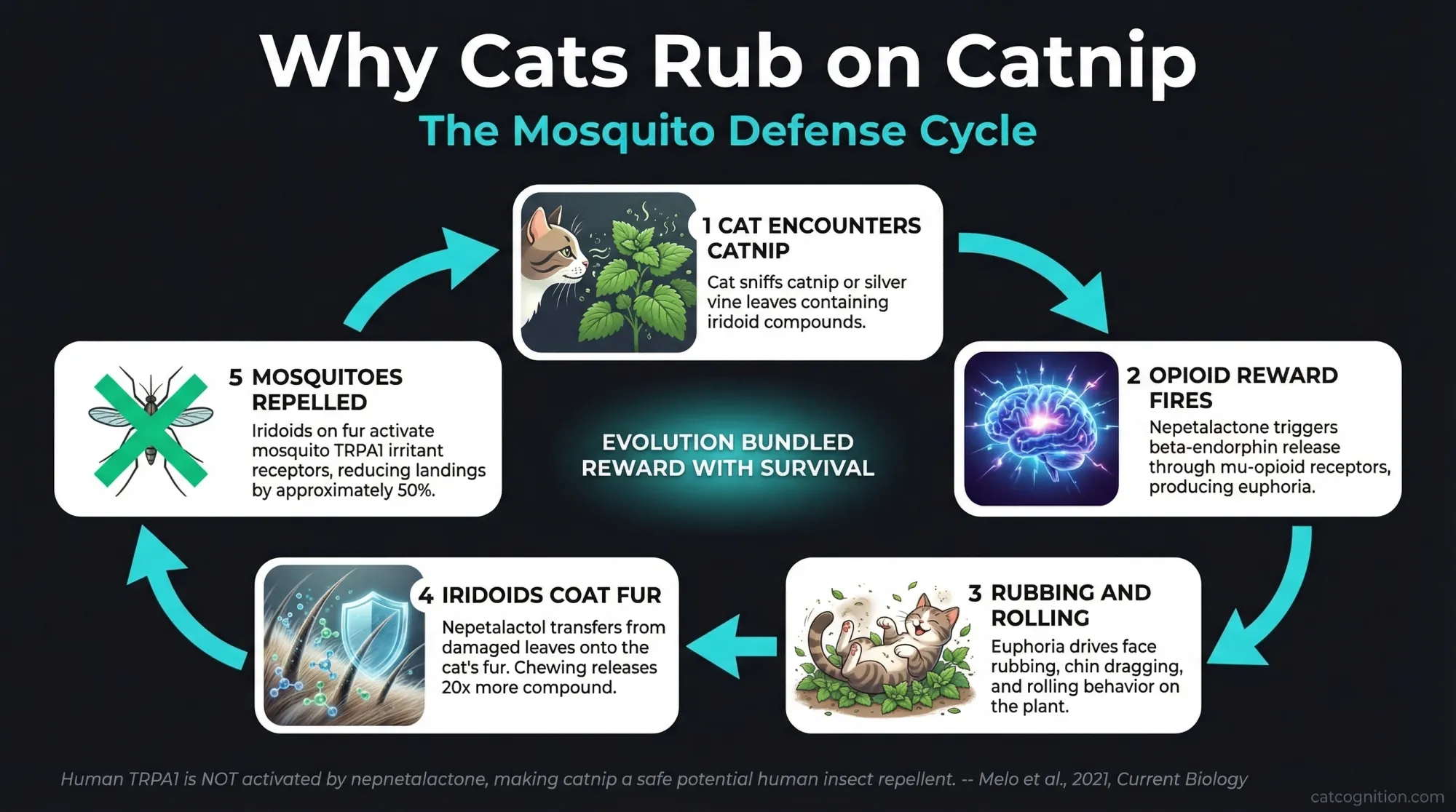
Cats rub, roll, lick, and chew catnip because each behavior transfers insect-repelling iridoid compounds onto cat fur. Nepetalactol-coated fur reduces mosquito landings by approximately 50%, making the catnip response a self-anointing defense against Aedes albopictus, the Asian tiger mosquito (Uenoyama et al., 2021, Science Advances).
Beta-endorphin is the neurochemical reward that motivates the behavior. When researchers administered naloxone, a mu-opioid receptor blocker, the rubbing and rolling behavior was inhibited. This confirmed that endogenous opioids drive the response. Hatch (1972) presaged this discovery by 50 years, showing that morphine prolonged the catnip response while amphetamine abolished it, implicating the opioid pathway decades before the mechanism was formally identified.
Evolution bundled the reward with the survival function. Cats experience genuine pleasure from catnip exposure because the brain's opioid system reinforces the rubbing and rolling behavior that coats their fur with mosquito-repelling compounds. The euphoria is not a side effect. It is the incentive that keeps cats performing the protective behavior. Understanding this reward-driven response connects to the broader science of cat behavior -- how evolution shaped the instincts domestic cats still carry today.
Why Do Cats Chew and Tear Catnip Leaves?
Cats chewing and tearing catnip leaves is not destructive play. Uenoyama et al. (2022, iScience) discovered that leaf damage dramatically amplifies the release of insect-repelling compounds. In silver vine, crumpled and torn leaves released approximately 10 times more iridoids than intact leaves, and manually crushed leaves released 40 times more. Damaged catnip leaves showed a roughly 20-fold increase in nepetalactone emission.
Leaf damage also diversified the iridoid cocktail emitted from silver vine, producing a more complex chemical mixture that increased mosquito repellency at lower concentrations. Every aspect of the cat's interaction with catnip or silver vine (rubbing, licking, biting, tearing) is optimized to maximize the chemical defense coating on the cat's fur.
📊 The Evidence:
"Cats chewing and tearing catnip leaves release roughly 20 times more insect-repelling nepetalactone than intact leaves provide, amplifying the plant's value as natural mosquito defense."
Is the Catnip Response Genetic?
The catnip response is hereditary. Neil Todd's foundational 1962 genetics study at Harvard University proposed that catnip sensitivity is inherited as an autosomal dominant trait, meaning a cat needs only one copy of the gene from either parent to respond. Todd found no correlation with sex, breed, coat color, or neuter status, and classified approximately 31% of cats in a shelter survey as non-responders (Todd, 1962, Journal of Heredity).
However, the genetics are more complex than Todd's original model suggested. A larger 2011 pedigree analysis of 210 cats by Villani at UC Davis found no evidence for simple Mendelian inheritance. Instead, the data indicated a polygenic liability threshold model with heritabilities of 0.51 to 0.89, meaning multiple genes contribute to catnip sensitivity rather than a single dominant gene. The key takeaway remains the same: catnip sensitivity is strongly heritable, but the underlying genetics involve multiple interacting genes rather than one on/off switch.
Kittens under approximately 3 to 6 months of age do not respond to catnip regardless of their genetics. The response requires neurological maturity to manifest. If a kitten ignores catnip entirely, that is normal development, not a sign of non-response. For more on how kittens develop, see our guide on when kittens open their eyes and the broader developmental timeline.
Do All Cats Respond to Catnip?
The commonly cited claim that "30% of cats don't respond to catnip" is more nuanced than most sources suggest. Response rates vary across studies: Bol et al. (2017) found a 68% response rate among 100 domestic cats, while a UC Davis study of 192 cats reported roughly 50% responding. International Cat Care cites 70 to 80%.
A 2017 study by Espin-Iturbe et al. added an important layer to this picture. Testing 60 cats across multiple age groups, the researchers observed that many apparent non-responders actually displayed subtle passive responses: sphinx-like stillness, decreased vocalization, and reduced motor activity. About 20% of cats in the study showed active responses (rolling and rubbing), while 80% responded passively in ways that owners typically mistake for indifference. These proportions come from a relatively small sample (n=60), and the study lacked a non-catnip control condition, so the exact percentages should be interpreted with caution.
This does not mean all cats truly respond. Larger studies by Bol (n=100) and the UC Davis team (n=192) identified cats that showed no discernible response of any kind, active or passive. The most accurate framing is that 60 to 70% of cats show a clear response, some additional cats may respond passively in ways that are easy to miss, and a genuine subset of cats are genetic non-responders.
📊 The Evidence:
"Silver vine elicits responses in 79% of domestic cats, outperforming catnip's 68% response rate. Among catnip non-responders, 71% responded to silver vine."
Why Did Cats Evolve to Love Catnip?
The catnip response is not a quirk of domestication. It is an ancient behavioral adaptation shared across the cat family (Felidae). Hill et al. (1976, Journal of Chemical Ecology) tested 33 large felids belonging to six species and found that lions and jaguars were extremely sensitive to catnip, while tigers, cougars, and bobcats gave little or no response. Uenoyama et al. (2021) confirmed that leopards, jaguars, and lynxes all display the characteristic rubbing and rolling response to nepetalactol. The behavior predates domestication by millions of years.
The evolutionary function was unknown until 2021. Prof. Masao Miyazaki's laboratory at Iwate University proved that face rubbing and rolling transfers nepetalactol from plant leaves onto cat fur, and that this chemical coating reduces mosquito landings by approximately 50%. Cats that responded to iridoid-producing plants gained a survival advantage: they carried a natural insect repellent.
On the plant side, nepetalactone has its own evolutionary story. Genomic analysis by Dr. Benjamin Lichman at the University of York revealed that iridoid production was lost in catnip's ancestor 55 to 65 million years ago, then re-evolved in the genus Nepeta tens of millions of years later via novel enzymes not found in any related plant species (Lichman et al., 2020, Science Advances). The plant produces nepetalactone as its own insect defense. In an extraordinary case of convergent evolution, pea aphids independently evolved the ability to produce nepetalactone and nepetalactol as sex pheromones using completely different enzymes (Journal of Biosciences, 2024).
Research by Nadia Melo and colleagues at Lund University identified the exact molecular target: nepetalactone activates the TRPA1 irritant receptor in mosquitoes, causing avoidance behavior (Melo et al., 2021, Current Biology). TRPA1 mutant mosquitoes were no longer repelled by catnip. Human TRPA1 is not activated by nepetalactone, which makes catnip a safe potential insect repellent for people.
What Is the Difference Between Catnip and Silver Vine?
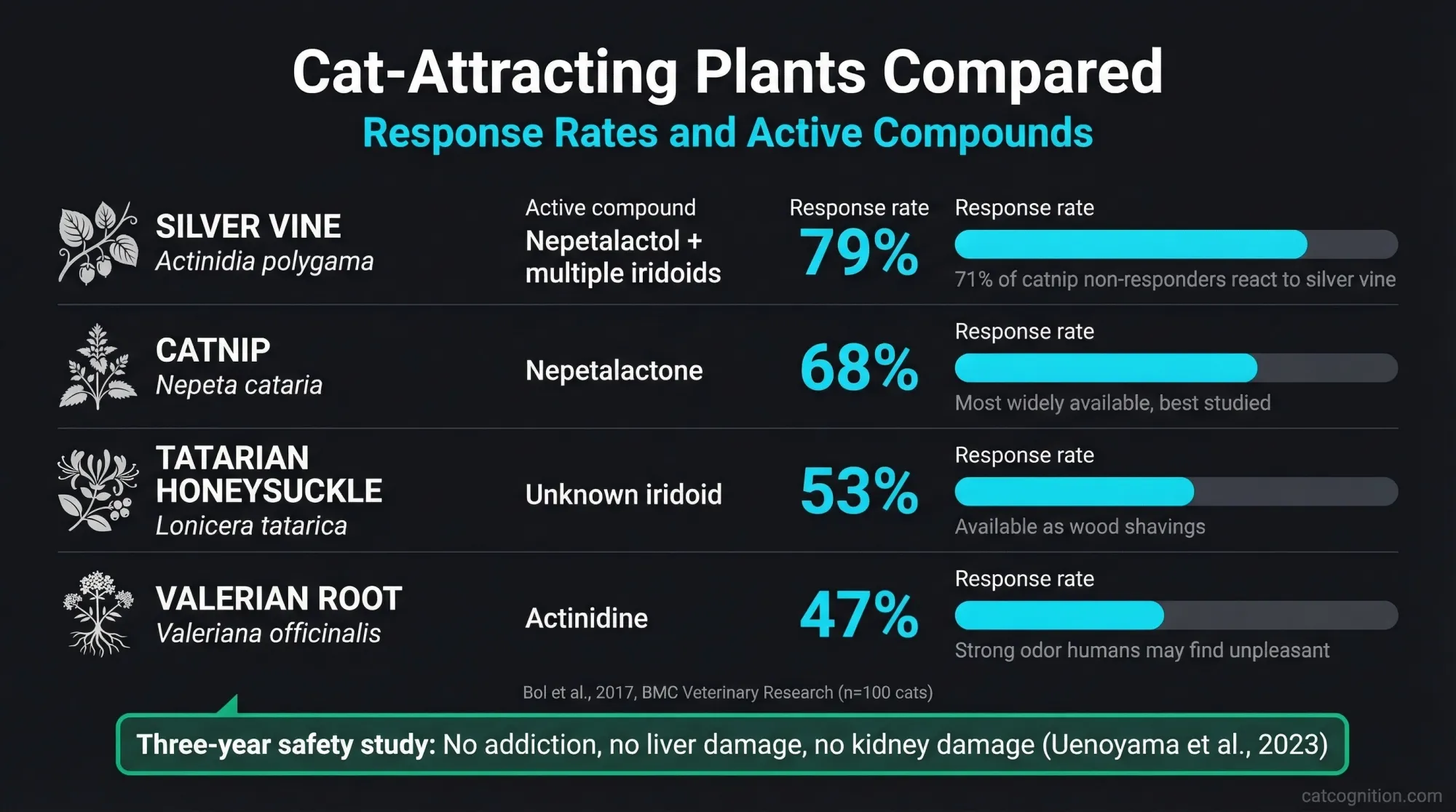
Catnip (Nepeta cataria) and silver vine (Actinidia polygama) both contain structurally related iridoid compounds that trigger the feline response, but silver vine produces a broader cocktail of active chemicals, including nepetalactol, and elicits a higher response rate. Dr. Sebastian Bol's comparative study of 100 domestic cats found that silver vine elicited a response in 79% of cats, compared to 68% for catnip (Bol et al., 2017, BMC Veterinary Research).
The practical significance is clear: among the 31 cats that did not respond to catnip, 22 (71%) responded to silver vine. For cat owners whose cats seem indifferent to catnip, silver vine is the first alternative to try. Tatarian honeysuckle (53% response rate) and valerian root (47%) are additional options for cats that respond to neither catnip nor silver vine.
| Plant | Active Compound | Response Rate | Notes |
|---|---|---|---|
| Catnip (Nepeta cataria) | Nepetalactone | 68% | Most widely available, best studied |
| Silver vine (Actinidia polygama) | Nepetalactol + multiple iridoids | 79% | Higher intensity responses, traditional in East Asia |
| Tatarian honeysuckle (Lonicera tatarica) | Unknown iridoid | 53% | Less studied, available as wood shavings |
| Valerian root (Valeriana officinalis) | Actinidine | 47% | Strong odor humans may find unpleasant |
Silver vine is the traditional cat-attracting plant in East Asia, where it has been used for centuries. Both catnip and silver vine have equivalent safety profiles: a three-year longitudinal study confirmed no addictive behavior, no liver damage, and no kidney damage from continuous exposure (Uenoyama et al., 2023, iScience).
One important distinction: the beta-endorphin and mu-opioid mechanism that Uenoyama et al. demonstrated in 2021 was tested using nepetalactol (from silver vine), not nepetalactone (from catnip) directly. Both compounds are structurally related iridoids that likely act through similar pathways, but the formal pharmacological confirmation applies to nepetalactol specifically.
Is Catnip Safe for Cats?
Catnip is one of the safest enrichment tools available for cats, backed by stronger safety data than most feline products on the market. A three-year longitudinal study by Uenoyama et al. (2023, iScience) monitored cats with continuous access to silver vine and found no hallmarks of addictive behavior. Serum biomarkers for liver function, kidney function, and stress all remained within normal ranges throughout the study.
Metabolic studies confirm efficient clearance. Waller et al. (1969, Science) demonstrated that 86 to 94% of ingested nepetalactone is excreted in urine, primarily as alpha-nepetalinic acid. Nepetalactone is not a substance that accumulates in the body.
The catnip response is also self-limiting. After approximately 10 minutes, cats enter a refractory period and will not respond again for 30 minutes to two hours. Cats cannot escalate their response by consuming more, and they naturally stop engaging with the plant when the response cycle completes. If you are looking for other safe enrichment strategies, our guide on what cats need to be happy covers the broader enrichment picture.
⚠️ CatCog Reality Check:
While catnip and silver vine are safe for all healthy adult cats, concentrated catnip essential oils can cause overstimulation or aggression in some cats. Use dried loose-leaf catnip rather than concentrated products. In multi-cat households, introduce catnip individually first, as overstimulated cats may redirect aggression toward housemates. If a cat eats large quantities of plant material and shows gastrointestinal upset, reduce the amount offered. The issue is plant fiber, not nepetalactone toxicity. Catnip is not a substitute for veterinary treatment of anxiety or behavioral disorders.
How to Use Catnip Effectively
Maximizing catnip's enrichment value depends on matching your approach to the biological mechanisms that drive the response. Leaf format, session timing, rotation strategy, and age thresholds all influence whether your cat gets the full benefit. These evidence-based guidelines translate the research reviewed throughout this article into practical recommendations.
Choose dried loose-leaf catnip over sprays or oils. Uenoyama et al. (2022) showed that leaf damage from licking, chewing, and tearing increases catnip iridoid emission roughly 20-fold. Loose leaves allow cats to perform the full behavioral sequence (rubbing, licking, biting, rolling) that maximizes both the enrichment experience and the mosquito-defense benefit. Concentrated oils bypass this natural interaction.
Offer catnip in 10 to 15 minute sessions. The response terminates in approximately 10 minutes, followed by a refractory period of 30 minutes to two hours. Offering more catnip during the refractory period provides no additional benefit and wastes material.
Rotate between catnip and silver vine. Response duration and intensity differ between individual compounds (Bol et al., 2022, BMC Biology), and alternating between sources helps maintain novelty. With continuous daily exposure, the response can wane due to habituation, so offering catnip 2 to 3 times per week preserves the enrichment value over time.
Try silver vine for non-responders. If a cat shows no response of any kind to catnip, silver vine is the first alternative: 71% of catnip non-responders respond to silver vine. Tatarian honeysuckle and valerian root offer additional options.
Store catnip in airtight containers. Nepetalactone is volatile and degrades with air exposure. Sealed storage maintains potency for months longer than loose, open bags.
Wait until 3 to 6 months of age. Kittens lack the neurological maturity to respond to catnip. Offering catnip to a kitten will cause no harm; the kitten will simply ignore it.
📊 The Evidence:
"Three-year longitudinal monitoring of cats with continuous access to silver vine found no addictive behavior, no liver damage, no kidney damage, and no elevated stress markers."
Key Terms
- Nepetalactone: The primary volatile iridoid compound in catnip (Nepeta cataria) that triggers the feline behavioral response by binding to olfactory receptors and stimulating beta-endorphin release.
- Nepetalactol: A structurally related iridoid found primarily in silver vine (Actinidia polygama). The compound used in the landmark 2021 Iwate University study that confirmed the mu-opioid reward mechanism.
- Iridoid: A class of monoterpenoid compounds produced by plants as chemical defense against herbivorous insects. Catnip produces nepetalactone; silver vine produces nepetalactol and several related iridoids.
- Mu-opioid receptor: A brain receptor activated by endogenous opioids like beta-endorphin. Activation produces analgesia and euphoria. The catnip response is mediated by beta-endorphin binding to mu-opioid receptors.
- Beta-endorphin: An endogenous opioid neuropeptide produced by the pituitary gland that functions as the body's natural reward signal. Nepetalactol exposure significantly increases plasma beta-endorphin levels in cats.
- TRPA1: Transient receptor potential ankyrin 1, an irritant-sensing receptor in insects. Nepetalactone activates mosquito TRPA1, causing avoidance behavior. Human TRPA1 is not activated by nepetalactone.
- Vomeronasal organ (Jacobson's organ): A chemosensory organ in the roof of the mouth that detects pheromones. Despite widespread claims, the catnip response does not involve this organ (Hart and Leedy, 1985).
- Refractory period: The 30-minute to two-hour window after a catnip response ends during which a cat will not respond to catnip again, regardless of the amount offered.
Frequently Asked Questions
Is catnip safe for kittens? Catnip is non-toxic at any age, but kittens under 3 to 6 months lack the neurological maturity to respond. Offering catnip to a kitten will not cause harm. The kitten will simply ignore it. Wait until 6 months before testing for a response.
Can cats overdose on catnip? No. The catnip response is self-limiting: it terminates in approximately 10 minutes, followed by a refractory period. Cats cannot escalate their response by consuming more. Metabolic studies by Waller et al. (1969) confirmed that 86 to 94% of ingested nepetalactone is excreted in urine. The only concern with eating large quantities is mild gastrointestinal upset from plant fiber, not nepetalactone toxicity.
My cat does not respond to catnip. Is something wrong? Nothing is wrong. Catnip sensitivity is genetic, and an estimated 30 to 50% of cats do not show a visible response. Some of these cats may be passive responders whose subtle reactions (stillness, quiet) are easy to miss. For cats that truly do not respond, try silver vine (79% response rate), Tatarian honeysuckle (53%), or valerian root (47%).
Does catnip work on big cats like lions? Yes. Hill et al. (1976) found that lions and jaguars were extremely sensitive to catnip. Uenoyama et al. (2021) confirmed that leopards, jaguars, and lynxes also display the characteristic rubbing and rolling response. The behavior is an ancient adaptation shared across the cat family. Tigers, cougars, and bobcats, however, showed little or no response.
Is catnip addictive? No. A three-year longitudinal study by Uenoyama et al. (2023) found no hallmarks of addictive behavior in cats with continuous access to silver vine. Blood markers for stress, liver function, and kidney function remained normal throughout the study.
Does catnip repel mosquitoes from humans? Nepetalactone activates the TRPA1 irritant receptor in mosquitoes, causing avoidance behavior (Melo et al., 2021). Human TRPA1 is not activated by nepetalactone, making catnip a safe potential insect repellent for people. However, commercial catnip-based repellents are not yet widely available, and the concentration required for human application differs from what cats self-apply through rolling.
How often should I give my cat catnip? Two to three times per week is a good baseline. This frequency provides consistent enrichment while avoiding habituation, which can reduce the response over time with daily exposure. Rotating between catnip and silver vine helps maintain novelty.
Is the catnip response sexual behavior? No. While some sources describe the rolling and rubbing as similar to estrus behavior, the response occurs in all cats regardless of sex, reproductive status, or neuter status (Todd, 1962). Neutered males and spayed females display the same behavioral patterns. The opioid mechanism (beta-endorphin via mu-opioid receptors) is a general reward pathway, not a reproductive one. This is consistent with the broader understanding of cat behavior after neutering -- hormonal changes do not affect the catnip response.
Key Takeaways
- Catnip triggers the release of beta-endorphins through mu-opioid receptors, producing a brief, self-limiting state of euphoria. This is the same opioid reward system that mediates pain relief and pleasure across mammals.
- The catnip response serves an evolutionary function: rubbing and rolling transfers insect-repelling iridoid compounds onto cat fur, reducing mosquito landings by approximately 50%.
- Catnip sensitivity is genetically inherited and shared across the cat family, from domestic cats to lions, jaguars, and leopards. An estimated 60 to 70% of domestic cats show a clear response, with some additional cats responding passively.
- Catnip works through the main olfactory system, not the vomeronasal organ. The widespread claim that catnip "mimics pheromones" is incorrect, as demonstrated by Hart and Leedy (1985).
- Catnip and silver vine are among the safest feline enrichment tools available, with three-year longitudinal data confirming no addictive behavior, no organ damage, and no elevated stress markers. For more on understanding instinctive cat behaviors, explore our guide to cat body language.
Sources
- The characteristic response of domestic cats to plant iridoids allows them to gain chemical defense against mosquitoes -- Uenoyama, R., Miyazaki, T., Hurst, J.L., Miyazaki, M., 2021, Science Advances (Science)
- Domestic cat damage to plant leaves containing iridoids enhances chemical repellency to pests -- Uenoyama, R., Miyazaki, T., Adachi, M., Nishikawa, T., Hurst, J.L., Miyazaki, M., 2022, iScience (Cell Press)
- Assessing the safety and suitability of using silver vine as an olfactory enrichment for cats -- Uenoyama, R., Ooka, S., Miyazaki, T., Mizumoto, H., Nishikawa, T., Hurst, J.L., Miyazaki, M., 2023, iScience (Cell Press)
- Inheritance of the catnip response in domestic cats -- Todd, N.B., 1962, Journal of Heredity (Oxford Academic)
- Responsiveness of cats (Felidae) to silver vine, Tatarian honeysuckle, valerian, and catnip -- Bol, S., Caspers, J., Buckingham, L., et al., 2017, BMC Veterinary Research (Springer)
- Active and passive responses to catnip are affected by age, sex and early gonadectomy in male and female cats -- Espin-Iturbe, L.T., et al., 2017, Behavioural Processes (ScienceDirect)
- The evolutionary origins of the cat attractant nepetalactone in catnip -- Lichman, B.R., et al., 2020, Science Advances (Science)
- The irritant receptor TRPA1 mediates the mosquito repellent effect of catnip -- Melo, N., Wolff, G.H., Costa-da-Silva, A.L., et al., 2021, Current Biology (Cell Press)
- Behavioral differences among domestic cats in the response to cat-attracting plants and their volatile compounds -- Bol, S., Scaffidi, A., Flematti, G.R., et al., 2022, BMC Biology (Springer)
- Convergent evolution: What do cats, catnip, aphids, and mosquitoes have in common? -- Editorial, 2024, Journal of Biosciences (Springer)
- Feline Attractant, cis,trans-Nepetalactone: Metabolism in the Domestic Cat -- Waller, G.R., Price, G.H., Mitchell, E.D., 1969, Science (PubMed)
- Effect of Drugs on Catnip (Nepeta cataria)-Induced Pleasure Behavior in Cats -- Hatch, R.C., 1972, American Journal of Veterinary Research (AVMA)
- Analysis of the catnip reaction: mediation by olfactory system, not vomeronasal organ -- Hart, B.L., Leedy, M.G., 1985, Behavioral and Neural Biology (PubMed)
- Species-characteristic responses to catnip by undomesticated felids -- Hill, J.O., Pavlik, E.J., Smith, G.L., et al., 1976, Journal of Chemical Ecology (Springer)
- Catnip: Its uses and effects, past and present -- Grognet, J., 1990, Canadian Veterinary Journal (PMC)
- Why do cats like catnip? -- International Cat Care, iCatCare (iCatCare)