Why Do Cats Rub Against You? The Science of Feline Scent Bonding
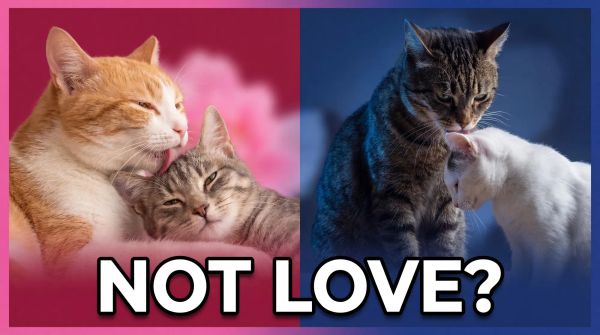
Cats rub against humans to deposit facial pheromones that integrate the human into the cat's social group. The same scent-bonding mechanism cats use in free-ranging colonies — not a dominance display or territorial claim.

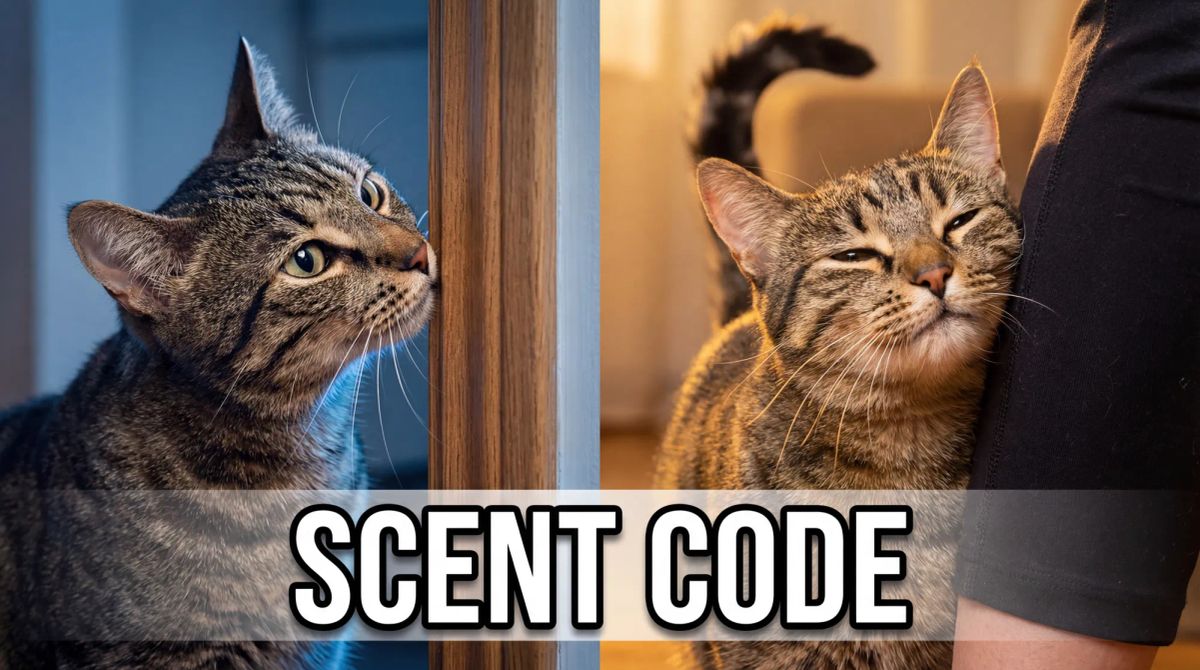
Table of Contents
- What Does It Mean When a Cat Rubs Against You?
- Why Do Cats Headbutt You?
- Why Do Cats Rub Against Your Legs?
- Why Do Cats Rub Their Face on Things?
- Why Do Stray Cats Rub Against Your Legs?
- What Is Cat Bunting?
- Why Do Cats Rub Against You Then Bite?
- Why Do Cats Mark Their Territory?
- The Emotional Dimension: Do Cats Adjust Rubbing to Human Mood?
- Key Terms
- Frequently Asked Questions
- Key Takeaways
- Sources
Cats rub against humans to deposit facial pheromones that integrate the human into the cat's social group. Specialized sebaceous glands on a cat's forehead, cheeks, chin, and tail base produce chemical signals during rubbing that create a shared "colony odor" -- the same scent-bonding mechanism cats use with other cats in free-ranging colonies. Cat rubbing is NOT a dominance display or territorial "claim" over a human. Rubbing is an affiliative, distance-reducing behavior inherited from the mother-kitten relationship. For more on the science of feline attachment, see our complete guide to cat bonding.
Your cat walks toward you, tail straight up, and presses the side of its face against your shin. Then the cheek. Then the full flank drags along your leg, and the tail curls around your calf like a question mark. The whole thing takes about three seconds.
In those three seconds, your cat executed a chemical communication protocol that researchers are still working to fully decode.
Most explanations of cat rubbing stop at "your cat loves you" or "your cat is marking you as theirs." Both framings miss what the science actually reveals. When a cat rubs against a person, the cat is running the same neurochemical program that free-ranging cats use to maintain colony cohesion -- depositing specific pheromone fractions from at least 5 distinct facial scent gland clusters to build a shared group identity.
As Dr. John Bradshaw of the University of Bristol's Anthrozoology Institute explains, the behaviors cats show toward humans are derived from the mother-kitten behavioral repertoire. Kittens rub on their mothers. In a colony, smaller cats tend to rub on larger cats. When a domestic cat rubs against a human, the cat is using the same affiliative signaling system, treating the person as a trusted member of its social group.
Cat bunting -- the fluid, sweeping motion of a cat rubbing its head against a person or object with normal alertness -- is NOT the same as head pressing. Head pressing is a cat pressing its head firmly against a wall or hard surface while standing still, often appearing disoriented. Head pressing can indicate serious neurological conditions including hepatic encephalopathy, brain tumors, or toxic poisoning. If a cat is pressing its head against walls with disorientation, circling, or behavioral changes, seek immediate veterinary attention.
What Does It Mean When a Cat Rubs Against You?
Cat rubbing against humans serves 4 distinct communicative functions depending on which body part makes contact, the context of the interaction, and whether the rubbing follows a reunion or occurs unprompted. Each rubbing pattern activates different scent gland clusters and deposits different chemical signals, making rubbing a layered communication system rather than a single behavior.
The research points to a framework for decoding rubbing behavior based on observable characteristics.
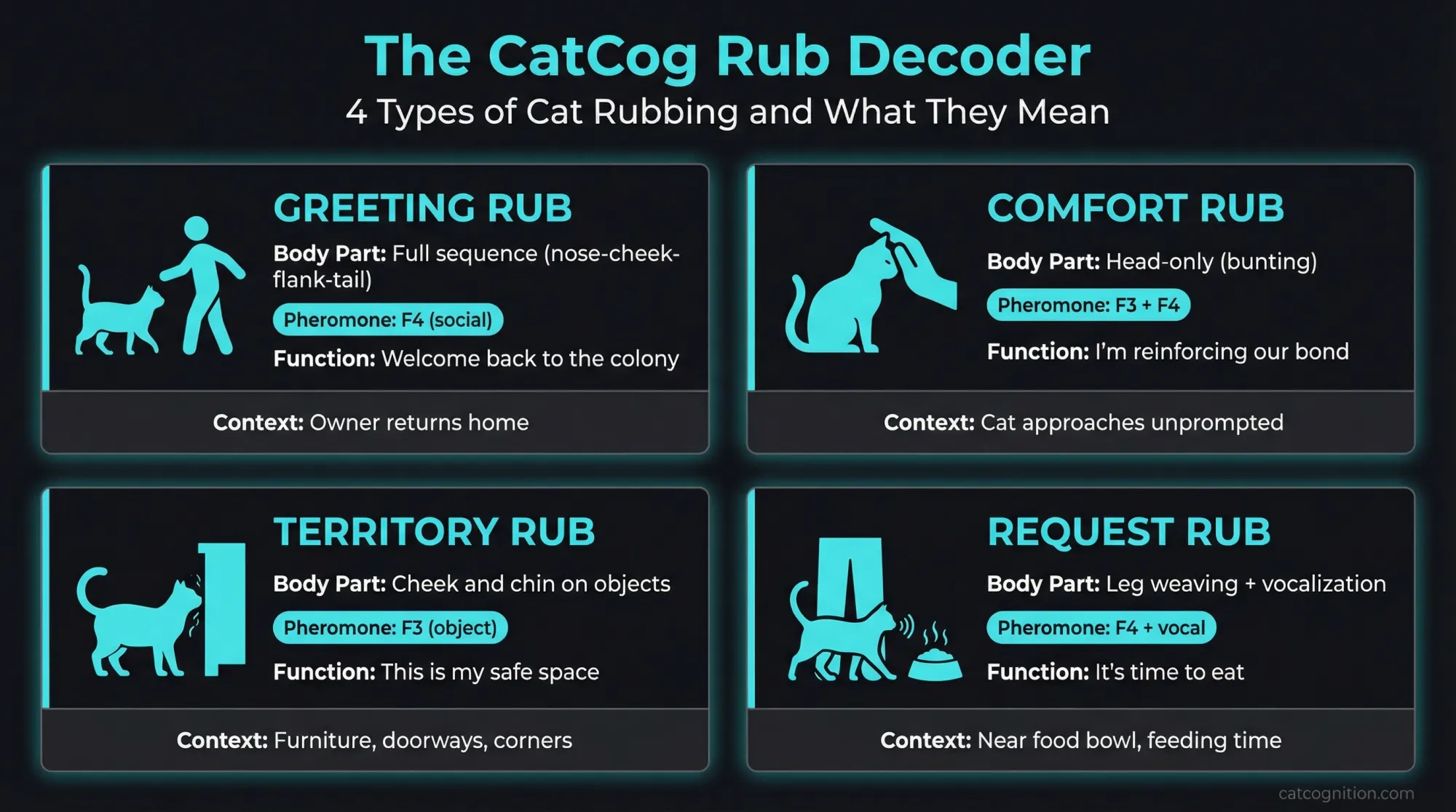
The CatCog Rub Decoder
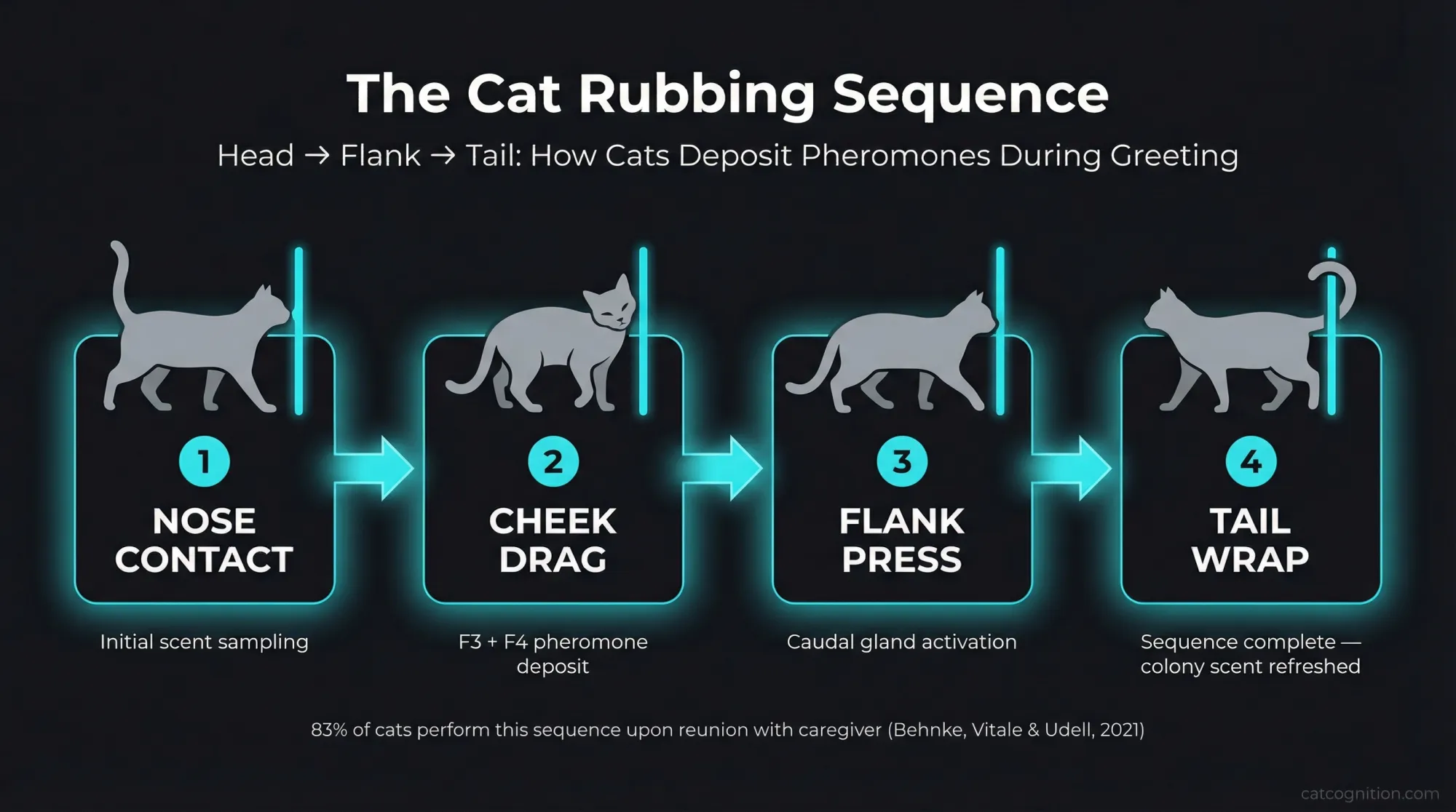
1. Greeting Rub — Full sequence (nose-cheek-flank-tail) when the owner returns home with a tail-up approach. Deposits F4 (social) pheromone. Reunion scent refresh: "Welcome back to the colony."
2. Comfort Rub — Head-only bunting when the cat approaches unprompted with slow movement. Deposits F3 + F4 pheromones. Affiliative bonding: "I'm reinforcing our relationship."
3. Territory Rub — Cheek and chin contact on corners, furniture edges, and doorways. Deposits F3 (object) pheromone. Environmental familiarization: "This is my safe space."
4. Request Rub — Leg weaving with flank contact and vocalization near the food bowl at regular feeding times. Deposits F4 pheromone combined with vocal signals. Resource solicitation: "It's time to eat."
French veterinarian Patrick Pageat identified five facial pheromone fractions (F1 through F5) in a 1998 patent (US Patent 5,709,863, filed 1995), a classification that has since been adopted across veterinary behavioral medicine, though independent peer-reviewed replication remains limited. Pageat's chemical analysis found the F3 fraction comprises approximately 68% oleic acid, 8% azealic acid, 9% primelic acid, and 15% palmitic acid -- a specific lipid profile that explains why rubbing deposits are oily to the touch and adhere to surfaces. The key distinction for understanding cat rubbing: F3 is deposited during object rubbing and creates environmental familiarity, while F4 is deposited specifically during social rubbing on other cats or humans and functions as a social bonding signal.
"Cats deposit different facial pheromone fractions depending on the target -- F3 when rubbing objects for environmental familiarity, F4 when rubbing other cats or humans as a social bonding signal. This distinction was identified by Patrick Pageat in a 1998 patent (US Patent 5,709,863) and has been adopted across veterinary behavioral medicine."
Understanding which type of rub a cat is performing changes the appropriate human response. A greeting rub after a separation calls for letting the cat complete the full sequence without interruption. A request rub near the food bowl is resource-driven. A comfort rub during quiet time is affiliative bonding -- and the most meaningful signal that the cat considers the human a core member of its social group.
Why Do Cats Headbutt You?
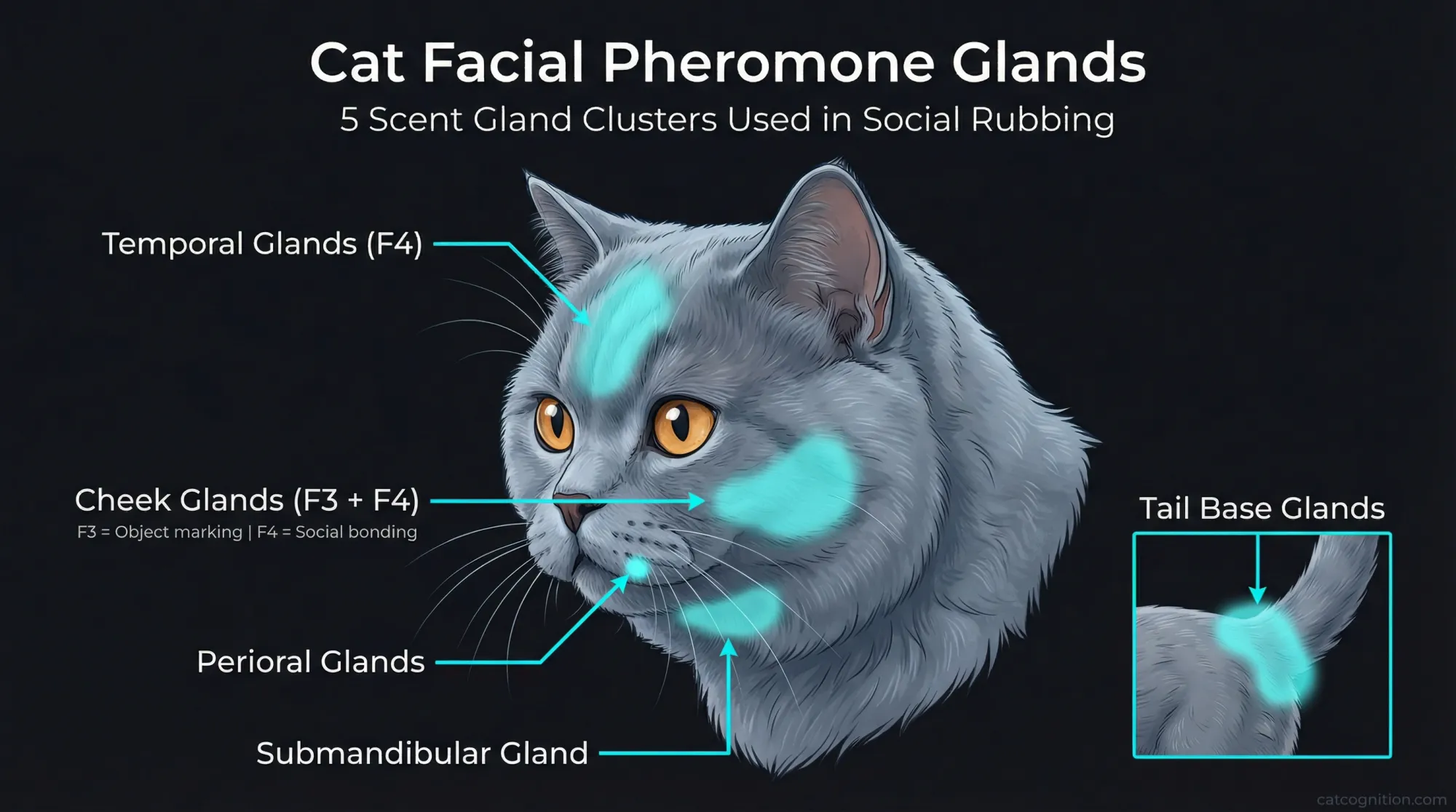
Cat headbutting -- a behavior called bunting -- deposits pheromones from temporal and cheek glands concentrated on the forehead and sides of the face. Bunting activates gland clusters that produce the F4 social pheromone fraction, making cat headbutting one of the strongest affiliative signals in the feline behavioral repertoire.
The anatomy behind bunting explains why cats press specific parts of their head against people. Cats possess specialized sebaceous glands concentrated on the forehead (temporal glands), cheeks, chin (submandibular gland), lip corners (circumoral glands), and the base of the tail. Each gland cluster produces slightly different chemical compounds.
When a cat headbutts a person, the temporal glands on the forehead and the cheek glands along the jaw are the primary sites of pheromone deposition. These are also the exact regions where cats prefer to be touched. Research by Haywood, Finka, and colleagues, published in Frontiers in Veterinary Science (2021), found that cats show the highest positive responses when touched at the base of the ears, cheeks, and under the chin -- the precise locations of the facial scent glands activated during bunting. The same study found that the tail base produced the highest negative-response rate of any body region. Understanding these preferred zones is essential to the science of petting cats correctly.
"Cats prefer being touched at the base of ears, cheeks, and under the chin -- the exact locations of facial scent glands activated during bunting. The tail base produced the highest negative-response rate." (Haywood, Finka et al. 2021, Frontiers in Veterinary Science)
This alignment between preferred petting zones and scent gland locations is not coincidental. When a human scratches a cat's cheek, the human is stimulating the same glands the cat activates during bunting. The cat may be encouraging a bidirectional scent exchange -- allowing its pheromones to transfer to the human's hand while simultaneously reading the human's scent through lateralized nostril processing.
Why Do Cats Rub Against Your Legs?
Cats rub against human legs using a full-body scent-deposition sequence -- nose first, then cheek, flank, and tail wrap -- that activates multiple gland clusters in a consistent pattern. In a modified Secure Base Test, 83% of cats rubbed against the caregiver upon reunion, making leg-rubbing the dominant feline greeting behavior.
The greeting context is particularly telling. A 2026 study by Salgirli Demirbas and colleagues in Ethology documented that cats deploy a multimodal greeting sequence combining 3 distinct signal types when reuniting with caregivers -- tail-up posture, vocalization, and physical rubbing coordinated into a single protocol. The study also found that cats greeting male caregivers produced more vocalizations during this sequence, suggesting cats adjust the greeting based on the individual recipient.
"In one study using a modified Secure Base Test, 83% of cats rubbed against their owner following a separation, establishing allorubbing as the dominant feline reunion behavior." (Behnke, Vitale & Udell 2021, Applied Animal Behaviour Science)
Multiple studies confirm that the tail-up position is an affiliative visual signal that precedes rubbing in the vast majority of cat-human greetings. Cameron-Beaumont (1997) established through silhouette experiments that cats approach a tail-up signal significantly more readily than a tail-down signal. Think of the full leg-rubbing sequence as a reunion handshake: the tail-up is the wave, the vocalization is the verbal greeting, and the physical rubbing is the chemical handshake that refreshes the colony scent. This greeting behavior is one of the clearest signs your cat considers you part of its social group.
Moon's reunion rubs follow a predictable pattern that I've timed on several occasions. When I return after being out for more than two hours, Moon meets me at the door with a full nose-cheek-flank-tail sequence that lasts about four seconds per leg. After shorter absences -- thirty minutes to an hour -- the greeting abbreviates to a head-only bunt against my ankle. On mornings after a full night apart, the rubbing is the most elaborate: both legs, full sequence, often with a tail wrap tight enough that I can feel the fur pressure through my jeans.
Why Do Cats Rub Their Face on Things?
Cats rub faces on objects to deposit the F3 facial pheromone fraction, which is chemically distinct from the F4 fraction deposited during social rubbing on people. Research suggests the F3 pheromone creates a chemical "nest scent" that reduces feline distress and makes the environment feel familiar and safe.
Object rubbing serves a fundamentally different communicative purpose than social rubbing. When a cat rubs its cheek against a doorframe, a chair leg, or a table corner, the cat is creating environmental familiarity -- not marking territory in the aggressive sense that the word "marking" implies.
Zhang and colleagues documented in a 2022 review published in Frontiers in Veterinary Science that the F3 pheromone fraction functions as a familiarity signal. The commercial pheromone product Feliway is a synthetic analogue of the F3 fraction, designed to reduce stress behaviors by mimicking this "nest scent." However, Zhang's review noted that existing studies "sometimes constitute weak evidence" for synthetic pheromone therapy, indicating the clinical evidence base remains uneven.
Cats preferentially rub on protruding objects at cat height -- corners, furniture edges, door frames -- because these surfaces efficiently collect and retain oily pheromone secretions. If a cat rubs excessively on objects but rarely rubs on household members, the cat may feel environmentally insecure rather than socially bonded.

Why Do Stray Cats Rub Against Your Legs?
Stray and socialized outdoor cats that rub against unfamiliar humans are executing an information-gathering protocol rather than requesting affection. The rubbing deposits the cat's scent on the stranger while simultaneously allowing the cat to sample the stranger's chemical profile through nose contact, making rubbing a bidirectional scent exchange rather than a one-way deposit.
A stray cat rubbing against a stranger's legs is not necessarily inviting petting. The cat is conducting what amounts to a scent interview -- depositing its own chemical signature while reading the human's.
Preliminary research by Miyairi and colleagues (2025) tested 30 domestic cats across 3 experimental conditions and found a statistical tendency for cats to process unfamiliar human odors using the right nostril initially (associated with novel or alerting stimuli), with a pattern of shifting toward left-nostril processing as the scent becomes familiar. This lateralized nostril pattern suggests different brain hemispheres may be engaged for novel versus familiar scent processing. However, the authors explicitly note that the study "cannot indicate whether cats recognize specific persons" -- so the sniffing component of rubbing reflects general novelty-familiarity discrimination rather than confirmed individual recognition.
"Domestic cats discriminate between familiar and unfamiliar human odors using lateralized nostril processing -- right nostril for novel scents, left nostril for familiar scents -- suggesting different brain hemispheres process social versus unknown chemical signals." (Miyairi et al. 2025, PLoS ONE)
Importantly, a cat rubbing against a stranger is almost certainly a stray (a previously socialized cat) rather than a truly feral cat. Feral cats -- those never socialized to humans during the critical 2-to-7-week primary sensitive period (some sources extend this window to 9 weeks) -- avoid human contact entirely. A cat that approaches and rubs against an unfamiliar person has neural wiring for human interaction that was established during kittenhood. For more on this distinction, see our guide to the difference between stray and feral cats.
The appropriate response when a stray cat rubs against you: let the cat complete the sequence. Do not reach down to pet immediately. The cat is gathering information, not necessarily requesting touch. Allow the cat to finish and observe whether the cat maintains proximity or moves away. Continued proximity after the rub is a stronger invitation for interaction than the rub itself.
What Is Cat Bunting?
Bunting is the behavior where a cat presses its forehead, cheeks, or chin against a person, animal, or object to deposit facial pheromones from the temporal, cheek, and submandibular glands. Bunting is affiliative -- not dominance or territorial claiming -- and the term comes from its resemblance to a gentle head-butt.
A common misconception frames bunting as a cat "claiming ownership" over a person or object. Research does not support this framing. Dr. John Bradshaw's work on feline social behavior establishes that rubbing is an affiliative, distance-reducing behavior. Cats feeling insecure or territorial mark with urine, not head rubs.
Cat rubbing is NOT a dominance display or territorial "claim." Rubbing tends to flow from smaller to larger individuals -- a directional pattern observed in mother-kitten, female-to-male, and smaller-to-larger cat relationships. This pattern mirrors the kitten-to-mother dynamic and is affiliative, not dominance-based. Current feline behavior literature explicitly rejects dominance hierarchy as a framework for understanding cat body language.
The directional pattern of rubbing is one of the most consistent findings in the literature. Multiple observational studies demonstrate that rubbing tends to flow from smaller cats to larger cats, from kittens to mothers, and from females to males. When a domestic cat rubs against a human, the cat is following the same directional pattern -- the smaller individual initiating contact with the larger -- using the behavioral repertoire established in the mother-kitten relationship.
Preliminary research with 22 participants at the University of Tsukuba (2025) suggests that the physical sensation of bunting -- replicated using a soft robot delivering 40-second bunting motion trials -- may reduce human tension, though the researchers acknowledged that the effect may not be specific to bunting itself versus general novel interaction. The study, published in ACM Transactions on Human-Robot Interaction, provides early objective evidence that being on the receiving end of bunting has measurable physiological effects for the human recipient.
Why Do Cats Rub Against You Then Bite?
The rub-then-bite sequence is an overstimulation response, not aggression or mixed signals. During rubbing and subsequent petting, sensory input accumulates until the cat reaches its individual tolerance threshold. The bite is the cat's nervous system responding to sensory overload after the pleasant window has closed.
The sequence typically follows a predictable pattern. The cat initiates rubbing, the human reciprocates with petting, and the continued tactile stimulation crosses from pleasant to overwhelming. Dr. Lauren Finka's research shows cats have a clear preference for minimal-contact interaction -- and the worst petting zone is the tail base, which many owners stroke during a rubbing exchange.
Watch for precursor signals that indicate a cat is approaching its overstimulation threshold:
| Warning Signal | What It Looks Like | Urgency |
|---|---|---|
| Skin rippling | Visible twitching along the back muscles | Early warning -- reduce contact |
| Tail tip flicking | Rapid side-to-side motion of the tail tip only | Moderate -- stop petting now |
| Ear rotation | Ears rotating backward toward flat position | High -- withdraw hands slowly |
| Pupil dilation | Sudden widening of the pupils | Imminent -- the bite is coming |
When any of these signals appear, stop touching immediately and let the cat disengage. Do not punish post-rub biting. The cat is not being aggressive -- the nervous system reached its limit. The cat did warn you; the signals were just in cat language.
Why Do Cats Mark Their Territory?
Cats mark their environment through two distinct chemical systems: facial rubbing deposits pheromones from sebaceous glands to create familiarity and social cohesion, while urine spraying deposits signals associated with territorial anxiety and sexual communication. Rubbing residue is potent enough to trigger defensive behavior in rats for up to four days.
The distinction between facial marking and urine marking matters. When a cat rubs its face on a doorframe, the cat is building environmental familiarity -- saying "this is safe." When a cat sprays urine on a wall, the cat is communicating territorial anxiety or reproductive status -- a fundamentally different message.
May and colleagues documented in a 2012 study that chemical residue from cat body rubbing triggers defensive behavior in rats persisting for up to four days following a single exposure. The rats did not encounter a live cat -- the rubbing residue alone activated prey-defense responses, demonstrating the potency of chemical signals deposited during rubbing.
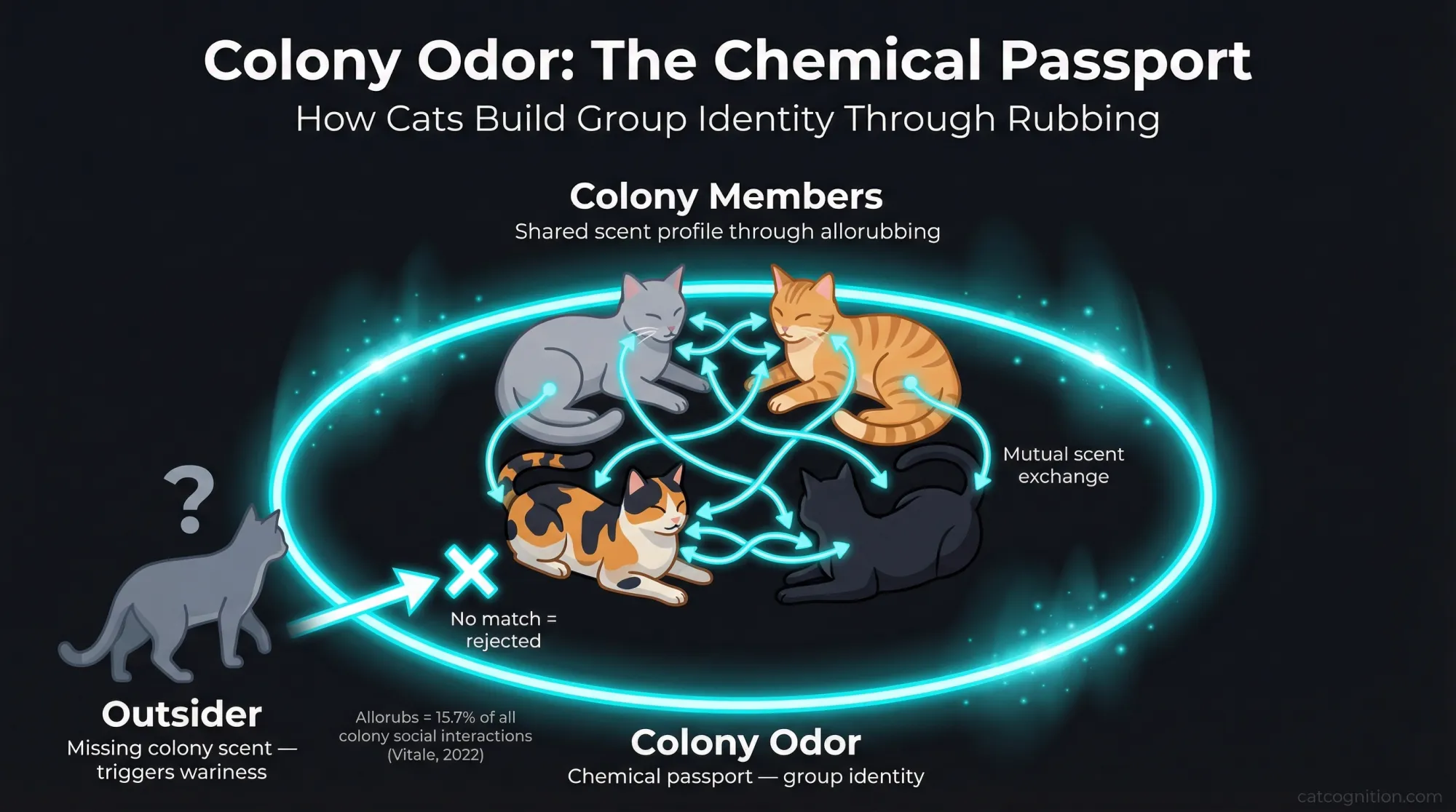
In free-ranging cat colonies, rubbing serves a group-cohesion function. Multiple observational studies confirm that cats maintain a shared colony odor through allorubbing, using mutual scent exchanges to identify group members. In a comprehensive review, Crowell-Davis, Curtis, and Knowles (2004) documented that colony members develop a shared chemical identity through these exchanges -- a chemical passport where cats that smell like the group are treated as members, while outsiders trigger wariness.
"Chemical residue from cat body rubbing triggers defensive behavior in rats persisting for up to four days after a single exposure, demonstrating the biological potency of the chemical signals deposited during rubbing." (May et al. 2012, Physiology & Behavior)
At Church Farm colony in the UK, allorubs accounted for 15.7% of all social interactions (Vitale 2022). In a separate observational study, Deputte et al. (2021) documented 254 cat-cat interactions among 29 cats over 100 hours, confirming the tail-up posture as a key affiliative signal preceding rubbing. Combined with allogrooming, affiliative behaviors dominated colony social life -- far outweighing aggressive interactions within the group.
Cats that groom each other are running a similar social bonding program -- for more on why cats lick their human companions, the mechanism shares the same affiliative roots. Pheromones degrade over time, which explains why cats re-rub the same surfaces and the same people daily. Avoid washing rubbed surfaces with strong-scented cleaners -- this erases the cat's scent marks and forces the cat to re-mark from scratch, potentially increasing rubbing frequency or triggering anxiety behaviors.
The Emotional Dimension: Do Cats Adjust Rubbing to Human Mood?
Observational research spanning more than 20 years by Dr. Dennis C. Turner at the Institute for Applied Ethology and Animal Psychology in Switzerland suggests cats may adjust rubbing behavior in response to human emotional states. Turner's 2021 review in Frontiers in Veterinary Science summarized decades of observational work indicating that cats increase head-rubbing and flank-rubbing on humans displaying depressive emotional states.
This finding should be interpreted carefully. Turner's paper is a mini review summarizing career observations, not a controlled experiment. The observation that cats rub more when humans are depressed could reflect cats responding to behavioral changes (reduced movement, more time seated) rather than "detecting" depression in any conscious sense. This kind of responsiveness is part of the broader reciprocal dynamic that makes cats such effective companions -- something explored further in our guide to why cats choose to sleep with their owners.
Turner also documented a reciprocal compliance dynamic: cats whose owners respond to rubbing initiations are themselves more responsive to their owner's interaction bids. The more a human respects the cat's communication attempts, the more the cat cooperates with the human's.

Key Terms
- Bunting: Head-rubbing behavior where cats press and rub the forehead, cheeks, or chin against objects or people to deposit facial pheromones from temporal and cheek glands. An affiliative signal, not a dominance display.
- Allorubbing: The scientific term for cats rubbing against other cats, humans, or companion animals as a social bonding behavior. "Allo" means "other" in Greek. Distinct from autogrooming (self-grooming) or object rubbing.
- Facial pheromone fractions (F1-F5): Five distinct chemical signals secreted from sebaceous glands on a cat's head, identified by Patrick Pageat in a 1998 patent (US Patent 5,709,863). F3 is deposited during object rubbing for environmental familiarity. F4 is deposited during social rubbing for bonding.
- Colony odor: A shared group scent created and maintained through mutual allorubbing among cats in the same social group. Functions as a chemical passport identifying group members and signaling affiliative intent.
- Tail-up posture: A vertical tail position functioning as an affiliative visual signal, typically displayed when a cat approaches another cat or human with friendly intent. Precedes rubbing in most cat-human greeting interactions.
- Kairomone: A chemical signal produced by one species (cats) that is intercepted and used by another species (rats) for survival advantage. Relevant to how rubbing deposits function as cross-species chemical communication.
Frequently Asked Questions
Why does my cat rub against me then bite?
The rub-then-bite pattern is an overstimulation response, not aggression. During rubbing and subsequent petting, sensory input accumulates until the cat reaches its individual tolerance threshold. Watch for precursor signals: skin rippling along the back, tail tip twitching, or ears rotating backward. When any of these appear, stop touching immediately and let the cat disengage. The cat is not being "mean" -- the nervous system reached its limit.
Why does my cat rub on everything in the house but not on me?
Object rubbing deposits the F3 pheromone fraction, which creates environmental familiarity. If a cat rubs excessively on furniture, doorways, and corners but rarely rubs on household members, the cat may feel environmentally insecure rather than socially bonded. Increasing calm, non-forceful social interaction and allowing the cat to initiate rubbing on its own terms can help shift the balance toward social rubbing.
Do cats rub their teeth on you?
When cats appear to rub their teeth on a person, the cat is actually depositing pheromones from the circumoral (perioral) glands located at the lip corners. The behavior often looks like the cat is dragging the side of its mouth along the human's hand or chin. The circumoral glands are part of the same facial scent-gland system activated during cheek and chin rubbing.
Why does my cat nuzzle my face specifically?
Cats target human faces because the face is the primary zone for cat-to-cat allogrooming and allorubbing. In feline social groups, head-to-head contact is the highest-value affiliative signal. A cat nuzzling a human face is performing the most socially significant version of bunting -- the feline equivalent of a close embrace rather than a casual wave.
Does my cat rubbing against me mean my cat loves me?
Cat rubbing indicates the cat considers the human a member of its social group and is maintaining the shared colony scent that identifies group members. Whether this constitutes "love" depends on how broadly one defines the term. The behavior is affiliative, socially bonding, and associated with reduced stress for the cat. Framing rubbing as "colony membership maintenance" rather than human-style love more accurately reflects what the research supports.
Should I rub my cat back when it rubs against me?
After a cat completes its rubbing sequence, reciprocating by touching the three preferred scent-gland zones -- base of ears, cheeks, and under the chin -- creates a bidirectional scent exchange that reinforces the social bond. Avoid the tail base, which produces the highest negative-response rate in petting studies. Let the cat finish the full rubbing sequence before reciprocating.
Why does my unneutered female cat rub excessively?
Unneutered female cats rub more than usual during estrus (heat) as part of mating behavior. The F2 pheromone fraction is associated with sexual contexts. Excessive rubbing combined with rolling on the floor, increased vocalization, and lordosis posturing (arched back with raised hindquarters) indicates estrus rather than normal affiliation. Consult a veterinarian about spaying.
When should I be worried about my cat's rubbing behavior?
Seek veterinary evaluation if: (1) a cat presses its head firmly against walls while appearing disoriented (head pressing -- neurological emergency), (2) rubbing behavior increases or decreases dramatically, especially with other behavioral changes, (3) rubbing is accompanied by excessive drooling, facial swelling, or pawing at the mouth (potential dental disease), or (4) a previously affectionate cat stops rubbing entirely (possible pain or illness).
Key Takeaways
Colony scent, not ownership: Cats rub against humans to create and maintain a shared colony odor using facial pheromones -- the same bonding mechanism used with other cats in free-ranging colonies. Rubbing is affiliative group maintenance, not territorial "claiming."
Different rubs mean different things: Head-only bunting deposits F4 social pheromones for bonding. Full-body leg rubbing layers multiple gland secretions during reunion greetings. Object rubbing deposits F3 pheromones for environmental familiarity. Context and body part determine the message.
Rubbing is bidirectional: Cats are not just depositing scent on humans -- cats simultaneously read the human's chemical profile during the rubbing motion, using lateralized nostril processing to discriminate familiar from unfamiliar scents.
The rub-then-bite is overstimulation: When cats bite after rubbing, the nervous system has exceeded its sensory threshold. Watch for skin rippling, tail-tip flicking, and ear rotation to withdraw before the bite occurs.
Head pressing is not bunting: Fluid, sweeping head-rubbing with normal alertness is bunting. Sustained head-pressing against walls with disorientation is a neurological emergency requiring immediate veterinary attention.
Sources
- Normal feline behaviour: and why problem behaviours develop - Bradshaw, J.W.S. (2018), Journal of Feline Medicine and Surgery (Link)
- The Social Lives of Free-Ranging Cats - Vitale, K.R. (2022), Animals (Link)
- Social organization in the cat: A modern understanding - Crowell-Davis, S.L., Curtis, T.M., & Knowles, R.J. (2004), Journal of Feline Medicine and Surgery (Link)
- The Mechanics of Social Interactions Between Cats and Their Owners - Turner, D.C. (2021), Frontiers in Veterinary Science (Link)
- Providing Humans With Practical, Research-Based Handling Guidelines During Cat-Human Interactions - Haywood, C., Finka, L.R. et al. (2021), Frontiers in Veterinary Science (Link)
- Behavioral responses of domestic cats to human odor - Miyairi, K. et al. (2025), PLoS ONE (Link)
- Feline Facial Pheromones - Pageat, P. (1998), US Patent 5,709,863 (Link)
- Feline Communication: Pheromones and Their Impact - Zhang, L. et al. (2022), Frontiers in Veterinary Science (Link)
- The effect of owner presence and scent on stress resilience in cats - Behnke, A.C., Vitale, K.R., & Udell, M.A.R. (2021), Applied Animal Behaviour Science (Link)
- Cat body rubbing residue triggers defensive behavior in rats - May, M.D. et al. (2012), Physiology & Behavior (Link)
- Heads and Tails: An Analysis of Visual Signals in Cats, Felis catus - Deputte, B.L. et al. (2021), Animals (Link)
- Greeting Vocalizations in Domestic Cats Are More Frequent With Male Caregivers - Salgirli Demirbas, D. et al. (2026), Ethology (Link)
- Development of a Robotic Device that Performs Head Bunting to Relieve User Tension - Adachi, Y. & Tanaka, F. (2025), ACM Transactions on Human-Robot Interaction (Link)
- Visual and tactile communication in the domestic cat (Felis silvestris catus) and undomesticated small felids - Cameron-Beaumont, C. (1997), PhD thesis, University of Southampton (Link)
- What are Cat Pheromones? - AVSAB (Link)