Why Does My Cat Meow at Night? A Vet-Backed Diagnosis Guide
Nighttime meowing is a decodable signal that maps to your cat's age. Use the CatCog Nighttime Meow Decoder to match age, timing, and pitch to the correct cause — from hunger to cognitive dysfunction.


Table of Contents
- Why Do Cats Meow at Night?
- What Causes Cats to Meow at Night?
- How Can You Decode Your Cat's Nighttime Meows?
- Why Does Nighttime Meowing Get Worse Before It Stops?
- The CatCog Bedtime Protocol
- When to See a Vet
- Age-Specific Guide
- Key Terms
- Frequently Asked Questions
- Key Takeaways
- Sources
Cats meow at night because the meow is a human-directed communication signal driven by one of seven age-dependent causes: hunger, crepuscular activity drive, learned attention-seeking, separation distress, medical conditions (cognitive dysfunction, hyperthyroidism, hearing loss), reproductive drive, or environmental change. Identifying the correct cause requires matching the cat's age, the meow's timing, and the meow's pitch direction. For more on how cats use vocalizations to communicate with humans, see our complete guide to cat communication.
You have not slept through the night in weeks. The meowing starts at 3 AM --- sometimes a short, insistent chirp, sometimes a long yowl that echoes through the house. Every article you find gives the same generic list of reasons without telling you which one applies to your cat.
Research from Dr. Susanne Schötz of Lund University's Meowsic Project, Dr. Danielle Gunn-Moore at the University of Edinburgh, and Dr. Mikel Delgado at Purdue University converges on a single insight: nighttime meowing is a decodable communication signal with diagnostic patterns that vary predictably by age. The pitch of the meow, the timing of the episodes, and the cat's life stage point to a specific cause --- and each cause has a different solution. If your cat is meowing excessively during the day as well, our guide to why cats meow so much covers the broader diagnostic framework.
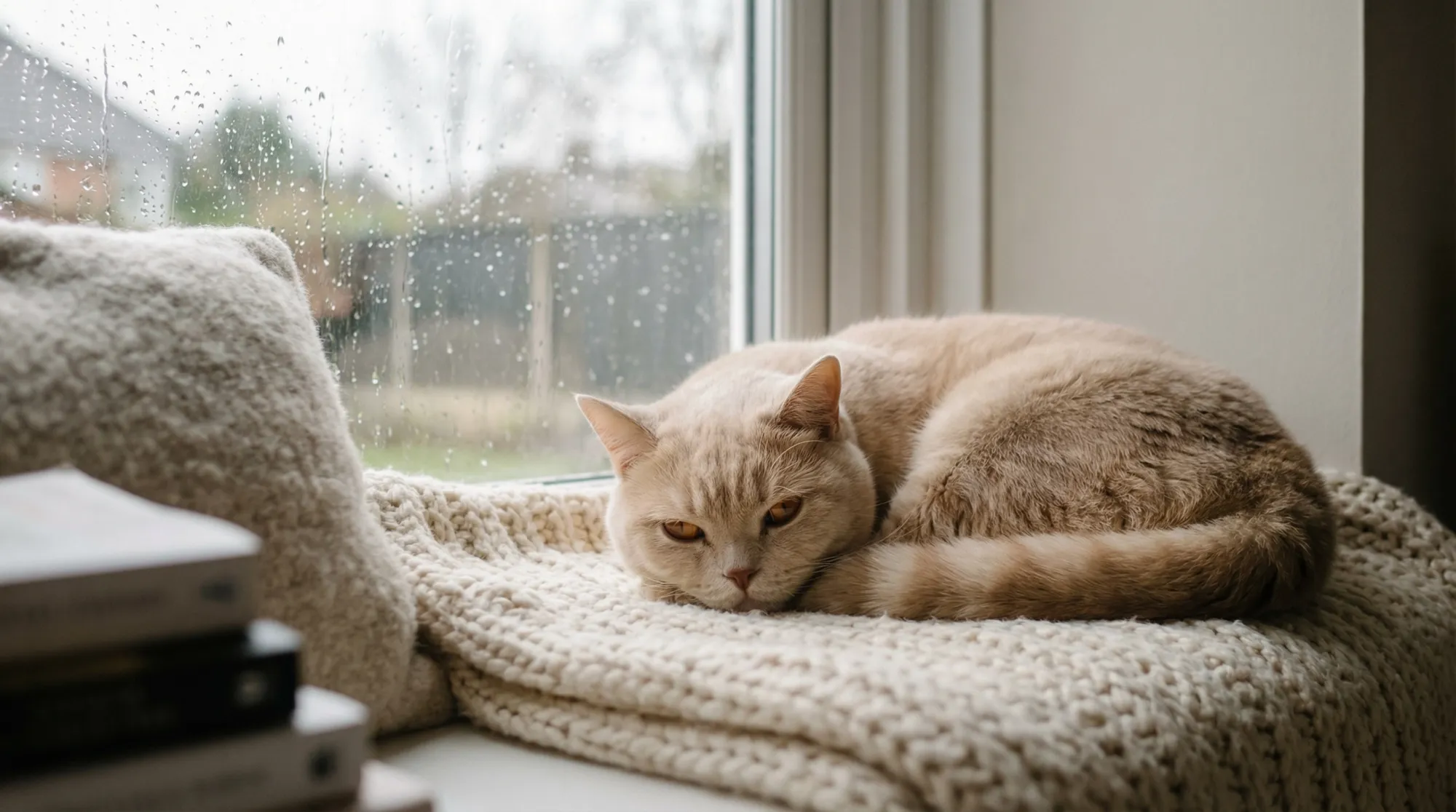
Why Do Cats Meow at Night?
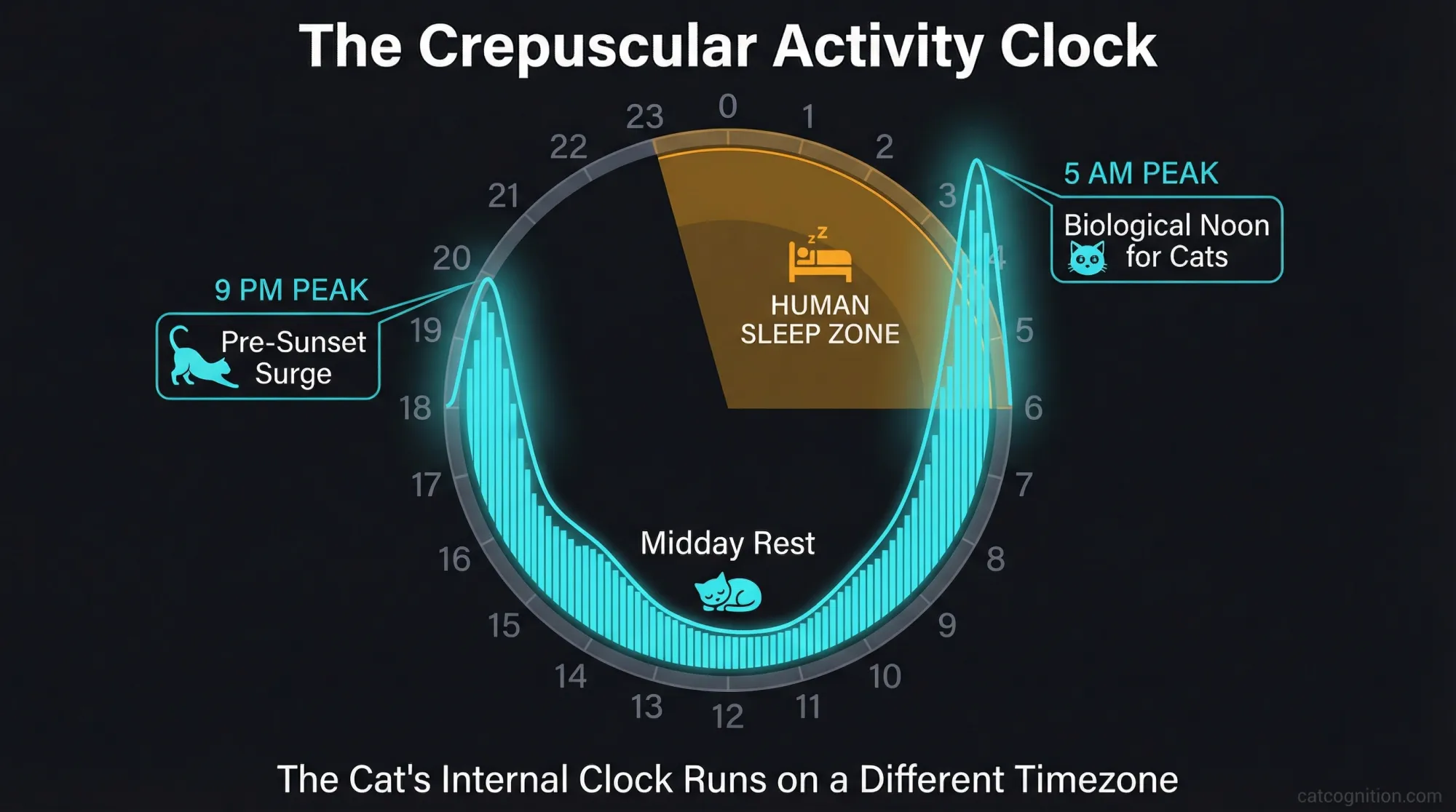
Cats meow at night because the domestic cat is primarily crepuscular with nocturnal tendencies, producing hardwired activity peaks at approximately 5 AM and 9 PM --- both peaks overlapping human sleep. The meow evolved specifically for human communication, not cat-to-cat signalling, making nighttime vocalization a human-directed signal driven by age-dependent causes.
Tavernier et al. (2020) established that the domestic cat vocal repertoire contains up to 21 distinct vocalizations --- more complex than any other carnivore --- and that the meow is rare in cat-cat interactions but among the most common vocalizations in cat-human interactions (Tavernier et al., 2020, Journal of Veterinary Science). Parker et al. (2019) tracked 14 cats living in a cattery 24/7 using RFID telemetry and found two clear activity peaks: one before sunrise and one before sunset, with nighttime activity never dropping to zero (Parker et al., 2019, Animal Biotelemetry). A 2023 chronobiology study confirmed free-ranging cats peak at approximately 21:00 and 05:00, describing cats as "nocturnal/crepuscular." The common claim that cats are "not nocturnal at all" oversimplifies the biology. Think of the cat's internal clock as running on a different timezone --- the 5 AM activity peak is the cat's biological noon.
Parker et al. (2019) found that domestic cats have bimodal activity peaks before sunrise and before sunset, with nighttime activity never dropping to zero. A 2023 chronobiology study pinpointed these peaks at approximately 05:00 and 21:00 in free-ranging cats. --- Parker et al. 2019, Animal Biotelemetry; Applied Animal Behaviour Science, 2023
What Causes Cats to Meow at Night?
The cause of nighttime meowing maps to the cat's age and the pattern of the vocalization. Seven age-dependent causes --- hunger, crepuscular drive, learned attention-seeking, separation distress, medical conditions, reproductive drive, and breed-typical behaviour --- each produce distinct vocal signatures. A kitten crying at 2 AM and a 14-year-old cat yowling at 2 AM require entirely different responses.
Hunger and Feeding Misalignment
Cats naturally eat 8--16 small meals per day when given free choice (Delgado & Dantas, 2020, Veterinary Clinics of North America). A cat fed two large meals experiences a 10--12 hour overnight gap that overlaps the crepuscular peak. Preliminary data from Dr. Susanne Schötz's Meowsic Project --- which analysed 1,591 vocalizations from 54 cats --- found that food-related meows tend to have rising pitch contours. These findings have not been independently replicated, so pitch direction is a helpful indicator rather than a definitive diagnostic.
Crepuscular Drive
Wild cats catch as many as 20 small prey per day, and dawn and dusk provide optimal light for a predator with a tapetum lucidum. As Dr. John Bradshaw notes in Cat Sense, indoor cats retain this core crepuscular rhythm even when food is freely available. Ohio State University's Indoor Pet Initiative notes that late-evening bursts of activity are a normal expression of this biological clock.
Learned Attention-Seeking
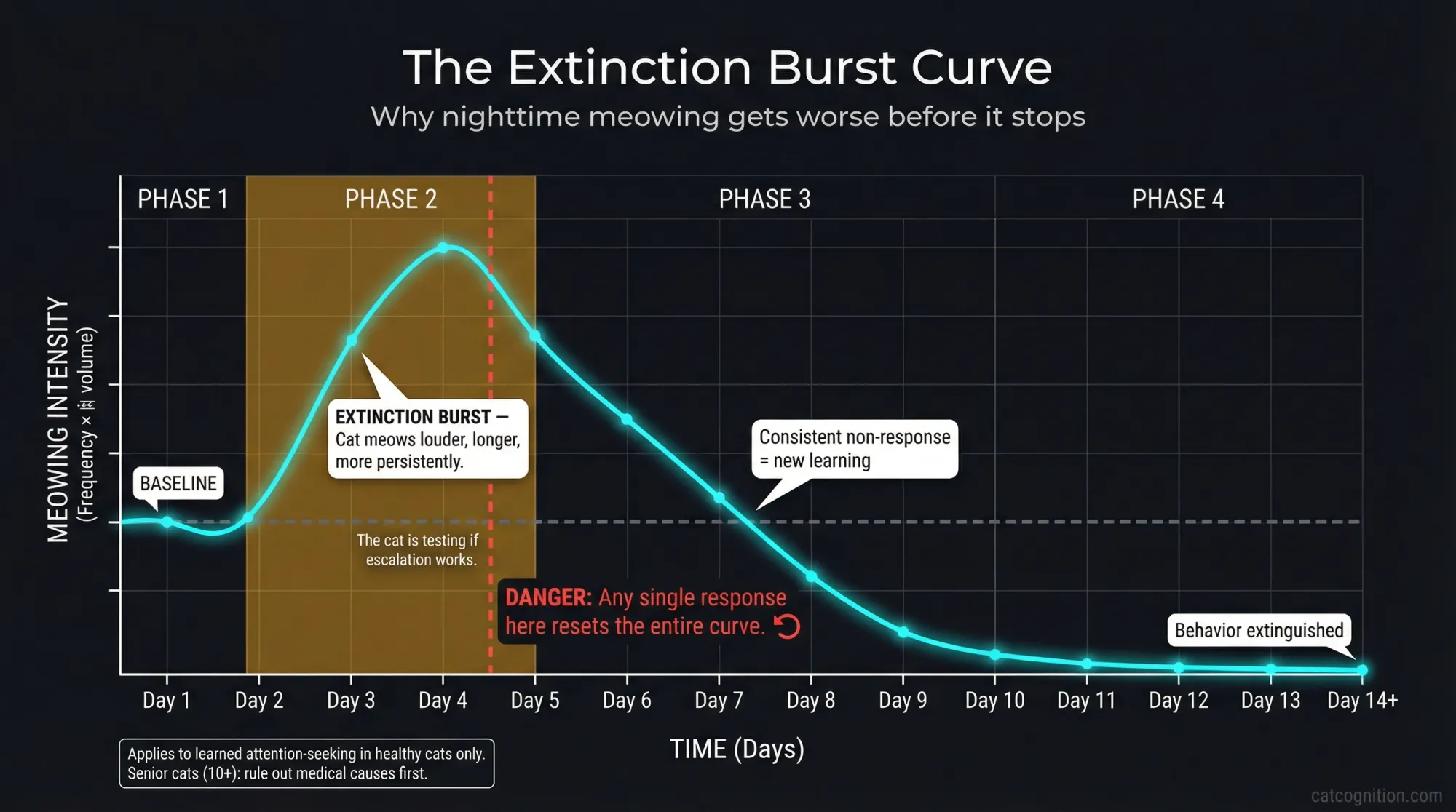
Every owner response to a nighttime meow --- getting out of bed, yelling, opening a door, even making eye contact --- constitutes reinforcement. The diagnostic marker: a cat that meows while looking directly at the owner is performing for an audience. A cat meowing while wandering aimlessly is not. Understanding your cat's body language signals can help distinguish these patterns. Vicky Halls, a registered veterinary nurse and behaviour counsellor, described the consequence of stopping the response in the Journal of Feline Medicine and Surgery: "A phenomenon referred to as 'extinction burst' may occur initially, with the cat increasing the behaviour in the short term when the reinforcement is removed" (Halls, 2018, JFMS).
Separation Distress
A 2019 study by Dr. Kristyn Vitale at Oregon State University found that 65.8% of cats demonstrated secure attachment to their owners (Vitale et al., 2019, Current Biology). Both securely and insecure-ambivalent attached cats vocalized significantly more during separation. A kitten meowing at night is exhibiting attachment behaviour, not misbehaving.
Medical Causes (Senior Cats 10+)
For cats over 10, sudden-onset nighttime meowing is a medical red flag. Five conditions commonly present as nighttime vocalization.
Cognitive Dysfunction Syndrome (CDS). Survey data suggests inappropriate vocalization affects approximately 40% of cats screening positive for CDS (MacQuiddy et al., 2022, JFMS). Note: MacQuiddy's survey had a 14.2% response rate, so owners of cats with noticeable problems may have been overrepresented. Dr. Gunn-Moore proposed the VISHDAAL framework --- placing Vocalisation first because owners report it most frequently (Sordo & Gunn-Moore, 2021, Veterinary Record). Approximately 28% of cats aged 11--14 and 50% of cats 15+ show at least one CDS-related behavioural change, though prevalence estimates range from 13% to over 50% depending on diagnostic criteria. CDS neuropathology shares features with Alzheimer's disease --- the nighttime vocalization may parallel "sundowning," though researchers note this analogy requires further investigation in cats.
Hyperthyroidism. Up to 10% of senior cats develop hyperthyroidism. Increased vocalization, particularly at night, is commonly reported in hyperthyroid cats. Sudden yowling with concurrent weight loss despite increased appetite indicates thyroid testing.
Hypertension. The Cornell Feline Health Center documents that hypertension causes retinal detachment and sudden blindness, leading to anxiety-driven vocalization --- especially at night when reduced visual cues compound vision loss (Cornell, 2024). Chronic kidney disease is found in at least 60% of hypertensive cats.
Pain. Cats in pain vocalize more at night because reduced ambient activity makes pain more salient. In one small survey (n=37), only 2.7% of owners of cats with CDS-related vocalization identified pain as the primary cause --- suggesting pain may be underrecognised, though the small sample limits interpretation (Cerna et al., 2020, Animals).
Hearing Loss. Age-related hearing loss begins around age 10. Cats with hearing loss cannot modulate vocal volume and produce louder vocalizations without realising the increase. Nighttime compounds the deficit: when visual cues disappear, a hearing-impaired cat vocalizes louder out of disorientation.
Survey data suggests inappropriate vocalization affects approximately 40% of cats screening positive for CDS, making it one of the most commonly reported signs --- though the most prevalent sign varies by age group. --- MacQuiddy et al. 2022, JFMS
Reproductive Vocalization
Intact cats produce loud, persistent calling that intensifies at night. Heat cycles recur every two to three weeks, with first heat possible at four months. Spaying or neutering resolves reproductive vocalization --- no behavioural intervention substitutes. If the vocalization sounds like sustained howling rather than short meows, our guide to caterwauling covers the acoustic differences and causes.
Breed-Typical Vocalization
Oriental breeds --- Siamese, Burmese, Oriental Shorthair --- are genetically predisposed to higher vocalization rates. Research from the University of Helsinki identified breed-specific behavioural traits across 4,300 cats (Mikkola et al., 2021, Animals). A Siamese meowing at night may express breed-typical behaviour rather than indicate a problem.

How Can You Decode Your Cat's Nighttime Meows?
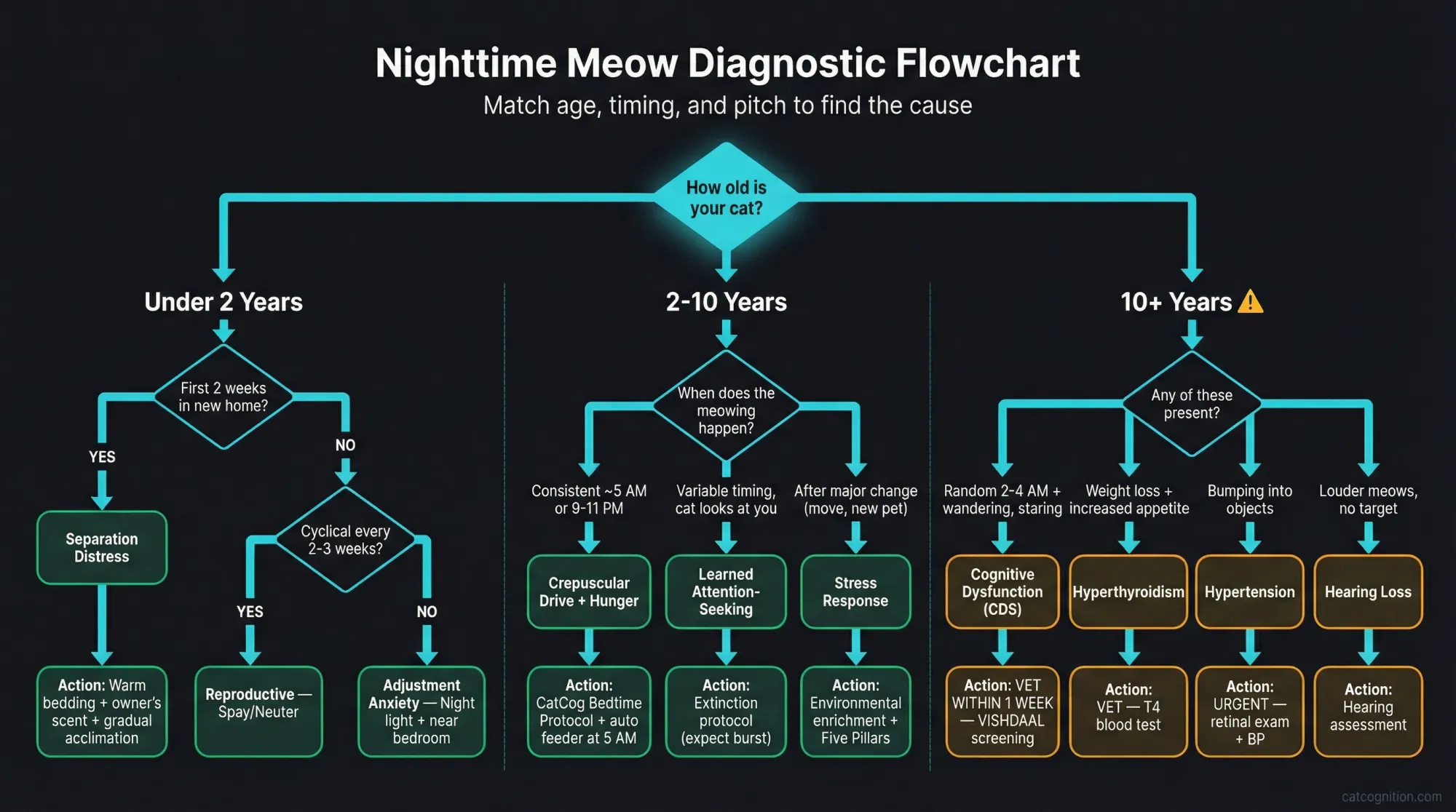
The CatCog Nighttime Meow Decoder combines three observable variables --- cat age, meow timing, and pitch direction --- to narrow the most likely cause of nighttime vocalization. Rising pitch contours correlate with hunger-related meows, while falling pitch contours correlate with stress-related meows, based on data from Schötz's Meowsic Project at Lund University.
1. Hunger + crepuscular drive (any age) — Consistent meowing around 5 AM with rising pitch. The cat's crepuscular activity peak coincides with an overnight feeding gap. First action: automatic feeder set to dispense at 5 AM.
2. Post-sunset crepuscular peak (any age) — Consistent meowing between 9--11 PM with rising pitch. The second daily activity peak hits as the owner winds down. First action: interactive play session followed by the largest meal of the day.
3. Separation distress (under 2 years) — Meowing during the first two weeks in a new home with falling pitch. The kitten is exhibiting attachment behaviour in an unfamiliar environment. First action: warm bedding with owner's scent and gradual acclimation.
4. Learned attention-seeking (2--10 years) — Variable timing, often when the owner is present, with short repeated meows. The cat has been reinforced by previous owner responses. First action: extinction protocol with complete non-response from all household members (expect an initial burst).
5. CDS / disorientation (10+ years) — Random meowing, especially between 2--4 AM, with falling pitch and loud volume. Cognitive dysfunction syndrome produces disoriented nighttime vocalization. First action: veterinary evaluation plus night lights to reduce disorientation.
6. Hyperthyroidism (10+ years) — Meowing at any time accompanied by weight loss, with any pitch pattern. Metabolic disease drives increased vocalization. First action: blood test for T4 levels within one week.
7. Reproductive (intact, any age) — Cyclical meowing every 2--3 weeks with long, caterwauling vocalization. Heat cycles produce persistent nighttime calling. First action: spay or neuter.
8. Breed-typical (Siamese / Oriental) — Frequent meowing at varied times with any pitch pattern. Oriental breeds are genetically predisposed to higher vocalization rates. First action: enrichment and adjusted expectations.
Additional diagnostics: Meowing at the same time nightly points to crepuscular drive or hunger. Random 2--4 AM meowing suggests CDS or pain. Two or more VISHDAAL signs alongside meowing warrant a veterinary evaluation. Pitch direction data comes from Schötz's Meowsic Project and has not been independently replicated --- treat as a starting point.
"Food-related meows tend to have rising pitch contours while stress-related meows tend to have falling pitch contours." --- Schötz, Meowsic Project, Lund University
Why Does Nighttime Meowing Get Worse Before It Stops?
When an owner stops responding to nighttime meowing, behaviorists generally observe an initial escalation --- the cat meows louder, longer, and more persistently. Halls (2018) described the mechanism: "the cat is attempting to reinstate the original reinforcement by intensifying the behaviour." The cat equivalent of a toddler who has always received candy at the checkout and is suddenly told "no."
Resolution typically takes days to weeks of complete non-response from all household members. Any single response during the burst resets the learning curve and teaches the cat that escalation works. The extinction burst is a sign the protocol is working, not failing.
The CatCog Bedtime Protocol
The CatCog Bedtime Protocol addresses the two most common behavioural causes --- crepuscular drive and hunger --- by mimicking the natural predatory sequence. Applied behaviourist Jackson Galaxy popularised the Hunt-Catch-Kill-Eat-Groom-Sleep framework, and Dr. Mikel Delgado's feeding research confirms the underlying science.
| Step | Timing | Action | Evidence |
|---|---|---|---|
| Hunt | 90 min before bed | 5--10 min interactive wand-toy play | Cecchetti et al. 2021: 5--10 min object play reduced prey brought home by 25% (n=355 cats) |
| Catch/Kill | End of play | Let cat "catch" the toy | Completing the predatory sequence prevents frustration |
| Eat | After play | Serve largest meal of the day | Delgado & Dantas 2020: late meal reduces nighttime activity |
| Groom/Sleep | Natural | Cat follows hardwired post-meal grooming-to-sleep sequence | Aligns cat's sleep window with owner's |
| Auto-feeder | 5 AM | Small portion decouples food from owner waking | Breaks the "meow at human = food" association |
Important caveat: No controlled trial has tested the combined protocol for nighttime vocalization specifically. The evidence base involves clinical reasoning: play reduces predatory arousal (Cecchetti 2021), late meals reduce nighttime activity (Delgado & Dantas 2020), and the combined approach is widely recommended by behaviourists.
Delgado & Dantas (2020) recommend feeding a large meal before bedtime and after an exercise session to reduce nighttime activity --- a common complaint of cat owners. --- Veterinary Clinics of North America

When to See a Vet
Sudden-onset nighttime meowing in cats over 10 is a medical red flag requiring veterinary evaluation within one week. Cognitive dysfunction, hyperthyroidism, hypertension, kidney disease, pain, and hearing loss all present as nighttime vocalization --- and each condition is treatable when caught early. ISFM recommends blood pressure screening every 12 months for cats aged 7--10 and every 6--12 months for cats 11+.
| Warning Sign | Possible Condition | Action |
|---|---|---|
| Sudden onset in cat 10+ | CDS, hyperthyroidism, hypertension, CKD | Vet exam within 1 week; bloodwork + BP |
| Meowing with wandering, staring at walls | Cognitive dysfunction syndrome | Describe VISHDAAL signs to vet |
| Weight loss despite increased appetite | Hyperthyroidism | T4 blood test within 1 week |
| Bumping into objects, reluctance to jump | Hypertension-induced blindness | URGENT: retinal exam + BP |
| Increased thirst, urination, litter changes | Chronic kidney disease | Bloodwork within 1 week |
| Signs of pain (hunching, hiding) | Arthritis, dental disease | Feline Grimace Scale assessment |
| Louder-than-usual meowing, no target | Age-related hearing loss | Hearing assessment |
Age-Specific Guide
Kittens (under 2 years). Primary causes: separation distress and adjustment anxiety. Provide warm bedding with the owner's scent, a heartbeat sound machine, a night light, and access near the bedroom. Use gradual acclimation over one to three weeks --- not extinction protocols.
Adults (2--10 years). Primary causes: crepuscular drive, hunger, and learned attention-seeking. The CatCog Bedtime Protocol is the first-line intervention. If meowing persists after two weeks, assess for enrichment deficits using the Five Pillars framework (Ellis et al., 2013, JFMS). Dr. Tony Buffington's Indoor Pet Initiative demonstrated that comprehensive environmental modification reduces stress-related behaviours significantly (P < 0.05) over 10 months (Buffington et al., 2006, JFMS). Understanding what your cat needs to be happy can help identify which environmental factors are missing.
Seniors (10+ years). Medical-first approach. Rule out CDS, hyperthyroidism, hypertension, kidney disease, pain, and hearing loss before behavioural intervention. For confirmed CDS: night lights, multiple resource stations per floor, antioxidant-enriched diet, consistent environment. As International Cat Care notes: "Providing your cat's quality of life is good, there's no reason why CDS should shorten their life" (iCatCare, 2024).


Key Terms
- Crepuscular: Most active during dawn and dusk; domestic cats are primarily crepuscular with nocturnal tendencies, producing activity peaks at approximately 5 AM and 9 PM
- Extinction burst: A temporary increase in behaviour frequency and intensity when reinforcement is first removed; nighttime meowing gets louder before the behaviour stops
- Operant conditioning: Learning through consequences; a cat repeats nighttime meowing when owner response reinforces the action
- VISHDAAL: Feline cognitive dysfunction screening acronym: Vocalisation, Interactions, Sleep-wake cycle, House-soiling, Disorientation, Activity, Anxiety, Learning (Sordo & Gunn-Moore, 2021)
- Cognitive dysfunction syndrome (CDS): Age-related neurodegenerative condition involving beta-amyloid and tau deposits, producing behavioural changes including nighttime vocalization; shares features with human Alzheimer's disease, though important differences exist
- Predatory motor sequence: The hunting behaviour chain (orient, stalk, chase, pounce, grab-bite, kill-bite, dissect); each stage can decouple and fire independently, forming the basis for the bedtime play protocol
Frequently Asked Questions
Should I ignore my cat meowing at night? For healthy adults (2--10 years) with confirmed learned attention-seeking: yes, but expect an extinction burst. For senior cats (10+): no --- rule out medical causes first. For kittens: gradual acclimation, not cold-turkey ignoring.
Why does my old cat yowl at night? The most common cause in cats over 10 is feline cognitive dysfunction, affecting 28% of cats aged 11--14 and 50% of cats 15+ (Sordo & Gunn-Moore, 2021). Hyperthyroidism, hypertension-induced blindness, hearing loss, and pain are also common --- all treatable.
How do I stop my cat from waking me up at 5 AM? Set an automatic feeder at 5 AM to decouple food from owner waking. Combine with the CatCog Bedtime Protocol: 5--10 minute play session, largest meal after play, consistent nightly timing.
Is my cat meowing out of spite? Cats lack the theory-of-mind complexity for deliberate retaliation. Nighttime meowing always communicates an unmet need --- hunger, crepuscular drive, separation distress, medical discomfort, or cognitive confusion. To learn more about how cats actually think and feel, see our guide to the psychology of cats.
Do some cat breeds meow more at night? Siamese, Burmese, and Oriental Shorthair breeds are genetically predisposed to higher vocalization rates. The CatCog Bedtime Protocol still helps, but complete silence may not be realistic for vocal breeds.
Can nighttime meowing be a sign of something serious? Yes. In cats over 10, sudden-onset nighttime meowing is a medical red flag. CDS, hypertension, hyperthyroidism, kidney disease, hearing loss, and untreated pain all present as nighttime vocalization. Veterinary evaluation with bloodwork and blood pressure screening is essential.
Will an automatic feeder solve the problem? An automatic feeder addresses hunger-driven meowing specifically. The feeder will not resolve learned attention-seeking, medical conditions, separation distress, or CDS. Diagnosis determines the right tool.
How long does the extinction burst last? No cat-specific study has measured extinction burst duration. Behaviorists generally observe the escalation lasting several days to weeks, depending on reinforcement history and consistency of household non-response.
Key Takeaways
Nighttime meowing is a decodable communication signal --- the cause maps predictably to the cat's age, and each cause requires a different intervention.
Cats are primarily crepuscular with nocturnal tendencies, producing activity peaks at approximately 5 AM and 9 PM that overlap both edges of human sleep.
For senior cats over 10, sudden-onset nighttime meowing is a medical red flag --- inappropriate vocalization is one of the most commonly reported signs of CDS, and hyperthyroidism, hypertension, hearing loss, and pain all require veterinary evaluation first.
The CatCog Bedtime Protocol (play, feed, groom, sleep) combined with an automatic feeder addresses crepuscular drive and hunger by mimicking the natural predatory sequence.
The extinction burst is expected and temporary --- behaviorists generally observe that meowing intensifies before stopping, and any single response during the burst resets the learning curve.
Sources
Tavernier, C., Ahmed, S., Houpt, K.A. & Yeon, S.C. (2020). Feline vocal communication. Journal of Veterinary Science, 21(1), e18. https://doi.org/10.4142/jvs.2020.21.e18
Parker, M., Lamoureux, S., Challet, E., Ract-Madoux, B., Deputte, B.L. & Serra, J. (2019). Daily rhythms in food intake and locomotor activity in a colony of domestic cats. Animal Biotelemetry, 7, Article 25. https://doi.org/10.1186/s40317-019-0188-0
Cerna, P., Gardiner, H., Sordo, L., Tornqvist-Johnsen, C. & Gunn-Moore, D.A. (2020). Potential causes of increased vocalisation in elderly cats with cognitive dysfunction syndrome. Animals (Basel), 10(6), 1092. https://doi.org/10.3390/ani10061092
Sordo, L. & Gunn-Moore, D.A. (2021). Cognitive dysfunction in cats: Update on neuropathological and behavioural changes plus clinical management. Veterinary Record, e3. https://doi.org/10.1002/vetr.3
MacQuiddy, B., Moreno, J., Frank, J. & McGrath, S. (2022). Survey of risk factors and frequency of clinical signs observed with feline cognitive dysfunction syndrome. JFMS, 24(12), e406--e416. https://doi.org/10.1177/1098612X221095680
Delgado, M.M. & Dantas, L.M.S. (2020). Feeding cats for optimal mental and behavioral well-being. Veterinary Clinics of North America, 50(5), 939--953. https://doi.org/10.1016/j.cvsm.2020.04.006
Cecchetti, M., Crowley, S.L., Goodwin, C.E.D. & McDonald, R.A. (2021). Provision of high meat content food and object play reduce predation of wild animals by domestic cats. Current Biology, 31(3), 477--483. https://doi.org/10.1016/j.cub.2020.12.044
Vitale, K.R., Behnke, A.C. & Udell, M.A.R. (2019). Attachment bonds between domestic cats and humans. Current Biology, 29(18), R864--R865. https://doi.org/10.1016/j.cub.2019.08.036
McComb, K., Taylor, A.M., Wilson, C. & Charlton, B.D. (2009). The cry embedded within the purr. Current Biology, 19(13), R507--R508. https://doi.org/10.1016/j.cub.2009.05.033
Halls, V. (2018). Tools for managing feline problem behaviours: Environmental and behavioural modification. JFMS, 20(11), 1005--1014. https://doi.org/10.1177/1098612X18806757
Ellis, S.L.H., Rodan, I., Carney, H.C. et al. (2013). AAFP and ISFM Feline Environmental Needs Guidelines. JFMS, 15(3), 219--230. https://doi.org/10.1177/1098612X13477537
Buffington, C.A.T., Westropp, J.L., Chew, D.J. & Bolus, R.R. (2006). Clinical evaluation of multimodal environmental modification (MEMO). JFMS, 8(4), 261--268. https://doi.org/10.1016/j.jfms.2006.02.002
Schötz, S. (2018). Melody in Human-Cat Communication (Meowsic). Lund University Publications. https://www.researchgate.net/publication/325415197
Landsberg, G.M., Denenberg, S. & Araujo, J.A. (2010). Cognitive dysfunction in cats. JFMS, 12(11), 837--848. https://doi.org/10.1016/j.jfms.2010.09.004
Cornell Feline Health Center (2024). Hypertension. https://www.vet.cornell.edu/departments-centers-and-institutes/cornell-feline-health-center/health-information/feline-health-topics/hypertension
Cornell Feline Health Center (2024). Cognitive Dysfunction. https://www.vet.cornell.edu/departments-centers-and-institutes/cornell-feline-health-center/health-information/feline-health-topics/cognitive-dysfunction
International Cat Care (2024). Cognitive dysfunction syndrome in cats. https://icatcare.org/articles/cognitive-dysfunction-syndrome-in-cats
Ohio State University Indoor Pet Initiative. Sleeping Habits. https://indoorpet.osu.edu/cats/understanding-cats/sleeping-habits
Mikkola, S., Salonen, M., Puurunen, J., Hakanen, E. & Lohi, H. (2021). Reliability and validity of seven feline behavior and personality traits. Animals, 11(7), 1991. https://www.mdpi.com/2076-2615/11/7/1991
Jackson Galaxy (2024). How to Train Your Cat to Let You Sleep. https://www.jacksongalaxy.com/blog/how-to-get-your-cat-to-stop-meowing-at-night
Delgado, M.M. et al. (2024). Identifying barriers to providing daily playtime for cats. Applied Animal Behaviour Science, 106339. https://doi.org/10.1016/j.applanim.2024.106339
Chronobiology of free-ranging domestic cats: Circadian, lunar and seasonal activity rhythms in a wildlife corridor (2023). Applied Animal Behaviour Science. https://doi.org/10.1016/j.applanim.2023.106091