What Do Cat Ear Positions Mean? The Science of Every Signal
Cat ears have 32 muscles and 7 distinct positions that predict interaction outcomes better than tail signals. Learn what each ear position means, from friendly forward to pain-indicator flattening, using the CatFACS coding system and Feline Grimace Scale.

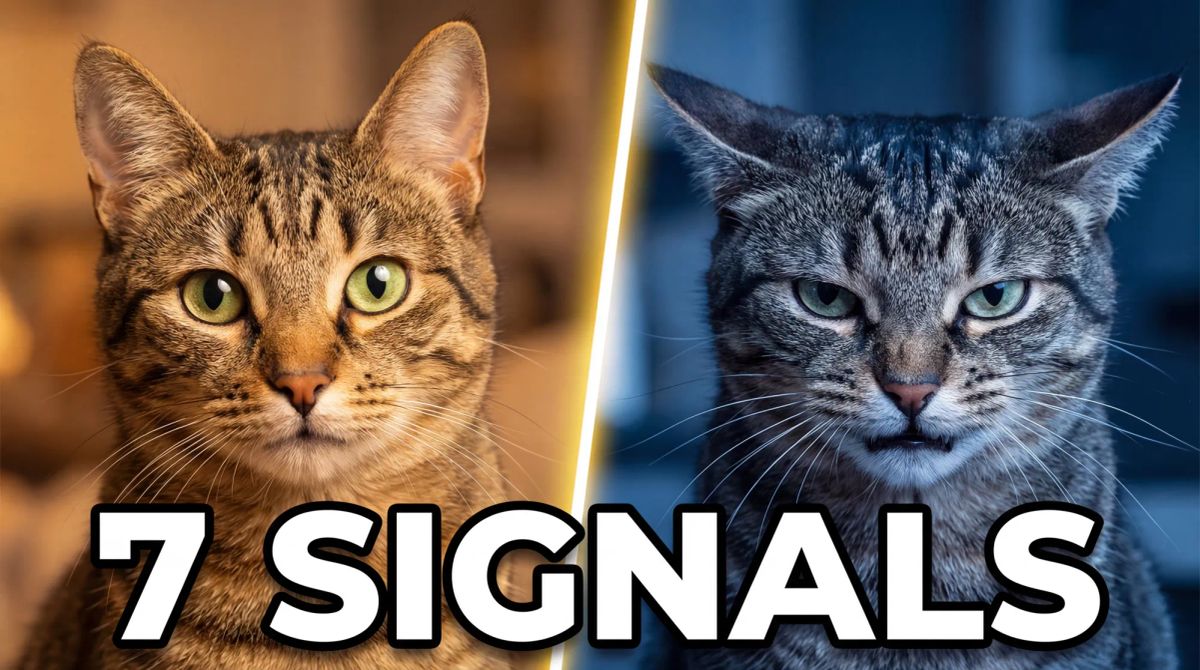
Table of Contents
- How Many Muscles Do Cat Ears Have, and Why Does It Matter?
- What Do Forward Ears Mean on a Cat?
- Why Does My Cat Flatten Its Ears?
- What Are Airplane Ears on a Cat?
- Do Fear and Frustration Look Different in Cat Ears?
- Do Cats Copy Each Other's Ear Movements?
- Can Cat Ear Position Tell You if a Cat Is in Pain?
- The CatCog Ear Decoder: All 7 Positions at a Glance
- When Ear Position Means "See a Vet"
- The Scottish Fold Exception
- Building Your Ear-Reading Skills
- Key Terms
- Frequently Asked Questions
- Key Takeaways
- Sources
Most people assume the tail tells the whole story. Twitch means annoyed, puff means scared, up means happy. But research from Dr. Bertrand Deputte of Ecole Nationale Veterinaire d'Alfort tells a different story: across 100 hours of observation of 29 cats, ears carried the conversation in cat-to-cat encounters. The tail-up display matters for cat-to-human greetings, but between cats, ear position configurations predicted interaction outcomes more reliably than any tail signal. For the full science of what cat tail movements mean, the tail tells its own story -- but the ears tell a more precise one.
The problem is that most humans are poor readers of cat faces. The largest study of human ability to interpret cat facial expressions, conducted across 6329 participants from 85 countries, found that the average person scored just 59% correct, above chance but low (Dawson et al., 2019, Animal Welfare). Women scored significantly higher than men, and veterinary professionals with daily cat experience scored highest of all groups. The good news, as Dr. John Bradshaw of the University of Bristol has emphasized in his work on feline social behavior: ear reading is a learnable skill, and understanding the science behind each position transforms vague intuition into precise cat communication.
This guide introduces the CatCog Ear Decoder, a framework that maps all 7 scientifically catalogued ear positions to plain-language emotional states, visual cues, and evidence-based response protocols.

How Many Muscles Do Cat Ears Have, and Why Does It Matter?
Each cat ear contains 32 individual muscles, compared to 9 auricular muscles in the human ear, giving cats the biomechanical precision to rotate each pinna independently through a full 180-degree arc. This muscular complexity explains why the CatFACS coding system (Caeiro et al., 2017, Applied Animal Behaviour Science) assigns 7 Ear Action Descriptors to the ear region -- more movement codes than any other area of the cat face, out of 28 total coded movements in the full CatFACS manual.
The 7 Ear Action Descriptors in the CatFACS system are:
| Code | Name | Movement |
|---|---|---|
| EAD101 | Ears forward | Neutral upright position |
| EAD102 | Ear adductor | Ears drawn together at tops |
| EAD103 | Ear flattener | Ears pressed flat against skull |
| EAD104 | Ear rotator | Ears rotated sideways |
| EAD105 | Ears downward | Ears pulled down and lateral |
| EAD106 | Ears constrictor | Ear opening narrowed |
| EAD107 | Ears backward | Ears swept backward |
A 2025 combinatorial analysis published in PLoS ONE found that the CatFACS coding system documents more ear-related facial movements than ChimpFACS does for chimpanzees (Mahmoud et al., 2025), placing feline ears among the most expressively coded anatomical structures in mammalian facial action systems.
What makes this muscular complexity significant is not just range but speed. Neuroscience research at the University of Wisconsin-Madison demonstrated that the cat pinna responds to auditory stimuli with a short-latency movement at approximately 25 milliseconds, roughly 10 times faster than the eyes orient to the same target at approximately 265 milliseconds (Populin & Yin, 1998, Journal of Neuroscience). That study used 6 cats in a laboratory setting with magnetic search coils, so the finding reflects automatic neural responses rather than naturalistic behavior. Still, the implication is notable: at least some ear movements include involuntary components that precede conscious orientation, suggesting ear position may be harder for a cat to suppress than behaviors like vocalizations or body posture.
What Do Forward Ears Mean on a Cat?
Forward-facing ears (CatFACS code EAD101) indicate a relaxed, friendly, or curious cat with an emotional state ranging from neutral to positive. Research by Lauren Scott at UCLA, published in Behavioural Processes, documented 276 distinct facial expressions built from 26 facial movements across 53 cats and found that 45% of expressions occurred during friendly interactions where cat ears and whiskers moved forward with eye closures present (Scott & Florkiewicz, 2023).
Forward ears are the baseline position for a content domestic cat. The pinnae face directly ahead, the ear canals are open, and the muscles are at rest. When both cats in a dyadic interaction held their ears erect, the outcome was significantly positive in the Deputte et al. (2021) study. No other ear configuration between two cats predicted a positive outcome.
This is the position you want to see before initiating any interaction. When your cat's ears are forward and upright, with relaxed whiskers and normal pupils, the cat is receptive to approach. Follow Dr. Lauren Finka's CAT framework from Nottingham Trent University: give cats Choice and control, pay Attention to their behavior, and Think about Touch location. Pet the base of the ears, cheeks, and under the chin -- the zones where cats naturally receive social grooming. For a deeper look at which touch zones cats prefer and why, see our guide to the science of petting cats.
A variation worth noting: ears that are pricked sharply forward with wide eyes and a tense, weight-shifted body indicate hunting focus, not friendliness. The ears are forward because the cat is tracking a target, funneling sound toward prey. The context signals (body tension, dilated pupils, stillness) distinguish hunting attention from relaxed curiosity.
Why Does My Cat Flatten Its Ears?
Ear flattening (CatFACS code EAD103) signals a defensive emotional state, typically fear or acute distress, where the cat presses both ears flat against the skull to protect the ear tissue from injury during a potential conflict. Ear flattening is also the first of five action units in the Feline Grimace Scale, a validated clinical tool developed across a cohort of 55 cats for detecting pain in cats (Evangelista et al., 2019, Scientific Reports).
Understanding ear flattening requires distinguishing between two similar but functionally different positions. A cat that flattens its ears tightly against its head, with dilated pupils, a low body, and a tucked tail, is in a defensive state. The ears are protected because the cat anticipates being attacked and is signaling that it wants to avoid conflict, not escalate it.
But a cat whose ears are flattened with the tips still visible from the front, combined with constricted pupils, a forward-leaning body, and raised hackles, is displaying offensive aggression. This cat is not protecting its ears. It is signaling readiness to attack. The subtle twist that makes the ear tips visible from the front distinguishes the aggressor from the defender.
Never approach a cat with flattened ears. Remove the threat source if identifiable. Provide a clear escape route. Reduce environmental stimulation by lowering lights, reducing noise, and moving slowly. A cornered cat with flattened ears is at the highest risk for defensive biting -- approximately 33% of cats surrendered to shelters for behavioral issues are given up due to aggression (Cornell Feline Health Center), a pattern covered in detail in our guide to why cats bite.
What Are Airplane Ears on a Cat?
Airplane ears, the colloquial term for ears rotated sideways to resemble aircraft wings (CatFACS codes EAD104 combined with EAD105), indicate escalating anxiety or irritation that sits between mild discomfort and active aggression. Research at Battersea Dogs and Cats Home found that ear rotation and flattening duration showed a large effect size (greater than 0.5) as an indicator of interaction quality during a study of 100 cats in a shelter environment (Haywood et al., 2021, Frontiers in Veterinary Science).
Airplane ears are a warning signal, not aggression itself. The cat is communicating "I am uncomfortable and approaching my limit." The head often drops to or below shoulder level, breathing may become rapid, and the body language reads as conflicted rather than committed to attack.
This is the critical intervention window. When you see airplane ears during a petting session, stop immediately. In multi-cat households, separate cats displaying airplane ears before the situation escalates to hissing, swatting, or fighting. In veterinary settings, airplane ears signal the need to pause the examination and allow the cat to reset.
As Dr. Sarah Ellis, Head of Cat Mental Wellbeing and Behaviour at International Cat Care, highlights in her comprehensive review of feline emotional assessment, ear position changes during interactions are a key real-time indicator for observers (Ellis, 2018, Journal of Feline Medicine and Surgery). The moment ears begin rotating from forward to sideways is an earlier and more reliable warning than waiting for a hiss or a swipe.
Do Fear and Frustration Look Different in Cat Ears?
Emerging research suggests that ear flattening and ear rotation may correspond to different emotional states depending on context, though the evidence is still developing and context-dependent. The first systematic CatFACS study of feline emotional states found that ear flattening (EAD103) was associated with fear contexts, particularly without human interaction present, while ear rotation (EAD104) appeared more in frustration contexts when people were involved (Bennett et al., 2017, Behavioural Processes).
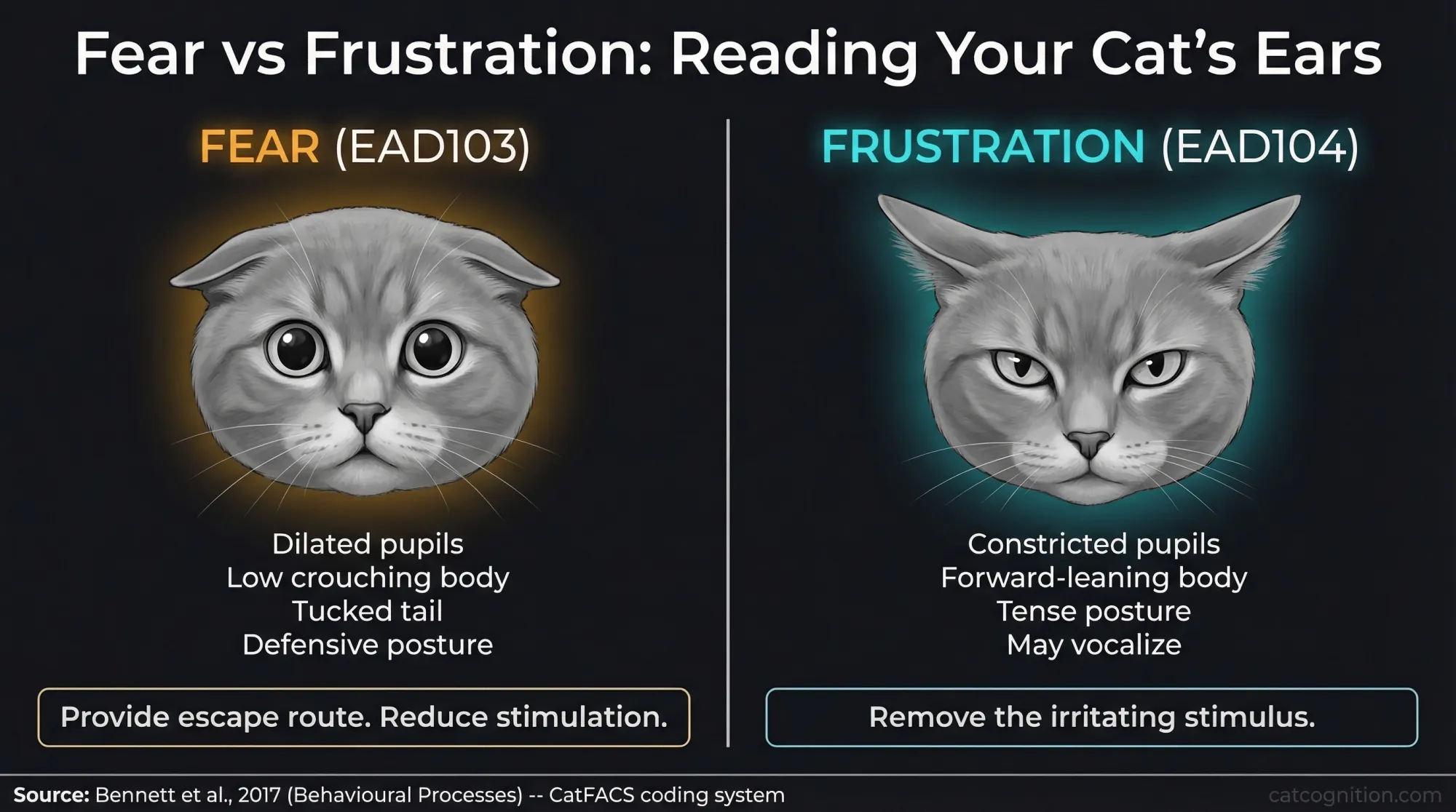
This finding is more nuanced than a simple binary. Prof. Daniel Mills of the University of Lincoln, UK's first RCVS specialist in veterinary behavioural medicine and a co-author on that study, has contributed to a growing body of work suggesting these ear movements map to distinct emotional processing. Unpublished pilot work on Scottish wildcats by Dr. Lauren Finka reportedly observed a related pattern with a right-rotation bias in frustration contexts, as cited in Ellis (2018, JFMS), though this finding has not been independently published.
The practical takeaway, even with this complexity, is that flattened ears and rotated ears call for different responses. A cat with flattened ears needs an escape route and reduced environmental pressure. A cat with rotated ears needs the irritating stimulus removed. Conflating both as simply "unhappy ears" misses a distinction that can change how effectively you respond.
Do Cats Copy Each Other's Ear Movements?
Cats exhibit rapid facial mimicry during social interactions, copying each other's facial movements within fractions of a second, and ear movements (specifically EAD103 and EAD104) are the signals most prone to this mimicry behavior. A 2024 computational analysis published in Scientific Reports documented this phenomenon for the first time in cats (Martvel et al., 2024).
Rapid facial mimicry had previously been documented in primates and several other mammalian species across more than 15 studies, including research on dogs and horses. The discovery that cats also mirror each other's ear positions during interactions, observed across 53 cats at CatCafe Lounge in Los Angeles, adds a new layer to feline social communication. Cats with higher instances of rapid facial mimicry may share stronger social bonds, though this connection requires further study.
For multi-cat households, this finding has a practical implication. When one cat flattens or rotates its ears during a tense encounter, the other cat may reflexively mirror that expression, potentially escalating the conflict through a feedback loop. Intervening early, before mimicry compounds the tension, is more effective than waiting for overt aggression.
Can Cat Ear Position Tell You if a Cat Is in Pain?
Ear position is the first of five action units in the Feline Grimace Scale (FGS), a validated clinical pain detection tool developed by Dr. Marina Evangelista at the Universite de Montreal and now used in veterinary practices worldwide. In painful cats, ears appear flattened, rotated laterally, and positioned lower than their normal resting angle (Evangelista et al., 2019, Scientific Reports).
The FGS works by scoring five facial features: ear position, orbital tightening, muzzle tension, whisker changes, and head position. The validated analgesic threshold score is 0.39 out of 1.0, developed from a study of 35 cats with confirmed painful conditions and 20 cats serving as controls. Above that score, pain treatment is clinically indicated. Ear position anchors this scoring system because ear changes are among the most visible and consistent indicators of acute feline pain.
What makes this clinically powerful is accessibility. A follow-up validation study tested 100 images across 4 groups of raters and confirmed that cat owners, not just veterinary professionals, can reliably score the Feline Grimace Scale, including the ear position component (Evangelista & Steagall, 2021, Scientific Reports). Geometric morphometrics research by Dr. Lauren Finka provided objective mathematical confirmation of the lateral and ventral ear displacement that occurs after painful stimuli (Finka et al., 2019, Scientific Reports). Pain-ear recognition is a learnable skill for any cat owner.
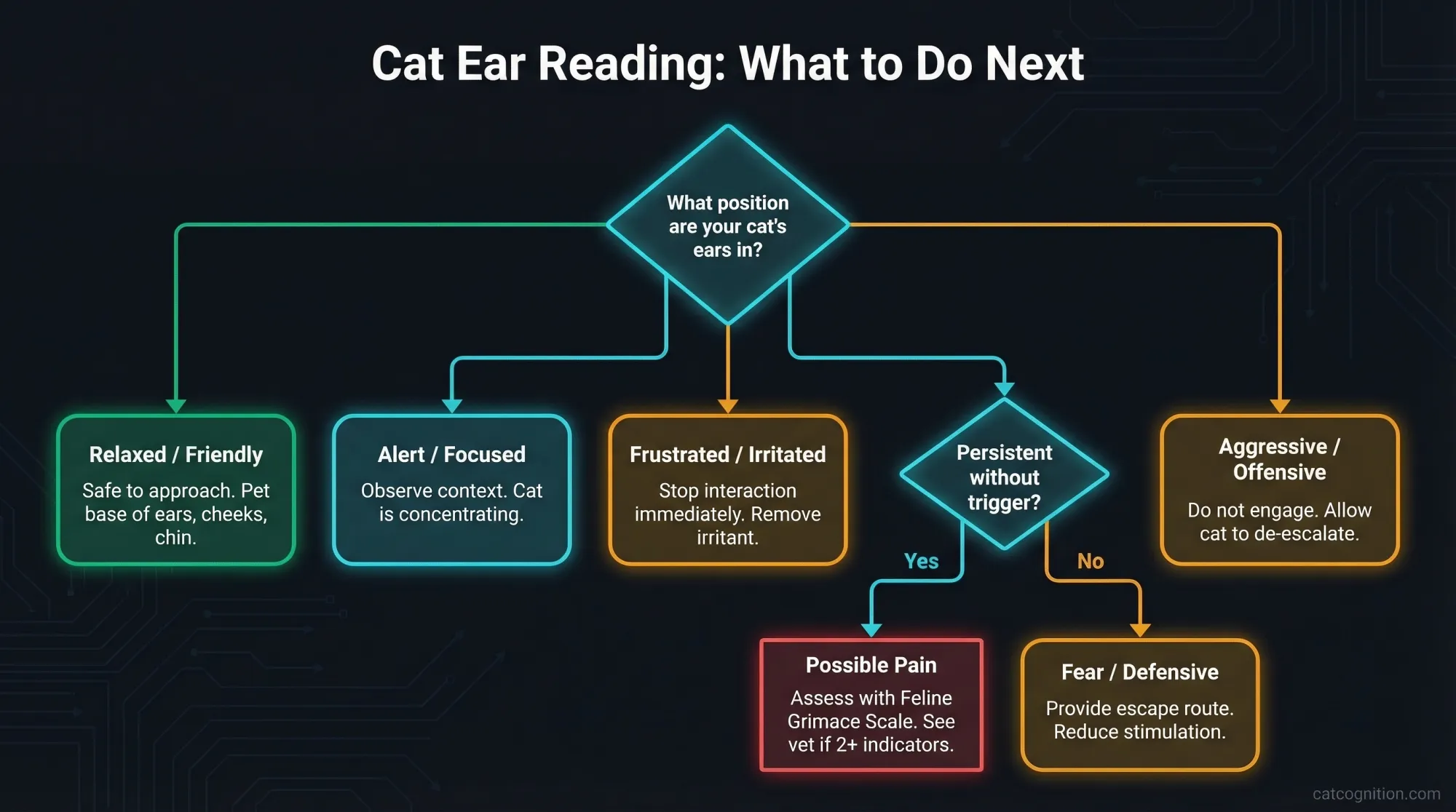
If your cat shows persistent ear flattening without any environmental trigger (no loud noise, no other animal, no recent interaction), assess for pain using the full FGS criteria. If ear flattening appears alongside any two other indicators (squinted eyes, tense muzzle, whiskers pulled forward, lowered head), schedule a veterinary evaluation. Free FGS training materials are available at felinegrimacescale.com.
The CatCog Ear Decoder: All 7 Positions at a Glance
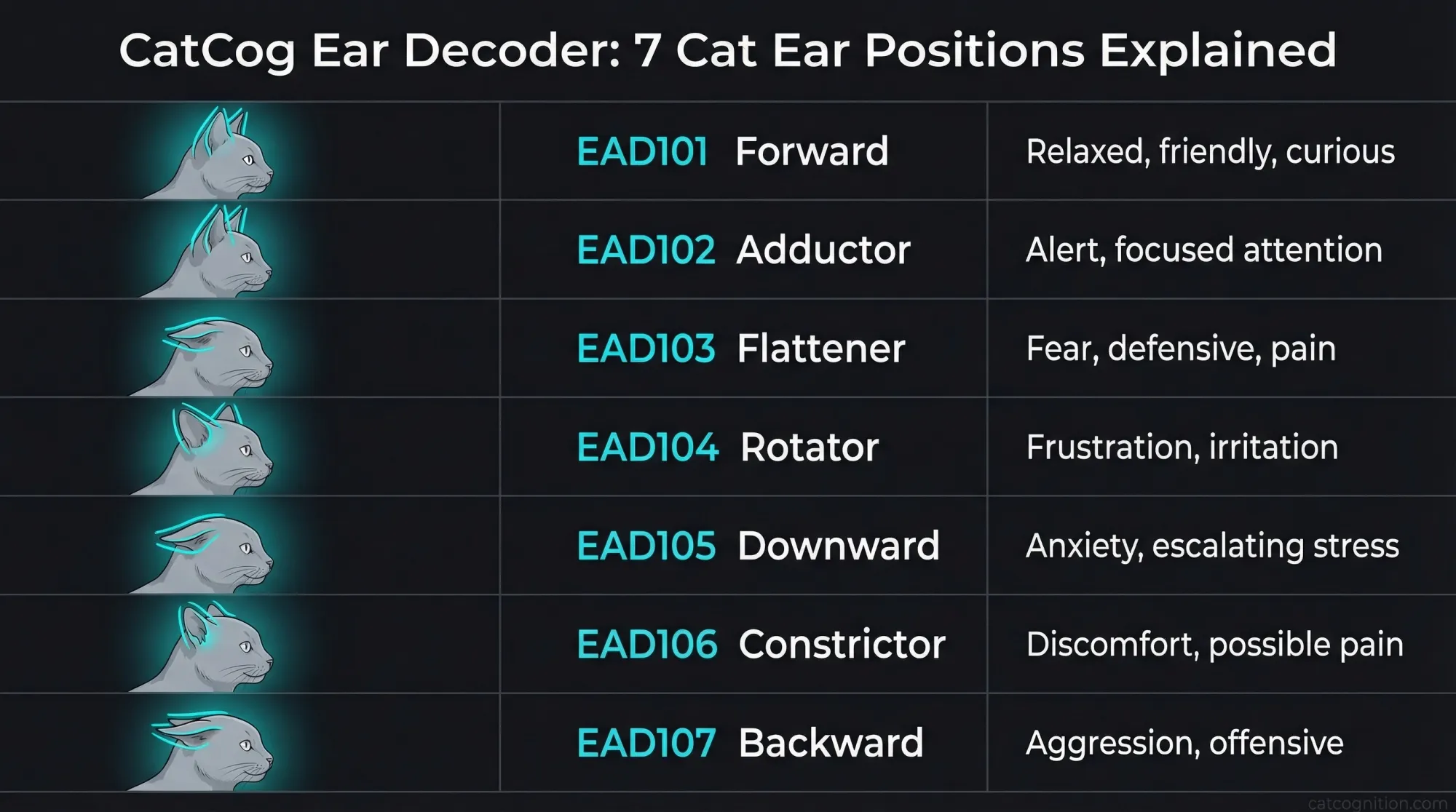
The CatCog Ear Decoder translates all 7 scientifically catalogued cat ear positions from the CatFACS coding system into plain-language emotional states with evidence-based response protocols for each position. No existing resource maps all 7 Ear Action Descriptors to owner-actionable guidance in one place.
| CatFACS Code | Common Name | What It Looks Like | What It Means | What to Do |
|---|---|---|---|---|
| EAD101 | Forward ears | Ears upright, facing forward | Relaxed, friendly, curious | Safe to approach and interact |
| EAD102 | Ear adductor | Ears drawn slightly together at tops | Alert, focused attention | Cat is concentrating; observe context |
| EAD103 | Ear flattener | Ears pressed flat against skull | Fear, defensive state, or pain | Do not approach; provide escape route |
| EAD104 | Ear rotator | Ears rotated sideways | Frustration, irritation | Stop current interaction immediately |
| EAD105 | Ears downward | Ears pulled down and lateral | Anxiety, escalating stress | Remove stressor; separate from other cats |
| EAD106 | Ears constrictor | Ear opening narrowed | Discomfort, possible pain | Assess for pain using FGS criteria |
| EAD107 | Ears backward | Ears swept backward against head | Aggression, offensive posture | Do not engage; let cat de-escalate |
A few important caveats apply to any ear-position taxonomy. Individual cats have unique baseline ear positions, so learning your own cat's resting posture comes first. Ear expressiveness may diminish with age as muscles weaken, and kittens develop ear control progressively. Breed morphology also affects readability: Scottish Folds have limited ear mobility due to the cartilage mutation that causes the fold (though their ears still swivel and rotate), while breeds like Siamese and Oriental Shorthairs have large ears that make signals more visually pronounced. For a complete overview of all feline body language channels beyond ears, see our guide to every cat body language signal explained.
When Ear Position Means "See a Vet"
Persistent head tilt toward one side may indicate otitis media (middle ear infection), otitis interna (inner ear infection), or idiopathic vestibular disease. According to the Merck Veterinary Manual, otitis media can cause facial nerve paralysis, constricted pupil, drooping eyelid, and protruding third eyelid on the affected side.
A single drooping or asymmetric ear lasting more than a few hours, without any environmental explanation, may indicate aural hematoma, ear mite infestation, or nerve damage. Excessive head shaking combined with ear scratching is the classic presentation of otitis externa or ear mites.
Ear position changes accompanied by loss of balance, stumbling, or nystagmus (rapid involuntary eye movement) signal vestibular disease. While idiopathic vestibular disease often resolves on its own, secondary vestibular disease caused by infection requires treatment.
White cats with two blue eyes deserve special attention. According to the Cornell Feline Health Center, approximately 65-85% of white cats with two blue eyes begin showing signs of deafness at around 4 days old due to cochlear degeneration. A deaf cat will not orient its ears toward sounds, which can be mistaken for emotional flatness or inattention. If a white blue-eyed cat consistently fails to orient its ears toward sudden sounds, congenital deafness screening is warranted.
Schedule a vet visit if: an unusual ear position persists for more than a few hours with no environmental cause; ear changes accompany neurological signs like head tilt, balance loss, or facial asymmetry; the cat shows persistent ear flattening without an identifiable environmental stressor (possible chronic pain); or any signs of ear infection appear, including discharge, odor, redness, swelling, or excessive scratching.
The Scottish Fold Exception
Scottish Fold cats require a separate note on ear reading. The genetic mutation that produces the characteristic folded ears (osteochondrodysplasia) affects cartilage throughout the body, not just the ears, and has been documented as causing painful joint disease in 100% of cats carrying two copies of the fold gene. International Cat Care (iCatCare) considers breeding Scottish Folds unethical due to the painful skeletal condition this mutation causes.
For owners of existing Scottish Folds, ear reading is still possible but requires closer attention. Scottish Fold ears still swivel, flatten, and rotate to express emotion despite the fold. The movements are subtler, so owners need to watch for smaller shifts rather than the dramatic position changes seen in upright-eared breeds.
Building Your Ear-Reading Skills
Reading cat ears accurately is a skill that improves with practice. The Dawson et al. (2019) study of 6,329 participants confirmed that professional experience with cats significantly improved accuracy. You do not need formal training to get better; you need deliberate observation.
Start during calm moments. Learn your cat's baseline forward position when the cat is relaxed, well-fed, and in a familiar environment. This is the reference point against which all other ear positions are measured.
During petting sessions, watch for the first sign of ear rotation (EAD104). That initial sideways shift is the most reliable early warning that your cat is approaching its tolerance threshold. Stopping at the first rotation is more effective than waiting for a hiss, a swipe, or a bite.
In multi-cat households, monitor ear-to-ear configurations during greetings and shared spaces. Across 196 cat-to-cat configurations analyzed in the Deputte et al. study, both cats holding ears erect was the only combination that predicted a significantly positive interaction. Any other configuration predicts increased distance and potential conflict. Early separation when one cat shows rotated or flattened ears prevents escalation.
For pain detection practice, download the free Feline Grimace Scale training materials from felinegrimacescale.com. The more familiar you become with the five FGS action units, the faster you will detect pain-related ear changes in your own cat.
Key Terms
- CatFACS -- Cat Facial Action Coding System, the standardized anatomical tool for objectively coding cat facial movements, identifying 7 Ear Action Descriptors among its total catalogue of facial movement codes
- Ear Action Descriptor (EAD) -- a specific, anatomically defined ear movement in the CatFACS system, numbered EAD101 through EAD107, each corresponding to a distinct muscular action and position
- Feline Grimace Scale (FGS) -- a validated clinical tool for detecting acute pain in cats using five facial action units, with ear position as the first and most prominent indicator
- Pinna -- the external visible part of the ear; cats possess 32 muscles per pinna enabling independent 180-degree rotation
- Rapid facial mimicry -- the involuntary copying of another individual's facial movements during social interaction, documented in cats for ear movements (EAD103, EAD104)
- Airplane ears -- colloquial term for ears rotated sideways (EAD104 + EAD105), indicating escalating anxiety or irritation before aggression
- Osteochondrodysplasia -- a painful genetic disorder affecting bone and cartilage development throughout the body, caused by the same mutation responsible for folded ears in Scottish Fold cats
Frequently Asked Questions
What do airplane ears mean on a cat?
Airplane ears, where both ears rotate sideways to resemble aircraft wings, indicate escalating anxiety, irritation, or stress. Scientifically corresponding to CatFACS codes EAD104 (ear rotator) combined with EAD105 (ears downward), airplane ears are a pre-aggression warning signal. The cat's head often drops to or below shoulder level. Stop all interaction and give the cat space immediately.
Can I tell if my cat is in pain from its ears?
Yes. The Feline Grimace Scale, a validated clinical tool used in veterinary practice worldwide, places ear position as the first indicator of acute pain. A pain-associated ear position appears flattened, rotated laterally, and lower than normal. Combined with orbital tightening, muzzle tension, whisker changes, and altered head position, ear flattening can help detect pain before other symptoms become obvious. Cat owners have been validated as reliable scorers of this scale.
Why do my cat's ears go back when I pet it?
Ears rotating backward during petting indicate the cat is approaching its tolerance threshold for tactile stimulation. Research found that ear rotation and flattening duration had a large effect size as an indicator of interaction quality (Haywood et al., 2021). The moment ears begin rotating, stop petting. Pet only preferred zones (base of ears, cheeks, under chin) and let the cat control the duration.
Are cat ears more important than tails for communication?
Context determines which signal matters more. In cat-to-cat interactions, a 2021 observational study found ear position was a better predictor of interaction outcomes than tail position (Deputte et al., 2021). However, the tail-up display is well-documented as an important greeting signal, particularly in cat-to-human interactions. Both channels carry meaningful information in different contexts.
Why does my cat move one ear forward and one ear back?
Asymmetric ear positions indicate the cat is processing conflicting environmental inputs. One ear may track a sound source while the other monitors a different direction. This is normal and reflects the cat's ability to rotate each ear independently through 180 degrees using 32 muscles per ear. Persistent asymmetry lasting hours without environmental explanation, however, may indicate a medical issue.
Do cats fake their ear positions?
Laboratory research suggests that at least some ear movements include involuntary components. In controlled conditions, cat pinnae responded to auditory stimuli at approximately 25 milliseconds, well before the eyes oriented to targets at approximately 265 milliseconds (Populin & Yin, 1998). While cats in naturalistic settings likely have more voluntary control than restrained lab cats, ear position appears to be a more reliable indicator of emotional state than deliberately modulated behaviors like vocalizations.
How many facial expressions do cats have?
Research by Lauren Scott at UCLA documented 276 morphologically distinct facial expressions in cats using 26 facial movements, observing 53 adult cats at CatCafe Lounge in Los Angeles (Scott & Florkiewicz, 2023). Of these expressions, 45.7% were classified as friendly, 37% as unfriendly, and 18% as ambiguous. Ear position, along with whisker and eye movements, was a key differentiator between friendly and aggressive signals.
Can I learn to read my cat's face better?
Yes. The largest study on this topic found that while the average person scores above chance but low at reading cat expressions, veterinary professionals and people with cat experience score significantly higher (Dawson et al., 2019). Experience improves accuracy. Start by learning your cat's baseline ear positions during calm moments, then practice identifying shifts during interactions.
Key Takeaways
Ear position outperforms tail position in cat-to-cat communication. A 2021 study of 254 interactions found that ear configurations were the best predictor of whether a cat encounter would end positively or negatively. Both cats holding ears erect was the only configuration that predicted a significantly positive outcome.
The CatFACS system identifies 7 distinct ear positions, each mapping to a specific emotional state. Forward ears (EAD101) signal friendliness. Flattened ears (EAD103) signal fear or pain. Rotated ears (EAD104) signal frustration or irritation. Learning these distinctions transforms vague "my cat seems upset" into actionable diagnosis.
Cat owners can detect pain through ear position using the Feline Grimace Scale. Ear position is the first of five action units in this validated clinical tool. A validation study confirmed that cat owners, not just veterinary professionals, can score the FGS reliably. Free training materials are available at felinegrimacescale.com.
Ear reading is a learnable skill that improves with practice. The average person scores 11.85 out of 20 at reading cat expressions, but professional experience dramatically improves accuracy. Start by learning your cat's baseline ear position during calm moments, then watch for the first sign of rotation during interactions.
Persistent or asymmetric ear changes without environmental triggers require veterinary attention. Normal communication signals change with context and resolve when the stimulus changes. Ear positions that persist for hours, affect only one side, or accompany balance problems or head tilts may indicate otitis, vestibular disease, or other medical conditions.
Sources
- Heads and Tails: An Analysis of Visual Signals in Cats -- Deputte, B.L. et al., 2021, Animals (PMC)
- Feline Faces: Unraveling the Social Function of Domestic Cat Facial Signals -- Scott, L. & Florkiewicz, B.J., 2023, Behavioural Processes (ScienceDirect)
- Development and application of CatFACS -- Caeiro, C.C. et al., 2017, Applied Animal Behaviour Science (ScienceDirect)
- Facial expressions of pain in cats: the development and validation of a Feline Grimace Scale -- Evangelista, M.C. et al., 2019, Scientific Reports (Nature)
- Facial correlates of emotional behaviour in the domestic cat -- Bennett, V. et al., 2017, Behavioural Processes (PubMed)
- Computational investigation of the social function of domestic cat facial signals -- Martvel, G. et al., 2024, Scientific Reports (Nature)
- Pinna Movements of the Cat during Sound Localization -- Populin, L.C. & Yin, T.C.T., 1998, Journal of Neuroscience (JNeurosci)
- Recognising and assessing feline emotions during the consultation -- Ellis, S.L.H., 2018, Journal of Feline Medicine and Surgery (PMC)
- Providing Humans With Practical, Best Practice Handling Guidelines During Human-Cat Interactions -- Haywood, C. et al., 2021, Frontiers in Veterinary Science (Frontiers)
- Humans can identify cats' affective states from subtle facial expressions -- Dawson, L.C. et al., 2019, Animal Welfare (Cambridge)
- Geometric morphometrics for the study of facial expressions in non-human animals -- Finka, L.R. et al., 2019, Scientific Reports (Nature)
- Agreement and reliability of the Feline Grimace Scale among cat owners, veterinarians, veterinary students and nurses -- Evangelista, M.C. & Steagall, P.V., 2021, Scientific Reports (Nature)
- Examining Mammalian facial behavior using Facial Action Coding Systems and combinatorics -- Mahmoud, M. et al., 2025, PLoS ONE (PLoS)
- Feline Behavior Problems: Aggression -- Cornell Feline Health Center, 2024 (Cornell)
- Feline Ear Disorders -- Cornell Feline Health Center, 2024 (Cornell)
- Cat Communication -- International Cat Care (iCatCare), 2024 (iCatCare)
- Scottish Fold osteochondrodysplasia -- International Cat Care (iCatCare), 2024 (iCatCare)
- Otitis Media and Interna in Cats -- Merck Veterinary Manual, 2024 (Merck)
- Feline Grimace Scale -- Official Site (FGS)
- CatFACS Official Manual and Certification (AnimalFACS)