Do Cats Growl? What Cat Growling Really Means and How to Respond
Cats growl as a voiced, low-frequency defensive warning produced by laryngeal vibration during exhalation. Learn the 6 causes, read the body language, and respond correctly with the CatCog Growl Diagnostic Decoder.

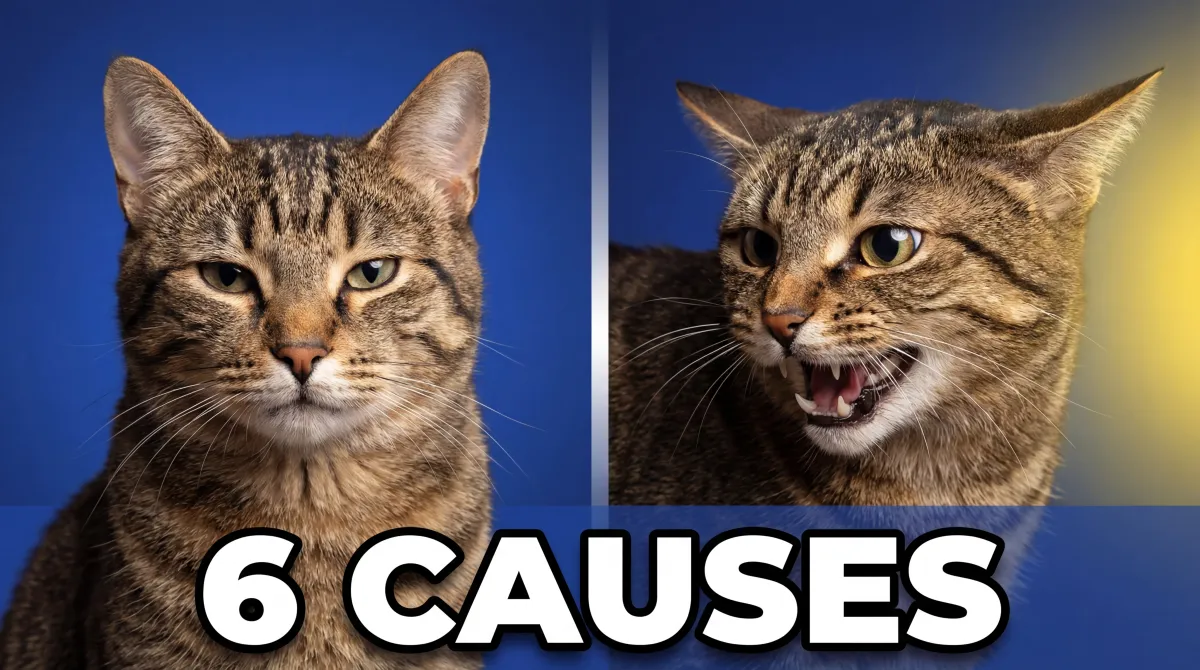
Table of Contents
- Can Cats Actually Growl?
- Why Do Cats Growl? The 6 Causes Explained
- What Does Cat Growling Sound Like?
- Why Is My Cat Growling at Me?
- Why Do Cats Growl at Each Other?
- Why Does My Cat Growl When Playing?
- Cat Growling in Sleep: Should You Worry?
- The CatCog Growl Diagnostic Decoder
- How to Respond to a Growling Cat
- Key Terms
- Frequently Asked Questions
- Key Takeaways
- Sources
Can Cats Actually Growl?
Your cat just made a sound you have never heard before. A low, sustained rumble, almost mechanical, vibrating through the air like a warning siren. Your first instinct is alarm. Your second instinct is to wonder whether something is seriously wrong.
That instinct is half right. A growl is always meaningful. But "meaningful" does not always mean "dangerous." Dr. Susanne Schotz, Associate Professor of Phonetics at Lund University and lead researcher on the Meowsic project, classifies the cat growl as a "guttural, harsh, regularly and rapidly pulse-modulated sound with a long duration," one of six distinct agonistic vocalization types she identified in a phonetic case study of 468 agonistic vocalizations (Schotz, 2015). In the broader Meowsic project data, growls comprised only 6% of 1,591 recorded vocalizations (Schotz et al., 2016), making cat growling a relatively rare signal compared to meowing (57%), trilling (10%), and trillmeowing (9%). For a complete breakdown of all feline vocalizations, see our guide to every level of cat sound explained.
That rarity matters. When a cat growls, the signal carries weight precisely because the cat reserves it for situations where distance regulation is urgent. As Brown and Bradshaw documented in the definitive Cambridge University Press textbook on domestic cat biology, growling carries consistent meaning across all cats because it functions as an intraspecies communication signal. Every cat on earth interprets a growl the same way. Meowing, by contrast, is individually developed by each cat for human interaction, with no fixed species-level meaning.
Cats produce growls through sustained vibration of the laryngeal muscles during controlled exhalation, with the mouth held lightly open in a fixed position. The foundational phonetic classification system established by Mildred Moelk in 1944 organizes cat vocalizations into three categories based on mouth position: closed-mouth sounds (purring, trilling), opening-to-closing mouth sounds (meowing, yowling), and fixed-open mouth sounds (growling, hissing, spitting). Growling falls into the third "strained intensity" category: sounds produced with the mouth held tensely open.
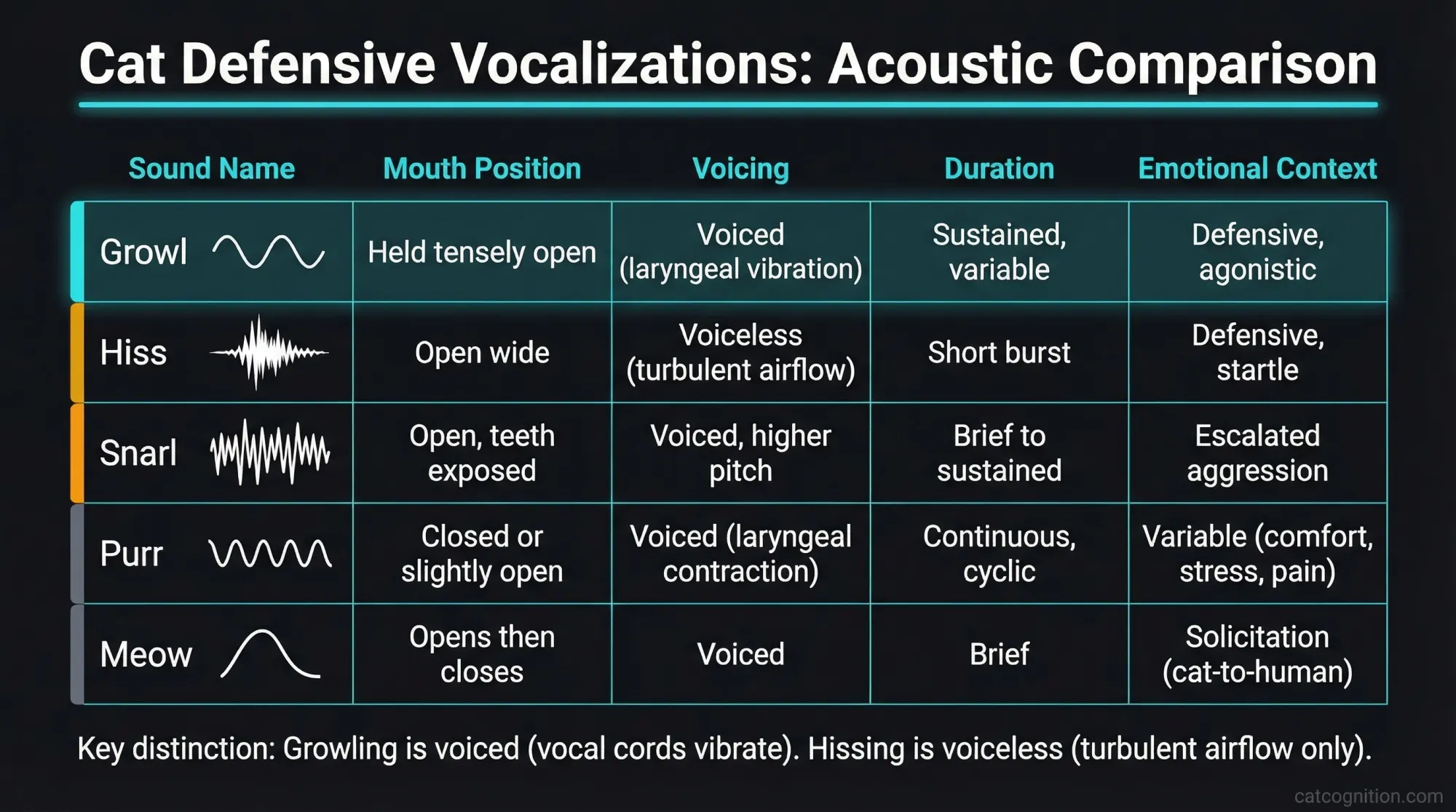
The critical acoustic distinction between cat growling and cat hissing is voicing. Growling is a voiced vocalization, meaning the vocal cords vibrate to produce the sound. Hissing is voiceless, produced by turbulent airflow through a constricted oral cavity without vocal cord engagement. This distinction explains a practical observation that most cat owners notice intuitively: growling can vary in pitch and intensity because the cat modulates laryngeal tension in real time, while hissing is more binary.
"The long duration of the sound and the gradation of the intensity of the growl can express a change in the motivation of the sender while producing the sound." Cat growling functions as a real-time broadcast of the cat's defensive state, not a fixed alarm. (Tavernier et al. 2020, Journal of Veterinary Science)
A 2011 comparative study of 25 feral cats and 13 house cats identified 23 distinct vocal patterns via spectrogram analysis and confirmed that growl pitch is a measurable index of fear intensity. Feral cats produced higher fundamental frequency in growls than house cats during agonistic encounters because the feral cats experienced greater fear (Yeon et al., 2011, Behavioural Processes). The higher the pitch, the more frightened the cat.
This article introduces the CatCog Growl Diagnostic Decoder, a six-context diagnostic framework that maps the growl to body language indicators, environmental triggers, likely causes, and evidence-based responses. Because a growl over food and a growl at a window require completely different interventions.
Why Do Cats Growl? The 6 Causes Explained
Cats growl for six distinct reasons, each tied to a different motivational state and each requiring a different response. A 2020 review cataloged up to 21 distinct vocalizations in the feline repertoire and classified the growl as "a ritualized agonistic signal in dyadic interaction" used to warn and establish distance (Tavernier et al., 2020, Journal of Veterinary Science). The following diagnostic framework cross-references context, body language, and trigger to identify the cause.
1. Territorial Tension and Intercat Conflict
The most common growling trigger in multi-cat households. The 2024 AAFP Intercat Tension Guidelines, co-chaired by Dr. Ilona Rodan, report that 62-88% of multi-cat households experience intercat tension, even when only two cats share the home. Growling between cats signals that one cat perceives the other as too close to a valued resource or territory.
Body language: Stiff posture, direct stare, piloerection, ears flattened sideways.
Trigger: Proximity to food, litter box, resting spot, or a specific human.
Response: Do not intervene physically. Add duplicate resources in separate locations. Follow the n+1 rule: the number of resources (food bowls, litter boxes, perches) should equal the number of cats plus one.
2. Fear and Defensive Arousal
A fearful cat growls from a hiding place at a distance and only bites if approached, crowded, or handled. The growl is a request for space, not an invitation to comfort. Cats not exposed to a wide range of humans during the critical socialization window of 2 to 7 weeks of age are significantly more likely to exhibit fear-based growling as adults.
Body language: Low body posture, weight shifted backward, ears flattened against the head, pupils fully dilated, tail tucked.
Trigger: Unfamiliar person, veterinary visit, loud noise, new environment.
Response: Do not approach. Do not make direct eye contact. Provide an escape route and wait for the cat to self-regulate. A fearful cat that can retreat voluntarily is far less likely to escalate to biting.
3. Pain-Mediated Growling
Cats in pain may growl as a defensive response to avoid touch on painful areas. Pain-mediated growling is a critical veterinary triage signal. When a cat growls consistently when touched in a specific body area, the sound is pointing directly at the source of the problem.
Body language: Flinching or tensing when a specific area is touched, guarded posture, possible reduced appetite.
Trigger: Touch on a specific body part (abdomen, joints, mouth area).
Response: Stop touching immediately. Schedule a veterinary exam. The Feline Grimace Scale, developed and validated by Dr. Marina C. Evangelista's research team at the Universite de Montreal, provides a facial assessment tool based on five action units (ear position, orbital tightening, muzzle tension, whisker position, head position), each scored 0 to 2 for a maximum score of 10. A score above 4/10 indicates the cat is likely in pain and needs professional evaluation (Evangelista et al., 2019, Scientific Reports).
4. Resource Guarding
A cat growling while eating or holding a toy is protecting a valued resource. Resource guarding stems from the normal desire to maintain access to valuable resources, and growling is the vocal expression of that instinct.
Body language: Crouched over resource, ears pinned back, may carry object away while growling.
Trigger: Another cat, dog, or human approaching during eating or play.
Response: Do not attempt to remove the resource. Feed cats in separate rooms. Provide multiple feeding stations and toy access points.
5. Redirected Aggression
One of the most misunderstood growling contexts and a significant contributor to the 27% of cats surrendered to shelters specifically for aggression (Herron, 2008). A cat staring out a window, growling at an outdoor animal, can redirect arousal toward the nearest available target, including the owner. The cat is not growling at the owner. The cat is growling at the external stimulus, and the emotional arousal has nowhere to go.
Body language: Redirected stare, tail lashing, agitated pacing, piloerection, dilated pupils.
Trigger: Sight or smell of outdoor animal through a window or door.
Response: Do not approach or touch the cat. Block the visual trigger (close blinds, apply window film). Wait 30 to 60 minutes for arousal to subside before interacting. Redirected aggression is particularly dangerous because the arousal level is disproportionate to the owner interaction.
According to the Cornell Feline Health Center, 27% of cats relinquished to shelters for behavioral reasons were surrendered specifically for aggression. Aggression is the second most common feline behavior problem after housesoiling (Herron, 2008). Many aggression cases involve misunderstood warning signals like growling that escalated because the underlying cause went unaddressed.
6. Sleep Growling (REM Motor Activation)
A cat growling while sleeping, with eyes closed and no body language changes, is experiencing a completely normal neurological phenomenon. During REM sleep, the brain produces motor commands for dream-related activity, but the brainstem normally inhibits these signals through muscle atonia. When suppression is incomplete, vocalizations including growling, facial twitches, paw paddling, and whisker movements can occur.
Body language: No change. Eyes closed. May twitch or paddle paws.
Trigger: No external trigger. Internally generated during REM sleep.
Response: Do not wake the cat. Sleep growling is involuntary motor activation and requires no intervention. Michel Jouvet's foundational REM sleep research used cats as the primary animal model to discover and characterize paradoxical sleep, and his work established that kittens spend up to 90% of their total sleep time in paradoxical (REM) sleep during the first days of life (Jouvet, 1965, Progress in Brain Research).
What Does Cat Growling Sound Like?
Cat growling is a low-frequency, sustained rumble produced with the mouth held lightly open, acoustically distinct from every other sound in the feline vocal repertoire. The Meowsic project at Lund University describes the growl as "guttural, harsh, regularly and rapidly pulse-modulated" with long duration. The pulse modulation creates the distinctive rumbling quality separating a growl from a purr, a hiss, or a yowl.
The difference from purring is important for new cat owners. Both sounds are sustained, low-frequency vibrations. Purring oscillates at 25 to 150 Hz through rapid contraction and relaxation of the laryngeal muscles during both inhalation and exhalation as a continuous cycle, while growling occurs only during exhalation. A purring cat has a relaxed body, soft eyes, and loose posture. A growling cat shows at least one tension indicator: ear rotation, pupil dilation, stiff posture, piloerection, or tail swishing.
| Sound | Mouth Position | Voicing | Duration | Emotional Context |
|---|---|---|---|---|
| Growl | Held tensely open | Voiced (laryngeal vibration) | Sustained, variable | Defensive, agonistic |
| Hiss | Open wide | Voiceless (turbulent airflow) | Short burst | Defensive, startle |
| Snarl | Open, teeth exposed | Voiced, higher pitch | Brief to sustained | Escalated aggression |
| Purr | Closed or slightly open | Voiced (laryngeal contraction) | Continuous, cyclic | Variable (comfort, stress, pain) |
| Meow | Opens then closes | Voiced | Brief | Solicitation (cat-to-human) |
Why Is My Cat Growling at Me?
A cat growling directly at a human is communicating one of four messages: fear, pain, overstimulation, or redirected aggression. Determining the cause requires reading the body language, not just hearing the sound. A cat growling at the owner with ears flattened and body low is afraid. A cat growling when touched in a specific area is in pain. A cat growling after staring out a window at another animal is redirecting arousal.
The most common owner-directed growling scenario is petting-induced overstimulation. The cat enjoyed petting for a period, and then sensory input exceeded the tolerance threshold. The warning sequence follows a predictable 4-stage escalation: tail tip twitching, skin rippling along the back, ears rotating from forward to sideways, and then the growl. Each signal is a warning the previous one was ignored.
Never punish a growling cat. This principle is critical and supported by clinical consensus. Punishing a cat for growling removes the warning signal without addressing the underlying cause, making the cat more likely to skip the growl and proceed directly to biting (Today's Veterinary Practice, 2024; Cornell Feline Health Center). A cat that has learned not to growl is not a calmer cat. It is a more dangerous cat.
Why Do Cats Growl at Each Other?
Cats growl at each other to establish and maintain distance, deploying an evolved signal every cat interprets identically. The 2024 AAFP Intercat Tension Guidelines specifically prefer the term "tension" over "conflict" because most intercat stress is silent. Staring, blocking access to resources, spatial avoidance, and changes in activity patterns are subtle signs preceding growling. By the time a cat growls at another cat, the tension has already escalated past the subtle warning stage.
Dr. Susanne Schotz's Meowsic project recorded 468 agonistic vocalizations in a single cat introduction event, including growls, howls, hisses, and spits. This demonstrates that vocal conflict during introductions is expected and should not be punished or suppressed.
Neuroscience research by Brudzynski demonstrated that growl duration directly parallels the development and subsiding of the cat's defensive emotional state. The longer the growl, the more intense the defensive arousal. Growling is not a fixed alarm; it is a real-time index of how threatened the cat feels. (Brudzynski, 1981, Acta Neurobiologiae Experimentalis)
Growling during cat introductions is concerning only when it persists for weeks without improvement, escalates to physical contact (swatting, biting), or when one cat begins hiding, refusing to eat, or eliminating outside the litter box. These signs indicate the introduction pace is too fast and the cats need more time with scent swapping and visual barriers before face-to-face contact.
Why Does My Cat Growl When Playing?
Play aggression in cats is distinguished from other aggression types by rarely including growling or hissing (Today's Veterinary Practice, 2024). Growling during play signals the interaction may have crossed from play into genuine defensive arousal. The presence of a growl during play is itself the diagnostic red flag.
A 2019 study of 74 cats (32 males, 42 females) published in Animals confirmed growling occurs almost exclusively in aversive contexts rather than pleasant interactions (Fermo et al., 2019).
Play indicators (no growling expected): Relaxed body, ears forward or neutral, no piloerection, normal pupils, tail relaxed. The cat may stalk, pounce, and chase, but the body language remains loose and springy.
Escalation indicators (growling signals genuine arousal): Ears flatten, piloerection appears, pupils dilate, body stiffens, tail lashes. If these appear alongside a growl during play, the interaction has crossed the line.
Response: Redirect with a toy thrown away from both cats. Do not use your hands. Do not physically separate the cats, as this risks redirected aggression toward the handler.
Cat Growling in Sleep: Should You Worry?
Cat growling during sleep is neurologically normal and requires no intervention in the vast majority of cases. Kittens spend up to 90% of total sleep time in REM during the first days of life, declining to adult proportions as the nervous system matures (Jouvet, 1965). During REM sleep, incomplete suppression of motor signals produces vocalizations including growling, chirping, and meowing, along with facial twitches, paw paddling, and whisker movements. The brainstem's motor inhibition system is simply allowing some signals through.
Cats were among the first animal models used to study REM sleep. Jouvet's foundational research established that the brain generates active motor commands during paradoxical sleep, which the brainstem normally blocks through muscle atonia. When atonia is incomplete, the result is visible movement and audible vocalization during sleep.
When sleep growling does warrant attention: If the growling is accompanied by changes in waking behavior (appetite loss, lethargy, increased hiding, aggression while awake, or changes in litter box habits), the sleep vocalization may be one symptom of a broader medical issue. A sudden increase in sleep vocalizations in a senior cat should be mentioned at the next veterinary visit to rule out cognitive dysfunction, hyperthyroidism, or hypertension.
The CatCog Growl Diagnostic Decoder
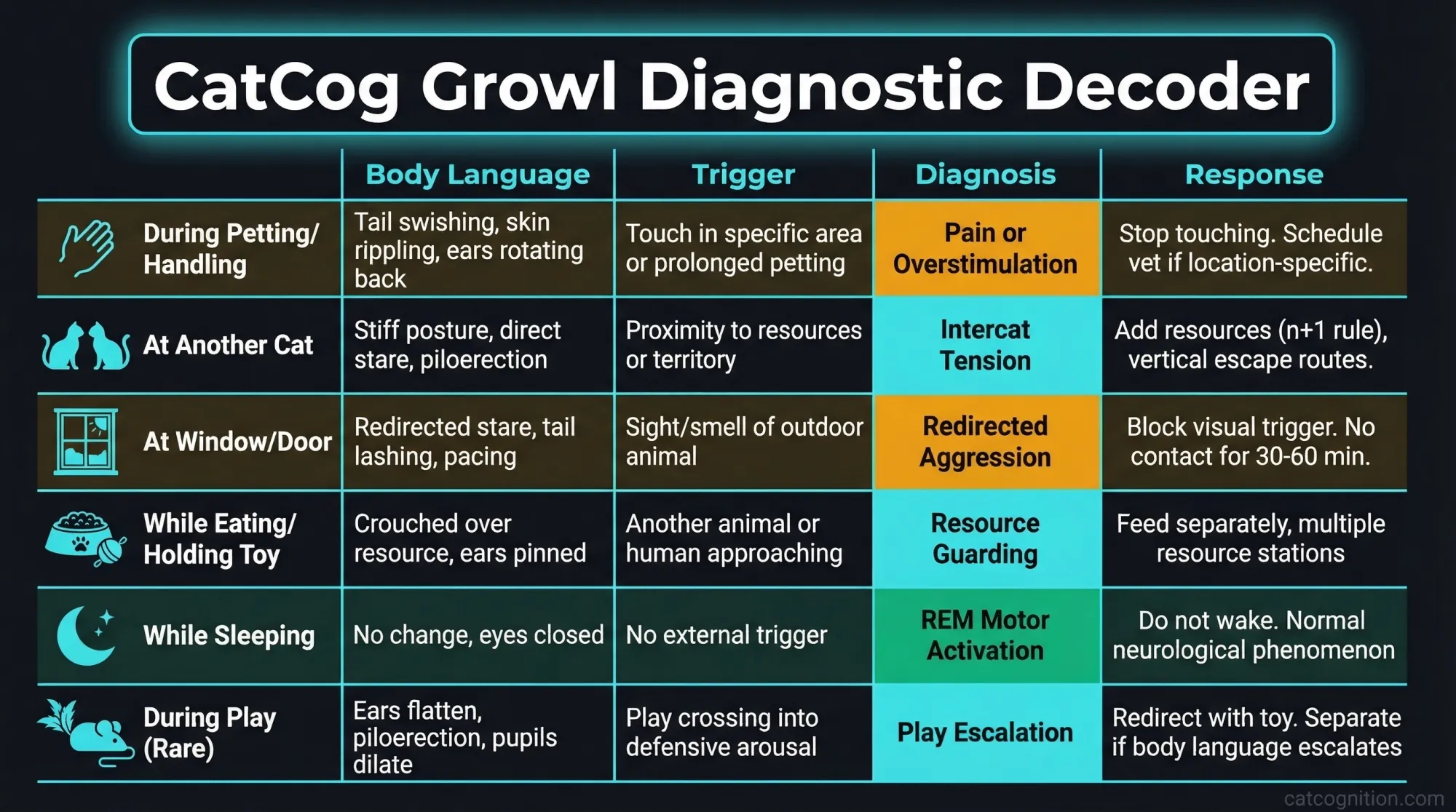
The CatCog Growl Diagnostic Decoder maps six growling contexts to body language indicators, environmental triggers, likely causes, and evidence-based responses. The Decoder uses body language cross-referencing rather than simple cause lists to identify the active trigger behind each growl.
| Growl Context | Key Body Language | Primary Trigger | Diagnosis | Response |
|---|---|---|---|---|
| During petting or handling | Tail swishing, skin rippling, ears rotating back | Touch in specific area or prolonged petting | Pain or overstimulation | Stop touching. If location-specific, schedule vet exam |
| At another cat | Stiff posture, direct stare, piloerection | Proximity to resources or territory | Intercat tension | Add resources (n+1 rule), create vertical escape routes |
| At a window or door | Redirected stare, tail lashing, pacing | Sight or smell of outdoor animal | Redirected aggression | Block visual trigger. Do not touch cat for 30-60 min |
| While eating or holding toy | Crouched over resource, ears pinned | Another animal or human approaching | Resource guarding | Feed separately, provide multiple resource stations |
| While sleeping | No body language change, eyes closed | No external trigger | REM motor activation | Do not wake. Normal neurological phenomenon |
| During play (rare) | Ears flatten, piloerection, pupils dilate | Play crossing into defensive arousal | Escalation from play | Redirect with toy. Separate if body language escalates |
How to Respond to a Growling Cat
The correct response depends on the cause, but three universal principles apply to every growling scenario: never punish the growl, never approach or corner the cat, and rule out medical causes before pursuing behavioral intervention. Given aggression ranks as the second most common feline behavior problem after housesoiling and accounts for 27% of behavioral surrenders to shelters (Herron, 2008), correct early response to growling prevents escalation. Cause-specific protocols follow below.
Rule 1: Never punish a growling cat. Growling is a communication signal. Punishing it removes the warning without addressing the cause. The cat does not learn to feel safe; it learns to skip the warning. The next step after a suppressed growl is a bite with no warning (Today's Veterinary Practice, 2024).
Rule 2: Never approach or corner a growling cat. A fearful cat growls from a hiding place at a distance and only bites if approached, crowded, or handled. Respect the distance the cat is requesting.
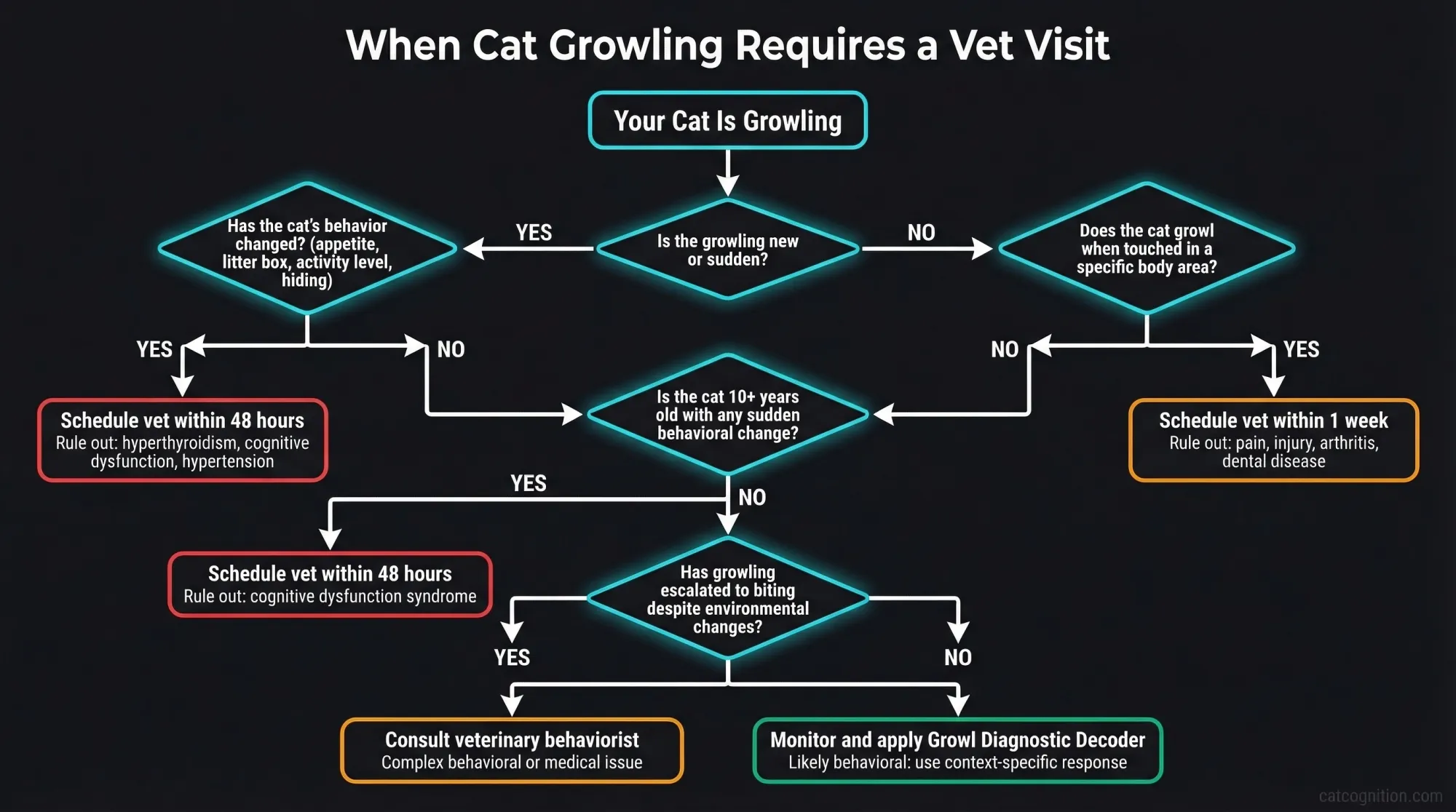
Rule 3: Rule out medical causes first. New-onset growling in a previously non-aggressive cat warrants veterinary examination before behavioral intervention.
Cause-specific responses:
| Growl Cause | Immediate Response | Follow-Up |
|---|---|---|
| Intercat tension | Do not intervene physically | Implement n+1 resource rule; create vertical escape routes with cat trees and wall shelves; consider pheromone diffusers |
| Redirected aggression | Block the external stimulus (close blinds) | Wait 30 to 60 minutes before any interaction |
| Resource guarding | Do not remove guarded items | Feed cats in separate rooms; provide multiple resource stations |
| Pain | Stop touching the painful area | Use the Feline Grimace Scale (score above 4/10 = vet visit); schedule veterinary exam |
| Sleep growling | Do not wake the cat | No intervention needed; neurologically normal REM motor activation |
The Brown and Bradshaw finding, published in the Cambridge University Press textbook The Domestic Cat, establishes that "there is far more consistency in the sound of a growl among individual cats and between cats" compared to meows. Cat growling is an evolved, species-level signal with fixed meaning. Meowing is a learned, individualized behavior that each cat develops for human interaction. (Brown & Bradshaw, 2013)
Growling is one vocalization within a broader system of cat sounds and communication signals. Understanding where growling sits on the defensive escalation ladder -- after staring and before hissing -- gives you a wider window to intervene before the situation escalates. For the complete defensive escalation framework, see our companion piece on why cats hiss. If a cat has already progressed past growling and hissing to physical contact, our guide to why cats bite covers the six bite types and how to stop each one.
Key Terms
- Agonistic signal -- any behavioral signal associated with conflict, including both offensive and defensive displays; growling is classified as a ritualized agonistic signal used to establish distance
- Laryngeal vibration -- the mechanism producing voiced vocalizations in cats, where the vocal cords vibrate during exhalation to create sound; growling uses sustained laryngeal vibration while hissing bypasses the vocal cords entirely
- Piloerection -- involuntary erection of fur along the body and tail caused by sympathetic nervous system activation, making the cat appear larger during perceived threats
- Redirected aggression -- aggressive behavior directed at a target other than the original source of arousal; a cat aroused by an outdoor animal may redirect aggression toward a nearby owner or companion cat
- REM atonia -- the normal suppression of voluntary muscle activity during rapid eye movement sleep; incomplete atonia allows sleep vocalizations including growling, twitching, and paw paddling
- Resource guarding -- defensive behavior over valued resources including food, toys, resting spots, and access to specific humans; growling is the vocal expression of resource guarding instinct
- Intercat tension -- the preferred clinical term for conflict between household cats, chosen because most signs are subtle (staring, blocking, spatial avoidance) rather than overt (growling, hissing, fighting)
Frequently Asked Questions
Is cat growling the same as cat hissing?
No. Growling and hissing are acoustically and mechanistically distinct defensive vocalizations. Growling is a voiced sound produced by laryngeal vibration during slow exhalation, with the mouth held lightly open. Hissing is a voiceless sound produced by turbulent airflow through a constricted oral cavity, with the mouth open wide. Growling can be modulated in pitch and intensity in real time. Hissing is a shorter, sharper burst. On the defensive escalation continuum, growling often precedes hissing as a lower-intensity warning.
Why does my cat growl when I pick it up?
A cat growling when picked up is communicating that being restrained is either painful, frightening, or unwanted. If the growling is new, start by ruling out pain. Cats with arthritis, abdominal pain, or injury growl when lifted because the handling compresses a painful area. If medical causes are excluded, the cat may simply dislike the loss of control that lifting creates. Respect the preference and interact at ground level instead.
Can kittens growl?
Yes. Kittens can produce growling sounds as early as a few weeks old, typically during play disputes over food or toys. Kitten growling during play is often part of learning the predatory motor sequence and is not cause for concern. If accompanied by piloerection and ear flattening, separate the kittens briefly and redirect with a toy.
Why does my cat growl at strangers?
Fear-based defensive growling at unfamiliar people is common, especially in cats that were not socialized to a wide range of humans during the critical socialization window (2 to 7 weeks of age). The cat perceives the stranger as a threat and is requesting distance. Never force a fearful cat to interact with visitors. Provide a safe room where the cat can retreat during gatherings.
Does growling mean my cat is aggressive?
Not necessarily. "Agonistic" encompasses both offensive and defensive motivational states. A growling cat may be fearful (defensive posture, body low), in pain (growling when touched in a specific area), resource guarding (crouched over food or toy), or experiencing involuntary REM motor activation during sleep. Misinterpreting fear-based growling as aggression leads to punishment, which worsens the underlying fear and increases bite risk.
Should I worry about my cat growling in sleep?
In most cases, no. Sleep growling is involuntary motor activation during REM sleep and is neurologically normal. Only be concerned if sleep vocalizations are accompanied by changes in waking behavior such as appetite loss, increased hiding, or litter box changes. A sudden increase in sleep vocalizations in a senior cat warrants a veterinary check.
Why does my cat growl at the vet?
Veterinary visits combine multiple growl triggers simultaneously: unfamiliar environment (fear), physical handling (restraint aversion), potential pain during examination, and the presence of unfamiliar animal scents. Growling at the vet is expected and should not be punished. The Cat Friendly Practice guidelines, developed by Dr. Ilona Rodan, focus on reducing veterinary visit stress through gentle handling, minimal restraint, and environmental modifications.
How is growling different from purring?
Both are sustained, low-frequency vibrations, which is why new cat owners sometimes confuse them. Purring oscillates at 25 to 150 Hz during both inhalation and exhalation as a continuous cycle, while growling occurs only during exhalation. A purring cat is typically relaxed with soft eyes and loose body posture. A growling cat shows visible tension in at least one area: ears, pupils, posture, fur, or tail.
Key Takeaways
Cat growling is a voiced, species-level defensive signal with universal meaning. Unlike meowing, which each cat develops individually, growling carries consistent "back off" meaning across all cats. Growls represent only 6% of feline vocalizations, making every growl a high-priority communication event.
Six distinct contexts produce cat growling, and each requires a different response. The CatCog Growl Diagnostic Decoder maps territorial tension, fear, pain, resource guarding, redirected aggression, and sleep vocalization to specific body language indicators and evidence-based interventions.
Never punish a growling cat. Growling is the warning system. Suppressing it removes the warning without addressing the cause, producing a cat that skips the growl and proceeds directly to biting with no advance signal.
Growling during play is itself the diagnostic red flag. Play aggression rarely includes growling or hissing. When growling appears during play, the interaction has likely crossed into genuine defensive arousal. Check for piloerection, flattened ears, and dilated pupils.
New-onset growling in a previously non-aggressive cat requires a veterinary exam. Hyperthyroidism, osteoarthritis, dental disease, and central nervous system problems can all cause aggression. Rule out medical causes before pursuing behavioral intervention.
Sources
- Feline vocal communication -- Tavernier, C., Ahmed, S., Houpt, K.A. & Yeon, S.C., 2020, Journal of Veterinary Science (PMC)
- Agonistic vocalisations in domestic cats: a case study -- Schotz, S., 2015, Working Papers (Lund University), vol. 55, pp. 85-90 (Lund University)
- Vocalizing in the House-Cat; A Phonetic and Functional Study -- Moelk, M., 1944, The American Journal of Psychology, Vol. 57, No. 2, pp. 184-205 (JSTOR)
- Communication in the domestic cat: within- and between-species -- Brown, S.L. & Bradshaw, J.W.S., 2013, The Domestic Cat: The Biology of its Behaviour, 3rd edition (Turner & Bateson, eds.), Cambridge University Press (Cambridge University Press)
- 2024 AAFP Intercat Tension Guidelines -- Rodan, I., Ramos, D., Carney, H., DePorter, T., Horwitz, D.F., Mills, D. & Vitale, K., 2024, Journal of Feline Medicine and Surgery (SAGE Journals)
- Differences between vocalization evoked by social stimuli in feral cats and house cats -- Yeon, S.C. et al., 2011, Behavioural Processes, 87(2), 183-189 (PubMed)
- Growling component of vocalization as a quantitative index of carbachol-induced emotional-defensive response in cats -- Brudzynski, S.M., 1981, Acta Neurobiologiae Experimentalis, 41(1), 33-51 (PubMed)
- Phonetic Methods in Cat Vocalisation Studies: A report from the Meowsic project -- Schotz, S., Eklund, R. & van de Weijer, J., 2016, Proceedings of Fonetik 2016, TMH-QPSR, pp. 19-24 (PDF)
- Only When It Feels Good: Specific Cat Vocalizations Other Than Meowing -- Fermo, J.L. et al., 2019, Animals (MDPI), 9(11), 878 (MDPI)
- Recherches sur les structures nerveuses et les mecanismes responsables des differentes phases du sommeil physiologique -- Jouvet, M., 1962, Archives Italiennes de Biologie, 100, 125-206 (Semantic Scholar)
- Paradoxical sleep -- a study of its nature and mechanisms -- Jouvet, M., 1965, Progress in Brain Research, vol. 18, pp. 20-57, Elsevier (ScienceDirect)
- Facial expressions of pain in cats: the development and validation of a Feline Grimace Scale -- Evangelista, M.C. et al., 2019, Scientific Reports (Feline Grimace Scale)
- Feline Behavior Problems: Aggression -- Cornell Feline Health Center, Cornell University College of Veterinary Medicine (Cornell)
- Advances in the Understanding of Feline Aggression -- Herron, M.E., 2008, in Veterinary Behavioral Medicine (clinical consensus: feline aggression is the second most common behavior problem after housesoiling)
- Aggression in Cats -- ASPCA (ASPCA)
- Owner-Directed Feline Aggression -- Today's Veterinary Practice, 2024 (NAVC)
- Decoding Feline Fury: Understanding Cat Aggression Toward Humans -- Preventive Vet (Preventive Vet)
- Helping owners handle aggressive cats -- dvm360 (dvm360)