How Extreme Breeding Broke Cats: The 75-Year Experiment That Cut Lifespans in Half
Sphynx cats live 6.68 years on average - half the typical cat lifespan. 100% of Scottish Folds develop arthritis. The Netherlands is banning ownership of extreme breeds starting 2026.

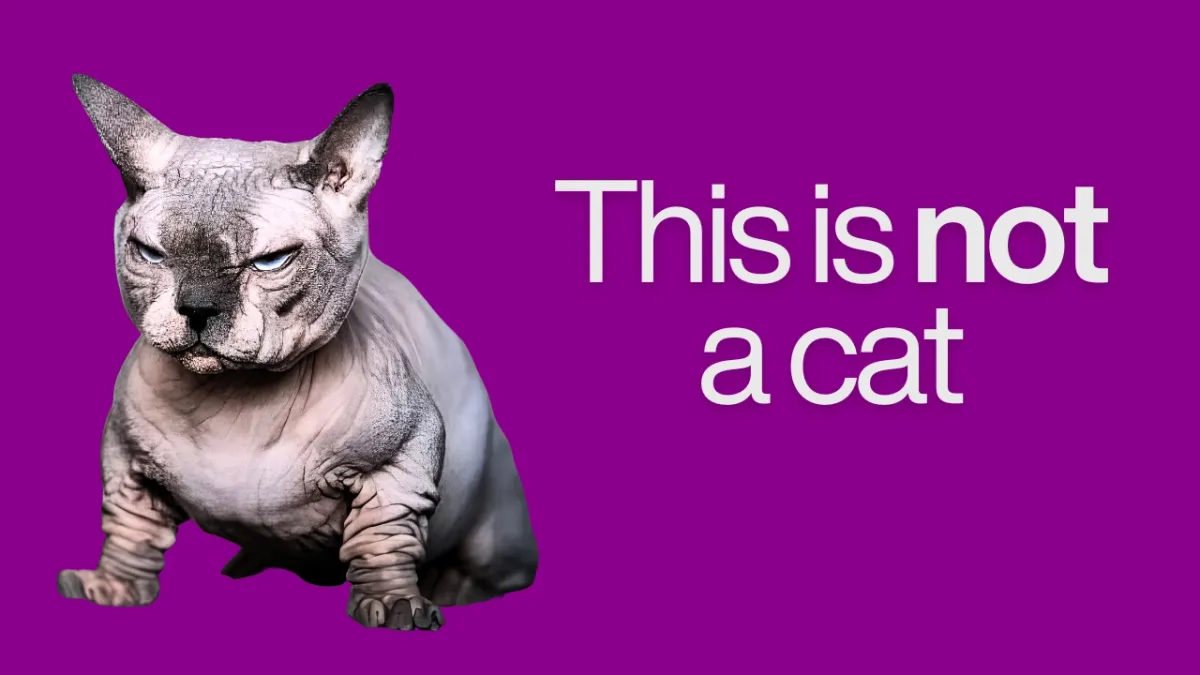
Yes - selective breeding for appearance has created cats with built-in diseases and dramatically shortened lifespans. Sphynx cats live an average of 6.68 years (nearly half the typical cat lifespan), 64.9% of Persian cats have at least one health disorder, and 100% of Scottish Fold cats will develop arthritis. The Netherlands has responded by banning ownership of these breeds starting 2026 - not just breeding, but keeping them as pets.
Table of Contents
- Why Is Cat Breeding a "75-Year Experiment"?
- How Much Life Do Extreme Breeds Lose?
- What Makes Scottish Fold Cats Different From Other Breeds?
- Why Are Persian Cats Called a "Brachycephalic Crisis"?
- What Makes the Munchkin Cat Mutation Dangerous?
- Which Countries Are Banning Extreme Cat Breeds?
- Can Genetic Testing Prevent Breed-Related Diseases?
- What Should Cat Owners Know Before Choosing a Breed?
- Key Takeaways
- Key Terms Used
- Frequently Asked Questions
- Sources
Why Is Cat Breeding a "75-Year Experiment"?
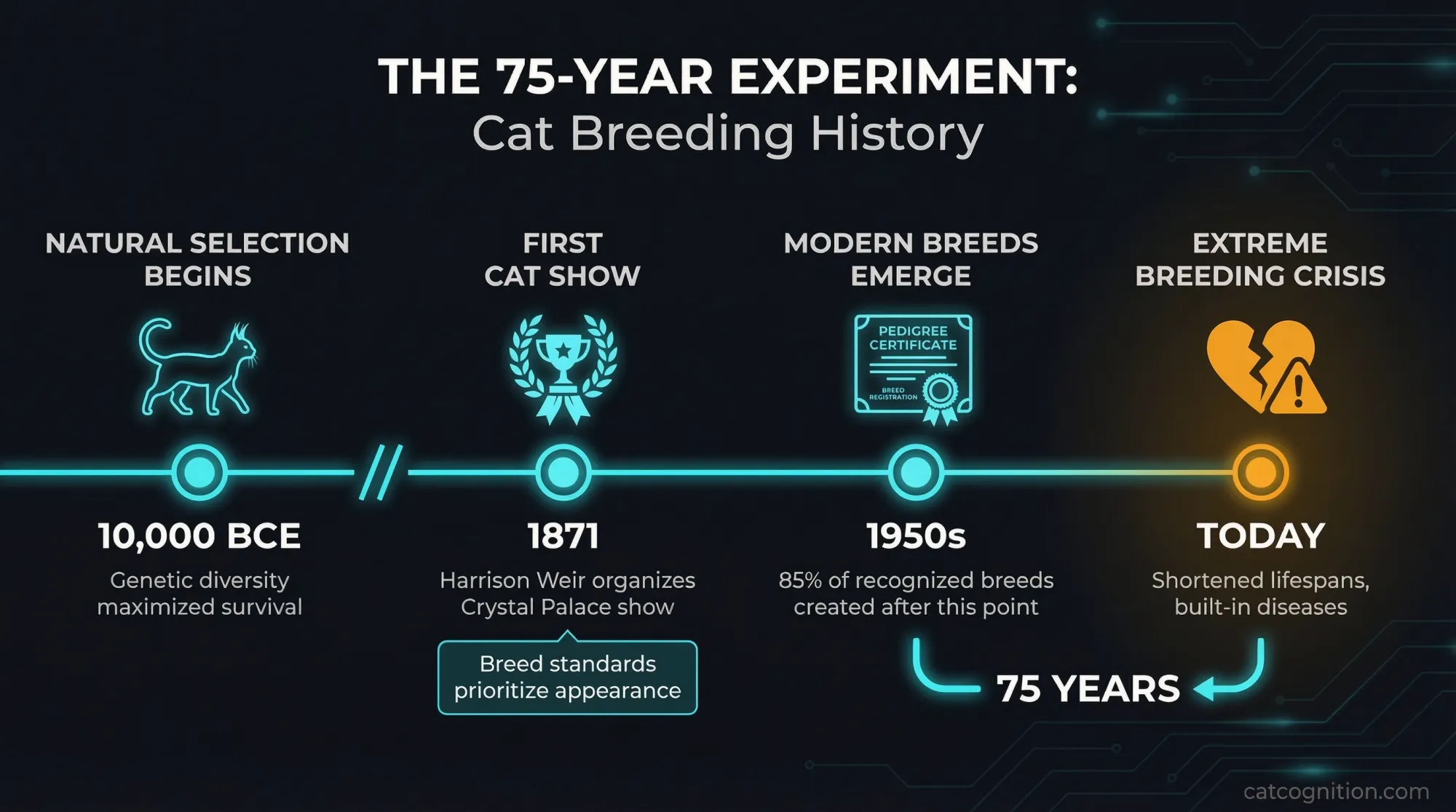
Over 85% of recognized cat breeds arose in just the past 75 years, making extreme cat breeding a remarkably recent experiment. While cats spent 10,000 years adapting through natural selection - where genetic diversity maximized survival - humans began selecting cats for aesthetic traits rather than survival traits only in 1871.
That year, Harrison Weir organized the first cat show at London's Crystal Palace, creating the concept of "breed standards" that prioritized appearance over function. What started as a Victorian hobby became an accelerating departure from natural cat anatomy.
The Evidence:
"Over 85% of recognized cat breeds arose in the past 75 years - extreme breeding is a very recent experiment with consequences we're only now measuring."
The timeline matters because it reveals how quickly we altered cats. Dogs were selectively bred for thousands of years for working roles - herding, guarding, hunting. Cat breeding has no such functional history. We bred cats for flat faces, folded ears, and short legs purely because humans found these features visually appealing - features that have zero survival advantage. Understanding this history is essential for making informed cat care decisions today.
How Much Life Do Extreme Breeds Lose?
A 2024 British lifespan study published in the Journal of Feline Medicine and Surgery analyzed thousands of cats and found Sphynx cats have the shortest lifespan of any breed at 6.68 years - nearly half the average cat lifespan of 11.74 years. This five-year gap represents the quantifiable cost of extreme breeding measured in lost time with a companion.
The lifespan variation across breeds is stark:
| Breed | Average Lifespan | Deviation from Mean |
|---|---|---|
| Burmese | 14.42 years | +2.59 years |
| Mixed-breed | 11.74 years | Baseline |
| Persian | 10-12 years | -1 to +1 years |
| Sphynx | 6.68 years | -5.15 years |
The Evidence:
"Sphynx cats live an average of 6.68 years - nearly half the typical cat lifespan of 11.74 years."
The Sphynx's shortened lifespan traces directly to heart disease. A 2024 New Zealand study published in Animals found that 40% of Sphynx cats screened at a median age of 5.8 years had hypertrophic cardiomyopathy (HCM), with approximately 60% of affected cats carrying an identified mutation in the ALMS1 gene. Dr. Leslie Lyons, Professor of Comparative Medicine at the University of Missouri and a leading feline geneticist, has documented how such mutations accumulate in closed breeding populations. The breed's hairlessness - the trait that defines it - emerged alongside genetic predispositions that damage the cardiovascular system.
Understanding how cats communicate health and comfort through body language becomes especially important for owners of breeds with higher health risks.
What Makes Scottish Fold Cats Different From Other Breeds?
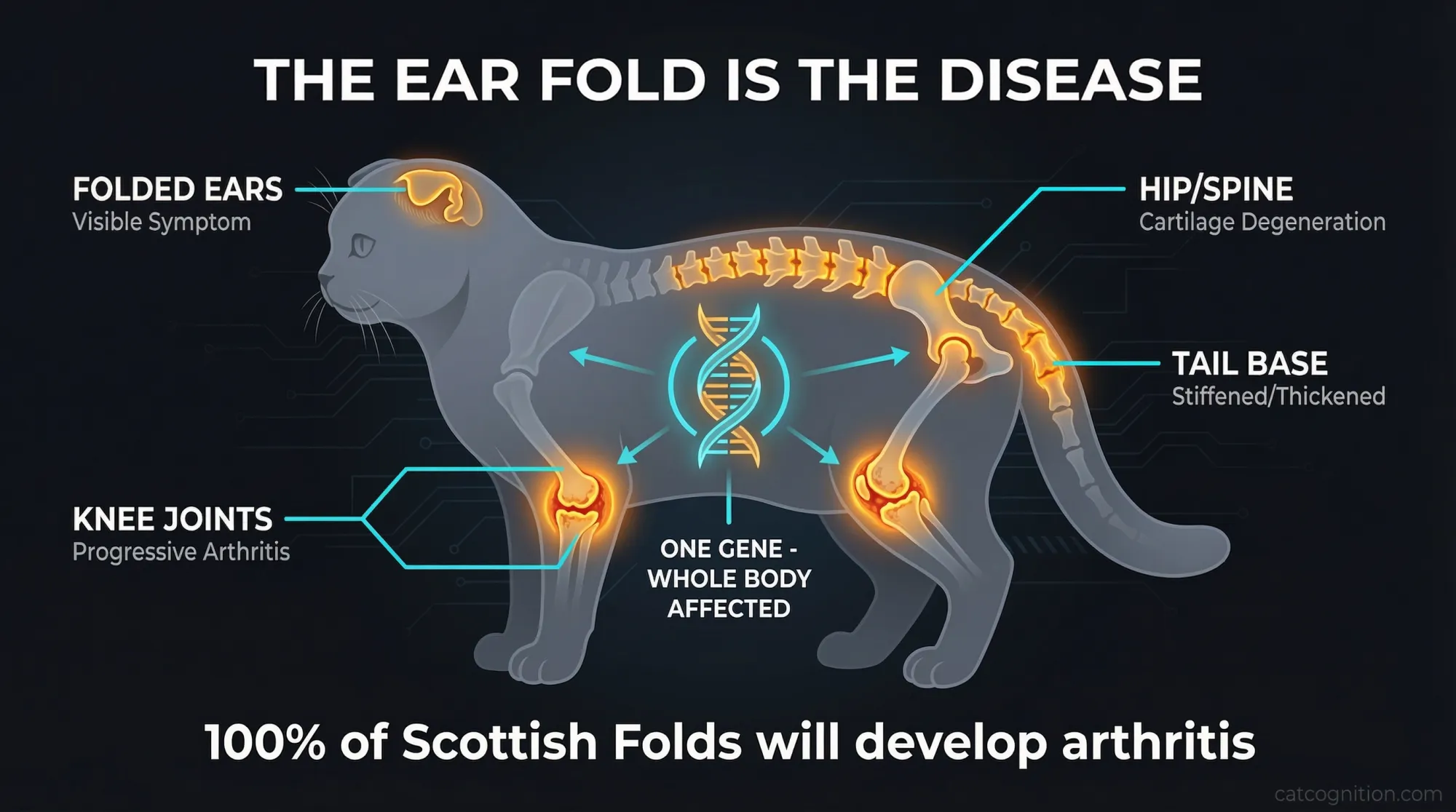
Scottish Fold cats represent the clearest example of a breed where the defining feature IS the disease. Every Scottish Fold cat will develop osteochondrodysplasia - a cartilage disorder causing progressive, painful arthritis - because the gene that folds the ear affects cartilage throughout the entire body.
This is not a probability or risk factor. This is certainty. The cute folded ears that give the breed its name are a visible symptom of a systemic cartilage defect. When owners select Scottish Fold cats for their distinctive appearance, they are selecting for a cat genetically programmed to develop joint disease.
The Evidence:
"Every Scottish Fold cat will develop arthritis because the gene that folds the ear affects cartilage throughout the entire body."
International Cat Care, the world's leading cat welfare charity, states this unequivocally: the Scottish Fold ear is the result of a cartilage abnormality, and all cats with folded ears will be affected by the painful degenerative joint disease. The only Scottish Fold cats without this condition are "Scottish Straights" - cats from Scottish Fold litters that did not inherit the fold gene and have normal, upright ears.
Adam's Lab Note:
I believe that giving people the information to make informed choices is the critical thing here. However, there is a lack of awareness surrounding the effects of breed health issues like this unfortunately.
Why Are Persian Cats Called a "Brachycephalic Crisis"?
Researchers now use the term "brachycephalic crisis" to describe flat-faced cat breeding, paralleling the veterinary emergency already recognized in dog breeds like Bulldogs and Pugs. VetCompass data from the Royal Veterinary College analyzed 3,235 Persian cats and found that 64.9% have at least one documented health disorder.
The flat face that defines the Persian breed is called brachycephaly - a skull deformation that compresses the respiratory system, causes eye problems due to shallow sockets, and creates dental crowding. These are not side effects of breeding. They are direct consequences of the breed standard itself.
The Evidence:
"64.9% of Persian cats have at least one documented health disorder according to Royal Veterinary College data from 3,235 cats."
Persian health problems extend beyond breathing difficulties. The Royal Veterinary College study found that 23.4% of Persian deaths were caused by kidney disease, reflecting the breed's predisposition to polycystic kidney disease (PKD). Historical screening data indicated PKD prevalence exceeded 50% in Persian populations before systematic testing began.
As Dr. Leslie Lyons, Professor of Comparative Medicine at the University of Missouri and Director of the 99 Lives Cat Genome Sequencing Initiative, explains: genetic testing has nearly eradicated PKD in Persian lines that use testing - proving that when breeders actually use the tools available, they can eliminate disease. The question is why more do not.
What Makes the Munchkin Cat Mutation Dangerous?
The Munchkin cat's short legs result from chondrodysplasia - a form of dwarfism affecting long bone development. Genetic research published in BMC Genetics in 2020 revealed that Munchkin embryos with two copies of the short-leg gene die in utero. The defining trait of the breed is embryo-lethal when inherited from both parents.
This means responsible Munchkin breeding requires pairing a short-legged cat with a normal-legged cat, knowing that approximately 50% of the kittens will not express the trait. Breeders cannot breed two Munchkins together without losing pregnancies to the lethal homozygous condition.
The Evidence:
"The Munchkin mutation is embryo-lethal when homozygous - embryos with two copies of the short-leg gene die in utero."
The Munchkin also illustrates how breeding for aesthetic traits creates functional compromises. Short legs limit jumping ability, affect mobility, and may contribute to spinal problems as the cat's skeleton compensates for altered proportions. These cats did not evolve short legs as an adaptation - the mutation was preserved and promoted because humans found it cute.
The science of why cats love boxes relates to this issue - cats with mobility limitations from breeding may struggle to access the elevated hiding spots and enclosed spaces that provide psychological security through thigmotaxis.
Which Countries Are Banning Extreme Cat Breeds?
The Netherlands will ban ownership - not just breeding - of Sphynx and Scottish Fold cats starting January 1, 2026. This represents a significant escalation from previous regulatory approaches that targeted only breeders, acknowledging that demand drives supply and addressing both ends of the market.
This builds on the Netherlands' 2014 breeding ban on these breeds, which proved insufficient to stop the practice. Belgium's Flanders region banned Scottish Fold breeding in 2021. The UK government issued a formal December 2024 opinion classifying extreme cat breeding as a welfare concern requiring action.
The Evidence:
"The Netherlands will ban ownership of Scottish Fold and Sphynx cats starting January 2026 - not just breeding, but keeping them as pets."
A coalition of European veterinary organizations - the Federation of Veterinarians of Europe (FVE), FECAVA, UEVP, and International Cat Care - is actively campaigning to ban extreme breed cats from advertising. Their position: using these breeds in commercials and social media normalizes their appearance and drives consumer demand for cats with built-in suffering.
Approximately 39% of UK veterinary professionals surveyed identified extreme conformation as a top welfare issue facing pedigree breeds, according to the PDSA PAW Report 2023. The veterinary consensus is forming: these breeds represent a welfare crisis that regulation must address.
Can Genetic Testing Prevent Breed-Related Diseases?
Genetic testing can identify carriers of harmful mutations and reduce disease frequency in breeding populations - but it cannot solve breeds where the disease IS the defining trait. Dr. Leslie Lyons' work at the University of Missouri's Feline Genetics and Comparative Medicine Laboratory has discovered approximately 70 DNA variants across more than 40 genes responsible for diseases and traits in cats.
The success stories are real. Genetic testing has nearly eradicated PKD in Persian lines that use it, eliminated blindness-causing mutations in Persians, addressed hypokalemia in Burmese, and reduced spasticity in Devon Rex and Sphynx populations. The 99 Lives Cat Genome Sequencing Initiative, with over 400 cat genomes in its database, continues expanding our understanding of feline genetic health.
However, Scottish Fold osteochondrodysplasia cannot be "tested out" because the disease and the ear fold are caused by the same gene. Testing would identify every Scottish Fold as positive. The same logic applies to brachycephalic Persians - you cannot test for "flat face" as a disease when flat face is the breed standard.
Adam's Lab Note:
Moon is a British Longhair - a pedigree cat, not a shelter mix. I'm not anti-pedigree; I'm anti-extreme. His breed has functional proportions: open airway, normal muzzle, upright ears with healthy cartilage, standard legs. The British Longhair got its long coat from Persian crosses, but breeders selected away from the flat face. He still gets HCM screening (closed gene pools carry risk), but his genetics aren't engineered to fail. That's the difference between a breed standard and a sentence.
What Should Cat Owners Know Before Choosing a Breed?
Purebred does not mean healthy - it means the cat meets appearance standards that may directly cause disease. Understanding this distinction helps prospective cat owners make informed decisions based on health outcomes rather than aesthetic preferences alone.
For Prospective Owners Considering Purebreds
| Priority | Action | Why It Matters |
|---|---|---|
| 1 | Demand genetic testing documentation from any breeder | Identifies carriers of harmful mutations in parents and grandparents |
| 2 | Avoid breeds where the defining trait IS the disease | Scottish Fold, Munchkin, extreme-face Persian have unavoidable health problems |
| 3 | Budget for higher lifetime veterinary costs | Some breeds require 10x the medical expenses of mixed-breed cats |
| 4 | Consider breed-specific pet insurance | Coverage must be in place before issues arise |
| 5 | Research breed-specific health screenings | Echocardiograms for HCM-prone breeds, kidney panels for Persians |
For Owners of Affected Breeds
| Priority | Action | Why It Matters |
|---|---|---|
| 1 | Establish baseline health metrics | Find a veterinarian familiar with breed-specific issues |
| 2 | Schedule preventive screenings | Based on known breed predispositions |
| 3 | Modify the environment | Low-rise cat furniture for short-legged or arthritic cats |
| 4 | Discuss pain management protocols | Begin conversations early with your veterinarian |
| 5 | Plan financially | Higher-than-average lifetime care costs are expected |
The genetic diversity in mixed-breed cats correlates with longer lifespans and fewer inherited disorders. Shelter cats offer both the ethical choice and, frequently, the healthier choice.
Key Takeaways
- Timeline Reality: Over 85% of cat breeds emerged in just 75 years - extreme breeding is a recent experiment, not ancient tradition
- Lifespan Cost: Sphynx cats live 6.68 years on average, nearly half the typical 11.74-year cat lifespan
- Built-In Disease: Scottish Fold cats have 100% arthritis rates because the folded ear gene damages cartilage body-wide
- Regulatory Response: The Netherlands will ban ownership (not just breeding) of extreme breeds from 2026
- Testing Limits: Genetic testing can reduce some diseases but cannot fix breeds where the breed standard IS the disease
Key Terms Used
- Brachycephaly: Skull deformation causing flat face; affects breathing, eyes, and dental structure in Persian and Exotic Shorthair cats.
- Osteochondrodysplasia: Cartilage disorder in Scottish Folds causing progressive, painful arthritis throughout the body.
- Chondrodysplasia: Dwarfism mutation in Munchkin cats affecting long bone development; embryo-lethal when inherited from both parents.
- Inbreeding depression: Reduced fitness from accumulation of harmful recessive genes in small, closed breeding populations.
- Hypertrophic cardiomyopathy (HCM): Heart muscle thickening; the most common heart disease in cats, affecting 10-15% of the general population and higher rates in certain breeds.
- Polycystic kidney disease (PKD): Inherited kidney condition once affecting over 50% of Persians; now manageable through genetic testing.
See the full Cat Cognition Glossary ->
Frequently Asked Questions
Has selective breeding really harmed cats?
Yes. Data from thousands of cats demonstrates that selective breeding for appearance has created breeds with dramatically shortened lifespans, high rates of chronic disease, and in some cases, genetic conditions affecting 100% of the breed population. The Sphynx lifespan of 6.68 years - versus the 11.74-year average - quantifies what "harm" means in years of life lost.
Why are Scottish Fold cats guaranteed to develop arthritis?
The gene that creates the distinctive folded ears is the same gene that causes osteochondrodysplasia - a cartilage disorder affecting the entire skeletal system. The ear fold is not separate from the disease; it is a visible symptom of it. International Cat Care confirms that all cats with folded ears will develop this painful condition.
Are there any purebred cats that are actually healthy?
Some breeds have fewer extreme features and more genetic diversity. Norwegian Forest Cats and Siberian cats have fewer documented breed-specific disorders. However, any closed gene pool increases disease risk over time - the question is degree, not whether. Mixed-breed cats generally have better health outcomes due to genetic diversity.
Can genetic testing prevent these problems?
Genetic testing can identify carriers and reduce disease frequency in breeds where the disease is separate from the defining trait. Dr. Leslie Lyons' work has nearly eradicated PKD in Persian lines that use testing. However, breeds like Scottish Fold cannot be "tested clean" because the breed-defining feature IS the disease gene.
Should I avoid getting a purebred cat entirely?
Not necessarily, but informed decision-making matters. If you want to minimize health risks and veterinary costs, mixed-breed shelter cats offer genetic diversity that correlates with longer lifespans. If you choose a purebred, select breeds without extreme features, demand genetic testing documentation, and budget for higher lifetime medical expenses.
Why is the Netherlands banning cat ownership instead of just breeding?
The Netherlands recognized that breeding bans alone (implemented in 2014) proved insufficient - demand continued driving supply through imports and underground breeding. The 2026 ownership ban addresses both ends of the market, acknowledging that as long as people want these cats, someone will produce them.
What is the "brachycephalic crisis" in cats?
Researchers now use this term to describe the welfare emergency caused by flat-faced cat breeding, paralleling the recognized crisis in brachycephalic dogs like Bulldogs. The term reflects veterinary consensus that flat-faced cats - primarily Persians and Exotic Shorthairs - face systemic health problems directly caused by breed standards.
How can I tell if a breeder is responsible?
Responsible breeders provide genetic testing documentation, health records for multiple generations, and honest information about breed-specific health risks. They welcome questions about health problems and do not dismiss concerns. Breeders who avoid these conversations or claim their lines are "problem-free" are red flags.
Sources
- Cat Lifespan Study 2024 - Journal of Feline Medicine and Surgery (Link)
- Persian Health VetCompass Study - Royal Veterinary College (Link)
- Scottish Fold Osteochondrodysplasia - International Cat Care (Link)
- Sphynx HCM Research - NC State College of Veterinary Medicine (Link)
- Munchkin Gene Lethality Study - BMC Genetics 2020 (Link)
- Netherlands Ownership Ban - DutchNews.nl (Link)
- UK Government Opinion on Feline Breeding - UK Government December 2024 (Link)
- Brachycephalic Crisis Terminology - PMC 2023 (Link)
- Cat Breed Genetics Study - Lipinski et al. 2008, Genetics/PMC (Link)
- Feline Genetics Laboratory - Dr. Leslie Lyons, University of Missouri (Link)
- HCM Prevalence in Cats - PMC 2017 (Link)
- FVE Advertising Campaign - Federation of Veterinarians of Europe (Link)
- Hypertrophic Cardiomyopathy - Cornell Feline Health Center (Link)
- Sphynx HCM Prevalence Study 2024 - Animals, New Zealand (Link)