Orange Cat Behavior: What Science Actually Says About Your Ginger Cat
Orange cat behavior is primarily a human perception phenomenon, not a genetic personality program. 80% of orange cats are male — and that sex ratio, not coat color, explains most of the stereotype.

Table of Contents
- What Is Orange Cat Behavior?
- Are Orange Cats Really Crazier? The Science
- What Breed Is an Orange Cat?
- Orange Cat Energy: Why the Internet Is Obsessed
- Tabby Cat Behavior vs Orange Cat Behavior
- Are Orange Cats Smarter (or Dumber) Than Other Cats?
- The Gene That Could Change Everything (But Hasn't Yet)
- Key Terms
- Frequently Asked Questions
- Key Takeaways
- Sources
The internet has decided: orange cats share one brain cell, and that brain cell is on vacation. The "All Orange Cats Share 1 Brain Cell" Facebook group has amassed over 126,000 members. The r/OneOrangeBraincell subreddit generates millions of views. And the search term "orange cat behavior" pulls 3,600 searches every month from people genuinely wondering whether their ginger cat is wired differently.
But here is the uncomfortable truth that no meme account will tell you: the strongest scientific evidence in the "orange cat behavior" space does not describe cat behavior at all. It describes human perception. Research by Dr. Mikel Delgado, a Certified Applied Animal Behaviorist and Senior Research Scientist at Purdue University (PhD, UC Berkeley), demonstrated that people consistently attribute friendliness to orange cats regardless of whether those personality differences actually exist. As Delgado said about that foundational 2012 study: "To date there is little evidence that these perceived differences between differently colored cats actually exist, but there are serious repercussions for cats if people believe that some cat colors are friendlier than others."
The science of orange cat behavior is really the science of human perception. And the story behind that disconnect is far more interesting than the meme.
What Is Orange Cat Behavior?
Orange cat behavior refers to the widely held belief that orange (ginger) cats display a distinct set of personality traits -- including goofiness, food obsession, boldness, excessive friendliness, and chaotic energy -- that set orange cats apart from cats of other coat colors. The concept gained mainstream traction online around 2019 and reached peak cultural saturation by 2022, partly driven by Jorts the Cat going viral and the explosive growth of social media communities dedicated to documenting the supposed antics of orange cats.
The term is not a veterinary diagnosis or a recognized behavioral classification. Orange cat behavior is a cultural label rooted in internet meme culture, specifically the "one brain cell" framework where every clumsy, bold, or food-driven moment from an orange cat is interpreted as evidence of a shared personality type. When a black cat knocks something off the counter, the owner says "cats are jerks." When an orange cat does the same thing, the owner says "classic orange cat behavior."
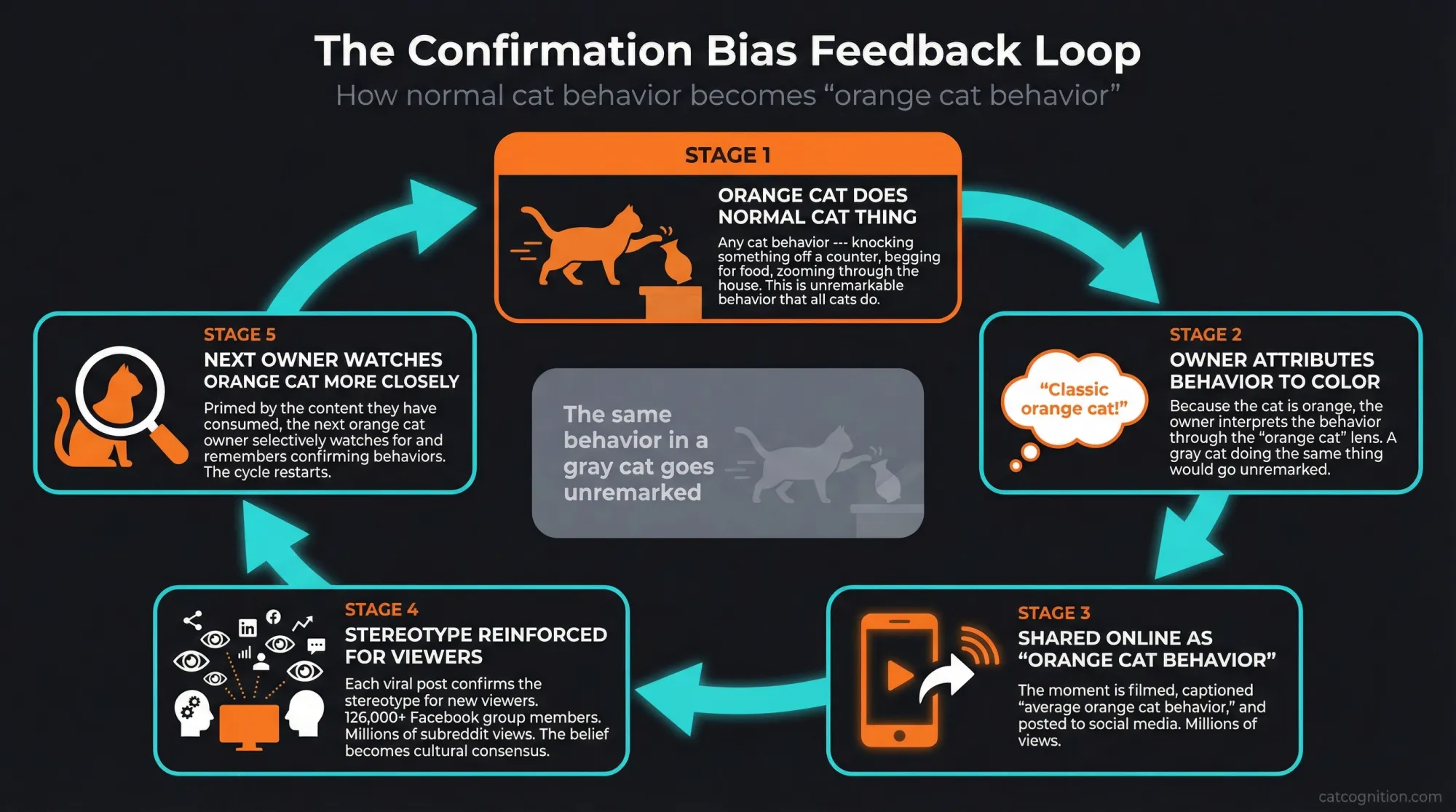
This framing matters because the label creates a confirmation bias feedback loop. Owners who expect orange cat behavior notice and remember behaviors that confirm the stereotype, while ignoring identical behaviors in non-orange cats. Understanding how to read actual cat body language signals is far more useful than relying on coat color assumptions. The result is an entire internet subculture built on pattern recognition that may have no biological basis.
📊 The Evidence:
"Approximately 80% of orange cats are male because the orange gene is X-linked, requiring only one copy in males versus two in females."
Are Orange Cats Really Crazier? The Science
Orange cats are not demonstrably crazier than cats of other coat colors when sex, breed, and socialization history are controlled for. A University of Pennsylvania study of 574 single-breed cats found that nearly all coat-behavior associations could be attributed to breed differences, concluding that the hypothesis linking appearance to behavior "was largely unsubstantiated" (Wilhelmy et al. 2016, co-authored by Dr. Carlo Siracusa, Director of Animal Behavior Service at Penn Vet).
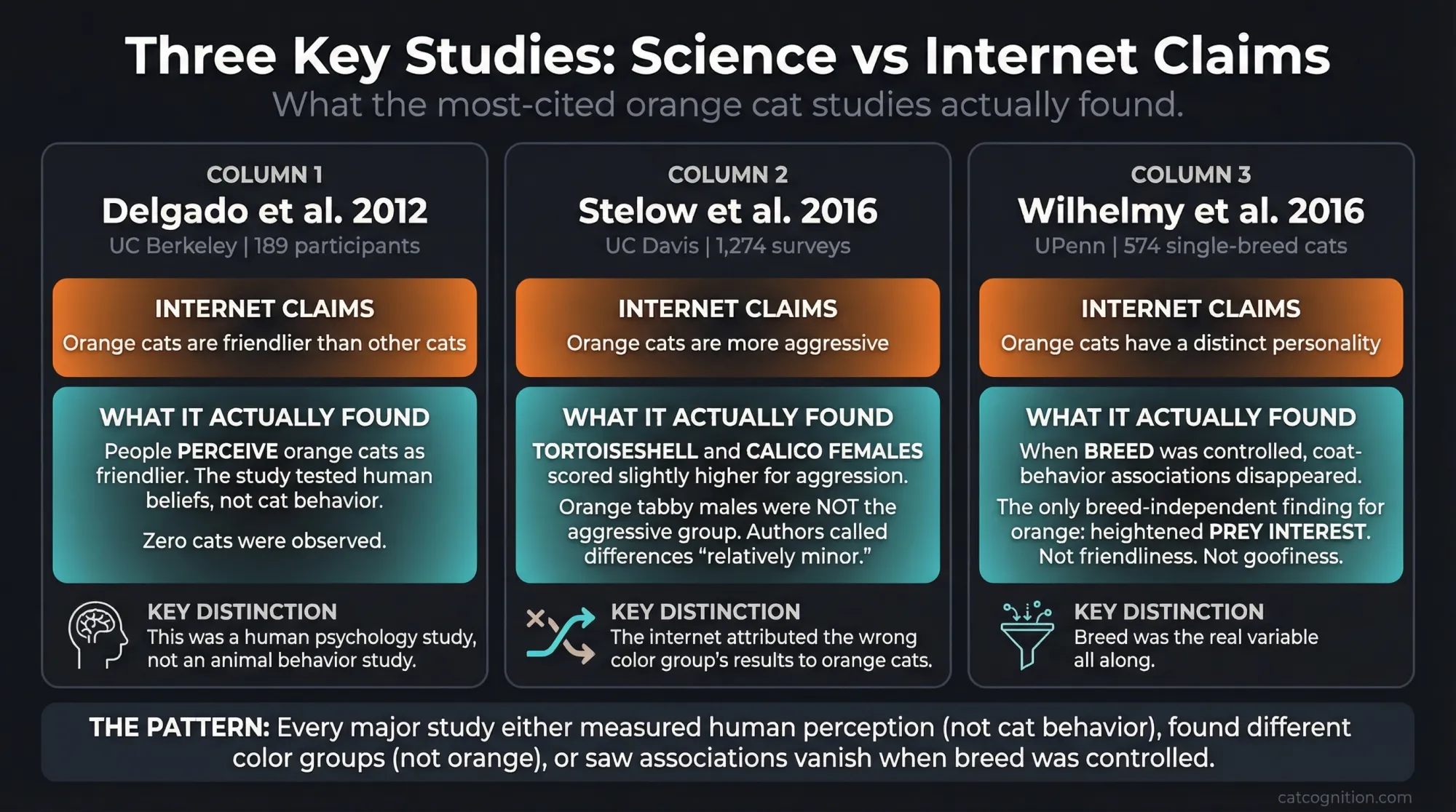
The three most-cited studies in the orange cat behavior space tell a surprising story when read carefully:
Study 1 -- Delgado et al. 2012 (189 participants, UC Berkeley): This study did not test cat behavior. It tested human perception. Participants rated orange cats as friendlier and white cats as more aloof -- but these ratings reflected human beliefs, not observed cat actions. The study measured what people think about orange cats, not how orange cats actually behave.
Study 2 -- Stelow et al. 2016 (1,274 surveys, UC Davis): This is the most misrepresented study in the entire topic. Competitor articles routinely cite Stelow 2016 as evidence that "orange cats are more aggressive." The study actually found that tortoiseshell, calico, and torbie females -- cats that carry one orange allele alongside other color genes -- scored slightly higher for aggression. Orange tabby males were not the aggressive group. The authors themselves described the differences as "relatively minor."
Study 3 -- Wilhelmy et al. 2016 (574 cats, University of Pennsylvania): When breed was controlled, coat-behavior associations disappeared almost entirely. The one breed-independent finding for red/orange cats was heightened prey interest -- not friendliness, not goofiness, not chaos. Orange cats liked to hunt, and that was the only color-linked behavioral signal that survived breed correction.
The question of whether cats have distinct personality types is real — research into whether some cats are genuinely psychopathic uses similar methodology — but the evidence consistently points to breed and sex, not coat color.
📊 The Evidence:
"The most-cited coat-aggression study found tortoiseshell females more aggressive, not orange males -- a distinction most articles reporting 'orange cat aggression' fail to make."
What Breed Is an Orange Cat?
Orange is a coat color, not a breed, and orange tabby cats appear across dozens of recognized breeds as well as in the general domestic cat population. The orange phenotype is controlled by a single X-linked gene, and the specific mutation responsible was identified in May 2025 when two independent research teams -- one at Stanford University (Kaelin et al.) and one at Kyushu University in Japan (Sasaki et al.) -- simultaneously published findings in Current Biology identifying a 5.1-kilobase deletion in the ARHGAP36 gene.
This discovery was remarkable for two reasons. First, the simultaneous confirmation by two independent teams working on opposite sides of the Pacific makes the finding exceptionally robust. Second, the ARHGAP36 pathway is unique to domestic cats. Nearly every other mammal produces orange or red coloring through the MC1R gene. Cats took a completely different evolutionary path. For more on how coat color genetics actually work in cats, see our guide to how cat coat color genetics work.
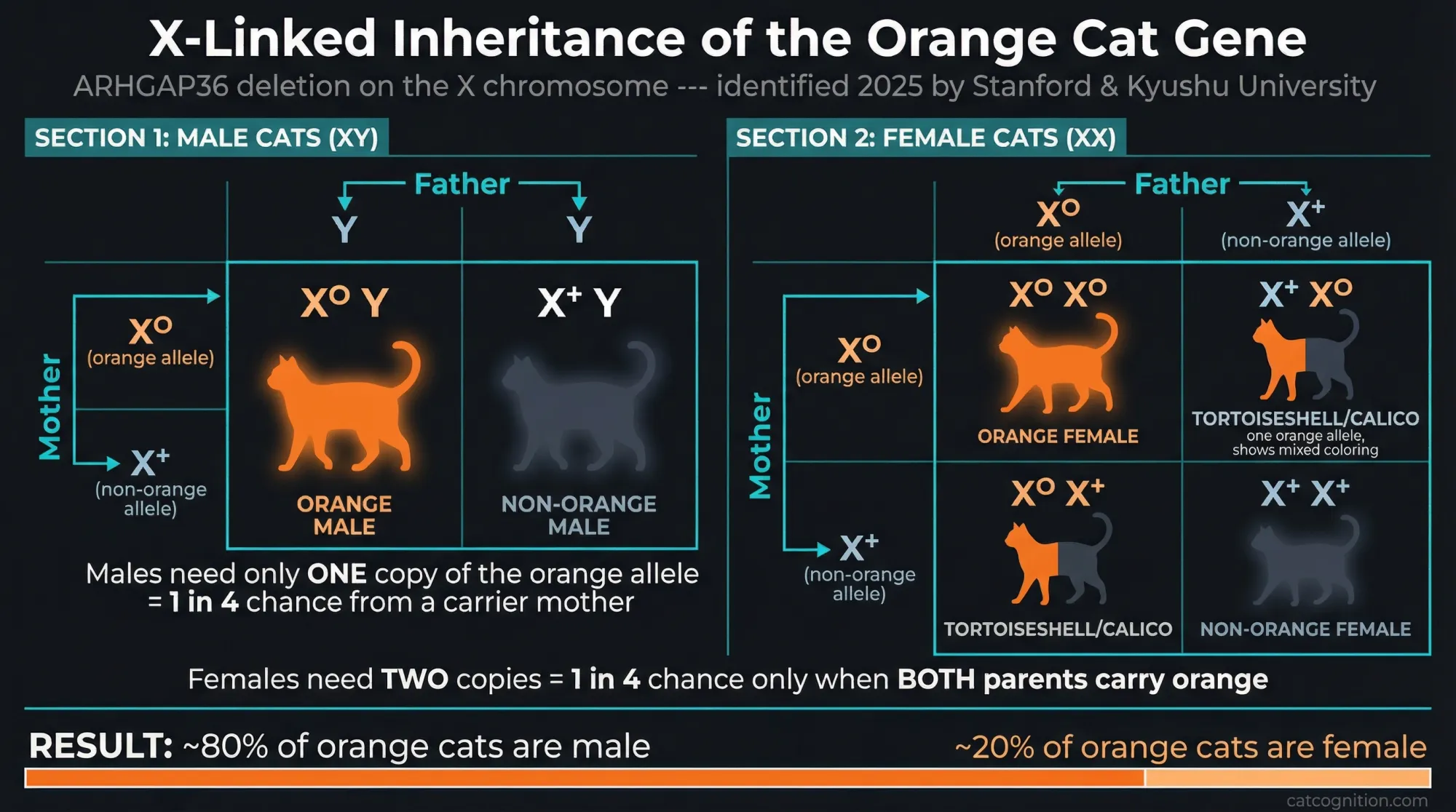
The ARHGAP36 deletion works by increasing gene activity in melanocytes (pigment-producing cells), which suppresses eumelanin (dark pigment) and promotes pheomelanin (orange pigment). Stanford researchers estimated the mutation originated more than 900 years ago. Because the gene sits on the X chromosome, male cats (XY) need only one copy to be fully orange, while female cats (XX) need two copies. This X-linked inheritance creates the approximately 80:20 male-to-female ratio among orange cats.
One critical implication: all orange cats are tabbies. The orange gene overrides the non-agouti gene, which means tabby markings are always visible in orange cats regardless of their genetic background. An orange cat might be a domestic shorthair, a Maine Coon, a Persian, a British Shorthair, or any number of other breeds. The orange coloring says nothing about breed and, by extension, nothing reliable about behavior. The health and behavioral problems that come from extreme cat breeding are a breed issue, not a color issue.
Think of the orange gene like a jersey in team sports -- wearing the same jersey does not make athletes behave the same way, but spectators who follow the team notice and remember every play by a player in that jersey. Orange is a coat color, not a personality program.
📊 The Evidence:
"Two independent 2025 studies identified the ARHGAP36 gene deletion as the sole cause of orange coloration in domestic cats -- a pathway unique among mammals."
Orange Cat Energy: Why the Internet Is Obsessed
Orange cat energy is an internet-born concept describing the perceived chaotic, food-driven, fearless personality that social media users attribute to orange cats, and the cultural phenomenon likely sustains itself through three converging factors: the male sex ratio confound, confirmation bias amplified by meme culture, and the sheer visibility of the orange coat itself.
The timeline is instructive. The orange cat behavior stereotype began gaining traction online in 2019, with early viral posts framing orange cats as "the crackhead of cats." By November 2020, the "All Orange Cats Share 1 Brain Cell" Facebook group launched and rapidly accumulated over 126,000 members. Jorts the Cat achieved widespread virality. The r/OneOrangeBraincell subreddit became one of the most active cat communities on Reddit. By 2022, "orange cat energy" had entered the broader lexicon of internet culture.
This cultural momentum creates a self-reinforcing cycle. Owners of orange cats are primed to interpret any bold, clumsy, or food-motivated behavior through the "orange cat" lens. The same behavior in a gray cat goes unremarked. The same behavior in an orange cat gets filmed, captioned "average orange cat behavior," and shared to thousands. Each viral post reinforces the stereotype for the next viewer, who then watches their own orange cat more closely, notices the behavior, and contributes another post.
The result is an entire content ecosystem built on confirmation bias at industrial scale. The behaviors are real -- cats of all colors do goofy, bold, chaotic things. The attribution to coat color is the illusion.
Tabby Cat Behavior vs Orange Cat Behavior
There is no meaningful behavioral distinction between tabby cat behavior and orange cat behavior because all orange cats are genetically tabby cats. The orange gene overrides the non-agouti gene in domestic cats, making tabby markings visible in every orange cat regardless of breed or genetic background. When people search for "tabby cat behavior" versus "orange cat behavior," the search terms describe the same population of cats viewed through different cultural lenses -- one focused on pattern, the other on color.
The University of Helsinki's study of over 4,300 cats (Mikkola et al. 2021, led by Prof. Hannes Lohi) identified seven distinct personality and behavior traits in cats: fearfulness, activity/playfulness, aggression toward humans, sociability toward humans, sociability toward cats, excessive grooming, and litterbox issues. The primary behavioral predictor across all seven traits was breed, not coat color or pattern. For a deeper dive into the science of feline personality, Dr. Jon Bowen's lecture on the psychology of cats covers the academic framework.
Similarly, the "Feline Five" personality model (Litchfield et al. 2017, n=2,802 cats) identified five personality dimensions -- Neuroticism, Extraversion, Dominance, Impulsiveness, and Agreeableness. The study did not examine coat color as a variable, and these dimensions were identified independent of coat color analysis.
| Factor | What It Predicts | What It Does NOT Predict |
|---|---|---|
| Breed | Activity level, sociability, fearfulness, prey drive | Nothing about coat color |
| Sex (male vs female) | Social boldness, vocalization, body size | Nothing about coat pattern |
| Coat color | Human perception of the cat | Actual measured behavior |
| Early socialization (weeks 2-7) | Adult confidence, human tolerance | Nothing about coat color |
| Environmental enrichment | Activity level, destructive behavior | Nothing about coat color |
The real behavioral variable hiding inside the "orange cat behavior" label is sex. Since approximately 80% of orange cats are male, and male cats -- particularly neutered males -- tend to be larger, bolder, more social, and more vocal than females, the behavior people attribute to "orangeness" is predominantly male-typical behavior. A neutered male brown tabby would display many of the same traits. The orange coat just makes the behavior more memorable.
Are Orange Cats Smarter (or Dumber) Than Other Cats?
Orange cats are not measurably smarter or dumber than cats of other coat colors, and no peer-reviewed study has found a cognitive difference linked to coat color in domestic cats. The "one brain cell" meme is a humor framework, not a scientific claim, and the perception of lower intelligence in orange cats likely results from the same confirmation bias that drives the entire orange cat behavior narrative.
The intelligence question deserves a careful unpacking. Cat cognition researchers, including Dr. Saho Takagi at Kyoto University, have demonstrated that cats can mentally map their owner's spatial location from voice alone and learn the names of familiar cats in their household. These cognitive abilities have been documented across cats of various coat colors without any color-based variation.
A 2022 survey of 211 cat owners in Mexico (Gonzalez-Ramirez and Landero-Hernandez 2022) actually rated orange cats highest for perceived trainability at 4.6 out of 7 -- the opposite of "dumb." But these were owner perceptions, not standardized cognitive tests, and the unweighted sample showed no statistically significant differences between coat color groups.
The "dumb orange cat" meme likely reflects a specific type of behavior that reads as unintelligent to human observers: boldness without hesitation. A cat that charges headfirst into a glass door or falls off a counter mid-jump looks foolish. But that same impulsivity may simply be high confidence with low caution -- a trait more common in male cats, who make up the majority of the orange cat population.
📊 The Evidence:
"When breed is controlled, coat-color personality associations in cats disappear -- except for heightened prey interest in orange cats."
The Gene That Could Change Everything (But Hasn't Yet)
The 2025 ARHGAP36 discovery opened one genuinely intriguing scientific question. Pigment cells originate from neural crest cells during embryonic development. Neural crest cells also differentiate into neurons and endocrine cells that produce catecholamines -- dopamine, norepinephrine, and epinephrine -- the hormones that control activity and excitability. The Kyushu University team noted that ARHGAP36 is expressed in brain and hormonal glands, not just skin.
This is the neural crest hypothesis: if the same gene that makes a cat orange is also active in the brain, could the gene influence behavior alongside color?
The answer, as of 2025, is: probably not. The Stanford team specifically tested for ARHGAP36 expression differences in non-skin tissues -- kidney, heart, brain, and adrenal glands -- and found no differences between orange and non-orange cats. Kyushu researcher Hiroyuki Sasaki was transparent about the limits of the finding: "I should like to stress, however, that this is just a speculation."
A French population genetics study spanning 1982-1992 (Pontier et al. 1995) observed higher frequencies of the orange allele in rural cat populations, which are characterized by polygynous mating systems, suggesting that orange males may have had a reproductive advantage through bolder, more dominant behavior. This is the one piece of evidence hinting at genuine evolutionary selection pressure on behavior linked to the orange phenotype -- but it suggests the link would have been shaped by natural selection over centuries, not by the gene directly encoding a "personality."
📊 The Evidence:
"Orange cats do not use the MC1R gene linked to pain sensitivity in human redheads, making the 'redhead pain myth' scientifically inapplicable to felines."
Key Terms
ARHGAP36 -- The gene identified in 2025 as responsible for orange coloration in domestic cats. A 5.1-kilobase deletion increases ARHGAP36 expression in melanocytes, suppressing dark pigment (eumelanin) and promoting orange pigment (pheomelanin). Unique to cats among mammals.
X-linked inheritance -- A genetic pattern where the gene sits on the X chromosome. Males (XY) need only one copy of the allele to express the trait, while females (XX) need two copies. This creates the approximately 80% male ratio in orange cats.
Pheomelanin -- The orange-red pigment produced in melanocytes when eumelanin production is suppressed. Responsible for the orange color in cat fur and for red hair in humans, though the genetic pathways differ between species.
Eumelanin -- The dark (black or brown) pigment in melanocytes. Suppressed by the ARHGAP36 deletion in orange cats.
Confirmation bias -- The tendency to notice, remember, and interpret information that confirms pre-existing beliefs while ignoring contradictory evidence. The primary psychological mechanism driving the "orange cat behavior" phenomenon.
Neural crest cells -- Embryonic cells that differentiate into multiple cell types including pigment cells, neurons, and endocrine cells. The speculative biological link between coat color and behavior.
Catecholamines -- Hormones including dopamine, norepinephrine, and epinephrine produced by neural crest-derived cells that regulate activity and excitability.
Frequently Asked Questions
Are orange cats friendlier than other cats? The evidence suggests the "friendly orange cat" perception is driven by sex ratio, not coat color. Approximately 80% of orange cats are male, and neutered male cats tend to be more social and affiliative than females. Dr. Mikel Delgado's 2012 UC Berkeley study confirmed that people attribute friendliness to orange cats regardless of actual behavior -- a textbook case of confirmation bias. The one large-scale behavioral study that controlled for breed found coat-behavior associations "largely unsubstantiated." For more on what feline affection actually looks like, see every sign your cat loves you.
Do orange cats feel pain differently like human redheads? No. In humans, the MC1R gene variant that produces red hair also affects pain sensitivity -- redheaded women required approximately 19% more desflurane (an inhalational anesthetic) than dark-haired women in one study (Liem et al. 2004). However, cats produce orange coloring through the ARHGAP36 gene -- a completely different genetic pathway discovered in 2025. Any claim that "orange cats need more anesthesia" based on human MC1R research is scientifically unsupported.
Why are most orange cats male? The orange gene sits on the X chromosome. Male cats (XY) need only one copy of the orange allele to be fully orange. Female cats (XX) need two copies -- one on each X chromosome. This X-linked inheritance pattern means roughly 80% of orange cats are male and only about 20% are female.
Are orange female cats rare? Orange female cats are less common than orange males but not exceptionally rare. Approximately 20% of orange cats are female. A female cat needs to inherit the orange allele from both parents, which requires either an orange father or a father carrying the orange allele, plus a mother who is orange, calico, or tortoiseshell.
Is there any real scientific basis for orange cats behaving differently? The evidence is thin but not zero. The Kyushu University team noted that ARHGAP36 is expressed in brain and hormonal glands, which theoretically could influence behavior. However, Stanford found no ARHGAP36 expression differences in brain tissue between orange and non-orange cats. The one breed-independent behavioral finding for orange cats was heightened prey interest -- not friendliness or goofiness. A possible evolutionary selection pressure exists, but the internet-driven "orange cat personality" lacks direct scientific support.
What breed is an orange cat? Orange is a coat color, not a breed. Orange tabby cats appear across dozens of recognized breeds including domestic shorthairs, Maine Coons, Persians, British Shorthairs, Abyssinians, and many others. All orange cats are genetically tabbies because the orange gene overrides the non-agouti gene, making tabby markings always visible.
Why do orange cats seem to eat so much? The food obsession attributed to orange cats likely reflects the larger body size and higher caloric needs of male cats -- and since 80% of orange cats are male, the observation has a real basis in sex-linked biology, not coat color. Neutered male cats are also more prone to weight gain due to metabolic changes following neutering.
Should I worry if my orange cat acts "crazy"? Normal cat behavior includes bursts of energy (especially at dawn and dusk), play-hunting, vocalizing, and exploring. These behaviors are not specific to orange cats. However, if behavior changes suddenly -- increased aggression, lethargy, hiding, loss of appetite, or excessive vocalization -- consult a veterinarian regardless of coat color. Sudden behavioral changes are the number one early indicator of illness in cats. Do not dismiss concerning behaviors as "just my orange cat being an orange cat."
Key Takeaways
Orange cat behavior is a perception phenomenon. The strongest scientific evidence describes human bias (attributing friendliness to orange cats regardless of actual behavior), not a genetic personality type linked to coat color.
The sex ratio explains most of the stereotype. Approximately 80% of orange cats are male due to X-linked inheritance. Male cats are naturally bolder, more social, and more vocal -- traits owners misattribute to coat color.
The 2025 ARHGAP36 gene discovery confirmed orange coloring affects pigment cells, not brain function. Two independent teams found no expression differences in brain tissue between orange and non-orange cats, and the neural crest behavioral hypothesis remains explicitly speculative.
The most commonly cited studies are misrepresented. Stelow 2016 found tortoiseshell females more aggressive, not orange males. The human redhead-pain connection (MC1R gene) does not apply to cats, which use an entirely different genetic pathway.
Treat your cat as an individual, not a color code. Breed, sex, socialization history, and environmental enrichment predict cat behavior far more reliably than coat color. If behavior concerns arise, consult a veterinarian -- do not dismiss changes as "orange cat personality."
Sources
Kaelin CB, McGowan KA, Barsh GS et al. "Molecular and genetic characterization of sex-linked orange coat color in the domestic cat." Current Biology, 2025. https://www.cell.com/current-biology/abstract/S0960-9822(25)00552-4
Sasaki H et al. "A deletion at the X-linked ARHGAP36 gene locus is associated with the orange coloration of tortoiseshell and calico cats." Current Biology, 2025. https://www.cell.com/current-biology/fulltext/S0960-9822(25)00391-4
Delgado MM, Munera JD, Reevy GM. "Human Perceptions of Coat Color as an Indicator of Domestic Cat Personality." Anthrozoos, 2012. https://doi.org/10.2752/175303712X13479798785779
Stelow EA, Bain MJ, Kass PH. "The Relationship Between Coat Color and Aggressive Behaviors in the Domestic Cat." Journal of Applied Animal Welfare Science, 2016. https://pubmed.ncbi.nlm.nih.gov/26467020/
Wilhelmy J, Serpell J, Brown D, Siracusa C. "Behavioral associations with breed, coat type, and eye color in single-breed cats." Journal of Veterinary Behavior, 2016. https://www.sciencedirect.com/science/article/abs/pii/S1558787816300284
Mikkola S, Salonen M, Hakanen E, Sulkama S, Lohi H. "Reliability and Validity of Seven Feline Behavior and Personality Traits." Animals (MDPI), 2021. https://pmc.ncbi.nlm.nih.gov/articles/PMC8300181/
Litchfield CA, Quinton G, Tindle H et al. "The 'Feline Five': An exploration of personality in pet cats." PLoS ONE, 2017. https://journals.plos.org/plosone/article?id=10.1371/journal.pone.0183455
Gonzalez-Ramirez MT, Landero-Hernandez R. "Cat Coat Color, Personality Traits and the Cat-Owner Relationship Scale: A Study with Cat Owners in Mexico." Animals (MDPI), 2022. https://pmc.ncbi.nlm.nih.gov/articles/PMC9024431/
Liem EB, Lin CM, Suleman MI, Doufas AG, Gregg RG, Veauthier JM, Loyd G, Sessler DI. "Anesthetic Requirement Is Increased in Redheads." Anesthesiology, 101(2):279-283, 2004. https://pubmed.ncbi.nlm.nih.gov/15277908/
Bittel J. "Are orange cats really the goofiest cats? Genetics may have an answer." National Geographic, 2025. https://www.nationalgeographic.com/animals/article/ginger-orange-cat-behavior-explained
Schmidt-Kuntzel A, Eizirik E, O'Brien SJ, Menotti-Raymond M et al. "A domestic cat X chromosome linkage map and the sex-linked orange locus." Genetics, 2009. https://pmc.ncbi.nlm.nih.gov/articles/PMC2666509/
Pontier D, Rioux N, Heizmann A. "Evidence of selection on the orange allele in the domestic cat Felis catus: the role of social structure." Oikos, 73, 299-308, 1995. Referenced via Wu K, "Why Orange Cats Are So Special, According to Science," Psychology Today, 2020. https://www.psychologytoday.com/us/blog/the-modern-heart/202009/why-orange-cats-are-so-special-according-science