Stray vs Feral Cat: What's the Difference?
A stray cat was once someone's pet. A feral cat has never been socialized to humans. The difference is determined by a 2-9 week socialization window in early kittenhood — not by species, breed, or choice.

Table of Contents
- What Is a Feral Cat?
- What Is a Stray Cat?
- Feral Cat vs Stray Cat: Key Differences
- The Science Behind the Distinction
- Do Feral Cats Meow, Purr, or Communicate?
- Understanding Feral Cat Behavior
- What Is TNR (Trap-Neuter-Return)?
- Can a Feral Cat Become a Pet?
- What to Do If You Find an Outdoor Cat
- The Ecological Debate
- Key Terms
- Frequently Asked Questions
- Key Takeaways
- Sources
An estimated 30 to 80 million community cats live outdoors across the United States, yet most people cannot tell a stray cat from a feral cat. The distinction is not a matter of opinion. The difference between a stray cat and a feral cat comes down to a specific developmental window in early kittenhood that permanently shapes how a cat's brain responds to human beings.
Dr. Kristyn Vitale, a Certified Applied Animal Behaviorist, has spent years studying how cats form bonds with people. Her review of 31 peer-reviewed studies concluded that free-ranging cats are "social generalists" — capable of adapting their social behavior to radically different environments, though the degree of sociality varies significantly between groups, with some forming strong bonds and others showing little social interaction. That flexibility is what makes the stray-feral distinction possible: the same species can produce individuals who seek out human laps and individuals who flee at the sight of a person.
Understanding where a cat falls on this spectrum determines whether the right response is a foster home or a humane trap and a return to colony life. For a broader overview of cat care topics, from kitten socialization to senior health, understanding this distinction is one of the most important first steps.
A stray cat was once someone's pet. A feral cat has never been socialized to humans. The difference is determined by a 2-to-9-week socialization window in early kittenhood — not by species, breed, or choice. Both are the same species (Felis catus). The difference is experiential, not genetic — domestication is a species-level trait, while socialization is an individual-level experience shaped by early kittenhood.

What Is a Feral Cat?
A feral cat is a domestic cat (Felis catus) that was never socialized to humans during the critical 2-to-9-week developmental window in early kittenhood. Feral cats are genetically identical to pet cats but experientially wild, developing without human social input during the sensitive period that permanently shapes a cat's capacity for human bonding.
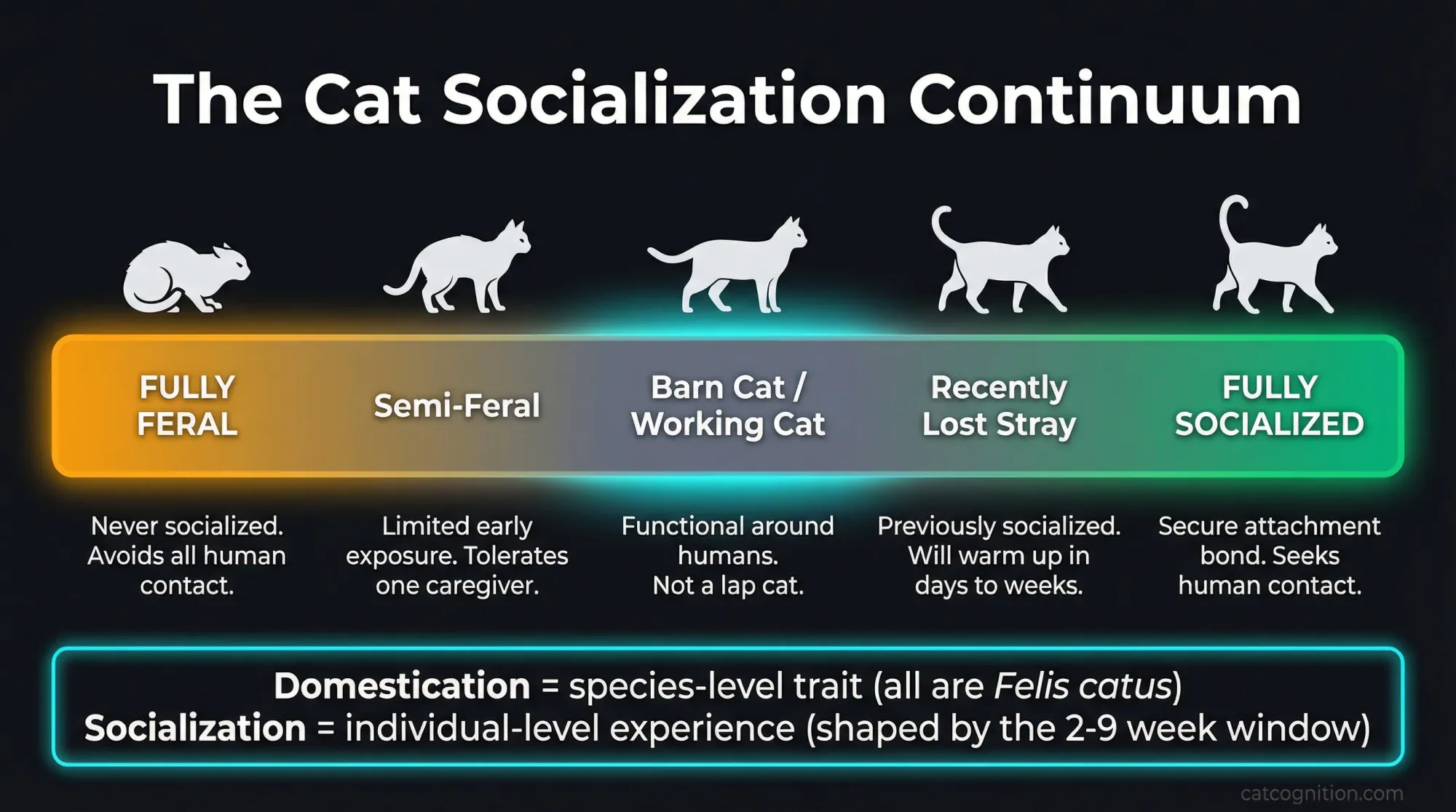
A feral cat is born outdoors — or sometimes indoors in hoarding situations — and grows up without meaningful human contact. The word "feral" describes a socialization status, not a species classification. Every feral cat carries the same DNA as the cat sleeping on your couch. The difference lies in what happened during the first weeks of life.
As Dr. John Bradshaw of the University of Bristol's Anthrozoology Institute has noted, domestic cats still have "three out of four paws firmly planted in the wild." Cats can revert to a fully independent way of life within only a few generations without human contact. That reversion is not a defect. Cat domestication began approximately 10,000 years ago when African wildcats (Felis silvestris lybica) self-selected for proximity to human grain stores — the bravest wildcats adapted to exploit rodent prey near human settlements. Domestication was a behavioral choice on the species level, not selective breeding imposed by humans.
Feral cats carry that same genetic toolkit for independence. When a kitten misses the socialization window, its nervous system develops without the neural wiring for human proximity. The result is an adult cat that is fully domestic by biology but fully self-sufficient by behavior.
The term "community cat" serves as an umbrella covering both stray and feral cats. Community cat describes a housing status — unowned, free-roaming — not a behavioral classification.

What Is a Stray Cat?
A stray cat is a domestic cat that was previously socialized to humans and then lost or abandoned from a human home. Stray cats retain the neural wiring for human attachment formed during kittenhood. A stray cat's sociability may be temporarily suppressed by fear, but the capacity for human bonding built during the 2-to-9-week socialization window remains intact.
A stray cat once had a home. Whether through abandonment, escape, or displacement, the cat ended up outdoors without a caregiver. But the attachment circuitry formed during kittenhood does not disappear.
Dr. Kristyn Vitale's landmark 2019 study in Current Biology found that approximately 65% of cats demonstrate secure attachment to their human caregivers — a proportion remarkably similar to what researchers find in human infants and domestic dogs. A stray cat that once formed a secure attachment bond carries that neurological foundation even after months on the street.
A stray cat may approach cautiously, make eye contact, meow, or walk with its tail raised. These are social signals directed at humans — behaviors that only emerge in cats whose brains wired for human interaction during the sensitive period. The signals may be muted by fear or hunger, but the underlying social architecture is there.
Critically, the ASPCA warns that "feral behavior can mask the social history of the cat." A frightened stray cat can appear completely feral for the first one to three days in a shelter or unfamiliar environment.
Feral Cat vs Stray Cat: Key Differences
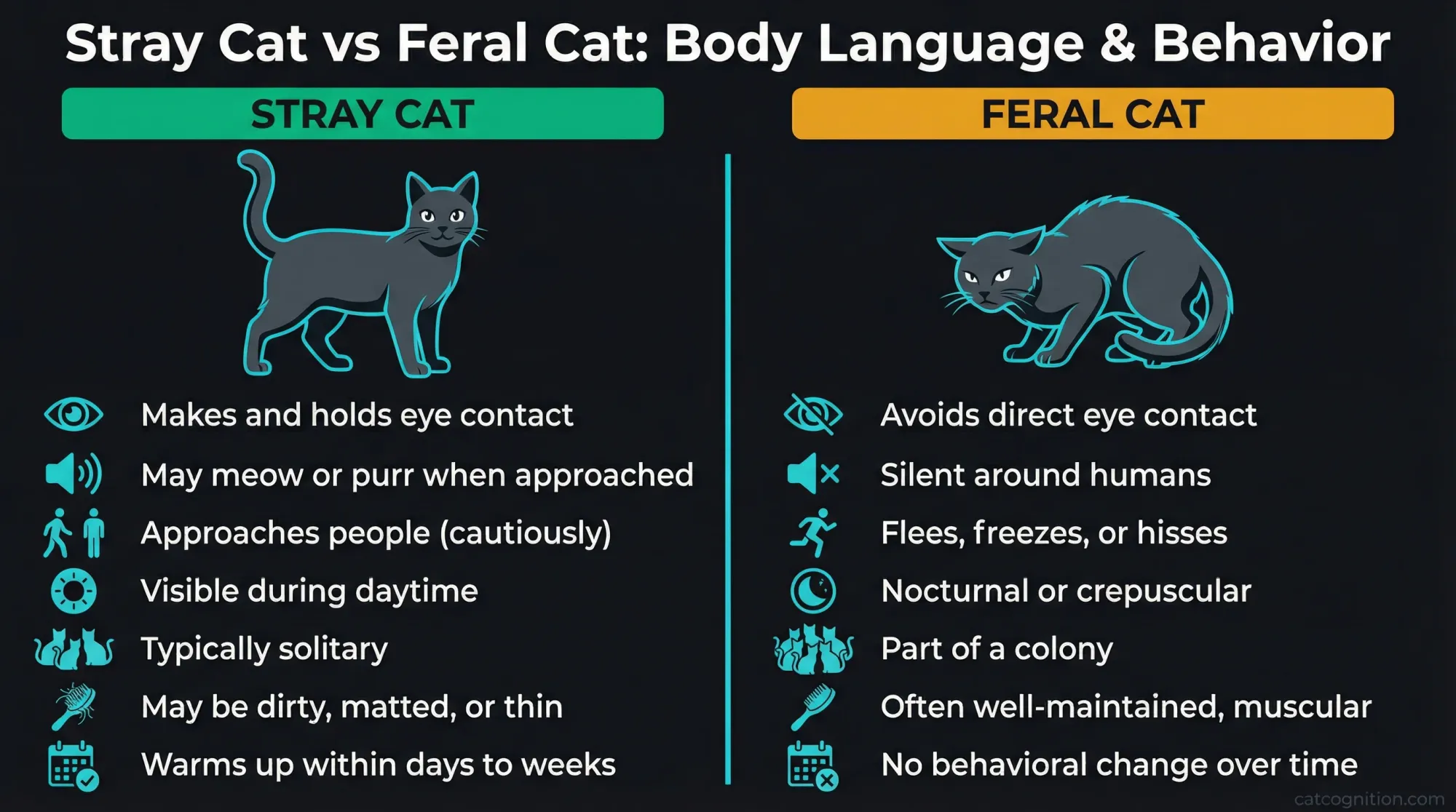
Feral cats and stray cats differ in socialization history, behavior toward humans, body language, activity patterns, and appropriate intervention. Feral cats avoid human contact, remain silent around people, and live in colonies. Stray cats may approach people, vocalize, and typically appear alone.
The behavioral differences between stray and feral cats are observable and consistent. Here is what to look for:
| Behavioral Signal | Likely Stray | Likely Feral |
|---|---|---|
| Approaches people | Yes, may be cautious | No — flees, freezes, or hisses |
| Eye contact | Makes and holds eye contact | Avoids direct eye contact |
| Vocalizations near humans | May meow, purr when approached | Silent around humans |
| Body posture | Walks with tail up, body relaxed | Crouches low, belly to ground, ears flat |
| Activity schedule | Visible during daytime | Primarily nocturnal or crepuscular |
| Coat condition | May be dirty, matted, or thin | Often well-maintained and muscular |
| Ear tip | Usually intact | Ear-tip clip indicates prior TNR |
| Colony membership | Typically solitary | Often part of a colony |
| Response over time | Warms up within days to weeks | No behavioral change after extended exposure |
One counterintuitive pattern: feral cats are frequently in better physical condition than recently lost strays. A feral cat has been self-sufficient its entire life. A stray cat that just lost its home may be thin, matted, and disoriented.
📊 The Evidence:
"A survey of 555 shelter and rescue programs found that only 15% had written guidelines for distinguishing feral cats from frightened stray cats, and holding periods of just 1-3 days were common before making a feral determination — often too short for a frightened stray to decompress." (Slater et al. 2010, Journal of Feline Medicine and Surgery)
The Science Behind the Distinction
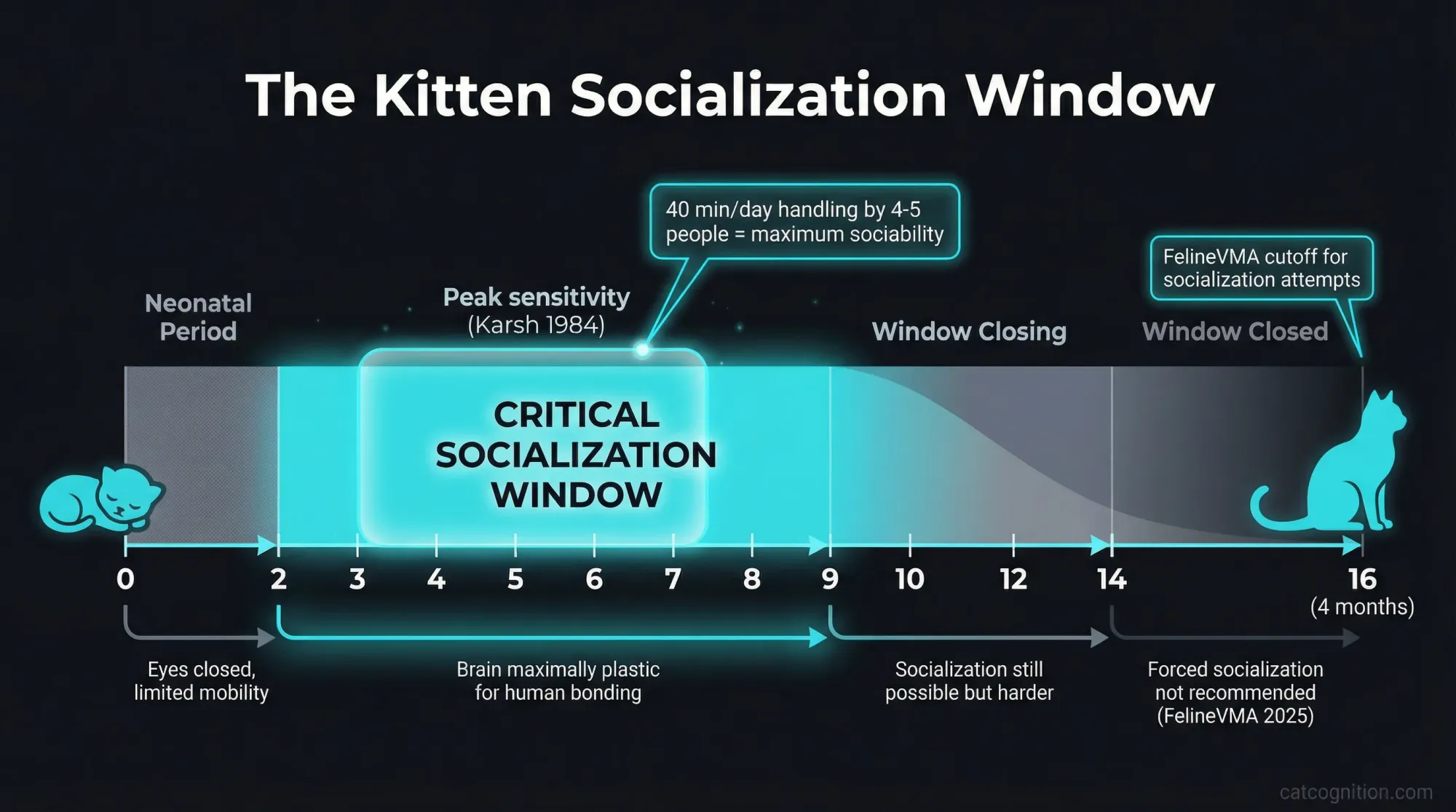
The feral-stray distinction is rooted in the feline socialization window — a sensitive period between 2 and 9 weeks of age when a kitten's brain is maximally plastic for forming social bonds with humans. Kittens handled during the 2-to-9-week sensitive period develop lasting sociability. Kittens that miss the socialization window develop into adults with nervous systems that never wired for human proximity.
Think of the socialization window like a language acquisition period. Children who learn a language before age seven speak it natively. Adults learning the same language always carry an accent. Kittens socialized before nine weeks "speak human" fluently. Feral cats never acquired the neural dialect.
Eileen Karsh's foundational 1984 study first established this sensitive period experimentally. Karsh demonstrated that kittens handled 40 minutes per day between weeks three and seven became significantly more sociable than kittens handled 15 minutes per day. Handling kittens for as few as 15 minutes per day produced lifelong socialization benefits, with 40 minutes daily producing significantly greater sociability (Karsh, 1984). Handling by four to five different people produced more broadly sociable cats than handling by one person alone. McCune (1995) and Casey and Bradshaw (2008) replicated these findings, and the sensitive socialization period for kittens is now placed roughly between 2 and 9 weeks of age (FelineVMA 2025 position statement), though the exact boundaries vary across sources — Karsh's original work identified 2 to 7 weeks, while the AVMA's 2024 review places it at 3 to 9 weeks. To understand how these early weeks fit into a cat's overall development, see cat life stages explained.
📊 The Evidence:
"Kittens handled 40 minutes daily between weeks 3 and 7 become measurably more sociable than kittens handled 15 minutes daily. Handling by 4-5 different people produces more broadly sociable adult cats than handling by 1 person alone." (Karsh 1984, replicated by McCune 1995 and Casey & Bradshaw 2008)
The Feline Veterinary Medical Association's 2025 position statement places the sensitive socialization period at 2 to 9 weeks and explicitly recommends against attempting to socialize feral kittens older than four months, stating that forced socialization beyond this age may be detrimental to their emotional health.
A stray cat passed through the socialization window with human contact and formed attachment bonds. A feral cat passed through the same window without human contact. The distinction is not about personality or stubbornness — the distinction is about neurology.

Do Feral Cats Meow, Purr, or Communicate?
Feral cats communicate extensively with each other through body language, scent marking, and vocalizations. Feral cats are typically silent around humans because meowing is a learned social behavior directed at people, not a species-wide instinct. Research shows feral cats actually produce higher call rates than house cats when stressed — the silence is selective, not absolute.
The popular belief that feral cats are silent is only half right. Feral cats are silent around humans. Among their colony mates, feral cats use the full range of feline communication: chirps, trills, yowls, hisses, and purrs.
A 2011 study published in Behavioural Processes found that feral cats actually produced significantly higher vocalization call rates than house cats in standardized test situations. The difference was attributed to less socialization to other animals and greater sensitivity to fearful situations. The feral cats were not quiet — they were louder. But those vocalizations were stress responses, not social bids for human attention.
Meowing at humans is a behavior that cats develop specifically for communicating with people. Kittens meow to their mothers, but adult cats in colonies rarely meow to each other. The meow directed at a human caregiver is a learned social signal — one that only develops in cats socialized during the sensitive period. When a stray cat meows at you, that sound is evidence of prior human socialization. For a deeper dive into the full range of feline vocalizations, see every level of cat sound explained.
Understanding Feral Cat Behavior
Feral cat colonies are not random aggregations of antisocial animals. Research by Dr. Sharon Crowell-Davis established that feral colonies are matrilineal societies organized around related females who cooperate in kitten rearing, share grooming duties, and maintain complex social bonds with preferred associates.
The science tells a different story than the "loner" myth. Dr. Sharon Crowell-Davis's foundational 2004 research in the Journal of Feline Medicine and Surgery established that feral cat colonies are matrilineal — organized around mothers, daughters, and granddaughters who cooperate in raising kittens, grooming each other, and defending territory. Colony members develop a shared "colony odor" through scent exchanges, form preferential affiliations with specific individuals, and show dramatically different behavior toward insiders versus outsiders. This pattern — known as facultative sociality — means cats are flexible in their social organization, forming tight bonds when conditions favor it.
📊 The Evidence:
"At one well-studied colony (Church Farm, UK), 53.4% of all interactions consisted of allogrooming (social grooming), while only 4.9% of within-group interactions were aggressive. Between-group interactions, by contrast, were 53.7% aggressive. Feral cats are deeply social with their colony — and deeply wary of strangers." (Vitale 2022, Animals)
These numbers challenge the assumption that "feral" means "antisocial." Feral cats are unsocialized to humans, but they maintain rich, complex social lives among their own kind. The distinction matters: labeling a cat "feral" should describe its relationship with people, not its capacity for social connection. Understanding the psychology of cats helps explain why these colony dynamics are so robust.

What Is TNR (Trap-Neuter-Return)?
TNR stands for Trap-Neuter-Return, an evidence-based management approach where feral cats are humanely trapped, surgically sterilized, ear-tipped for identification, and returned to their colony location. Two long-term studies demonstrate TNR's effectiveness: the University of Central Florida program achieved an 85% population reduction over 28 years, and the ORCAT program in Key Largo documented a 55% decline over 23 years.
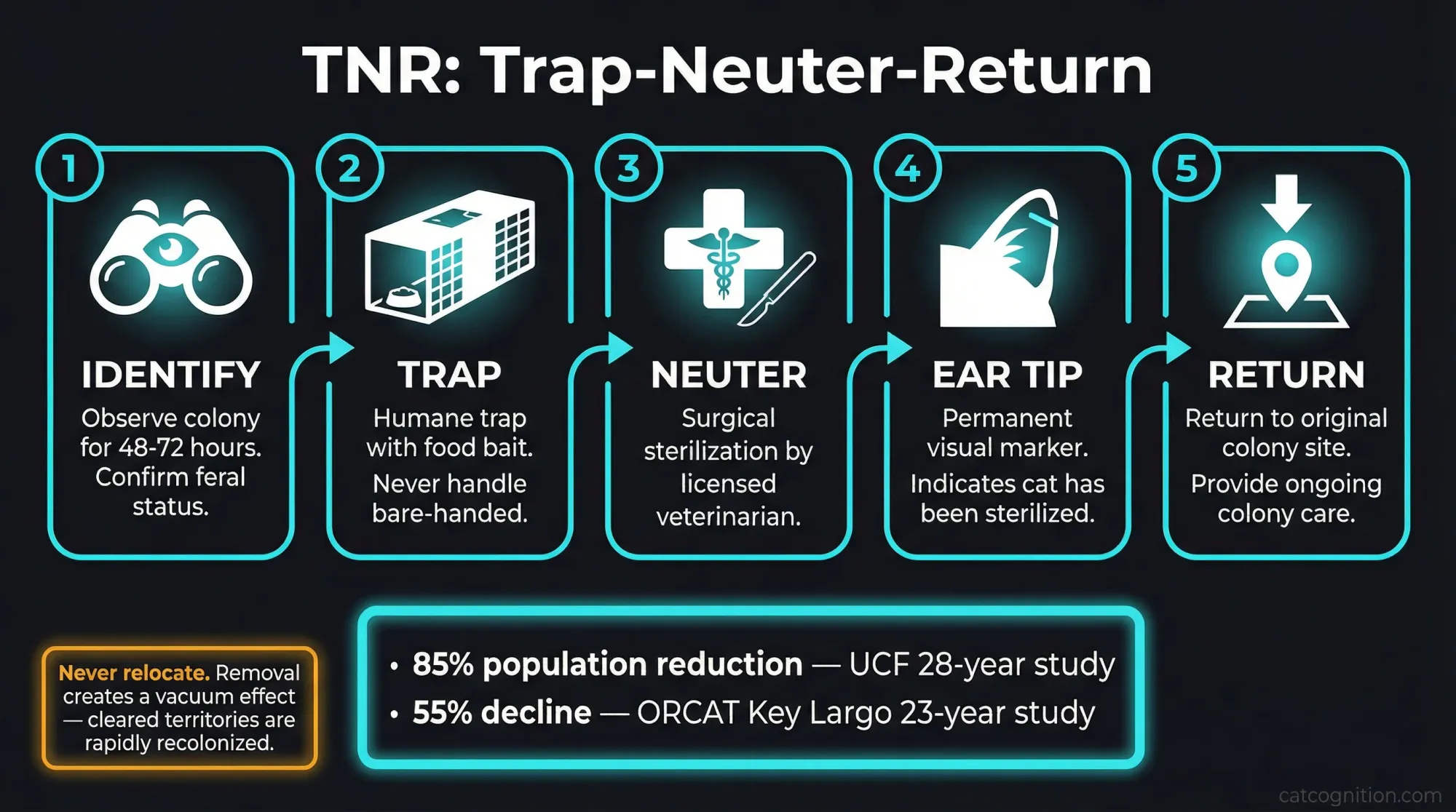
TNR is not a feel-good compromise. Peer-reviewed, multi-decade studies demonstrate measurable population decline when TNR programs achieve sustained community engagement.
The University of Central Florida ran a volunteer-led TNR and adoption program for 28 years, reducing its colony population from 68 cats to 10 — an 85% decline. The study's authors note that this success was "not wholly attributable to biology": 45% of enrolled cats were adopted out through intensive volunteer socialization, making this a TNR-plus-adoption hybrid rather than a pure TNR result.
The ORCAT program in Key Largo operated for 23 years and served 2,529 individual cats, reporting a 55% population decline with a statistically significant downward trend — though the program's authors acknowledged that population growth in early phases, likely from cat immigration, initially counteracted sterilization efforts. The program also improved welfare: mean cat age increased from 16.6 months to 43.8 months, and FIV prevalence declined 0.16% annually.
📊 The Evidence:
"A study of low-level, intermittent culling of feral cat populations in Tasmania found that cat numbers increased by 75% and 211% at study sites due to the vacuum effect — removed cats are rapidly replaced through reproduction, immigration, and abandonment." (Lazenby, Mooney & Dickman, 2015) In the most successful documented applications, high community participation in TNR programs achieved population reductions exceeding 77% (Community Engagement review, 2024) — though a 2022 PNAS study found that sustained reductions require high-intensity sterilization across contiguous areas to overcome compensatory immigration (Gunther et al., 2022).
The ear-tip — a small, straight-line removal of the tip of one ear performed during spay/neuter surgery — serves as a permanent visual indicator that a cat has been sterilized. An ear-tipped cat has already been through a TNR program and should be left in place.
Can a Feral Cat Become a Pet?
Feral kittens under four months old can be socialized, especially when handled during the 2-to-9-week sensitive period. Adult feral cats older than four months without prior human contact should not be subjected to forced socialization attempts. The Feline Veterinary Medical Association explicitly warns that socializing feral kittens beyond four months may be detrimental to their emotional health.
The answer depends entirely on age.
Feral kittens under four months: Socialization is possible and recommended. The earlier handling begins, the better. During the 2-to-9-week sensitive window, even brief daily handling produces lasting sociability. The protocol: handle the kitten for at least 40 minutes per day, involve four to five different people to build broad sociability, and expose the kitten to varied but gentle experiences. Avoiding common cat owner mistakes during this phase — like forcing interaction or overwhelming a shy kitten — makes all the difference.
Adult feral cats over four months without prior human socialization: The FelineVMA's 2025 position statement explicitly recommends against forced socialization. This is a welfare recommendation grounded in the developmental science of the socialization window. For adult feral cats, the appropriate intervention is TNR — not a foster home.
That said, outcomes exist on a spectrum. Some adult feral cats in sanctuary settings develop limited tolerance for specific caregivers, and rare cases of adult ferals becoming adoptable have been documented. But these are exceptions, not protocols — success is slow, uncertain, and requires months of patient, non-coercive interaction. Forcing the process causes genuine psychological harm.
If you have found an adult feral cat, the most compassionate response is TNR and colony care, not a rescue attempt the cat's neurology cannot support.
What to Do If You Find an Outdoor Cat
When encountering an unowned outdoor cat, observe the cat from a distance for at least 48 to 72 hours before making any determination. Behavioral signals over time — not a single encounter — reveal whether a cat is a stray that can be rehomed or a feral cat best served by TNR.
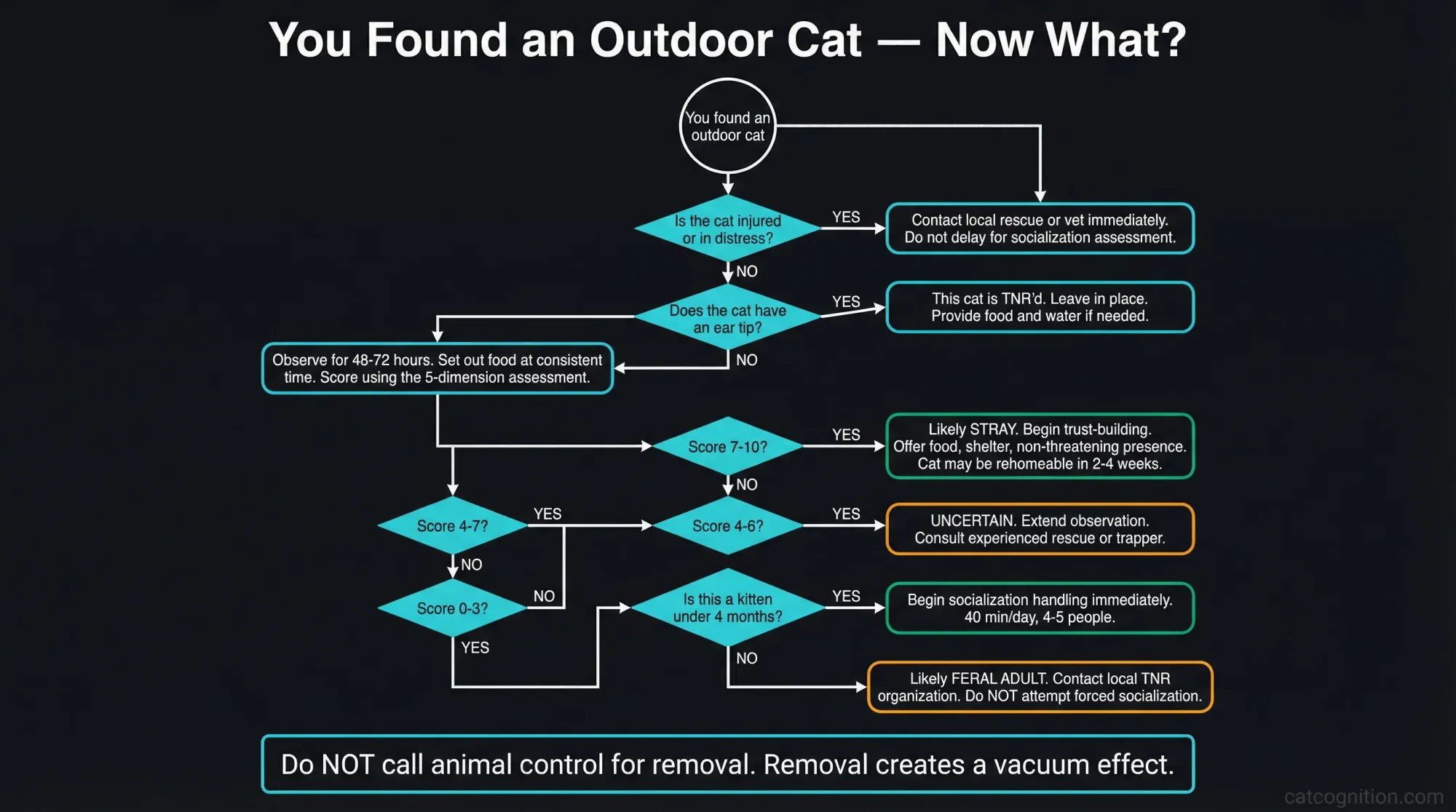
Here is a step-by-step protocol:
Step 1: Observe for 48-72 hours. Do not approach, grab, or trap the cat immediately. Set out food and water at a consistent time and distance. Watch for the behavioral signals listed in the comparison table above. A frightened stray cat can appear completely feral during the first one to three days in an unfamiliar situation.
Step 2: Score the cat using The CatCog Socialization Spectrum Assessment. Rate the cat from 0 to 2 on each of five behavioral dimensions:
| Dimension | Score 0 (Feral) | Score 1 (Uncertain) | Score 2 (Stray) |
|---|---|---|---|
| Approach distance | Flees immediately | Holds ground | Moves toward you |
| Eye contact tolerance | Averts gaze | Brief glances | Makes and holds eye contact |
| Vocalization toward humans | Hisses or silent | Occasional sounds | Meows at people |
| Body posture and tail position | Crouched low, ears flat | Neutral, tense | Tail up, body relaxed |
| Response change over 72 hours | No change | Slight warming | Clear warming trend |
Score interpretation:
- 0-3: Likely feral. Contact a local TNR organization.
- 4-6: Uncertain or semi-feral. Extend observation. Consider consulting an experienced trapper or rescue organization.
- 7-10: Likely stray. This cat may be rehomeable. Begin building trust with food, shelter, and non-threatening human presence.
Step 3: Match the intervention to the assessment.
- If stray: Allow 5-14 days of decompression. Offer food, shelter, and non-threatening human presence. Previously socialized cats typically readjust within two to four weeks. When beginning to approach and pet a stray cat, let the cat initiate contact and move at its own pace.
- If feral adult: Contact a local TNR organization. Do NOT attempt forced socialization.
- If feral kitten under four months: Begin socialization handling as soon as possible.
- If unsure: Allow more time. A stray will warm up. A feral cat will not.
Step 4: Do NOT call animal control for removal. Removing cats creates a "vacuum effect" — cleared territories are rapidly recolonized through reproduction, immigration, and abandonment.
The Ecological Debate
Feral and free-ranging cats are the subject of a significant ecological debate. A 2013 study published in Nature Communications modeled that cats kill 1.3 to 4 billion birds and 6.3 to 22.3 billion mammals annually in the United States alone. Wildlife conservation organizations and animal welfare organizations hold differing positions on how to manage feral cat populations.
Any honest discussion of feral cats must acknowledge their impact on wildlife. A landmark 2013 study by Loss, Will, and Marra, published in Nature Communications, modeled that free-ranging domestic cats in the United States kill an estimated 1.3 to 4 billion birds and 6.3 to 22.3 billion mammals annually — ranges that reflect substantial uncertainty in un-owned cat population sizes and predation rates. Un-owned cats — including feral cats — account for the majority of that predation.
These numbers have shaped the positions of major conservation organizations. The Wildlife Society's position statement opposes maintaining free-ranging cat colonies, citing predation impacts on native wildlife. In Australia and New Zealand, where native species evolved without mammalian predators, feral cat management includes lethal control programs.
Animal welfare organizations counter that TNR is the most humane and effective long-term approach, pointing to documented population declines at managed sites and the counterproductive vacuum effect of culling.
📊 The Evidence:
"Free-ranging domestic cats in the United States kill an estimated 1.3 to 4 billion birds and 6.3 to 22.3 billion mammals annually, with un-owned cats responsible for the majority of predation." (Loss, Will & Marra 2013, Nature Communications)
This article does not aim to resolve this debate. Both the welfare data and the conservation data come from peer-reviewed, high-quality research. What matters for the person who has found a cat in their yard is this: regardless of where you stand on the broader policy question, the immediate practical steps are the same. Identify the cat's socialization status, respond appropriately, and support sterilization to prevent reproduction.
Key Terms
| Term | Definition |
|---|---|
| Feral Cat | A domestic cat (Felis catus) that was never socialized to humans during the sensitive period in early kittenhood. Feral cats are genetically domestic but behaviorally self-sufficient. |
| Stray Cat | A domestic cat that was previously socialized to humans and then lost or abandoned. Stray cats retain the capacity for human bonding. |
| Community Cat | An umbrella term for any outdoor, unowned, free-roaming cat regardless of socialization level. Community cat describes a housing status, not a behavioral classification. |
| TNR (Trap-Neuter-Return) | An evidence-based management approach where feral cats are humanely trapped, surgically sterilized, and returned to their colony location. |
| Cat Colony | A group of feral or community cats living together in a shared territory, typically organized as a matrilineal society around related females. |
| Socialization Window | The sensitive developmental period (2-9 weeks in kittens) during which the brain is maximally plastic for forming social bonds with humans. |
| Ear Tip | The surgical removal of the tip of one ear during TNR surgery, providing a permanent visual indicator that a cat has been sterilized. |
Frequently Asked Questions
Can you tell the difference between a stray and feral cat just by looking?
Not reliably from a single observation. Body language, vocalizations, and response to human presence provide clues, but a frightened stray cat can appear completely feral for the first one to three days. Observe the cat for 48-72 hours before making a determination.
Do feral cats suffer?
Feral cats in managed colonies can live healthy lives. The ORCAT study documented mean cat age increasing from 16.6 months to 43.8 months under sustained TNR management, with declining disease rates. Unmanaged feral cats face greater health risks from reproduction, fighting, and lack of veterinary care.
How many feral cats are in the United States?
No coordinated national survey exists. Estimates range from 30 to 80 million community cats (both stray and feral combined) in the United States.
Is it safe to feed feral cats?
Feeding feral cats is generally safe when done at a consistent location and time. Consistent feeding supports colony health and makes TNR trapping easier. Avoid hand-feeding feral cats or attempting physical contact.
Can a stray cat that has been outside for years become a pet again?
In most cases, yes. A stray cat that was socialized to humans during kittenhood retains the underlying neural wiring for human attachment, even after years outdoors. The decompression process may take longer — weeks rather than days — but the foundational social architecture is there.
What is the difference between a feral cat and a wild cat?
A feral cat is a domestic cat (Felis catus) that was never socialized to humans. A wild cat refers to non-domestic species like the European wildcat (Felis silvestris) or the African wildcat (Felis lybica). Feral cats are genetically domestic. Wild cats are a different species entirely.
Should I bring a feral cat to an animal shelter?
Generally, no. Shelters are stressful environments for feral cats, and historically, cats identified as feral faced high euthanasia rates. A survey of 555 shelters found that only 15% had written guidelines for feral identification. Contact a local TNR organization instead.
Are feral cats dangerous to humans?
Feral cats avoid human contact and rarely pose a direct threat. The risk arises when people attempt to handle feral cats, provoking defensive bites or scratches. These carry infection risk including cat scratch disease and, rarely, rabies. Never handle a feral cat without proper trapping equipment.
Key Takeaways
| Takeaway | Detail |
|---|---|
| The feral-stray distinction is neurological, not behavioral. | Whether a cat was handled by humans during the 2-to-9-week socialization window determines its lifelong relationship with people. Domestication is a species-level trait; socialization is an individual-level experience. |
| Observation over time is the only reliable identification method. | A single encounter cannot distinguish a frightened stray from a feral cat. Watch for 48-72 hours. A stray cat will gradually warm up. A feral cat will not. |
| Feral cats are not broken pets. | Feral cats maintain complex social lives within their colonies — matrilineal societies where over half of all interactions are cooperative grooming. "Unsocialized to humans" does not mean "antisocial." |
| TNR is the evidence-based response for feral cats; rehoming is the response for strays. | Matching the intervention to the cat's socialization history is the most important decision. Forcing the wrong approach causes harm in both directions. |
| The ecological impact is real and debated. | Free-ranging cats kill billions of birds and mammals annually in the United States. Both the welfare science and conservation science come from peer-reviewed research. Supporting sterilization is the common ground. |
Sources
- Crowell-Davis, S.L., Curtis, T.M., & Knowles, R.J. (2004). Social organization in the cat: A modern understanding. Journal of Feline Medicine and Surgery. https://pmc.ncbi.nlm.nih.gov/articles/PMC10822437/
- Vitale, K.R. (2022). The Social Lives of Free-Ranging Cats. Animals (Basel). https://pmc.ncbi.nlm.nih.gov/articles/PMC8749887/
- Vitale, K.R., Behnke, A.C., & Udell, M.A.R. (2019). Attachment bonds between domestic cats and humans. Current Biology. https://doi.org/10.1016/j.cub.2019.08.036
- Feline Veterinary Medical Association. (2025). Position Statement on the Socialization of Feral Kittens. https://pmc.ncbi.nlm.nih.gov/articles/PMC11954556/
- Todd, Z. (2017). The Sensitive Period for Socialization in Puppies and Kittens. Companion Animal Psychology. https://www.companionanimalpsychology.com/2017/07/the-sensitive-period-for-socialization.html
- Bradshaw, J.W.S. (2018). Normal feline behaviour: ... and why problem behaviours develop. Journal of Feline Medicine and Surgery. https://journals.sagepub.com/doi/10.1177/1098612X18771203
- Bradshaw, J.W.S. (2013). Interview: Author of "Cat Sense." NPR. https://www.npr.org/transcripts/219254626
- Spehar, D.D., & Wolf, P.J. (2019). Back to School: An Updated Evaluation of the Effectiveness of a Long-Term Trap-Neuter-Return Program on a University's Free-Roaming Cat Population. Animals (Basel). https://pmc.ncbi.nlm.nih.gov/articles/PMC6826864/
- Kreisler, R.E., Cornell, H.N., & Levy, J.K. (2019). Decrease in Population and Increase in Welfare of Community Cats in a Twenty-Three Year Trap-Neuter-Return Program in Key Largo, FL. Frontiers in Veterinary Science. https://www.frontiersin.org/journals/veterinary-science/articles/10.3389/fvets.2019.00007/full
- Slater, M.R., Miller, K.A., Weiss, E., Makolinski, K.V., & Weisbrot, L.A.M. (2010). A survey of the methods used in shelter and rescue programs to identify feral and frightened pet cats. Journal of Feline Medicine and Surgery. https://pubmed.ncbi.nlm.nih.gov/20460192/
- Community Engagement and the Effectiveness of Free-Roaming Cat Control Techniques: A Systematic Review. (2024). Animals (Basel). https://pmc.ncbi.nlm.nih.gov/articles/PMC10854515/
- Lazenby, B.T., Mooney, N.J., & Dickman, C.R. (2015). Effects of low-level culling of feral cats in open populations: a case study from the forests of southern Tasmania. Wildlife Research. https://doi.org/10.1071/WR14030
- Gunther, I., et al. (2022). Reduction of free-roaming cat population requires high-intensity sterilization. PNAS. https://pmc.ncbi.nlm.nih.gov/articles/PMC9169806/
- Loss, S.R., Will, T., & Marra, P.P. (2013). The impact of free-ranging domestic cats on wildlife of the United States. Nature Communications. https://doi.org/10.1038/ncomms2380
- Yeon, S.C., et al. (2011). Differences between vocalization evoked by social stimuli in feral cats and house cats. Behavioural Processes. https://pubmed.ncbi.nlm.nih.gov/21443933/
- Earliest evidence for commensal processes of cat domestication. (2013). PNAS. https://www.pnas.org/doi/abs/10.1073/pnas.1311439110
- ASPCA. A Closer Look at Community Cats. https://www.aspca.org/helping-shelters-people-pets/closer-look-community-cats
- Alley Cat Allies. Feral and Stray Cats — An Important Difference. https://www.alleycat.org/resources/feral-and-stray-cats-an-important-difference/
- Alley Cat Allies. The Cat Socialization Continuum: A Guide. https://www.alleycat.org/resources/cat-socialization-continuum-guide/
- Cornell University College of Veterinary Medicine. Community Cat Spay/Neuter Clinics. https://www.vet.cornell.edu/hospitals/maddiesr-shelter-medicine-program/community-partnerships/community-cat-spayneuter-clinics
- International Cat Care. Cat Friendly Solutions for Unowned Cats. https://icatcare.org/articles/cat-friendly-solutions-for-unowned-cats
- Benka, V.A., et al. (2022). Guidance for management of free-roaming community cats: a bioeconomic analysis. Journal of Feline Medicine and Surgery. https://journals.sagepub.com/doi/10.1177/1098612X211055685
- Turner, D.C. (2000). The human-cat relationship. In The Domestic Cat: The Biology of Its Behaviour. https://gwern.net/doc/cat/psychology/2000-turner.pdf
- Welfare of feral cats and potential influencing factors. (2019). Journal of Applied Animal Welfare Science. https://www.sciencedirect.com/science/article/abs/pii/S1558787818302272
- Spacing pattern in a social group of stray cats: effects on male reproductive success. (2004). Animal Behaviour. https://www.sciencedirect.com/science/article/abs/pii/S0003347204000983