What Do Cats Think About? The Science of the Feline Mind
Cats think about where you are, who you are, and what your face is telling them. Research reveals cats maintain mental maps of their owner's location, recognize their own names, and form secure attachment bonds at a rate of 65.8%.

Cats think about where you are, who you are, and what your face is telling them. Feline cognition research reveals cats maintain mental maps of their owner's location, distinguish their own names from other words, and form secure attachment bonds at a rate of 65.8% -- matching human infants. Understanding cat behavior through science shows that cat thinking is spatial, social, and sensory rather than abstract or narrative.
Your cat is staring at the wall. Eyes fixed. Ears twitching. Absolutely nothing visible to you.
What is going on in there?
For decades, science largely ignored the question. A comprehensive 2015 review by Dr. Kristyn Vitale and Dr. Monique Udell at Oregon State University found that despite thousands of years of coexistence, cat cognition research significantly trailed canine studies. Dogs had entire university labs devoted to their minds. Cats had anecdotes.
That has changed. Research from Dr. Saho Takagi at Kyoto University, Dr. Atsuko Saito at Sophia University, and Dr. John Bradshaw at the University of Bristol now reveals a feline mind that is far more active, strategic, and socially aware than the "aloof predator" stereotype suggests. The cat cerebral cortex contains approximately 250 million neurons -- fewer than a dog's 530 million, but organized into specialized circuits for spatial tracking, identity recognition, and emotional reading that rival canine performance in targeted domains.
Here is what the science actually says about what happens inside your cat's head.
Table of Contents
- Do Cats Actually Think?
- What Do Cats Think About?
- Do Cats Think Humans Are Cats?
- What Do Cats Think About All Day?
- What Do Cats Think When They Just Sit There?
- What Do Cats Think of Humans?
- Do Cats Think We Are Their Parents?
- Do Cats Think Like Humans?
- Do Cats Think They Own Us?
- The CatCog Feline Cognitive Profile
- Key Terms
- Frequently Asked Questions
- Key Takeaways
- Sources

Do Cats Actually Think?
Domestic cats possess a cerebral cortex containing approximately 250 million neurons -- enough neural hardware to support object permanence equivalent to a human toddler, working memory lasting up to 60 seconds, and episodic-like recall of specific past events. Cat cognition represents genuine cognitive processing, not simple reflexive behavior.
The short answer: absolutely. But the kind of thinking matters.
Cat cognition is not human-like abstract reasoning. Cats do not contemplate the meaning of life, plan next week's schedule, or construct narrative thoughts. When a cat stares out a window, the feline brain is running spatial surveillance and prey-detection circuits -- processing movement patterns, tracking environmental changes, and monitoring territorial boundaries.
Cat cognition is also not simple stimulus-response. The opposite misconception is equally wrong. Multiple studies across four decades confirm cats understand hidden objects continue to exist (Stage 4-5 object permanence). Cats maintain working memory for spatial information above chance for up to 60 seconds. And in a 2017 Kyoto University study, 49 cats recalled which specific food was in which specific container from a single incidental experience -- not repeated training -- suggesting episodic-like memory.
"The cat cerebral cortex contains 250 million neurons -- fewer than dogs' 530 million but sufficient to support spatial memory, attachment bonds, and name recognition (Herculano-Houzel et al., 2017, Frontiers in Neuroanatomy)."
Feline cognition occupies a middle ground: rich associative and spatial processing without human-like abstract thought. Cats build knowledge through associative chains -- the sound of a can opener connects to food connects to the kitchen -- layered on top of sophisticated spatial and social awareness that goes well beyond mechanical conditioning. For a deeper look at how researchers study feline minds, see the psychology of cats.
The neural hardware confirms cognitive capacity. Dr. Suzana Herculano-Houzel's research at Vanderbilt University established that cortical neuron count is the best available predictor of cognitive capability. At 250 million cortical neurons, the cat brain has less raw processing power than a dog's -- but that processing power is concentrated in circuits evolution optimized for specific tasks: spatial mapping, prey detection, and individual survival.
Think of a cat brain as a specialized processor. Fewer total cores than a general-purpose CPU, but highly efficient at the specific computations evolution selected for.
What Do Cats Think About?
Cats think about five primary domains: spatial location of resources and social partners, identity of familiar individuals through voice and scent, emotional states of nearby humans, status of the cat's physical territory, and the presence of potential prey. Feline brains process all five domains through 250 million cortical neurons organized for spatial and social cognition.
Feline cognition research has identified five interlocking systems that constitute what cats "think about" on a daily basis. Each system maps to specific peer-reviewed evidence.
Spatial Awareness
Cats mentally map their environment and the people in it. A 2021 Kyoto University study demonstrated that cats form mental representations of where their owner is based on voice alone. When researchers played an owner's voice from a speaker in one room, then suddenly played it from a different room -- creating an impossible "teleportation" -- cats showed clear surprise. The effect disappeared when non-vocal sounds were used, confirming cats specifically link the owner's voice to a spatial position.
This spatial mapping extends to objects. Cats maintain working memory for hidden objects above chance for up to 60 seconds. When a cat watches you hide a treat under a blanket, the cat holds that location in mind long after the treat disappears from view.
Identity Recognition
Cats know who you are -- by voice, by face, and by smell. Dr. Atsuko Saito's research at Sophia University demonstrated that cats discriminate their own names from other words and other cats' names across 77 tested subjects and four experiments. Earlier work by Saito confirmed that cats identify their owner's voice from strangers' using vocal cues alone.
The recognition goes deeper than sound. Cat cafe cats showed surprise when a familiar voice was paired with the wrong face, demonstrating cross-modal representation -- cats hold integrated mental models linking a specific voice to a specific face. Notably, household cats in the same study did not show this effect, suggesting that regular exposure to multiple people may strengthen cross-modal recognition.
Olfactory Processing
Smell-based cognition is a major component of what cats think about. Cats possess up to 200 million olfactory receptors compared to a human's 5 million, and a significant portion of feline cognitive processing is devoted to interpreting scent information. A 2025 PLOS ONE study from Tokyo University of Agriculture demonstrated that cats distinguish familiar from unfamiliar human odors, suggesting cats identify people through scent -- not just sight and sound.
Olfactory processing drives territorial thinking. When a cat rubs its face against furniture, the cat is depositing pheromones from facial glands and simultaneously reading scent information already present. Every surface in a cat's environment carries a chemical record that the feline brain continuously monitors and updates. Cats think about their scent landscape the way humans think about their visual surroundings.
Emotional Reading
Cats monitor human emotions and adjust behavior accordingly. In a 2015 study, 79% of cats looked between their owner and an unfamiliar object for emotional guidance -- a social referencing rate comparable to the 76% observed in dogs in a related study (Merola et al., 2012). Preliminary research also suggests cats display more positive behaviors when owners are smiling versus frowning, though this finding comes from a small sample of 12 cats and showed modest sensitivity primarily with familiar owners.
Slow blink exchanges add another communication layer. A 2020 study in Scientific Reports found that cats produce more half-blinks in response to owner slow blinks and approach slow-blinking strangers more readily. Cats process and respond to specific human facial signals, indicating active social cognition during what looks like passive observation. Reading your cat's visual cues works both ways -- our guide to cat body language signals covers the other side of that exchange.
Predatory Surveillance
Cats retain essentially the same behavioral repertoire as their wild ancestors (Bradshaw, 2013). A substantial portion of the feline cognitive budget goes toward prey detection and tracking, even in indoor cats who never encounter real prey. When a cat watches a bird through a window, chattering its teeth, the feline brain is running motor planning, trajectory calculation, and timing circuits that evolved for ambush hunting.
This predatory cognition explains much of what owners interpret as "thinking about nothing." A cat sitting motionless on a windowsill is scanning for movement, monitoring wind-driven leaf patterns, and processing visual information through circuits optimized for detecting small, fast-moving objects against complex backgrounds.
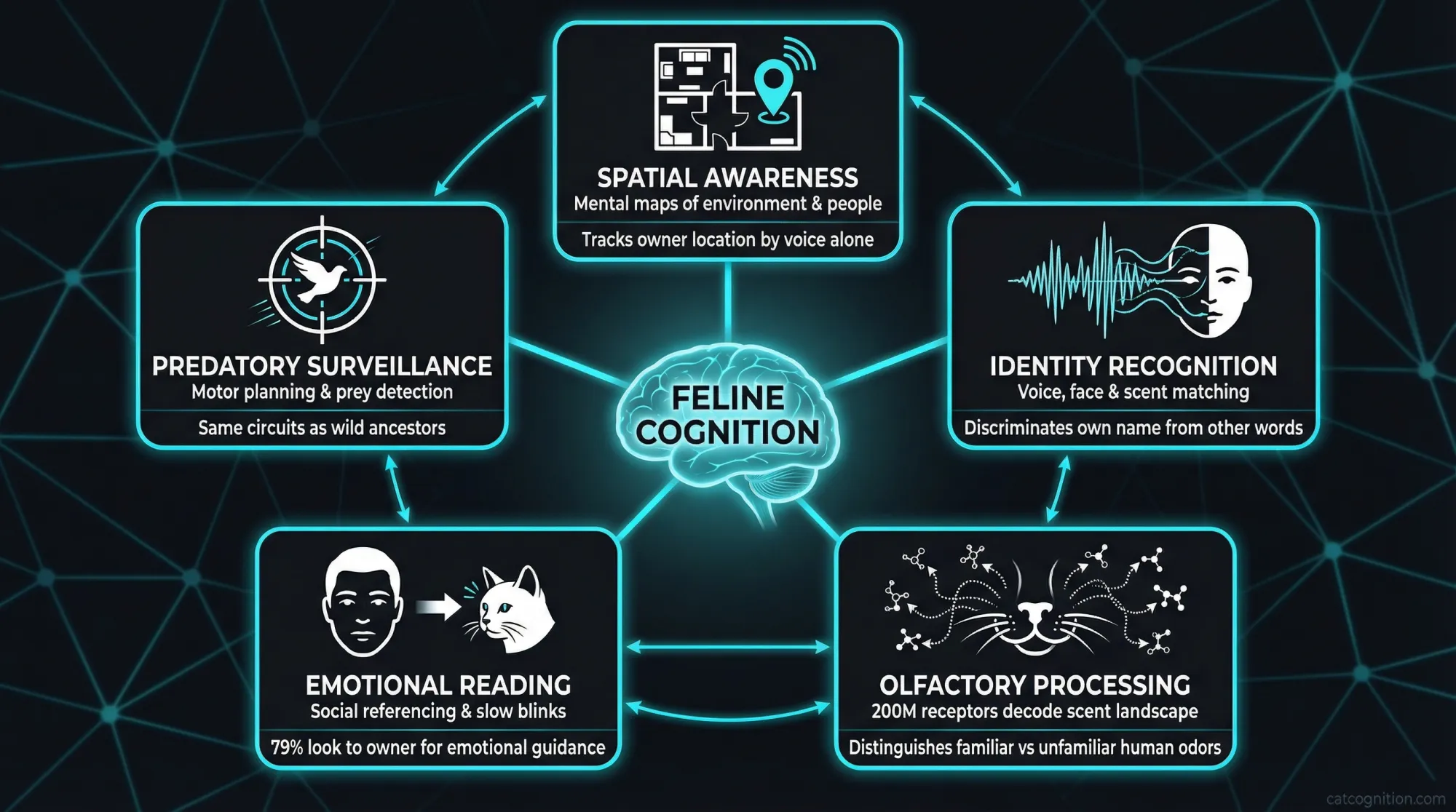
"Cats mentally map their owner's location by voice, showing surprise when the voice appears to teleport to a new room (Takagi et al., 2021, PLOS ONE, n=50)."
Do Cats Think Humans Are Cats?
Cats do not literally mistake humans for fellow cats. Dr. John Bradshaw of the University of Bristol documented cats using the same behavioral repertoire with humans as with other cats -- tail-raising, leg-rubbing, grooming -- but the overlap reflects behavioral continuity, not identity confusion. Cats recognize humans as distinct from other cats while applying familiar feline social strategies.
This is the single most common answer to "what do cats think about humans" -- and the most commonly oversimplified.
Dr. John Bradshaw's observation, published in his 2013 book Cat Sense and widely reported in National Geographic, is that cats' behavior toward humans is "not distinguishable" from their behavior toward other cats. Cats tail-raise, rub, groom, and knead with both species.
But Bradshaw's point is about behavioral repertoire overlap, not categorical confusion. Cats clearly perceive physical differences between humans and cats. The evidence shows cats adjust their communication depending on whether the human is paying attention. Cats showed significantly more gaze alternation during unsolvable tasks when the person was available for visual interaction versus when the person was facing away -- demonstrating sensitivity to human attention states that would be unnecessary if cats treated humans identically to other cats.
What the evidence actually supports: cats apply their existing social toolkit to human relationships because they lack a separate "human interaction" behavioral module. Dogs evolved under direct selection for cooperative behavior with humans over 15,000+ years of domestication. Cats self-domesticated as commensal hunters, arriving in human settlements to hunt rodents attracted to grain stores. No evolutionary pressure created cat-specific "talk to the human" behaviors. Instead, cats repurposed behaviors originally used with other cats -- and the research shows this repurposing works remarkably well.
What Do Cats Think About All Day?
Cats cycle between spatial surveillance, social monitoring, predatory scanning, and rest-state processing throughout the day. Indoor cats spend 50-70% of each day sleeping, with the remaining waking hours divided between territorial patrol, grooming, social interaction, and environmental monitoring -- all driven by the same cognitive architecture wild cats use for survival.
The honest answer is that most of a cat's day involves monitoring rather than active problem-solving.
Cats are ambush predators. Unlike dogs, which evolved as pursuit predators requiring sustained attention on a moving target, cats evolved to wait, scan, and strike. This means the feline cognitive default is vigilant observation -- watching for environmental changes, tracking movement patterns, and maintaining awareness of territorial boundaries.
During waking rest, resting brain networks observed across mammals -- including in cats -- suggest ongoing internal cognitive processing even when cats appear inactive. Research on the default mode network (a brain system linked to mind-wandering and self-referential processing in humans) has confirmed this network exists across mammalian species, including cats. However, the DMN's function in cats likely differs from its role in human daydreaming. Cats are not replaying their day or imagining future scenarios in narrative form. More likely, resting-state brain activity maintains spatial maps, consolidates recent sensory information, and keeps the cat in a state of readiness for rapid response.
Sleep occupies the largest portion of a cat's day. Cats experience REM sleep with brain activity closely matching wakefulness, and classical research by Michel Jouvet in the 1960s demonstrated that cats with experimentally disabled REM atonia (the muscle paralysis that prevents movement during dreams) appeared to act out hunting sequences during sleep. While we cannot confirm subjective dream experience, the neurological evidence shows that predatory circuits remain active during feline sleep. If you have ever wondered why your cat sleeps with you, attachment bond research suggests the answer involves more than warmth.
The typical indoor cat's cognitive day looks something like this:
| Activity | Approximate Time | Primary Cognitive System |
|---|---|---|
| Sleep (including REM) | 12-16 hours | Memory consolidation, predatory circuits |
| Territorial patrol/monitoring | 2-3 hours | Spatial mapping, scent processing |
| Social interaction | 1-2 hours | Identity recognition, emotional reading |
| Grooming | 1-2 hours | Self-maintenance (partially automatic) |
| Active hunting/play | 30-60 minutes | Motor planning, trajectory calculation |
| Eating | 30 minutes | Associative memory, preference recall |

What Do Cats Think When They Just Sit There?
When a cat sits motionless and stares, the feline brain is processing environmental stimuli invisible to human perception -- ultraviolet light patterns, subsonic vibrations, air current changes carrying scent information, and micro-movements below the human detection threshold -- through sensory systems calibrated for prey detection and territorial surveillance.
That blank stare is not blank at all.
Cats see in ultraviolet wavelengths invisible to humans. Cats hear frequencies up to 85 kHz (humans peak at 20 kHz). Cats detect air current changes carrying scent molecules through up to 200 million olfactory receptors. When a cat stares at a wall, the cat may be tracking a sound vibration, detecting a scent trail from an insect that passed hours ago, or watching a UV light pattern shift as sunlight changes angle through a window. To understand more about what cats perceive that we cannot, see our guide to whether cats can see in the dark.
The motionless posture itself is cognitively strategic. Ambush predators minimize movement to avoid detection while maximizing sensory intake. A cat sitting still on a windowsill is in optimal predatory scanning mode -- ears rotating independently to triangulate sound sources, pupils adjusting to ambient light shifts, and whiskers detecting air current changes. Every sense is active. Only the body is still. If your cat does this while staring directly at you, the cognitive processing shifts from predatory surveillance to social monitoring.
"79% of cats look between their owner and an unfamiliar object for emotional guidance -- a social referencing rate comparable to dogs at 76% (Merola et al., 2015, Animal Cognition)."
What Do Cats Think of Humans?
Cats form genuine attachment bonds with owners, with 65.8% of cats demonstrating secure attachment styles matching the 65% rate in human infants. Cats process humans as social partners providing safety, warmth, and resources -- monitoring human emotional states, tracking human location by voice, and preferring social interaction with humans over food, toys, or scent.
The old narrative -- cats see humans as automated food dispensers -- is thoroughly debunked.
Dr. Kristyn Vitale's landmark 2019 study at Oregon State University used the Secure Base Test (the same protocol used with human infants) to measure attachment bonds between cats and their owners. The results: 65.8% of cats displayed secure attachment. These cats used their owner as a secure base, exploring confidently when the owner was present and showing stress signals when the owner left. The remaining 34.2% displayed insecure attachment styles -- not absence of attachment, but different expressions of the bond. For the full science of how cats express attachment, see our guide to every sign your cat loves you.
Even more telling: when Vitale's team offered cats a free choice between social interaction with humans, food, toys, or scent, the majority of cats preferred social interaction. Cats think about humans not because humans provide food, but because the social bond itself has value to the feline brain.
Cats also track human emotional information with surprising precision. When encountering something unfamiliar, cats look to their owner's face for guidance before deciding how to respond. Cats follow a human's gaze direction in approximately 70% of food-selection trials. Cats recognize their owner's voice and face and hold integrated cross-modal representations linking the two.
What cats do not appear to think about humans: moral character. Unlike dogs, who avoid people who behave negatively toward their owners, cats showed no preference for helpers over non-helpers in a Kyoto University study. Cats process human identity, location, and emotion -- but not human social reputation. This is consistent with cats' evolutionary history as solitary rather than cooperative species. Research into whether some cats display psychopathic traits explores this lack of cooperative moral cognition in more detail.
"65.8% of domestic cats form secure attachment bonds to their owners, matching the 65% secure attachment rate in human infants (Vitale et al., 2019, Current Biology)."
Do Cats Think We Are Their Parents?
Cats display attachment behaviors toward owners paralleling kitten-to-mother bonding patterns -- kneading, purring, head-butting, and following -- evidence the caregiver relationship activates developmental bonding circuits originally evolved for the kitten-mother bond. Cats do not literally perceive owners as biological parents, but the neurological pathway is the same.
Kneading behavior provides the clearest evidence. Kittens knead their mother's mammary area to stimulate milk flow. Adult cats knead their owners' laps using the same motor pattern. The behavior serves no functional purpose in adulthood -- it is a vestigial kitten behavior reactivated by the security of the attachment bond.
The 65.8% secure attachment rate from Vitale's 2019 study was measured using a protocol originally designed for human infants and their parents. The fact that cats display the same attachment patterns -- secure base effect, separation distress, reunion behavior -- as human infants suggests the underlying neurological mechanism is conserved across mammals. Cats do not "think" the owner is their mother in a conceptual sense. But the brain circuits activated during caregiver interaction appear to be the same circuits that mediated the kitten-mother bond.
This has practical implications. Cats who were separated from their mothers too early (before 8 weeks) show increased aggression toward strangers and higher rates of stereotypic behaviors such as excessive grooming (Ahola et al., 2017, n=5,726). While anecdotal reports suggest early-weaned cats may show heightened attachment behaviors such as kneading and following, the peer-reviewed evidence links early weaning to behavioral problems rather than strengthened caregiver bonds. The critical socialization window shapes how the feline brain develops social behavior -- disrupting it affects multiple behavioral systems.
Do Cats Think Like Humans?
Cat cognition differs fundamentally from human cognition in three ways: cats lack evidence of metacognition (thinking about thinking), cats do not engage in abstract reasoning or future planning, and cats process social information through individual association rather than categorical moral judgment. Cats match or exceed humans in spatial memory precision and sensory processing speed.
The most important distinction is between associative cognition and abstract cognition.
Humans think in narratives. We construct mental stories about the past, simulate possible futures, and evaluate choices against abstract principles. No evidence supports this kind of thinking in cats. When a cat "decides" to jump to a shelf, the cat brain is running motor calculations and spatial assessments -- not weighing pros and cons.
Cats think in associations. The sound of a cabinet opening connects to food. A specific human footstep pattern connects to social interaction. The sight of the cat carrier connects to veterinary visits. These associative chains can be remarkably complex and long-lasting -- cats remember specific associations for years -- but they operate through linked experiences rather than abstract logic.
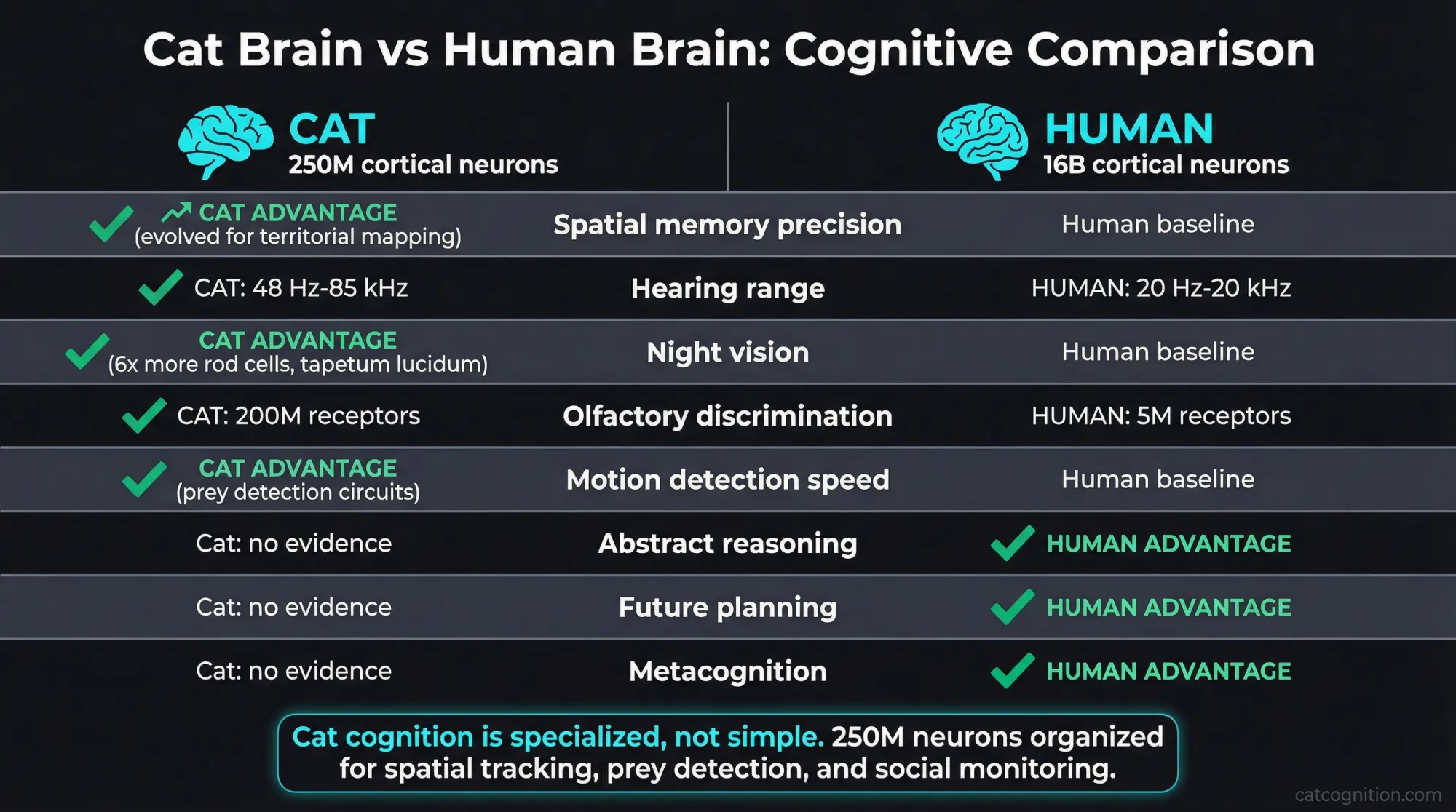
Where cats match or exceed human cognitive performance:
| Cognitive Domain | Cat vs. Human |
|---|---|
| Spatial memory precision | Cat advantage -- evolved for territorial mapping |
| Hearing range | Cat: 48 Hz - 85 kHz vs. Human: 20 Hz - 20 kHz |
| Night vision | Cat advantage -- 6x more rod cells, tapetum lucidum |
| Olfactory discrimination | Cat: 200M receptors vs. Human: 5M receptors |
| Motion detection speed | Cat advantage -- prey detection circuits |
| Abstract reasoning | Human advantage -- no evidence in cats |
| Future planning | Human advantage -- no evidence in cats |
| Metacognition | Human advantage -- no evidence in cats |
One preliminary finding pushes the boundary. A single cat named Ebisu reproduced human-demonstrated actions with 81% accuracy across 16 trials using the "Do as I Do" paradigm -- a form of imitative learning previously documented only in dolphins, parrots, apes, and killer whales. This is a case study (n=1) that requires replication, but if confirmed, it would suggest cats possess a capacity for body-mapping and motor imitation that bridges the gap between associative and representational cognition.
Every study cited in this article measures observable behavior -- response times, gaze direction, approach patterns, brain activity. No experiment can access what a cat subjectively experiences. Neuroscience calls this the "hard problem of consciousness": researchers can map which circuits fire and predict behavioral outcomes, but cannot determine whether cats have inner experience the way humans do. The evidence confirms cats process spatial, social, and sensory information with genuine complexity. Whether cats "think" in the sense of conscious awareness remains an open scientific question that current methods cannot resolve.
Do Cats Think They Own Us?
Cats do not conceptualize "ownership," but cats do treat the home territory -- and the humans within the territory -- as resources under feline management. Territorial behavior including scent-marking, patrol routes, and access control reflects a cognitive framework where the cat functions as territorial custodian rather than subordinate pet.
The framing of "ownership" is anthropomorphic. Cats lack the abstract reasoning required for property concepts.
What cats do demonstrate is territorial management behavior that functionally resembles ownership. Cats maintain scent boundaries by rubbing facial pheromones on doorways, furniture, and humans. Cats patrol established routes through the home at predictable intervals. Cats control access to preferred resources -- the sunny window spot, the elevated perch, the owner's lap -- through spatial positioning and, when necessary, through communicative signals like hissing or blocking.
When your cat head-butts you, the cat is depositing pheromones from temporal glands onto your skin. This scent-marking behavior labels you as part of the cat's territorial inventory. The cat is not "claiming ownership" in a human sense -- the cat is integrating you into the scent landscape that defines the territory.
The behavioral result looks like ownership because the underlying cognitive system -- territorial management -- produces similar outcomes. The cat controls resources, monitors boundaries, marks possessions, and resists intrusion. The mechanism is spatial-territorial, not conceptual-abstract. But the practical effect, from the human perspective, is that the cat does indeed act like the cat owns the place.
The CatCog Feline Cognitive Profile
Peer-reviewed research identifies five measurable cognitive systems in domestic cats -- spatial intelligence, social cognition, identity processing, self-awareness, and adaptive learning. Each domain maps to specific experimental evidence, and a 2024 study confirms environment and socialization shape cognitive performance as much as genetics, meaning enriched cats develop stronger abilities across all five systems.
| Cognitive Domain | What It Measures | Research Basis |
|---|---|---|
| Spatial Intelligence | Mental mapping, object tracking, location memory | Takagi et al., 2021; Fiset & Dore, 2006 |
| Social Cognition | Social referencing, attachment behavior, emotional reading | Merola et al., 2015; Vitale et al., 2019 |
| Identity Processing | Name recognition, voice discrimination, face-voice matching | Saito et al., 2019; Takagi et al., 2019 |
| Self-Awareness | Body-size negotiation, physical self-representation | Pongracz, 2024 |
| Adaptive Learning | Novel problem-solving, behavioral flexibility, imitation | Fugazza et al., 2020; PMC, 2024 |
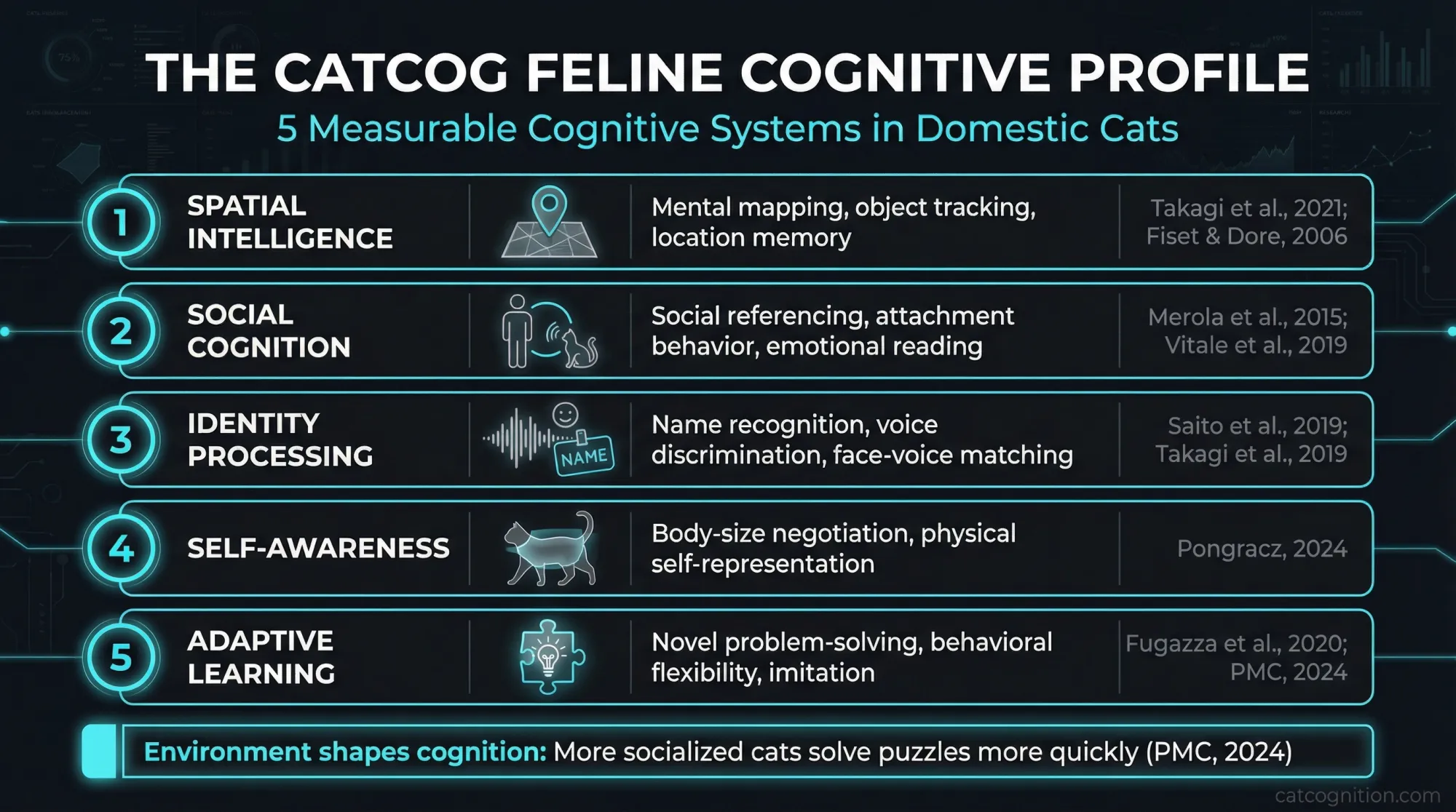
A 2024 study found that more socialized cats solved puzzles more quickly, suggesting cognitive engagement is shaped by environment and experience, not just genetics. Cats in enriched environments with regular social interaction develop stronger performance across all five domains.
A 2024 iScience study by Dr. Peter Pongracz at Eotvos Lorand University found that cats hesitate before openings too short for their body but attempt even the narrowest openings with far less hesitation than expected -- revealing selective body-size self-representation along the height dimension only. Cats hold a partial self-model. They think about their own physical dimensions, but only selectively.
"Cats discriminate their own names from other words and other cats' names across 77 tested subjects and four experiments (Saito et al., 2019, Scientific Reports)."

Key Terms
Object permanence: The understanding that objects continue to exist when hidden from view. Cats demonstrate Stage 4-5 object permanence, equivalent to a human toddler aged 12-18 months.
Episodic-like memory: Memory for specific events encoding "what" and "where" information from single experiences. The "like" qualifier reflects that subjective re-experiencing cannot be confirmed in non-human animals.
Cross-modal representation: The ability to connect information from different senses, such as matching a familiar voice to a familiar face. Cats demonstrate voice-to-face matching for familiar individuals.
Default mode network: A network of brain regions active during wakeful rest, associated with mind-wandering and self-referential processing in humans. Identified across mammalian species including cats, suggesting internal cognitive processing during apparent inactivity.
Social referencing: Looking toward another individual for emotional guidance when encountering an unfamiliar or ambiguous situation. 79% of cats display social referencing toward their owners.
Associative learning: Learning through connections between stimuli, responses, and outcomes. Cats primarily build knowledge through associative chains rather than abstract reasoning.
Metacognition: The capacity to monitor one's own cognitive processes. No direct evidence of metacognition exists in cats -- a confirmed research gap.
Frequently Asked Questions
Cats demonstrate measurable cognitive abilities across spatial memory, social bonding, name recognition, emotional reading, and sensory processing. The following answers address the most common questions about feline minds using peer-reviewed evidence from over 20 published studies rather than anecdote or speculation.
Do cats think about their owners when apart?
Cats maintain mental representations of their owners even when owners are not visible. Dr. Saho Takagi's 2021 study at Kyoto University demonstrated that cats track their owner's location by voice alone, showing surprise when the voice appeared to "teleport." Combined with the 65.8% secure attachment rate, evidence suggests cats hold their owners in mind during separation, though the nature of this representation is associative rather than narrative.
Are cats smarter than dogs?
The question is scientifically misleading. Dogs have approximately 530 million cortical neurons versus cats' 250 million, suggesting greater raw processing capacity. However, cats match or exceed dogs in specific domains: spatial memory duration, object permanence tasks, and independence in problem-solving. Intelligence in cats is specialized, not diminished. Comparing cat intelligence to dog intelligence on dog-centric metrics misrepresents both species.
Can cats remember specific events from their past?
Emerging evidence supports episodic-like memory in cats. Takagi et al. (2017) showed cats recalled "what" food was in "which" container from a single incidental experience -- not repeated training. Working memory for spatial information persists above chance for up to 60 seconds. Long-term memory in cats can persist for years, though the mechanisms are less studied than in dogs or primates.
Do cats know their own names?
Yes. Research by Dr. Atsuko Saito at Sophia University tested 77 cats across four experiments and confirmed cats discriminate their own names from other words and from other cats' names. Cats responded with orienting behavior (ear movement, head movement) rather than approaching behavior, which explains why many owners believe their cat "ignores" its name. The cat hears and recognizes the name -- the cat simply chooses not to respond.
Can cats sense human emotions?
Cats display sensitivity to human emotional states, though the evidence is preliminary. Cats show social referencing behavior (looking to the owner's face for guidance) at a 79% rate. Preliminary research with 12 cats suggests cats display more positive behaviors when owners smile, though this effect was modest and only observed with familiar owners. Cats also respond to slow blink exchanges as positive emotional communication.
Do cats dream?
Cats experience REM sleep with brain activity closely matching wakefulness. Classical research demonstrated that cats with disabled REM muscle paralysis appeared to stalk, pounce, and engage in hunting sequences during sleep. While subjective dream experience cannot be confirmed in non-human animals, the neurological evidence shows predatory cognitive circuits remain active during feline REM sleep.
When should I worry about my cat's thinking abilities?
Sudden behavioral changes in cats 10 years or older -- disorientation, altered sleep-wake cycles, loss of litter box habits, decreased interaction, increased vocalization, or failure to recognize familiar people -- may indicate cognitive dysfunction syndrome. This is a medical condition requiring veterinary evaluation, not a normal part of aging. Signs become clearly noticeable in cats 10 years of age or older, according to the Cornell Feline Health Center.
Do indoor cats think differently than outdoor cats?
Indoor cats redirect predatory cognition toward environmental stimuli -- birds outside windows, insects, moving shadows -- rather than actual prey. A 2024 study found that more socialized cats solved problems faster, suggesting environment shapes cognitive flexibility. Indoor cats benefit from enrichment that challenges spatial mapping (puzzle feeders in rotating locations), predatory circuits (interactive toys mimicking prey movement), and social cognition (structured play sessions with owners).
Key Takeaways
Cats think about spatial relationships above all else. Mental mapping of owner location, resource positioning, and territorial boundaries forms the core of feline cognitive processing. Working memory lasting up to 60 seconds; episodic-like recall from single experiences (Takagi et al., 2017).
Cats process human identity through voice, face, scent, and emotion. Cats discriminate names, recognize voices, match voices to faces, distinguish human odors, and adjust behavior based on emotional expressions. Multi-modal recognition across 77 subjects (Saito et al., 2019); cross-modal matching (Takagi et al., 2019); odor discrimination (Miyairi et al., 2025).
Cats do not think in narrative or abstract terms. Feline cognition is associative, spatial, and sensory rather than narrative, abstract, or future-oriented. The "blank stare" is active sensory processing, not philosophical contemplation. No evidence of metacognition (Templer & Hampton, 2012); no moral judgment of third parties (Chijiiwa et al., 2021).
The 65.8% secure attachment rate proves cats think about social bonds. Cats form genuine attachment bonds matching the rate in human infants, prefer social interaction over food or toys, and maintain mental representations of absent caregivers. Secure Base Test (Vitale et al., 2019); social preference over food/toys (Vitale Shreve et al., 2017).
Cat cognition is specialized, not simple. With 250 million cortical neurons organized for spatial tracking, prey detection, and social monitoring, the feline brain outperforms dogs in spatial precision and sensory processing while lacking canine cooperative cognition. Cortical neuron counts (Herculano-Houzel et al., 2017); "Different" is not "less."
Sources
- Vitale Shreve, K.R. & Udell, M.A.R. (2015). "What's inside your cat's head? A review of cat cognition research." Animal Cognition. PubMed
- Saito, A. & Shinozuka, K. (2013). "Vocal recognition of owners by domestic cats." Animal Cognition. PubMed
- Saito, A. et al. (2019). "Domestic cats discriminate their names from other words." Scientific Reports. Nature
- Vitale, K.R. et al. (2019). "Attachment bonds between domestic cats and humans." Current Biology. Cell Press
- Merola, I. et al. (2015). "Social referencing and cat-human communication." Animal Cognition. Springer
- Takagi, S. et al. (2021). "Socio-spatial cognition in cats: Mentally mapping owner's location from voice." PLOS ONE. PLOS
- Takagi, S. et al. (2019). "Cats match voice and face: cross-modal representation of humans in cats." Animal Cognition. PubMed
- Takagi, S. et al. (2017). "Use of incidentally encoded memory from a single experience in cats." Behavioural Processes. ScienceDirect
- Herculano-Houzel, S. et al. (2017). "Dogs Have the Most Neurons, Though Not the Largest Brain." Frontiers in Neuroanatomy. Frontiers
- Miklosi, A. et al. (2005). "A comparative study of the use of visual communicative signals in interactions between dogs and humans and cats and humans." Journal of Comparative Psychology. PubMed
- Fugazza, C. et al. (2020). "Did we find a copycat? Do as I Do in a domestic cat." Animal Cognition. PubMed
- Pongracz, P. (2024). "Cats are (almost) liquid! Cats selectively rely on body size awareness." iScience. Cell Press
- Fiset, S. & Dore, F.Y. (2006). "Duration of cats' working memory for disappearing objects." Animal Cognition. PubMed
- Triana, E. & Pasnak, R. (1981). "Object permanence in cats and dogs." Animal Learning & Behavior. Springer
- Galvan, M. & Vonk, J. (2016). "Man's other best friend: domestic cats and their discrimination of human emotion cues." Animal Cognition. Springer
- Pongracz, P. et al. (2021). "Feline communication strategies when presented with an unsolvable task." Animal Cognition. PMC
- Chijiiwa, H. et al. (2021). "Cats show no avoidance of people who behave negatively to their owner." Animal Behavior and Cognition. PDF
- Humphrey, T. et al. (2020). "The role of cat eye narrowing movements in cat-human communication." Scientific Reports. Nature
- Lu, W. et al. (2012). "Rat brains also have a default mode network." PNAS. PNAS
- Vitale Shreve, K.R. et al. (2017). "Social interaction, food, scent or toys? A formal assessment of domestic pet and shelter cat preferences." Behavioural Processes. PubMed
- Templer, V.L. & Hampton, R.R. (2012). "Animal Metacognition: A Tale of Two Comparative Psychologies." Animal Cognition. PMC
- Cornell Feline Health Center. "Cognitive Dysfunction." Cornell
- Miyairi, Y. et al. (2025). "Behavioral responses of domestic cats to human odor." PLOS ONE. PLOS
- Ahola, M.K. et al. (2017). "Early weaning increases aggression and stereotypic behaviour in cats." Scientific Reports. Nature
- Pongracz, P. et al. (2019). "Cats (Felis silvestris catus) read human gaze for referential information." Intelligence. ScienceDirect
- Dumas, C. & Dore, F.Y. (1991). "Object permanence in cats: an ecological approach to the study of invisible displacements." Journal of Genetic Psychology. PubMed