Why Do Cats Bite? The 6 Types of Cat Biting and How to Stop Each One
Most cat bites aren't random attacks — 92% are provoked by human interaction. Learn the 6 types of cat biting, read the warning signs, and stop each one with evidence-based protocols.


Table of Contents
- Why Do Cats Bite? The Evolutionary Mismatch Behind Feline Aggression
- Why Do Cats Play Bite? The Hardwired Hunter
- Why Do Cats Bite When You Pet Them? The Overstimulation Trap
- What Is Redirected Aggression in Cats? The Invisible Trigger
- What Are Cat Love Bites? The Affectionate Nibble
- Fear and Defensive Biting: The Cornered Cat
- Sudden Onset Biting: When Pain Changes Everything
- The CatCog Bite Decoder: Diagnose Your Cat's Bite Type
- How to Read Pre-Bite Body Language: The Warning Sequence
- How to Stop Cat Biting: The Long-Term Protocol
- When Cat Bites Become a Medical Emergency
- Key Terms
- Frequently Asked Questions
- Key Takeaways
- Sources
In a Brazilian survey published in the Journal of Feline Medicine and Surgery, 49.5% of pet cats exhibited some form of human-directed aggression (Ramos & Mills, 2009). If your cat has bitten you, you are not dealing with a rare problem. You are dealing with the second most common feline behavior issue seen by animal behaviorists (ASPCA). Understanding why cats bite is one of the most important aspects of cat behavior.
But here is what most cat biting articles get wrong: they treat all bites the same. A cat ambushing your ankles at 3 a.m. has nothing in common with a cat that bites after five minutes of belly rubs. Research from Dr. Carlo Siracusa, Director of the Animal Behavior Service at Penn Vet and Immediate Past President of the American College of Veterinary Behaviorists, Dr. John Bradshaw of the University of Bristol's Anthrozoology Institute, Dr. Lauren Finka of Nottingham Trent University, and Dr. Marta Amat of the Autonomous University of Barcelona converges on a single conclusion: cat biting is a communication failure, not a character flaw.
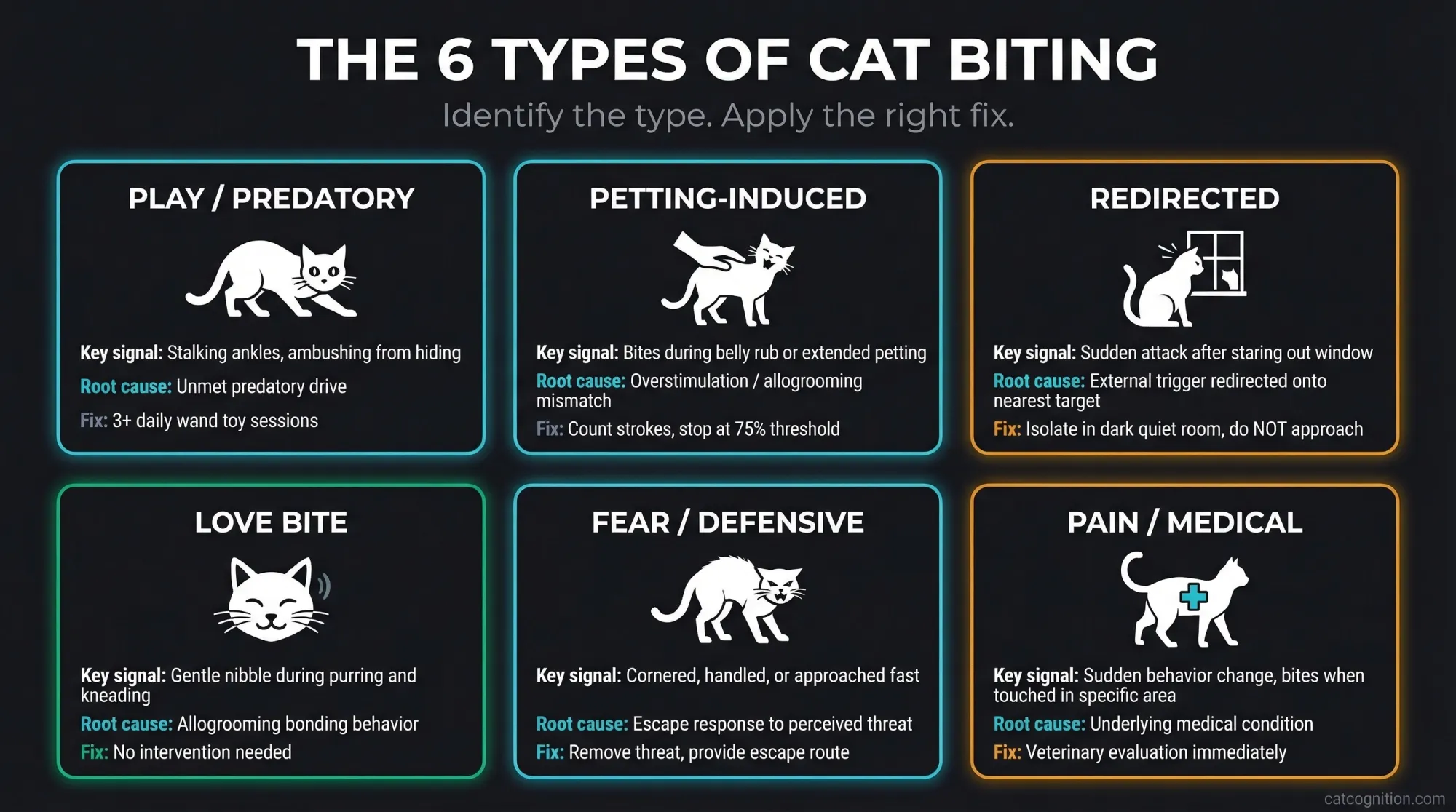
This guide introduces the CatCog Bite Decoder -- a diagnostic framework that classifies cat bites into six categories based on context, body language, and intensity, then matches each type to an evidence-based intervention protocol.

Why Do Cats Bite? The Evolutionary Mismatch Behind Feline Aggression
Cats bite because the feline nervous system is wired for a predatory motor sequence -- stalk, pounce, bite -- one domestic life suppresses but never eliminates. Domestic cats retain 95% of the wild behavioral repertoire (Bradshaw, 2018), and as Dr. John Bradshaw of the University of Bristol established, most feline behavioral disorders result from cats being prevented from achieving emotional equilibrium.
Think of a cat's nervous system like a spring under tension. In the wild, the hunting cycle compresses and releases that spring dozens of times per day. In a living room, the spring stays compressed. Petting, playing, and environmental triggers can all release it in ways humans do not expect.
The fundamental mismatch runs deeper than unmet hunting needs. Human petting -- long, repetitive strokes down the back -- directly conflicts with the short, targeted grooming bouts (allogrooming) that cats evolved to exchange with each other. When a human pets a cat the way humans pet dogs, the cat's nervous system registers an escalating conflict between expected tactile input and actual tactile input.
According to Dr. Marta Amat and Dr. Xavier Manteca of the Autonomous University of Barcelona, whose comprehensive review of owner-directed feline aggression was published in the Journal of Feline Medicine and Surgery, there are distinct categories of feline aggression, each with different triggers, warning signals, and interventions. The critical reframe: most bites have an identifiable trigger that the owner missed, not a malicious cat that snapped without reason.
Why Do Cats Play Bite? The Hardwired Hunter
Play biting is the most common type of aggression directed at owners (ASPCA), driven by the predatory motor pattern sequence -- stalk, pounce, bite -- a cycle hardwired into every cat's nervous system. Kittens learn to calibrate bite force and sheathe claws through social play with littermates between 2 and 9 weeks of age, and orphaned or early-weaned kittens may never acquire proper calibration.
You will recognize play biting immediately. The cat stalks your ankles from behind furniture. It ambushes your feet under blankets. It pounces on your hand when you reach for the remote. There are no fear signals -- no flattened ears, no hissing. The cat's eyes are wide and locked on target, its body coiled, its rear end wiggling before the strike.
The mechanism is straightforward. A cat's predatory motor pattern fires involuntarily when movement triggers it. Your wiggling toes under a blanket look exactly like a mouse to a cat's visual processing system. The cat is not choosing to attack you. It is responding to a stimulus that activates the same neural pathway it would use to catch prey.
This is especially pronounced in single-cat households and indoor-only cats who lack adequate outlets for predatory behavior. Long hours alone without interactive play create a pressure cooker of unused hunting energy. When the owner finally appears, that energy finds its target.
How to stop play biting:
- Provide a minimum of three interactive play sessions per day using wand toys that simulate prey movement (Feline Engineering).
- Never use hands or feet as toys. This trains the cat to view human body parts as acceptable targets (VCA Hospitals).
- When a bite occurs, freeze completely. Do not pull away -- pulling triggers the chase reflex and intensifies the attack. Go still, withdraw attention, and leave the room for 30 seconds.
- Expect an extinction burst. When previously rewarded biting stops being reinforced, the behavior temporarily intensifies before decreasing. This is normal and does not mean the strategy has failed.
Why Do Cats Bite When You Pet Them? The Overstimulation Trap
Petting-induced aggression accounts for approximately 40% of feline behavioral referral cases, a figure consistent across multiple peer-reviewed studies (Amat & Manteca, 2019, JFMS). Three competing scientific theories explain why cats bite during petting, and the answer is likely a combination of all three.
Theory 1: Overstimulation with missed signals. Repetitive tactile input accumulates until it becomes aversive. The cat escalated through a sequence of increasingly urgent warnings -- tail twitching, skin rippling, ear rotation, dilated pupils -- but the owner did not read them.
Theory 2: The cat controls the interaction. The cat bites to terminate contact on its own terms. This is not aggression in the traditional sense. It is a boundary enforcement.
Theory 3: The allogrooming mismatch. Research by Dr. Sharon Crowell-Davis at the University of Georgia found that when cats groom each other, males initiate allogrooming 90.4% of the time, and the grooming involves short, localized licks to the head and neck (Crowell-Davis et al., 2004, JFMS). Human long strokes down the entire body differ fundamentally from this pattern. The mismatch becomes intolerable after a threshold that varies by individual cat.
Preliminary research suggests that petting aggression functions as escape behavior. A 2022 functional analysis demonstrated that in the cats studied, biting during petting was maintained by social-negative reinforcement -- the cat bit to make the petting stop (Fritz et al., 2022, Journal of Applied Behavior Analysis). The bite was not random hostility; it was a communication strategy that had previously worked.
How to stop petting-induced biting:
| Strategy | Details |
|---|---|
| Count strokes, not seconds | Some cats tolerate only 1-3 seconds of petting before needing a break (Humane Society of Southern Arizona) |
| Stop at 75% of threshold | If warning signs start at 2 minutes, stop at 1.5 minutes |
| Pet head and cheeks only | Allogrooming zones where cats naturally receive social grooming. See our guide on the science of petting cats |
| Let the cat initiate contact | Offer a closed hand and let the cat approach |
| Apply Dr. Finka's CAT framework | Choice and control, Attention to behavior, Think about where you touch |
What Is Redirected Aggression in Cats? The Invisible Trigger
Redirected aggression may account for up to 50% of human-directed aggression in referral practices, and in 95% of cases the trigger is loud noises or the presence of an unreachable outdoor cat (Amat et al., 2008, Journal of the American Veterinary Medical Association). Redirected aggression ranks as the most dangerous bite type because owners often receive zero warning before the attack.
Imagine this scenario. Your cat is sitting on the windowsill, intensely watching a stray cat in the yard. Every muscle is taut. The pupils are fully dilated. Then you walk past, and the cat launches at your leg with full force. You did nothing wrong. You were simply the nearest available target for an arousal state that your cat could not direct at the actual threat.
The mechanism is the same as a human who, frustrated by a bad day at work, snaps at a family member over something trivial. The arousal state is real. The target is wrong.
What makes redirected aggression especially dangerous is that the arousal state persists for hours to days after the initial trigger (Amat et al., 2008; VCA Hospitals). A cat that was triggered by a stray cat at 9 a.m. can still attack unprovoked at midnight. In 80% of redirected aggression cases, defensive posture was observed before the attack, suggesting that fear and frustration are the underlying drivers.
How to handle redirected aggression:
- Identify and remove the trigger. Block window views of outdoor cats. Reduce exposure to sudden loud noises.
- Do NOT approach the aroused cat. The arousal state can persist for hours to days.
- Isolate the cat in a dark, quiet room until fully calm. This may take 24 hours or longer.
- Rebuild positive associations gradually after the arousal has completely subsided. Start with treats tossed from a distance, then slowly decrease the distance over days.
What Are Cat Love Bites? The Affectionate Nibble
Love bites are gentle, non-skin-breaking nibbles occurring during comfortable, bonded moments -- typically while a cat is purring, kneading, or being groomed -- and represent affiliative allogrooming behavior, not aggression. Love bites require no behavioral intervention because the cat treats the owner as a trusted social companion. If you are wondering whether your cat's nibbles are a sign of affection, our guide to every sign your cat loves you covers the full spectrum of feline bonding signals.
Love bites look nothing like aggressive bites. The cat is relaxed. The ears are forward. The body is soft. The cat may be purring or kneading. Then it takes your hand gently in its mouth and applies light pressure without breaking skin.
This behavior connects directly to allogrooming -- mutual grooming between cats. When cats groom each other, the groomer delivers small nibbles as part of the bonding sequence. A cat that love-bites its owner is extending the same social grooming behavior it would share with a trusted feline companion, reinforcing the social bond between cat and owner (PetMD / Dr. Alison Gerken, DACVB).
If the nibbling is uncomfortable, gently redirect with a toy or slowly withdraw your hand. Do not punish the behavior -- the cat is expressing trust and affection.
Fear and Defensive Biting: The Cornered Cat
Fear-based biting occurs when a cat perceives a genuine danger and has no escape route, making fear-based aggression the most predictable bite type because the body language signals are unmistakable: dilated pupils, ears flattened outward, whiskers pressed down, tail tucked between the legs, body lowered to the ground (Cornell Feline Health Center; UC Davis).
A cat that bites out of fear has already tried everything else. It has flattened its ears. It has pressed its body low. It has tucked its tail. It has hissed. Each of these signals says "I feel threatened" in progressively louder volume. The bite is the last resort when every earlier warning has been ignored or when the threat has not withdrawn.
Common triggers include: being cornered during veterinary handling (a significant proportion of cats show aggression at veterinary clinics), being approached too fast by strangers, being picked up against the cat's will, or encountering loud, sudden environmental changes. Learning to read these defensive signals is essential -- our guide to every cat body language signal explained breaks down the full vocabulary cats use before resorting to biting.
The 2022 AAFP/ISFM Cat Friendly Interaction Guidelines, co-developed by Dr. Ilona Rodan, provide the professional gold standard for approaching cats without triggering defensive aggression: give the cat an escape route, let the cat approach you, avoid direct eye contact, and move slowly.
How to prevent fear-based biting:
- Always provide an escape route. Never corner a frightened cat.
- Remove the threat source before attempting interaction.
- Follow the AAFP/ISFM Cat Friendly Interaction Guidelines: slow movements, indirect eye contact, let the cat set the pace.
- For veterinary visits, discuss low-stress handling techniques with your vet or seek a Cat Friendly Practice certified clinic.
Sudden Onset Biting: When Pain Changes Everything
Sudden aggression changes in a previously gentle cat require immediate veterinary evaluation because the cause is often medical -- hyperthyroidism, osteoarthritis, dental disease, neurological disorders, or cognitive dysfunction -- not behavioral. Pain-related biting is the one type where behavioral modification alone will not work.
If your cat has bitten without warning and this is new behavior, stop reading the behavioral sections of this article and call your vet. A cat that was gentle for eight years and suddenly starts biting is almost certainly in pain or experiencing a medical change.
Conditions that cause sudden onset aggression include: hyperthyroidism (common in older cats, causes irritability), osteoarthritis (estimated to affect a significant portion of cats over 6 years), dental disease (tooth pain makes any face or head touch excruciating), neurological disorders, cognitive dysfunction in senior cats, epilepsy, toxoplasmosis, and abscesses.
The diagnostic signal is specificity. A cat that bites only when you touch its lower back may have spinal arthritis. A cat that bites only when you touch its face may have dental disease. A cat that bites everyone, everywhere, without pattern, may have a systemic condition.
When to see a vet:
| Warning Sign | Details |
|---|---|
| Sudden aggression change | No environmental trigger identified |
| Localized pain response | Cat reacts when touched in a specific area |
| Behavioral changes | Aggression accompanied by changes in eating, litter box use, or activity level |
| Escalating aggression | Frequency or severity increases despite 4+ weeks of behavioral intervention |
| Idiopathic aggression | No identifiable trigger -- the ASPCA classifies as dangerous, requiring specialist assessment |
The CatCog Bite Decoder: Diagnose Your Cat's Bite Type
The CatCog Bite Decoder classifies cat bites into six categories based on context, body language, and intensity, then matches each type to an evidence-based intervention protocol. Use the table below to identify which type of biting your cat is displaying.
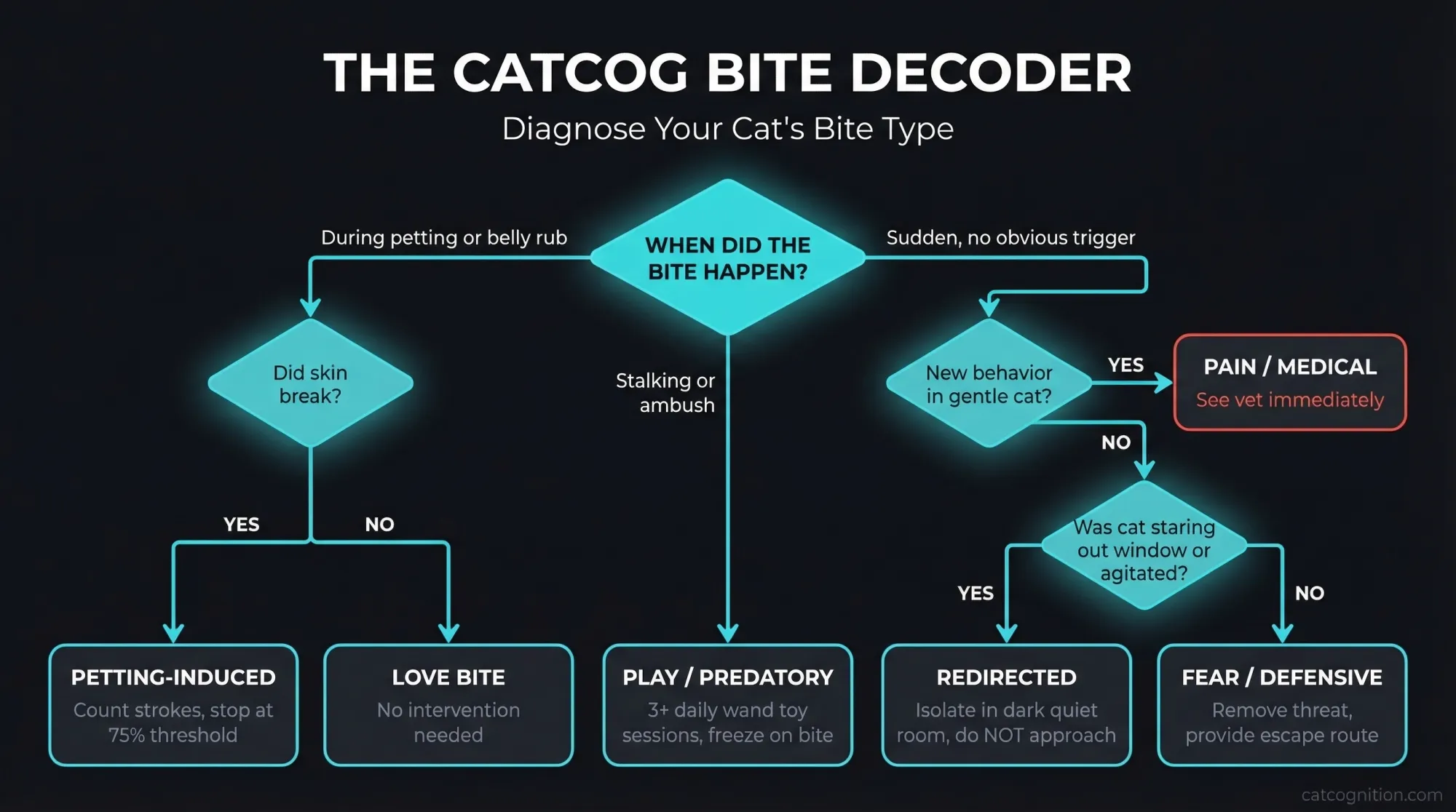
| Context | Body Language Before Bite | Skin Break? | Bite Type | Root Cause | Action |
|---|---|---|---|---|---|
| During belly rub or extended petting | Tail twitching, skin rippling, ears rotating back | Usually yes | Petting-induced | Overstimulation / allogrooming mismatch | Count strokes, stop at 75% threshold, pet head/cheeks only |
| Stalking ankles, ambushing from hiding, attacking moving feet or hands | Wide eyes locked on target, wiggling rear, no fear signals | Yes, often multiple bites | Play/Predatory | Unmet predatory drive, under-stimulation | 3+ daily wand toy sessions, never use hands as toys, freeze on bite |
| Sudden attack with no apparent trigger; cat was staring out window | Tense body, dilated pupils, tail lashing, may growl | Yes, often severe | Redirected | External trigger redirected onto nearest target | Identify trigger, do NOT approach, isolate in dark quiet room |
| Gentle nibble during purring and kneading | Relaxed body, forward ears, soft eyes | No | Love bite | Allogrooming bonding behavior | No intervention needed; redirect if uncomfortable |
| Cat was cornered, handled, or approached fast | Ears flat, body low, tail tucked, dilated pupils, hissing | Yes | Fear/Defensive | Escape response to perceived threat | Remove threat, provide escape route, slow approach |
| Sudden behavior change; bites when touched in specific area | Variable; may appear normal until touched | Yes | Pain/Medical | Underlying medical condition | Veterinary evaluation immediately |
How to Read Pre-Bite Body Language: The Warning Sequence
Every cat bite except redirected aggression follows a predictable escalation of body language signals -- signals giving owners a 5-to-15-second window to prevent the bite once recognized. Learning to read these signals is the single most effective way to stop cat biting permanently.
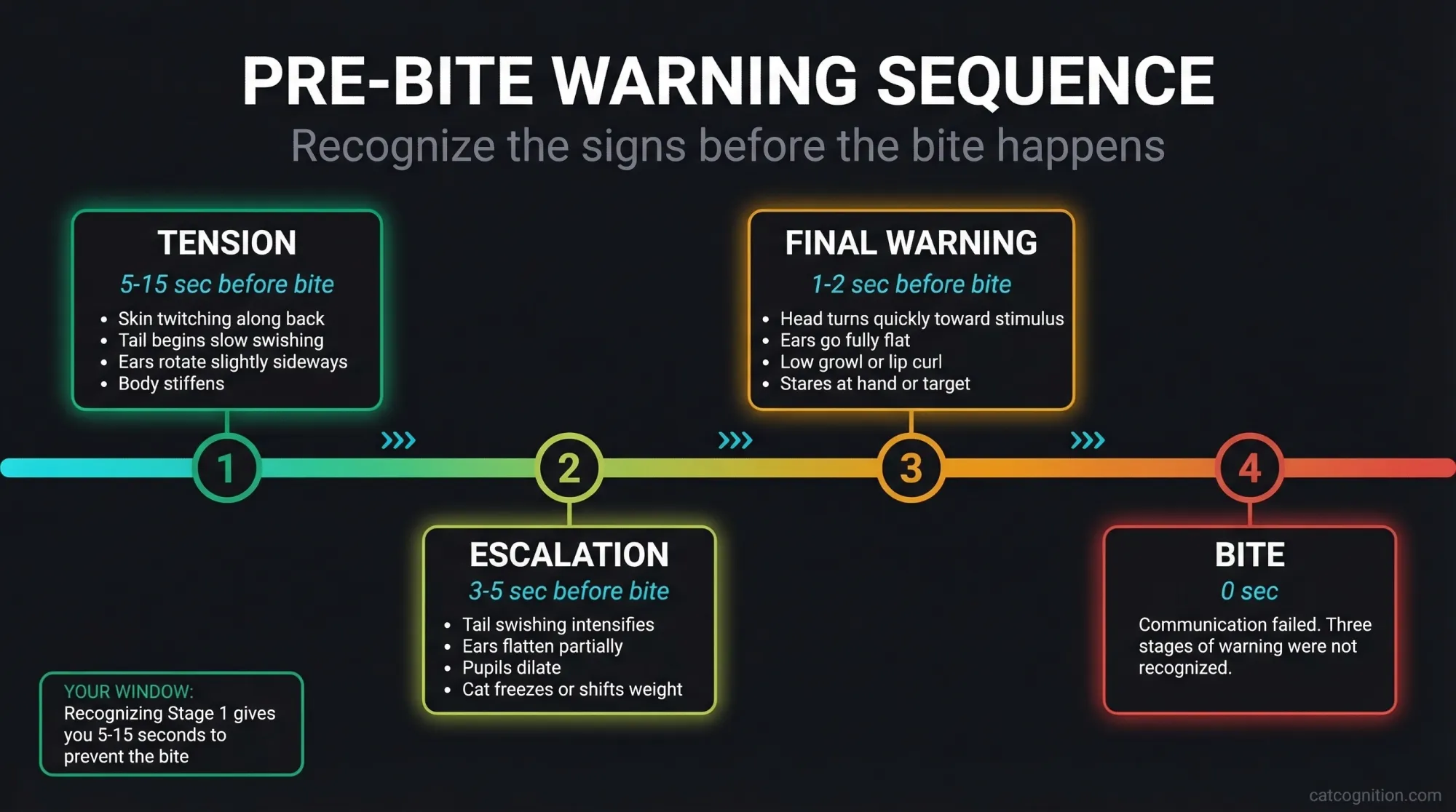
The warning sequence moves through four stages, from subtle to urgent:
Stage 1 -- Tension (5-15 seconds before bite). Skin twitching along the back. Tail begins slow, rhythmic swishing. Ears rotate slightly sideways. The cat's body stiffens.
Stage 2 -- Escalation (3-5 seconds before bite). Tail swishing intensifies. Ears flatten partially. Pupils dilate. The cat freezes or shifts weight.
Stage 3 -- Final warning (1-2 seconds before bite). Head turns quickly toward the stimulus. Ears go fully flat. Low growl or lip curl. The cat stares at the hand or target. Understanding what growling and hissing mean in context can help -- see our guide to every level of cat sound explained.
Stage 4 -- Bite. If you reach Stage 4, the communication failed. The cat is not being "suddenly aggressive." The cat gave three stages of warning that were not recognized.
How to Stop Cat Biting: The Long-Term Protocol
Stopping cat biting permanently requires addressing the root cause -- unmet environmental needs -- not just managing individual incidents. Environmental enrichment based on Buffington's Five Pillars provides the foundation: a safe space, multiple separated resources, play and predatory opportunities, positive human interaction, and respect for the cat's sense of smell.
The five principles that prevent biting across all types:
Never use physical punishment. Any type of physical punishment increases fear and anxiety and worsens aggression (Cornell Feline Health Center). Spraying water, scruffing, flicking the nose -- all of these create a cat that fears human hands, which increases biting. This is one of the most damaging mistakes cat owners make.
Meet the predatory need. Three or more interactive play sessions daily using wand toys that simulate prey. End each session with a treat to complete the hunt-catch-eat cycle.
Respect the cat's autonomy. Let the cat initiate contact. Use Dr. Lauren Finka's CAT framework: Choice and control, Attention to behavior, Think about Touch location.
Manage the environment. Block visual access to outdoor cats (reduces redirected aggression triggers). Provide vertical space. Ensure one litter box per cat plus one additional.
Know when to escalate. For persistent or escalating aggression, the clinical protocol involves five steps: (1) identify and avoid triggers, (2) rebuild a positive relationship, (3) environmental enrichment, (4) desensitization and counterconditioning, and (5) medication if necessary (Today's Veterinary Practice). Fluoxetine, clomipramine, and gabapentin are among the pharmaceutical adjuncts a veterinary behaviorist may consider.
When Cat Bites Become a Medical Emergency
See a doctor immediately if:
| Symptom or Situation | Risk Level |
|---|---|
| Any bite breaks the skin, especially on hands, face, or near joints | High -- infection risk 20-80% |
| Redness, swelling, warmth, or red streaks within 12-24 hours | High -- signs of active infection |
| Fever develops after a bite | High -- possible systemic infection |
| Bite near joints or tendons | High -- deep structure involvement |
| Patient is immunocompromised | Elevated -- reduced infection defense |
| Biting cat's vaccination status unknown | Elevated -- rabies risk assessment needed |
Children face elevated risk. In children aged 0-14, 19% of cat bites target the head and neck, compared to 7% in the overall population (Palacio et al., 2007). Supervise all cat-child interactions, and teach children to recognize Stage 1 warning signals.
Key Terms
- Allogrooming: mutual grooming between cats that reinforces social bonds and establishes communal scent
- Predatory motor pattern: the hardwired stalk-pounce-bite sequence that activates involuntarily during play and arousal
- Petting-induced aggression: biting triggered by overstimulation during petting, typically after a threshold of tactile input is exceeded
- Redirected aggression: aggressive behavior directed at a bystander when the cat cannot access the actual source of arousal
- Extinction burst: a temporary intensification of unwanted behavior when the previously rewarding response is removed, occurring before the behavior decreases
- Social-negative reinforcement: a behavioral mechanism where an action (biting) is maintained because it successfully removes an aversive stimulus (petting)
- Bite inhibition: the learned ability to control bite force, typically acquired through social play with littermates during the 2-9 week socialization window
- Emotional equilibrium: Dr. Bradshaw's framework describing the balanced emotional state cats require; aggression results from disruption of this balance
Frequently Asked Questions
Why does my cat bite me when I pet it? Petting-induced aggression occurs when tactile stimulation exceeds the cat's tolerance threshold. Consistent across multiple peer-reviewed studies, this type accounts for approximately 40% of feline behavioral referral cases. The cat is not being hostile -- it is communicating that the petting has become aversive. Stop before warning signs appear, pet only the head and cheeks, and let the cat control the duration.
Why does my cat bite me and no one else? The owner is typically the person who pets most frequently, pets for the longest duration, and is most often present when redirected aggression triggers occur. The cat's behavior is context-specific, not personal. Visitors interact briefly and cautiously; owners interact constantly and comfortably, which means owners cross the cat's thresholds more often.
Are cat bites dangerous? Yes. Cat bites carry a significantly higher infection rate than dog bites (20-80% versus 3-18%). Pasteurella multocida bacteria is carried in approximately 90% of cat mouths and is the primary source of wound infections. Any bite that breaks skin -- especially on the hands -- warrants prompt medical attention.
Why does my cat gently nibble me? Gentle nibbles without skin breakage during relaxed, purring moments are love bites -- affiliative allogrooming behavior where the cat is treating the owner as a social companion. The cat is extending the same social grooming behavior it would share with a trusted feline companion. This is bonding behavior, not aggression.
How do I stop my kitten from biting? Kittens learn bite inhibition through social play with littermates between 2 and 9 weeks of age. For kittens who missed this window (orphaned or early-weaned), redirect all biting onto toys, freeze when bitten (do not pull away), and provide three or more daily interactive play sessions. Never use hands as toys. Expect an extinction burst -- the biting will temporarily intensify before it decreases.
My cat suddenly started biting -- what changed? Sudden aggression changes in a previously gentle cat are often medical, not behavioral. Conditions including hyperthyroidism, osteoarthritis, dental disease, and neurological disorders can cause irritability and pain-related biting. Schedule a veterinary evaluation before attempting behavioral modification.
Why does my cat bite me when I stop petting it? Some cats bite to request more petting (attention-seeking), while others bite because the stop-and-start pattern itself is overstimulating. Observe whether the cat is relaxed and nudging for more (attention-seeking) or tense with dilated pupils (overstimulation). The context determines the response.
Can I train my cat not to bite? Yes, but the approach depends on the bite type. Play biting responds to increased enrichment and consistent non-reinforcement. Petting-induced biting responds to shorter interactions and respecting thresholds. Fear biting responds to trust-building and cat-friendly handling. Redirected aggression requires trigger management. For persistent cases, consult a veterinary behaviorist (DACVB).
Key Takeaways
Cat biting is communication, not aggression. A six-year epidemiological study found that 92% of cat bites were provoked by human interaction, meaning most bites have an identifiable trigger that the owner can learn to recognize and avoid.
The six bite types require six different solutions. Play biting needs more enrichment, petting-induced biting needs shorter interactions, redirected aggression needs trigger removal, love bites need no intervention, fear biting needs escape routes, and sudden onset biting needs a vet visit.
Every aggressive bite has a warning sequence. Cats escalate through tension, ear rotation, tail swishing, and pupil dilation before biting. Learning to read Stage 1 signals gives owners a 5-to-15-second window to prevent the bite.
Cat bites are medically serious. With an infection rate of 20-80% and Pasteurella multocida present in ~90% of cat mouths, any cat bite that breaks skin warrants prompt medical attention -- especially on the hands.
Never punish a biting cat. Physical punishment increases fear, anxiety, and aggression (Cornell Feline Health Center). Instead, identify the bite type using the CatCog Bite Decoder, address the root cause, and apply the type-specific intervention protocol.
Sources
- Amat, M. & Manteca, X. (2019). Common feline problem behaviours: Owner-directed aggression. Journal of Feline Medicine and Surgery. https://pmc.ncbi.nlm.nih.gov/articles/PMC11373754/
- Fritz et al. (2022). Functional analysis and treatment of aggression exhibited by cats toward humans during petting. Journal of Applied Behavior Analysis. https://pubmed.ncbi.nlm.nih.gov/34449088/
- Palacio, J. et al. (2007). Incidence of and risk factors for cat bites. Journal of Feline Medicine and Surgery. https://pmc.ncbi.nlm.nih.gov/articles/PMC10822621/
- Amat, M. et al. (2008). Evaluation of inciting causes, alternative targets, and risk factors associated with redirected aggression in cats. JAVMA. https://avmajournals.avma.org/view/journals/javma/233/4/javma.233.4.586.xml
- Ramos, D. & Mills, D.S. (2009). Human directed aggression in Brazilian domestic cats. Journal of Feline Medicine and Surgery. https://pubmed.ncbi.nlm.nih.gov/19577496/
- Bradshaw, J. (2018). Normal feline behaviour: and why problem behaviours develop. Journal of Feline Medicine and Surgery. https://journals.sagepub.com/doi/10.1177/1098612X18771203
- Crowell-Davis, S.L. et al. (2004). Social organization in the cat: A modern understanding. Journal of Feline Medicine and Surgery. https://pmc.ncbi.nlm.nih.gov/articles/PMC10822437/
- Rodan, I. et al. (2022). AAFP/ISFM Cat Friendly Veterinary Interaction Guidelines. Journal of Feline Medicine and Surgery. https://journals.sagepub.com/doi/10.1177/1098612X221128760
- Cornell Feline Health Center. (2024). Feline Behavior Problems: Aggression. https://www.vet.cornell.edu/departments-centers-and-institutes/cornell-feline-health-center/health-information/feline-health-topics/feline-behavior-problems-aggression
- ASPCA. (2024). Aggression in Cats. https://www.aspca.org/pet-care/cat-care/common-cat-behavior-issues/aggression-cats
- VCA Animal Hospitals. (2024). Play and Predatory Aggression in Cats. https://vcahospitals.com/know-your-pet/play-and-predatory-aggression-in-cats
- VCA Animal Hospitals. (2024). Cat Behavior Problems - Aggression Redirected. https://vcahospitals.com/know-your-pet/cat-behavior-problems-aggression-redirected
- PetMD / Dr. Alison Gerken, DACVB. (2024). Cat Love Bites. https://www.petmd.com/cat/behavior/cat-love-bites
- PetMD. (2024). Causes of Sudden Aggression in Cats. https://www.petmd.com/cat/behavior/causes-sudden-aggression-cats
- Today's Veterinary Practice. (2024). Owner-Directed Feline Aggression. https://todaysveterinarypractice.com/behavior/owner-directed-feline-aggression/
- UC Davis School of Veterinary Medicine. (2024). Kitten Play: Managing Rough Play. https://healthtopics.vetmed.ucdavis.edu/health-topics/feline/managing-your-kittens-rough-play
- American Academy of Family Physicians. (2023). Dog and Cat Bites: Rapid Evidence Review. https://www.aafp.org/pubs/afp/issues/2023/1100/dog-cat-bites.html
- Zoonoses and Public Health. (2008). Pasteurella multocida susceptibility study. https://pubmed.ncbi.nlm.nih.gov/18811910/
- Humane Society of Southern Arizona. (2024). Feline Overstimulation. https://hssaz.org/wp-content/uploads/2024/02/Feline-Overstimulation.pdf
- Feline Engineering. (2024). Stop Your Cat's Biting. https://felineengineering.com/blog/stop-your-cats-biting/
- Frontiers in Ethology. (2025). Assessing the impact of a training video on human recognition of cat emotions. https://www.frontiersin.org/journals/ethology/articles/10.3389/fetho.2025.1675587/full