Why Do Cats Knock Things Over? The Predatory Science Behind the Chaos
Cats knock things over because batting activates a decoupled predatory motor sequence — the same neural circuitry that drives hunting fires independently of hunger. Dense paw pad mechanoreceptors and a novelty-driven habituation cycle explain the rest.

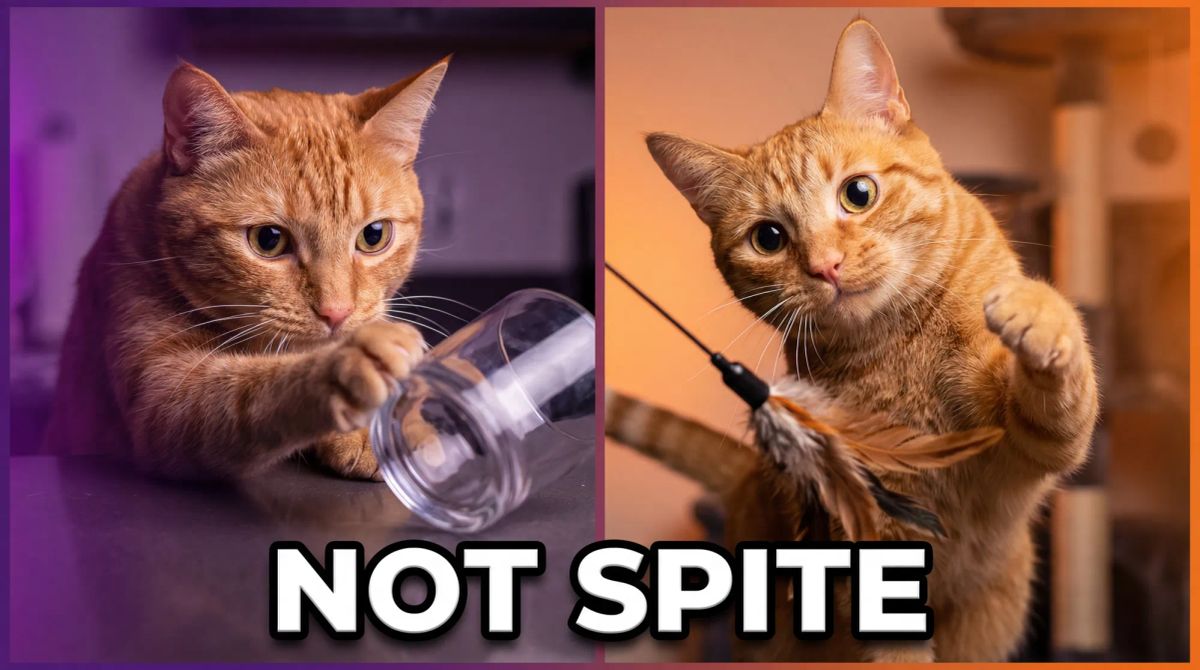
Table of Contents
- The Predatory Motor Sequence: Why Batting Is Hardwired
- Why Cats Target One Object After Another
- Paw Pads as Precision Sensors
- Do Cats Understand What Happens When Objects Fall?
- When Knocking Things Over Is Learned Attention-Seeking
- The Play Deficit Behind the Behaviour
- The Contrafreeloading Paradox: Why This Is Not About Food
- Is It Normal for Cats to Knock Things Over?
- How to Reduce Object-Knocking Behaviour
- Key Terms
- Frequently Asked Questions
- Key Takeaways
- Sources
You have probably lived through the scene: a cat perched calmly on the kitchen counter, one paw extended, nudging a water glass millimetre by millimetre toward the edge --- then watching it shatter on the floor with what looks suspiciously like satisfaction. The behaviour feels deliberate, calculated, maybe even spiteful. But the science behind the crash tells a different story, one rooted in predatory neurology, tactile exploration, and a play deficit that affects the majority of indoor cats. Understanding cat behavior through science rather than assumption reveals why this habit is one of the most normal things a cat can do.
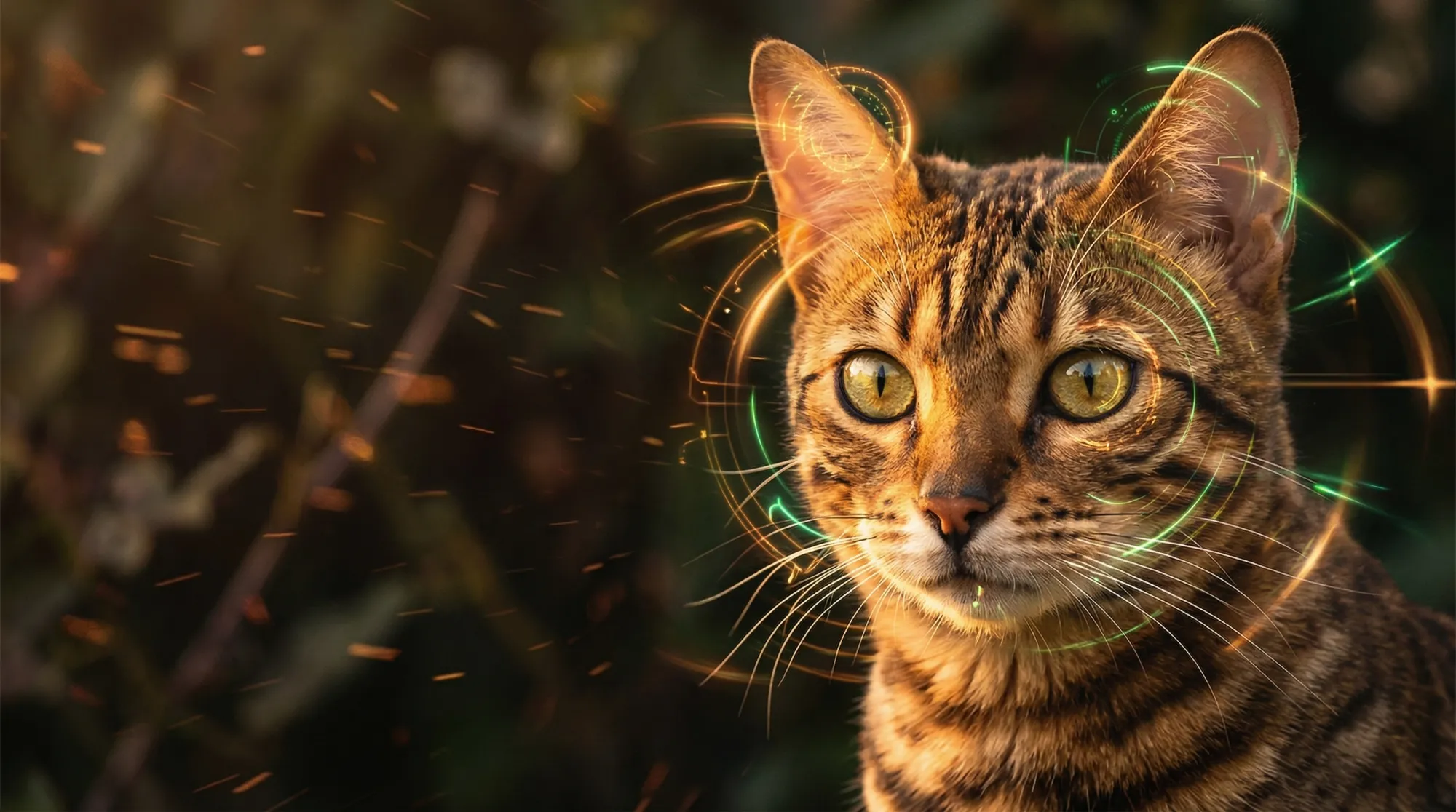
As Dr. Mikel Delgado, Senior Research Scientist at Purdue University and Certified Applied Animal Behaviorist, established in her 2019 review of feline play, object-focused play in cats incorporates "behavioral sequences like those observed in prey handling, prey capture, and post-hunting prey manipulation: poke/bat, scoop, leap, pounce, grasp, and bite/mouth." The paw swipe that sends a pen off the desk is not random mischief --- Delgado's research confirms the same motor pattern used in post-capture prey testing. Building on Paul Leyhausen's foundational ethological work and reinforced by Dr. John Bradshaw's research at the University of Bristol, a convergent picture emerges: knocking things over is one of the most normal behaviours a cat can perform.
The Predatory Motor Sequence: Why Batting Is Hardwired
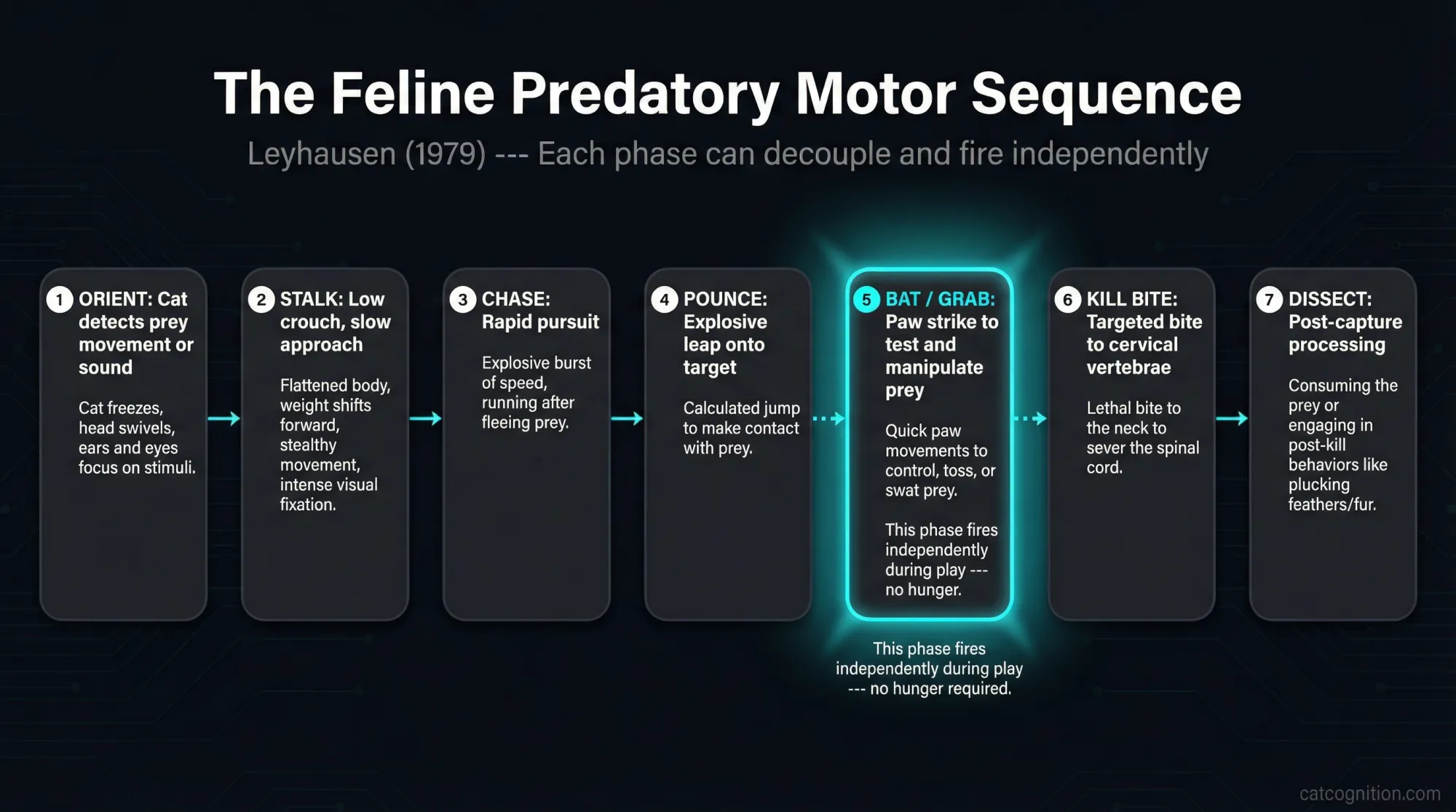
Cats knock objects off surfaces because batting is a discrete component of the feline predatory motor sequence, firing independently of hunger or prey availability. Ethologist Paul Leyhausen documented the full feline hunting chain --- orient, stalk, chase, pounce, grab-bite, kill-bite, dissect --- and showed each motor pattern can decouple and activate alone (Leyhausen, 1979).
A cat does not need to complete the entire hunt to activate the predatory reward system. The batting component alone provides neurological reward. As Leyhausen (1979) and Bradshaw (2018) both established, predatory behaviour in cats is so highly motivated that even in the absence of hunger it will be expressed.
"In a 12-week controlled trial across 219 households, Cecchetti et al. (2021) found that 5--10 minutes of daily object play reduced prey brought home by 25% --- demonstrating that object play partially satisfies the same predatory motivational system that drives actual hunting."
Dr. John Bradshaw reinforces the predatory framing in a 2018 paper in the Journal of Feline Medicine and Surgery: "Cats' motivations for 'playing' are focused around predatory behavior, during which they become largely oblivious to their owner's involvement." When a cat is batting a salt shaker across the counter, the cat is running prey-testing software. The owner standing three feet away, arms folded, may as well not exist.
Why Cats Target One Object After Another
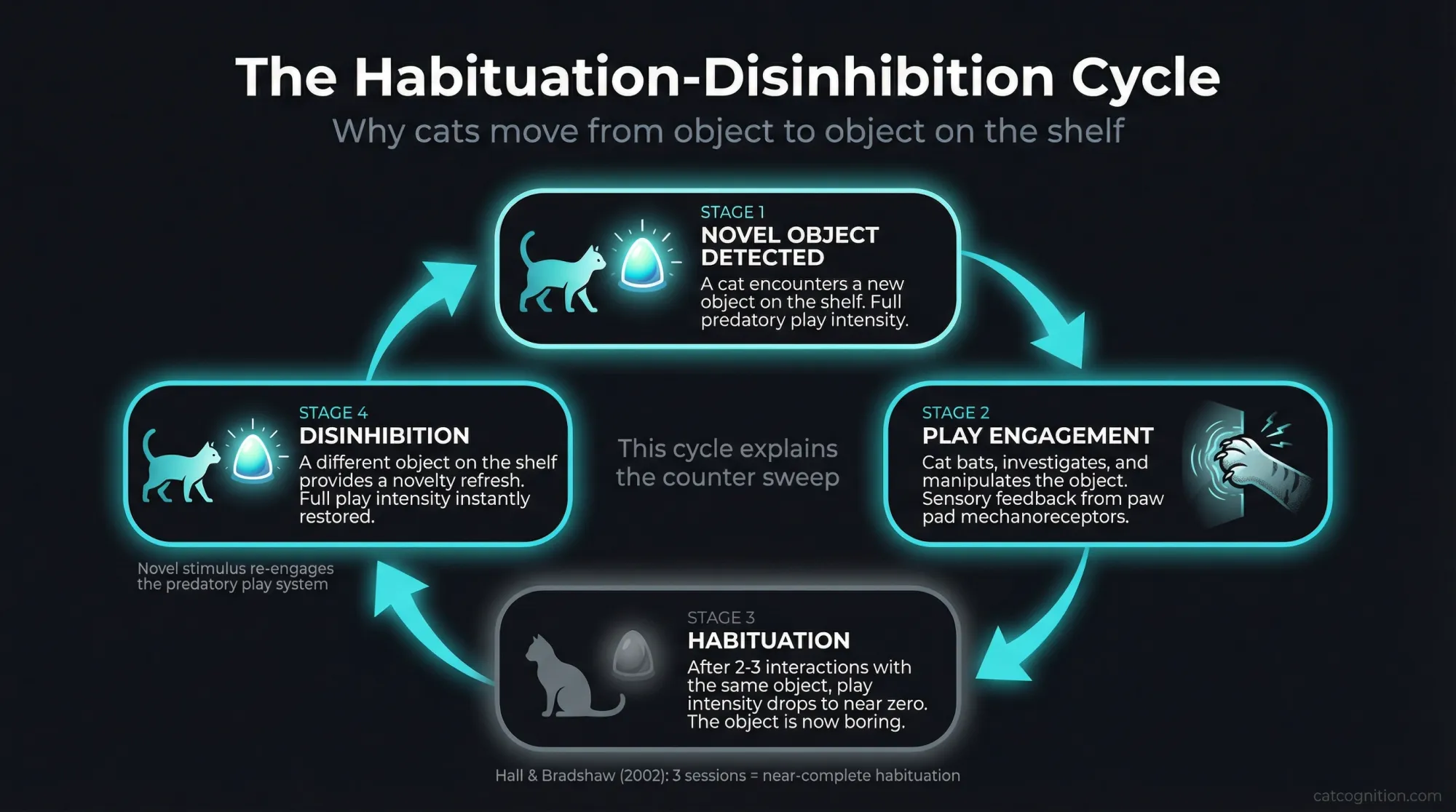
Cats move from item to item on a shelf because a novelty-dependent habituation cycle governs feline object play --- each new object re-engages the predatory play system after the cat habituates to the last-touched object. Bradshaw and Hall demonstrated three sessions with the same toy caused near-complete habituation, but a novel toy restored full play intensity (Hall & Bradshaw, 2002).
The cat had not lost motivation to play. The cat had lost interest in that specific object. This explains the methodical counter sweep --- each new item provides a novelty refresh.
"Hall and Bradshaw (2002) demonstrated that three play sessions with the same toy caused near-complete habituation, but introducing a novel toy immediately restored full play intensity --- confirming that feline object play is governed by stimulus-specific novelty, not declining overall motivation."
A 2023 international survey of 1,591 cat guardians from 55 countries confirmed this finding at scale: play variety was more predictive of cat welfare than play quantity, and regular variation of games and toys minimised habituation and boredom (Henning et al., 2023, Animal Welfare).
Paw Pads as Precision Sensors
Cat paw pads contain dense networks of specialised mechanoreceptors --- Pacinian corpuscles for vibration, Merkel endings for texture, and Meissner-like corpuscles for light touch --- transforming every bat into a rich sensory event providing feedback on weight, surface friction, and movement simultaneously.
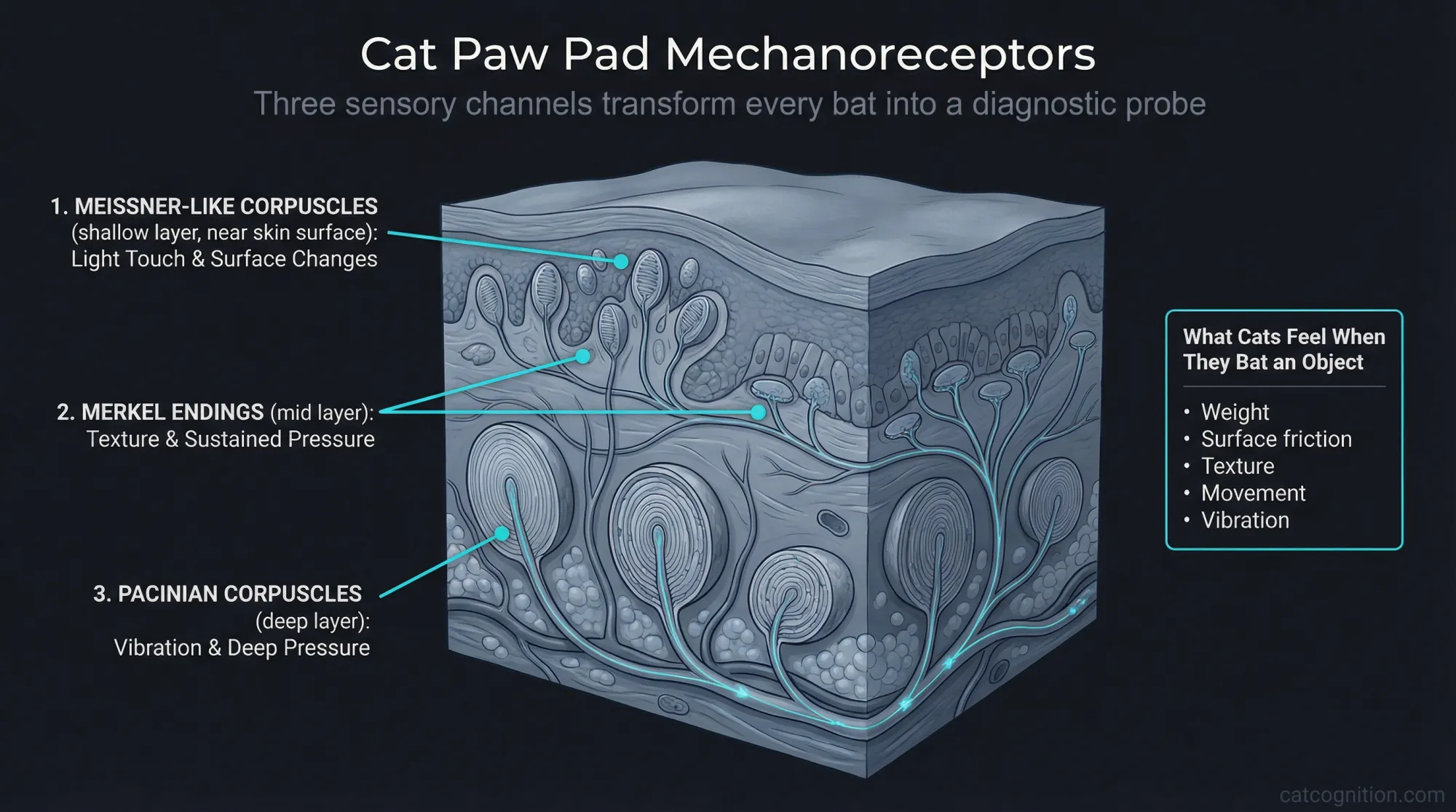
When a cat's paw connects with a glass, a phone, or a set of keys, the paw pad mechanoreceptors report weight, texture, surface friction, and movement. X-ray cinematography analysis of five cats revealed that digits 3 and 4 act in concert to establish object contact while digits 2 and 5 stabilise the paw --- a level of biomechanical precision that shows batting is not random flailing but structured sensory assessment (Boczek-Funcke et al., 1998, European Journal of Neuroscience). The cat paw functions like a diagnostic probe, gathering tactile intelligence about every object in the environment.
Do Cats Understand What Happens When Objects Fall?
Preliminary research suggests cats possess a basic understanding of cause-and-effect physics, which may make watching objects fall cognitively stimulating rather than purely instinctive. A 2016 Kyoto University study found cats stared significantly longer at physically incongruent outcomes --- such as an object dropping from a silent container --- indicating expectation violation consistent with rudimentary causal reasoning (Takagi et al., 2016).
The researchers noted that "hunting cats often need to infer the location or the distance of their prey from sounds alone." However, Dr. John Bradshaw has publicly called the Takagi study "seriously flawed" while describing the underlying idea as "entirely plausible" --- specifically questioning whether cats were responding to auditory cues rather than demonstrating genuine causal reasoning. The gravity cognition angle remains suggestive but contested.
What is more firmly established is that cats reach Stage 5 object permanence --- tracking objects through visible displacements --- but fail Stage 6 tasks involving invisible displacement (Goulet et al., 1994). Cats need to SEE movement to engage their object-tracking cognition. Knocking something off a shelf creates exactly the kind of visible displacement that activates feline spatial cognition. This intersection of physical awareness and predatory play hints at a level of cat intelligence that goes beyond simple instinct.
Not every cat engages equally with object manipulation. A 2025 PLoS ONE study found that 56% of tested cats failed to find a hidden toy in visible displacement trials, and 42% of those failures were cats that did not even attempt to search --- suggesting significant individual variation in motivation for object interaction (Forman et al., 2025).
When Knocking Things Over Is Learned Attention-Seeking
Some object-knocking behaviour is maintained through operant conditioning rather than intrinsic predatory motivation, and cats making eye contact before or during the behaviour are likely responding to a history of owner reinforcement. The Halls (2018) clinical guidelines on behaviour modification confirm "unintentional reinforcement by owners commonly maintains problematic behaviors" and recommend removing all reinforcement consistently for extinction to succeed.
Every owner response to a knocked object --- picking it up, scolding, gasping, laughing, even glancing at the cat --- constitutes social reinforcement. The critical distinction: cats engaged in genuine predatory play tend to be "largely oblivious to their owner's involvement" (Bradshaw, 2018), while attention-seeking cats typically orient toward the owner before, during, or after knocking. If you've ever wondered whether your responses might be encouraging unwanted habits, common cat owner mistakes covers this pattern and others.
The Play Deficit Behind the Behaviour
Cats lacking adequate daily play redirect predatory energy toward household objects, and the scale of the deficit is notable: only 29.3% of cat owners provide daily interactive wand-toy play, suggesting most indoor cats receive insufficient predatory stimulation and compensate by batting objects off shelves and counters (Delgado et al., 2024).
The environmental enrichment framework developed by Dr. Tony Buffington through Ohio State University's Indoor Pet Initiative and formalised by Ellis et al. (2013) in the AAFP/ISFM Five Pillars guidelines establishes that cats need environmental outlets for natural behaviours including predatory play and exploration. When those outlets are absent, cats improvise --- and improvisation often means the nearest shelf of breakable objects. Understanding what cats need to be happy starts with meeting these enrichment requirements.
Indoor-only cats appear especially susceptible. Without access to actual prey or outdoor exploration, indoor cats compensate with increased predatory play directed at household objects.
"A 2024 survey by Delgado et al. found that only 29.3% of cat owners provide daily interactive wand-toy play --- meaning the majority of indoor cats may receive insufficient predatory play stimulation to satisfy the motor sequences that drive object-batting behaviour."

The Contrafreeloading Paradox: Why This Is Not About Food
In a preliminary study of 17 cats, domestic cats preferred freely available food over food requiring puzzle effort --- making cats a notable exception among tested species including chimpanzees, rats, and maned wolves, all of which work for food when free food is available (Delgado et al., 2021). The sample was small, so the finding remains preliminary.
The implication, however, is significant. Cats that refuse to work for food but voluntarily bat and manipulate objects are revealing that the batting itself is intrinsically rewarding. The motivation to knock things over operates through the predatory and exploratory systems, not the nutritional system. Object-knocking behaviour in cats is not practice for catching dinner --- the behaviour IS the reward.
Is It Normal for Cats to Knock Things Over?
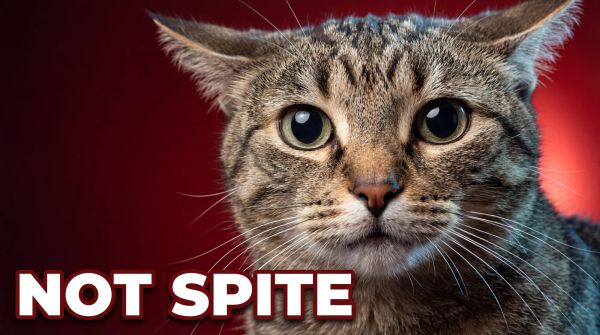
Object batting is a normal expression of the predatory motor sequence, not a behavioural disorder, and the Cornell Feline Health Center classifies destructive behaviours in cats as usually part of normal investigation and play, not signs of a behavioural disorder. Knocking things over reflects predatory drive and tactile exploration, not spite --- current evidence suggests cats lack the theory-of-mind complexity typically associated with revenge.
However, not every cat is a chronic knocker. Individual variation in object interaction motivation is significant, and factors including age, activity level, breed tendencies, and environmental enrichment all influence whether a particular cat expresses this behaviour frequently. The behaviour is most commonly reported in young-to-middle-aged cats with higher activity levels and is predominantly an indoor cat phenomenon.
When to see a veterinarian: Sudden onset of knocking in a previously calm adult cat may indicate pain, hyperthyroidism, or cognitive decline. Knocking accompanied by pica (eating non-food objects), compulsive targeting of the same object without variation, or escalation into destructive shredding warrants a veterinary examination.
How to Reduce Object-Knocking Behaviour
The most effective approach combines daily structured play to satisfy predatory drive, toy rotation every two to three days to prevent habituation, and complete non-response to attention-seeking episodes. Punishment --- spraying with water, shouting, physical intervention --- is ineffective and potentially harmful because the behaviour stems from neurological motivation, not defiance.
| Motivation | Intervention | Evidence Basis |
|---|---|---|
| Predatory play deficit | 5--10 minutes daily wand-toy play mimicking stalk-chase-pounce-catch sequence | Cecchetti et al. 2021: 25% prey reduction |
| Habituation/novelty seeking | Rotate toys every 2--3 days; vary textures, sizes, and movement patterns | Hall & Bradshaw 2002: novelty re-engages play |
| Attention-seeking (learned) | Zero response to knocking --- no eye contact, no picking up, no scolding; redirect BEFORE knocking | Halls 2018: remove all reinforcement consistently |
| General enrichment deficit | Environmental overhaul: vertical space, window bird feeders, rotating solo toys | Ellis et al. 2013: Five Pillars guidelines |
Timing matters. Cats are crepuscular --- most active at dawn and dusk. Scheduling interactive play sessions at these natural activity peaks maximises engagement and reduces after-hours object destruction.
Safety-proofing is immediate. Remove breakable, hazardous, or valuable items from elevated surfaces the cat frequents. Lit candles, toxic substances, and glass objects on accessible shelves present genuine safety risks. Replace with safe alternatives --- crinkle balls, small stuffed toys, items that reward investigation without creating hazards.

Key Terms
- Predatory motor sequence: The complete chain of hunting behaviours (orient, stalk, chase, pounce, grab-bite, kill-bite, dissect) identified by ethologist Paul Leyhausen; individual segments can fire independently during play.
- Habituation: The decrease in response to a repeated, unchanging stimulus; explains why cats lose interest in one object and move to the next.
- Disinhibition: The return of a habituated response when a new stimulus is introduced; explains why a novel object re-engages a cat that just lost interest in the previous one.
- Contrafreeloading: The preference to work for food when identical free food is available; most animals contrafreeload but cats notably do not in preliminary testing.
- Mechanoreceptors: Sensory nerve endings in cat paw pads (Pacinian corpuscles, Merkel endings, Meissner-like corpuscles) that detect pressure, vibration, texture, and temperature.
- Operant conditioning: Learning through consequences; a cat repeats knocking behaviour when the outcome (owner attention) reinforces the action.
- Object permanence: The understanding that objects continue to exist when out of sight; cats achieve Stage 5 (visible displacement tracking) but typically fail Stage 6 (invisible displacement inference).
Frequently Asked Questions
Why does my cat knock things off the table and stare at me?
A cat that makes eye contact before, during, or after knocking an object is likely performing learned attention-seeking behaviour reinforced through operant conditioning. Every owner response --- scolding, laughing, picking up the object, even glancing at the cat --- reinforces the behaviour. The Halls (2018) clinical guidelines recommend complete non-response (extinction) to break this reinforcement cycle.
Why does my cat push things off the edge specifically?
Cats may find objects falling off edges particularly engaging because the fall creates visible displacement that activates spatial cognition. Preliminary research by Takagi et al. (2016) at Kyoto University suggests cats have a basic understanding of object-gravity relationships, though this finding remains contested. The sound, movement, and observable cause-and-effect of a falling object provide multisensory stimulation that a stationary object on a flat surface does not.
Is it normal for cats to knock things over?
Object batting is a normal expression of the feline predatory motor sequence. The Cornell Feline Health Center notes that destructive behaviours in cats are usually part of normal investigation and play. However, sudden onset of knocking behaviour in a previously calm adult cat may indicate hyperthyroidism, pain, or cognitive changes and warrants veterinary evaluation.
How do I stop my cat from knocking things over?
Combine three strategies: (1) provide 5--10 minutes of daily interactive wand-toy play that mimics the full predatory sequence, (2) rotate toys every 2--3 days to prevent habituation, and (3) maintain complete non-response to knocking episodes if attention-seeking is the motivation. Environmental enrichment --- vertical space, window perches, and rotating solo toys --- reduces the behaviour at its source by meeting predatory and exploratory needs.
Do cats knock things over out of spite?
Cats do not knock objects off surfaces out of spite or revenge. Current evidence suggests cats lack the theory-of-mind complexity typically associated with retaliatory behaviour. The motivation is predatory play, tactile exploration, novelty-seeking, cognitive stimulation, or learned attention-seeking --- never emotional retaliation against an owner.
Will puzzle feeders stop my cat from knocking things over?
Puzzle feeders are unlikely to reduce object-knocking behaviour. Cecchetti et al. (2021) found puzzle feeders actually increased prey returned to the home by 33%, suggesting food-based challenges amplify predatory arousal rather than satisfy it. Interactive object play --- wand toys, chase-and-catch games --- is the effective substitute for the predatory drive that fuels knocking behaviour.
Why does my cat only knock over certain objects?
Cats preferentially target objects that provide rewarding sensory feedback when batted: items that roll, slide, make sounds, or have interesting textures. Objects at the edge of surfaces are especially attractive because they produce visible displacement (falling) with minimal effort. If a cat returns to the same specific object repeatedly, the cat may be responding to a history of owner reinforcement (reliable attention from that particular item) or depositing scent through interdigital pheromone glands on the paw pads.
Do some cat breeds knock things over more than others?
No peer-reviewed study has directly compared breed-specific knocking rates, but breeds with higher activity levels and stronger predatory drive intensity --- such as Bengals and Siamese --- are commonly reported to engage in more object manipulation. The underlying mechanisms (predatory motor sequence, novelty-seeking, tactile exploration) are universal across domestic cats, but the frequency and intensity of expression varies with individual temperament and breed-associated activity levels.
Key Takeaways
Batting is a decoupled predatory motor sequence. Cats knock things over because the same neural circuitry that drives hunting fires independently of hunger. (Leyhausen 1979; Bradshaw 2018)
Habituation drives the counter sweep. Three play sessions with the same toy cause near-complete habituation, which is why cats move systematically from object to object. (Hall & Bradshaw 2002)
Most cats have a play deficit. Only 29.3% of cat owners provide daily interactive wand-toy play, suggesting most indoor cats redirect predatory energy toward household objects. (Delgado et al. 2024)
Structured play works; puzzle feeders backfire. Five to ten minutes of daily structured play reduces prey-related behaviour by 25%, while puzzle feeders increase predatory arousal by 33%. (Cecchetti et al. 2021)
Combine three interventions. The most effective approach is daily wand-toy play, toy rotation every 2--3 days, and complete non-response to attention-seeking episodes. (Ellis et al. 2013; Halls 2018)
Sources
Delgado, M.M. & Hecht, J. (2019). A review of the development and functions of cat play, with future research considerations. Applied Animal Behaviour Science, 214, 1--17. https://doi.org/10.1016/j.applanim.2019.03.004
Hall, S.L., Bradshaw, J.W.S., & Robinson, I.H. (2002). Object play in adult domestic cats: the roles of habituation and disinhibition. Applied Animal Behaviour Science, 79(3), 263--271. https://doi.org/10.1016/S0168-1591(02)00153-3
Takagi, S. et al. (2016). There's no ball without noise: cats' prediction of an object from noise. Animal Cognition, 19(5), 1043--1047. https://doi.org/10.1007/s10071-016-1001-6
Boczek-Funcke, A. et al. (1998). Shaping of the cat paw for food taking and object manipulation: an X-ray analysis. European Journal of Neuroscience, 10(12), 3885--3897. https://doi.org/10.1046/j.1460-9568.1998.00399.x
Goulet, S., Dore, F.Y., & Rousseau, R. (1994). Object permanence and working memory in cats (Felis catus). Journal of Experimental Psychology: Animal Behavior Processes, 20(4), 347--365. https://pubmed.ncbi.nlm.nih.gov/7964519/
Cecchetti, M. et al. (2021). Provision of high meat content food and object play reduce predation of wild animals by domestic cats. Current Biology, 31(5), 1107--1111. https://doi.org/10.1016/j.cub.2020.12.044
Bradshaw, J.W.S. (2018). Normal feline behaviour: ... and why problem behaviours develop. Journal of Feline Medicine and Surgery, 20(5), 411--421. https://doi.org/10.1177/1098612X18771203
Ellis, S.L.H. et al. (2013). AAFP and ISFM Feline Environmental Needs Guidelines. Journal of Feline Medicine and Surgery, 15(3), 219--230. https://doi.org/10.1177/1098612X13477537
Herron, M.E. & Buffington, C.A.T. (2010). Environmental enrichment for indoor cats. Compendium: Continuing Education for Veterinarians, 32(12), E1--E5. https://pmc.ncbi.nlm.nih.gov/articles/PMC3922041/
Delgado, M.M. et al. (2021). Domestic cats (Felis catus) prefer freely available food over food that requires effort. Animal Cognition, 24, 1053--1063. https://doi.org/10.1007/s10071-021-01530-3
Delgado, M., Marcinkiewicz, E., Rhodes, P., & Ellis, S.L.H. (2024). Identifying barriers to providing daily playtime for cats: A survey-based approach using COM-B analysis. Applied Animal Behaviour Science, 280, 106420. https://doi.org/10.1016/j.applanim.2024.106420
Henning, J., Nielsen, T., Fernandez, E.J., & Hazel, S. (2023). Cats just want to have fun: Associations between play and welfare in domestic cats. Animal Welfare, 32, e9. https://www.cambridge.org/core/journals/animal-welfare/article/cats-just-want-to-have-fun-associations-between-play-and-welfare-in-domestic-cats/03F9B841EFF468344BC1B0D01D37CBC6
Halls, V. (2018). Tools for managing feline problem behaviours: Environmental and behavioural modification. Journal of Feline Medicine and Surgery, 20(11), 1005--1014. https://doi.org/10.1177/1098612X18806757
Cornell Feline Health Center. Feline Behavior Problems: Destructive Behavior. Cornell University College of Veterinary Medicine. https://www.vet.cornell.edu/departments-centers-and-institutes/cornell-feline-health-center/health-information/feline-health-topics/feline-behavior-problems-destructive-behavior
Leyhausen, P. (1979). Cat Behavior: The Predatory and Social Behavior of Domestic and Wild Cats. Garland Series in Ethology. https://www.amazon.com/Cat-Behavior-Predatory-Domestic-ethology/dp/0824070178
Ohio State University Indoor Pet Initiative. Toys. https://indoorpet.osu.edu/cats/basic-indoor-cat-needs/toys
Forman, J., Rowe, J.S., & Leavens, D.A. (2025). Object permanence in domestic cats (Felis catus) using violation-of-expectancy by owner and stranger. PLoS ONE, 20(7), e0312225. https://doi.org/10.1371/journal.pone.0312225