Why Do Cats Wag Their Tails? The Science Behind Every Tail Movement
Cat tail wagging signals frustration, not happiness. Learn what 10 tail positions mean with the CatCog Tail Decoder, backed by 14 peer-reviewed studies on feline body language.

Table of Contents
- What Does Cat Tail Wagging Actually Mean?
- Why Did Cats Evolve Tail Signals? The Domestication Story
- How Does the Cat Tail Work? Anatomy and Neuroscience
- The CatCog Tail Decoder: 10 Tail Positions Explained
- Why Does My Cat Wag Its Tail When I Pet It?
- Do Cats Wag Their Tails When Happy?
- Ears vs. Tails: What Matters More in Cat Communication?
- When Tail Behavior Signals a Medical Problem
- Key Terms
- Frequently Asked Questions
- Key Takeaways
- Sources
If you have ever watched a dog wag its tail and assumed your cat's tail movements mean the same thing, you are not alone. The dog-to-cat translation error is one of the most widespread misunderstandings in pet ownership. Dogs evolved as cooperative pack hunters with broadly affiliative tail signals. Cats descended from a solitary, territorial ancestor, the African wildcat (Felis silvestris lybica), and developed their tail communication system under entirely different selective pressures.
As Dr. John Bradshaw of the University of Bristol's Anthrozoology Institute explains in his research on feline domestication, cats still rely more on territorial security than on psychological attachments to people or other cats (Bradshaw, 2018, Journal of Feline Medicine and Surgery). That evolutionary heritage shapes every flick, lash, and quiver of your cat's tail. According to Dr. Mikel Delgado, Certified Applied Animal Behaviorist and Senior Research Scientist at Purdue University, "You can't know how a cat is feeling by looking at just one part of their body. You always have to consider the cat's entire body as well as what is happening in the cat's environment."
This guide introduces the CatCog Tail Decoder, a diagnostic framework that maps 10 distinct cat tail positions to their emotional meaning, requiring full-body context before interpretation. Because a high tail with forward ears means something entirely different from a high tail with flattened ears. Understanding tail language is a core part of reading cat behavior and building a stronger relationship with your cat.

What Does Cat Tail Wagging Actually Mean?
Cat tail wagging signals a range of emotional states from mild arousal to active frustration, depending on the speed, direction, and amplitude of the movement. Preliminary research from a 2023 pilot study suggests lateral tail lashing correlates with frustrating situations, while a slow, gentle sway in a relaxed cat can indicate contentment (de Mouzon et al., 2023, Animals).
The critical distinction is movement type. A rapid side-to-side lash during petting is a warning. A slow, sweeping sway while watching birds through a window is focused attention. A gentle quiver of an upright tail when greeting an owner is excitement. Lumping all of these under "tail wagging" creates the same confusion as saying all human hand movements mean the same thing.
The dog comparison fails at a fundamental level. A 2005 comparative study published in the Journal of Comparative Psychology found that 85% of dogs displayed gaze alternation with humans compared to only 42% of cats (Miklosi et al., 2005). Dogs evolved to broadcast their emotional states. Cats evolved to communicate selectively, in specific contexts, to specific recipients. The tail is one channel in a multimodal system that includes ears, whiskers, pupil dilation, body posture, and vocalization. For a comprehensive breakdown of every signal in that system, see our guide to every cat body language signal explained.
Why Did Cats Evolve Tail Signals? The Domestication Story
The tail-up greeting signal is a domestication invention wild cats never developed. Doctoral research by Charlotte Cameron-Beaumont at the University of Southampton demonstrated through silhouette experiments: wild cats do not use the tail-up posture, while domestic cats evolved the tail-up greeting specifically to communicate peaceful intent at a distance (Cameron-Beaumont, 1997).
When domestic cats began living at higher densities near human grain stores approximately 10,000 years ago, solitary animals suddenly needed a way to say "I come in peace" before getting close enough to fight. The tail-up signal solved that problem. It is visible from across a room or a farmyard, unambiguous in meaning, and requires no physical contact to interpret.
Cameron-Beaumont's experiments showed that cats approached a tail-up silhouette significantly faster than a tail-down silhouette. The tail-down silhouette induced aggressive postures in responding cats. The signal works because it exposes the cat's vulnerable underside and anal glands, a gesture that only makes sense between individuals who do not intend to fight.
This signal is not simply a "happy greeting." A 2009 study published in Behavioural Processes observed a feral colony of 10 cats across 23 dyads and 109 tail-up interactions. The researchers found that lower-ranking cats displayed the tail-up signal more frequently toward higher-ranking individuals (Cafazzo & Natoli, 2009). The signal communicates recognition of social status and intention to interact amicably. A cat can hold its tail high while approaching a dominant cat it does not particularly enjoy, because the message is "I acknowledge your status and I will not attack," not "I am happy to see you."
The tail-up signal also precedes one of the most common cat-to-human behaviors: rubbing. When your cat approaches with a raised tail and then weaves against your legs, the tail-up is the opening statement and the rub is the full greeting. For more on what rubbing means, see why cats rub against you.
How Does the Cat Tail Work? Anatomy and Neuroscience
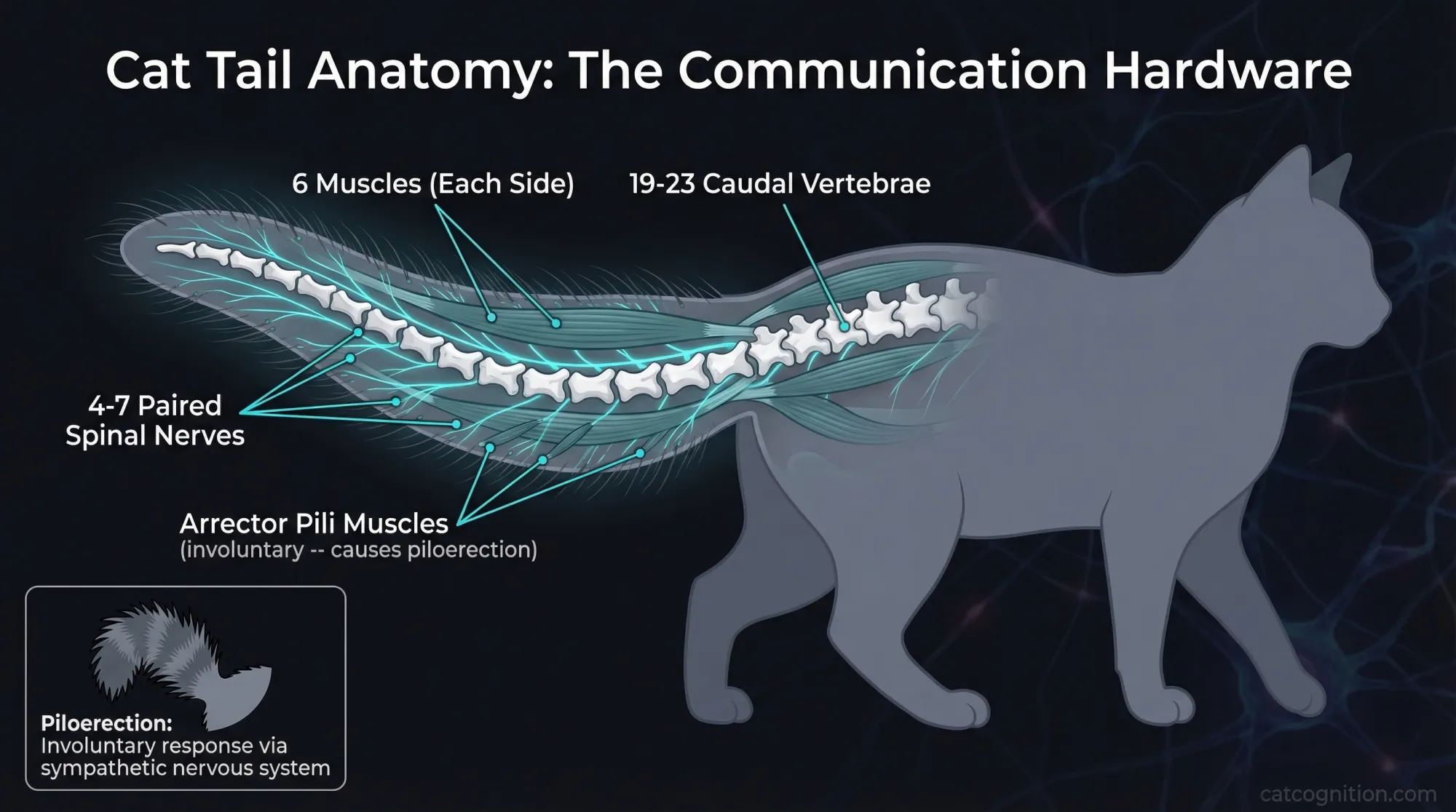
The cat tail contains 19 to 23 caudal vertebrae (Cats Protection, 2024), six muscles on each side, and 4 to 7 paired caudal spinal nerves connecting tail muscles to the central nervous system. The caudal nerve network transmits emotional state from brain to tail almost instantaneously, making the tail one of the most responsive indicators of a cat's internal experience.
Tail movements fall into two categories based on voluntary control.
Voluntary movements include the tail-up greeting, slow lateral swishing during focused attention, and wrapping the tail around a companion. The cat controls these deliberately to signal intent. These are conscious communicative acts, the feline equivalent of a human wave or handshake.
Involuntary movements include piloerection, the dramatic "bottle-brush" puffing that makes a tail appear twice its normal size. This response is triggered by the sympathetic nervous system as part of the fight-or-flight cascade. Norepinephrine binds to alpha-1-adrenergic receptors on arrector pili muscles, causing the hair to stand erect (VETgirl Veterinary CE, 2024). The cat cannot control this response. Punishing a cat for a puffed tail is like punishing a human for flinching. This is the same involuntary fear response that drives why cats hiss -- both are defensive signals the cat cannot suppress.
Beyond communication, the tail serves as a precision counterbalance during locomotion. Research at the University of Florida demonstrated that cats without supraspinal tail control fell significantly more often during perturbed locomotion on a narrow beam (Walker et al., 1998, Behavioural Brain Research). Intact cats held their tails rigidly erect on a stable plank with lateral deviations typically less than 15 degrees. The tail is not decorative; it is an active stabilization instrument.
The CatCog Tail Decoder: 10 Tail Positions Explained
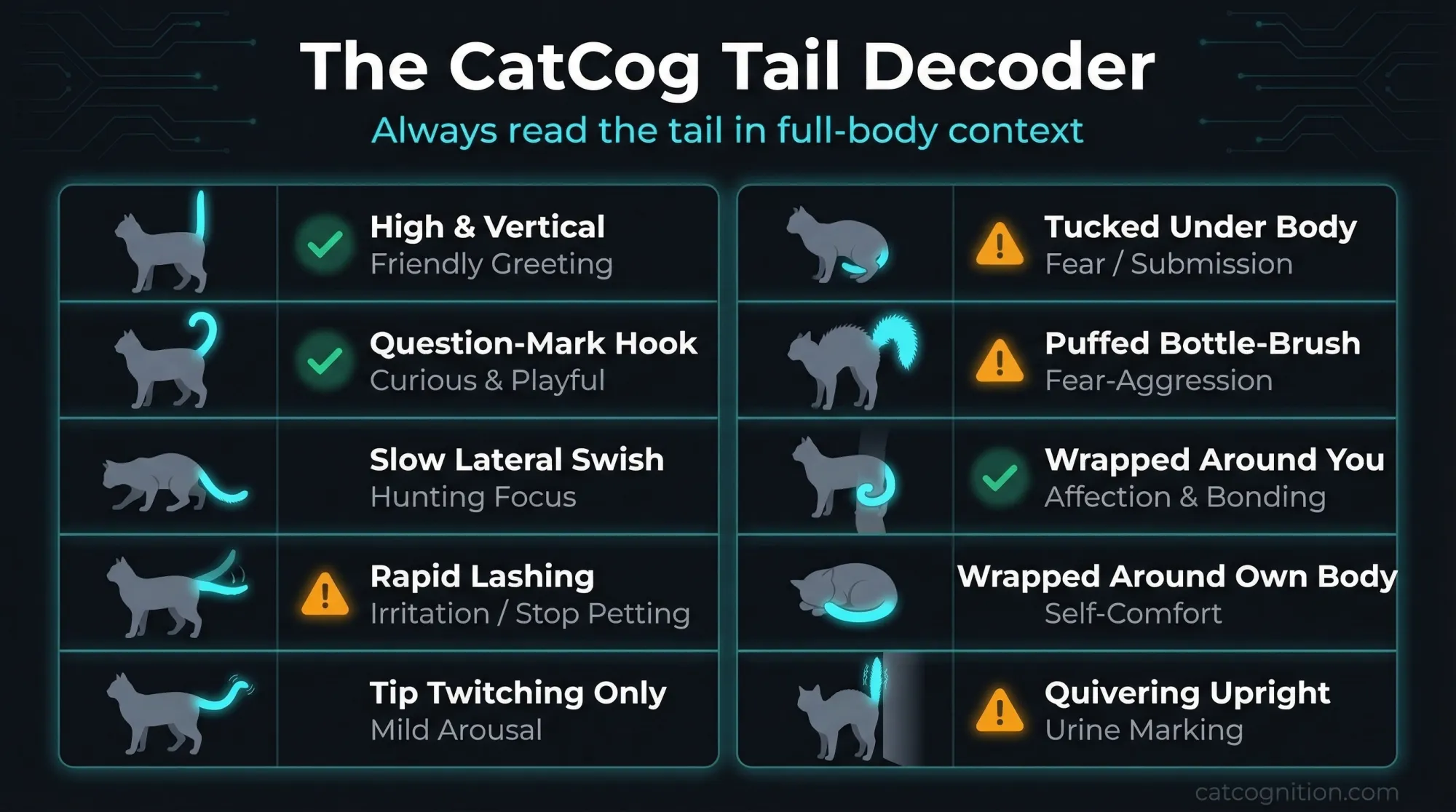
The CatCog Tail Decoder maps 10 distinct cat tail positions to corresponding emotional meanings, requiring body-language context validation before interpretation. No single tail position means anything in isolation. Dr. Sarah Ellis of International Cat Care emphasizes assessing feline emotions requires observing tail position, movement speed, and full body context simultaneously (Ellis, 2018, JFMS).
| Tail Position | Body Context | Likely Meaning | Your Response |
|---|---|---|---|
| Held high, vertical, tip slightly curved | Approaching with ears forward, relaxed body | Friendly greeting, ready to interact | Respond with a slow blink, offer a hand for sniffing |
| High with question-mark hook | Ears forward, whiskers relaxed, body loose | Curious, playful (clinical observation; not formally studied) | Engage with interactive toy or gentle interaction |
| Slow lateral swishing | Low body posture, ears forward, dilated pupils | Hunting focus, stalking prey | Do not interrupt; cat is in predatory mode |
| Rapid lashing, thrashing | Ears rotating back, skin rippling, pupils dilating | Irritation, overstimulation | Stop petting immediately. Give the cat space |
| Tip twitching only | Otherwise relaxed body | Mild arousal, slight excitement | Monitor; could escalate or settle |
| Tucked under body | Crouched posture, ears flat, whiskers pulled back | Fear, submission | Remove threat source, provide escape route |
| Puffed "bottle-brush" | Arched back, ears flat, hissing | Fear-aggression, defensive | Do not touch. Remove stressor. Allow retreat |
| Wrapped around your leg or arm | Relaxed body, purring | Affection, bonding | Reciprocate with gentle cheek scratches |
| Wrapped tightly around own body | Sitting or lying, neutral expression | Self-comfort, thermoregulation | Normal resting behavior; no action needed |
| Quivering while backed against vertical surface | Standing, rear elevated | Urine marking (spraying) | Consult vet for behavioral or hormonal evaluation |
A note on breed variation: Tailless breeds (Manx), bobtailed breeds (Japanese Bobtail), and short-tailed breeds communicate with reduced tail vocabulary. A 2024 case report documented two cats with Spitz-like curled tails that could not perform the standard tail-up greeting signal, potentially impairing their social communication (Van Belle et al., 2024, The Veterinary Journal). This was a case report of only two cats, so broader conclusions about curled-tail breeds await further research.
Why Does My Cat Wag Its Tail When I Pet It?
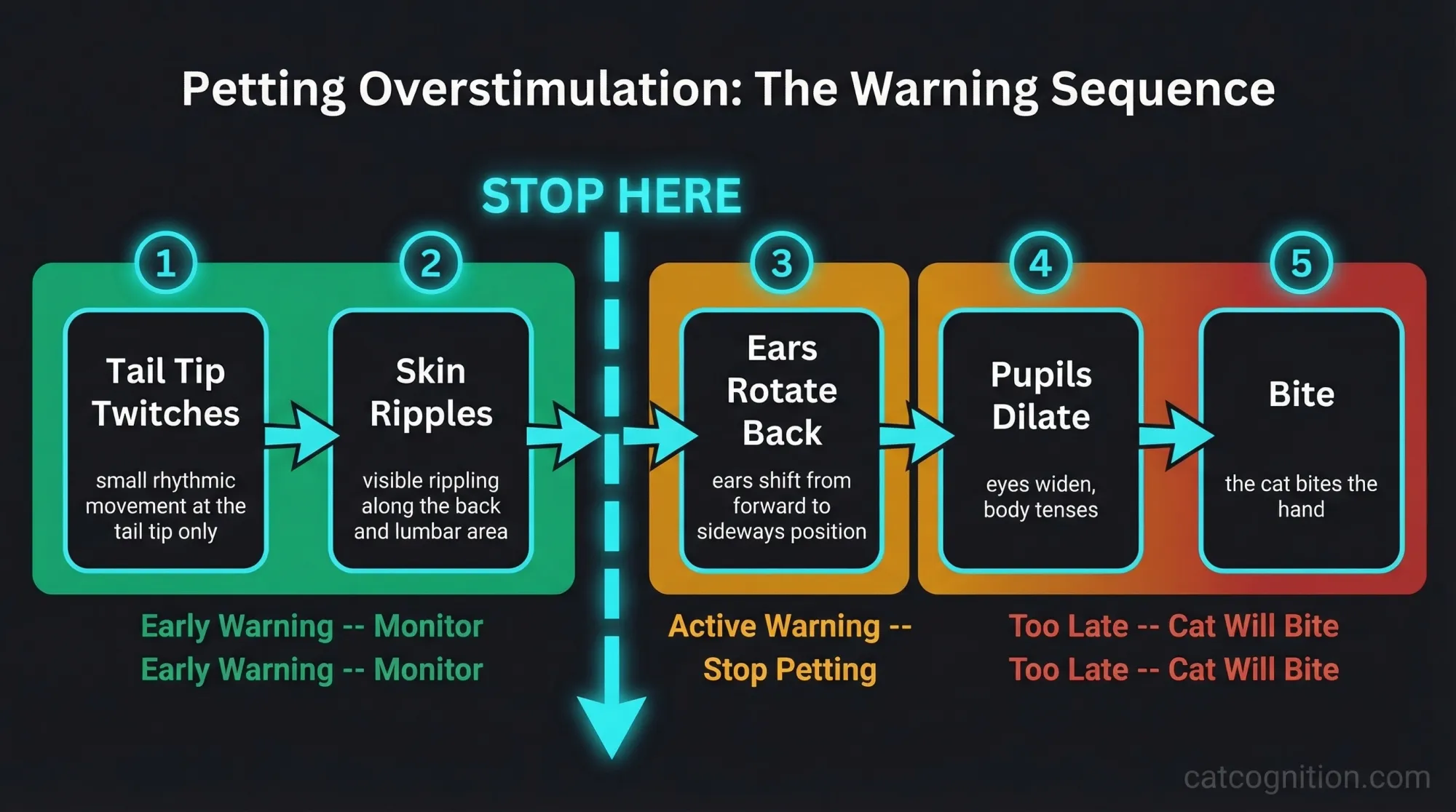
Lateral tail lashing during petting signals escalating irritation or overstimulation, and petting-induced aggression accounts for approximately 40% of feline aggression cases seen by behaviorists (Today's Veterinary Practice, 2024). The tail lash is the cat's structured warning: tactile input has exceeded the cat's tolerance threshold.
The escalation sequence follows a predictable pattern. First, the tail tip begins twitching. Then the skin along the back ripples. The ears rotate from forward to sideways. The pupils dilate. Finally, the cat bites. Each signal is a warning that the previous one was ignored. If you reach the bite, the communication did not fail on the cat's end. For the full breakdown of what happens after these warnings are missed, see our guide to why cats bite.
How to respond to tail lashing during petting:
- Stop petting immediately. Do not "push through" the signal.
- Note the cat's tolerance threshold. Some cats tolerate 30 seconds, others tolerate 5 minutes. Stop at 75% of the known limit.
- Pet the head and cheeks only. These are allogrooming zones where cats naturally exchange social grooming. Avoid the belly and tail base. For the science of where and how to pet cats, see our guide to the science of petting cats.
- Let the cat initiate contact. Dr. Dennis Turner, who has studied cat-human relationships for over three decades, confirms that cat-initiated contact produces longer interaction sessions (Turner, 2021, Frontiers in Veterinary Science).
Do Cats Wag Their Tails When Happy?
Cats do not wag the tail when happy in the way dogs do. The closest feline equivalent to a "happy" tail signal is the upright tail with a slight curve at the tip, combined with forward ears and a relaxed body. A gentle quiver of the upright tail when greeting an owner signals excitement, not the broad lateral wagging people associate with canine joy.
Lateral tail lashing specifically correlates with frustration and conflict. However, context determines meaning. A slow, gentle sway in an otherwise relaxed cat can indicate contentment or mild interest. The distinction is speed, amplitude, and accompanying body signals.
Here is the practical translation:
- Upright tail with slight curve + forward ears + relaxed body = affiliative greeting. The cat is happy to see you.
- Gentle quiver of upright tail = excitement. Often seen at feeding time or when you return home.
- Slow, sweeping sway + relaxed posture = mild interest or contentment. Monitor, but no concern.
- Rapid lateral lashing + ears rotating back + skin rippling = frustration or overstimulation. Stop what you are doing.
The "happy tail" misconception comes from importing dog behavior into cat interpretation. Dogs evolved as social pack animals with tail wagging as a broadly affiliative signal. Cats evolved from solitary hunters and developed tail signals only during domestication, under different pressures entirely. For a deeper look at the affection signals cats actually use, see every sign your cat loves you.
Ears vs. Tails: What Matters More in Cat Communication?
Ear positions, not tail positions, are the strongest predictor of outcomes in cat-to-cat interactions. A 2021 study published in Animals observed 254 interactions among 29 cats over 100 hours and found ears were more reliable indicators of whether an encounter would be affiliative or agonistic (Deputte et al., 2021).
The same study revealed that cats use tail signals disproportionately toward humans rather than toward other cats. The tail-up greeting precedes leg rubbing behavior, which is directed at humans far more frequently than at feline companions. Cats appear to use the tail-up signal disproportionately for interspecies communication.
This finding has practical implications. When reading your cat's mood, pay attention to the ears first. Forward ears signal confidence and curiosity. Ears rotated sideways signal growing unease. Ears flattened backward signal fear or aggression. The tail provides confirmation and additional nuance, but the ears are the leading indicator.
When Tail Behavior Signals a Medical Problem
Abnormal tail behavior can indicate medical conditions requiring veterinary evaluation. Feline hyperesthesia syndrome (FHS) causes episodes of skin rippling over the lumbar area, tail chasing, and self-mutilation (Cornell Feline Health Center, 2024). The condition is also known as "rolling skin syndrome" or "twitchy cat disease" (Amengual Batle et al., 2019). Episodes can last from seconds to several minutes.
See a vet if you observe:
- Repeated tail chasing with skin rippling along the back (possible FHS)
- A suddenly limp tail or tail held at an unusual angle (possible fracture or nerve damage)
- Tail self-mutilation, including biting, over-grooming, or hair loss on the tail
- Persistent tail tucking with no identifiable environmental stressor (possible chronic pain from arthritis or dental disease)
- Any sudden change in tail carriage or mobility
"Pull tail" injuries, where the tail is caught in a door, stepped on, or pulled, can damage the cauda equina nerves, affecting bladder and bowel control as well as tail function. These injuries require immediate veterinary attention.
Key Terms
- Tail-up signal -- an affiliative greeting posture where the cat holds its tail vertically, evolved during domestication as a distance-visible signal of peaceful intent
- Piloerection -- involuntary erection of fur along the tail and body caused by the sympathetic nervous system, making the cat appear larger during perceived threats
- Allogrooming -- mutual grooming between cats that reinforces social bonds and establishes communal scent; the head and cheeks are primary allogrooming zones
- Petting-induced aggression -- biting triggered by overstimulation during petting, typically preceded by tail lashing, skin rippling, and ear rotation
- Feline hyperesthesia syndrome (FHS) -- a neurological condition causing episodes of skin rippling, tail chasing, self-mutilation, and sudden running; also called "rolling skin syndrome" or "twitchy cat disease"
- Caudal vertebrae -- the 19 to 23 small bones that form the tail, controlled by six muscles on each side and innervated by 4 to 7 paired spinal nerves
- Predatory motor pattern -- the hardwired stalk-pounce-bite sequence visible in the slow, focused tail swishing that precedes a hunting strike
Frequently Asked Questions
Why does my cat wag its tail while lying down?
A slow tail swish while lying down typically indicates mild stimulation or focused attention, not agitation. The cat may be tracking a sound, watching movement, or processing its environment. If the rest of the body is relaxed and the ears are neutral, the tail movement is not a concern. Rapid lashing while lying down with tense body posture is different and may signal irritation.
Why does my cat's tail puff up?
Tail puffing (piloerection) is an involuntary sympathetic nervous system response to perceived threat. Norepinephrine triggers the arrector pili muscles to erect the fur, making the cat appear larger. The cat cannot control this reaction. Do not approach or touch a cat with a puffed tail. Remove the stressor and allow the cat to retreat to a safe space.
Do cats wag their tails like dogs?
No. Dog tail wagging broadly correlates with arousal and social engagement. Cat tail movements encode context-specific emotional states. Lateral lashing in cats correlates with frustration and irritation, not happiness. The two behaviors share no functional relationship. Domestic cats and dogs evolved tail communication independently under different social pressures.
What does it mean when a cat wraps its tail around you?
Tail wrapping is an affiliative bonding gesture, the tail equivalent of a hug. The cat is depositing scent from glands at the tail base while signaling trust and social inclusion. Combined with purring and a relaxed body, tail wrapping is one of the clearest signs of feline affection.
Why does my cat chase its own tail?
Occasional tail chasing in kittens is normal play behavior. In adult cats, repeated tail chasing combined with skin rippling, vocalization, and self-directed biting may indicate feline hyperesthesia syndrome (FHS) and warrants veterinary evaluation. FHS has a median onset at age 1 year and occurs predominantly in male cats.
Can cats control their tail movements?
Cats can voluntarily control communicative tail positions like the tail-up greeting and slow lateral swishing. However, piloerection (the "bottle-brush" puffed tail) is an involuntary response driven by the sympathetic nervous system. The cat has no conscious control over fur erection during fight-or-flight activation.
Why does my cat's tail quiver when it sees me?
An upright, quivering tail when greeting a familiar human signals excitement and positive anticipation. This is distinct from the quivering seen during urine spraying (which occurs with the rear elevated and backed against a vertical surface). The greeting quiver is one of the closest feline equivalents to the "happy tail wag" that people expect from dogs.
Do tailless cats have trouble communicating?
Tailless breeds like the Manx and bobtailed breeds like the Japanese Bobtail have a reduced tail vocabulary. A 2024 case report documented two cats with Spitz-like curled tails that could not perform the standard tail-up greeting, potentially impairing social signaling (Van Belle et al., 2024, The Veterinary Journal). These cats likely compensate through increased reliance on ear position, vocalization, and body posture.
Key Takeaways
Cat tail wagging signals frustration, not happiness. Preliminary research suggests that lateral tail lashing correlates with frustrating situations, the opposite of the assumption people import from dogs. A slow sway or upright quiver can indicate contentment or excitement, but rapid lateral movement is a warning.
The tail-up signal is a domestication invention. Wild cats do not use the tail-up posture. Domestic cats evolved tail-up specifically to signal peaceful intent at a distance when they began living in groups near human settlements approximately 10,000 years ago.
Always read the tail in full-body context. The CatCog Tail Decoder maps 10 tail positions to their emotional meaning, but every interpretation requires validation from ear position, body posture, and environmental context. A high tail with forward ears means something entirely different from a high tail with flattened ears.
Ears are actually more reliable than tails for reading cat-to-cat interactions. Across 254 observed interactions, ear positions were the best predictor of whether an encounter would be friendly or aggressive. Cats appear to reserve tail signals disproportionately for communicating with humans.
Stop petting when the tail starts lashing. Petting-induced aggression accounts for approximately 40% of feline aggression cases seen by behaviorists. The tail lash is the cat's structured warning sequence. Stop at the first signal, and you prevent the bite.
Sources
- The social function of tail up in the domestic cat - Cafazzo, S. & Natoli, E., Behavioural Processes, 2009 (ScienceDirect)
- Heads and Tails: An Analysis of Visual Signals in Cats - Deputte, B.L. et al., Animals, 2021 (PMC)
- Multimodal Communication in the Human-Cat Relationship: A Pilot Study - de Mouzon, C. et al., Animals, 2023 (PMC)
- Visual and tactile communication in the Domestic cat and undomesticated small felids - Cameron-Beaumont, C., PhD Thesis University of Southampton, 1997 (University of Southampton)
- Normal feline behaviour: and why problem behaviours develop - Bradshaw, J.W.S., Journal of Feline Medicine and Surgery, 2018 (SAGE Journals)
- Recognising and assessing feline emotions during the consultation - Ellis, S.L.H., Journal of Feline Medicine and Surgery, 2018 (SAGE Journals)
- Behavioral awareness in the feline consultation - Horwitz, D.F. & Rodan, I., Journal of Feline Medicine and Surgery, 2018 (SAGE Journals)
- Balance in the cat: role of the tail and effects of sacrocaudal transection - Walker, C. et al., Behavioural Brain Research, 1998 (ScienceDirect)
- Spitz-like tail carriage in two domestic cats - Van Belle, M. et al., The Veterinary Journal, 2024, DOI: 10.1016/j.tvjl.2024.106256 (ScienceDirect)
- Feline Behavior Problems: Aggression - Cornell Feline Health Center, 2024 (Cornell)
- Hyperesthesia Syndrome - Cornell Feline Health Center, 2024 (Cornell)
- Cat Communication - International Cat Care (iCatCare), 2024 (iCatCare)
- Feline hyperaesthesia syndrome with self-trauma to the tail: retrospective study of seven cases - Amengual Batle, P. et al., Journal of Feline Medicine and Surgery, 2019 (PMC)
- A Comparative Study of the Use of Visual Communicative Signals in Interactions Between Dogs and Humans and Cats and Humans - Miklosi, A. et al., Journal of Comparative Psychology, 2005 (ResearchGate)
- Do cats communicate with their tails? - Live Science, 2024 (Live Science)
- Curly-Tailed Cats Communicate with an 'Accent' - Leste-Lasserre, C., Scientific American, 2024 (Scientific American)
- The Mechanics of Social Interactions Between Cats and Their Owners - Turner, D.C., Frontiers in Veterinary Science, 2021 (PMC)
- Lateral bias and temperament in the domestic cat - McDowell, L.J. et al., Journal of Comparative Psychology, 2016 (PubMed)
- How does your young cat communicate with their tail? - VCA Animal Hospitals, 2024 (VCA)
- Why Is That Cat's Tail Puffing? From Fear Response to Final Sympathetic Discharge - VETgirl Veterinary CE, 2024 (VETgirl)
- Owner-Directed Feline Aggression - Today's Veterinary Practice, 2024 (NAVC)
- Cat tail meanings - Cats Protection, 2024 (Cats Protection)