Why Does My Cat Stare at Me? Every Reason Explained by Science
Cats stare at owners to monitor their 'secure base' and update mental maps of their environment. 65% of cats demonstrate secure attachment, using owners as a source of safety. Cat staring is attachment-driven vigilance, not aggression.

Cats watch their owners to monitor their "secure base" and update mental maps of their environment. A landmark 2019 study found 65% of cats demonstrate secure attachment to their caregivers, using owners as a source of safety from which to explore. Cat staring is NOT plotting or aggression—it is attachment-driven vigilance rooted in 10,000 years of territorial surveillance instinct.
Table of Contents
- Why Do Cats Watch Their Owners?
- How Do Cats Mentally Track Their Owners?
- What Does the Slow Blink Mean?
- Can Cats Read Human Facial Expressions?
- The CatCog Stare Decoder Protocol
- How Should I Respond to My Cat's Stare?
- The Secure Base Check-In
- Why Does My Cat Stare at Me While I Sleep?
- Key Takeaways
- Key Terms Used
- Frequently Asked Questions
- Sources
Your cat is watching you right now. From across the room. Through the crack in the door. Maybe while you sleep. That unblinking feline gaze has launched a thousand internet memes about cats "plotting murder," but the science tells a completely different story---one rooted in attachment, cognition, and evolutionary biology.
Why Do Cats Watch Their Owners?
Cats watch their owners because visual monitoring serves two parallel neurological systems: attachment-driven security seeking and territorial surveillance programming. Whether cats form true secure attachment bonds remains one of the most debated questions in feline science. A 2019 study by Dr. Kristyn Vitale at Oregon State University found that 65% of cats demonstrated secure attachment behaviors in the Strange Situation Test (Vitale et al., 2019). However, subsequent research challenges this interpretation. Potter & Mills (2015) found no preference for owners over strangers when test methodology was counterbalanced (Potter & Mills, 2015), and Pongracz et al. (2025) found no attachment signs even in highly sociable therapy cats, arguing that cats "preserved their functional independence" through domestication (Pongracz et al., 2025). According to Vitale et al., securely attached cats use their owners as a "secure base" from which to explore, and watching is how cats verify their source of safety remains present and predictable.
Dr. John Bradshaw of the University of Bristol---one of the world's leading experts on cat domestication---explains that cats evolved from solitary territorial ancestors. That vigilant watching behavior running in your living room is 10,000 years of survival programming still active. In the wild, the ancestors of domestic cats (Felis silvestris lybica) survived by constant visual monitoring. Missing even the smallest visual cue could mean death or missed meals.
The same vigilant monitoring system now activates toward human caregivers. Cats cannot distinguish between "safe human" and "large moving creature that needs watching." Their territorial surveillance instinct persists despite millennia of domestication. This watching behavior is remarkably similar to the signs cats show when they love you—both stem from secure attachment bonds.

How Do Cats Mentally Track Their Owners?
Cats maintain internal mental maps of their owners' locations, updating these representations through visual and auditory cues even when owners are out of sight. Research from Dr. Saho Takagi at Kyoto University demonstrated that cats mentally map their owner's spatial location from voice alone, a cognitive ability called socio-spatial cognition previously unidentified in domestic cats (Takagi et al., 2021).
Think of a cat's mental map like a GPS tracker running constantly in the background. Even when you leave the room, your cat's brain continues plotting your estimated location based on sound cues until visual confirmation resumes. The cat cerebral cortex contains approximately 250 million neurons, enabling this complex cognitive processing and mental modeling of owner behavior.
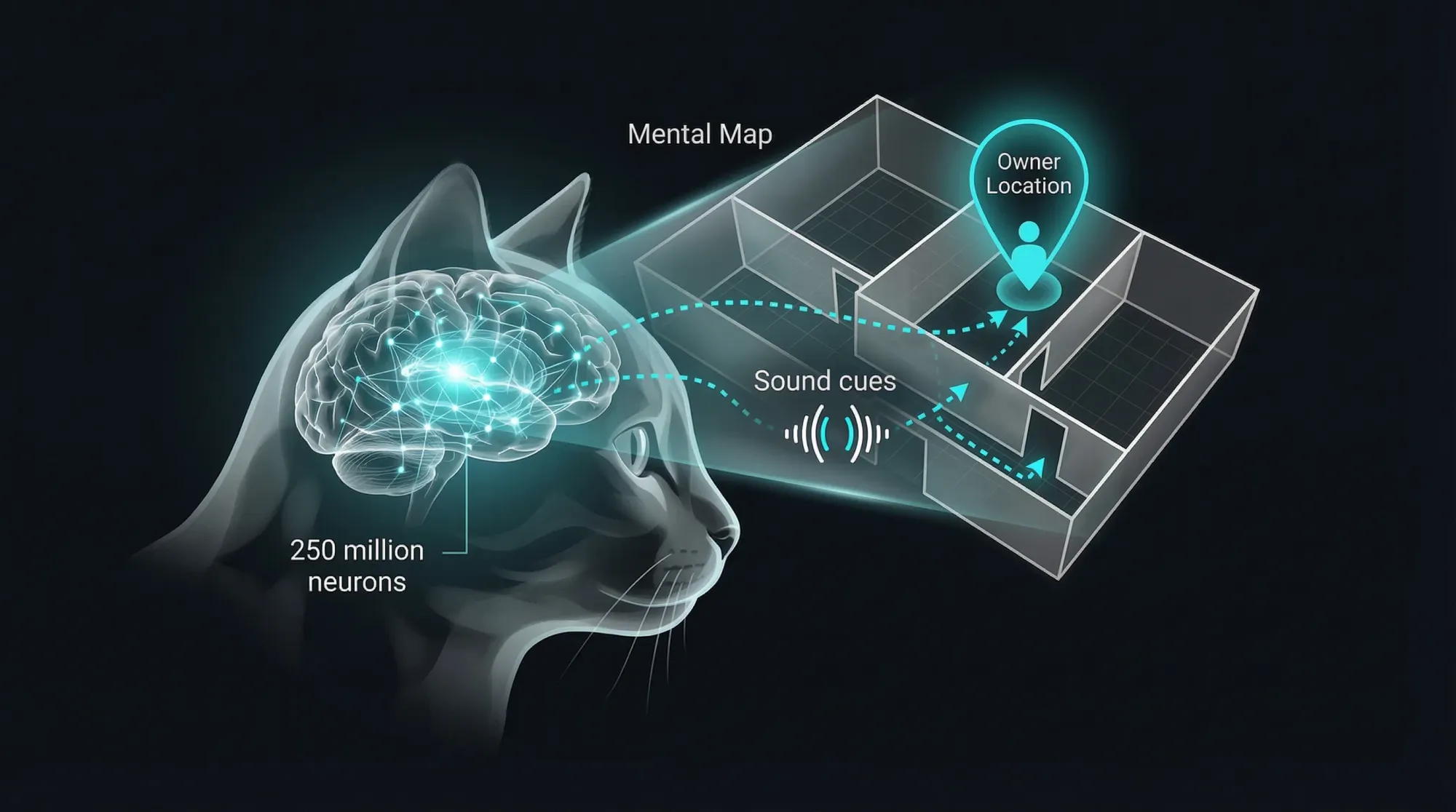
When cats watch their owners, they are updating this internal model. The watching behavior helps maintain proximity to their source of security while verifying that environmental conditions remain predictable.
What Does the Slow Blink Mean?
The slow blink is a cat's way of communicating positive emotion and trust, functioning as an intentional communication signal rather than sleepiness or random behavior. Research by Dr. Tasmin Humphrey and Dr. Leanne Proops at the University of Sussex demonstrated that slow blink sequences between cats and humans serve as positive emotional communication, with cats significantly more likely to approach humans who slow blink at them (Humphrey et al., 2020).
Slow blinking may have evolved to interrupt an unbroken stare, which cats interpret as potentially threatening in social interaction. When your cat gives you a slow blink while watching, that is the feline equivalent of a smile---a deliberate signal that the cat feels safe and content in your presence.
Can Cats Read Human Facial Expressions?
Cats possess sophisticated visual communication systems and demonstrate measurable ability to interpret human facial expressions, though not as precisely as dogs. Research from UCLA found that cats have 276 distinct facial expressions using 26 facial movements, with 45.7% being friendly and 37% unfriendly (Scott et al., 2023). Eyes serve as a primary component of this communication system.
A 2019 study found that cats successfully followed human gaze to locate hidden food with 70% accuracy, demonstrating that cats attend to and process human visual cues. Contrary to the "aloof cat" stereotype, research confirms that human social interaction was the most-preferred stimulus for the majority of cats tested—even over food (Shreve & Udell, 2017).
However, research also reveals a communication gap. Studies indicate that many owners describe their relationship with cats in human terms (such as "family member" or "child"), yet most owners struggle to correctly identify positive cat emotions. Many cat owners struggle to recognize signs of an unhappy cat. Anthropomorphic perception is negatively associated with correct interpretation of feline cues---the more we project human emotions onto cats, the worse we become at reading their actual signals. Understanding how to correctly interact with cats can help bridge this communication gap.
The CatCog Stare Decoder Protocol
The CatCog Stare Decoder Protocol provides a systematic framework for interpreting cat watching behavior by examining four body language factors simultaneously. No single signal tells the complete story—context determines meaning.
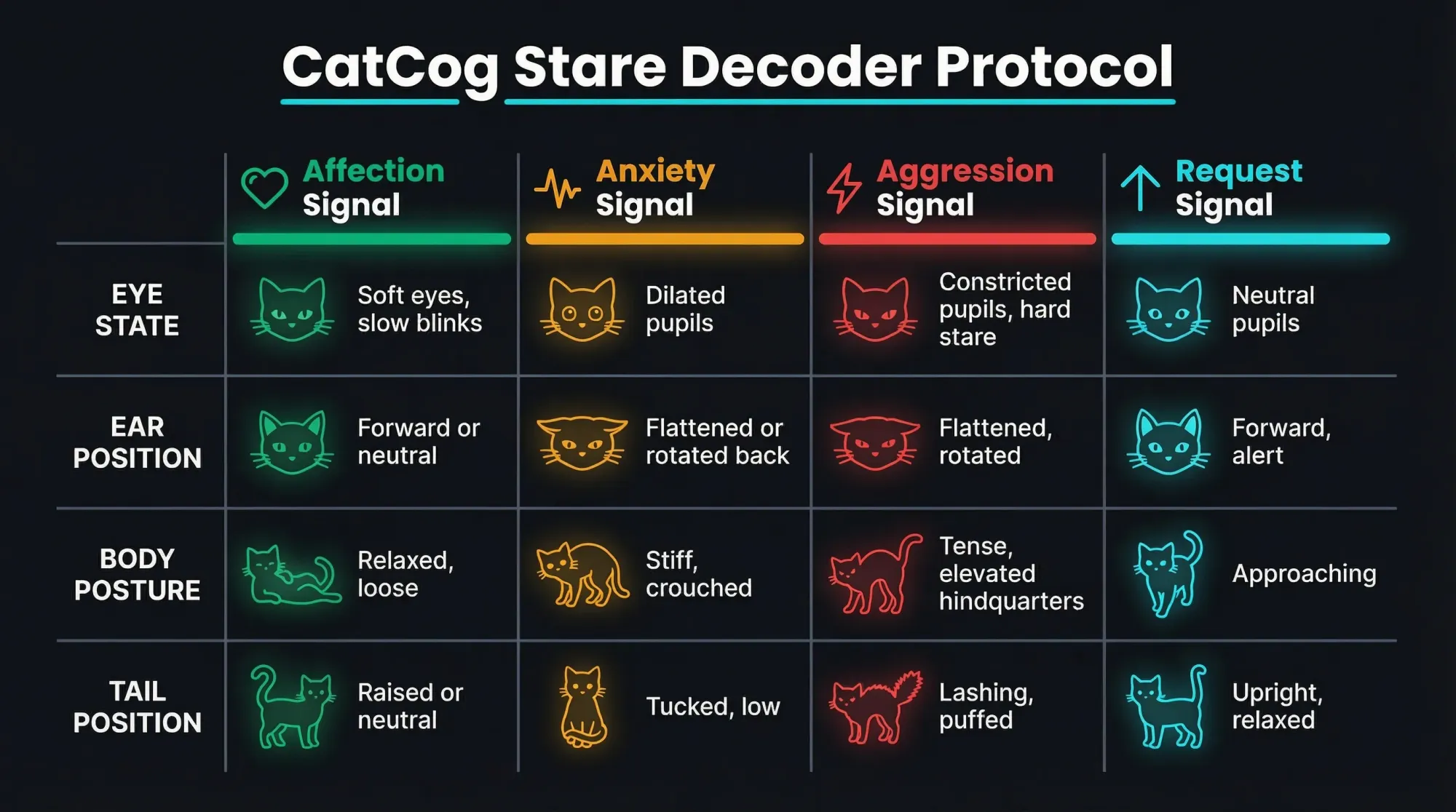
The Four-Factor Assessment:
| Factor | Affection Signal | Anxiety Signal | Aggression Signal | Request Signal |
|---|---|---|---|---|
| Eye State | Soft eyes, slow blinks | Dilated pupils | Constricted pupils, hard stare | Neutral pupils |
| Ear Position | Forward or neutral | Flattened or rotated back | Flattened, rotated | Forward, alert |
| Body Posture | Relaxed, loose | Stiff, crouched | Tense, elevated hindquarters | Approaching |
| Tail Position | Raised or neutral | Tucked, low | Lashing, puffed | Upright, relaxed |
Reading the Stare:
- Soft eyes + slow blinks + relaxed ears = affection/contentment. Your cat is communicating trust and positive emotion.
- Dilated pupils + stiff body + tucked tail = fear/anxiety. Your cat perceives a threat and is preparing for defensive action.
- Constricted pupils + hard stare + elevated hindquarters = potential aggression. Do not stare back---break eye contact and create distance.
- Neutral pupils + ears forward + approaching = curiosity/request. Your cat wants something---food, play, attention, or access to a resource.
How Should I Respond to My Cat's Stare?
Match your response to the type of stare your cat displays, using the CatCog Stare Decoder Protocol assessment to guide appropriate interaction. Responding incorrectly—such as staring back at an anxious or aggressive cat—can escalate stress or provoke defensive behavior.
Response Protocol by Stare Type:
- Affectionate stare: Return the slow blink to strengthen your bond. This reciprocal communication reinforces the positive emotional connection.
- Fearful stare: Reduce perceived threat by looking away, shrinking your posture, and giving space. Avoid approaching until body language relaxes.
- Aggressive stare: Do not stare back. Break eye contact immediately and create distance. Staring back at a cat showing aggression signals can escalate defensive aggression.
- Request stare: Fulfill the need if appropriate. Check food bowl, offer play, or provide attention depending on context and your cat's routine.
Building Communication Habits:
Practice slow blinks during calm moments to build a shared trust vocabulary with your cat. Avoid prolonged direct eye contact during new situations---cats interpret unbroken stares as threatening. Observe before acting. Watching back helps you learn your individual cat's signals over time. Most cats develop predictable watching routines tied to feeding, play, and social needs. For a deeper understanding of what cats need from their environment, see our guide on what cats expect from their owners.
The Secure Base Check-In
The Secure Base Check-In describes a specific watching behavior pattern associated with secure attachment—though whether cats form true attachment bonds remains debated. According to Dr. Kristyn Vitale's 2019 research, cats showing secure attachment behaviors demonstrate a predictable sequence: watch from distance, approach when acknowledged, then resume independent exploration.
Signs of Secure Base Behavior:
- Cat watches from across the room without apparent anxiety
- When owner returns eye contact or slow blinks, cat approaches
- After brief interaction or acknowledgment, cat resumes exploration
- Cat periodically "checks in" visually throughout the day
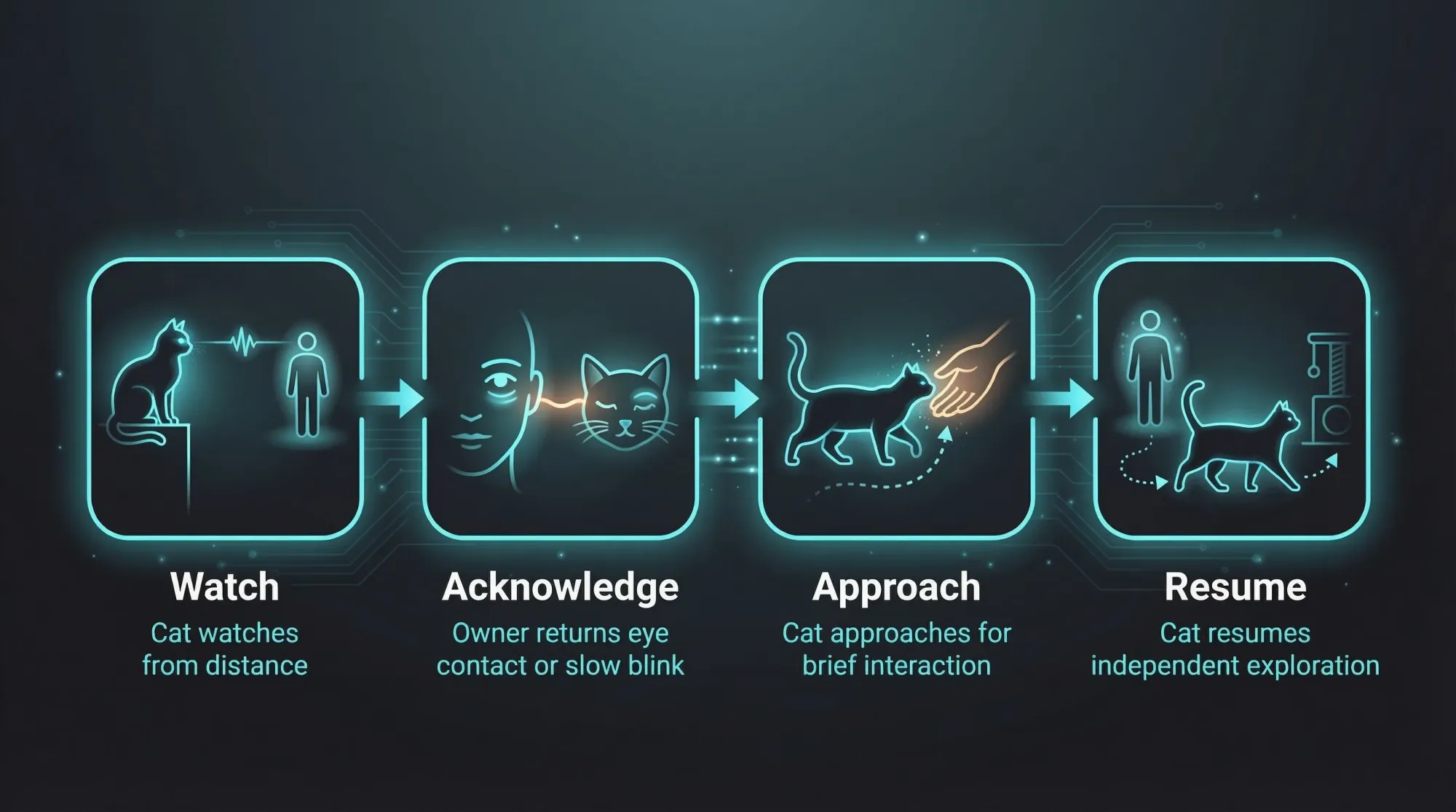
This pattern mirrors attachment behaviors in human infants and demonstrates that the cat has formed a healthy bond. Recent research (Chang et al., 2025) found that securely attached cats show increased oxytocin levels after owner interaction, with approach-hovering behavior positively correlated with oxytocin increase.
Why Does My Cat Stare at Me While I Sleep?
Cats stare at sleeping owners due to a combination of crepuscular activity patterns and learned associations between owner waking and resource provision. Cats experience peak activity at dawn and dusk, meaning they are often awake and alert during human sleep hours. Pre-dawn watching typically correlates with learned feeding schedules---your cat has associated your waking with breakfast.
Your cat is monitoring their secure base (you) and anticipating your waking routine. This behavior is not predatory or sinister. The cat is simply maintaining awareness of when resources (food, attention, play) will become available.
Key Takeaways
- Attachment Science: Whether cats form true attachment bonds is actively debated---one study found 65% show secure attachment behaviors; subsequent studies found none.
- Mental Mapping: Cats mentally track owner location from voice alone, updating internal representations even when owners are out of sight.
- Slow Blink Communication: Slow blinks function as positive emotional signals---returning the slow blink strengthens your bond.
- Context Matters: Use the CatCog Stare Decoder Protocol to assess eyes, ears, body, and tail together before interpreting stare meaning.
- Evolutionary Basis: Cat watching behavior stems from 10,000 years of territorial surveillance instinct, now redirected toward caregivers as attachment figures.
Key Terms Used
- Secure Attachment: A bonding pattern where a cat uses their human as a "safe base," seeking proximity during stress and showing reduced anxiety in the owner's presence.
- Socio-Spatial Cognition: The cognitive ability to mentally represent and track the location of social partners, even when they are not directly visible.
- Slow Blink: A deliberate, prolonged eye closure lasting 0.5-1 second that signals non-aggression and trust between cats or from cat to human.
- Crepuscular: The behavioral pattern where cats are most active during dawn and dusk twilight periods.
- Cognitive Dysfunction Syndrome: A condition in senior cats involving decline in cognitive abilities, sometimes manifested as disorientation or blank staring.
See the full Cat Cognition Glossary ->
Frequently Asked Questions
Why does my cat stare at me?
Cats stare at owners to monitor their environment and maintain awareness of their caregiver's location. Whether cats form true attachment bonds is debated---one study found 65% show secure attachment behaviors; others found none. Regardless of interpretation, watching is how cats verify their source of safety remains present---it is vigilance, not aggression.
Should I stare back at my cat?
Avoid prolonged direct eye contact, which cats interpret as threatening. Instead, return a soft-eyed slow blink to communicate trust and affection. If your cat gives a hard stare with tense body language, look away to de-escalate---staring back may provoke defensive aggression.
What does a slow blink from my cat mean?
The slow blink is a cat's way of communicating positive emotion and trust. Research demonstrates that slow blinks function as intentional positive communication signals, with cats more likely to approach humans who slow blink at them. It is the feline equivalent of a smile.
Why does my cat stare at me while I sleep?
Your cat is monitoring their secure base (you) and anticipating your waking routine. Cats are crepuscular with peak activity at dawn and dusk. Pre-dawn watching often correlates with learned feeding schedules---your cat has associated your waking with breakfast.
Can cats read human facial expressions?
Cats demonstrate measurable ability to interpret human visual cues. A 2019 study found cats followed human gaze with 70% accuracy. Cats possess 276 distinct facial expressions themselves. However, the communication gap exists---most owners struggle to correctly identify positive cat emotions.
When should I be concerned about my cat staring?
Consult a veterinarian if staring is accompanied by prolonged blank staring at walls (not at you), spatial disorientation, or significant behavior changes---especially in cats over 10 years old. These signs may indicate cognitive dysfunction syndrome. Normal watchful behavior directed at people or prey items is not concerning.
Is my cat plotting against me when it stares?
No. Cat staring is NOT inherently aggressive or mysterious. Watching behavior serves evolutionary and attachment functions: territorial surveillance, secure base monitoring, and communication attempts. The "plotting murder" meme is internet humor, not feline psychology.
How do I know if my cat's stare is affectionate or aggressive?
Use the four-factor assessment: examine eyes (soft vs. hard), ears (forward vs. flattened), body (relaxed vs. tense), and tail (raised vs. tucked/lashing) together. Soft eyes with slow blinks and relaxed posture indicate affection. Constricted pupils, stiff body, and lashing tail indicate potential aggression.
Sources
- Attachment bonds between domestic cats and humans - Vitale KR et al., 2019, Current Biology (Link)
- Domestic Cats (Felis silvestris catus) Do Not Show Signs of Secure Attachment to Their Owners - Potter A & Mills DS, 2015, PLOS ONE (Link)
- The biological irrelevance of 'Cattachment' - Pongracz P et al., 2025, Applied Animal Behaviour Science (Link)
- Socio-spatial cognition in cats: Mentally mapping owner's location from voice - Takagi S et al., 2021, PLoS ONE (Link)
- The role of cat eye narrowing movements in cat-human communication - Humphrey T et al., 2020, Scientific Reports (Link)
- Feline Faces: Unraveling the Social Function of Domestic Cat Facial Signals - Scott L et al., 2023, Behavioural Processes (Link)
- Normal feline behaviour: and why problem behaviours develop - Bradshaw JWS, 2018, Journal of Feline Medicine and Surgery (Link)
- Cognitive Dysfunction in Cats - Cornell Feline Health Center (Link)
- Indoor Pet Initiative - Ohio State University (Link)