Why Do Cats Groom Each Other? The Science of Allogrooming
Cats groom each other (allogrooming) to maintain social bonds, exchange colony scent, and manage tension. Research shows 91.6% of grooming is one-directional, with 35% of sessions followed by agonistic behavior from the groomer.

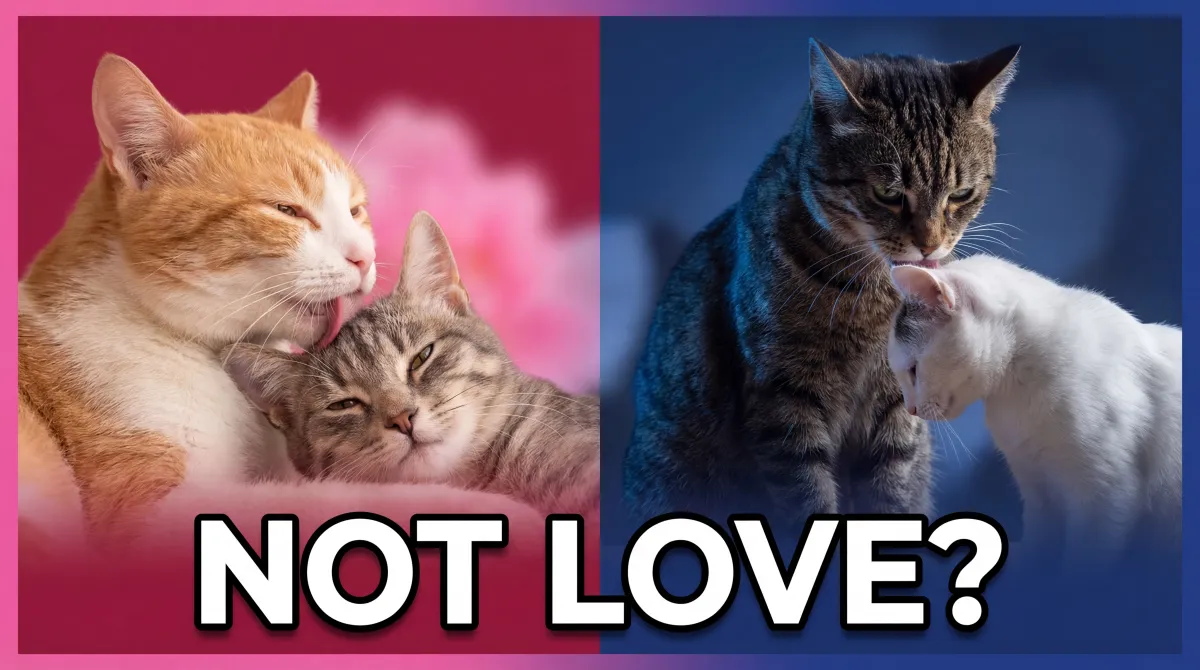
Table of Contents
- Why Do Cats Lick Each Other?
- What Does It Mean When Cats Groom Each Other?
- Why Do My Cats Groom Each Other and Then Fight?
- Why Do Cats Lick Each Other's Bums?
- Are Cats Social Animals?
- The CatCog Grooming Network Map
- How to Support Healthy Grooming Between Your Cats
- Key Terms
- Frequently Asked Questions
- Key Takeaways
- Sources
Cats groom each other (allogrooming) to maintain social bonds, reinforce colony scent identity, and manage tension within their social group. Allogrooming targets the head and neck because cats cannot tongue-groom these areas themselves. In one study, 35% of grooming sessions were followed by agonistic behavior (threat displays, stiffening, or swats) from the groomer, revealing that allogrooming serves as a tension-management behavior, not just affection. This behavior connects to broader patterns of cat behavior that reveal how cats navigate their social world.
Your cat gently licks his companion's head for two solid minutes. Eyes half-closed. Purring fills the room. Then, without warning, the groomer clamps down and delivers a swift swat to the face. The groomee bolts. You sit there wondering what just happened.
This groom-then-fight sequence confuses millions of cat owners every year. It looks like affection gone wrong. But the science tells a more layered story: allogrooming in domestic cats is simultaneously an act of social bonding, a mechanism for scent exchange, a display of social positioning, and a way to defuse tension before it escalates into costly conflict.
As Dr. Sharon Crowell-Davis of the University of Georgia's College of Veterinary Medicine established in her landmark 2004 paper on feline social organization, allogrooming between preferred associates is one of the core behaviors that maintains social cohesion in cat colonies. Understanding what drives this behavior changes how you interpret everything happening between the cats in your home.

Why Do Cats Lick Each Other?
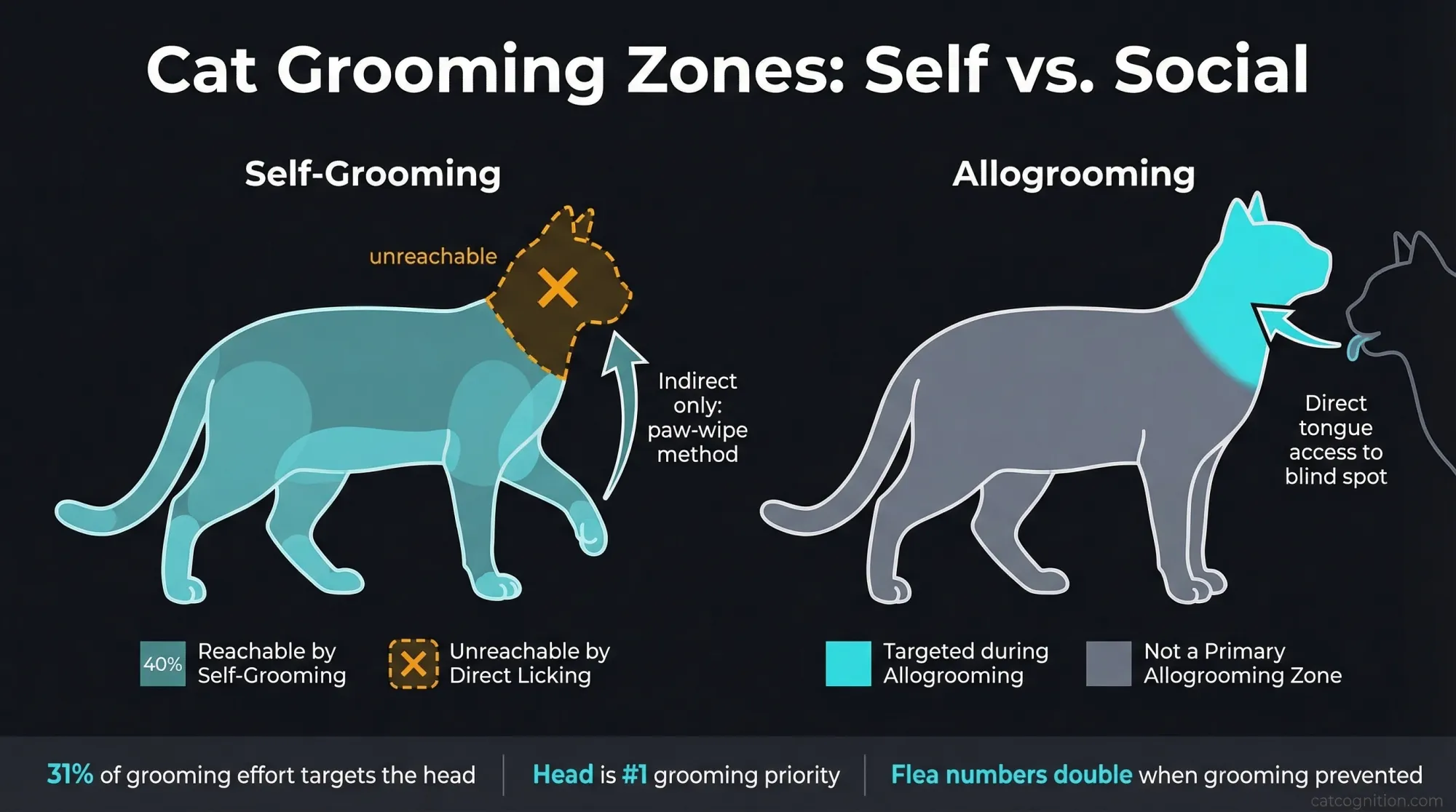
Cats lick each other primarily to maintain social bonds, exchange colony scent, and provide parasite defense for body areas unreachable by self-grooming. UC Davis research found cats devote approximately 8% of waking hours to self-grooming, with the head receiving the most effort (31%) despite being impossible to tongue-groom directly. Allogrooming solves this biological blind spot.
The blind spot explanation
Every cat faces the same anatomical problem. The head and neck receive more grooming attention than any other body region, yet cats physically cannot reach these areas with their own tongues. Cats resort to an indirect workaround: licking a paw and wiping it across the face. This "face washing" method is less effective than direct tongue contact for removing debris and ectoparasites.
Allogrooming fills the gap. When one cat grooms another, the grooming is directed almost exclusively at the head and neck area. The groomer's barbed tongue provides the direct cleaning that self-grooming cannot achieve. Research from Eckstein and Hart at UC Davis demonstrated that when cats were prevented from grooming (using Elizabethan collars), flea numbers doubled within three weeks compared to cats allowed to groom freely. The head and neck, being the hardest to self-clean, are the most vulnerable to parasite accumulation.
"Cats devote 31% of their self-grooming effort to the head and face, yet cannot reach these areas directly with their tongue. Allogrooming partners provide direct tongue access to this biological blind spot, explaining why cat-to-cat grooming targets the head and neck almost exclusively."
The scent exchange function
Allogrooming is not just cleaning. When one cat licks another's head and neck, the groomer deposits saliva on areas rich in scent-producing sebaceous glands. Combined with allorubbing, these contact behaviors contribute to a shared colony odor profile. Dr. John Bradshaw of the University of Bristol's Anthrozoology Institute notes that colony cohesion is "expressed as, and probably maintained by, allorubbing and allogrooming," adding that the scent-exchange role of allogrooming "may also play a largely uninvestigated role." If cats stop grooming each other, the shared scent profile may degrade, potentially weakening social recognition between group members. This scent-exchange function shares the same underlying mechanism as cat rubbing behavior, where cats deposit facial pheromones to build a shared group identity.
A 2017 review by Vitale and Udell on chemical signaling in cat social groups reports that kittens gain their first experience with family odors through maternal grooming. This early olfactory bonding creates the template for colony scent recognition in adulthood, though direct evidence for long-term behavioral effects of early grooming deprivation remains limited.
The endorphin hypothesis
Grooming is widely reported to trigger endorphin release, producing a calming neurochemical effect in both groomer and recipient. Research in primates has demonstrated endorphin release during social grooming, and feline behaviorists extrapolate a similar mechanism in cats based on the observable relaxation response (purring, slow-blinking, muscle relaxation) during grooming sessions. The recipient typically cooperates actively during allogrooming, tilting and rotating the head to give the groomer better access, often while purring.
What Does It Mean When Cats Groom Each Other?
Allogrooming signals an established social relationship between two cats, though the nature of the bond is more nuanced than simple "affection." Research consistently shows cats groom specific preferred partners rather than random colony members. Multiple University of Georgia studies confirm preferred associates engage in significantly more allogrooming, allorubbing, and physical contact than non-preferred associates.
It means they are preferred associates
Cats do not groom indiscriminately. Barry and Crowell-Davis (1999) found that cats seek out their preferred associate to groom, not simply the cat sitting nearest to them. Curtis, Knowles, and Crowell-Davis (2003) confirmed this selective pattern in a colony of 28 cats, finding that grooming frequency correlated with both familiarity and, in their study, genetic relatedness. Relatives were within 1 meter of a focal cat 8.44 times on average, compared to 4.17 times for equivalent non-relatives.
This selectivity is consistent across research settings. In a study of free-ranging cats by Dr. Kristyn Vitale, a Certified Applied Animal Behaviorist at Unity Environmental University, colony cats at Church Farm displayed allogrooming preferentially, directing grooming at specific partners rather than distributing it evenly across the group.
It does not necessarily mean "equals"
A single study from 1998 by van den Bos, observing 83 grooming interactions among 25 confined, neutered cats, found that 91.6% of allogrooming was unidirectional: one cat groomed while the other received. The same study reported that higher-ranking cats initiated grooming toward lower-ranking cats in 78.6% of observed interactions. These findings suggest allogrooming may reflect social rank, not mutual affection between equals.
However, these statistics come with important caveats. The sample was small (83 interactions in a single confined group of neutered cats), and no replication study exists for these specific numbers. More significantly, the dominance interpretation itself is debated. Bradshaw (2016) notes that cat hierarchies "do not predict reproductive success in females, or priority of access to key resources," unlike hierarchies in dogs or wolves. Cats also lack the ritualized submissive signals found in more social carnivores.
"In one study of 25 confined cats, 91.6% of allogrooming was unidirectional and higher-ranking cats initiated grooming 78.6% of the time. However, no replication exists, and current behavioral science questions whether stable dominance hierarchies are a valid construct for domestic cats."
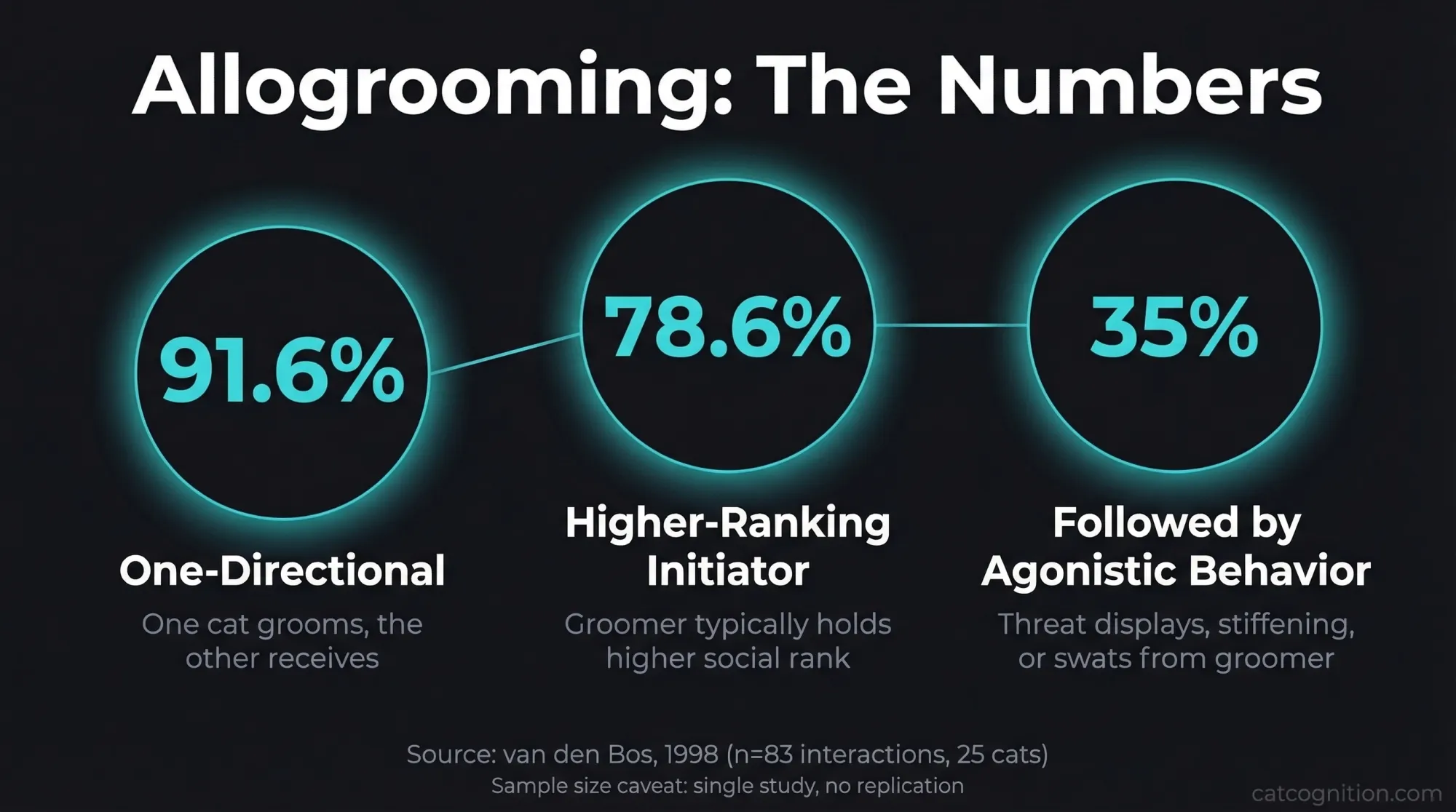
The science here is genuinely unsettled. The van den Bos data supports a social-rank interpretation. The 2024 AAFP Intercat Tension Guidelines, co-authored by leading feline behaviorists including Vitale and Prof. Daniel Mills of the University of Lincoln, frame allogrooming as an affiliative behavior characteristic of bonded cats, not as dominance signaling. Both interpretations may contain truth: allogrooming likely serves multiple functions simultaneously, and the balance between dominance signaling and affiliative bonding may shift depending on the specific cats and context involved.
Why Do My Cats Groom Each Other and Then Fight?
The groom-then-swat pattern occurs in approximately 35% of allogrooming sessions, based on van den Bos (1998) observations of 25 confined cats. The leading hypothesis is redirected tension: grooming functions as a low-cost tension-management behavior, but underlying social tension sometimes surfaces during or immediately after the session. The groomer, not the groomee, typically initiates the agonistic behavior.
The redirected aggression hypothesis
Van den Bos (1998) proposed that allogrooming serves as a way of redirecting potential aggression in situations where overt fighting would be too costly. In a confined environment where cats cannot easily avoid each other, grooming provides a socially acceptable outlet for tension. But the tension does not always stay contained.
In approximately 35% of the 83 grooming interactions van den Bos observed, agonistic behavior followed the grooming session. This ranged from threat displays and body stiffening to swats and bites. The groomer typically occupied a physically dominant posture during the interaction (sitting upright, in an elevated position), and the agonistic behavior was initiated by the groomer, not the groomee.
It is worth noting that these observations come from a single group of confined, neutered cats. Van Belle et al. (2025) at Ghent University, in the most recent dedicated allogrooming study using citizen-science video data of 106 cats, reported that allogrooming was associated with "paw movements and bites" in 30 of 53 home videos (57%), based on conference and thesis data, but suggested these physical actions may be components of the grooming behavior itself rather than necessarily representing aggression. The field has not reached consensus on how to interpret post-grooming physical contact.
Warning signs before the switch
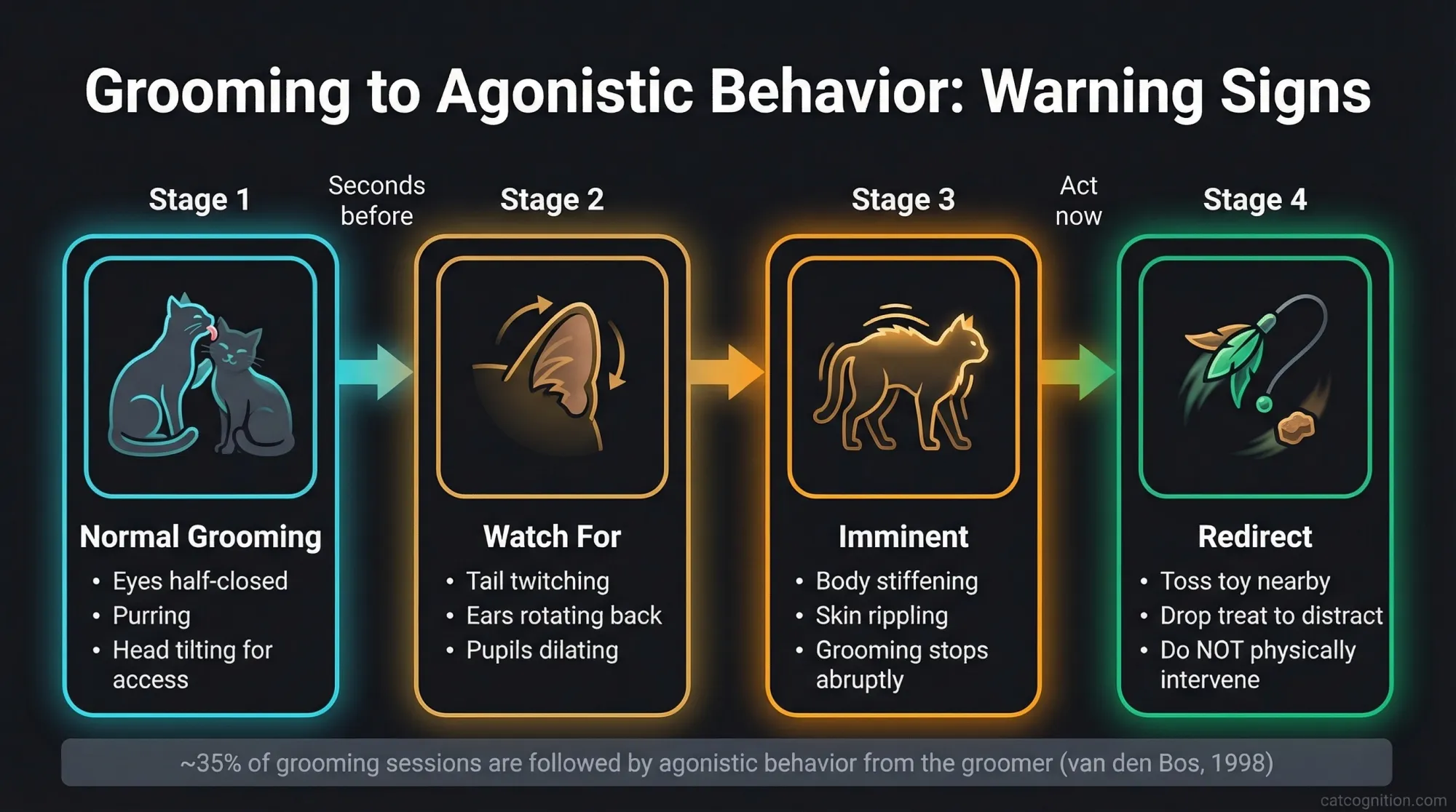
Whether the mechanism is redirected aggression, sensory overstimulation, or something else, the behavioral warning signs are consistent. Watch for: tail twitching or lashing, ears rotating backward or flattening, dilated pupils, body stiffening, and skin rippling along the back. These signals typically appear seconds before the groomer strikes. If you notice them, gently redirect with a toy or treat tossed nearby. Do not physically intervene or punish either cat. Learning to read these cat body language signals transforms how you manage multi-cat interactions.
"Preliminary research suggests that approximately 35% of cat-to-cat grooming sessions are followed by agonistic behavior from the groomer, ranging from threat displays to swats. The groomer, not the groomee, initiates the agonistic behavior, and the transition is preceded by tail twitching, ear rotation, and body stiffening."
The petting-aggression parallel
The pattern of gentle contact followed by sudden aggression is not unique to cat-to-cat grooming. Leading veterinary sources report that petting-induced aggression accounts for approximately 40% of feline aggression cases seen by behaviorists. Crowell-Davis et al. (2004) observed that when humans pet cats on the head and neck (the natural allogrooming zone), cats are highly cooperative. Petting cats on other body areas not typically groomed during allogrooming may contribute to petting-induced aggression. Research on the science of petting cats confirms that restricting touch to the head and neck area significantly reduces overstimulation responses.
The parallel is suggestive, but it remains a hypothesis. The 2024 AAFP Guidelines list multiple distinct causes for petting-related aggression, including pain, fear, and motivational conflict, not just overstimulation. The pattern resembles post-allogrooming aggression and may share underlying processes, but no study has demonstrated that the mechanisms are identical.
Why Do Cats Lick Each Other's Bums?
Anogenital licking between adult cats is an extension of maternal grooming behavior, which is essential for neonatal kitten survival. Mother cats lick kittens' anogenital areas during the first three to four weeks of life to stimulate urination and defecation. Between adults, anogenital licking likely serves a scent-identification function, as the anogenital area contains concentrated pheromone glands that produce individually distinctive chemical signatures.
The maternal origin
Maternal grooming is the first and most critical form of allogrooming. Newborn kittens depend entirely on their mother's licking to trigger elimination. Orphaned kittens under three to four weeks of age require manual stimulation of the anogenital area to survive. The mother's grooming also removes ectoparasites from newborns and applies antibacterial saliva that may help control eye infections such as neonatal conjunctivitis.
This survival-essential behavior does not simply disappear when kittens mature. Adult anogenital licking between bonded cats represents a retained developmental behavior repurposed for social scent identification. Cats possess highly concentrated apocrine glands in the perianal region, and the chemical signature from these glands is individually unique. Anogenital licking between adults likely functions as an identity check, confirming "you belong to my social group."
When to be concerned
Occasional anogenital licking between bonded cats is normal behavior. If one cat is excessively licking another's anogenital area to the point of causing hair loss, redness, or skin irritation, consult a veterinarian. The groomer may be detecting an underlying medical condition (urinary tract infection, skin disease, or anal gland issues) in the recipient.
Are Cats Social Animals?
Domestic cats are the only small felid species that forms social groups with other members of its own species when free-ranging. Cats are best described as "socially flexible," capable of living alone or forming complex social groups depending on resource availability and individual temperament. Free-ranging cat colonies are organized as matriarchies built around related female lineages, with allogrooming and allorubbing serving as the primary mechanisms for maintaining group cohesion. Understanding the difference between stray and feral cats reveals how dramatically social structure varies based on human contact and resource availability.
The matrilineal colony structure
Bradshaw's 2016 comparative review established that free-ranging cat social groups are matriarchies bearing "only a superficial similarity" to lion or cheetah social groups, which evolved separately under different selection pressures. Colony cohesion is maintained through allogrooming and allorubbing, with scent exchange playing a central role in group identity.
In one well-studied colony at Church Farm, licking (allogrooming) accounted for 53.4% of all social interactions observed, according to data from Macdonald et al. (1987) as reviewed by Vitale (2022). Allogrooming was not just one of many social behaviors; it was the dominant form of social communication in that colony.
"At Church Farm colony, allogrooming accounted for 53.4% of all social interactions observed, making it the single most common form of social communication between cats. The domestic cat is the only small felid to form intraspecific social groups."
Bonds are fragile
Bradshaw's research carries a sobering caveat for multi-cat households. Affiliative bonds between cats break easily unless the cats are related and have been together since the birth of the younger cat. This helps explain why introducing an unrelated adult cat to an established household often produces prolonged tension rather than the allogrooming partnerships owners hope for.
The relatedness debate
Whether genetic relatedness independently increases grooming frequency remains an open scientific question. Curtis et al. (2003) at the University of Georgia found that relatedness and familiarity both significantly increased allogrooming frequency in a colony of 28 cats. However, van den Bos (1998) found no relatedness effect, and Solomon et al. (2025), in the most recent study on this question, also found that relatedness did not influence affiliative behavior frequency when familiarity was controlled.
The conflicting results likely reflect differences in colony structure and ecological conditions. Curtis et al. studied a colony where the mother was present, which may amplify relatedness effects. Van den Bos and Solomon studied colonies where cats had been together long enough that familiarity may have overridden relatedness. The honest answer: the science is not settled, and results vary by population.
The CatCog Grooming Network Map
Tracking who grooms whom, how often, and what happens afterward reveals the hidden social structure of a multi-cat household. Over one week, observe and record every grooming interaction between your cats using the five-point observation framework below. The resulting data maps directional grooming relationships, identifies preferred associates, and flags pairs with elevated tension.
| Observation | What to Record | Why It Matters |
|---|---|---|
| Initiator | Which cat approaches and begins grooming | The consistent initiator likely holds higher social standing |
| Recipient | Which cat receives grooming | Consistent recipients may hold lower social standing, or may be preferred associates |
| Body area | Head/neck, body, anogenital, or other | Head/neck grooming aligns with typical allogrooming; other areas are less common |
| Duration | Short (<1 min), medium (1-3 min), long (>3 min) | Longer sessions indicate stronger social tolerance between the pair |
| Outcome | Peaceful end, groomer agonistic behavior, or groomee leaves | Compare your household's rate of post-grooming tension to the research baseline of approximately 35% |
After seven days, you will have a social map of your multi-cat household. You will know who grooms whom, whether grooming is reciprocal or one-directional, which pairs have the highest tension index (percentage of sessions ending in agonistic behavior), and which body areas are being groomed. This transforms passive observation into active understanding of your cats' social dynamics.
How to Support Healthy Grooming Between Your Cats
Healthy allogrooming depends on environmental conditions that allow both cats to feel secure during and after grooming sessions. The groomer needs unobstructed access to the recipient, while the recipient needs a clear escape route if the session turns aggressive. Vertical spaces, separate resource stations, and petting in the natural allogrooming zone all reduce tension and support stable grooming partnerships.
Provide vertical escape routes. Cat trees, shelves, and elevated platforms give the groomee a quick exit path if a session turns aggressive. Cats that feel trapped are more likely to escalate conflicts.
Maintain separate resource stations. Food bowls, water sources, and litter boxes should not be controlled by a single pathway. If the dominant groomer positions itself between the subordinate and essential resources, social tension increases.
Pet in the allogrooming zone. When petting your cat, focus on the head, neck, and chin, the areas where cats naturally groom each other. Petting along the back, tail base, or belly falls outside the natural allogrooming zone and carries a higher risk of triggering overstimulation.
Do not force grooming relationships. Some cats are not social groomers. The absence of allogrooming does not mean your cats have a bad relationship. Cats introduced as unrelated adults may never develop grooming partnerships, and pressuring proximity to encourage grooming can increase stress and aggression. Understanding what it really means when a cat loves you helps set realistic expectations for multi-cat bonding.
Post-grooming agonistic behavior (one cat grooming another then stiffening, swatting, or biting) is a documented pattern in cat social behavior, not a sign of a "toxic" relationship requiring intervention. Approximately 35% of grooming sessions in one research setting were followed by agonistic behavior from the groomer. However, if interactions escalate beyond a single swat to sustained fighting, if one cat is being over-groomed to the point of hair loss, or if a cat that previously groomed companions suddenly stops (which may indicate pain or illness), consult your veterinarian.
Moon is a solo cat, so I have never observed him in an allogrooming exchange with another cat. But the research on allogrooming zones changed how I interact with him during petting sessions. I used to stroke from his head all the way down his back in one long motion, because that is what felt natural to me. About two months ago, after reading Crowell-Davis's work on allogrooming zones, I started keeping my petting focused on just his head, cheeks, and the back of his neck.
The difference was immediate. Moon used to tolerate about 90 seconds of full-body petting before his tail started twitching and he would walk away. When I restricted petting to his head and neck only, the sessions now run three to four minutes before he disengages, and the tail-twitch warning signal has almost entirely disappeared. He tilts his head and rotates it to give me access to different spots, exactly the solicitation posture Crowell-Davis describes between cats. I had been unintentionally triggering the same overstimulation response that causes the groom-then-fight pattern between cats. The fix was not petting less. The fix was petting in the right zone.
Key Terms
- Allogrooming: One cat using its tongue to groom another cat, primarily directed at the head and neck area; the most common affiliative behavior observed in cat colonies
- Allorubbing: One cat pressing its head, flank, or tail against another cat to exchange scent through sebaceous glands; distinct from allogrooming but serves a similar scent-exchange function
- Preferred associate: A specific social partner that a cat preferentially seeks out for affiliative interactions such as grooming, proximity, and sleeping contact
- Colony odor: A shared scent profile created and maintained through physical contact behaviors (allogrooming, allorubbing) that identifies members of the same social group
- Redirected aggression: Aggression directed at a target other than the original trigger; in grooming contexts, the hypothesis that the groomer's underlying social tension surfaces as aggression toward the groomee
- Unidirectional grooming: A grooming interaction where one cat grooms and the other receives, without reciprocation; one study found this pattern in 91.6% of observed interactions
Frequently Asked Questions
Why does my cat groom me?
When a cat licks your hand, arm, or hair, the cat is treating you as a social partner and applying the same grooming behavior directed at feline companions. Head and face licking in particular mirrors the allogrooming patterns observed between bonded cats. Cats may also lick human skin for the salt content, though the social bonding interpretation is more consistent with the overall behavioral context. For a deeper look at this behavior, see our guide on why cats lick their owners.
Is it normal for cats to groom each other and then fight?
Yes. Preliminary research found that approximately 35% of allogrooming sessions were followed by agonistic behavior -- which can range from a stare or body stiffening to a swat -- from the groomer. The leading hypothesis is that grooming manages social tension, but that tension sometimes surfaces during or immediately after the session. The groomer, not the groomee, typically initiates the agonistic behavior. This pattern does not indicate a dysfunctional relationship unless interactions escalate to sustained fighting or injury.
What does it mean if my cats never groom each other?
The absence of allogrooming does not necessarily indicate conflict. Some cats are not social groomers. Cats introduced as unrelated adults may never develop grooming partnerships. Research suggests affiliative bonds between cats are fragile unless the cats are related and raised together. Other affiliative behaviors (allorubbing, nose touches, sleeping in proximity) may indicate a positive social relationship even without allogrooming.
Should I groom my cat to simulate allogrooming?
Gently brushing or stroking your cat's head and neck mimics the natural allogrooming zone and is typically well-tolerated. Crowell-Davis et al. (2004) found that cats cooperate with head and neck petting because these areas overlap with allogrooming targets. Avoid prolonged petting of the belly, tail base, or lower back, as these areas fall outside the natural allogrooming zone and may trigger overstimulation.
Do cats groom each other more if they are related?
The scientific evidence is conflicting. Curtis et al. (2003) found that relatedness and familiarity both increased grooming frequency in a colony of 28 cats. Van den Bos (1998) and Solomon et al. (2025) found no relatedness effect when familiarity was controlled. The conflicting results likely reflect differences in colony structure and ecology rather than a universal rule.
Why does one cat always groom the other, but not the reverse?
One study found that 91.6% of allogrooming interactions were unidirectional (one cat grooms, the other receives). This asymmetry may reflect social rank differences, as the same study found that higher-ranking cats initiated grooming more frequently. However, these findings come from a single study of 25 confined cats, and the broader question of whether one-directional grooming reflects dominance or a different social dynamic remains debated among researchers.
Can excessive grooming of another cat be a problem?
Yes. If one cat is grooming another to the point of creating bald patches, skin irritation, or redness on the recipient, this may indicate compulsive behavior in the groomer or a medical condition in the recipient that the groomer can detect. Consult a veterinarian if over-grooming produces visible skin damage. Excessive self-grooming or grooming of human hair can also signal underlying issues, as explored in our article on why cats love human hair.
Do male or female cats groom more?
Van den Bos (1998) found that male cats initiated allogrooming in 90.4% of observed interactions in a group of 14 neutered males and 11 neutered females. However, observations at Portsmouth Dockyard (free-ranging, intact cats) found that female cats initiated affiliative behavior more frequently than males. The conflicting results may reflect differences between neutered confined cats and intact free-ranging populations, and no universal sex-based grooming rule has been established.
Key Takeaways
- The blind spot function: Cats groom each other's heads and necks because these areas receive the most grooming effort (31%) yet cannot be reached directly by a cat's own tongue. Allogrooming solves a biological self-care limitation.
- Not mutual: Preliminary research found that 91.6% of cat-to-cat grooming is one-directional, challenging the popular concept of "mutual grooming" between cats.
- Post-grooming tension is normal: Approximately 35% of grooming sessions in one study were followed by agonistic behavior from the groomer. This is a documented behavioral pattern, not a sign that your cats' relationship is failing.
- Selective partners: Cats groom specific preferred associates, not random group members. Allogrooming between your cats signals a selective social relationship, though the nature of that relationship (affiliative bond, social rank display, or both) is debated.
- Pet in the grooming zone: Restricting petting to the head, neck, and chin (the natural allogrooming zone) reduces the risk of overstimulation and may extend your cat's tolerance for physical contact.
Sources
- The function of allogrooming in domestic cats (Felis silvestris catus); a study in a group of cats living in confinement -- van den Bos, 1998, Journal of Ethology (Springer)
- Social organization in the cat: A modern understanding -- Crowell-Davis, Curtis, Knowles, 2004, Journal of Feline Medicine and Surgery (PubMed Central)
- The Social Lives of Free-Ranging Cats -- Vitale, 2022, Animals (PubMed Central)
- Sociality in cats: A comparative review -- Bradshaw, 2016, Journal of Veterinary Behavior (ScienceDirect)
- The organization and control of grooming in cats -- Eckstein & Hart, 2000, Applied Animal Behaviour Science (ScienceDirect)
- Grooming and control of fleas in cats -- Eckstein & Hart, 2000, Applied Animal Behaviour Science (ScienceDirect)
- Influence of familiarity and relatedness on proximity and allogrooming in domestic cats (Felis catus) -- Curtis, Knowles, Crowell-Davis, 2003, American Journal of Veterinary Research (PubMed)
- Gender differences in the social behavior of the neutered indoor-only domestic cat -- Barry & Crowell-Davis, 1999, Applied Animal Behaviour Science (ScienceDirect)
- Influence of Food Distribution and Relatedness on Social Interactions in a Colony of Free-Ranging Domestic Cats -- Solomon et al., 2025, Ethology (Wiley)
- Behavior of Single Cats and Groups in the Home -- Bradshaw, 2020, PMC Review Chapter (PubMed Central)
- Feline Behavior Problems: Aggression -- Cornell Feline Health Center, 2024 (Cornell)
- Owner-Directed Feline Aggression -- Today's Veterinary Practice, 2023 (Today's Veterinary Practice)
- Programmed Grooming after 30 Years of Study: A Review of Evidence and Future Prospects -- Mooring et al., 2024, Animals (PubMed Central)
- Stress, security, and scent: The influence of chemical signals on the social lives of domestic cats and implications for applied settings -- Vitale Shreve & Udell, 2017, Applied Animal Behaviour Science (ScienceDirect)
- Social dynamics, nursing coalitions and infanticide among farm cats, Felis catus -- Macdonald, Apps, Carr, Kerby, 1987, Advances in Ethology 28: 1-66
- 2024 AAFP Intercat Tension Guidelines -- Rodan, Ramos, Carney, DePorter, Horwitz, Mills, Vitale, 2024 (AAFP)