How Many Lives Does a Cat Have? The Real History
The nine lives myth traces to the Egyptian sun god Atum-Ra, who took cat form and created nine deities. But not every culture says nine. Here is the full history.

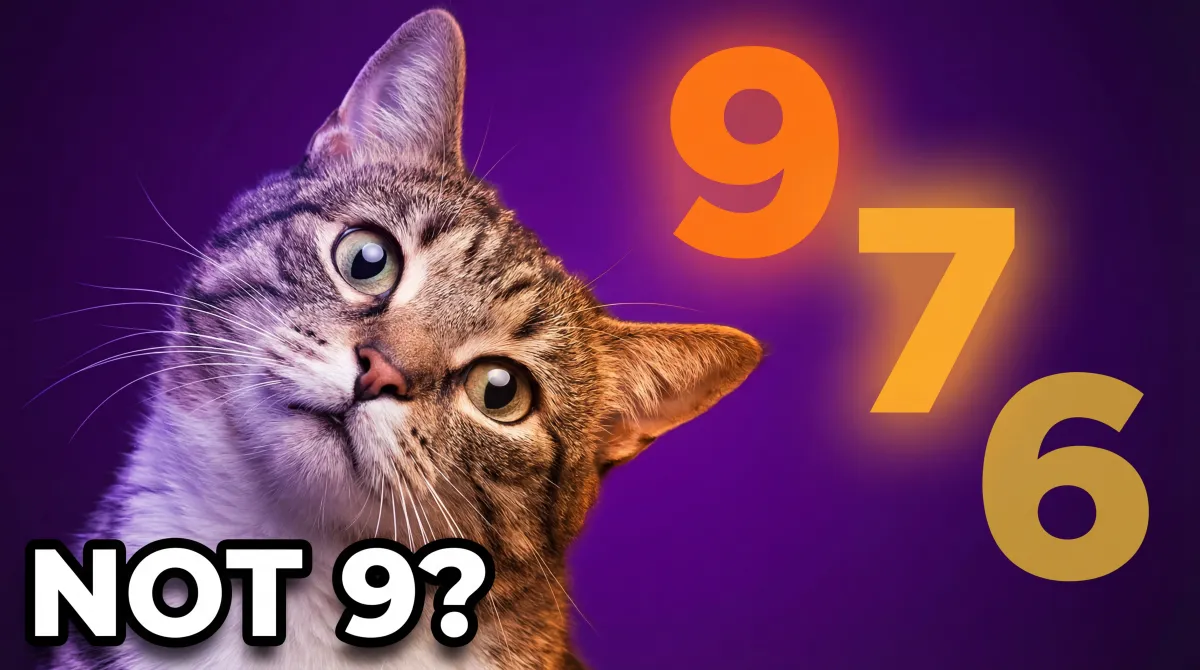
Cats have exactly one life. The saying "a cat has nine lives" is a proverb about feline resilience, not a literal claim. The number nine traces most commonly to ancient Egyptian theology, where the sun god Atum-Ra took cat form and created nine deities called the Ennead. But not every culture agrees on the number. Spanish-speaking countries, Germany, Italy, and Brazil say seven. Some Arabic traditions say six. The variation reflects different numerological traditions across civilizations, not different observations about cats. What every culture agrees on is that cats display survival abilities that seem almost supernatural.
Table of Contents
- Where Does the "Nine Lives" Saying Come From?
- What Is the Egyptian Connection to Nine Lives?
- Why Do Different Cultures Say Different Numbers?
- How Did Cats Go from Sacred to Demonized in Europe?
- When Did "Nine Lives" Enter the English Language?
- What Role Do Cats Play in Islamic and East Asian Traditions?
- What Biology Makes the Myth Believable?
- One Life Is All They Get
- Key Terms
- Frequently Asked Questions
- Key Takeaways
- Sources

Where Does the "Nine Lives" Saying Come From?
The "nine lives" saying most likely traces to ancient Egyptian theology, where the sun god Atum-Ra took cat form and created nine deities called the Ennead. A competing origin comes from Celtic folklore, where witches could supposedly transform into cats nine times. As Bradshaw notes in Cat Sense, cats' persistent independence likely fueled myths about supernatural resilience across civilizations.
The nine lives proverb is one of the oldest and most widely recognized sayings about cats, appearing across English-speaking cultures for at least 500 years, though its roots stretch back thousands of years further. The most widely cited origin theory connects the number nine to ancient Egyptian theology, where the sun god Atum-Ra created a group of nine deities called the Ennead and was depicted in cat form as the "Great Tomcat" or Mau. No single ancient text states "cats have nine lives," but the convergence of a cat-form deity with the sacred number nine likely planted the seed that traveled through Mediterranean trade routes, medieval European folklore, and English literary tradition to become the proverb people use today.
This is not the only explanation, however. Celtic folklore offers a competing origin through the legend of the Cat Sith (Cat Sidhe), a fairy creature in Scottish and Irish tradition that was said to be a witch who could transform into a cat nine times. On the ninth transformation, the witch would remain permanently in cat form. William Baldwin's 1553 text "Beware the Cat," which contains the first known English reference to cats having nine lives, explicitly connects witchcraft to the number: "a Cat hath nine lives, that is to say, a witch may take on her a Cats body nine times." The Cat Sith tradition, rooted in the same British and Celtic cultural context as the English proverb, may have been just as influential as the Egyptian theory in establishing the number nine.
As Dr. John Bradshaw of the University of Bristol notes in Cat Sense, cats lived alongside humans for millennia "without the cat ever becoming fully domesticated." That persistent independence, that refusal to be fully tamed, likely fueled myths about supernatural resilience across every culture cats inhabited. Understanding cat behavior through a scientific lens reveals why these myths took such deep root.
"The nine lives myth traces to the Egyptian sun god Atum-Ra, who took cat form and created nine deities called the Ennead."
What Is the Egyptian Connection to Nine Lives?
Ancient Egyptian theology provides the most detailed cultural link between cats and the number nine. The sun god Atum-Ra was the creator deity of the Ennead, a group of nine gods and goddesses who represented the fundamental principles of the universe. Atum-Ra was also depicted taking cat form as "Mau," the Great Tomcat, when descending into the underworld each night to battle the forces of chaos.
In Spell 17 of the Egyptian Book of the Dead, the great cat Mau kills the chaos serpent Apophis with a knife beneath the sacred Ished tree. This scene, preserved in tomb paintings and papyri, depicts a divine cat defeating death itself. The convergence of a cat-form god who creates nine deities and slays the embodiment of chaos is the theological backbone of the most popular origin theory for the nine lives saying.
The reverence Egyptians held for cats was not limited to mythology. The Greek historian Herodotus reported in the 5th century BCE that Egyptian households shaved their eyebrows as a sign of mourning when a cat died and would rescue cats before putting out fires. Archaeological evidence confirms the scale of this relationship. A 2023 study in the Journal of Egyptian Archaeology by Chris Elliott documented that approximately 180,000 mummified cats, weighing 19.5 tons (roughly 17,700 kg), were shipped from the burial site at Beni Hasan to Liverpool in 1890 and sold as agricultural fertilizer. X-ray analyses of mummified cats from similar sites revealed that most were under one year old and killed by blows to the head, indicating industrial-scale breeding for religious offerings rather than simple reverence for deceased pets.
According to the American Research Center in Egypt, Egyptians believed feline deities shared character traits with cats. Bastet, initially depicted as a fierce lioness, assumed the image of a domestic cat in the 2nd millennium BCE. Egyptians did not worship cats themselves as gods; they saw cats as earthly embodiments of divine qualities like grace, protective ferocity, and independence.
It is worth noting that while the individual theological elements (Atum-Ra, the Ennead, Mau, Spell 17) are well-established Egyptological facts, the specific causal link between these elements and the English proverb is a modern inference, not an ancient Egyptian belief. No surviving Egyptian text states "cats have nine lives." The story of Felicette, the first cat in space, shows how cats continued to find themselves in extraordinary circumstances thousands of years after the Egyptians first elevated them.
"Approximately 180,000 mummified cats were shipped from Egypt to Liverpool in 1890 and sold as agricultural fertilizer."
Why Do Different Cultures Say Different Numbers?
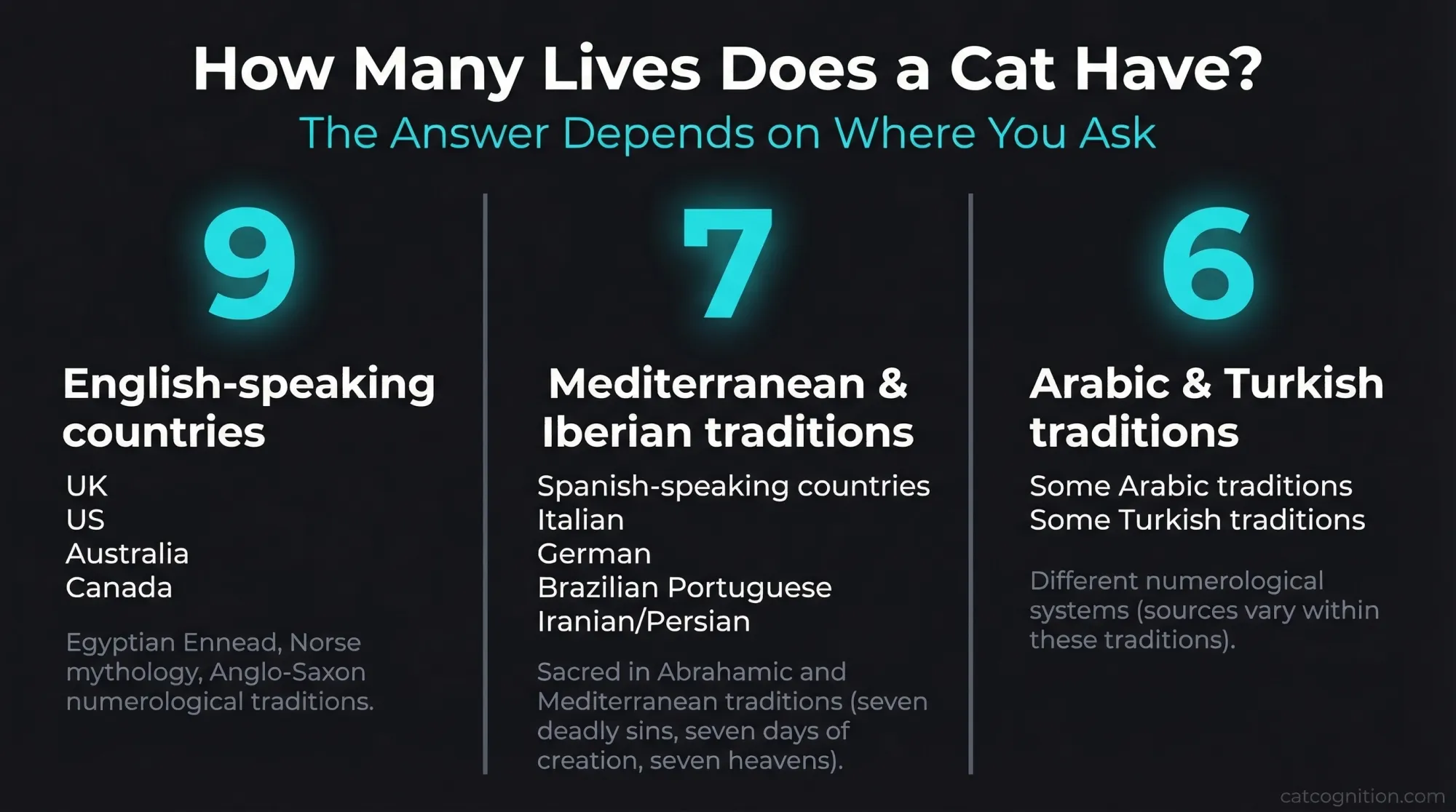
Different cultures assign different numbers of lives to cats. English-speaking countries say nine, Spanish-speaking countries and much of continental Europe say seven, and some Arabic traditions say six. The number varies across civilizations, reflecting different numerological and religious traditions rather than different observations about feline resilience. Eight distinct cultural traditions assign three different numbers to the same myth.
| Cultural Tradition | Number of Lives | Reasoning |
|---|---|---|
| English-speaking (UK, US, Australia, Canada) | 9 | Egyptian Ennead, Norse mythology, Anglo-Saxon numerological traditions |
| Spanish-speaking countries | 7 | Seven as sacred in Abrahamic and Mediterranean traditions |
| Italian | 7 | Mediterranean seven tradition (seven deadly sins, seven days of creation) |
| German | 7 | Same seven tradition, possibly reinforced through Moorish cultural exchange |
| Brazilian Portuguese | 7 | Portuguese/Iberian seven tradition |
| Iranian/Persian | 7 | Seven as sacred in Persian and Zoroastrian tradition |
| Some Arabic traditions | 6 | Different numerological systems (sources vary within these traditions) |
| Some Turkish traditions | 6 | Possibly influenced by Arabic traditions (sources inconsistent) |
The number nine holds sacred significance in several traditions that influenced the English-speaking world. In Norse mythology, the universe is divided into 9 worlds connected by Yggdrasil, and the goddess Freya traveled in a chariot pulled by 2 large cats. In Greek mythology, the nine Muses represented the arts and sciences. In Chinese culture, nine (jiu) sounds like the word for "long-lasting." Hinduism treats nine as representing completeness, being the final single digit.
Seven, by contrast, dominates the Mediterranean and Abrahamic traditions. Seven deadly sins, seven days of creation, seven heavens. For cultures steeped in these traditions, seven became the natural number to attach to a proverb about resilience.
The Arabic and Turkish attributions to six lives should be treated with caution. Sources are inconsistent on the exact number, and even Britannica notes that Iran uses seven rather than six. The safest framing acknowledges the variation without false precision: the numbers differ even within these traditions.
How Did Cats Go from Sacred to Demonized in Europe?
Cats went from sacred temple animals in ancient Egypt to demonized witch familiars in medieval Europe. The shift began with Pope Gregory IX's 1233 papal bull "Vox in Rama," which associated cats with heretical rituals. The same feline independence Egyptians revered became the quality medieval Christians feared, amplifying rather than weakening the nine lives myth.
Cat domestication began approximately 12,000 years ago in the Fertile Crescent, when wildcats (Felis silvestris lybica) were attracted to rodent-rich grain stores in early agricultural settlements. Ancient DNA analysis of over 200 cat remains by Ottoni et al. (2017, Nature Ecology and Evolution) revealed two waves of cat dispersal: Near Eastern cats spread with farming in the Neolithic period, and Egyptian cats spread through maritime trade routes during the Classical period. By the time cats reached medieval Europe, they carried thousands of years of accumulated mythology about divine associations and supernatural abilities.
Then the narrative reversed. Pope Gregory IX's 1233 papal bull "Vox in Rama" described black cats in the context of heretical rituals. This document is often cited as the beginning of organized cat persecution in Europe, but the popular claim that Gregory ordered mass cat killings, which then caused the Black Death by reducing rat-hunting predators, is not supported by historians. Snopes and multiple medieval scholars have debunked this causal chain. The bull was addressed to specific German clergy about alleged Luciferian practices in a particular region. It was not a general decree to kill cats.
What the medieval Church did accomplish, however, was cementing the association between cats and witchcraft. The 1324 trial of Alice Kyteler in Ireland included the accusation that she consorted with a demon that appeared in various forms, including a cat. Medieval historian Irina Metzler argues that the independent nature of cats was the root of medieval anxiety: cats could not be trained to be loyal and obedient like dogs, violating the medieval belief that animals existed to serve humans. That very independence, the same quality that had made cats sacred in Egypt, now made them suspect. Reading a cat's body language signals reveals the same independent streak that medieval Europeans found so unsettling.
This paradox is central to the nine lives myth. The medieval Church demonized cats as witch familiars while simultaneously reinforcing the narrative that cats possessed supernatural abilities. If a cat could be a witch's companion, if a witch could take a cat's body, then cats were extraordinary creatures. The demonization did not weaken the nine lives myth. It amplified it.
"Shakespeare referenced nine lives in Romeo and Juliet when Mercutio challenges Tybalt, the 'King of Cats,' in 1597."
When Did "Nine Lives" Enter the English Language?
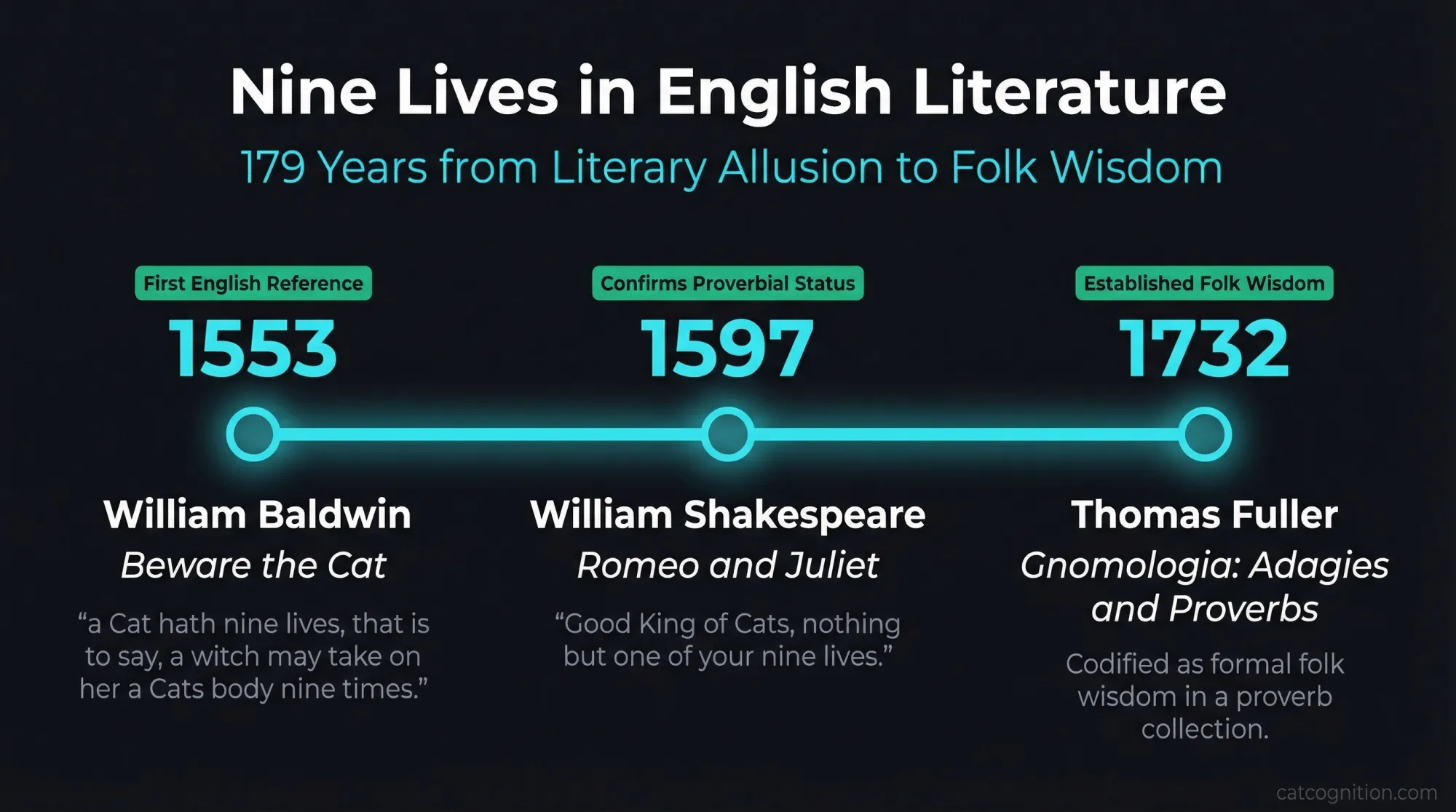
The phrase "nine lives" first appeared in English in William Baldwin's 1553 text "Beware the Cat," linking cats to witchcraft. Shakespeare used the concept without explanation in Romeo and Juliet (1597), confirming proverbial status. Thomas Fuller codified the saying in 1732. Three landmark texts spanning 179 years trace the proverb from literary allusion to established folk wisdom.
| Year | Author | Work | Significance |
|---|---|---|---|
| 1553 | William Baldwin | "Beware the Cat" | First known English reference to cats having nine lives |
| 1597 | William Shakespeare | Romeo and Juliet | Used nine lives without explanation, confirming proverbial status |
| 1732 | Thomas Fuller | Gnomologia: Adagies and Proverbs | Codified nine lives as formal folk wisdom |
William Baldwin's "Beware the Cat" (written c.1553, delayed 8 years to publication in 1561) contains the first known English reference connecting cats to nine lives. Baldwin wrote: "a Cat hath nine lives, that is to say, a witch may take on her a Cats body nine times." The text, considered by some scholars to be the first English-language novel, was written as anti-Catholic satire during the reign of Edward VI but was delayed from publication by Mary Tudor's Catholic restoration. The witchcraft framing directly connects to the Celtic Cat Sith tradition, where witches could transform into cats nine times before becoming permanently trapped in cat form.
Shakespeare reinforced the concept in Romeo and Juliet (c.1597) when Mercutio challenges Tybalt, the "King of Cats": "Good King of Cats, nothing but one of your nine lives." By 1597, Shakespeare could reference nine lives without explanation, suggesting the phrase was already proverbial.
Thomas Fuller codified the proverb in his 1732 collection Gnomologia: Adagies and Proverbs: "A cat has nine lives, and a woman has nine cats' lives." Fuller's inclusion in a formal proverb collection confirmed that nine lives had passed from literary allusion to folk wisdom.
What Role Do Cats Play in Islamic and East Asian Traditions?
The nine lives proverb is primarily a European concept, but every major civilization developed unique mythology around cats' extraordinary qualities. Islamic tradition treats cats as ritually clean animals possessing divine blessing. Japanese folklore features shape-shifting cat spirits. Chinese creation myths placed cats in charge of the world. Parallel traditions across cultures confirm a genuinely universal human fascination with feline resilience.
In Islamic tradition, cats hold a position of special reverence. The Prophet Muhammad is reported to have said, "Cats are not impure; they are among those who go around among us." Cats are permitted in mosques and considered the quintessential pet in Muslim households. Muslims believe cats possess "barakah," a concept of divine blessing. The widely told story of Muezza, in which Muhammad cut his robe sleeve rather than disturb his sleeping cat, is a beloved tradition, though Islamic scholars note it is not found in any authenticated hadith collection.
This cultural reverence for cats in Islamic cultures provides context for why Arabic and Turkish traditions developed their own "multiple lives" sayings. The emphasis falls on cats' spiritual blessing rather than on supernatural abilities, a different cultural lens on the same underlying observation that cats are extraordinary animals.
Japanese cat folklore adds another dimension. The bakeneko is a supernatural cat that develops powers when it lives to old age, gaining the ability to shapeshift into human form, reanimate corpses, and speak human language. The nekomata, first referenced in the Meigetsuki diary around 1233 CE, is a cat yokai whose tail splits in two, associated with necromancy and death. While Japan does not have a specific "number of lives" equivalent, the transformation trope (cats becoming something more through sheer persistence of life) runs parallel to the European nine lives concept. The way cats communicate through tail movements makes the nekomata's split-tail legend all the more evocative.
According to a widely retold folk tradition, Chinese mythology includes Li Shou, a cat deity from creation myths in which gods initially placed cats in charge of running the world. The famous story of why cats are excluded from the Chinese zodiac (the rat tricked the cat into missing the selection race) reflects a cultural awareness of cats as creatures who operate by their own rules, outside established systems.
"Spanish-speaking countries say cats have seven lives, not nine, reflecting different numerological traditions across cultures."
What Biology Makes the Myth Believable?
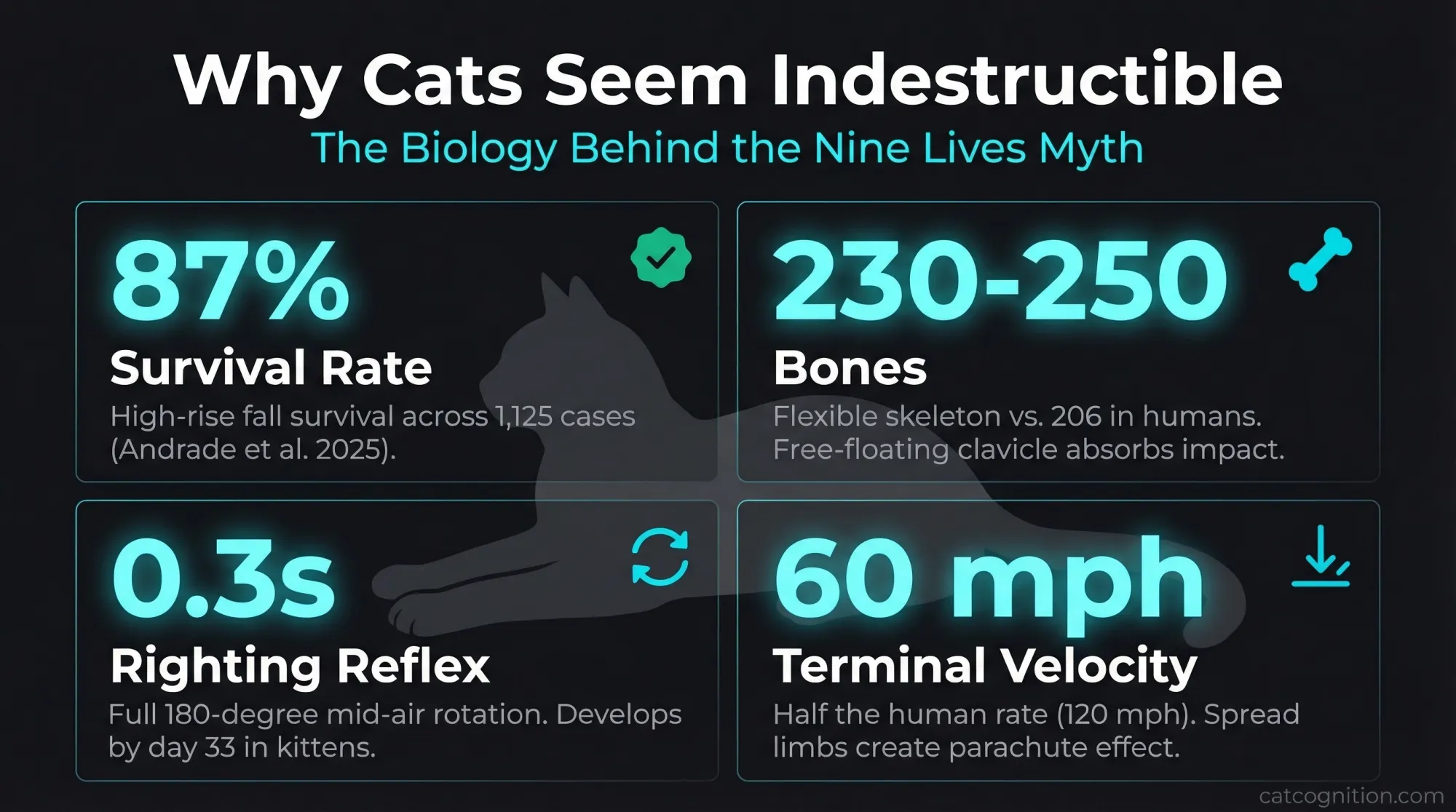
Cats survive 87% of high-rise falls, possess 230 to 250 bones with a uniquely flexible spine, and can rotate 180 degrees mid-fall in approximately 0.3 seconds. A terminal velocity of 60 mph (half the human rate) gives cats a built-in parachute effect. The "multiple lives" myth encodes real biological advantages in metaphorical language.
Cats have approximately 230 to 250 bones (compared to 206 in humans) with 52 to 53 vertebrae. The feline spine is held together by muscles rather than ligaments, with extra elastic cushioning in intervertebral discs. The clavicle is free-floating, attached only through musculature, allowing cats to squeeze through any opening their skull can fit through and absorb landing impacts that would shatter a rigid skeleton.
A cat's terminal velocity is approximately 60 mph, roughly half that of a human at approximately 120 mph. Cats achieve this through their relatively large surface area compared to body weight. When falling, cats spread their limbs to increase drag, functioning like a parachute. Cats also possess an innate self-righting reflex that develops by day 33 in kittens, allowing a full 180-degree rotation in approximately 0.3 seconds to orient mid-fall and land feet-first. For a deep dive into how this reflex actually works, see our full breakdown of why cats land on their feet.
How effective are these adaptations? The largest study ever conducted on high-rise syndrome in cats, a 2025 mega-study by Andrade et al. at Freie Universitat Berlin analyzing 1,125 cases, found an overall survival rate of 87%. A landmark 1987 study by Whitney and Mehlhaff at the Animal Medical Center in New York found that 90% of treated cats survived among 132 high-rise fall cases. An important caveat applies to both studies: they only include cats brought to veterinary hospitals, meaning cats that died on impact and were never presented for treatment are not counted. Still, an 87% survival rate across 1,125 cases is remarkable evidence that cats are genuinely harder to kill than most animals their size.
Preliminary research also suggests a possible healing mechanism in purring itself. A 2001 conference presentation by Elizabeth von Muggenthaler at the Acoustical Society of America found that all felids purr at frequencies between 25 and 150 Hz, with domestic cats producing strong fundamental frequencies at exactly 25 Hz and 50 Hz. These frequencies correspond to those used in human medicine for bone growth and fracture healing. The correlation between purring frequencies and therapeutic frequencies is documented, though the direct causal pathway in cats remains theoretical. For more on what science knows about cat purring and its effects on humans, we cover the full research.
One Life Is All They Get
The nine lives myth is a beautiful piece of cultural poetry about feline resilience. It should never become an excuse to skip the vet visit, leave the balcony window open, or assume a cat can handle anything. Cats have exactly one life. The 87% survival rate from high-rise falls sounds impressive until you consider the 13% that did not survive, and the significant injuries sustained by many of those that did. Secure your windows. Keep toxic plants out of reach. Schedule annual veterinary checkups. The myth celebrates cats' toughness; responsible ownership protects the one life they actually have.
Cat myths are not harmless curiosities. As Croney, Udell, Delgado, and colleagues documented in their 2023 "CATastrophic Myths" research in The Veterinary Journal, persistent misconceptions about cats directly impact welfare outcomes, with cats receiving 50% fewer veterinary visits than dogs on average. The perception that cats are self-sufficient, resilient, and essentially indestructible contributes to cats receiving less veterinary care than dogs. If a cat "has nine lives," the reasoning goes, one skipped vet visit cannot matter that much. But it does. Understanding the common mistakes cat owners make is the first step toward replacing myth with evidence-based care.
The nine lives myth, stripped of its poetry, tells us something true. Cats are remarkable survivors. Their flexible skeletons, low terminal velocity, righting reflexes, and sheer independence have made them one of the most successful mammals on the planet, colonizing 6 of 7 continents over 12,000 years of living alongside humans. But surviving a fall is not the same as being invincible. Cats are mortal animals who need preventive care, safe environments, and owners who understand the difference between a beautiful metaphor and a medical reality. Knowing what each life stage demands is how you honor the one life your cat actually has.
"Cats survive 87% of high-rise falls, according to the largest study ever conducted on 1,125 cats. But survivorship bias applies: only cats brought to hospitals are counted."
Key Terms
- Ennead: A group of nine deities in ancient Egyptian theology, with the creator god Atum at the head. The connection between the Ennead and the cat-form sun god is the most commonly cited origin for the "nine" in nine lives.
- Mau (Great Tomcat): The cat form taken by the sun god Ra (or Atum-Ra) in Egyptian mythology. Mau appears in Spell 17 of the Book of the Dead, killing the chaos serpent Apophis beneath the sacred Ished tree.
- Bastet: Egyptian goddess initially depicted as a fierce lioness, later taking the form of a domestic cat or cat-headed woman in the 2nd millennium BCE. Central to the cult of feline worship at Bubastis.
- Cat Sith (Cat Sidhe): A fairy creature in Scottish and Irish folklore resembling a large black cat with a white chest spot. Some traditions held the Cat Sith was a witch who could transform into a cat nine times, with the ninth transformation being permanent.
- Bakeneko: A supernatural cat in Japanese folklore that develops powers when it lives to old age, including the ability to shapeshift into human form and speak human language.
- Barakah: A concept of divine blessing in Islam. Cats are believed by Muslims to possess barakah, contributing to their elevated status in Islamic cultures.
- Righting reflex: An innate vestibular-controlled ability that allows cats to orient their bodies mid-fall and land feet-first. Develops by day 33 in kittens.
- Terminal velocity: The maximum speed an object reaches during free fall when air resistance equals gravitational pull. Cat terminal velocity is approximately 60 mph, roughly half the human rate.
- High-rise syndrome: A veterinary term for injuries sustained by cats falling from elevated structures, typically two or more stories. Despite the name, survival rates are high (87% per Andrade et al. 2025).
Frequently Asked Questions
Do cats really have nine lives?
No. Cats have exactly one life, like every other animal. The "nine lives" saying is a proverb that describes cats' remarkable survival abilities, not a literal claim about multiple lives. The saying originated from cultural and religious traditions, primarily ancient Egyptian theology and medieval European folklore, and persists because cats genuinely display resilience that appears almost supernatural.
Why do some countries say seven lives instead of nine?
The number attached to the myth reflects the numerological traditions of each culture, not different observations about cats. English-speaking cultures say nine, likely influenced by the significance of nine in Egyptian, Norse, and Anglo-Saxon traditions. Spanish-speaking countries, Italy, Germany, and several other European nations say seven, reflecting the sacredness of seven in Abrahamic and Mediterranean traditions (seven deadly sins, seven days of creation, seven heavens).
Did ancient Egyptians believe cats had nine lives?
There is no surviving Egyptian text that states "cats have nine lives." The connection is a modern inference based on two established theological facts: the sun god Atum-Ra took cat form (as Mau), and Atum created the Ennead, a group of nine deities. The convergence of a cat-form god with the sacred number nine likely influenced the proverb, but the specific causal link is plausible rather than proven.
Is there a Celtic origin for the nine lives myth?
Yes. In Scottish and Irish folklore, the Cat Sith (Cat Sidhe) was believed to be a witch who could transform into a cat nine times. On the ninth transformation, the witch would remain permanently in cat form. This tradition aligns closely with William Baldwin's 1553 text, which explicitly connects witchcraft to nine lives: "a Cat hath nine lives, that is to say, a witch may take on her a Cats body nine times."
Can cats really survive falls from tall buildings?
Cats survive high-rise falls at remarkably high rates. The largest study, by Andrade et al. (2025) analyzing 1,125 cases, found an 87% survival rate. Cats achieve this through their flexible skeleton, low terminal velocity (approximately 60 mph), and innate righting reflex. However, survival does not mean no injury. Many surviving cats require significant veterinary treatment, and an important survivorship bias applies: cats that died on impact and were never brought to a hospital are not included in these statistics.
Why are cats considered special in Islam?
In Islamic tradition, cats are considered ritually clean animals. The Prophet Muhammad is reported to have said, "Cats are not impure; they are among those who go around among us." Cats are permitted in mosques and believed to possess barakah, or divine blessing. This reverence makes cats the preferred pet in many Muslim households.
Did the Pope really order people to kill cats?
This is a widely repeated myth. Pope Gregory IX's 1233 papal bull "Vox in Rama" described black cats in the context of heretical rituals, but it was addressed to specific German clergy about alleged practices in a particular region. It was not a general decree to kill cats. The popular claim that this decree reduced cat populations and worsened the Black Death is debunked by historians.
Do cats have healing powers through purring?
Preliminary research suggests a possible mechanism. A 2001 conference presentation at the Acoustical Society of America found that cats purr at frequencies between 25 and 150 Hz, which correspond to frequencies used in human medicine for bone growth and fracture healing. However, this was a one-page conference abstract, not a full peer-reviewed study, and no subsequent research has confirmed a direct causal healing mechanism in cats. The correlation is documented; the causation remains theoretical.
Key Takeaways
- Cats have exactly one life. The "nine lives" saying is a proverb about feline resilience that traces back thousands of years through Egyptian theology, Celtic folklore, and medieval European witchcraft traditions.
- The number varies across cultures: English-speaking countries say nine, most Spanish-speaking and European countries say seven, and some Arabic traditions say six. The variation reflects different numerological traditions, not different observations about cats.
- The most widely cited origin theory connects the Egyptian sun god Atum-Ra (who took cat form as Mau) to the Ennead (nine deities), but a competing Celtic tradition about witches transforming into cats nine times may be equally influential on the English proverb.
- Every culture that developed a "multiple lives" myth did so because cats genuinely display remarkable survival abilities, including an 87% survival rate from high-rise falls, a flexible skeleton with 230 to 250 bones, and a righting reflex that develops by day 33.
- The myth is charming but not harmless. Research by Croney, Udell, Delgado, and colleagues shows that persistent misconceptions about cats, including the belief that they are inherently self-sufficient, contribute to cats receiving less veterinary care than dogs.
Sources
- The palaeogenetics of cat dispersal in the ancient world -- Ottoni, C., Van Neer, W., De Cupere, B. et al., 2017, Nature Ecology & Evolution (Nature)
- The Near Eastern Origin of Cat Domestication -- Driscoll, C.A. et al., 2007, Science (PubMed)
- High-rise syndrome in cats -- Whitney, W.O. & Mehlhaff, C.J., 1987, JAVMA (PubMed)
- High-rise syndrome in cats (parts 1 & 2) -- Andrade, M.C. et al., 2025, Journal of Feline Medicine and Surgery (SAGE)
- The felid purr: A healing mechanism? -- von Muggenthaler, E., 2001, Journal of the Acoustical Society of America (JASA)
- CATastrophic Myths Part 1 -- Croney, C., Udell, M., Delgado, M. et al., 2023, The Veterinary Journal (PMC)
- Cats, Commerce, and Cemeteries: The Mummified Felines of Beni Hasan -- Elliott, C., 2023, Journal of Egyptian Archaeology (SAGE)
- Development of the air righting reflex in cats visually deprived since birth -- 1984, Experimental Brain Research (PubMed)
- Cats, Bastet and the Worship of Feline Gods -- ARCE (American Research Center in Egypt) (ARCE)
- Herodotus on Cats in Egypt -- World History Encyclopedia (WHE)
- Cats in the Middle Ages -- World History Encyclopedia (WHE)
- Re in the form of a cat slays Apep -- Egypt Museum (Egypt Museum)
- Why Do They Say Cats Have Nine Lives? -- Encyclopaedia Britannica (Britannica)
- Cat Sense -- Bradshaw, J.W.S., 2013, Allen Lane / Basic Books
- Gnomologia: Adagies and Proverbs -- Fuller, T., 1732 (Internet Archive)