Why Do Cats Bring You Dead Animals? The Science Behind the "Gift"
Cats bring dead animals home because the predatory drive operates independently of hunger. Three biological mechanisms explain the behavior — and evidence-based interventions can reduce it.

Table of Contents
- Why Do Cats Bring You Dead Animals?
- Is Your Cat Really Giving You a "Gift"?
- The Predatory Motor Sequence: How Cats Hunt
- Why Do Cats Hunt Even When They're Not Hungry?
- The Teaching Hypothesis: Are Cats Trying to Train You?
- What Your Cat's Prey Tells You
- Why Do Cats Play With Their Prey?
- How to Reduce Your Cat Bringing Dead Animals Home
- Why Do Cats Kill Birds? The Conservation Impact
- The CatCog Prey Profile: Understanding Your Cat's Hunting Type
- Key Terms
- Frequently Asked Questions
- Key Takeaways
- Sources
Cats bring dead animals home because the feline predatory drive operates independently of hunger. Paul Leyhausen's influential ethological model shows that each stage of the hunting sequence -- stalk, chase, pounce, kill, consume -- fires on separate motivation. A well-fed cat can kill without eating. The uneaten carcass then gets carried to the cat's safest territory: the owner's home. This behavior is part of the broader science of cat behavior -- specifically the instinctive patterns cats never lost through domestication. Bringing dead animals home is NOT a "gift" in the human sense -- cats lack the cognitive framework for gift-giving as humans understand it.

Why Do Cats Bring You Dead Animals?
Cats bring dead animals to owners because three biological mechanisms converge: independent motivational phases disconnect killing from eating, a maternal teaching program misfires on human household members, and territorial instinct drives prey transport to the safest available location. Prey-bringing reflects hardwired predatory neurology in domestic cats, not affection, pride, or hunger.
According to John Bradshaw, anthrozoologist and Director Emeritus of the Anthrozoology Institute at the University of Bristol and author of Cat Sense, the domestic cat evolved as a solitary ambush predator of small prey. Unlike pack hunters such as wolves, cats hunt alone and consume 10-20 small meals per day in their natural feeding pattern. This ecology required a predatory drive that fires independently of hunger -- a cat that only hunted when starving would miss the small, unpredictable windows when prey becomes available.
Paul Leyhausen, an ethologist at the Max Planck Institute for Behavioral Physiology, developed an influential model describing the cat's complete predatory motor sequence: orient, stalk, chase, pounce, kill-bite, consume. Leyhausen proposed that each phase is controlled by a separate motivational system. Each phase can activate without triggering the next. A cat can stalk without chasing, kill without consuming, and consume without having hunted.
This phase independence explains the dead mouse on the kitchen floor. The hunt-and-kill phases fired, but the consume phase never activated. The cat's nutritional needs were already met by commercial food, so the carcass became surplus. And surplus prey, in feline logic, goes to the safest territory the cat knows -- which happens to be the owner's home.
📊 The Evidence:
"In one US study of 55 cats fitted with video cameras, owners saw only 23% of captured prey brought home. Another 49% was left at the capture site, and 28% was consumed outdoors. The dead animal on the doorstep represents roughly one-quarter of a cat's actual predation output."
Bradshaw describes domestic cats as retaining essentially the same behavioral repertoire as their wild ancestors despite approximately 10,000 years of living alongside humans. The cat-human relationship originated in the Fertile Crescent specifically because cats hunted rodents attracted to stored grain. Humans valued cats precisely for the behavior that now puzzles modern owners.

Is Your Cat Really Giving You a "Gift"?
Cats bringing dead animals home is not cognitively equivalent to human gift-giving -- cats lack the theory of mind required for intentional generosity. The behavior does serve a social function in feral colonies, where prey-sharing strengthens group bonds. In pet cats, prey-bringing likely reflects territorial transport and misdirected maternal instinct rather than deliberate affection.
The "gift" framing dominates popular cat content. Nearly every competitor article describes prey-bringing as a cat "showing love" or "being proud of the catch." This anthropomorphism is comforting but misleading. Cats do not have the cognitive architecture for gratitude, pride, or intentional generosity in the way humans experience those emotions. If you are wondering whether your cat's behavior really means does my cat love me, the answer is more nuanced than a dead mouse on the doorstep.
That said, dismissing the social dimension entirely would be an overcorrection. In feral cat colonies, prey-sharing does occur between related individuals, and this behavior serves a genuine social-bonding function. Dr. Sarah Ellis, Head of Cat Mental Wellbeing and Behaviour at International Cat Care (iCatCare), has stated that "we haven't bred out of cats the need to hunt, and these instincts still exist in the cat." The behavior exists on a spectrum between purely mechanical territorial transport and rudimentary social exchange.
The more useful framing: when a cat brings a dead animal home, the cat is not saying "I love you." The cat is saying "this is home, and home is where the food goes." The same instinct that makes a feral cat drag prey under a bush makes a pet cat drag prey through the cat flap. Understanding this distinction shifts the owner's response from confusion to practical enrichment strategies that address the underlying drive.
The Predatory Motor Sequence: How Cats Hunt
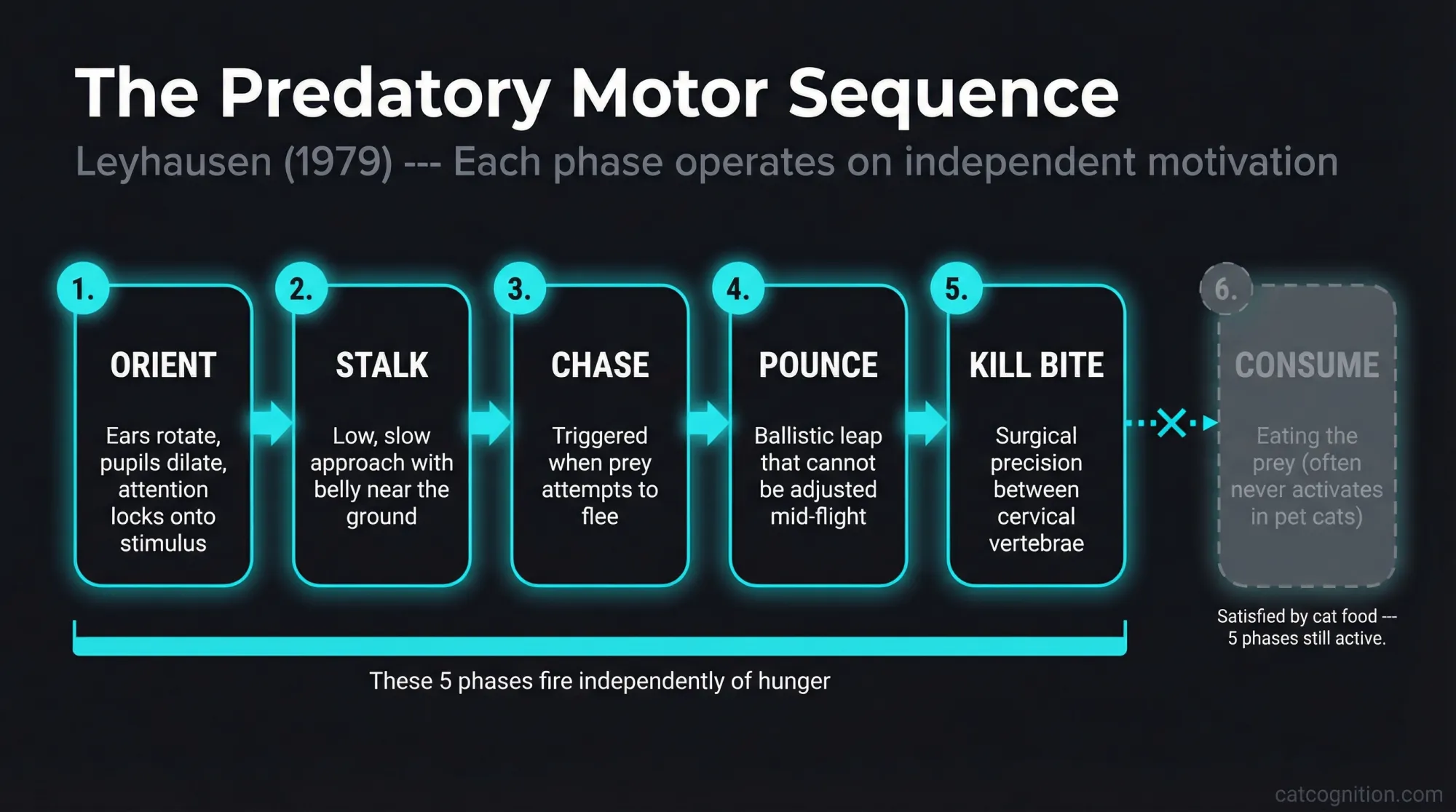
The feline predatory motor sequence consists of six phases -- orient, stalk, chase, pounce, kill-bite, consume -- each controlled by independent motivational systems in Leyhausen's ethological model. Commercial cat food satisfies the consume phase but leaves five preceding phases unsatisfied. The mismatch between nutritional satiation and predatory neurology drives hunting behavior in well-fed domestic cats.
Think of the predatory sequence as a chain of dominoes where each domino can fall independently. The "stalk" domino can topple without knocking over the "eat" domino. Feeding a cat knocks down the "eat" domino, but leaves five others standing.
The sequence begins when a stimulus -- a rustling sound, a flash of movement -- triggers the orient phase. The cat's ears rotate, pupils dilate, and attention locks onto the source. Leyhausen's research noted that auditory stimuli like scratching and grating sounds are particularly effective at triggering precise prey location. These early signals are part of a cat's broader body language repertoire -- the same dilated pupils and forward-rotating ears appear in other high-arousal states.
Next comes the stalk: a low, slow approach with belly pressed near the ground. Then the chase, triggered when prey attempts to flee. The pounce follows -- a ballistic leap that cannot be adjusted mid-flight. The kill-bite targets the cervical vertebrae of the prey, delivered with surgical precision between neck vertebrae. And finally, consumption -- which, in the well-fed pet cat, often never arrives.
Fitzgerald and Turner, in their chapter in The Domestic Cat: The Biology of its Behaviour (Cambridge University Press, 2000), report that owned cats need 2-4 attacks per successful catch of small rodents and birds, and 5 attacks per rabbit. Cat hunting is opportunistic, targets prey smaller than the cat, and varies substantially between individual cats.
Why Do Cats Hunt Even When They're Not Hungry?
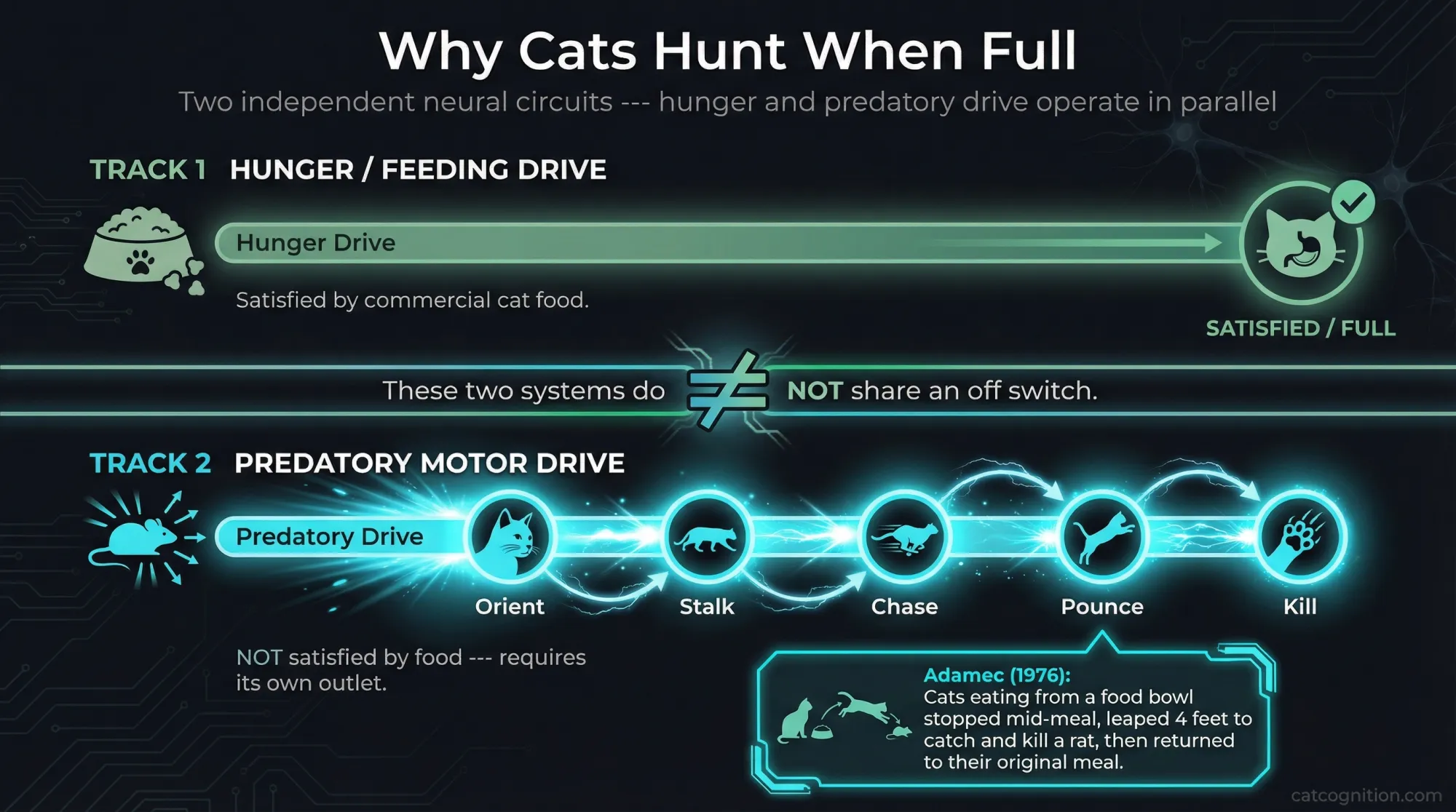
Cats hunt when well-fed because the neurological circuitry driving predatory behavior operates on a separate motivational track from hunger. A 1976 experiment by Robert Adamec demonstrated that cats stopped eating mid-meal to kill available prey, then returned to the original food. Hunger increases hunting speed but is not required to trigger the predatory motor sequence.
Adamec's experiment produced a striking result: cats that were actively eating from a food bowl stopped mid-meal, leaped four feet off a shelf, caught and killed a live rat, carried the rat back to the food dish, and resumed eating their original meal. The predatory drive literally overrode active food consumption.
This finding aligns with Leyhausen's model of independent motivational phases. The eat-from-bowl behavior and the hunt-kill behavior run on parallel neural tracks. Hunger makes cats kill faster -- satiated cats spend more time toying with prey -- but hunger is not the on/off switch for predatory behavior. The subsequent observational literature broadly supports this: well-fed cats continue to hunt at comparable rates to food-deprived cats.
📊 The Evidence:
"A 12-week randomized trial at the University of Exeter involving 355 cats in Southwest England found that switching to a high-meat-protein diet reduced prey brought home by 36%. The hunting drive, while separate from hunger, is still modifiable through nutritional optimization -- suggesting that some commercially fed cats may be deficient in micronutrients that prompt compensatory hunting."
This is why the most common advice -- "just feed your cat more" -- fails. Increasing food volume satisfies the consume phase. It does nothing for the orient, stalk, chase, pounce, and kill-bite phases. Those five phases require their own outlet, which is why interactive play is more effective than extra kibble.
The Teaching Hypothesis: Are Cats Trying to Train You?
Mother cats bring prey to kittens in a progressive difficulty sequence -- dead, then wounded, then live -- meeting Tim Caro's formal criteria for teaching in non-human animals. When a pet cat brings dead prey to a human, the behavior may represent this maternal program activating toward a perceived family member who never hunts. This extrapolation remains inference, not demonstrated fact.
Tim Caro, a behavioral ecologist at the University of California, Davis, proposed a rigorous three-criteria framework for identifying teaching in non-human animals (published in The Quarterly Review of Biology, 1992, with co-author Marc Hauser). The framework requires that: (1) the teacher modifies behavior in the presence of naive individuals, (2) the teacher incurs an immediate cost, and (3) the pupil learns earlier or more rapidly than without teaching. Mother cats meet all three criteria -- they sacrifice captured prey, adjust difficulty to kitten skill level, and recapture escaped prey. This kind of cognitive flexibility is part of what makes the psychology of cats so compelling to researchers.
A note on this citation: Hauser, then at Harvard, was later found solely responsible for scientific misconduct in 2010 relating to separate, unrelated research on primates conducted between 2002 and 2007. The 1992 teaching framework itself was not implicated. Importantly, Thornton and Raihani independently validated the teaching criteria framework in a 2008 review, confirming its scientific standing regardless of Hauser's later misconduct.
The teaching hypothesis offers an elegant explanation for one specific pattern: cats that bring live or wounded prey to their owners. A cat that drops a stunned bird at the owner's feet and watches expectantly may be performing the same behavioral sequence a mother cat performs with kittens -- presenting manageable prey for "practice." However, no study has directly tested whether prey-bringing to humans involves the same neural pathways as maternal prey-presentation to kittens. The "misfiring maternal instinct" explanation is plausible but remains a working hypothesis.
What Your Cat's Prey Tells You
In one US study of 55 cats fitted with KittyCam video cameras, owners saw only 23% of captured prey brought home -- roughly one-quarter of actual predation. A French citizen science project tracking 5,048 cats documented returned prey as 68% mammals, 21% birds, and 8% squamates (lizards and snakes). Individual cats develop distinct prey preferences, with some specializing in specific species.
The KittyCam study by Loyd et al. (2013) at the University of Georgia revealed that what appears on the doorstep is a biased sample. Of all prey captured, 49% was left at the capture site and 28% was consumed outdoors. The dead mouse on the kitchen floor is the tip of a much larger predation iceberg.
Individual variation matters enormously. Research by van Heezik et al. (2014) at the University of Otago found that individual cats vary significantly in hunting efficiency and prey preference. Some cats specialize -- one cat may target mice exclusively while another focuses on birds. Thomas et al. (2012) found that only 20% of cats are prolific hunters returning 4 or more prey items per year. Most cats rarely bring prey home at all.
What your cat brings tells you something specific:
| Prey Type | Hunting Style | Recommended Enrichment |
|---|---|---|
| Mice and voles | Ground-level ambush hunting | Ground-movement toys like feather wands dragged along the floor |
| Birds | Arboreal or elevated hunting | Toys with flight-like movement patterns |
| Live or wounded prey | Teaching instinct active | Structured play sessions with simulated "kill" and treat reward |
| Consistently dead prey | Completed predatory sequence | Standard enrichment; only transport brought the carcass home |
📊 The Evidence:
"University of Exeter researchers found that cat personality traits -- specifically boldness and low agreeableness -- predicted which cats brought home more birds. Overall prey numbers were not significantly affected by personality scores alone, but individual variation in hunting was substantial, supporting an individualized approach to hunting management rather than one-size-fits-all advice."
Why Do Cats Play With Their Prey?
Cats play with prey because the independent motivational phases of the predatory sequence allow chase and pounce to re-fire after a successful catch. Satiation suppresses the kill-bite phase while leaving chase-pounce active, so well-fed cats play with prey longer. Dr. Mikel Delgado at Purdue University classifies cat play as "pseudo-predatory behavior" that mirrors the full hunting sequence.
The sight of a cat batting a wounded mouse back and forth can look cruel by human standards. But predatory play is not cruelty -- it is phase independence made visible. The chase phase has fired. The pounce phase has fired. The kill-bite phase has not. The cat is trapped in a loop where the appetitive phases (stalking, chasing, pouncing) keep activating while the consummatory phase (killing, eating) remains below threshold.
Delgado's research at Purdue establishes that play in cats activates the same motor programs as hunting. When an indoor cat stalks a feather wand, the neural circuits are functionally identical to those firing during an actual hunt. This is precisely why interactive play works as a substitute for hunting -- in the cat's brain, play and hunting are the same behavior performed on different targets.
Hunger changes the equation. Adamec's 1976 research showed that hungry cats dispatch prey faster. Satiated cats -- the state of most pet cats -- have the kill-bite threshold raised, making them more likely to enter the play loop. This is why well-fed cats seem to "torture" prey more than hungry ones. The motivation to kill is dampened, but the motivation to chase and pounce remains high.
How to Reduce Your Cat Bringing Dead Animals Home
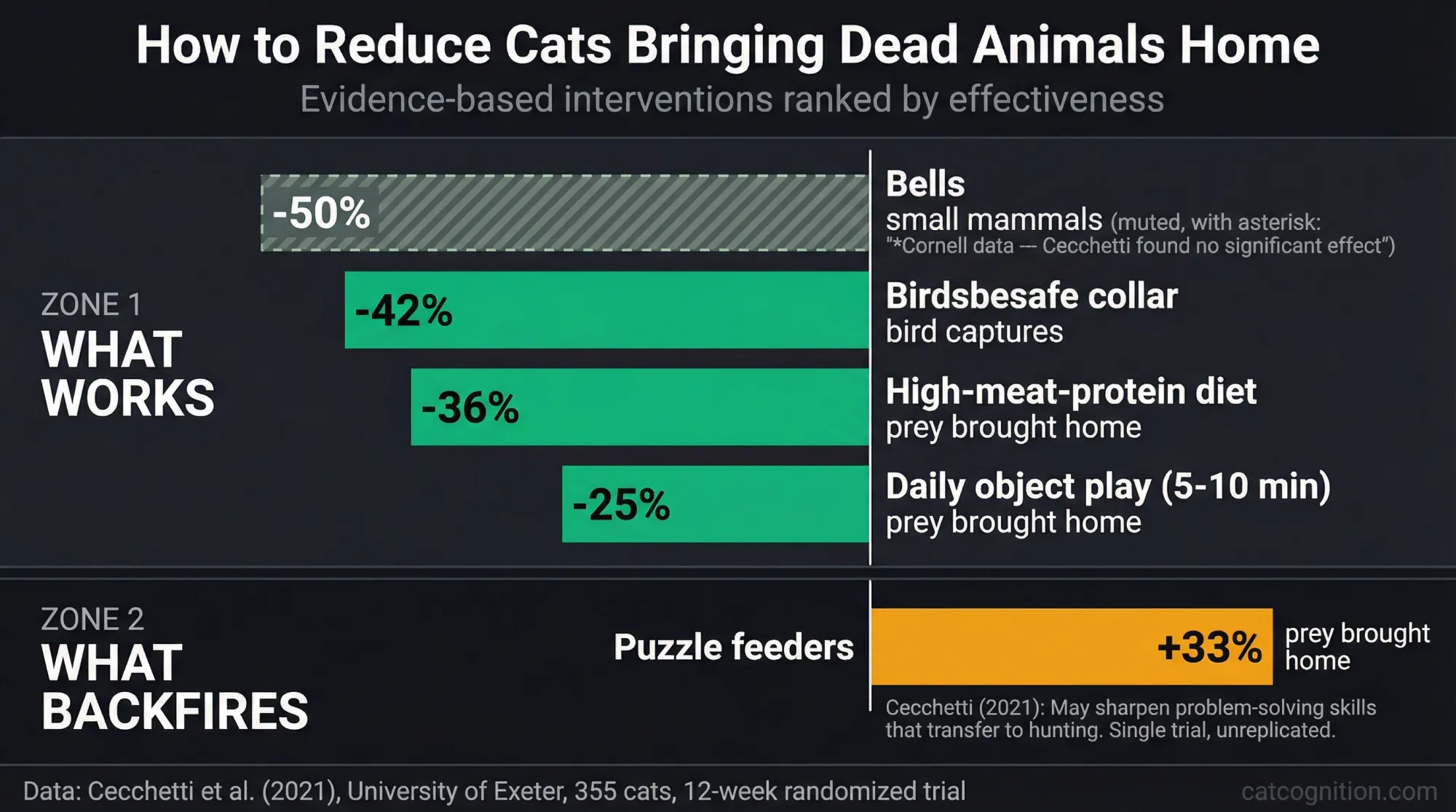
A 12-week randomized trial of 355 cats by Cecchetti's team at the University of Exeter found that a high-meat-protein diet reduces prey brought home by 36%, and 5-10 minutes of daily object play reduces prey returns by 25%. These interventions address the underlying predatory drive rather than suppressing behavior through punishment.
| Step | Intervention | Details |
|---|---|---|
| 1 | Identify your cat's hunting profile | Observe for two weeks. Note prey type (mice, birds, reptiles, insects), frequency, condition (dead, wounded, alive), and time of day. Only 20% of cats are prolific hunters returning 4+ prey items per year. Occasional hunters may not need intensive intervention. |
| 2 | Switch to a high-meat-protein diet | Cecchetti et al. found grain-free, high-meat-protein food reduced prey brought home by 36%. Some commercial foods contain protein from plant sources that may leave cats deficient in micronutrients, prompting compensatory hunting. Consult a veterinarian before changing diet. |
| 3 | Provide daily interactive play | 5-10 minutes of daily object play using a wand toy that mimics the full predatory sequence reduced prey brought home by 25%. Structure sessions: let the toy "hide" (orient), "flee" (chase), get "caught" (pounce), go "limp" (kill-bite). End with a treat to simulate the consume phase. |
| 4 | Consider Birdsbesafe collar covers | If bird predation is the primary concern, brightly colored collar covers make cats more visible to birds, reducing bird captures by 42%. These covers do not reduce mammal catches. |
| 5 | Restrict morning outdoor access | Cats hunt most successfully in the early morning hours. Keeping cats indoors until mid-morning reduces encounters with prey during peak activity periods. |
Understanding what cats need to be happy goes beyond just managing hunting -- but satisfying the predatory drive is a core piece of the enrichment puzzle.
What NOT to do:
- Do not use puzzle feeders as a hunting-reduction tool. Cecchetti's study found that puzzle feeders increased prey brought home by 33%. This counterintuitive finding -- currently unreplicated, with a speculative explanation -- suggests that puzzle feeders may sharpen problem-solving skills that transfer to hunting efficiency. Puzzle feeders remain excellent enrichment tools for other purposes, but they are not effective for reducing hunting specifically.
- Do not punish the cat. Punishment after the fact is ineffective because cats cannot associate a delayed punishment with a prior action. The hunting occurred outdoors, possibly hours earlier. Punishment damages the cat-owner bond without reducing hunting behavior.
- Do not rely on bells. Cornell Feline Health Center data suggests bells reduce mammal and bird kills by approximately 50%, but Cecchetti's more rigorous trial found no statistically significant effect for bells. The evidence is mixed at best.
📊 The Evidence:
"Puzzle feeders -- widely recommended as enrichment -- actually increased prey brought home by 33% in a single 12-week trial in Southwest England. The proposed explanation is that puzzle feeders sharpen the problem-solving skills that transfer to hunting efficiency. This finding has not been replicated, and the mechanism remains speculative."
Why Do Cats Kill Birds? The Conservation Impact
Free-ranging domestic cats kill an estimated 1.3-4.0 billion birds and 6.3-22.3 billion mammals annually in the United States, according to the most widely cited estimate by Loss et al. (2013), published in Nature Communications. The wide confidence intervals (a 3x variance for birds) reflect deep uncertainty. Un-owned cats -- feral and unmanaged populations -- cause the majority of this mortality, not pet cats with owners.
A 2023 global synthesis by Lepczyk et al., published in Nature Communications, found that domestic cats prey on 2,084 different species worldwide, 347 (16.65%) of which are species of conservation concern. The scale of cat predation is ecologically significant, particularly on islands where native species evolved without mammalian predators. Many cat owners have heard the distinctive chirping and chattering sounds their cats make when watching birds through a window -- that sound is the predatory motor sequence activating without the ability to complete.
Important context: the Loss et al. estimates, while widely cited, are not uncontested. Published responses have challenged the extrapolation methodology, and the confidence intervals are extraordinarily wide. A 2000 review found "few, if any studies apart from island ones that actually demonstrate that cats have reduced bird populations" on mainland habitats. The distinction between island and mainland ecology matters: island species face extinction-level risk from cat predation, while mainland species generally have larger, more resilient populations.
The conservation question is separate from the behavioral question. Understanding why cats hunt does not require taking a position on the indoor-outdoor debate. What the research consistently shows is that un-owned cats (strays and ferals) account for the majority of wildlife mortality, and that pet cat owners who implement evidence-based interventions -- high-meat diets, daily play, and timed outdoor access -- can meaningfully reduce their cat's predation impact.
The CatCog Prey Profile: Understanding Your Cat's Hunting Type
The CatCog Prey Profile is a five-dimension assessment framework that maps an individual cat's hunting pattern to the most effective evidence-based intervention. Because research consistently shows that cats vary enormously in hunting behavior, one-size-fits-all advice like "play with your cat more" ignores meaningful individual differences.
| Dimension | What to Observe | What It Tells You |
|---|---|---|
| 1. Prey Type | What your cat catches (mice, birds, reptiles, insects) | Ground-level ambush vs. elevated stalking vs. opportunistic hunting. Each prey type maps to a different enrichment toy profile. |
| 2. Frequency | Prey items per month | Low (0-1): may need no intervention. Moderate (2-4): responds to diet and play changes. High (5+): may need combined interventions including access restriction. |
| 3. Prey Condition | Dead, wounded, or alive | Dead = full predatory sequence completing, only transport involved. Live/wounded = teaching instinct active; benefits from structured play with simulated "kill" and treat reward. |
| 4. Peak Hunting Time | When prey appears | Morning hunters: restrict early outdoor access. Evening hunters: pre-dusk play session to satisfy drive before peak activity. |
| 5. Cat Personality | Boldness and agreeableness (Maguire et al., 2022) | Bold, less "agreeable" cats bring home more birds specifically; overall prey numbers show high individual variation regardless of personality. |
Combining these five dimensions creates an individualized hunting profile that guides targeted intervention rather than generic advice.
Moon has never caught a real mouse -- he's been indoor-only since kittenhood. But his predatory motor sequence is fully intact. At 6:15 AM most mornings, he crouches behind the couch arm, ears forward, pupils blown wide, tracking something invisible along the baseboard. The stalk lasts 30-45 seconds before an explosive pounce on absolutely nothing. I started running structured play sessions with a wand toy after researching this article, mimicking the full hunt-to-treat sequence. The early morning phantom stalking dropped from daily to maybe twice a week within two weeks. The predatory drive needs an outlet -- even when there is no prey.
Consumed prey carries real health risks. Wild rodents can harbor parasites (roundworms, tapeworms, *Toxoplasma gondii*), bacteria (*Salmonella*, *Bartonella*), and -- if the rodent consumed poisoned bait -- rodenticide that transfers to the cat through secondary poisoning. Wild birds can transmit avian parasites and *Salmonella*. If a cat actively hunts, maintain a regular deworming schedule (consult a veterinarian for frequency) and keep rabies vaccinations current. Do not allow prey consumption if rodenticide use is known in the area.
Any sudden change in hunting behavior -- a previously inactive cat starting to hunt aggressively, or a prolific hunter suddenly stopping -- warrants a veterinary visit. Sudden increases can signal hyperthyroidism, nutritional deficiency, or dental pain making commercial food difficult to eat. Sudden decreases may indicate illness-related lethargy.
Key Terms
- Predatory motor sequence: The hardwired behavioral chain in cats: orient, stalk, chase, pounce, kill-bite, consume. Each phase operates on independent motivation in Leyhausen's ethological model.
- Independent motivational phases: Leyhausen's model describing how each step of the hunting sequence can activate without triggering subsequent steps -- the central explanation for why cats kill without eating.
- Appetitive behavior: Goal-directed behavior driven by internal motivation (stalking, chasing) that is rewarding in itself, even without the consummatory act of eating.
- Consummatory behavior: The terminal act that reduces a drive (eating prey). In cats, the consummatory phase is dissociated from the appetitive phases.
- Kill-bite: The specialized neck bite targeting the cervical vertebrae that terminates prey. Controlled by a separate motivational system from the chase and consume phases.
- Surplus killing: When a predator kills more prey than it can immediately consume. Common in domestic cats due to the dissociation between hunting instinct and hunger.
- Prey transport: The behavior of carrying captured prey to a secure location. In domestic cats, the "secure location" is the home territory.
- Secondary poisoning: Toxin transfer when a predator consumes prey that has ingested rodenticide or other poisons.
Frequently Asked Questions
Should I punish my cat for bringing dead animals?
No. Punishment after the fact is ineffective because cats cannot connect a delayed punishment with an earlier action. The predatory sequence -- orient, stalk, chase, pounce, kill -- occurred outdoors, often hours before the cat returned home with prey. Punishing the cat damages the cat-owner bond and increases stress without reducing hunting. This is one of the most common cat owner mistakes when dealing with natural feline behavior. Instead, implement evidence-based interventions: switch to a high-meat-protein diet (36% reduction in prey brought home), provide 5-10 minutes of daily interactive play (25% reduction), and consider Birdsbesafe collar covers if bird predation is the concern (42% reduction in bird captures).
Is it safe to let my cat eat prey?
Consumed prey carries health risks. Wild rodents can carry parasites (roundworms, tapeworms, Toxoplasma gondii), bacteria (Salmonella, Bartonella), and rodenticide through secondary poisoning. Wild birds can transmit avian parasites and Salmonella. If a cat actively hunts, maintain a regular deworming schedule and keep rabies vaccinations current. Do not allow prey consumption if rodenticide use is known in the area. Consult a veterinarian for a deworming schedule appropriate to your cat's hunting frequency.
Do indoor cats still have hunting instincts?
Yes. A 2021 study (Pyari et al., Applied Animal Behaviour Science) found that indoor-only cats actually show greater interest in prey-like toys and sounds than cats with outdoor access, suggesting a larger unmet predatory drive. The predatory motor sequence is innate, not learned from hunting experience. Indoor cats need daily interactive play sessions that simulate the complete predatory motor sequence -- orient, stalk, chase, pounce, kill-bite, and consume (ending with a treat) -- to satisfy the same neurological drive that outdoor cats fulfill through actual hunting.
Does neutering or spaying reduce hunting?
No. Hunting behavior is not hormonally driven in the way that mating behavior is. Spaying and neutering eliminate reproductive behaviors but do not affect the predatory motor sequence. Neutered and spayed cats hunt at comparable rates to intact cats. The predatory drive operates on independent neural circuitry from reproductive hormones. This is one of the most common misconceptions about cat hunting behavior.
Why does my cat bring live animals?
Live or wounded prey suggests one of two things: the kill-bite phase did not fire (phase independence at work), or the maternal teaching program is active. Mother cats bring live prey to kittens in a progressive difficulty sequence. A spayed pet cat that drops a stunned mouse at the owner's feet and watches expectantly may be performing the same behavioral sequence -- presenting manageable prey for "practice." Structured play sessions that include a simulated "kill" (letting the toy go limp) and a treat reward can help satisfy this drive.
Do certain cat breeds hunt more?
Research suggests personality traits that vary across breeds -- particularly boldness and low "agreeableness" -- predict hunting frequency. Maguire et al. (2022) found that cats described as less agreeable by their owners brought home more birds specifically, though overall prey numbers were not significantly affected by personality scores alone. Breeds commonly reported as prolific hunters include Maine Coons, Siamese, and Bengals, though individual variation within breeds is significant. A sedentary Bengal may hunt less than an active domestic shorthair. Personality and individual experience matter more than breed alone.
How do I clean up after my cat brings prey inside?
Wear disposable gloves when handling prey. Place the carcass in a sealed plastic bag and dispose of it in an outdoor bin. Clean the area where the prey was found with an enzymatic cleaner or diluted bleach solution to remove bacteria and scent marks. Wash hands thoroughly afterward. If the prey was alive, check for and seal the entry point the cat used. If the cat consumed any part of the prey, monitor for signs of gastrointestinal distress (vomiting, diarrhea, lethargy) for 48 hours and contact a veterinarian if symptoms appear.
Will feeding my cat more stop hunting?
No. This is the single most important misconception about cat hunting behavior. Increasing food volume satisfies the consume phase of the predatory motor sequence, but the five preceding phases -- orient, stalk, chase, pounce, kill-bite -- operate on independent motivational systems. A cat with a full stomach still has five unsatisfied predatory phases. What does help is switching to a high-meat-protein diet (which reduced prey brought home by 36% in one 12-week trial) and providing daily interactive play that simulates the complete hunting sequence.
Key Takeaways
| # | Takeaway | Detail |
|---|---|---|
| 1 | Independent motivational phases drive prey-bringing, not hunger or affection | The predatory motor sequence -- orient, stalk, chase, pounce, kill-bite, consume -- fires on separate neural tracks. Feeding a cat satisfies consumption but leaves five predatory phases unaddressed. |
| 2 | Owners see only a fraction of what cats catch | In one US study of 55 cats with video cameras, only 23% of captured prey was brought home. The dead animal on the doorstep is roughly one-quarter of the actual predation picture. |
| 3 | Diet and play are the most effective evidence-based interventions, not punishment or bells | A high-meat-protein diet reduced prey brought home by 36%, and 5-10 minutes of daily interactive play reduced it by 25%, in a 12-week randomized trial of 355 cats in Southwest England. |
| 4 | Individual cats vary enormously in hunting behavior | Only 20% of cats are prolific hunters. Prey type, frequency, condition, timing, and personality all differ between individuals -- effective management requires individualized assessment. |
| 5 | Indoor cats retain the full predatory drive | Indoor-only cats show even greater interest in prey-like stimuli than outdoor-access cats, indicating a larger unmet predatory need. Daily structured play simulating the complete hunting sequence is essential enrichment. |
Sources
- Loss, S. R., Will, T., & Marra, P. P. (2013). The impact of free-ranging domestic cats on wildlife of the United States. Nature Communications, 4, 1396. https://www.nature.com/articles/ncomms2380
- Cecchetti, M., Crowley, S. L., Goodwin, C. E. D., & McDonald, R. A. (2021). Provision of high meat content food and object play reduce predation of wild animals by domestic cats. Current Biology, 31(5), 477-483. https://pubmed.ncbi.nlm.nih.gov/33577746/
- Cecchetti, M., Crowley, S. L., Goodwin, C. E. D., & McDonald, R. A. (2021). Drivers and facilitators of hunting behaviour in domestic cats and options for management. Mammal Review, 51(3), 285-303. https://onlinelibrary.wiley.com/doi/abs/10.1111/mam.12230
- Loyd, K. A. T., Hernandez, S. M., Carroll, J. P., Abernathy, K. J., & Marshall, G. J. (2013). Quantifying free-roaming domestic cat predation using animal-borne video cameras. Biological Conservation, 160, 183-189. https://www.researchgate.net/publication/256669203_Quantifying_free-roaming_domestic_cat_predation_using_animal-borne_video_cameras
- Caro, T. M., & Hauser, M. D. (1992). Is there teaching in nonhuman animals? The Quarterly Review of Biology, 67(2), 151-174. https://www.semanticscholar.org/paper/Is-There-Teaching-in-Nonhuman-Animals-Caro-Hauser/48847f5d7a9da65e9324123b5413ebb6c123a663
- Adamec, R. E. (1976). The interaction of hunger and preying in the domestic cat: An adaptive hierarchy? Behavioral Biology, 18(2), 263-272. https://www.sciencedirect.com/science/article/abs/pii/S0091677376921660
- Leyhausen, P. (1979). Cat Behavior: The Predatory and Social Behavior of Domestic and Wild Cats. Garland STPM Press. https://archive.org/details/catbehaviorpreda0000leyh
- Maguire, J. R., Cecchetti, M., Crowley, S. L., & McDonald, R. A. (2022). Owner-ascribed personality profiles distinguish domestic cats that capture and bring home wild animal prey. Applied Animal Behaviour Science, 255, 105740. https://www.sciencedirect.com/science/article/pii/S0168159122002349
- Castañeda, I., Forin-Wiart, M.-A., Pisanu, B., & de Bouillane de Lacoste, N. (2023). Spatiotemporal and individual patterns of domestic cat hunting behaviour in France. Animals, 13(22), 3507. https://www.mdpi.com/2076-2615/13/22/3507
- Bradshaw, J. W. S. (2013). Cat Sense: How the New Feline Science Can Make You a Better Friend to Your Pet. Basic Books. https://www.hachettebookgroup.com/titles/john-bradshaw/cat-sense/9780465064960/
- International Cat Care. Understanding the hunting behaviour of cats. https://icatcare.org/articles/understanding-the-hunting-behaviour-of-cats
- Ohio State University Indoor Pet Initiative. Cats as predators. https://indoorpet.osu.edu/cats/understanding-cats/cats-predators
- Pyari, A., Uccheddu, S., Lenkei, R., & Pongracz, P. (2021). Inexperienced but still interested—indoor-only cats are more inclined for predatory play than cats with outdoor access. Applied Animal Behaviour Science, 241, 105373. https://www.sciencedirect.com/science/article/pii/S016815912100160X
- van Heezik, Y., et al. (2014). Individual hunting behaviour and prey specialisation in the house cat. Applied Animal Behaviour Science. https://www.sciencedirect.com/science/article/abs/pii/S016815911400255X
- Thomas, R. L., Fellowes, M. D. E., & Baker, P. J. (2012). Spatio-temporal variation in predation by urban domestic cats (Felis catus) and the acceptability of possible management actions in the UK. PLoS ONE, 7(11), e49369. https://journals.plos.org/plosone/article?id=10.1371/journal.pone.0049369
- Fitzgerald, B. M., & Turner, D. C. (2000). Hunting behaviour of domestic cats and their impact on prey populations. In D. C. Turner & P. Bateson (Eds.), The Domestic Cat: The Biology of its Behaviour (2nd ed., pp. 151-175). Cambridge University Press.
- Lepczyk, C. A., et al. (2023). A global synthesis and assessment of free-ranging domestic cat diet. Nature Communications, 14, 7809. https://www.nature.com/articles/s41467-023-42766-6
- Cornell Feline Health Center. Help! My cat's a killer; what can I do? https://www.vet.cornell.edu/departments-centers-and-institutes/cornell-feline-health-center/health-information/feline-health-topics/ask-elizabeth-help-my-cats-killer-what-can-i-do